Sarga 18
पुत्रजन्मोत्सवः — Birth of the Princes and Viśvāmitra’s Arrival (Bālakāṇḍa 18)
बालकाण्ड
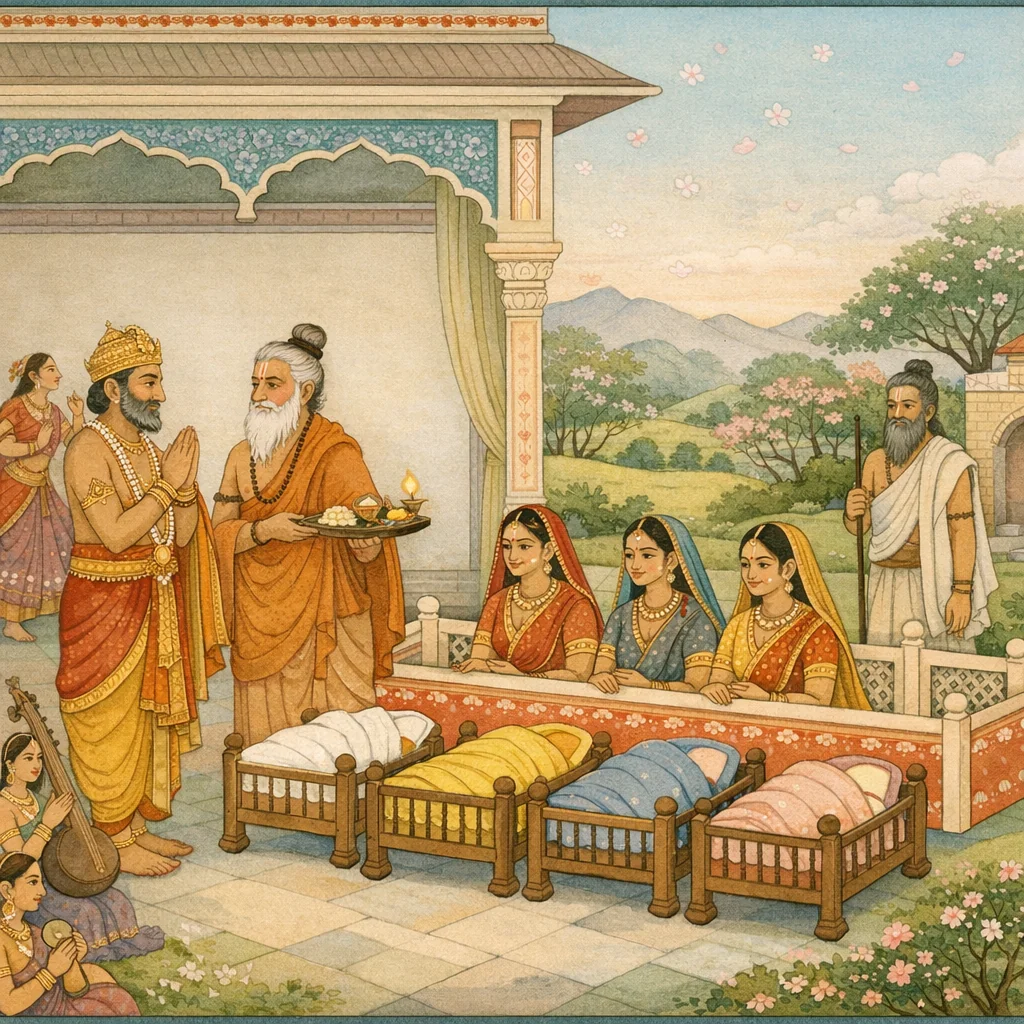
After Daśaratha’s great sacrifices were completed, the devas received their allotted havis and returned to their own abodes. The king, having fulfilled the disciplines of dīkṣā, re-entered Ayodhyā with his queens, attendants, and forces. The visiting rulers, duly honoured, departed; and Ṛśyaśṛṅga, with Śāntā, returned with Romapāda. When the full cycle of six seasons had passed, the text sets forth in detail the calendrical and astrological configuration of Rāma’s birth: in the month of Caitra, on the bright ninth tithi, under Punarvasu presided over by Aditi, with five planets exalted and Karkaṭa as the lagna. Kauśalyā bore Rāma, a manifestation of Viṣṇu; Kaikeyī bore Bharata (Viṣṇu’s fourth part); and Sumitrā bore Lakṣmaṇa and Śatrughna (manifestations of Viṣṇu), with further notes of star and lagna (Puṣya/Meena for Bharata; Āśleṣā/Karkaṭa for the twins). Ayodhyā rejoiced with gandharva song, apsaras dance, celestial drums, and a rain of flowers. The king bestowed abundant gifts and had Vasiṣṭha perform the naming rites. The princes’ virtues are then summarized—Vedic learning, heroism, care for public welfare, and skill in archery—highlighting Lakṣmaṇa’s life-like attachment to Rāma and Śatrughna’s bond with Bharata. As Daśaratha began to consider their marriages, the great sage Viśvāmitra arrived. Received with arghya and proper protocol, he inquired after the kingdom’s welfare; and the king greeted him with elaborate hospitality and a pledge of service, delighting the ascetic.
Shlokas
Verse 1
निर्वृत्ते तु क्रतौ तस्मिन्हयमेधे महात्मन:।प्रतिगृह्य सुरा भागान्प्रतिजग्मुर्यथागतम्।।।।
When that Aśvamedha sacrifice of the great-souled king was completed, the gods, having received their allotted shares, returned each to the place from which they had come.
Verse 2
समाप्तदीक्षानियम: पत्नीगणसमन्वित:।प्रविवेश पुरीं राजा सभृत्यबलवाहन:।।।।
Having completed the disciplines and observances of the consecration, the king entered the city together with his queens, accompanied by his attendants, troops, and vehicles.
Verse 3
यथार्हं पूजितास्तेन राज्ञा वै पृथिवीश्वरा:।मुदिता: प्रययुर्देशान्प्रणम्य मुनिपुङ्गवम्।।।।
Duly honored by the king, the lords of the earth departed joyfully to their own realms, after bowing to the foremost of sages (Vasiṣṭha).
Verse 4
श्रीमतां गच्छतां तेषां स्वपुराणि पुरात्तत:।बलानि राज्ञां शुभ्राणि प्रहृष्टानि चकाशिरे।।।।
As those illustrious kings set out from that city toward their own capitals, their bright armies—exultant—shone forth.
Verse 5
गतेषु पृथिवीशेषु राजा दशरथस्तदा।प्रविवेश पुरीं श्रीमान् पुरस्कृत्य द्विजोत्तमान्।।।।
After the other kings had departed, the illustrious King Daśaratha entered his capital city, with the foremost brāhmaṇas going before him in honor.
Verse 6
शान्तया प्रययौ सार्धमृश्यशृङ्गस्सुपूजित:।अन्वीयमानो राज्ञाऽथ सानुयात्रेण धीमता।।।।
After being duly honoured, the sage Ṛśyaśṛṅga set out together with Śāntā, accompanied by the wise king Romapāda and his retinue.
Verse 7
एवं विसृज्य तान्सर्वान्राजा सम्पूर्णमानस:।उवास सुखितस्तत्र पुत्रोत्पत्तिं विचिन्तयन्।।।।
Thus, after sending them all off, the king—his mind now at ease—remained there happily, reflecting upon the hope of begetting sons.
Verse 8
ततो यज्ञे समाप्ते तु ऋतूनां षट्समत्ययु:।ततश्च द्वादशे मासे चैत्रे नावमिके तिथौ।।।।नक्षत्रेऽदितिदैवत्ये स्वोच्चसंस्थेषु पञ्चसु।ग्रहेषु कर्कटे लग्ने वाक्पताविन्दुना सह।।।।प्रोद्यमाने जगन्नाथं सर्वलोकनमस्कृतम्।कौसल्याऽजनयद्रामं सर्वलक्षणसंयुतम्।।।।विष्णोरर्धं महाभागं पुत्रमैक्ष्वाकुवर्धनम्।
When the sacrifice was completed and the six seasons had passed, in the twelfth month—Chaitra—on the ninth lunar day of the bright fortnight, under the star presided over by Aditi (Punarvasu), with the five planets in their exaltations, and with Cancer rising while Bṛhaspati stood with the Moon, Kauśalyā gave birth to Rāma: the Lord of the world, revered by all worlds, endowed with every auspicious mark, a divine portion of Viṣṇu, the illustrious son who would uphold the Ikṣvāku line.
Verse 9
ततो यज्ञे समाप्ते तु ऋतूनां षट्समत्ययु:। ततश्च द्वादशे मासे चैत्रे नावमिके तिथौ।।1.18.8।। नक्षत्रेऽदितिदैवत्ये स्वोच्चसंस्थेषु पञ्चसु। ग्रहेषु कर्कटे लग्ने वाक्पताविन्दुना सह।।1.18.9।। प्रोद्यमाने जगन्नाथं सर्वलोकनमस्कृतम्। कौसल्याऽजनयद्रामं सर्वलक्षणसंयुतम्।।1.18.10।। विष्णोरर्धं महाभागं पुत्रमैक्ष्वाकुवर्धनम्।
When the sacrifice was completed and the six seasons had passed, in the twelfth month—Chaitra—on the ninth lunar day of the bright fortnight, under the star presided over by Aditi (Punarvasu), with the five planets in their exaltations, and with Cancer rising while Bṛhaspati stood with the Moon, Kauśalyā gave birth to Rāma: the Lord of the world, revered by all worlds, endowed with every auspicious mark, a divine portion of Viṣṇu, the illustrious son who would uphold the Ikṣvāku line.
Verse 10
ततो यज्ञे समाप्ते तु ऋतूनां षट्समत्ययु:। ततश्च द्वादशे मासे चैत्रे नावमिके तिथौ।।1.18.8।। नक्षत्रेऽदितिदैवत्ये स्वोच्चसंस्थेषु पञ्चसु। ग्रहेषु कर्कटे लग्ने वाक्पताविन्दुना सह।।1.18.9।। प्रोद्यमाने जगन्नाथं सर्वलोकनमस्कृतम्। कौसल्याऽजनयद्रामं सर्वलक्षणसंयुतम्।।1.18.10।। विष्णोरर्धं महाभागं पुत्रमैक्ष्वाकुवर्धनम्।
At that auspicious rising of the destined hour, Kausalyā gave birth to Rāma—Lord of the world, revered by all beings, endowed with every noble mark—an exalted son, a very portion of Viṣṇu, who would augment the Ikṣvāku line.
Verse 11
कौसल्या शुशुभे तेन पुत्रेणामिततेजसा।।।।यथा वरेण देवानामदितिर्वज्रपाणिना।
Kausalyā shone with that son of immeasurable radiance, as Aditi shone with Indra, foremost among the gods, the wielder of the thunderbolt.
Verse 12
भरतो नाम कैकेय्यां जज्ञे सत्यपराक्रम:।।।।साक्षाद्विष्णोश्चतुर्भागस्सर्वैस्समुदितो गुणै:।
To Kaikeyī was born a son named Bharata, whose valor was grounded in truth—manifestly a fourth portion of Viṣṇu—endowed with every virtue in full measure.
Verse 13
अथ लक्ष्मणशत्रुघ्नौ सुमित्राऽजनयत्सुतौ।।।।वीरौ सर्वास्त्रकुशलौ विष्णोरर्धसमन्वितौ।
Then Sumitrā gave birth to two sons—Lakṣmaṇa and Śatrughna—both heroic, skilled in every weapon, and endowed with a share of Viṣṇu’s divine qualities.
Verse 14
पुष्ये जातस्तु भरतो मीनलग्ने प्रसन्नधी:।।।।सार्पे जातौ च सौमित्री कुलीरेऽभ्युदिते रवौ।
Bharata, of clear and tranquil understanding, was born when Puṣya was ascendant and the lagna was Mīna; and Sumitrā’s sons were born under Āśleṣā, with the lagna in Kulīra (Karkaṭa), at sunrise.
Verse 15
राज्ञ: पुत्रा महात्मानश्चत्वारो जज्ञिरे पृथक्।।।।गुणवन्तोऽनुरूपाश्च रुच्या प्रोष्ठपदोपमा:।
Thus, in due sequence, four high-souled sons were born to the king—virtuous, fitting in every respect, and radiant like the Proṣṭhapadā stars.
Verse 16
जगु: कलं च गन्धर्वा ननृतुश्चाप्सरोगणा:।।।।देवदुन्दुभयो नेदु: पुष्पवृष्टिश्च खाच्च्युता।उत्सवश्च महानासीदयोध्यायां जनाकुल:।।।।
Gandharvas sang in sweet measure, and hosts of apsarases danced; celestial kettledrums resounded, and showers of flowers fell from the sky.
Verse 17
जगु: कलं च गन्धर्वा ननृतुश्चाप्सरोगणा:।।1.18.16।।देवदुन्दुभयो नेदु: पुष्पवृष्टिश्च खाच्च्युता। उत्सवश्च महानासीदयोध्यायां जनाकुल:।।1.18.17।।
And in Ayodhyā a great festival arose, crowded with throngs of people.
Verse 18
रथ्याश्च जनसम्बाधा नटनर्तकसङ्कुला: ।गायनैश्च विराविण्यो वादनैश्च तथाऽपरै:।।।।
The streets were packed with people, crowded with actors and dancers, and resounded with singers, instrumental music, and other performers.
Verse 19
प्रदेयांश्च ददौ राजा सूतमागधवन्दिनाम्।ब्राह्मणेभ्यो ददौ वित्तं गोधनानि सहस्रश:।।।।
The king bestowed gifts worthy of offering upon the sūtas, māgadhas, and bards; and to the brāhmaṇas he gave wealth and cattle in the thousands.
Verse 20
अतीत्यैकादशाहं तु नामकर्म तथाऽकरोत्।ज्येष्ठं रामं महात्मानं भरतं कैकयीसुतम्।।।।सौमित्रिं लक्ष्मणमिति शत्रुघ्नमपरं तथा।वसिष्ठ: परमप्रीतो नामानि कृतवान् तदा ।।।।
When eleven days had passed, the naming rite was duly performed. Then Vasiṣṭha, greatly delighted, bestowed the names: the eldest, the great-souled one, as Rāma; Kaikeyī’s son as Bharata; and Sumitrā’s sons as Lakṣmaṇa and likewise the other as Śatrughna.
Verse 21
अतीत्यैकादशाहं तु नामकर्म तथाऽकरोत्।ज्येष्ठं रामं महात्मानं भरतं कैकयीसुतम्।।1.18.20।।सौमित्रिं लक्ष्मणमिति शत्रुघ्नमपरं तथा।वसिष्ठ: परमप्रीतो नामानि कृतवान् तदा ।।1.18.21।।
When eleven days had passed, the naming rite was duly performed: the eldest, the great-souled one, was named Rāma; Kaikeyī’s son was named Bharata; Sumitrā’s son was named Lakṣmaṇa; and the other was named Śatrughna. Thus Vasiṣṭha, greatly pleased, bestowed their names.
Verse 22
ब्राह्मणान्भोजयामास पौराञ्जानपदानपि।अददाद्ब्रह्मणानां च रत्नौघममितं बहु।।।।तेषां जन्मक्रियादीनि सर्वकर्माण्यकारयत्।
He arranged feasts for the brāhmaṇas, for the townspeople, and for the rural folk as well. He bestowed upon the brāhmaṇas abundant, immeasurable heaps of jewels in charity, and had all the birth-rites and the remaining prescribed ceremonies for the newborns duly performed.
Verse 23
तेषां केतुरिव ज्येष्ठो रामो रतिकर: पितु:।।।।बभूव भूयो भूतानां स्वयम्भूरिव सम्मत:।
Among those sons, the eldest—Rāma—stood out like a banner; he brought special joy to his father, and, like Svayambhū (Brahmā), he came to be held in high esteem by living beings.
Verse 24
सर्वे वेदविदश्शूरास्सर्वे लोकहिते रता:।।।।सर्वे ज्ञानोपसम्पन्नास्सर्वे समुदिता गुणै:।
All of them became learned in the Vedas; all were heroic; all were devoted to the welfare of the people; all were endowed with knowledge, and all were rich in virtues.
Verse 25
तेषामपि महातेजा रामस्सत्यपराक्रम:।।।।इष्टस्सर्वस्य लोकस्य शशाङ्क इव निर्मल:।
Even among them, Rāma—of great radiance and true, steadfast valor—was beloved of the whole world; pure and stainless, he shone like the moon.
Verse 26
गजस्कन्धेऽश्वपृष्ठे च रथचर्यासु सम्मत:।।।।धनुर्वेदे च निरत: पितृशुश्रूषणे रत:।
He was acknowledged as skilled in riding elephants, mounting horses, and in the maneuvers of chariots; he was diligent in the science of archery and devoted to serving his parents.
Verse 27
बाल्यात्प्रभृति सुस्निग्धो लक्ष्मणो लक्ष्मिवर्धन:।।।।रामस्य लोकरामस्य भ्रातुर्ज्येष्ठस्य नित्यश:।
From childhood onward, Lakṣmaṇa—an increaser of prosperity—remained ever deeply devoted to his elder brother Rāma, the delight of the world.
Verse 28
सर्वप्रियकरस्तस्य रामस्यापि शरीरत:।।।।लक्ष्मणो लक्ष्मिसम्पन्नो बहि:प्राण इवापर:।
Lakṣmaṇa—endowed with auspicious fortune—did everything dear to Rāma, even more than one would for one’s own body; he was like another life-breath moving outside him.
Verse 29
न च तेन विना निद्रां लभते पुरुषोत्तम:।।।।मृष्टमन्नमुपानीतमश्नाति न हि तं विना।
And without him, the best of men (Rāma) could not even find sleep; nor would he eat the finest food that had been served, if Lakṣmaṇa were absent.
Verse 30
यदा हि हयमारूढो मृगयां याति राघव:।।।।तदैनं पृष्ठतोऽन्वेति सधनु: परिपालयन्।
Whenever Rāghava (Rāma) went hunting mounted on a horse, Lakṣmaṇa would follow behind him, bow in hand, guarding him.
Verse 31
भरतस्यापि शत्रुघ्नो लक्ष्मणावरजो हि स:।।।।प्राणै: प्रियतरो नित्यं तस्य चासीत्तथा प्रिय:।
So too Śatrughna—Lakṣmaṇa’s younger brother—was always dearer than life itself to Bharata; and in the same way Bharata was dear to Śatrughna.
Verse 32
स चतुर्भिर्महाभागै:पुत्रैर्दशरथ: प्रियै:।।।।बभूव परमप्रीतो देवैरिव पितामह:।
With his four beloved and most fortunate sons, Daśaratha became supremely delighted—like the Grandfather (Brahmā) rejoicing in the gods.
Verse 33
ते यदा ज्ञानसम्पन्नास्सर्वैस्समुदिता गुणै:।।।।ह्रीमन्त: कीर्तिमन्तश्च सर्वज्ञा दीर्घदर्शिन:।तेषामेवं प्रभावानां सर्वेषां दीप्ततेजसाम्।।।।पिता दशरथो हृष्टो ब्रह्मा लोकाधिपो यथा।
When they were rich in knowledge and complete in every virtue—modest, renowned, discerning, and far-seeing—then their father Daśaratha rejoiced at those radiant sons, like Brahmā, lord of the worlds.
Verse 34
ते यदा ज्ञानसम्पन्नास्सर्वैस्समुदिता गुणै:।।1.18.33।।ह्रीमन्त: कीर्तिमन्तश्च सर्वज्ञा दीर्घदर्शिन:।तेषामेवं प्रभावानां सर्वेषां दीप्ततेजसाम्।।1.18.34।।पिता दशरथो हृष्टो ब्रह्मा लोकाधिपो यथा।
When they were rich in knowledge and complete in every virtue—modest, renowned, discerning, and far-seeing—then their father Daśaratha rejoiced at those radiant sons, like Brahmā, lord of the worlds.
Verse 35
ते चापि मनुजव्याघ्रा वैदिकाध्ययने रता:।।।।पितृशुश्रूषणरता धनुर्वेदे च निष्ठिता:।
Those men, tiger-like among mortals, were devoted to Vedic study, intent on serving their father, and firmly accomplished in the science of archery as well.
Verse 36
अथ राजा दशरथस्तेषां दारक्रियां प्रति।।।।चिन्तयामास धर्मात्मा सोपाध्यायस्सबान्धव:।
Then righteous King Daśaratha, together with his priests and kinsmen, began to consider the matter of arranging marriages for them.
Verse 37
तस्य चिन्तयमानस्य मन्त्रिमध्ये महात्मन:।।।।अभ्यगच्छन्महातेजा विश्वामित्रो महामुनि:।
As that great-souled king deliberated among his ministers, the mighty and radiant great sage Viśvāmitra arrived.
Verse 38
स राज्ञो दर्शनाकाङ्क्षी द्वाराध्यक्षानुवाच ह।।।।शीघ्रमाख्यात मां प्राप्तं कौशिकं गाधिनस्सुतम्।
Wishing to see the king, he spoke to the gatekeepers: “Quickly announce that I have arrived—Kauśika, the son of Gādhi.”
Verse 39
तच्छ्रुत्वा वचनं त्रासाद्राज्ञो वेश्म प्रदुद्रुवु:।।।।सम्भ्रान्तमनसस्सर्वे तेन वाक्येन चोदिता:।
Hearing those words, all of them—alarmed—rushed to the king’s residence, their minds agitated and driven by that message.
Verse 40
ते गत्वा राजभवनं विश्वामित्रमृषिं तदा।।।।प्राप्तमावेदयामासुर्नृपायैक्ष्वाकवे तदा।
Having gone to the royal palace, they informed the Ikṣvāku king, Daśaratha, that the sage Viśvāmitra had arrived.
Verse 41
तेषां तद्वचनं श्रुत्वा सपुरोधास्समाहित:।।।।प्रत्युज्जगाम तं हृष्टो ब्रह्माणमिव वासव:।
Hearing their report, Daśaratha—composed and accompanied by his priests—went out joyfully to welcome him, like Vāsava (Indra) going forth to receive Brahmā.
Verse 42
तं दृष्ट्वा ज्वलितं दीप्त्या तापसं संशितव्रतम्।।।।प्रहृष्टवदनो राजा ततोऽर्घ्यमुपहारयत्।
Seeing the ascetic—radiant with spiritual brilliance and firm in his vows—the king, his face bright with joy, offered him the arghya of honor.
Verse 43
स राज्ञ: प्रतिगृह्यार्घ्यं शास्त्रदृष्टेन कर्मणा।।।।कुशलं चाव्ययं चैव पर्यपृच्छन्नराधिपम्।2
Viśvāmitra, receiving the king’s arghya according to the rites prescribed in the śāstras, then asked the ruler about the realm’s welfare and its stable prosperity.
Verse 44
पुरे कोशे जनपदे बान्धवेषु सुहृत्सु च ।।।।कुशलं कौशिको राज्ञ: पर्यपृच्छत्सुधार्मिक:।
The supremely righteous Kauśika (Viśvāmitra) asked the king whether all was well—in the city, in the treasury, throughout the realm, and among his kinsmen and friends.
Verse 45
अपि ते सन्नतास्सर्वे सामन्ता रिपवो जिता:।।।।दैवं च मानुषं चापि कर्म ते साध्वनुष्ठितम्।
Are all your neighboring vassal-kings duly submissive? Have your enemies been conquered? And are both divine rites and human duties being rightly carried out by you?
Verse 46
वसिष्ठं च समागम्य कुशलं मुनिपुङ्गव:।।।।ऋषींश्च तान्यथान्यायं महाभागानुवाच ह।
The foremost of sages approached Vasiṣṭha as well, and—according to proper custom—addressed those illustrious ṛṣis, asking after their well-being.
Verse 47
ते सर्वे हृष्टमनसस्तस्य राज्ञो निवेशनम्।।।।विविशु: पूजितास्तत्र निषेदुश्च यथार्हत:।
All of them, delighted at heart, entered the king’s residence; honored there, they sat down according to their respective rank and worth.
Verse 48
अथ हृष्टमना राजा विश्वामित्रं महामुनिम्।।।।उवाच परमोदारो हृष्टस्तमभिपूजयन्।
Then the king, glad at heart and exceedingly generous, spoke to the great sage Viśvāmitra, while continuing to honor him with reverent hospitality.
Verse 49
यथाऽमृतस्य सम्प्राप्तिर्यथावर्षमनूदके।यथा सदृशदारेषु पुत्रजन्माऽप्रजस्य च ।।।।प्रणष्टस्य यथालाभो यथा हर्षो महोदये।तथैवागमनं मन्ये स्वागतं ते महामुने।।।।
O great sage, welcome. I deem your arrival to be like the gaining of nectar, like rain upon parched land, like the birth of a son to the childless through a worthy wife, like the recovery of what was lost, and like the joy that comes with a great success.
Verse 50
यथाऽमृतस्य सम्प्राप्तिर्यथावर्षमनूदके।यथा सदृशदारेषु पुत्रजन्माऽप्रजस्य च ।।1.18.49।।प्रणष्टस्य यथालाभो यथा हर्षो महोदये।तथैवागमनं मन्ये स्वागतं ते महामुने।।1.18.50।।
O great sage, welcome. I deem your arrival to be like the gaining of nectar, like rain upon parched land, like the birth of a son to the childless through a worthy wife, like the recovery of what was lost, and like the joy that comes with a great success.
Verse 51
कं च ते परमं कामं करोमि किमु हर्षित: ।।।।पात्रभूतोऽसि मे ब्रह्मन्दिष्टया प्राप्ताऽसि कौशिक ।अद्य मे सफलं जन्म जीवितं च सुजीवितम्।।।।
What highest wish of yours may I fulfill—and how may I do it, so that you are truly pleased?
Verse 52
कं च ते परमं कामं करोमि किमु हर्षित: ।।1.18.51।। पात्रभूतोऽसि मे ब्रह्मन्दिष्टया प्राप्ताऽसि कौशिक । अद्य मे सफलं जन्म जीवितं च सुजीवितम्।।1.18.52।।
O brāhmaṇa, you are worthy to be honored by me; blessed indeed am I that you have come, O Kauśika. Today my birth is fruitful, and my life is truly well-lived.
Verse 53
पूर्वं राजर्षिशब्देन तपसा द्योतितप्रभः।ब्रह्मर्षित्वमनुप्राप्त: पूज्योऽसि बहुधा मया।।।।
Formerly you were renowned as a rājaṛṣi; by your austerities your splendor shone forth. Now you have attained the rank of brahmarṣi; therefore you are worthy of my worship in many ways.
Verse 54
तदद्भुतमिदं ब्रह्मन्पवित्रं परमं मम।शुभक्षेत्रगतश्चाहं तव सन्दर्शनात्प्रभो।।।।
O brāhmaṇa, this is wondrous and supremely purifying for me. O lord, by merely beholding you, I feel as though I have gained the merit of visiting a sacred pilgrimage-place.
Verse 55
ब्रूहि यत्प्रार्थितं तुभ्यं कार्यमागमनं प्रति।इच्छाम्यनुगृहीतोऽहं त्वदर्थपरिवृद्धये।।।।
Tell me what purpose you desire in coming here. I wish—counting myself favored—to help bring about your intended aim.
Verse 56
कार्यस्य न विमर्शं च गन्तुमर्हसि कौशिक।कर्ता चाहमशेषेण दैवतं हि भवान्मम।।।।
O Kauśika, you should not hesitate in stating the task. I will accomplish it fully, for you are truly a deity to me.
Verse 57
मम चायमनुप्राप्तो महानभ्युदयो द्विज।तवागमनज: कृत्स्नो धर्मश्चानुत्तमो मम।।।।
O brāhmaṇa, a great good fortune has come upon me. Through your arrival, as it were, my entire store of unsurpassed merit and dharma has arisen.
Verse 58
इति हृदयसुखं निशम्य वाक्यंश्रुतिसुखमात्मवता विनीतमुक्तम्।प्रथितगुणयशा गुणैर्विशिष्ट:परमऋषि: परमं जगाम हर्षम्।।।।
Hearing those words—humble, self-possessed, pleasing to the heart and delightful to the ear—spoken by the prudent king, the supreme sage, famed for virtue and renown and distinguished by excellence, was filled with profound joy.
Verse 59
For Yuddhakanda and Uttarakanda, the Data was being entered. For Remaining the Data doesn't exist for the selected values!!
In the provided input, the verse text for 1.18.59 is not available; instead, a data-availability notice is shown.
Verse 60
Source text for 1.18.60 was not provided; please supply the Devanāgarī verse so I can translate it accurately without guessing.
Verse 61
Father Daśaratha was delighted with all his sons, who possessed such power and resplendent glory, just as Brahmā, the Lord of the Worlds, rejoices (in the gods).
Frequently Asked Questions
The pivotal action is Daśaratha’s exemplary fulfillment of rājadharma: completing the sacrificial vows, returning to civic order, distributing charity (cows and jewels) to brāhmaṇas and court functionaries, and observing saṃskāras (naming rites), thereby aligning royal power with ritual and social responsibility.
The reception of Viśvāmitra models atithi-satkāra and humility: Daśaratha treats a sage as a moral authority, offers arghya per śāstra, inquires and responds with restraint, and pledges service without hesitation—presenting dharma as disciplined speech, protocol, and readiness to support ascetic aims.
Ayodhyā is depicted as the ceremonial and civic hub (processions, music, flower-rain, crowded rathyās), while the cultural landmarks include Vedic saṃskāras (birth rites and naming), yajña distributions (havis to devas), and courtly institutions (bards, genealogists, royal gate protocol).