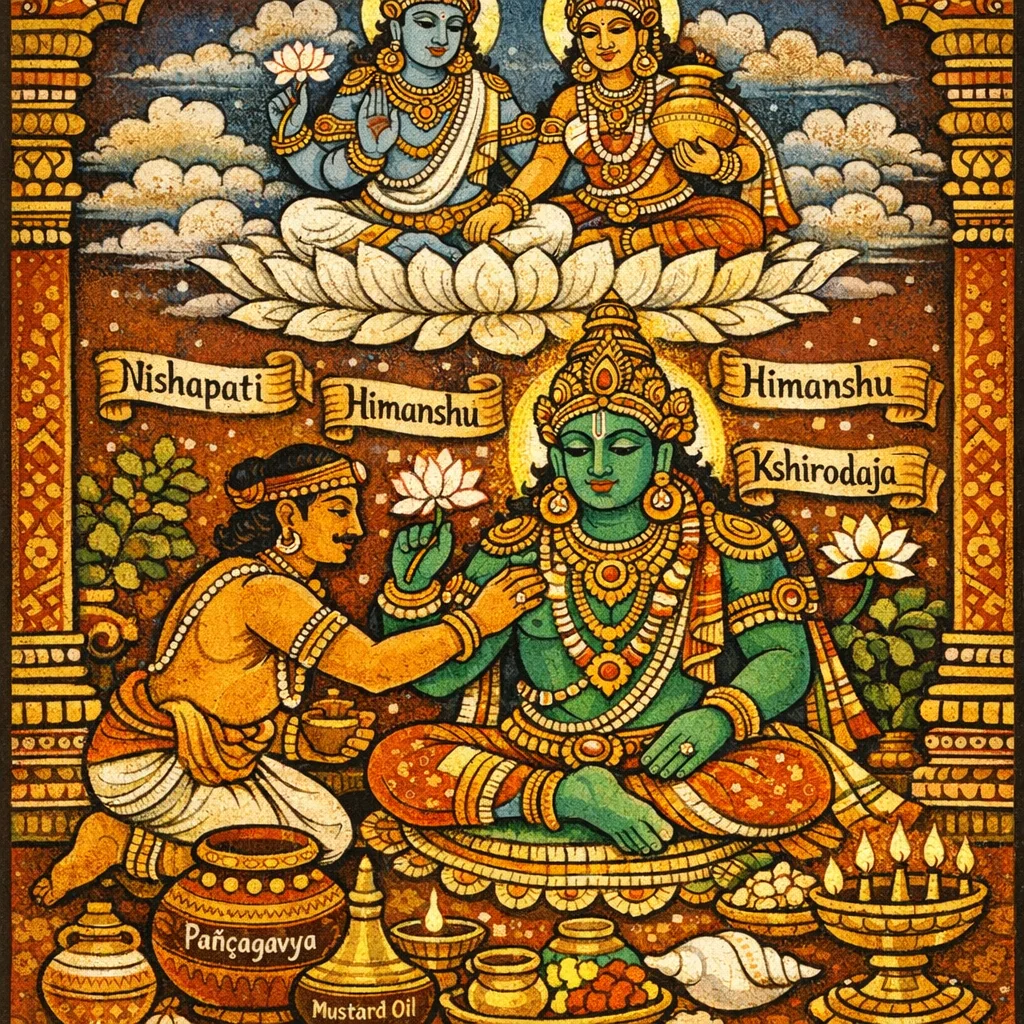
Adhyaya 57: The Rohiṇī–Candraśayana Vow (with Indu-kīrtana): Longevity, Health, Prosperity, and Liberation
रोहिणी–चन्द्रशयन-व्रतवर्णनम् (इन्दुकीर्तन-सहितम्)
Speaker: Nārada, Śrī Bhagavān (Indumaule, Moon-crested Lord)
Nārada asks the Moon-crested Lord for a vrata that grants āyus (longevity), ārogya (health), kula-vṛddhi (increase of the family line), and repeated association with the noble and royal. The Lord praises the merit of the inquiry and reveals a rahasya: the Rohiṇī–Candraśayana observance. Its timing is set as Somavāra (Monday) joined with Paurṇimā (full moon), or a Paurṇimā falling under the Brahma-nakṣatra; one should purify oneself and repeat the “āpyāyasva” japa 800 times. Even a devoted Śūdra (untainted by pāṣaṇḍa influence) may bow to Soma, the boon-giver, and to Viṣṇu. The rite continues with home worship of Madhusūdana while chanting Soma’s names, a detailed aṅga-pūjā using lunar epithets, worship of Rohiṇī/Lakṣmī, sleeping on the ground, morning bathing, honoring Brahmins with haviṣya, regulated eating, and listening to itihāsa. Observed for a year, it concludes with gifts—bed with mirror, gold Rohiṇī–Chandra icons, a pearl/milk pot, a white cow, and a conch—and a prayer for non-difference, bhukti–mukti, and steady bhakti. The fruits are Pitṛ-pleasing merit, attainment of Chandra-loka, and eventual mokṣa; reciting or hearing this account also bestows divine honor in Viṣṇu’s abode.
Key Concepts
Shlokas in Adhyaya 57
Verse 1
*नारद उवाच दीर्घायुरारोग्यकुलाभिवृद्धियुक्तः पुमान्भूपकुलायुतः स्यात् मुहुर्मुहुर्जन्मनि येन सम्यग् व्रतं समाचक्ष्व तदिन्दुमौले //
Nārada said: “O Indumaule, Lord crowned with the Moon, please explain that vow by which a man is endowed with long life, freedom from disease, and the flourishing of his family—indeed, gaining association with royal lineages—again and again in successive births.”
Verse 2
*श्रीभगवानुवाच त्वया पृष्टमिदं सम्यग् उक्तं चाक्षय्यकारकम् रहस्यं तव वक्ष्यामि यत्पुराणविदो विदुः //
The Blessed Lord said: “You have asked rightly, and what you have spoken is indeed a cause of imperishable merit. I shall tell you the secret teaching—that very doctrine understood by the knowers of the Purāṇas.”
Verse 3
रोहिणीचन्द्रशयनं नाम व्रतमिहोत्तमम् तस्मिन्नारायणस्यार्चाम् अर्चयद् इन्दुनामभिः //
Here the excellent vow called “Rohiṇī–Candraśayana” is taught; on that occasion one should worship the image of Nārāyaṇa, honoring Him with the names of the Moon (Indu).
Verse 4
यदा सोमदिने शुक्ला भवेत्पञ्चदशी क्वचित् अथवा ब्रह्मनक्षत्रं पौर्णमास्यां प्रजायते //
Whenever, on a Monday, the fifteenth lunar day of the bright fortnight (the full-moon tithi) occurs, or whenever the Brahma-nakṣatra arises on the full-moon day, this is regarded as an especially significant and auspicious occurrence.
Verse 5
तदा स्नानं नरः कुर्यात् पञ्चगव्येन सर्षपैः आप्यायस्वेति तु जपेद् विद्वानष्टशतं पुनः //
Then one should bathe using pañcagavya (the five products of the cow) together with mustard seeds; and the learned man should again recite the mantra “āpyāyasva” eight hundred times.
Verse 6
शूद्रो ऽपि परया भक्त्या पाषण्डालापवर्जितः सोमाय वरदायाथ विष्णवे च नमो नमः //
Even a Śūdra, if endowed with supreme devotion and free from the speech and ways of heretical sectarians, may offer repeated salutations—to Soma, to the boon-giving Lord, and to Viṣṇu.
Verse 7
कृतजप्यः स्वभवनम् आगत्य मधुसूदनम् पूजयेत्फलपुष्पैश्च सोमनामानि कीर्तयन् //
Having completed his prescribed japa, he should return to his own home and worship Madhusūdana (Viṣṇu) with fruits and flowers, while reciting the names of Soma.
Verse 8
सोमाय शान्ताय नमो ऽस्तु पादाव् अनन्तधाम्नेति च जानुजङ्घे ऊरुद्वयं चापि जलोदराय सम्पूजयेन्मेढ्रमनन्तबाहवे //
Let him bow to the two feet, saying, “Homage to Soma, the Peaceful.” Let him worship the knees and shanks with the formula, “(Homage) to the One whose abode is endless.” Let him also worship the pair of thighs with “(Homage) to Jalodara (the One with the watery belly).” Let him duly worship the generative organ with “(Homage) to Anantabāhu, the One of infinite arms.”
Verse 9
नमो नमः कामसुखप्रदाय कटिः शशाङ्कस्य सदार्चनीया तथोदरं चाप्यमृतोदराय नाभिः शशाङ्काय नमो ऽभिपूज्या //
Homage, homage—to the Moon (Śaśāṅka), whose waist bestows the pleasures of love and happiness and is ever worthy of worship. Homage also to his belly, like a vessel of nectar; and homage to the Moon’s navel, which is to be especially revered.
Verse 10
नमो ऽस्तु चन्द्राय मुखं च पूज्यं दन्ता द्विजानामधिपाय पूज्याः हास्यं नमश्चन्द्रमसे ऽभिपूज्यम् ओष्ठौ कुमुद्वन्तवनप्रियाय //
Salutations to Chandra (Soma). May his face be worshipped; may his teeth be revered—he who is lord of the twice-born. Salutation to his smile, worthy of adoration; and may his lips be worshipped—he who delights in the grove of kumuda water-lilies.
Verse 11
नासा च नाथाय वनौषधीनाम् आनन्दभूताय पुनर्भ्रुवौ च नेत्रद्वयं पद्मनिभं तथेन्दोर् इन्दीवरश्यामकराय शौरेः //
For Śauri (Viṣṇu), whose hands are dark like the blue lotus (indīvara), one should fashion the nose as befits the Lord of forest-herbs, the healer of all; and again the eyebrows as suited to the embodiment of bliss. The pair of eyes should be lotus-like, and also moon-like in their cool radiance.
Verse 12
नमः समस्ताध्वरवन्दिताय कर्णद्वयं दैत्यनिषूदनाय ललाटमिन्दोरुदधिप्रियाय केशाः सुषुम्नाधिपतेः प्रपूज्याः //
Homage to Him who is praised in all sacrifices. His pair of ears is that of the Slayer of the daityas; His forehead is like the moon, beloved of the ocean; and His hair is to be especially worshipped as that of the Lord of Suṣumnā.
Verse 13
शिरः शशाङ्काय नमो मुरारेर् विश्वेश्वरायेति नमः किरीटिने पद्मप्रिये रोहिणि नाम लक्ष्मीः सौभाग्यसौख्यामृतचारुकाये //
Salutations to the Moon-crested One; salutations to Murāri; salutations to the Lord of the universe; salutations to the Crowned One. O Lotus-beloved Goddess, O Rohiṇī—named Lakṣmī—you who are the lovely nectar of good fortune and happiness, to you be reverence.
Verse 14
देवीं च संपूज्य सुगन्धपुष्पैर् नैवेद्यधूपादिभिरिन्दुपत्नीम् सुप्त्वाथ भूमौ पुनरुत्थितेन स्नात्वा च विप्राय हविष्ययुक्तः //
Having duly worshipped the Goddess—Indu’s consort—with fragrant flowers, food-offerings (naivedya), incense, and the like, one should then sleep upon the ground. Rising again thereafter and bathing, one should honour a Brāhmaṇa while observing the haviṣya regimen of pure sacrificial food.
Verse 15
देयः प्रभाते सहिरण्यवारिकुम्भो नमः पापविनाशनाय संप्राश्य गोमूत्रममांसमन्नम् अक्षारमष्टावथ विंशतिं च ग्रासान्पयःसर्पिर्युतानुपोष्य भुक्त्वेतिहासं शृणुयान्मुहूर्तम् //
In the morning one should offer a water-pot together with gold, with the salutation, “Homage to the Destroyer of sin.” Then, having sipped cow’s urine, one should take a meal free of meat; and after fasting, consume twenty-eight mouthfuls mixed with milk and ghee. Having eaten, one should listen to the Itihāsa (sacred history) for one muhūrta (a fixed ritual period).
Verse 16
कदम्बनीलोत्पलकेतकानि जाती सरोजं शतपत्त्रिका च अम्लानकुब्जान्यथ सिन्दुवारं पुष्पं पुनर्नारद मल्लिकायाः शुभ्रं च विष्णोः करवीरपुष्पं श्रीचम्पकं चन्द्रमसः प्रदेयम् //
Kadamba, blue lotus, and ketakī; jāti-jasmine, lotus, and the hundred-petalled lotus; as well as amlāna, kubja, and sinduvāra—again, O Nārada, the white flowers of mallikā (jasmine) are to be offered to Viṣṇu; and the karavīra flower, and the auspicious campaka, are to be offered to the Moon (Candramas).
Verse 17
श्रावणादिषु मासेषु क्रमादेतानि सर्वदा यस्मिन्मासे व्रतादिः स्यात् तत्पुष्पैरर्चयेद्धरिम् //
In the months beginning with Śrāvaṇa, these offerings are always to be employed in proper sequence. In whichever month a vow (vrata) or allied observance is undertaken, one should worship Hari with the flowers prescribed for that month.
Verse 18
एवं संवत्सरं यावद् उपास्य विधिवन्नरः व्रतान्ते शयनं दद्याद् दर्पणोपस्करान्वितम् //
Thus, having duly performed the observance for as long as a full year, at the conclusion of the vow one should gift a bed furnished with a mirror and the requisite accessories.
Verse 19
रोहिणीचन्द्रमिथुनं कारयित्वाथ काञ्चनम् चन्द्रः षडङ्गुलः कार्यो रोहिणी चतुरङ्गुला //
Then, having fashioned in gold the paired figure of Rohiṇī and the Moon, the Moon should be made six aṅgulas in measure, and Rohiṇī four aṅgulas.
Verse 20
मुक्ताफलाष्टकयुतं सितनेत्रपटावृतम् क्षीरकुम्भोपरि पुनः कांस्यपात्राक्षतान्वितम् दद्यान्मन्त्रेण पूर्वाह्णे शालीक्षुफलसंयुतम् //
One should arrange an offering furnished with eight pearls, covered with a white cloth, and place it upon a pot filled with milk; and further, add a bronze vessel containing akṣata (unbroken rice-grains). In the forenoon, it should be presented with the prescribed mantra, accompanied by rice, sugarcane, and fruits.
Verse 21
श्वेतामथ सुवर्णास्यां खुरै रौप्यैः समन्विताम् सवस्त्रभाजनां धेनुं तथा शङ्खं च शोभनम् //
Then one should offer a white cow, with a golden face and hooves adorned with silver, together with cloth and a suitable vessel; and also a beautiful conch-shell (śaṅkha).
Verse 22
भूषणैर्द्विजदाम्पत्यम् अलंकृत्य गुणान्वितम् चन्द्रो ऽयं द्विजरूपेण सभार्य इति कल्पयेत् //
One should adorn the Brahmin couple with ornaments, endowed with auspicious qualities, and contemplate: “This is Chandra (the Moon), in the form of a Brahmin, together with his wife.”
Verse 23
यथा न रोहिणी कृष्ण शय्यां संत्यज्य गच्छति सोमरूपस्य ते तद्वन् ममाभेदो ऽस्तु भूतिभिः //
“O Kṛṣṇa, just as Rohiṇī does not abandon the couch and depart from you in your form as Soma (the Moon), so too—may there be non-difference between me and you, together with your divine powers and prosperities.”
Verse 24
यथा त्वमेव सर्वेषां परमानन्दमुक्तिदः भुक्तिर्मुक्तिस्तथा भक्तिस् त्वयि चन्द्रास्तु मे सदा //
As you alone are the giver of supreme bliss and liberation to all, so may I always have—through you—both worldly enjoyment (bhukti) and final release (mukti), and may unwavering devotion to you, O Chandra, ever arise within me.
Verse 25
इति संसारभीतस्य मुक्तिकामस्य चानघ रूपारोग्यायुषामेतद् विधायकमनुत्तमम् //
Thus, O sinless one, for a person who fears saṃsāra and longs for mokṣa, this is the unsurpassed ordinance that bestows beauty of form, health, and longevity.
Verse 26
इदमेव पितॄणां च सर्वदा वल्लभं मुने त्रैलोक्याधिपतिर्भूत्वा सप्तकल्पशतत्रयम् चन्द्रलोकमवाप्नोति विद्युद्भूत्वा तु मुच्यते //
This alone is ever especially dear to the Pitṛs, O sage. Having become lord of the three worlds for three hundred and seven hundred kalpas, one attains the Moon-world; and then, becoming like lightning, one is released—attaining mokṣa.
Verse 27
नारी वा रोहिणी चन्द्रशयनं या समाचरेत् सापि तत्फलमाप्नोति पुनरावृत्तिदुर्लभम् //
Whether a woman—or one practising under Rohiṇī (the lunar asterism)—performs the Candraśayana observance, she too attains its fruit: a state from which return to rebirth is hard to come by.
Verse 28
इति पठति शृणोति वा य इत्थं मधुमथनार्चनम् इन्दुकीर्तनेन मतिमपि च ददाति सो ऽपि शौरेर् भवनगतः परिपूज्यते ऽमरौघैः //
Whoever thus recites—or even listens to—this worship of Madhumathana, and offers devotion through the praise called Indukīrtana, he too, having reached the abode of Śauri (Viṣṇu), is honored there by hosts of gods.
Frequently Asked Questions
The chapter teaches the Rohiṇī–Candraśayana vrata as a disciplined, year-long lunar observance combining calendrical timing (Somavāra Paurṇimā/Brahma-nakṣatra), purification, mantra-japa, Soma-name worship of Viṣṇu, ethical dietary restraint, and concluding dānas—aimed at health, longevity, prosperity, and ultimately liberation.
This adhyāya is primarily Dharma (vrata-dharma and dāna). It includes ritual astronomy (tithi–nakṣatra timing), mantra practice, pūjā-vidhi, dietary discipline, and soteriological promises (Chandra-loka and mokṣa). It does not address Vāstu-śāstra, royal policy (rājadharma), or genealogies in this chapter.
It is highlighted as especially significant when the full-moon (śukla pañcadaśī/paurṇimā) coincides with Monday (Somavāra), or when the Brahma-nakṣatra arises on the full-moon day.
Key actions include bathing with pañcagavya and mustard, chanting “āpyāyasva” 800 times, worshipping Madhusūdana/Viṣṇu while reciting Soma names, performing limb-by-limb aṅga-pūjā with specific epithets, worshipping Rohiṇī (as Lakṣmī/Indu’s consort), sleeping on the ground, observing haviṣya discipline, giving morning gifts (notably a water-pot with gold), and listening to itihāsa for a muhūrta.
The text prescribes gifting a bed with a mirror and accessories, crafting gold figures of Chandra (6 aṅgulas) and Rohiṇī (4 aṅgulas), offering an arrangement with eight pearls on a milk-filled pot with white cloth and a bronze vessel with unbroken rice, and giving a white cow (golden face, silver-adorned hooves) with cloth and vessel, plus a beautiful conch; a Brahmin couple is honored and contemplated as Chandra with his wife.
Performing the vow is said to confer beauty, health, longevity, family prosperity, and exalted post-mortem attainments culminating in liberation; it is also described as dear to the Pitṛs. Additionally, one who recites or listens to this worship and offers devotion through Indu-kīrtana is said to reach Śauri/Viṣṇu’s abode and be honored by hosts of gods.