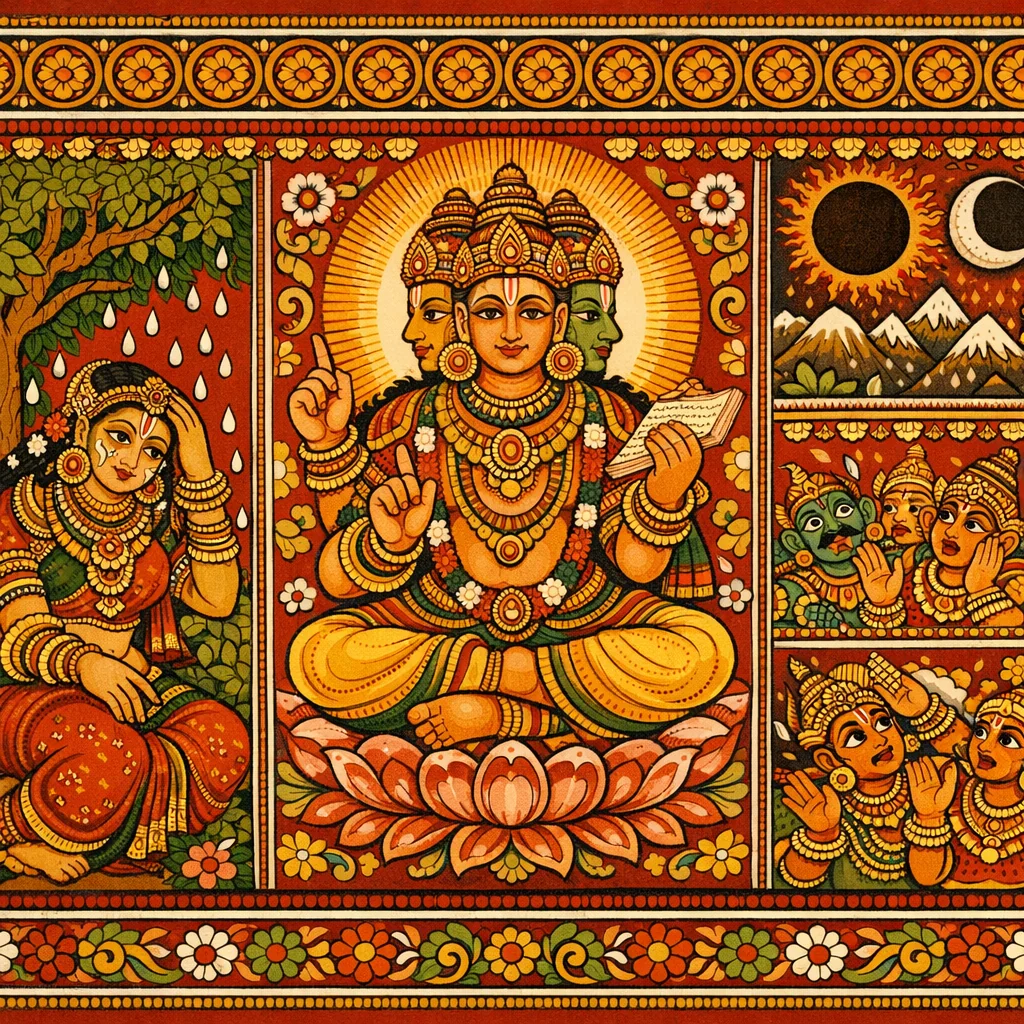
Adhyaya 147: The Birth of Tāraka: Varāṅgī’s Lament, Brahmā’s Intervention, and the Rise of an Asura King
तारकजन्मवृत्तान्तः (वज्राङ्ग-वराङ्गी संवादः)
Speaker: Varāṅgī, Brahmā (Pitāmaha, Caturānana), Vajrāṅga (Daityendra), Narrator (Purāṇic frame: Sūta-to-Ṛṣis style implied)
Adhyāya 147 advances the Deva–Asura conflict through the domestic and political catalyst of Varāṅgī’s suffering and her demand for a “tāraka” (deliverer) son. The narrative frames grief as a force that can generate world-altering resolve: Varāṅgī, abused and abandoned by Indra, turns to self-sacrifice unless granted a son who can redeem her. Vajrāṅga (Daitya lord) responds by preparing for fierce tapas to secure a child capable of defeating even the Tridaiva powers. Brahmā intervenes strategically, redirecting the Asura’s intent with a teaching on true renunciation: abandoning what is already available is harder—and more meritorious—than long fasting. Brahmā then grants the boon directly: a mighty son named Tāraka will be born. The chapter culminates in omens accompanying Tāraka’s birth—cosmic tremors, dimmed luminaries, and fear across realms—followed by Asuric celebration and Tāraka’s consecration as sovereign. The adhyāya thus links tapas/boons, statecraft (abhisheka and sovereignty), and cosmic order destabilized by unchecked power.
Key Concepts
Shlokas in Adhyaya 147
Verse 1
*वराङ्ग्युवाच त्रासितास्म्यपविद्धास्मि ताडिता पीडितापि च रौद्रेण देवराजेन नष्टनाथेव भूरिशः //
Varāṅgī said: “I have been terrified, cast aside, struck, and tormented as well—by the fierce lord of the gods. I am like a woman bereft of her protector, O Bhūriśa.”
Verse 2
दुःखपारमपश्यन्ती प्राणांस्त्यक्तुं व्यवस्थिता पुत्रं मे तारकं देहि दुःखशोकमहार्णवात् //
Seeing no end to her suffering, she resolved to give up her life: “Grant me a son—one who will be my deliverer—and rescue me from this vast ocean of grief and sorrow.”
Verse 3
एवमुक्तः स दैत्येन्द्रः कोपव्याकुललोचनः शक्तो ऽपि देवराजस्य प्रतिकर्तुं महासुरः //
Thus addressed, that lord of the Daityas—his eyes trembling with rage—though a mighty Asura capable of retaliating against the king of the gods (Indra), was constrained in that moment.
Verse 4
तपः कर्तुं पुनर्दैत्यो व्यवस्वेत महाबलः ज्ञात्वा तु तस्य संकल्पं ब्रह्मा क्रूरतरं पुनः //
Then the mighty Daitya again resolved to undertake austerities (tapas). But Brahmā, having understood his intention, once more devised a harsher counter-course.
Verse 5
आजगाम तदा तत्र यत्रासौ दितिनन्दनः उवाच तस्मै भगवान् प्रभुर्मधुरया गिरा //
Then he came to that very place where Diti’s son was; and the Blessed Lord, the sovereign Master, spoke to him in a gentle voice.
Verse 6
*ब्रह्मोवाच किमर्थं पुत्रं भूयस्त्वं नियमं क्रूरमिच्छसि आहाराभिमुखो दैत्य तन्नो ब्रूहि महाव्रत //
Brahmā said: “For what purpose, my son, do you again desire a harsh observance? O Daitya, though you are inclined toward food, tell us—O great-vowed one—what is your intention?”
Verse 7
यावदब्दसहस्रेण निराहारस्य यत्फलम् क्षणेनैकेन तल्लभ्यं त्यक्त्वाहारमुपस्थितम् //
Whatever merit is gained by remaining without food for a thousand years—one obtains that very fruit in a single moment, by renouncing the food that is present and ready at hand.
Verse 8
त्यागो ह्यप्राप्तकामानां कामेभ्यो न तथा गुरुः यथा प्राप्तं परित्यज्य कामं कमललोचन //
O lotus-eyed one, renunciation is not so weighty for those whose desires have not been fulfilled; but to abandon a desire after one has already obtained its object—this is the truly difficult renunciation.
Verse 9
श्रुत्वैतद्ब्रह्मणो वाक्यं दैत्यः प्राञ्जलिरब्रवीत् चिन्तयंस्तपसा युक्तो हृदि ब्रह्ममुखेरितम् //
Having heard these words of Brahmā, the Daitya, with joined palms, spoke—meditating within his heart on what had been uttered from Brahmā’s mouth, and being steadfastly engaged in austerity.
Verse 10
*वज्राङ्ग उवाच उत्थितेन मया दृष्टा समाधानात्त्वदाज्ञया महिषी भीषिता दीना रुदती शाखिनस्तले //
Vajrāṅga said: “When I rose—composed in mind and acting under your command—I saw the queen, terrified and wretched, weeping beneath the shade of a tree.”
Verse 11
सा मयोक्ता तु तन्वङ्गी दूयमानेन चेतसा किमेवं वर्तसे भीरु वद त्वं किं चिकीर्षसि //
But that slender-limbed woman, though addressed by me, remained with a mind consumed by sorrow. So I asked: “Why do you behave like this, O timid one? Tell me—what is it that you intend to do?”
Verse 12
इत्युक्ता सा मया देव प्रोवाच स्खलिताक्षरम् वाक्यं चोवाच तन्वङ्गी भीता सा हेतुसंहितम् //
Thus addressed by me, O Lord, that slender-limbed woman—frightened—replied in faltering syllables, and spoke words that were reasoned and to the point.
Verse 13
*वराङ्ग्युवाच त्रासितास्म्यपविद्धास्मि कर्षिता पीडितास्मि च रौद्रेण देवराजेन नष्टनाथेव भूरिशः //
Varāṅgī said: “I am terrified; I have been cast aside. I have been dragged and tormented as well—by the fierce Lord of the gods. O Bhūriśa, I am like a woman who has lost her protector.”
Verse 14
दुःखस्यान्तमपश्यन्ती प्राणांस्त्यक्तुं व्यवस्थिता पुत्रं मे तारकं देहि ह्य् अस्माद्दुःखमहार्णवात् //
Seeing no end to her sorrow, she resolved to give up her life: “Grant me a son—one who will be my deliverer—so that I may cross beyond this great ocean of grief.”
Verse 15
एवमुक्तस्तु संक्षुब्धस् तस्याः पुत्रार्थमुद्यतः तपो घोरं करिष्यामि जयाय त्रिदिवौकसाम् //
Thus addressed, he was deeply agitated; and, striving to obtain a son for her sake, he resolved: “I shall undertake terrible austerities, to win victory even over the dwellers of the three heavens.”
Verse 16
एतच्छ्रुत्वा वचो देवः पद्मगर्भोद्भवस्तदा उवाच दैत्यराजानं प्रसन्नश्चतुराननः //
Having heard these words, the god born from the lotus-womb (Brahmā) then spoke to the king of the Daityas; the four-faced one was gracious and pleased.
Verse 17
*ब्रह्मोवाच अलं ते तपसा वत्स मा क्लेशे दुस्तरे विश पुत्रस्ते तारको नाम भविष्यति महाबलः //
Brahmā said: “Enough, dear child, with this austerity—do not torment yourself with a hardship so difficult to endure. A son of yours will be born, named Tāraka, and he will be exceedingly mighty.”
Verse 18
देवसीमन्तिनीनां तु धम्मिल्लस्य विमोक्षणः इत्युक्तो दैत्यनाथस्तु प्रणिपत्य पितामहम् //
“For the divine ladies, the releasing (or loosening) of the hair-knot (dhammilla) is prescribed.” Thus instructed, the lord of the Daityas bowed down to Pitāmaha (Brahmā).
Verse 19
आगत्यानन्दयामास महिषीं हर्षिताननः तौ दम्पती कृतार्थौ तु जग्मतुः स्वाश्रमं मुदा //
Having arrived, he gladdened the queen, his face radiant with joy; and the two spouses, their purpose fulfilled, went happily to their own hermitage.
Verse 20
वज्राङ्गेणाहितं गर्भं वराङ्गी वरवर्णिनी पूर्णं वर्षसहस्रं च दधारोदर एव हि //
The lady of beautiful limbs and radiant complexion, having conceived the fetus implanted by Vajrāṅga, indeed bore it within her womb for a full thousand years.
Verse 21
ततो वर्षसहस्रान्ते वराङ्गी सुषुवे सुतम् जायमाने तु दैत्येन्द्रे तस्मिंल्लोकभयंकरे //
Then, at the end of a thousand years, the beautiful-limbed lady gave birth to a son. And when that lord of the Daityas was born—one who would become a terror to the worlds—fear spread through all realms.
Verse 22
चचाल सकला पृथ्वी समुद्राश्च चकम्पिरे चेलुर्महीधराः सर्वे ववुर्वाताश्च भीषणाः //
The entire earth shook; the oceans trembled; all the mountains swayed, and dreadful winds began to blow.
Verse 23
जेपुर्जप्यं मुनिवरा नेदुर्व्यालमृगा अपि चन्द्रसूर्यौ जहुः कान्तिं सनीहारा दिशो ऽभवन् //
The foremost sages ceased their sacred recitations; even serpents and wild beasts cried out. The moon and the sun lost their radiance, and all the directions became shrouded in mist.
Verse 24
जाते महासुरे तस्मिन् सर्वे चापि महासुराः आजग्मुर्हृषितास्तत्र तथा चासुरयोषितः //
When that mighty Asura was born, all the great Asuras came there in delight—along with the women of the Asuras as well.
Verse 25
जगुर्हर्षसमाविष्टा ननृतुश्चासुराङ्गनाः ततो महोत्सवो जातो दानवानां द्विजोत्तमाः //
Overcome with delight, the women of the Asuras sang and danced; thus, O best of the twice-born, a great festival arose among the Dānavas.
Verse 26
विषण्णमनसो देवाः समहेन्द्रास्तदाभवन् वराङ्गी स्वसुतं दृष्ट्वा हर्षेणापूरिता तदा //
Then the gods—along with Indra—became downcast at heart. But Varāṅgī, on seeing her own son, was at that moment filled completely with joy.
Verse 27
बहु मेने न देवेन्द्रविजयं तु तदेव सा जातमात्रस्तु दैत्येन्द्रस् तारकश्चण्डविक्रमः //
She did not regard Indra’s victory as anything great; for that very reason, as soon as he was born, the Daitya-lord Tāraka was of fierce and formidable prowess.
Verse 28
अभिषिक्तो ऽसुरैः सर्वैः कुजम्भमहिषादिभिः सर्वासुरमहाराज्ये पृथिवीतुलनक्षमैः //
He was duly consecrated by all the Asuras—by Kujambha, Mahiṣa, and others—as the great sovereign over the entire Asura realm, rulers whose might was deemed a match for the very earth.
Verse 29
स तु प्राप्य महाराज्यं तारको मुनिसत्तमाः उवाच दानवश्रेष्ठान् युक्तियुक्तमिदं वचः //
Having attained great sovereignty, Tāraka then addressed the foremost of the Dānavas, O best of sages, speaking these words that were grounded in sound strategy and reason.
Frequently Asked Questions
The chapter’s explicit instruction comes through Brahmā’s teaching on renunciation: the merit of long fasting can be gained instantly by renouncing food that is already present, and the hardest tyāga is abandoning a desire after its object is attainable. This ethical point is embedded within the larger narrative of tapas and boons producing world-shaking political consequences.
This adhyāya is primarily Genealogy/Itihāsa-style narrative and Rajadharma-adjacent material (kingship legitimation via abhiṣeka). It does not teach Vāstu measurements or temple architecture here; instead it focuses on the birth-cycle of Tāraka, the mechanics of tapas and boons, and the cosmic-political fallout that affects devas, asuras, and the worlds.
Varāṅgī experiences humiliation and torment at Indra’s hands and sees no end to her suffering. She therefore demands a son who can function as her rescuer—one powerful enough to counter the lord of the gods—so she may cross beyond her ‘ocean’ of grief.
The text describes classic ominous portents: the earth shakes, oceans tremble, mountains sway, terrifying winds blow, sages pause recitation, animals cry out, the sun and moon lose radiance, and the directions become misty—signaling a birth that will disturb cosmic balance.