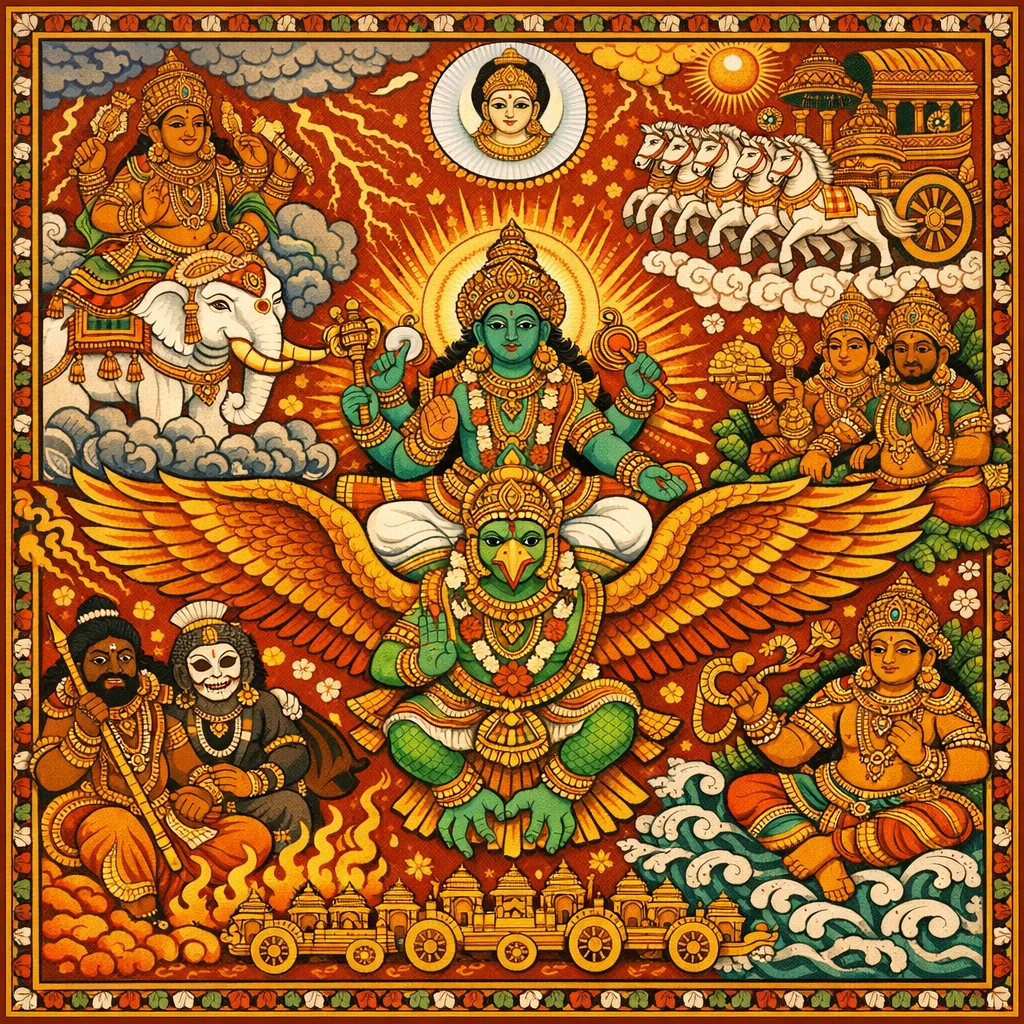
Adhyaya 174: The Array of the Gods: Description of the Vaiṣṇava Host and the Lokapālas
वैष्णवसैन्यविस्तारः (देवसेनावर्णनम्)
Speaker: Lord Matsya (narrator), Ravinandana / Son of Ravi (listener addressed by Matsya)
Matsya continues the war narrative: having already detailed the Daitya forces, he now enumerates the Devas’ Vaiṣṇava host. The gods assemble in ordered ranks; Indra advances with his celestial retinue as omens appear in the sky. Yama and Kāla strike terror into the Daityas; Varuṇa stands ready with his pāśa; Kubera arrives with Yakṣas/Rākṣasas and the Puṣpaka vimāna. The four Lokapālas take their stations in the east/south/west/north. Sūrya and Soma are described in their cosmic motion, while wind/Prāṇa motifs and the Maruts heighten the martial mood. Viṣṇu is praised with great epithets, lifts the cakra, bears weapons, and mounts Garuḍa amid the chants of gods and sages. The chapter ends with reciprocal “svasti” blessings: Bṛhaspati for the Devas and Uśanā for the Dānavas.
Key Concepts
Shlokas in Adhyaya 174
Verse 1
*मत्स्य उवाच श्रुतस्ते दैत्यसैन्यस्य विस्तारो रविनन्दन सुराणामपि सैन्यस्य विस्तारं वैष्णवं शृणु //
Matsya said: “O son of Ravi (the Sun), you have heard in detail the full array of the Daityas’ army; now listen to the detailed account of the gods’ army—the Vaiṣṇava host.”
Verse 2
आदित्या वसवो रुद्रा अश्विनौ च महाबलौ सबलाः सानुगाश्चैव संनह्यन्त यथाक्रमम् //
The Ādityas, the Vasus, the Rudras, and the two mighty Aśvins—together with their forces and attendants—arrayed themselves in readiness, each in due order.
Verse 3
पुरुहूतस्तु पुरतो लोकपालः सहस्रदृक् ग्रामणीः सर्वदेवानाम् आरुरोह सुरद्विपम् //
Then Puruhūta—Indra, the guardian of the worlds, the thousand-eyed leader of all the gods—advanced to the front and mounted the divine elephant.
Verse 4
मध्ये चास्य रथः सर्वपक्षिप्रवरहंसः सुचारुचक्रचरणो हेमवज्रपरिष्कृतः //
And in its very center is his chariot—likened to the supreme haṃsa among all birds—having exquisitely fashioned wheels and supports, and adorned with gold and vajra-like (diamond/adamantine) embellishments.
Verse 5
देवगन्धर्वयक्षौघैर् अनुयातः सहस्रशः दीप्तिमद्भिः सदस्यैश्च ब्रह्मर्षिभिरभिष्टुतः //
He was followed in thousands by hosts of Devas, Gandharvas, and Yakṣas; attended by radiant members of the assembly, and extolled by the Brahmarṣis.
Verse 6
वज्रविस्फूर्जितोद्भूतैर् विद्युदिन्द्रायुधोदितैः युक्तो बलाहकगणैः पर्वतैरिव कामगैः //
Filled with hosts of rain-clouds—born of the thunder’s crashing roar, and lit up by lightning that rises like Indra’s weapon—the sky appeared as though it were joined with mountains that move at will.
Verse 7
यमारूढः स भगवान् पर्येति सकलं जगत् हविर्धानेषु गायन्ति विप्रा मखमुखे स्थिताः //
Mounted upon Yama, that Blessed Lord moves throughout the entire world. And the Brahmin priests—stationed at the very ‘mouth’ of the sacrifice—chant hymns at the places where the offerings are set down.
Verse 8
स्वर्गे शक्रानुयातेषु देवतूर्यनिनादिषु सुन्दर्यः परिनृत्यन्ति शतशो ऽप्सरसां गणाः //
In heaven, when Indra is being attended and followed, and the sounds of divine instruments resound, beautiful companies of Apsarases dance in their hundreds.
Verse 9
केतुना नागराजेन राजमानो यथा रविः युक्तो हयसहस्रेण मनोमारुतरंहसा //
Shining with the serpent-king Ketu like the Sun himself, he was harnessed to a thousand horses, swift as the mind and the wind in his course.
Verse 10
स स्यन्दनवरो भाति गुप्तो मातलिना तदा कृत्स्नः परिवृतो मेरुर् भास्करस्येव तेजसा //
Then that excellent chariot shone forth, guarded by Mātali; it was wholly encircled with radiance, like Mount Meru blazing with the splendor of the Sun.
Verse 11
यमस्तु दण्डमुद्यम्य कालयुक्तश्च मुद्गरम् तस्थौ सुरगणानीके दैत्यान्नादेन भीषयन् //
But Yama, raising aloft his staff, and Kāla too with his mace, stood within the host of the gods, terrifying the Dāityas with a thunderous roar.
Verse 12
चतुर्भिः सागरैर्युक्तो लेलिहानैश्च पन्नगैः शङ्खमुक्ताङ्गदधरो बिभ्रत्तोयमयं वपुः //
Joined with the four oceans and surrounded by licking, serpentine nāgas, He bore the conch and pearl-ornaments and armlets—manifesting a body made of water itself.
Verse 13
कालपाशान्समाविध्यन् हयैः शशिकरोपमैः वाय्वीरितैर् जलाकारैः कुर्वंल्लीलाः सहस्रशः //
He hurled the nooses of Time, and with horses gleaming like moonbeams—water-formed shapes driven onward by the wind—he performed thousands of feats as if in play.
Verse 14
पाण्डुरोद्धूतवसनः प्रवालरुचिराङ्गदः मणिश्यामोत्तमवपुर् हरिभारार्पितो वरः //
Clad in spotless, fluttering garments, wearing armlets radiant like coral, possessing an excellent body dark-hued like a precious gem—he is the noble one, specially offered (as a sacred burden/service) to Hari.
Verse 15
वरुणः पाशधृङ् मध्ये देवानीकस्य तस्थिवान् युद्धवेलामभिलषन् भिन्नवेल इवार्णवः //
Varuṇa, bearing his noose, stood in the midst of the gods’ host—yearning for the moment of battle—like the ocean when its boundary (shoreline) is breached.
Verse 16
यक्षराक्षससैन्येन गुह्यकानां गणैरपि युक्तश्च शङ्खपद्माभ्यां निधीनामधिपः प्रभुः //
The Lord—sovereign over the treasures (Nidhis)—is attended by an army of Yakṣas and Rākṣasas, and also by hosts of Guhyakas; and he is accompanied by Śaṅkha and Padma (the two chief Nidhis).
Verse 17
राजराजेश्वरः श्रीमान् गदापाणिरदृश्यत विमानयोधी धनदो विमाने पुष्पके स्थितः //
Then the glorious Lord of kings, the mace-bearing Dhanada (Kubera), famed as a warrior of aerial chariots, was seen—seated within the Pushpaka vimāna.
Verse 18
स राजराजः शुशुभे युद्धार्थी नरवाहनः उक्षाणमास्थितः संख्ये साक्षादिव शिवः स्वयम् //
That emperor among kings shone forth, eager for battle; mounted on a bull in the thick of combat, he appeared as if he were Śiva himself made manifest.
Verse 19
पूर्वपक्षः सहस्राक्षः पितृराजस्तु दक्षिणः वरुणः पश्चिमं पक्षम् उत्तरं नरवाहनः //
The eastern quarter belongs to the Thousand‑eyed one (Indra); the southern to the King of the Pitṛs (Yama); the western quarter to Varuṇa; and the northern to the one who rides upon men (Kubera).
Verse 20
चतुर्षु युक्ताश्चत्वारो लोकपाला महाबलाः स्वासु दिक्षु स्वरक्षन्त तस्य देवबलस्य ते //
Stationed in the four quarters, the four mighty Lokapālas guarded their own directions, protecting that divine power.
Verse 21
सूर्यः सप्ताश्वयुक्तेन रथेनामितगामिना श्रिया जाज्वल्यमानेन दीप्यमानैश्च रश्मिभिः //
The Sun, mounted on a chariot yoked with seven horses—moving with immeasurable speed—blazes with splendor, and shines forth with radiant rays.
Verse 22
उदयास्तगचक्रेण मेरुपर्वतगामिना त्रिदिवद्वारचक्रेण तपता लोकमव्ययम् //
With the wheel of sunrise and sunset, moving along the mountain Meru, and with the wheel that passes through the gates of heaven, the Sun heats (illumines) the imperishable world.
Verse 23
सहस्ररश्मियुक्तेन भ्राजमानेन तेजसा चचार मध्ये लोकानां द्वादशात्मा दिनेश्वरः //
Endowed with a thousand rays and blazing with radiant splendor, the Lord of the Day—the Sun, whose nature is twelvefold—moved along through the midst of the worlds.
Verse 24
सोमः श्वेतहये भाति स्यन्दने शीतरश्मिवान् हिमवत्तोयपूर्णाभिर् भाभिराह्लादयञ्जगत् //
Soma (the Moon) shines upon a chariot drawn by white horses, cool-rayed; and with radiances filled like the waters of Himavat, he gladdens the world.
Verse 25
तमृक्षपूगानुगतं शिशिरांशुं द्विजेश्वरम् शशच्छायाङ्किततनुं नैशस्य तमसः क्षयम् //
He is the cool-rayed lord of the twice-born, moving along with the multitude of constellations; his body is marked by the hare-like emblem, and he is the waning of the night’s darkness.
Verse 26
ज्योतिषामीश्वरं व्योम्नि रसानां रसदं प्रभुम् ओषधीनां सहस्राणां निधानममृतस्य च //
In the sky, (I worship) the Lord of the luminaries; the sovereign who grants the very essence of all essences; the master—treasury of thousands of healing herbs, and the repository of immortality (amṛta) as well.
Verse 27
जगतः प्रथमं भागं सौम्यं सत्यमयं रथम् ददृशुर्दानवाः सोमं हिमप्रहरणं स्थितम् //
The Dānavas beheld Soma—standing firm, his weapon being frost—upon a gentle chariot made of truth, occupying the foremost portion of the world.
Verse 28
यः प्राणः सर्वभूतानां पञ्चधा भिद्यते नृषु सप्तधातुगतो लोकांस् त्रीन्दधार चचार च //
That vital life-breath which belongs to all beings becomes divided fivefold in human beings; entering into the seven bodily constituents, it sustains the three worlds and also moves through them.
Verse 29
यमाहुरग्निकर्तारं सर्वप्रभवमीश्वरम् सप्तस्वरगतो यश्च नित्यं गीर्भिरुदीर्यते //
They declare Yama to be the ordainer of the sacred fire, the Lord—the source from whom all arises—who abides within the seven notes and is ever invoked through hymns and words.
Verse 30
यं वदन्त्युत्तमं भूतं यं वदन्त्यशरीरिणम् यमाहुराकाशगमं शीघ्रगं शब्दयोगिनम् //
Whom they call the highest Being; whom they describe as bodiless; whom they declare to move through the sky, swift-moving—him they call the yogin of sound (Śabda-yogin).
Verse 31
स वायुः सर्वभूतायुर् उद्भूतः स्वेन तेजसा ववौ प्रव्यथयन्दैत्यान् प्रतिलोमं सतोयदः //
That Wind—the very life-breath of all beings—arose by its own fiery power and began to blow, violently afflicting the Daityas, driving the waters to surge in a contrary (reverse) course.
Verse 32
मरुतो दिव्यगन्धर्वैर् विद्याधरगणैः सह चिक्रीडुरसिभिः शुभ्रैर् निर्मुक्तैरिव पन्नगैः //
The Maruts sported together with the divine Gandharvas and the hosts of Vidyādharas, brandishing bright swords—like shining serpents released from their slough.
Verse 33
सृजन्तः सर्पपतयस् तीव्रतोयमयं विषम् शरभूता दिवीन्द्राणां चेरुर्व्यात्तानना दिवि //
The lords of serpents, spewing a fierce, flood-like poison, became like śarabhas; with gaping mouths they roamed in the sky, assailing the rulers of heaven.
Verse 34
पर्वतैश्च शिलाशृङ्गैः शतशश्चैव पादपैः उपतस्थुः सुरगणाः प्रहर्तुं दानवं बलम् //
Armed with mountains, rocky peaks, and hundreds upon hundreds of trees, the hosts of the gods arrayed themselves, ready to strike down the Dānava forces.
Verse 35
यः स देवो हृषीकेशः पद्मनाभस्त्रिविक्रमः युगान्तकृष्णवर्त्माभो विश्वस्य जगतः प्रभुः //
He is that very God—Hṛṣīkeśa, Padmanābha, and Trivikrama—whose radiance is like the dark path at the world’s end, the sovereign Lord of the entire universe and all moving creation.
Verse 36
सर्वयोनिः स मधुहा हव्यभुक्क्रतुसंस्थितः भूम्यापोव्योमभूतात्मा श्यामः शान्तिकरो ऽरिहा //
He is the source-womb of all beings; the slayer of Madhu; the eater of the oblation, abiding in the sacrifice. He is the very Self of earth, waters, and sky; dark-hued, the giver of peace, and the destroyer of foes.
Verse 37
अरिघ्नममरादीनां चक्रं गृह्य गदाधरः अर्कं नागादिवोद्यन्तम् उद्यम्योत्तमतेजसा //
The Bearer of the mace, taking up the discus—the foe-slaying weapon of the immortals—raised it aloft with supreme splendor, blazing like the sun as it rose above the mountains.
Verse 38
सव्येनालम्ब्य महतीं सर्वासुरविनाशिनीम् करेण कालीं वपुषा शत्रुकालप्रदां गदाम् //
With the left hand (the image should be shown) supporting a great mace—dark-hued in appearance—one that destroys all the Asuras and brings the appointed hour of death to enemies.
Verse 39
अन्यैर्भुजैः प्रदीप्तानि भुजगारिध्वजः प्रभुः दधारायुधजातानि शार्ङ्गादीनि महाबलः //
With his other arms blazing with splendor, the mighty Lord—whose banner bears the emblem of the serpent—held the various divine weapons, beginning with the Śārṅga bow.
Verse 40
स कश्यपस्यात्मभुवं द्विजं भुजगभोजनम् पवनाधिकसंपातं गगनक्षोभणं खगम् //
He is the self-born son of Kaśyapa—twice-born, the eater of serpents—whose rush is swifter than the wind, and who, as a mighty bird, can shake the very sky.
Verse 41
भुजगेन्द्रेण वदने निविष्टेन विराजितम् अमृतारम्भनिर्मुक्तं मन्दराद्रिम् इवोच्छ्रितम् //
Adorned by the great serpent set upon (or within) the mouth, it shines forth—lofty like Mount Mandara when freed at the very outset of the churning of nectar.
Verse 42
देवासुरविमर्देषु बहुशो दृष्टविक्रमम् महेन्द्रेणामृतस्यार्थे वज्रेण कृतलक्षणम् //
In the many clashes between the gods and the asuras, his prowess was repeatedly witnessed; and for the sake of the nectar of immortality, Great Indra marked him with the thunderbolt (vajra).
Verse 43
शिखिनं बलिनं चैव तप्तकुण्डलभूषणम् विचित्रपत्रवसनं धातुमन्तमिवाचलम् //
He should be depicted with a crest or topknot, powerfully built, adorned with gleaming ear-ornaments, clothed in garments of variegated, patterned fabric, and standing firm like an immovable mountain rich in minerals.
Verse 44
स्फीतक्रोडावलम्बेन शीतांशुसमतेजसा भोगिभोगावसक्तेन मणिरत्नेन भास्वता //
It shines with a radiant jewel—hanging from a broad, prominent chest—whose brilliance is like the cool-rayed moon, set upon the coils of a serpent and gleaming with gem-like splendor.
Verse 45
पक्षाभ्यां चारुपत्राभ्याम् आवृत्य दिवि लीलया युगान्ते सेन्द्रचापाभ्यां तोयदाभ्यामिवाम्बरम् //
At the end of the age, playfully spreading its two wings—lovely as leaves—it covered the sky, like two rain-clouds bearing Indra’s rainbow veiling the heavens.
Verse 46
नीललोहितपीताभिः पताकाभिरलंकृतम् केतुवेषप्रतिच्छन्नं महाकायनिकेतनम् //
Adorned with blue, red, and yellow banners, and covered with the fittings and dress of lofty pennants, it becomes a grand abode of vast proportions.
Verse 47
अरुणावरजं श्रीमान् आरुह्य समरे विभुः सुवर्णवर्णवपुषा सुपर्णं खेचरोत्तमम् //
The glorious Lord—mighty in battle—mounted Aruṇa’s younger brother, Suparṇa (Garuḍa), the foremost of sky‑moving beings, whose body shone with a golden hue.
Verse 48
तमन्वयुर्देवगणा मुनयश्च समाहिताः गीर्भिः परममन्त्राभिस् तुष्टुवुश्च जनार्दनम् //
The hosts of gods and the sages, composed and intent, followed Him and praised Janārdana with sacred utterances—supreme, mantra-like hymns.
Verse 49
तद्वैश्रवणसंश्लिष्टं वैवस्वतपुरःसरम् द्विजराजपरिक्षिप्तं देवराजविराजितम् //
That foremost city of Vaivasvata was closely linked with Vaiśravaṇa (Kubera); it was encircled by the king of the twice-born (the best of Brahmins), and it shone with the splendor of the king of the gods (Indra).
Verse 50
चन्द्रप्रभाभिर्विपुलं युद्धाय समवर्तत पवनाविद्धनिर्घोषं संप्रदीप्तहुताशनम् //
Blazing with moon-like radiance, the vast host drew itself up for battle—roaring like a fire fanned by the wind, a fully kindled conflagration.
Verse 51
विष्णोर्जिष्णोश्च भ्राजिष्णोस् तेजसा तमसावृतम् बलं बलवदुद्वृत्तं युद्धाय समवर्तत //
Then the mighty, surging force—wrapped in darkness yet blazing with radiance—of Viṣṇu, the unconquered and the resplendent One, gathered itself together for battle.
Verse 52
स्वस्त्यस्तु देवेभ्य इति बृहस्पतिरभाषत स्वस्त्यस्तु दानवानीक उशना वाक्यमाददे //
“May there be well-being for the gods,” said Bṛhaspati. “May there be well-being for the host of Dānavas,” replied Uśanā, taking up the word in turn.
Frequently Asked Questions
The chapter’s core instruction is a structured vision of divine order expressed as battle-formation: the Devas assemble as the Vaiṣṇava host, with the Lokapālas guarding the four directions and Viṣṇu presiding as the supreme, weapon-bearing protector. Even in war, cosmic hierarchy (dik, graha-like movements of Sūrya/Soma, and dharmic guardianship) is presented as the stabilizing principle.
This adhyāya is primarily martial-cosmological (Deva–Asura conflict) and dharmic-symbolic. It does not give architectural dimensions or genealogies, but it strongly supports Vāstu-relevant spatial doctrine through the Lokapāla directional map (east–Indra, south–Yama, west–Varuṇa, north–Kubera), a key template later used in sacred space planning and directional guardianship concepts.