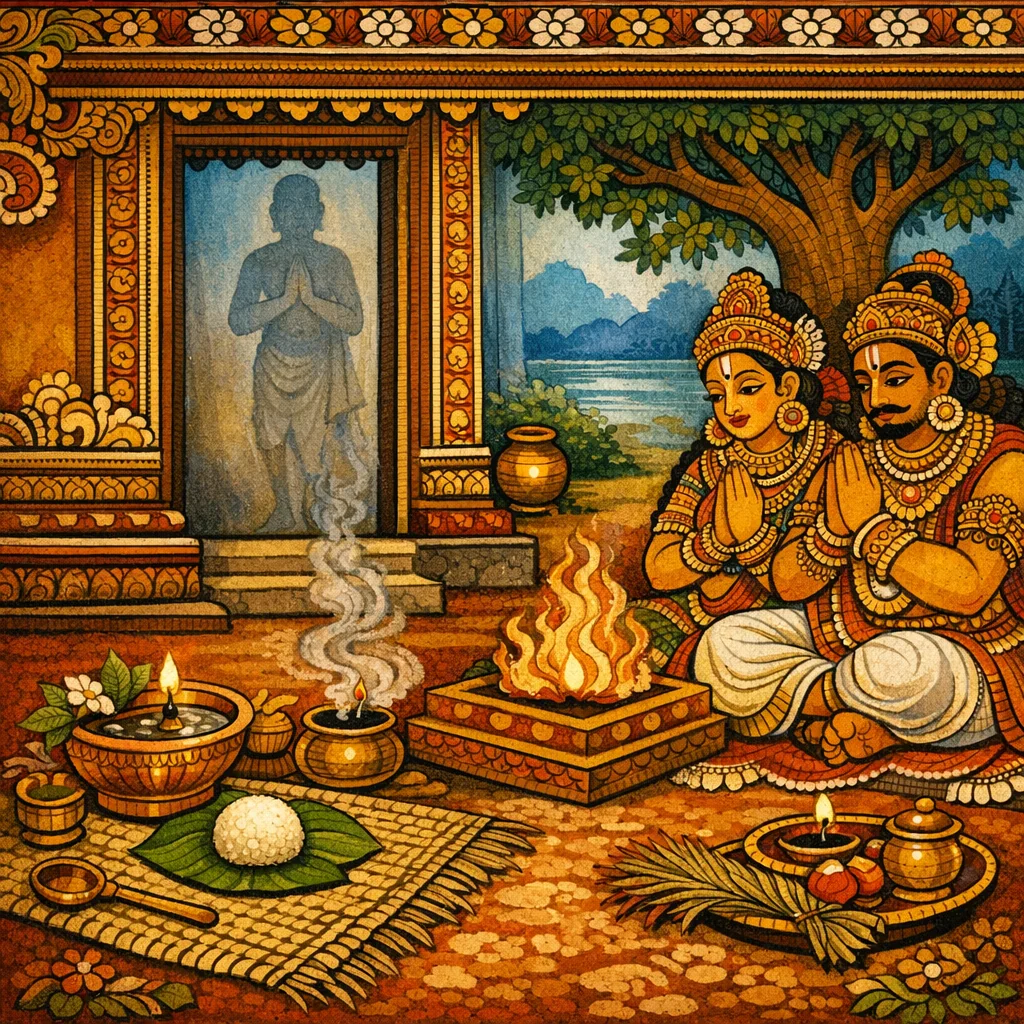
Adhyaya 18: Ekoddiṣṭa Śrāddha, Death-Impurity (Āśauca), and Sapīṇḍīkaraṇa Procedure
एकोद्दिष्टश्राद्ध-आशौच-सपिण्डीकरणविधिः
Speaker: Sūta
Sūta continues by presenting Cakrapāṇi (Viṣṇu)’s teaching on the ekoddiṣṭa rite and a son’s duties after a father’s death. He lists āśauca (death-impurity) periods by varṇa and special cases, then explains the twelve-day preta phase sustained by piṇḍa-dāna and other pacifying acts. He sets out the form and repetition of ekoddiṣṭa-śrāddha, extends observances through a month, and prescribes gifts and vṛṣotsarga. Finally he lays down the year-long sequence leading to sapīṇḍīkaraṇa, describes the ritual transfer that joins the preta to the Pitṛs, forbids mixing śrāddha types on the death-day, and concludes with rules on lepa/piṇḍa entitlement and the sapinda range up to seven generations.
Key Concepts
Shlokas in Adhyaya 18
Verse 1
*सूत उवाच एकोद्दिष्टमतो वक्ष्ये यदुक्तं चक्रपाणिना मृते पुत्रैर्यथा कार्यम् आशौचं च पितर्यपि //
Sūta said: Now I shall explain the rite called Ekoddiṣṭa, as it was taught by Cakrapāṇi (Viṣṇu), and also the rules of āśauca—ritual impurity—that sons must observe when a father dies.
Verse 2
दशाहं शावमाशौचं ब्राह्मणेषु विधीयते क्षत्रियेषु दश द्वे च पक्षं वैश्येषु चैव हि //
The period of death-related āśauca is prescribed as ten days for Brāhmaṇas; twelve days for Kṣatriyas; and for Vaiśyas, indeed, a fortnight.
Verse 3
शूद्रेषु मासमाशौचं सपिण्डेषु विधीयते नैशं वाकृतचूडस्य त्रिरात्रं परतः स्मृतम् //
For a Śūdra, āśauca is prescribed for a month, and the same is enjoined among sapinda (blood-related kin). But for one who has not yet undergone the cūḍā hair-rite (first tonsure), impurity is held to last only three nights thereafter.
Verse 4
जनने ऽप्येवमेव स्यात् सर्ववर्णेषु सर्वदा तथास्थिसंचयाद् ऊर्ध्वम् अङ्गस्पर्शो विधीयते //
The same rule applies at birth as well, for all varṇas at all times; and likewise, after the gathering of the bones (following cremation), bodily contact is again permitted.
Verse 5
प्रेताय पिण्डदानं तु द्वादशाहं समाचरेत् पाथेयं तस्य तत्प्रोक्तं यतः प्रीतिकरं महत् //
One should perform the offering of rice-balls (piṇḍa-dāna) for the departed spirit (preta) for twelve days. This is declared to be his “provision for the journey” (pātheya), because it brings him great satisfaction and benefit.
Verse 6
तस्मात्प्रेतपुरं प्रेतो द्वादशाहं न नीयते गृहं पुत्रं कलत्रं च द्वादशाहं प्रपश्यति //
Therefore, the departed one, as a preta, is not led to the city of the pretas for twelve days; for those twelve days he continues to behold his home, his son, and his wife.
Verse 7
तस्मान्निधेयमाकाशे दशरात्रं पयस्तथा सर्वदाहोपशान्त्यर्थम् अध्वश्रमविनाशनम् //
Therefore, milk should be kept out in the open air for ten nights; it is intended to pacify all burning heat and to remove the fatigue of travel.
Verse 8
तत एकादशाहे तु द्विजानेकादशैव तु क्षत्रादिः सूतकान्ते तु भोजयेदयुजो द्विजान् //
Then, on the eleventh day, one should feed eleven Brahmins; and for a Kṣatriya and the other varṇas, at the conclusion of the period of birth-impurity (sūtaka), one should feed Brahmins who are without physical defects, that is, ritually fit.
Verse 9
द्वितीये ऽह्नि पुनस्तद्वद् एकोद्दिष्टं समाचरेत् आवाहनाग्नौकरणं दैवहीनं विधानतः //
On the second day as well, one should perform the Ekoddiṣṭa-śrāddha in the same manner, according to the prescribed rule—carrying out the invocation and the fire-rite, but omitting the offerings to the gods, for it is directed solely to the departed.
Verse 10
एकं पवित्रमेको ऽर्घ एकः पिण्डो विधीयते उपतिष्ठतामित्येतद् देयं पश्चात्तिलोदकम् //
One sanctifying ring of kuśa-grass is used; one argha-offering is presented; and one piṇḍa (rice-ball) is prescribed. Saying, “May they be present (here),” one should then offer sesame-water (tilodaka) afterward.
Verse 11
स्वदितं विकिरेद्ब्रूयाद् विसर्गे चाभिरम्यताम् शेषं पूर्ववदत्रापि कार्यं वेदविदा पितुः //
Having said “svaditam” (“it is well-tasted/accepted”), he should scatter the offering; and at the concluding dismissal he should say, “may you delight (be pleased).” The remainder here too is to be performed as before by the father who is a knower of the Veda.
Verse 12
अनेन विधिना सर्वम् अनुमासं समाचरेत् सूतकान्ताद्द्वितीये ऽह्नि शय्यां दद्याद्विलक्षणाम् //
In this manner, one should duly perform all the prescribed observances for the whole month. Then, after the period of sūtaka (ritual impurity) has ended, on the second day one should give in charity a special bed, as enjoined.
Verse 13
काञ्चनं पुरुषं तद्वत् फलवस्त्रसमन्विताम् संपूज्य द्विजदाम्पत्यं नानाभरणभूषणैः //
Likewise, one should fashion a golden male figure and, together with fruits and garments, duly worship a Brahmin couple, adorning them with various ornaments and decorations.
Verse 14
वृषोत्सर्गं प्रकुर्वीत देया च कपिला शुभा उदकुम्भश्च दातव्यो भक्ष्यभोज्यसमन्वितः //
One should perform the rite of vṛṣotsarga, the releasing of a bull. One should also give in charity an auspicious tawny cow (kapilā), and donate a water-pot as well, accompanied by provisions of food and refreshments.
Verse 15
यावदब्दं नरश्रेष्ठ सतिलोदकपूर्वकम् ततः संवत्सरे पूर्णे सपिण्डीकरणं भवेत् //
O best of men, for the space of a year one should perform the rites beginning with offerings of water mixed with sesame; then, when the year is fully completed, the sapiṇḍīkaraṇa—joining the departed to the ancestral line—should be performed.
Verse 16
सपिण्डीकरणादूर्ध्वं प्रेतः पार्वणभाग्भवेत् वृद्धिपूर्वेषु योग्यश्च गृहस्थश्च भवेत्ततः //
After the sapiṇḍīkaraṇa has been performed, the departed (preta) becomes entitled to a share in the ancestral offerings of the monthly śrāddha (pārvaṇa). From that time onward, he is fit to be included among the ancestors in vṛddhi-type śrāddhas performed for auspicious increase, and is thereafter regarded as a gṛhastha, a settled member of the ancestral household-line.
Verse 17
सपिण्डीकरणे श्राद्धे देवपूर्वं नियोजयेत् पितॄन् निवासयेत्तत्र पृथक्प्रेतं विनिर्दिशेत् //
In the śrāddha performed for sapiṇḍīkaraṇa, one should first assign the offering to the gods, and then seat the Pitṛs there; and one should explicitly indicate the departed (preta) separately.
Verse 18
गन्धोदकतिलैर्युक्तं कुर्यात्पात्रचतुष्टयम् अर्घार्थं पितृपात्रेषु प्रेतपात्रं प्रसेचयेत् //
One should prepare a set of four vessels, furnished with perfumed water and sesame. Then, for the offering of arghya, one should pour from the preta-vessel into the vessels intended for the Pitṛs.
Verse 19
तद्वत्संकल्प्य चतुरः पिण्डान्पिण्डप्रदस्तथा ये समाना इति द्वाभ्याम् अन्त्यं तु विभजेत्त्रिधा //
In the same manner, having made the saṅkalpa (ritual resolve), the giver of the piṇḍas should prepare four rice-balls; then, with the two utterances beginning “ye samānāḥ…”, he should divide the last piṇḍa into three parts.
Verse 20
चतुर्थस्य पुनः कार्यं न कदाचिदतो भवेत् ततः पितृत्वमापन्नः सर्वतस्तुष्टिमागतः //
But thereafter, no further obligation remains for the fourth; then, having attained the status of a pitṛ (venerable ancestor), he becomes satisfied in every respect.
Verse 21
अग्निष्वात्तादिमध्यत्वं प्राप्नोत्यमृतमुत्तमम् सपिण्डीकरणादूर्ध्वं तस्मै तस्मान्न दीयते //
He attains the excellent, deathless state and is placed among the groups beginning with the Agniṣvāttas. But after the rite of sapiṇḍīkaraṇa, no separate offering is to be given to him from that point onward.
Verse 22
पितृष्वेव तु दातव्यं तत्पिण्डो येषु संस्थितः ततः प्रभृति संक्रान्ताव् उपरागादिपर्वसु //
That piṇḍa-offering is to be given only to the Pitṛs, in whom that offering is understood to abide; and from that time onward it should be performed on Saṅkrānti days and on festival occasions such as eclipses and the like.
Verse 23
त्रिपिण्डमाचरेच्छ्राद्धम् एकोद्दिष्टे मृते ऽहनि एकोद्दिष्टं परित्यज्य मृताहे यः समाचरेत् //
On the day of death, when the rite is to be performed as the eka-oddiṣṭa (an offering intended for a single departed person), one should perform the śrāddha with three piṇḍas. Whoever, on the death-day, abandons the eka-oddiṣṭa and instead performs another form (of śrāddha) acts improperly.
Verse 24
सदैव पितृहा स स्यान् मातृभ्रातृविनाशकः मृताहे पार्वणं कुर्वन् नधो ऽधो याति मानवः //
A man who performs the pārvaṇa-śrāddha on the very day of death becomes, as it were, a constant slayer of his forefathers and a destroyer of his mother and brothers; he goes ever further downward into lower states of suffering.
Verse 25
संपृक्तेष्वाकुलीभावः प्रेतेषु तु गतो भवेत् प्रतिसंवत्सरं तस्माद् एकोद्दिष्टं समाचरेत् //
When rites are performed in a mixed (combined) manner, confusion arises regarding the departed who are in the preta-state. Therefore one should duly perform the ekoddiṣṭa-śrāddha—separate and single-intention—every year.
Verse 26
यावदब्दं तु यो दद्याद् उदकुम्भं विमत्सरः प्रेतायान्नसमायुक्तं सो ऽश्वमेधफलं लभेत् //
Whoever, free from envy, gives a water-pot (udakumbha) for the span of a year, together with food meant for the preta, attains the merit that is declared to be the fruit of the Aśvamedha sacrifice.
Verse 27
आमश्राद्धं यदा कुर्याद् विधिज्ञः श्राद्धदस्तदा तेनाग्नौकरणं कुर्यात् पिण्डांस्तेनैव निर्वपेत् //
Whenever a ritual expert performs an āma-śrāddha (an unelaborated śrāddha), then, being duly engaged in the śrāddha, he should also perform the agnaukaraṇa rite by that same procedure, and by that very method he should duly offer the piṇḍas (rice-balls) as well.
Verse 28
त्रिभिः सपिण्डीकरणे अशेषत्रितये पिता यदा प्राप्स्यति कालेन तदा मुच्येत बन्धनात् //
When, in due course of time, the father attains the complete triad through the three sapīṇḍīkaraṇa rites, then he is released from bondage (bandhana).
Verse 29
मुक्तो ऽपि लेपभागित्वं प्राप्नोति कुशमार्जनात् लेपभाजश्चतुर्थाद्याः पित्राद्याः पिण्डभागिनः पिण्डदः सप्तमस्तेषां सापिण्ड्यं साप्तपौरुषम् //
Even one who is otherwise released from direct entitlement attains a share in the residual rite (lepa) through cleansing with kuśa-grass. Those beginning from the fourth ancestor are entitled to the lepa-share; those beginning with the father are entitled to the piṇḍa-offerings. The seventh is the giver of the piṇḍa; thus sapinda-relationship extends to seven generations.
Frequently Asked Questions
It lays down the correct post-death ritual sequence: observe varṇa-specific āśauca, perform twelve days of piṇḍa-dāna for the preta, conduct ekoddiṣṭa-śrāddha in the prescribed single-intention form (without offerings to gods), continue observances through the month with appropriate dānas, and complete the annual cycle with sapīṇḍīkaraṇa so the departed becomes a Pitṛ eligible for ongoing ancestral śrāddhas.
This chapter is primarily Dharma/ritual law (śrāddha-vidhi and impurity rules), with a kinship-structure component (sapinda boundaries and entitlement to piṇḍa/lepa). It does not teach Vāstu-śāstra, temple dimensions, rājadharma, or creation narratives in this adhyāya.
It prescribes 10 days for Brāhmaṇas, 12 days for Kṣatriyas, 15 days (a fortnight) for Vaiśyas, and 1 month for Śūdras; similar rules apply among sapiṇḍa kin. A special case is noted for one whose cūḍā/tonsure rite has not been performed: three nights of impurity.
Piṇḍa-dāna for twelve days is called the preta’s pātheya (provision for the journey), giving satisfaction and benefit. The text states the preta is not taken to the preta-city for twelve days and continues to see the home, son, and wife during that interval.
It insists the death-day should be ekoddiṣṭa, performed with three piṇḍas. Performing a different form such as pārvaṇa on the death-day is condemned as improper and spiritually harmful, creating confusion for preta-state recipients and leading to negative consequences for the performer.
After sapīṇḍīkaraṇa, the departed is treated as a Pitṛ: he gains a share in monthly pārvaṇa śrāddha and becomes eligible for inclusion in vṛddhi-type śrāddhas. The chapter also states that separate offerings to him as a distinct preta should not continue after this rite.
It defines entitlement such that those from the father upward receive piṇḍa shares, while those from the fourth ancestor onward receive lepa shares; the seventh is identified as the ‘piṇḍa-giver,’ and sapinda relationship is stated to extend across seven persons/generations (sāptapauruṣa).