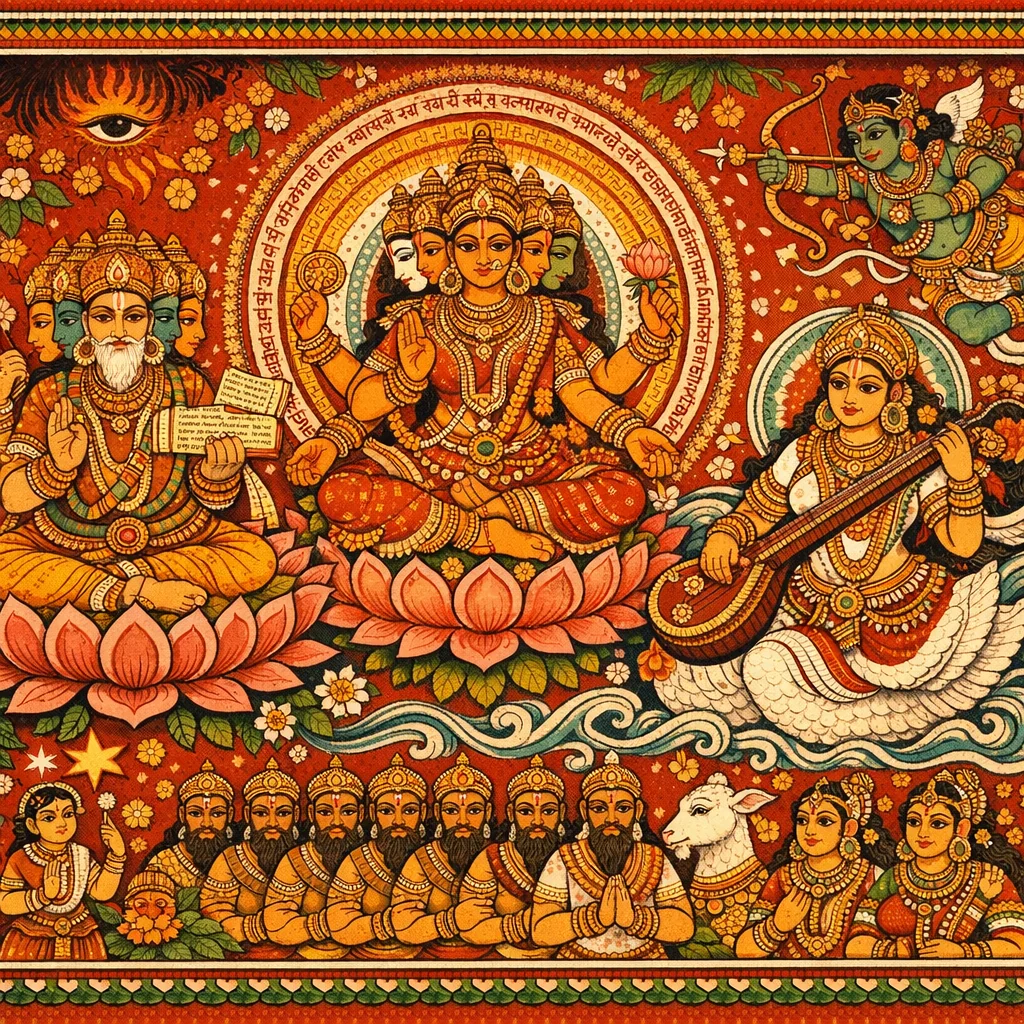
Adhyaya 4: Brahmā–Gāyatrī as a Divine Pair and the Early Genealogies of Creation (Manu to Dakṣa)
ब्रह्म-गायत्री-सरस्वती-मिथुनतत्त्वं तथा प्रजासृष्टि-वंशानुक्रमः
Speaker: Vaivasvata Manu, Lord Matsya, Brahmā, Kāma (Kusumāyudha)
Manu asks how Brahmā could approach his own offspring, and how sagotra ties and marriage alliances first arose. Matsya replies that the earliest creation is divine and suprasensory, not fully judgeable by human moral categories; only divine beings know divine pathways. He identifies Brahmā as Veda-personified and Gāyatrī/Sāvitrī as his inseparable presiding śakti, implying no fault in Sāvitrī-upāsanā or recitation. Yet Brahmā’s shame is narrated, leading to his curse on Kāma: Rudra will burn him for disturbing Brahmā’s mind. Kāma petitions that he was created to stir the senses; Brahmā mitigates the curse with a boon of future embodiment and eventual return to Matsya’s proximity. Manu then asks about Yadu, Kāma’s Yādava connection, Rudra’s burning, and the Bharata line. Matsya answers by unfolding the creation-and-lineage chain: Śatarūpā/Gāyatrī as Manu’s consort, progeny lists, Vāmadeva’s varṇa-creation, Dhruva’s tapas and fixed station, later Manvantaric descendants, the Pracetases, Mārīṣā and Dakṣa, and Dakṣa’s expansive progeny, culminating in daughter-marriages to Dharma, Kaśyapa, and Soma that populate the cosmos.
Key Concepts
Shlokas in Adhyaya 4
Verse 1
*मनुर् उवाच अहो कष्टतरं चैतद् अङ्गजागमनं विभो कथं न दोषमगमत् कर्मणानेन पद्मभूः //
Manu said: “Alas, this indeed is most grievous—this union with one’s own offspring, O Lord. How did the Lotus-born (Brahmā) not incur fault through such an act?”
Verse 2
परस्परं च सम्बन्धः सगोत्राणाम् अभूत् कथम् वैवाहिकस्तत्सुतानां छिन्द्धि मे संशयं विभो //
How did mutual relationships arise among those of the same lineage (sagotra)? And how did marital alliance come about for their sons? O Lord, dispel my doubt.
Verse 3
*मत्स्य उवाच दिव्येयमादिसृष्टिस्तु रजोगुणसमुद्भवा अतीन्द्रियेन्द्रिया तद्वद् अतीन्द्रियशरीरिका //
Lord Matsya said: This primordial creation is divine, arising from the quality of rajas. Its faculties of perception and action are beyond the senses, and likewise its embodiment is of a suprasensory kind.
Verse 4
दिव्यतेजोमयी भूप दिव्यज्ञानसमुद्भवा न मर्त्यैरभितः शक्या वक्तुं वै मांसचक्षुभिः //
O King, that reality is made of divine radiance and arises from divine knowledge; it cannot be fully described by mortals who perceive only through fleshly eyes.
Verse 5
यथा भुजंगाः सर्पाणाम् आकाशं विश्वपक्षिणाम् विदन्ति मार्गं दिव्यानां दिव्या एव न मानवाः //
Just as serpents alone know the ways of serpents, and the sky is known in its paths by the birds that roam it, so too the course of divine beings is known only by the divine—not by human beings.
Verse 6
कार्याकार्ये न देवानां शुभाशुभफलप्रदे यस्मात्तस्मान्न राजेन्द्र तद्विचारो नृणां शुभः //
Because the gods do not directly determine what is to be done and what is not to be done—even though they bestow auspicious and inauspicious results—therefore, O best of kings, such over-analysis is not wholesome for human beings.
Verse 7
अन्यच्च सर्ववेदानाम् अधिष्ठाता चतुर्मुखः गायत्री ब्रह्मणस्तद्वद् अङ्गभूता निगद्यते //
Moreover, the four-faced Brahmā is declared to be the presiding deity of all the Vedas; likewise, Gāyatrī is spoken of as an integral limb—an essential component—of Brahmā.
Verse 8
अमूर्तं मूर्तिमद् वापि मिथुनं तत्प्रचक्षते विरिञ्चिर् यत्र भगवांस् तत्र देवी सरस्वती भारती यत्र यत्रैव तत्र तत्र प्रजापतिः //
Whether unmanifest or embodied, that Reality is spoken of as a paired principle. Wherever the Blessed Viriñci (Brahmā) is present, there too is the Goddess Sarasvatī—Bhāratī, the power of speech and knowledge. And wherever she is, there indeed is Prajāpati, the Lord of progeny.
Verse 9
यथातपो न रहितश् छायया दृश्यते क्वचित् गायत्री ब्रह्मणःपार्श्वं तथैव न विमुञ्चति //
Just as the sun is never seen anywhere without its shadow, so too does Gāyatrī never leave the side of Brahmā.
Verse 10
वेदराशिः स्मृतो ब्रह्मा सावित्री तदधिष्ठिता तस्मान्न कश्चिद्दोषः स्यात् सावित्रीगमने विभो //
Brahmā is remembered as the very “mass of the Vedas,” and Sāvitrī (Gāyatrī) presides over that Vedic revelation. Therefore, O Lord, there can be no fault at all in approaching or reciting Sāvitrī.
Verse 11
तथापि लज्जावनतः प्रजापतिर् अभूत्पुरा स्वसुतोपगमाद् ब्रह्मा शशाप कुसुमायुधम् //
Even so, the Prajāpati (Brahmā) once bowed down in shame because of his approach toward his own daughter; and Brahmā then pronounced a curse upon Kusumāyudha (Kāma, the god of love).
Verse 12
यस्मान्ममाभिभवता मनः संक्षोभितं शरैः तस्मात्त्वद्देहमचिराद् रुद्रो भस्मीकरिष्यति //
Because, by your overpowering assault, my mind has been violently shaken by your arrows; therefore Rudra will soon reduce your body to ashes.
Verse 13
ततः प्रसादयामास कामदेवश्चतुर्मुखम् न मामकारणे शप्तुं त्वमिहार्हसि मानद //
Then Kāma-deva sought to appease the four-faced Brahmā, saying: “O bestower of honor, you should not curse me here without cause.”
Verse 14
अहमेवंविधः सृष्टस् त्वयैव चतुरानन इन्द्रियक्षोभजनकः सर्वेषामेव देहिनाम् //
O four-faced one (Brahmā), I have been created by you in this very form, as the cause that stirs and agitates the senses of all embodied beings.
Verse 15
स्त्रीपुंसोरविचारेण मया सर्वत्र सर्वदा क्षोभ्यं मनः प्रयत्नेन त्वयैवोक्तं पुरा विभो //
O Lord, because I have been heedless in matters of women and men, my mind becomes agitated everywhere and at all times. Yet formerly you yourself declared that, through deliberate effort, the mind must be brought under control.
Verse 16
तस्मादनपराधो ऽहं त्वया शप्तस्तथा विभो कुरु प्रसादं भगवन् स्वशरीराप्तये पुनः //
Therefore, though I am not at fault, I have been cursed by you, O mighty Lord. O Bhagavān, be gracious—grant me favor, so that I may regain my own body once again.
Verse 17
*ब्रह्मोवाच वैवस्वते ऽन्तरे प्राप्ते यादवान्वयसम्भवः रामो नाम यदा मर्त्यो मत्सत्त्वबलमाश्रितः //
Brahmā said: When the Vaivasvata Manvantara had arrived, there arose in the Yādava lineage a mortal named Rāma, who relied upon the power and strength of the Matsya (Fish) nature.
Verse 18
अवतीर्यासुरध्वंसी द्वारकाम् अधिवत्स्यति तद्भ्रातुस्तत्समस्य त्वं तदा पुत्रत्वमेष्यसि //
Descending to earth as the destroyer of the demons, he will dwell in Dvārakā; and you, at that time, will attain sonship as the child of his brother—one equal to him.
Verse 19
एवं शरीरमासाद्य भुक्त्वा भोगानशेषतः ततो भरतवंशान्ते भूत्वा वत्सनृपात्मजः //
Thus, having obtained a body and having fully experienced pleasures without remainder, he was then born at the end of the Bharata lineage as the son of King Vatsa.
Verse 20
विद्याधराधिपत्यं च यावद् आभूतसंप्लवम् सुखानि धर्मतः प्राप्य मत्समीपं गमिष्यसि //
You will attain sovereignty over the Vidyādharas until the cosmic dissolution of beings; having gained joys in accordance with dharma, you will then come into My presence (near Matsya).
Verse 21
एवं शापप्रसादाभ्याम् उपेतः कुसुमायुधः शोकप्रमोदाभियुतो जगाम स यथागतम् //
Thus, Kusumāyudha (Kāma), having come under both a curse and a favor, and filled with grief and joy alike, departed and went away as he had come.
Verse 22
*मनुरुवाच को ऽसौ यदुरिति प्रोक्तो यद्वंशे कामसम्भवः कथं च दग्धो रुद्रेण किमथ कुसुमायुधः //
Manu said: “Who is this one called Yadu? And how did Kāma, the god of desire, arise in the line of Yadu? Moreover, how was he burned by Rudra (Śiva), and why is he known as ‘Kusumāyudha’, the Flower-weaponed?”
Verse 23
भरतस्यान्वये कस्य का च सृष्टिः पुराभवत् एतत्सर्वं समाचक्ष्व मूलतः संशयो हि मे //
In the lineage of Bharata, whose line was it, and what creation (sṛṣṭi) came to be in ancient times? Explain all of this to me from the very root, for I indeed have doubt.
Verse 24
*मत्स्य उवाच या सा देहार्धसम्भूता गायत्री ब्रह्मवादिनी जननी या मनोर्देवी शतरूपा शतेन्द्रिया //
Lord Matsya said: She who was born from half of his body—Gayatrī, the knower and utterer of Brahman—she who became the mother, the divine consort of Manu, is Śatarūpā, ‘of a hundred forms’, endowed with a hundred faculties (senses/powers).
Verse 25
रतिर्मनस्तपो बुद्धिर् महान् दिक्सम्भ्रमस् तथा ततः स शतरूपायां सप्तापत्यान्यजीजनत् //
Rati, Manas, Tapa, Buddhi, Mahān, and also Diksambhrama—thus, from her, upon Śatarūpā, he begot seven offspring.
Verse 26
ये मरीच्यादयः पुत्रा मानसास्तस्य धीमतः तेषामयमभूल्लोकः सर्वज्ञानात्मकः पुरा //
Those sons—beginning with Marīci—who were mind-born of that wise progenitor: for them, in ancient times, there existed this realm whose very nature was complete knowledge.
Verse 27
ततो ऽसृजद्वामदेवं त्रिशूलवरधारिणम् सनत्कुमारं च विभुं पूर्वेषामपि पूर्वजम् //
Then he created Vāmadeva, bearer of the trident and the boon‑granting hand, and also the mighty Sanatkumāra—ancestor even of the ancients.
Verse 28
वामदेवस्तु भगवान् असृजन्मुखतो द्विजान् राजन्यान् असृजद्बाह्वोर् विट्छूद्रान् ऊरुपादयोः //
The Blessed Lord Vāmadeva created the twice-born from his mouth; he created the royal class from his arms, and the vaiśyas and śūdras from his thighs and feet.
Verse 29
विद्युतो ऽशनिमेघांश्च रोहितेन्द्रधनूंषि च छन्दांसि च ससर्जादौ पर्जन्यं च ततः परम् //
In the beginning, he created lightning, thunder, and clouds; the red glow and the rainbow as well; and also the Vedic metres. Thereafter, he brought forth Parjanya—the rain-bearing power.
Verse 30
ततः साध्यगणानीशस् त्रिनेत्रानसृजत्पुनः कोटीश्च चतुरशीतिं जरामरणवर्जिताः //
Then the Lord of the hosts (Īśa), the Three-eyed one, again brought forth the Sādhyas—eighty-four crores in number—free from old age and death.
Verse 31
वामो ऽसृजन्नमर्त्यांस् तान् ब्रह्मणा विनिवारितः नैवंविधा भवेत्सृष्टिर् जरामरणवर्जिता //
Vāma began creating those beings as deathless; but he was restrained by Brahmā, for creation should not be of such a kind—devoid of old age and death.
Verse 32
शुभाशुभात्मिका या तु सैव सृष्टिः प्रशस्यते एवं स्थितः स तेनादौ सृष्टेः स्थाणुरतो ऽभवत् //
That creation which is of the nature of both the auspicious and the inauspicious is indeed what is acknowledged as “creation.” Thus established, at the very beginning of creation he became the sthāṇu—the steadfast pillar of the creative process.
Verse 33
स्वायम्भुवो मनुर्धीमांस् तपस्तप्त्वा सुदुश्चरम् पत्नीमेवाप रूपाढ्याम् अनन्ता नाम नामतः //
The wise Svāyambhuva Manu, having performed exceedingly difficult austerities, obtained as his wife a beautiful woman, named Anantā.
Verse 34
प्रियव्रतोत्तानपादौ मनुस्तस्याम् अजीजनत् धर्मस्य कन्या चतुरा सूनृता नाम भामिनी //
From her, Manu begot Priyavrata and Uttānapāda. She was the daughter of Dharma—wise and capable—known by the name Sūnṛtā, a noble lady.
Verse 35
उत्तानपादात्तनयान् प्राप मन्थरगामिनी अपस्यतिम् अपस्यन्तं कीर्तिमन्तं ध्रुवं तथा //
From Uttānapāda she obtained sons—Apasyati, Apasyanta, the illustrious Dhruva, and others as well—born of Mantharagāminī.
Verse 36
उत्तानपादो ऽजनयत् सूनृतायां प्रजापतिः ध्रुवो वर्षसहस्राणि त्रीणि कृत्वा तपः पुरा //
The Prajāpati Uttānapāda begot a son in Sūnṛtā; and Dhruva, in ancient times, performed austerity for three thousand years.
Verse 37
दिव्यमाप ततः स्थानम् अचलं ब्रह्मणो वरात् तमेव पुरतः कृत्वा ध्रुवं सप्तर्षयः स्थिताः //
Thereafter he attained a divine, immovable station by the boon of Brahmā. Placing Dhruva himself before them, the Seven Sages took their stand in the heavens.
Verse 38
धन्या नाम मनोः कन्या ध्रुवाच्छिष्टम् अजीजनत् अग्निकन्या तु सुच्छाया शिष्टात्सा सुषुवे सुतान् //
Dhanyā, the daughter of Manu, bore a son named Chiṣṭa by Dhruva. And Succhāyā—said to be Agni’s daughter—then bore sons from that Chiṣṭa.
Verse 39
कृपं रिपुं जयं वृत्तं वृकं च वृकतेजसम् चक्षुषं ब्रह्मदौहित्र्यां वीरिण्यां स रिपुंजयः //
From Vīriṇī—Brahmā’s granddaughter—Cākṣuṣa begot sons named Kṛpa, Ripu, Jaya, Vṛtta, Vṛka, and Vṛkatejas; and also another son, Ripuñjaya.
Verse 40
वीरणस्यात्मजायां तु चक्षुर्मनुमजीजनत् मनुर् वै राजकन्यायां नड्वलायां स चाक्षुषः //
From Vīraṇa’s daughter, Cakṣus begot Manu. That Manu—known as Cākṣuṣa—was born from the royal maiden Naḍvalā.
Verse 41
जनयामास तनयान् दश शूरानकल्मषान् ऊरुः पूरुः शतद्युम्नस् तपस्वी सत्यवाग्घविः //
He begot ten sons—heroic and free from blemish—namely Ūru, Pūru, Śatadyumna, Tapasvī, Satyavāk, and Ghavi (among them).
Verse 42
अग्निष्टुदतिरात्रश्च सुद्युम्नश्चापराजितः अभिमन्युस्तु दशमो नड्वलायाम् अजायत //
Agniṣṭut, Atirātra, and Sudyumna—together with Aparājita—were born in that lineage. Abhimanyu was the tenth son, and he was born of Naḍvalā.
Verse 43
ऊरोर् अजनयत् पुत्रान् षड् आग्नेयी तु सुप्रभान् अग्निं सुमनसं ख्यातिं क्रतुमङ्गिरसं गयम् //
From Ūru, the Agneyī (fire-born) lady Suprabhā gave birth to six illustrious sons—Agni, Sumanas, Khyāti, Kratu, Aṅgiras, and Gaya.
Verse 44
पितृकन्या सुनीथा तु वेनमङ्गादजीजनत् वेनमन्यायिनं विप्रा ममन्थुस् तत्कराद् अभूत् पृथुर्नाम महातेजाः स पुत्रौ द्वाव् अजीजनत् //
Sunīthā, the daughter of Pitṛ (Yama), bore Vena by King Aṅga. When that unrighteous Vena was churned by the sages, from his hand there arose the greatly radiant one named Pṛthu; and he in turn begot two sons.
Verse 45
अन्तर्धानस् तु मारीचं शिखण्डिन्यामजीजनत् हविर्धानात् षड् आग्नेयी धिषणाजनयत् सुतान् प्राचीनबर्हिषं साङ्गं यमं शुक्रं बलं शुभम् //
Antardhāna begot Mārīca upon Śikhaṇḍinī. From Havirdhāna, the Agneyī-born lady Dhiṣaṇā gave birth to six sons: Prācīnabarhiṣ, Sāṅga, Yama, Śukra, Bala, and Śubha.
Verse 46
प्राचीनबर्हिर् भगवान् महान् आसीत् प्रजापतिः हविर्धानाः प्रजास् तेन बहवः सम्प्रवर्तिताः //
The venerable and great Prācīnabarhi was a Prajāpati; through him many progenies—known as the Havirdhānas—were set into fruitful continuation and expansion.
Verse 47
सवर्णायां तु सामुद्र्यां दशाधत्त सुतान्प्रभुः सर्वे प्रचेतसो नाम धनुर्वेदस्य पारगाः //
In Savarṇā, also called Sāmudrī, the Lord begot ten sons; all were known as the Pracetases and were accomplished masters of Dhanurveda, the sacred science of archery.
Verse 48
तत्तपोरक्षिता वृक्षा बभुर् लोके समन्ततः देवादेशाच्च तानग्निर् अदहद्रविनन्दन //
Those trees, protected by the power of austerity (tapas), flourished everywhere in the world; yet, by the command of the gods, Fire—Agni—burned them, O delight of the Solar line.
Verse 49
सोमकन्याभवत् पत्नी मारीषा नाम विश्रुता तेभ्यस्तु दक्षमेकं सा पुत्रम् अग्र्यम् अजीजनत् //
His wife was Soma’s daughter, renowned as Mārīṣā; and from them she bore a single son, the foremost among sons—Dakṣa.
Verse 50
दक्षादनन्तरं वृक्षान् औषधानि च सर्वशः अजीजनत्सोमकन्या नदीं चन्द्रवतीं तथा //
After Dakṣa, Soma’s daughter brought forth, in every manner, the trees and all medicinal plants; and she also generated the river named Candravatī.
Verse 51
सोमांशस्य च तस्यापि दक्षस्याशीतिकोटयः वक्ष्ये तासां तु विस्तारं लोके यः सुप्रतिष्ठितः //
And of that very Dakṣa—who is also a portion of Soma—there are eighty koṭis (vast multitudes) of progeny. I shall describe in detail their expansion, which is firmly established and renowned in the world.
Verse 52
द्विपदश्चाभवन् केचित् केचिद् बहुपदा नराः वलीमुखाः शङ्कुकर्णाः कर्णप्रावरणास् तथा //
Some were born two-footed, while some humans came forth with many feet; some had wrinkled or folded faces, some had conch-like ears, and others had ears that served as coverings.
Verse 53
अश्वऋक्षमुखाः केचित् केचित् सिंहाननास्तथा श्वसूकरमुखाः केचित् केचिदुष्ट्रमुखास् तथा //
Some had the faces of horses and bears; some had lion-faces. Some bore the faces of dogs and boars, and some likewise had camel-faces.
Verse 54
जनयामास धर्मात्मा म्लेच्छान्सर्वाननेकशः स सृष्ट्वा मनसा दक्षः स्त्रियः पश्चादजीजनत् //
That righteous one brought forth all the Mlecchas in many varieties; and Dakṣa—having first created them by his mind (manasā)—afterwards generated women.
Verse 55
ददौ स दश धर्माय कश्यपाय त्रयोदश सप्तविंशतिं सोमाय ददौ नक्षत्रसंज्ञिताः देवासुरमनुष्यादि ताभ्यः सर्वमभूज्जगत् //
He gave ten (daughters) to Dharma, thirteen to Kaśyapa, and twenty-seven—known as the Nakṣatras—to Soma. From those unions arose the entire world, consisting of gods, demons (Asuras), humans, and the rest.
Frequently Asked Questions
The chapter teaches that primordial creation (ādi-sṛṣṭi) operates on a divine, suprasensory plane and should not be over-analyzed using ordinary human ethical categories. It also establishes a Vedic-theological principle: Brahmā is Veda-personified, and Gāyatrī/Sāvitrī is his inseparable presiding śakti—hence Sāvitrī recitation/approach is presented as intrinsically faultless, even while the narrative acknowledges Brahmā’s shame and the karmic consequence enacted through Kāma’s curse.
This adhyāya is primarily about Sṛṣṭi (creation philosophy) and Puranic Genealogy (lineages from Manu through Dhruva, Pracetases, and Dakṣa). It includes Dharma framing (limits of human moral judgment in divine matters) and Vedic personification theology (Brahmā–Gāyatrī–Sarasvatī). Vāstu Śāstra and Rājadharma are not central in this chapter.
Matsya distinguishes the divine pairing principle—Brahmā and Gāyatrī/Sāvitrī as inseparable Veda and Veda-śakti—from human social categories. Since Brahmā is ‘Veda-rāśi’ and Sāvitrī presides over Vedic revelation, approaching/reciting Sāvitrī is treated as Vedic alignment rather than a human-style transgression. The story still preserves Brahmā’s shame to signal restraint and the gravity of desire’s disturbance.
Kāma is portrayed as the divinely created force that agitates the senses of embodied beings. When his arrows disturb Brahmā’s mind, Brahmā curses him that Rudra will burn his body; yet Brahmā also grants a compensating boon involving future embodiment and eventual restoration/attainment. This frames desire as cosmically functional but needing containment under higher tapas and dharma.
The chapter links Śatarūpā (identified with Gāyatrī’s emergence) as Manu’s divine consort, moves through mind-born progenitors and Vāmadeva’s creation schema, highlights Dhruva’s tapas and fixed celestial station with the Saptarṣis, proceeds through later descendants including the Pracetases, then Mārīṣā and the birth of Dakṣa, and culminates with Dakṣa’s daughters given to Dharma, Kaśyapa, and Soma (Nakṣatras), from which the worlds of gods, demons, humans, and others expand.