Adhyaya 330
Nārāyaṇasya Guhya-nāmāni Niruktāni (Etymologies of Nārāyaṇa’s Secret Epithets) / नारायणस्य गुह्यनामानि निरुक्तानि
Upa-parva: Nārāyaṇīya (Discourse on Nārāyaṇa and Divine Names)
This chapter presents a sustained self-description by Śrī Bhagavān (identified with Nārāyaṇa/Kṛṣṇa) in which divine epithets are justified through cosmological function, ritual participation, and semantic derivation. The discourse begins by associating the sun and moon with the Lord’s radiance and governance of awakening and heating, then proceeds to explain names such as Hari, Satya/Ṛtadhāman, Govinda, Śipiviṣṭa, Aja, Sātvata, Kṛṣṇa, Vaikuṇṭha, Acyuta, Adhokṣaja, Ghṛtārcis, Tridhātu, Vṛṣākapi, Śuciśravāḥ, and others—often linking each to a specific act (e.g., rescuing the earth), a textual tradition (nirukta, Vedic branches), or a metaphysical attribute (unborn witnesshood). A mythic interlude narrates a high-stakes confrontation between Rudra and Nārāyaṇa in which cosmic stability is disturbed; Brahmā mediates, leading to mutual recognition and emblematic marks (śrīvatsa/śūlāṅka). The chapter closes with pragmatic reassurance to Arjuna: Rudra operates as a forward-moving force in battle, identified with time and wrath-born potency, and is to be approached with disciplined reverence.
Chapter Arc: भीष्म युधिष्ठिर से कहते हैं—एक सूने अंतराल में देवर्षि नारद शुकदेव के आश्रम में आते हैं, जहाँ शुक स्वाध्याय में निमग्न हैं; वैराग्य और ज्ञान का प्रसंग स्वयं चलकर द्वार पर आ खड़ा होता है। → शुक वेदोक्त विधि से अर्घ्यादि देकर नारद का सत्कार करते हैं। प्रसन्न नारद पूछते हैं—‘धर्मधारियों में श्रेष्ठ! किस श्रेय के द्वारा मैं तुम्हें जोड़ूँ?’ और फिर मानव-देह की विडम्बना, विषयासक्ति की मूढ़ता, तथा क्रोध-मत्सर-मान-अपमान-प्रमाद जैसे सूक्ष्म शत्रुओं का क्रमशः उद्घाटन करते हैं। → नारद कर्म-बंधन का तीखा चित्र खींचते हैं—इन्द्रियाँ, गुण (सत्त्व-रजस्-तमस्) और अव्यक्त की गणना से जगत-यंत्र का संकेत देते हुए बताते हैं कि मोहग्रस्त जीव मथानी की भाँति कर्मों से मथा जाता है; अपथ्य खाने वाले रोगी की तरह भोग के बाद भी तपता है और चक्रवत् संसार में बार-बार घूमता है। → उपदेश का निष्कर्ष वैराग्य-ज्ञान में स्थिरता है—कर्म-आसक्ति से निवृत्त होकर, भाव-विवर्जित, बन्धन-मुक्त, ‘सर्ववित्, सर्वजित्, सिद्ध’ होने की दिशा; तप को क्रोध से, लक्ष्मी को मत्सर से, विद्या को मान-अपमान से और आत्मा को प्रमाद से बचाने का व्यावहारिक अनुशासन भी साथ चलता है।
Shlokas
Verse 1
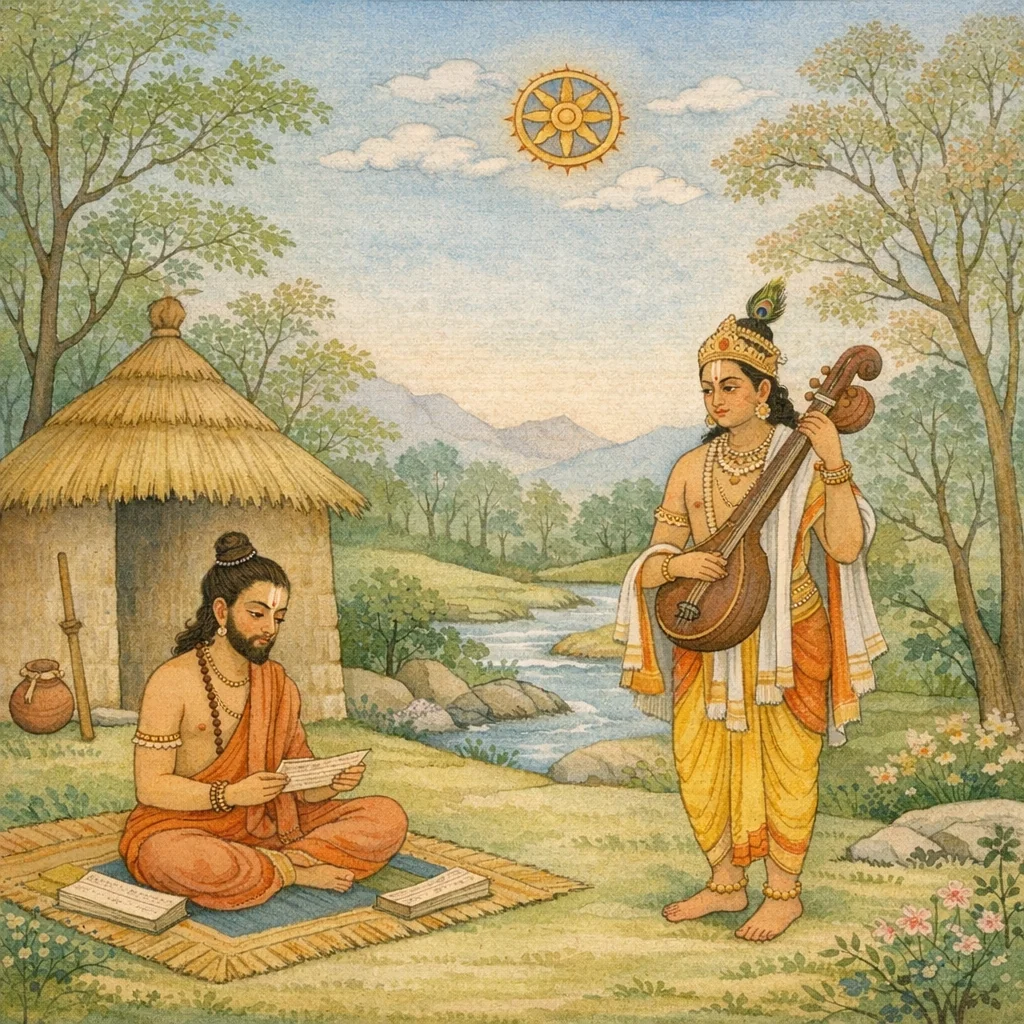
एकोनत्रिशर्दाधिकत्रिशततमो< ध्याय: शुकदेवजीको नारदजीका वैराग्य और ज्ञानका उपदेश भीष्म उवाच एतस्मिन्नन्तरे शून्ये नारद: समुपागमत् | शुकं स्वाध्यायनिरतं वेदार्थान् वक्तुमीप्सितान्,भीष्मजी कहते हैं--युधिष्ठिर! व्यासजीके चले जानेके बाद उस सूने आश्रममें स्वाध्यायपरायण शुकदेवसे अपना इच्छित वेदोंका अर्थ कहनेके लिये देवर्षि नारदजी पधारे
Bhishma said: In the meantime, when the hermitage had become quiet and empty, the divine sage Narada arrived. He approached Shuka, who was devoted to self-study, intending to have him expound the meanings of the Vedas that Narada wished to hear—thus setting the stage for instruction in knowledge and dispassion.
Verse 2
देवर्षि तु शुको दृष्टवा नारदं समुपस्थितम् । अर्घ्यपूर्वेण विधिना वेदोक्तेना भ्यपूजयत्,देवर्षि नारदको उपस्थित देख शुकदेवने वेदोक्त विधिसे अर्घ्य आदि निवेदन करके उनका पूजन किया
Bhishma said: Seeing the divine sage Narada who had come and stood before him, the sage Shuka honored him according to the Veda-prescribed rite—beginning with the offering of arghya—thus showing the proper reverence due to a venerable guest and spiritual authority.
Verse 3
नारदोथाब्रवीत् प्रीतो ब्रूहि धर्मभूृतां वर । केन त्वां श्रेयसा वत्स योजयामीति हृष्टवत्,शुकदेवजीको नारदजीका उपदेश उस समय नारदजीने प्रसन्न होकर कहा--“वत्स! तुम धर्मात्माओंमें श्रेष्ठ हो। बताओ, तुम्हें किस श्रेष्ठ वस्तुकी प्राप्ति कराऊँ?” यह बात उन्होंने बड़े हर्षके साथ कही
Bhishma said: Then Narada, pleased at heart, spoke: “O dear child, you are the foremost among those who uphold dharma. Tell me—by what highest good shall I unite you? What supreme benefit do you seek that I may help you attain it?” He said this with evident joy.
Verse 4
नारदस्य वच: श्रुत्वा शुक: प्रोवाच भारत | अस्मिल्लोके हितं यत् स्यात् तेन मां योक्तुमहसि,भरतनन्दन! नारदजीकी यह बात सुनकर शुकदेवने कहा--“इस लोकमें जो परम कल्याणका साधन हो, उसीका मुझे उपदेश देनेकी कृपा करें”
Hearing Nārada’s words, Śuka said, “O Bhārata, please instruct me in that which would be truly beneficial in this world—the means to the highest welfare.”
Verse 5
नारद उवाच तत्त्वं जिज्ञासतां पूर्वमृषीणां भावितात्मनाम् | सनत्कुमारो भगवानिदं वचनमत्रवीत्,नारदजीने कहा--वत्स! पूर्वकालकी बात है, पवित्र अन्तःकरणवाले ऋषियोंने तत्त्वज्ञान प्राप्त करनेकी इच्छासे प्रश्न किया। उसके उत्तरमें भगवान् सनत्कुमारने यह उपदेश दिया
Nārada said: “My child, in ancient times the seers, whose hearts were purified and disciplined, questioned in their longing to know the true principle. In reply, the Blessed Lord Sanatkumāra spoke these words of instruction.”
Verse 6
नास्ति विद्यासमं चक्षुर्नास्ति सत्यसमं तपः । नास्ति रागसमं दु:ःखं नास्ति त्यागसमं सुखम्,विद्याके समान कोई नेत्र नहीं है। सत्यके समान कोई तप नहीं है। रागके समान कोई दुःख नहीं है और त्यागके सदृश कोई सुख नहीं है
Nārada said: “There is no eye like knowledge; there is no austerity like truth. There is no sorrow like attachment, and there is no happiness comparable to renunciation.”
Verse 7
निवृत्ति: कर्मण: पापात् सततं पुण्यशीलता । सद्वृत्ति: समुदाचार: श्रेय एतदनुत्तमम्,पापकर्मोंसे दूर रहना, सदा पुण्यकर्मोंका अनुष्ठान करना, श्रेष्ठ पुरुषोंके-से बर्ताव और सदाचारका पालन करना--यही सर्वोत्तम श्रेय (कल्याण)-का साधन है
Nārada said: “Turning away from sinful action, maintaining a constant disposition toward meritorious deeds, and living with the conduct and good customs of the virtuous—this is the unsurpassed means to true welfare and highest good.”
Verse 8
मानुष्यमसुखं प्राप्प य: सज्जति स मुहाृति । नालं स दुःखमोक्षाय संयोगो दुःखलक्षणम्,जहाँ सुखका नाम भी नहीं है, ऐसे इस मानव-शरीरको पाकर जो विषयोंमें आसक्त होता है, वह मोहको प्राप्त होता है। विषयोंका संयोग दुःखरूप ही है, अतः दुःखोंसे छुटकारा नहीं दिला सकता
Nārada said: “Having obtained this human condition—so often devoid of true happiness—whoever becomes attached to sense-objects falls into delusion. Contact with objects is itself marked by suffering; therefore it is not sufficient to free one from sorrow.”
Verse 9
सक्तस्य बुद्धिश्बलति मोहजालविवर्धनी । मोहजालावृतो दुःखमिह चामुत्र सो5श्लुते,विषयासक्त पुरुषकी बुद्धि चंचल होती है। वह मोहजालको बढ़ानेवाली है, मोहजालसे बँधा हुआ पुरुष इस लोक तथा परलोकमें दुःख ही भोगता है
Nārada said: “When a person is attached to sense-objects, his intellect becomes unsteady and only strengthens the web of delusion. Ensnared and covered by that net of delusion, he experiences suffering—both in this world and in the next.”
Verse 10
सर्वोपायात् तु कामस्य क्रोधस्य च विनिग्रह: । कार्य: श्रेयोडर्थिना तौ हि श्रेयोघातार्थमुद्यती,जिसे कल्याणप्राप्तिकी इच्छा हो, उसे सभी उपायोंसे काम और क्रोधको दबाना चाहिये; क्योंकि ये दोनों दोष कल्याणका नाश करनेके लिये उद्यत रहते हैं
Nārada said: One who seeks true welfare should, by every possible means, restrain desire and anger; for these two faults are ever poised to strike down one’s good and ruin one’s highest benefit.
Verse 11
नित्यं क्रोधात् तपो रक्षेच्छ़ियं रक्षेच्च मत्सरात् । विद्यां मानावमानाभ्यामात्मानं तु प्रमादतः,मनुष्यको चाहिये कि वह सदा तपको क्रोधसे, लक्ष्मीको डाहसे, विद्याको मानापमानसे और अपने-आपको प्रमादसे बचावे
Narada said: One should always safeguard one’s austerity from anger, protect prosperity from envy, preserve learning from the disturbances of honor and dishonor, and guard one’s very self from heedlessness. The teaching is that inner virtues and achievements are not lost chiefly by external enemies, but by these four inner faults that quietly undo spiritual effort, worldly well-being, and self-mastery.
Verse 12
आनुृ्शंस्यं परो धर्म: क्षमा च परमं बलम् | आत्मज्ञानं परं ज्ञानं न सत्याद् विद्यते परम्,क्रूर स्वभावका परित्याग सबसे बड़ा धर्म है। क्षमा सबसे बड़ा बल है। आत्माका ज्ञान ही सबसे उत्तकृष्ट ज्ञान है और सत्यसे बढ़कर तो कुछ है ही नहीं
Narada said: “Compassion is the highest dharma, and forgiveness is the greatest strength. Knowledge of the Self is the supreme knowledge, and nothing surpasses truth.”
Verse 13
सत्यस्य वचन श्रेय: सत्यादपि हित॑ं वदेत् । यद् भूतहितमत्यन्तमेतत् सत्यं मतं मम,सत्य बोलना सबसे श्रेष्ठ है; परंतु सत्यसे भी श्रेष्ठ है हितकारक वचन बोलना। जिससे प्राणियोंका अत्यन्त हित होता हो, वही मेरे विचारसे सत्य है
Nārada said: “Speaking the truth is indeed the highest good; yet even higher than bare truth is speech that is beneficial. That which brings the greatest welfare to living beings—this, in my view, is what truly deserves to be called ‘truth.’”
Verse 14
सर्वारम्भपरित्यागी निराशीरन्निष्परिग्रह: । येन सर्व परित्यक्त स विद्वान स च पण्डित:,जो कार्य आरम्भ करनेके सभी संकल्पोंको छोड़ चुका है, जिसके मनमें कोई कामना नहीं है, जो किसी वस्तुका संग्रह नहीं करता तथा जिसने सब कुछ त्याग दिया है, वही विद्वान है और वही पण्डित
One who has abandoned every resolve to undertake new works, who is without longing and without possessiveness, who gathers nothing and has renounced all—he alone is the learned, and he alone is the paṇḍita, the wise.
Verse 15
इन्द्रियैरिन्द्रियार्थान् यश्चरत्यात्मवशैरिह । असज्जमान: शान्तात्मा निर्विकार: समाहित:,जो अपने वशमें की हुई इन्द्रियोंके द्वारा यहाँ अनासक्त भावसे विषयोंका अनुभव करता है, जिसका चित्त शान्त, निर्विकार और एकाग्र है तथा जो आत्मस्वरूप प्रतीत होनेवाले देह और इन्द्रियाँ हैं, उनके साथ रहकर भी उनसे तद्रूप न हो अलग-सा ही रहता है, वह मुक्त है और उसे बहुत शीघ्र परम कल्याणकी प्राप्ति होती है
Nārada said: He who, with senses brought under the governance of the Self, experiences the objects of the senses in this world without clinging—whose inner being is calm, unperturbed, and steadily collected—though dwelling amid body and senses that appear as the self, remains distinct from them and does not become identical with them. Such a person is liberated, and very quickly attains the highest good.
Verse 16
आत्मभूतैरतदभूत: सह चैव विनैव च । स विमुक्तः परं श्रेयो नचिरेणाधितिष्ठति,जो अपने वशमें की हुई इन्द्रियोंके द्वारा यहाँ अनासक्त भावसे विषयोंका अनुभव करता है, जिसका चित्त शान्त, निर्विकार और एकाग्र है तथा जो आत्मस्वरूप प्रतीत होनेवाले देह और इन्द्रियाँ हैं, उनके साथ रहकर भी उनसे तद्रूप न हो अलग-सा ही रहता है, वह मुक्त है और उसे बहुत शीघ्र परम कल्याणकी प्राप्ति होती है
Nārada said: He who, though living amid the body and senses that appear as the self, does not become identical with them—remaining with them and yet apart from them—is truly liberated. Such a person, having mastered the senses and moving among objects without attachment, quickly comes to abide in the highest good.
Verse 17
अदर्शनमसंस्पर्शस्तथासम्भाषणं सदा । यस्य भूतै: सह मुने स श्रेयो विन्दते परम्,मुने! जिसकी किसी प्राणीकी ओर दृष्टि नहीं जाती, जो किसीका स्पर्श तथा किसीसे बातचीत नहीं करता, वह परम कल्याणको प्राप्त होता है
Nārada said: “O sage, one who maintains constant non-engagement with living beings—neither looking toward them, nor touching them, nor conversing with them—attains the highest good.”
Verse 18
न हिंस्यात् सर्वभूतानि मैत्रायणगतकश्चरेत् । नेदं जन्म समासाद्य वैरं कुर्वीत केनचित्,किसी भी प्राणीकी हिंसा न करे। सबके प्रति मित्रभाव रखते हुए विचरे तथा यह मनुष्य-जन्म पाकर किसीके साथ वैर न करे
Nārada said: One should not injure any living being. Moving through the world with a mind grounded in friendliness, and having attained this rare human birth, one should not create enmity with anyone.
Verse 19
आकिज्चन्यं सुसंतोषो निराशीस्त्वमचापलम् | एतदाहुः: परं श्रेय आत्मज्ञस्थ जितात्मन:,जो आत्मतत्त्वका ज्ञाता तथा मनको वशमें रखनेवाला है, उसके लिये यही परम कल्याणका साधन बताया गया है कि वह किसी वस्तुका संग्रह न करे, संतोष रखे तथा कामना और चंचलताको त्याग दे
Narada said: “Non-possessiveness, deep contentment, freedom from craving, and steadiness without restlessness—these are declared to be the highest good for one who knows the Self and has mastered oneself.”
Verse 20
परिग्रहं परित्यज्य भव तात जितेन्द्रिय: । अशोकं स्थानमातिष्ठ इह चामुत्र चाभयम्,तात शुकदेव! तुम संग्रहका त्याग करके जितेन्द्रिय हो जाओ तथा उस पदको प्राप्त करो, जो इस लोक और परलोकमें भी निर्भय एवं सर्वथा शोकरहित है
Narada said: “My dear child, renounce possessiveness and all acquisitive grasping; become one who has mastered the senses. Take refuge in that state which is free from sorrow and, both in this world and the next, is utterly without fear.”
Verse 21
निरामिषा न शोचन्ति त्यजेदामिषमात्मन: । परित्यज्यामिषं सौम्य दुःखतापाद् विमोक्ष्यसे,जिन्होंने भोगोंका परित्याग कर दिया है, वे कभी शोकमें नहीं पड़ते, इसलिये प्रत्येक- मनुष्यको भोगासक्तिका त्याग करना चाहिये। सौम्य! भोगोंका त्याग कर देनेपर तुम दुःख और संतापसे छूट जाओगे
Nārada said: “Those who are free from craving for sense-objects do not fall into grief. Therefore one should cast off attachment to pleasures from within oneself. O gentle one, by renouncing such pleasures you will be released from sorrow and inner torment.”
Verse 22
तपोनित्येन दान्तेन मुनिना संयतात्मना | अजित जेतुकामेन भाव्यं सड्लेष्वसज्धिना,जो अजित (परमात्मा)-को जीतनेकी इच्छा रखता हो, उसे तपस्वी, जितेन्द्रिय, मननशील, संयतचित्त और विषयोंमें अनासक्त रहना चाहिये
Nārada said: One who longs to conquer the Unconquered (the Supreme Self) should live as a steadfast ascetic—self-restrained, disciplined in the senses, reflective, and with the inner self held in control—remaining unattached amid the objects of sense.
Verse 23
गुणसज्रजेष्वनासक्त एकचर्यारत: सदा । ब्राह्मणो नचिरादेव सुखमायात्यनुत्तमम्,जो ब्राह्मण त्रिगुणात्मक विषयोंमें आसक्त न होकर सदा एकान्तवास करता है, वह शीघ्र ही सर्वोत्तम सुखरूप मोक्षको प्राप्त कर लेता है
Nārada said: A brāhmaṇa who remains unattached amid contacts with the guṇas and their objects, and who is ever devoted to solitary, disciplined living, soon attains the unsurpassed happiness—liberation itself.
Verse 24
द्वन्द्धारामेषु भूतेषु य एको रमते मुनि: । विद्धि प्रज्ञानतृप्तं तं॑ ज्ञानतृप्तो न शोचति,जो मुनि मैथुनमें सुख माननेवाले प्राणियोंके बीचमें रहकर भी अकेले रहनेमें ही आनन्द मानता है, उसे विज्ञानसे परितृप्त समझना चाहिये। जो ज्ञानसे तृप्त होता है, वह कभी शोक नहीं करता
Nārada said: A sage who, though dwelling among beings who delight in sexual pleasure and the play of opposites, rejoices in solitude—know him to be satisfied by wisdom. One who is satisfied by knowledge does not grieve.
Verse 25
शुभेर्लभति देवत्वं व्यामिश्रैर्जन्म मानुषम् । अशुभैश्वाप्यधो जन्म कर्मभिलभतेडवश:,जीव सदा कर्मोंके अधीन रहता है। वह शुभ कर्मोंके अनुष्ठानसे देवता होता है, दोनोंके सम्मिश्रणसे मनुष्य-जन्म पाता है और केवल अशुभ कर्मोंसे पशु-पक्षी आदि नीच योनियोंमें जन्म लेता है
A living being is ever subject to karma. By auspicious deeds one attains divinity; by a mixture of both one gains human birth; and by inauspicious deeds alone one is born in low wombs—among beasts, birds, and the like.
Verse 26
तत्र मृत्युजरादु:खै सततं समभिद्रुत: । संसारे पच्यते जन्तुस्तत्कर्थं नावबुद्धयसे,उन-उन योनियोंमें जीवको सदा जरा-मृत्यु और नाना प्रकारके दुःखोंसे संतप्त होना पड़ता है। इस प्रकार संसारमें जन्म लेनेवाला प्रत्येक प्राणी संतापकी आगमें पकाया जाता है--इस बातकी ओर तुम क्यों नहीं ध्यान देते?
There, in that round of existence, a living being is continually assailed by death, old age, and sorrow. Thus every creature born into saṃsāra is, as it were, cooked in the fire of affliction—why do you not grasp and attend to this truth?
Verse 27
अहिते हितसंज्ञस्त्वमध्रुवे ध्रुवसंज्ञक: | अनर्थ चार्थसंज्ञस्त्वं किमर्थ नावबुद्धयसे,तुमने अहितमें ही हित-बुद्धि कर ली है, जो अध्रुव (विनाशशील) वस्तुएँ हैं, उन्हींको "ध्रुव" (अविनाशी) नाम दे रखा है और अनर्थमें ही तुम्हें अर्थका बोध हो रहा है। यह बात तुम्हारी समझमें क्यों नहीं आती है?
Nārada said: You have mistaken what is harmful for what is beneficial; you label the impermanent as though it were permanent; and you perceive ‘profit’ where there is only ruin. Why do you not recognize this for what it is?
Verse 28
संवेष्ट्यमानं बहुभिमोहात् तन्तुभिरात्मजै: । कोषकार इवात्मानं वेष्टयन् नावबुध्यसे,जैसे रेशमका कीड़ा अपने ही शरीरसे उत्पन्न हुए तन््तुओंद्वारा अपने-आपको आच्छादित कर लेता है, उसी प्रकार तुम भी मोहवश अपनेहीसे उत्पन्न सम्बन्धके बन्धनोंद्वारा अपने-आपको बाँधते जा रहे हो तो भी यह बात तुम्हारी समझमें नहीं आ रही है
Nārada said: Overpowered by manifold delusion, you keep wrapping yourself in bonds spun from your own self—like a silkworm enclosing itself in threads born of its own body. Yet even as you bind yourself in this way, you do not recognize what is happening.
Verse 29
अलें परिग्रहेणेह दोषवान् हि परिग्रह: । कृमिर्हि कोषकारस्तु बध्यते स परिग्रहात्,यहाँ विभिन्न वस्तुओंके संग्रहकी कोई आवश्यकता नहीं है, क्योंकि संग्रहसे महान् दोष प्रकट होता है। रेशमका कीड़ा अपने संग्रह-दोषके कारण ही बन्धनमें पड़ता है
Nārada said: Here, there is no need for accumulating many possessions, for attachment to acquisition is indeed fraught with fault. The silkworm, though it fashions a cocoon, is bound precisely because of that very hoarding—its own collection becomes its bondage.
Verse 30
पुत्रदारकुट॒म्बेषु सक्ता: सीदन्ति जन्तव: । सर:पड्कार्णवे मग्ना जीर्णा वनगजा इव,स्त्री-पुत्र और कुट॒म्बमें आसक्त रहनेवाले प्राणी उसी प्रकार कष्ट पाते हैं, जैसे जंगलके बूढ़े हाथी तालाबके दलदलमें फँसकर दुःख उठाते हैं
Nārada said: Creatures who cling to wife, children, and the household sink into distress—just as old wild elephants, trapped in the mire of a lake, suffer helplessly.
Verse 31
महाजालसमाकृष्टान् स्थले मत्स्यानिवोद्धृतान् । स्नेहजालसमाकृष्टान् पश्य जन्तून् सुदु:ःखितान्,जिस प्रकार महान् जालमें फँसकर पानीसे बाहर आये हुए मत्स्य तड़पते हैं, उसी प्रकार स्नेहजालसे आकृष्ट होकर अत्यन्त कष्ट उठाते हुए इन प्राणियोंकी ओर दृष्टिपात करो
As fish caught in a great net and hauled out onto dry land writhe in agony, so too—behold these creatures, drawn in by the net of attachment, suffering grievously.
Verse 32
कुट॒म्बं पुत्रदारां श्व शरीरं संचयाश्व ये । पारक्यमश्रुवं सर्व कि स्वं सुकृतदुष्कृतम्,संसारमें कुटु॒म्ब, स्त्री, पुत्र, शरीर और संग्रह--सब कुछ पराया है। सब नाशवान् है। इसमें अपना क्या है, केवल पाप और पुण्य
Nārada said: Family, sons and wife, the body, and whatever one amasses—these are all, in truth, not one’s own. Everything is unstable and perishable. What, then, is truly one’s own in this world? Only one’s merit and demerit.
Verse 33
यदा सर्व परित्यज्य गन्तव्यमवशेन ते । अनर्थे किं प्रसक्तस्त्वं स्वमर्थ नानुतिष्ठसि,जब सब कुछ छोड़कर तुम्हें यहाँसे विवश होकर चल देना है, तब इस अनर्थमय जगत्में क्यों आसक्त हो रहे हो? अपने वास्तविक अर्थ--मोक्षका साधन क्यों नहीं करते हो?
Nārada said: “When you must, against your will, depart from here leaving everything behind, why do you cling to what is ultimately purposeless? Why do you not pursue your true good—the discipline that leads to liberation?”
Verse 34
अविश्रान्तमनालम्बमपाथेयमदैशिकम् । तमःकान्तारमध्वानं कथमेको गमिष्यसि
Narada said: “How will you, all alone, travel that road—a journey without rest, without support, without provisions, without a guide—through a wilderness of darkness?”
Verse 35
जहाँ ठहरनेके लिये कोई स्थान नहीं, कोई सहारा देनेवाला नहीं, राहखर्च नहीं तथा अपने देशका कोई साथी अथवा राह बतानेवाला नहीं है, जो अन्धकारसे व्याप्त और दुर्गम है, उस मार्गपर तुम अकेले कैसे चल सकोगे? ।। नहिव्वां प्रस्थितं कश्चित् पृष्ठतोडनुगमिष्यति । सुकृतं दुष्कृतं च त्वां यास्यन्तमनुयास्यति,जब तुम परलोककी राह लोगे, उस समय तुम्हारे पीछे कोई नहीं जायगा। केवल तुम्हारा किया हुआ पुण्य या पाप ही वहाँ जाते समय तुम्हारा अनुसरण करेगा
Nārada said: “When there is no place to rest, no one to support you, no provisions for the road, and no companion from your own land to guide your way—when the path is dark and difficult—how will you travel it alone? For when you set out on the road to the next world, no one will follow behind you. Only your own deeds—your merit and your sin—will accompany you as you go.”
Verse 36
विद्या कर्म च शौचं च ज्ञानं च बहुविस्तरम् । अर्थार्थमनुसार्यन्ते सिद्धार्थश्व॒ विमुच्यते,अर्थ (परमात्मा) की प्राप्तिके लिये ही विद्या, कर्म, पवित्रता और अत्यन्त विस्तृत ज्ञानका सहारा लिया जाता है। जब कार्यकी सिद्धि (परमात्माकी प्राप्ति) हो जाती है, तब मनुष्य मुक्त हो जाता है
Nārada said: Learning, action, purity, and even knowledge spread out in many branches are all pursued for the sake of the highest aim. When that aim is accomplished—when the supreme purpose is fulfilled—a person is released (attains liberation).
Verse 37
निबन्धनी रज्जुरेषा या ग्रामे वसतो रति: । छित्त्वैतां सुकृतो यान्ति नैनां छिन्दन्ति दुष्कृत:,गाँवोंमें रहनेवाले मनुष्यकी विषयोंके प्रति जो आसक्ति होती है, वह उसे बाँधनेवाली रस्सीके समान है। पुण्यात्मा पुरुष उसे काटकर आगे--परमार्थके पथपर बढ़ जाते हैं; किंतु जो पापी हैं, वे उसे नहीं काट पाते
Nārada said: The attachment to sense-objects that arises in a person living amid village life is like a rope that binds. The virtuous cut this rope and move onward on the higher path of true good; but those who act sinfully do not succeed in cutting it.
Verse 38
रूपकूलां मनःस्रोतां स्पर्शद्वीपां रसावहाम् । गन्धपड्कां शब्दजलां स्वर्गमार्गदुरावहाम्,यह संसार एक नदीके समान है, जिसका उपादान या उदगम सत्य है, रूप इसका किनारा, मन स्रोत, स्पर्श द्वीप और रस ही प्रवाह है, गन्ध उस नदीकी कीचड़, शब्द जल और स्वर्गरूपी दुर्गम घाट है। शरीररूपी नौकाकी सहायतासे उसे पार किया जा सकता है। क्षमा इसको खेनेवाली लग्गी और धर्म इसको स्थिर करनेवाली रस्सी (लंगर) है। यदि त्यागरूपी अनुकूल पवनका सहारा मिले तो इस शीघ्रगामिनी नदीको पार किया जा सकता है। इसे पार करनेका अवश्य प्रयत्न करे
Narada said: “This world is like a river. Truth is its source; form is its bank; the mind is its current; touch is its islands; and taste is its flowing stream. Smell is its mire, sound is its water, and the difficult ford is the path to heaven. With the help of the body as a boat one may cross it. Forbearance is the pole that rows it, and dharma is the rope/anchor that steadies it. If one gains the favorable wind of renunciation, this swift river can be crossed. Therefore one should certainly strive to cross it.”
Verse 39
क्षमारित्रां सत्यमयीं धर्मस्थैर्यवटारकाम् । त्यागवाताध्वगां शीघ्रां नौतार्या तां नदीं तरेत्,यह संसार एक नदीके समान है, जिसका उपादान या उदगम सत्य है, रूप इसका किनारा, मन स्रोत, स्पर्श द्वीप और रस ही प्रवाह है, गन्ध उस नदीकी कीचड़, शब्द जल और स्वर्गरूपी दुर्गम घाट है। शरीररूपी नौकाकी सहायतासे उसे पार किया जा सकता है। क्षमा इसको खेनेवाली लग्गी और धर्म इसको स्थिर करनेवाली रस्सी (लंगर) है। यदि त्यागरूपी अनुकूल पवनका सहारा मिले तो इस शीघ्रगामिनी नदीको पार किया जा सकता है। इसे पार करनेका अवश्य प्रयत्न करे
Nārada said: “Let one cross that swift-flowing river of worldly existence by means of a boat. Its oar is forgiveness, its very substance is truth, and its anchoring-rope—steadfastness in dharma. With the favorable wind of renunciation, this rapid current can be traversed. Therefore one should certainly strive to cross it.”
Verse 40
त्यज धर्ममधर्म च तथा सत्यानृते त्यज । उभे सत्यानृते त्यक्त्वा येन त्यजसि तं त्यज,धर्म और अधर्मको छोड़ो। सत्य और असत्यको भी त्याग दो और उन दोनोंका त्याग करके जिसके द्वारा त्याग करते हो, उसको भी त्याग दो
Narada said: “Let go of both dharma and adharma; likewise, let go of truth and untruth. Having abandoned both truth and untruth, abandon even that by which you perform the act of abandoning.” In ethical context, the verse points beyond ordinary moral oppositions toward inner freedom: when the seeker clings even to ‘renunciation’ as an identity or instrument, that subtle attachment must also be released.
Verse 41
त्यज धर्ममसंकल्पादधर्म चाप्यलिप्सया । उभे सत्यानृते बुद्धया बुद्धिं परमनिश्चयात्,संकल्पके त्यागद्वारा धर्मको और लिप्साके अभावद्वारा अधर्मको भी त्याग दो। फिर बुद्धिके द्वारा सत्य और असत्यका त्याग करके परमतत्त्वके निश्चयद्वारा बुद्धिको भी त्याग दो
Nārada said: Renounce even ‘dharma’ by becoming free from compulsive intention, and renounce ‘adharma’ as well by the absence of craving. Then, with clear discernment, abandon both truth and untruth; and by firm certainty in the Supreme Reality, relinquish even the intellect itself. The teaching points beyond moral self-assertion toward inner freedom, where action is no longer driven by desire, and even conceptual supports are finally let go in realization.
Verse 42
अस्थिस्थूणं स्नायुयुतं मांसशोणितलेपनम् | चर्मावनद्ध॑ दुर्गन्धिं पूर्ण मूत्रपुरीषयो:
Nārada said: “This body is but a framework of bones, bound with sinews, smeared with flesh and blood, wrapped in skin, foul-smelling, and filled with urine and excrement.” In this teaching, the sage exposes the body’s true, impure composition to weaken pride, lust, and attachment, and to turn the mind toward dharma and inner discipline rather than outward fascination.
Verse 43
जराशोकसमादविदष्टं रोगायतनमातुरम् । रजस्वलमनित्यं च भूतावासमिमं त्यज
Nārada said: “Renounce this body—overpowered by old age and grief, a seat of disease and affliction; impure and ever-changing, it is merely a dwelling-place of living beings.”
Verse 44
यह शरीर पंचभूतोंका घर है। इसमें हड्डियोंके खंभे लगे हैं। यह नस-नाड़ियोंसे बँधा हुआ, रक्त-मांससे लिपा हुआ और चमड़ेसे मढ़ा हुआ है। इसमें मल-मूत्र भरा है, जिससे दुर्गन्ध आती रहती है। यह बुढ़ापा और शोकसे व्याप्त, रोगोंका घर, दुःखरूप, रजोगुणरूपी धूलसे ढका हुआ और अनित्य है; अतः तुम्हें इसकी आसक्तिको त्याग देना चाहिये ।। इदं विश्व जगत् सर्वमजगच्चापि यद् भवेत् | महाभूतात्मकं सर्व महद् यत् परमाश्रयात्
Nārada said: This body is a dwelling made of the five great elements. Its bones stand like pillars; it is bound together by sinews and vessels, smeared with blood and flesh, and covered with skin. It is filled with filth and urine and continually gives off a foul odor. Pervaded by old age and grief, it is a home of diseases—painful in nature, coated with the dust of rajas, and impermanent. Therefore, you should abandon attachment to it. Indeed, this entire universe—whatever is moving and whatever is unmoving—arises as a vast formation constituted of the great elements, resting upon the supreme support.
Verse 45
इन्द्रियाणि च पञ्चैव तम: सत्त्वं रजस्तथा । इत्येष सप्तदशको राशिरव्यक्तसंज्ञक:
Nārada said: “The five sense-faculties, together with tamas, sattva, and rajas—these make up a group of seventeen, a total that is designated as ‘the Unmanifest’ (avyakta).”
Verse 46
यह सम्पूर्ण चराचर जगत् पंचमहाभूतोंसे उत्पन्न हुआ है। इसलिये महाभूतस्वरूप ही है। जो शरीरसे परे है, वह महत्तत्त्व अर्थात् बुद्धि, पाँच इन्द्रियाँ, पाँच सूक्ष्म महाभूत अर्थात् तन्मात्राएँ, पाँच प्राण तथा सत्त्व आदि गुण--इन सत्रह तत्त्वोंके समुदायका नाम अव्यक्त है ।। सर्वेरिहेद्धियार्थश्न व्यक्ताव्यक्तै्हि संहित: | चतुर्विशक इत्येष व्यक्ताव्यक्तमयो गण:
Nārada said: “All the objects of the senses in this world are, indeed, comprised within the manifest and the unmanifest. This aggregate—made of both the manifest and the unmanifest—is known as the set of twenty-four principles. In other words, the entire moving and unmoving universe is traced to elemental constituents and their subtle causes, so that ethical discernment may rest on understanding what is truly the Self and what is merely the field of nature.”
Verse 47
इनके साथ ही इन्द्रियोंके पाँच विषय अर्थात् स्पर्श, शब्द, रूप, रस और गन्ध एवं मन और अहंकार--इन सम्पूर्ण व्यक्ताव्यक्तको मिलानेसे चौबीस तत्त्वोंका समूह होता है, उसे व्यक्ताव्यक्तमय समुदाय कहा गया है ।। एतै: सर्वे: समायुक्त: पुमानित्यभिधीयते । त्रिवर्ग तु सुखं दुःखं जीवितं मरणं तथा
Nārada said: “Along with these are the five objects of the senses—touch, sound, form, taste, and smell—and also mind (manas) and egoity (ahaṃkāra). When all this manifest and unmanifest is taken together, it becomes the aggregate of twenty-four principles, called the collectivity made of the manifest and the unmanifest. When a person is conjoined with all these constituents, he is designated as the ‘puruṣa’ (the embodied person). And within this embodied condition are found the triad of worldly aims, along with pleasure and pain, and likewise life and death—showing how the self’s experience in the manifest world is structured by these factors.”
Verse 48
य इदं वेद तत्त्वेन स वेद प्रभवाप्ययौ । इन सब तत्त्वोंसे जो संयुक्त है, उसे पुरुष कहते हैं। जो पुरुष धर्म, अर्थ, काम, सुख- दुःख और जीवन-मरणके तत्त्वको ठीक-ठीक समझता है, वही उत्पत्ति और प्रलयके तत्त्वको भी यथार्थरूपसे जानता है ।। पारम्पर्येण बोद्धव्यं ज्ञानानां यच्च किउचन,ज्ञानके सम्बन्धमें जितनी बातें हैं, उन्हें परम्परासे जानना चाहिये। जो पदार्थ इन्द्रियोंद्वारा ग्रहण किये जाते हैं, उन्हें व्यक्त कहते हैं और जो इन्ट्रियोंक अगोचर होनेके कारण अनुमानसे जाने जाते हैं, उनको अव्यक्त कहते हैं
Narada said: Whoever truly knows this reality (tattva) also knows the principles of origination and dissolution. The one who is integrated with these fundamental realities is called the Puruṣa. He who accurately understands the truths of dharma, artha, kāma, pleasure and pain, and life and death, thereby understands—just as they are—the truths of coming-into-being and passing-away. Moreover, whatever is to be known regarding knowledge should be learned through an authentic lineage of transmission. What is grasped by the senses is called the manifest (vyakta); what is beyond the reach of the senses and is known by inference is called the unmanifest (avyakta).
Verse 49
इन्द्रियैर्ग.ह्यते यद् यत् तत् तद् व्यक्तमिति स्थिति: । अव्यक्तमिति विज्ञेयं लिड्रग्राह्ममतीन्द्रियम्,ज्ञानके सम्बन्धमें जितनी बातें हैं, उन्हें परम्परासे जानना चाहिये। जो पदार्थ इन्द्रियोंद्वारा ग्रहण किये जाते हैं, उन्हें व्यक्त कहते हैं और जो इन्ट्रियोंक अगोचर होनेके कारण अनुमानसे जाने जाते हैं, उनको अव्यक्त कहते हैं
Narada said: Whatever is apprehended by the senses is to be regarded as ‘manifest’—this is the settled understanding. That which is beyond the reach of the senses, and is known only through inferential marks (signs), should be understood as ‘unmanifest’. In matters of knowledge, one should learn these distinctions through the received tradition of teaching.
Verse 50
इन्द्रियैर्नियतैर्देही धाराभिरिव तर्प्यते । लोके विततमात्मानं लोकांक्षात्मनि पश्यति,जिनकी इन्द्रियाँ अपने वशमें हैं, वे जीव उसी प्रकार तृप्त हो जाते हैं, जैसे वर्षाकी धारासे प्यासा मनुष्य। ज्ञानी पुरुष अपनेको प्राणियोंमें व्याप्त और प्राणियोंको अपनेमें स्थित देखते हैं
Nārada said: When a living being has brought the senses under restraint, he becomes satisfied—like a thirsty man refreshed by streams of rain. Such a knower perceives the Self as spread throughout all beings, and all beings as abiding within the Self; thus he lives in the world with inner fullness and non-attachment.
Verse 51
परावरदृश: शक्तिर्ज्ञनमूला न नश्यति । पश्यत: सर्वभूतानि सर्वावस्थासु सर्वदा
Nārada said: The power of discernment that sees both the higher and the lower—rooted in true knowledge—does not perish. For one who truly sees, all beings are beheld at all times, in every condition and state of existence.
Verse 52
ज्ञानेन विविधान् क्लेशानतिवृत्तस्य मोहजान्
Narada said: “For one who has transcended the many afflictions born of delusion through true knowledge…”
Verse 53
लोके बुद्धिप्रकाशेन लोकमार्गो न रिष्यते | जो ज्ञानके बलसे मोहजनित नाना प्रकारके क्लेशोंसे पार हो गया है, उसके लिये जगतमें बौद्धिक प्रकाशसे कोई भी लोक-व्यवहारका मार्ग अवरुद्ध नहीं होता ।। अनादिनिधनं जन्तुमात्मनि स्थितमव्ययम्
Nārada said: In the world, when one’s intellect is illumined, the path of worldly conduct is not harmed or obstructed. For the person who, by the strength of true knowledge, has crossed beyond the many kinds of sufferings born of delusion, no avenue of proper worldly dealings is blocked by that intellectual light. Such a one recognizes the living being as beginningless and endless, abiding in the Self, and imperishable.
Verse 54
यो जन््तु: स्वकृतैस्तैस्तै: कर्मभिर्नित्यदु:खित:
Nārada said: “That living being who, through those very actions of his own making, becomes perpetually afflicted with sorrow…”
Verse 55
स दुःखप्रतिघातार्थ हन्ति जन्तूननेकथा । जो जीव अपने ही किये हुए विभिन्न कर्मोके कारण सदा दुःखी रहता है, वही उस दुःखका निवारण करनेके लिये नाना प्रकारके प्राणियोंकी हत्या करता है ।। ततः कर्म समादत्ते पुनरन्यज्नवं बहु
Nārada said: Seeking to ward off his own suffering, a person kills living beings in many ways. Yet the very soul that remains perpetually miserable because of the diverse deeds it has itself performed, tries to remove that misery by committing violence against various creatures. From that, it takes up further action again, and so enters many more births.
Verse 56
अजस्रमेव मोहान्धो दुःखेषु सुखसंज्ञित:
Nārada said: Blinded by delusion without cease, he mistakes suffering itself for happiness—taking what is painful to be pleasant, and thus remaining trapped in error.
Verse 57
ततो निबद्धः स्वां योनिं कर्मणामुदयादिह
Then, bound to one’s own womb—one’s particular mode of birth and condition of existence—here in this world, a being comes to rise and manifest according to the emergence of its past actions. The statement underscores the ethical causality of karma: one’s circumstances are shaped by deeds, and embodied life unfolds under that binding momentum.
Verse 58
स त्वं निवृत्तबन्धस्तु निवृत्तश्नापि कर्मत:
Nārada said: You, having withdrawn from worldly ties, and having also turned away from action (as a binding pursuit), now stand free from the entanglements that ordinarily compel a person. The ethical emphasis is on inner renunciation—loosening attachment to relationships and to karma performed for personal ends.
Verse 59
सर्ववित् सर्वजित् सिद्धो भव भावविवर्जित: । इसलिये तुम कर्मोसे निवृत्त, सब प्रकारके बन्धनोंसे मुक्त, सर्वज्ञ, सर्वविजयी, सिद्ध और सांसारिक भावनासे रहित हो जाओ ।। ५८ $ || संयमेन नवं बन्ध॑ निवर्त्य तपसो बलात् | सम्प्राप्ता बहवः सिद्धिमप्यबाधां सुखोदयाम्,बहुत-से ज्ञानी पुरुष संयम और तपस्याके बलसे नवीन बन्धनोंका उच्छेद करके अनन्त सुख देनेवाली अबाध सिद्धिको प्राप्त हो चुके हैं
Nārada said: Become all-knowing and all-conquering; become perfected, free from worldly moods and attachments. By self-restraint, cutting off newly forming bonds through the power of austerity, many wise persons have already attained an unobstructed perfection that gives rise to unending happiness.
Verse 328
इस प्रकार श्रीमहाभारत शान्तिपर्वके अन्तर्गत गोक्षधर्मपर्वमें अनध्यायके कारणका कथन नामक तीन सौ जअद्ठाईसवाँ अध्याय पूरा हुआ
Thus ends the three-hundred-and-twenty-eighth chapter of the Mahābhārata’s Śānti Parva, within the Gokṣa-dharma section, entitled “The Account of the Cause for Anadhyāya (suspension of Vedic study).” This colophon marks the completion of Bhīṣma’s discourse on when and why sacred study is to be paused in accordance with dharma.
Verse 329
इति श्रीमहाभारते शान्तिपर्वणि मोक्षधर्मपर्वणि एकोनत्रिंशदधिकत्रिशततमो< ध्याय:,इस प्रकार श्रीमहद़्ा भारत शान्तिपवके अन्तर्गत मोक्षधर्मपर्वमें तीन सौ उनतीसवाँ अध्याय पूरा हुआ
Thus, in the Śrī Mahābhārata, within the Śānti Parva—specifically in the Mokṣa-dharma section—the three-hundred-and-twenty-ninth chapter concludes. (This is a colophon marking the end of the chapter rather than a spoken doctrinal verse.)
Verse 513
सर्वभूतस्य संयोगो नाशुभेनोपपद्यते | उस परावरदर्शी ज्ञानी पुरुषकी ज्ञाममूलक शक्ति कभी नष्ट नहीं होती। जो सम्पूर्ण भूतोंको सभी अवस्थाओंमें सदा देखा करता है, वह सम्पूर्ण प्राणियोंके सहवासमें आकर भी कभी अशुभ कर्मोंसे युक्त नहीं होता अर्थात् अशुभ कर्म नहीं करता
Association with all beings does not, by itself, accord with what is inauspicious. The wise man who beholds both ends possesses a power rooted in knowledge that is never destroyed. He who ever sees all creatures in all conditions, even while dwelling among them, is never joined to evil deeds—indeed, he does not commit inauspicious action.
Verse 536
अकर्तारममूर्त च भगवानाह तीर्थवित् | मोक्षके उपायको जाननेवाले भगवान् नारायण कहते हैं कि आदि-अन्तसे रहित, अविनाशी, अकर्ता और निराकार जीवात्मा इस शरीरमें स्थित है
Nārada said: The Blessed One, knower of the sacred ford of liberation, declares that the individual Self dwelling within this body is beginningless and endless, imperishable, non-agent, and formless. Thus, the means to liberation is grounded in discerning the Self as untouched by bodily action and change, directing one toward inner detachment and right understanding rather than mere external acts.
Verse 553
तप्यते5थ पुनस्तेन भुक्त्वापथ्यमिवातुर: । तदनन्तर वह और भी बहुत-से नये-नये कर्म करता है और जैसे रोगी अपथ्य खाकर दुःख पाता है, उसी प्रकार उस कर्मसे वह अधिकाधिक कष्ट पाता रहता है
Nārada said: Thereafter he is scorched again by the very consequences of that deed. Like a sick man who suffers after eating what is unwholesome, he then goes on to perform many more new actions, and from those actions he continues to incur ever-increasing distress.
Verse 563
बध्यते मथ्यते चैव कर्मभिर्मन्थवत् सदा । जो मोहसे अन्धा (विवेकशून्य) हो गया है, वह सदा ही दुःखद भोगोंमें ही सुखबुद्धि कर लेता है और मथानीकी भाँति कर्मोसे बँधता एवं मथा जाता है
Nārada said: One is bound and churned again and again by one’s own actions, like a churning-stick. The person who is blinded by delusion—bereft of discernment—keeps mistaking painful enjoyments for happiness, and thus remains continually bound and ground down by karma.
Verse 576
परिभ्रमति संसारं चक्रवद् बहुवेदन: । फिर प्रारब्ध कर्मोके उदय होनेपर वह बद्ध प्राणी कर्मके अनुसार जन्म पाकर संसारमें नाना प्रकारके दुःख भोगता हुआ उसमें चक्रकी भाँति घूमता रहता है
Narada said: The bound soul, burdened with many pains, keeps wandering through saṃsāra, revolving like a wheel—taking birth according to its karma and repeatedly undergoing diverse forms of suffering as the results of past actions come to fruition.
Frequently Asked Questions
How divine names function as epistemic labels: the chapter argues that epithets are not ornamental but encode cosmological roles, ritual relations, and metaphysical attributes, requiring disciplined interpretation (nirukta).
A unified metaphysics underlies diverse divine forms and names: the ultimate principle is described as unborn, witnessing, and order-sustaining, while sectarian difference is moderated through claims of non-separation and shared cosmic purpose.
Yes. By presenting the Lord as kṣetrajña (witness of beings), aja (unborn), kūṭastha (immutable ground), and as the basis of dharma and inner purity, the chapter positions correct understanding of names and functions as supportive of mokṣa-oriented insight.