Adhyaya 327
Yajña-bhāga-vyavasthā and the Pravṛtti–Nivṛtti Framework (यज्ञभागव्यवस्था तथा प्रवृत्तिनिवृत्तिधर्मविवेचनम्)
Upa-parva: Mokṣa-dharma (Liberation Teachings) — Nārāyaṇa, Yajña-bhāga, and Pravṛtti–Nivṛtti Synthesis
Janamejaya questions how the Supreme Lord—described as foremost recipient in sacrifices and as perpetually bearing the sacrificial order—can simultaneously be established in nivṛtti-dharma while also instituting pravṛtti-dharma. He further asks why devas are made “share-entitled” (bhāgārha) in ritual action, what the logic of their worship is, and to whom devas themselves offer shares when they perform great sacrifices. Vaiśaṃpāyana replies that the inquiry is exceptionally subtle and transmits a prior account taught by Vyāsa to his disciples. Vyāsa, citing knowledge obtained through austerity and Nārāyaṇa’s favor, outlines a cosmogenic sequence: the Paramātman is spoken of by sāṃkhya-yoga experts; from him proceeds avyakta/pradhāna, from which the manifest arises for world-creation; Aniruddha is identified with the “Great Self,” and from the principle termed ahaṃkāra emerge the five mahābhūtas, their qualities, and eight foundational progenitors (including the seven ṛṣis and Svāyambhuva Manu). Brahmā fashions Vedas, Vedāṅgas, yajñas, and yajña-auxiliaries for world-functioning. Rudra and other divine agents arise and approach Brahmā asking how to preserve their assigned offices without depletion. They proceed to the northern shore of the Kṣīroda ocean and undertake severe tapas; a Veda-adorned voice instructs them to establish a Vaiṣṇava rite, allocate shares, and thereby become “enjoyers of pravṛtti-fruits” across yugas. The Lord grants that those worshipped by yajñas will sustain worlds, and that Vedas and yajñas were created for this reciprocal stabilization (bhāvanā). The chapter distinguishes pravṛtti teachers (Vedic-oriented sages) from nivṛtti teachers (Sanaka and related mind-born sages, Kapila, etc.), mapping ritual action to cyclical return and mokṣa-dharma to rare non-return. It also sketches yuga-dharma decline and advises devas to align with regions where Veda, yajña, tapas, truth, restraint, and ahiṃsā operate. In a concluding theological tableau, Brahmā beholds the Lord in a Hayagrīva-like form, receives reassurance of divine support, and the narrative closes with praise of Padmanābha as both nirguṇa and guṇātmaka, followed by a phalaśruti promising welfare to reciters and listeners.
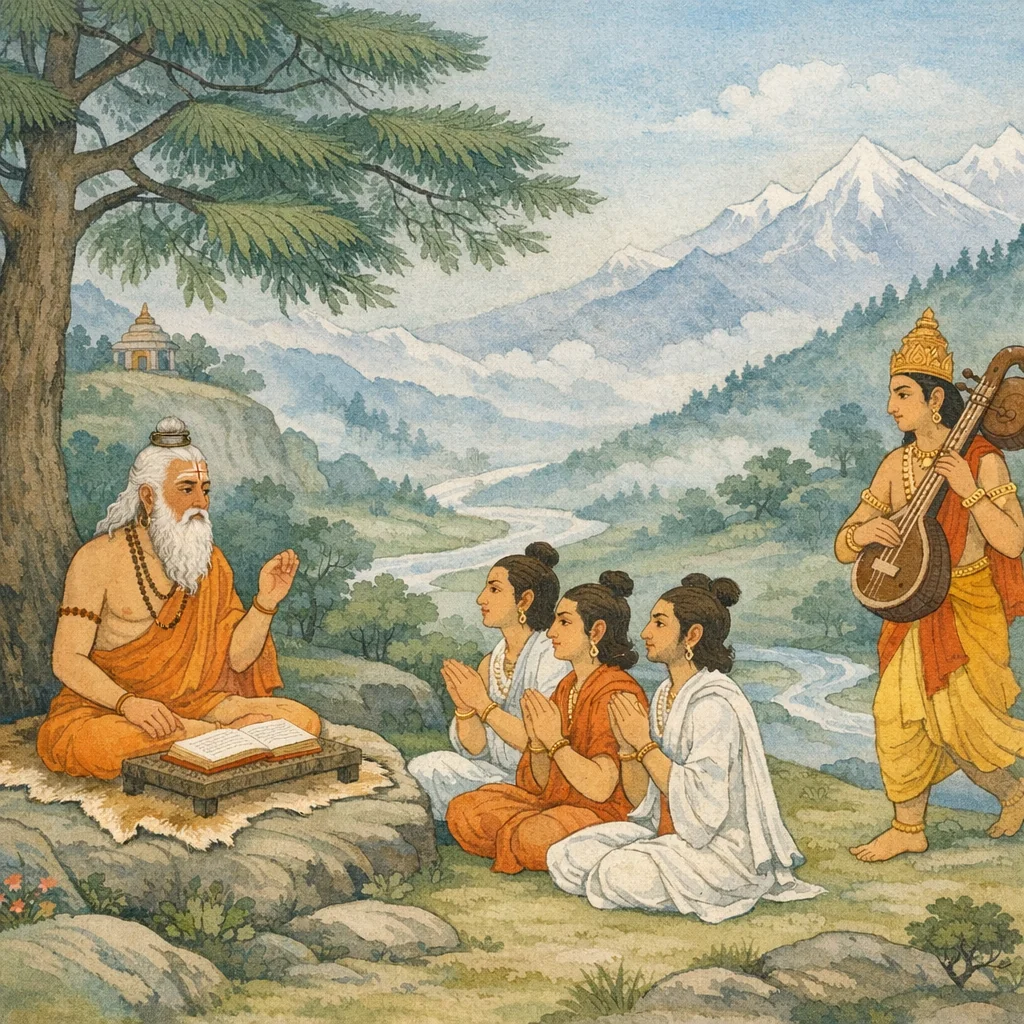
Chapter Arc: जनक के उपदेश से कृतार्थ होकर युधिष्ठिर का मन शान्त होता है; उसी समय कथा-धारा हिमालय की ओर मुड़ती है—जहाँ देवर्षि नारद सिद्ध-चारणों से सेवित पर्वत पर पहुँचते हैं। → हिमालय-पृष्ठ पर महर्षि व्यास का आश्रम-जीवन उभरता है—वे शिष्यों को अध्यापन कर रहे हैं। शिष्य-समुदाय की आकांक्षा बढ़ती है: वे वरदान चाहते हैं कि गुरु की कीर्ति अक्षुण्ण रहे और शिष्य-परम्परा मर्यादित बने। इसी के साथ ‘किसे विद्या दी जाए’—यह प्रश्न तीखा होता जाता है। → व्यास धर्म्य नैःश्रेयस वचन कहकर शिष्य-धर्म का निर्णायक विधान करते हैं: अपरीक्षित-चारित्र वाले को विद्या देना निषिद्ध है; अधर्मपूर्वक प्रश्न-उत्तर करने वाले दोनों के लिए पतन का भय है। वेद-ज्ञ ब्राह्मण का अपमान/तिरस्कार करने का दुष्परिणाम भी कठोर शब्दों में उद्घाटित होता है। → गुरु-शिष्य सम्बन्ध की कसौटी स्पष्ट हो जाती है—विद्या का दान ‘पात्रता’ पर टिका है, और प्रश्न भी धर्म-सीमा में ही शोभता है। शिष्य-समुदाय को आचार, विनय, और सत्य-निष्ठा की अनिवार्यता समझाकर व्यास आश्रम-व्यवस्था को स्थिर करते हैं। → नारद का आगमन और हिमालय-आश्रम में आगे होने वाला संवाद—किस प्रसंग को जन्म देगा—यह संकेत देकर अध्याय आगे की कथा के लिए भूमि तैयार करता है।
Shlokas
Verse 1
इस प्रकार श्रीमह्ाभारत शान्तिपर्वके अन्तर्गत मोक्षधर्मपर्वमें शुकोत्पत्तिविषयक तीन सौ छब्बीसवाँ अध्याय पूरा हुआ ॥/ ३२६ ॥। ऑपन-- मा बक। डे सप्तविशर्त्याधिकत्रिशततमो< ध्याय: शुकदेवजीका पिताके पास लौट आना तथा व्यासजीका अपने शिष्योंको स्वाध्यायकी विधि बताना भीष्म उवाच एतच्छुत्वा तु वचन कृतात्मा कृतनिश्चयः । आत्मना55त्मानमास्थाय दृष्टू चात्मानमात्मना,भीष्मजी कहते हैं-युधिष्ठिर राजा जनककी यह बात सुनकर विशुद्ध अन्तःकरणवाले शुकदेवजी एक दृढ़ निश्चयपर पहुँच गये और बुद्धिके द्वारा आत्मामें स्थित होकर स्वयं अपने आत्मस्वरूपका साक्षात्कार करके कृतार्थ हो गये। एवं आनन्दमग्न हो, बड़ी शान्तिका अनुभव करते हुए हिमालयपर्वतको लक्ष्य करके वायुके समान वेगसे चुपचाप उत्तर दिशाकी ओर चल दिये
Bhīṣma said: Hearing these words, Śuka—his inner being purified and his resolve made firm—took refuge in the Self through the Self, and by the Self beheld the Self. Thus fulfilled, he became absorbed in bliss and, experiencing profound peace, silently set out northward toward the Himālayas with the speed of the wind.
Verse 2
कृतकार्य: सुखी शान्तस्तूष्णीं प्रायादुदड्मुख: । शैशिरं गिरिमुद्दिश्य सधर्मा मातरिश्वन:,भीष्मजी कहते हैं-युधिष्ठिर राजा जनककी यह बात सुनकर विशुद्ध अन्तःकरणवाले शुकदेवजी एक दृढ़ निश्चयपर पहुँच गये और बुद्धिके द्वारा आत्मामें स्थित होकर स्वयं अपने आत्मस्वरूपका साक्षात्कार करके कृतार्थ हो गये। एवं आनन्दमग्न हो, बड़ी शान्तिका अनुभव करते हुए हिमालयपर्वतको लक्ष्य करके वायुके समान वेगसे चुपचाप उत्तर दिशाकी ओर चल दिये
Bhīṣma said: Having accomplished his purpose, content and inwardly tranquil, he set out in silence, facing north. With righteousness as his companion, he directed himself toward the wintry mountain (the Himālaya) and moved with the speed of the wind.
Verse 3
एतस्मिन्नेव काले तु देवर्षिनरिदस्तथा । हिमवन्तमियादू् द्रष्ट सिद्धाचारणसेवितम्,इसी समय देवर्षि नारद सिद्धों और चारणोंसे सेवित हिमालय पर्वतपर उसका दर्शन करनेके लिये आये
Bhīṣma said: Just at that time, the divine seer Nārada too set out for the Himālaya, wishing to see that mountain which is frequented and revered by Siddhas and Cāraṇas.
Verse 4
तमप्सरोगणाकीर्ण शान्तस्वननिनादितम् | किन्नराणां सहसैश्व॒ भूड़जैस्तथैव च,उस पर्वतपर सब ओर अप्सराएँ विचर रही थीं। चारों ओर विविध प्राणियोंकी शान्तिमयी ध्वनिसे वहाँका सारा प्रान्त व्याप्त हो रहा था। सहस्रों किन्नर, भ्रमर, मदगु, विचित्र खंजरीट, चकोर, सैकड़ों मधुर वाणीसे सुशोभित विचित्र वर्णवाले मयूर, राजहंसोंके समुदाय तथा काले कोकिल वहाँ अपनी शान्त मधुर ध्वनि फैला रहे थे
Bhīṣma said: That mountain region was thronged with hosts of apsarases, and it resounded with gentle, peace-bearing sounds. There too were thousands of kinnaras, and likewise swarms of bees—so that the whole place seemed pervaded by a calm, sweet harmony, suggesting a world ordered by serenity rather than conflict.
Verse 5
मदगुभि: खग्जरीटैश्न विचित्रैर्जीवजीवकै:,उस पर्वतपर सब ओर अप्सराएँ विचर रही थीं। चारों ओर विविध प्राणियोंकी शान्तिमयी ध्वनिसे वहाँका सारा प्रान्त व्याप्त हो रहा था। सहस्रों किन्नर, भ्रमर, मदगु, विचित्र खंजरीट, चकोर, सैकड़ों मधुर वाणीसे सुशोभित विचित्र वर्णवाले मयूर, राजहंसोंके समुदाय तथा काले कोकिल वहाँ अपनी शान्त मधुर ध्वनि फैला रहे थे
Bhishma said: “On that mountain, apsarases wandered everywhere. The whole region was filled with a calm, soothing resonance produced by many kinds of living creatures. There were thousands of kinnaras, along with bees, madagu-birds, variegated wagtails, and partridges; hundreds of peacocks of diverse colors, adorned with sweet voices; flocks of royal swans; and dark cuckoos—all spreading a gentle, melodious sound.”
Verse 6
चित्रवर्णमयूरैश्व केकाशतविराजितै: । राजहंससमूहैश्च॒ कृष्ण: परभृतैस्तथा,उस पर्वतपर सब ओर अप्सराएँ विचर रही थीं। चारों ओर विविध प्राणियोंकी शान्तिमयी ध्वनिसे वहाँका सारा प्रान्त व्याप्त हो रहा था। सहस्रों किन्नर, भ्रमर, मदगु, विचित्र खंजरीट, चकोर, सैकड़ों मधुर वाणीसे सुशोभित विचित्र वर्णवाले मयूर, राजहंसोंके समुदाय तथा काले कोकिल वहाँ अपनी शान्त मधुर ध्वनि फैला रहे थे
Bhīṣma said: “That mountain region was adorned with peacocks of many hues, resplendent with hundreds of ringing calls; with flocks of royal swans; and likewise with dark cuckoos. All around, the area was filled with the calm, sweet sounds of diverse creatures, while apsarases wandered everywhere—an atmosphere of serenity and auspicious beauty.”
Verse 7
पक्षिराजो गरुत्मांश्व॒ यं नित्यममधितिष्ठति । चत्वारो लोकपालाश्ष देवा: सर्षिगणास्तथा
Bhīṣma said: “That one whom Garuḍa—the king of birds—ever attends and bears aloft; whom the four guardians of the worlds, the gods, and the hosts of ṛṣis likewise honor and uphold.”
Verse 8
विष्णुना यत्र पुत्रार्थे तपस्तप्तं महात्मना,वहीं महात्मा श्रीविष्णु (श्रीकृष्ण) ने पुत्रके लिये तप किया था। वहीं कुमार कार्तिकेयने बाल्यावस्थामें देवताओंपर आक्षेप किया था और त्रिलोकीका अपमान करके पृथ्वीमें अपनी शक्ति गाड़ दी थी
Bhīṣma said: “In that very place where the great-souled Viṣṇu performed austerities for the sake of obtaining a son, there too the noble Śrī Viṣṇu (Śrī Kṛṣṇa) undertook penance for a son. In that same spot, the youthful Kumāra Kārttikeya, in his boyhood, reproached the gods; and, after slighting the three worlds, he drove and fixed his own power into the earth.”
Verse 9
तत्रैव च कुमारेण बाल्ये क्षिप्ता दिवौकस: । शक्तिनन्यस्ता क्षितितले त्रैलोक्यमवमन्य वै,वहीं महात्मा श्रीविष्णु (श्रीकृष्ण) ने पुत्रके लिये तप किया था। वहीं कुमार कार्तिकेयने बाल्यावस्थामें देवताओंपर आक्षेप किया था और त्रिलोकीका अपमान करके पृथ्वीमें अपनी शक्ति गाड़ दी थी
Bhīṣma said: “In that very place, the youthful Kumāra (Kārttikeya), while still a child, once challenged the gods; and, having shown contempt for the three worlds, he drove his spear-power down into the earth.”
Verse 10
तत्रोवाच जगत् स्कन्द: क्षिपन् वाक्यमिदं तदा । योअन्यो<स्ति मत्तो5भ्यधिको विप्रा यस्याधिकं प्रिया:,उस समय वहाँ स्कन्दने सम्पूर्ण जगतपर आक्षेप करते हुए यह बात कही थी-“जो कोई भी दूसरा पुरुष मुझसे अधिक बलवान हो, जिसे ब्राह्मण अधिक प्रिय हों, जो दूसरा व्यक्ति मुझसे भी अधिक ब्राह्मणभक्त तथा तीनों लोकोंमें पराक्रमशाली हो, वह इस शक्तिको उखाड़ दे अथवा हिला दे”
Then Skanda, casting a challenge before the whole world, spoke these words: “If there exists any other man superior to me—one to whom the Brahmins are dearer, who is even more devoted to Brahmins and mighty in prowess across the three worlds—let him uproot this śakti or make it tremble.”
Verse 11
यो ब्रह्माण्यो द्वितीयो<स्ति त्रिषु लोकेषु वीर्यवान् । सो<भ्युद्धरत् त्विमां शक्तिमथवा कम्पयत्विति,उस समय वहाँ स्कन्दने सम्पूर्ण जगतपर आक्षेप करते हुए यह बात कही थी-“जो कोई भी दूसरा पुरुष मुझसे अधिक बलवान हो, जिसे ब्राह्मण अधिक प्रिय हों, जो दूसरा व्यक्ति मुझसे भी अधिक ब्राह्मणभक्त तथा तीनों लोकोंमें पराक्रमशाली हो, वह इस शक्तिको उखाड़ दे अथवा हिला दे”
Bhishma said: “If there exists in the three worlds any second hero—mighty in prowess and truly devoted to the Brahmins—let him uproot this spear, or at least make it tremble.” Thus Skanda, casting his challenge upon the whole universe, proclaimed that only one whose strength is matched by reverence for the Brahmins could move the divine weapon—linking power with righteous devotion rather than mere force.
Verse 12
तच्छुत्वा व्यथिता लोकाः क इमामुद्धरेदिति । अथ देवगणं सर्व सम्भ्रान्तेन्द्रियमानसम्,उनकी यह तिरस्कारपूर्ण घोषणा सुनकर सब लोग व्यथित हो उठे और मन-ही-मन सोचने लगे, “भला, कौन वीर इस शक्तिको उखाड़ सकता है?” उस समय भगवान् विष्णुने देखा कि सम्पूर्ण देवताओंकी इन्द्रियाँ और चित्त भयसे व्याकुल हैं तथा असुर और राक्षसों- सहित सम्पूर्ण जगतपर स्कन्दद्वारा आक्षेप किया गया है। यह देखकर वे सोचने लगे कि यहाँ क्या करना अच्छा होगा?
Bhishma said: Hearing that, the people were shaken with distress and began to wonder inwardly, “Who could possibly uproot this power?” Just then the entire host of gods stood in turmoil, their senses and minds thrown into confusion. Seeing their fear and the peril pressing upon the worlds, Vishnu reflected on what course of action would be best.
Verse 13
अपश्यद् भगवान् विष्णु: क्षिप्तं सासुरराक्षसम् । किं त्वत्र सुकृतं कार्य भवेदिति विचिन्तयन्,उनकी यह तिरस्कारपूर्ण घोषणा सुनकर सब लोग व्यथित हो उठे और मन-ही-मन सोचने लगे, “भला, कौन वीर इस शक्तिको उखाड़ सकता है?” उस समय भगवान् विष्णुने देखा कि सम्पूर्ण देवताओंकी इन्द्रियाँ और चित्त भयसे व्याकुल हैं तथा असुर और राक्षसों- सहित सम्पूर्ण जगतपर स्कन्दद्वारा आक्षेप किया गया है। यह देखकर वे सोचने लगे कि यहाँ क्या करना अच्छा होगा?
Bhishma said: The Blessed Lord Vishnu observed that the whole world—together with the asuras and rakshasas—had been thrown into turmoil. Reflecting carefully, he considered: “What course of action here would be truly beneficial and rightly done?”
Verse 14
अनामृष्य तत: क्षेपमवैक्षत च पावकिम् | सम्प्रगृह् विशुद्धात्मा शक्ति प्रज्वलितां तदा
Bhishma said: Without hesitation, he then looked toward the blazing, fire-like weapon. With a purified and steady mind, he took up that spear as it flared brilliantly—readying himself with disciplined resolve rather than impulsive anger.
Verse 15
शकक्त्यां तु कम्प्यमानायां विष्णुना बलिना तदा
Bhīṣma said: “At that time, when the śakaṭī (a cart-like contrivance) was shaking, it was set in motion by mighty Viṣṇu.”
Verse 16
शक्तेनापि समुद्धर्तु कम्पिता साभवत् तदा
Bhīṣma said: “At that moment, she began to tremble—so much so that even a capable person could not lift her up.”
Verse 17
तां कम्पयित्वा भगवान प्रह्लादमिदमब्रवीत्
Having shaken him, the Blessed Lord then addressed Prahlāda with these words.
Verse 18
सोअमृष्यमाणस्तद्वाक्यं समुद्धरणनिश्चित:
Bhīṣma said: “Unable to endure those words, he became firmly resolved to take decisive action—to lift the matter out of its difficulty and bring it to a clear outcome.”
Verse 19
नादं महान्तं मुक्त्वा स मूर्च्छितो गिरिमूर्धनि
Having let out a mighty cry, he then fell unconscious upon the mountain’s summit.
Verse 20
तत्रोत्तरां दिश॑ं गत्वा शैलराजस्य पार्श्चुत:
Then, proceeding toward the northern quarter, he went along the side of the king of mountains—his journey deliberate, guided by direction and terrain, as dharma-shaped narratives often mark the right path by both geography and purpose.
Verse 21
पावकेन परिक्षिप्तं दीप्पता यस्य चाश्रमम्,भगवान् शंकरके उस आश्रमको प्रज्वलित अग्निने चारों ओरसे घेर रक्खा है। उस पर्ववशिखरका नाम आदित्यगिरि है, जिसपर अजितात्मा पुरुष नहीं चढ़ सकते। यक्ष, राक्षस और दानवोंके लिये वहाँ पहुँचना सर्वधा असम्भव है
Bhīṣma said: That hermitage is ringed about by blazing fire; the blessed Lord Śaṅkara has encircled it on every side with fiercely kindled flame as a divine safeguard. The mountain-peak is called Ādityagiri, and men who have not conquered themselves cannot ascend it. For Yakṣas, Rākṣasas, and Dānavas, reaching that place is altogether impossible.
Verse 22
आदित्यपर्वत॑ नाम दुर्धर्षमकृतात्मभि: । न तत्र शक्यते गन्तुं यक्षराक्षसदानवै:,भगवान् शंकरके उस आश्रमको प्रज्वलित अग्निने चारों ओरसे घेर रक्खा है। उस पर्ववशिखरका नाम आदित्यगिरि है, जिसपर अजितात्मा पुरुष नहीं चढ़ सकते। यक्ष, राक्षस और दानवोंके लिये वहाँ पहुँचना सर्वधा असम्भव है
Bhīṣma said: There is a mountain called Ādityaparvata, unassailable to those who have not mastered themselves. Yakṣas, Rākṣasas, and Dānavas cannot reach it at all. Around that hermitage, the blessed Lord Śaṅkara has encircled the place with blazing fire, making the summit—known as Ādityagiri—inaccessible to the undisciplined.
Verse 23
दशयोजनविस्तारमग्निज्वालासमावृतम् । भगवान् पावकस्तत्र स्वयं तिष्ठति वीर्यवान्,वह दस योजन विस्तृत शिखर आगकी लपटोंसे घिरा हुआ है। शक्तिशाली भगवान् अग्निदेव वहाँ स्वयं विराजमान हैं
Bhīṣma said: “There stands a peak spread over ten yojanas, enveloped by tongues of fire. There the blessed Fire-god (Pāvaka), mighty in power, abides in person.”
Verse 24
सर्वान् विध्नान् प्रशमयन् महादेवस्य धीमत: । दिव्यं वर्षमहस्रं हि पादेनैकेन तिकछत:
Bhīṣma said: “Pacifying all obstacles, he stood—by the power of the wise Mahādeva—for a full thousand divine years, remaining poised upon a single foot.”
Verse 25
ऐन्द्रीं तु दिशभास्थाय शैलराजस्य धीमतः,उसी बुद्धिमान् गिरिराज हिमवानकी पूर्व दिशाका आश्रय लेकर पर्वतके एकान्त तटप्रान्तमें महातपस्वी महाबुद्धिमान् पराशरनन्दन व्यास अपने शिष्य महाभाग सुमन्तु, महाबुद्धिमान् जैमिनि, तपस्वी पैल तथा वैशम्पायन-इन चार शिष्योंको वेद पढ़ा रहे थे
Bhīṣma said: Having taken refuge in the eastern quarter—Indra’s direction—of the wise king of mountains, Himavān, Vyāsa, the great ascetic and profound sage, son of Parāśara, dwelt on a secluded mountainside. There, he was teaching the Vedas to his four eminent disciples: the fortunate Sumantu, the highly intelligent Jaimini, the ascetic Paila, and Vaiśampāyana. The passage highlights the ethical ideal that sacred knowledge is preserved and transmitted through disciplined study, worthy teachers, and a lineage of responsible students.
Verse 26
विविक्ते पर्वततटे पाराशर्यों महातपा: । वेदानध्यापयामास व्यास: शिष्यान् महामति:,उसी बुद्धिमान् गिरिराज हिमवानकी पूर्व दिशाका आश्रय लेकर पर्वतके एकान्त तटप्रान्तमें महातपस्वी महाबुद्धिमान् पराशरनन्दन व्यास अपने शिष्य महाभाग सुमन्तु, महाबुद्धिमान् जैमिनि, तपस्वी पैल तथा वैशम्पायन-इन चार शिष्योंको वेद पढ़ा रहे थे
Bhishma said: In a secluded spot on a mountain slope, the great ascetic Vyasa—the son of Parashara, a sage of profound intellect—was instructing his disciples in the Vedas. The scene underscores the ethical ideal that sacred knowledge is preserved and transmitted through disciplined study, austerity, and a teacher–student lineage, away from distraction and worldly noise.
Verse 27
सुमन्तुं च महाभागं वैशम्पायनमेव च । जैमिनिं च महाप्राज्ञं पैलं चापि तपस्विनम्,उसी बुद्धिमान् गिरिराज हिमवानकी पूर्व दिशाका आश्रय लेकर पर्वतके एकान्त तटप्रान्तमें महातपस्वी महाबुद्धिमान् पराशरनन्दन व्यास अपने शिष्य महाभाग सुमन्तु, महाबुद्धिमान् जैमिनि, तपस्वी पैल तथा वैशम्पायन-इन चार शिष्योंको वेद पढ़ा रहे थे
Bhishma said: “(He taught) the illustrious Sumantu, and also Vaishampayana; the greatly wise Jaimini; and Paila as well, the ascetic.” In context, the verse recalls Vyasa’s transmission of sacred knowledge through worthy disciples—emphasizing that learning is safeguarded by character, discipline, and fitness to receive it.
Verse 28
यत्र शिष्यै: परिवृती व्यास आस्ते महातपा: । तत्राश्रमपद रम्यं ददर्श पितुरुत्तमम्,जहाँ महातपस्वी व्यास अपने शिष्योंसे घिरे हुए बैठे थे, वहाँ शुकदेवजीने अपने पिताके उस रमणीय एवं उत्तम आश्रमको देखा
Bhīṣma said: “There, where the great ascetic Vyāsa sat surrounded by his disciples, Śukadeva beheld his father’s hermitage—beautiful, serene, and most excellent.”
Verse 29
आरणेयो विशुद्धात्मा नभसीव दिवाकर: । अथ व्यास: परिक्षिप्तं ज्वलन्तमिव पावकम्
Bhīṣma said: “Āraṇeya, pure in spirit, shone like the sun in the sky. Then Vyāsa appeared—like a blazing fire that has been kindled.” The verse heightens the moral atmosphere of the discourse by portraying the sages as embodiments of inner purity and spiritual power, whose presence itself commands reverence and signals the gravity of the teaching to follow.
Verse 30
असज्जमान वृक्षेषु शैलेषु विषयेषु च । योगयुक्त महात्मानं यथा बाणं गुणच्युतम्,योगयुक्त महात्मा शुकदेव धनुषकी डोरीसे छूटे हुए बाणके समान तीव्र गतिसे आ रहे थे। वे वृक्षों और पर्वतोंमें कहीं भी अटक नहीं पाते थे
Bhīṣma said: “Unimpeded by trees, mountains, or any objects of sense, that great-souled one, established in Yoga, moved onward with the speed of an arrow released from the bowstring.”
Verse 31
सो$भिगम्य पितु: पादावगृह्नादरणीसुत: । यथोपजोष॑ं तैश्वापि समागच्छन्महामुनि:,निकट आकर अरणीपुत्र महामुनि शुकदेवने पिताके दोनों पैर पकड़ लिये और शान्तभावसे उनके अन्य सब शिष्योंके साथ भी मिले
Bhīṣma said: “Approaching his father, the son of Araṇī respectfully clasped his father’s feet. With a calm and agreeable demeanor, that great sage also greeted and met the other disciples who were present, in a manner befitting the occasion.”
Verse 32
ततो निवेदयामास पित्रे सर्वमशेषत: । शुको जनकराजेन संवादं प्रीतमानस:,तदनन्तर प्रसन्नचित्त हुए शुकने राजा जनकके साथ जो वार्तालाप हुआ था, वह सारा- का-सारा वृत्तान्त अपने पितासे कह सुनाया
Then Śuka, his mind filled with joy, reported to his father—completely and without omission—the entire dialogue he had held with King Janaka.
Verse 33
एवमध्यापयन् शिष्यान् व्यास: पुत्र च वीर्यवान् उवास हिमवत्पृष्ठे पाराशर्यो महामुनि:,इस प्रकार शक्तिशाली महामुनि पराशरनन्दन व्यास अपने शिष्यों और पुत्रको पढ़ाते हुए हिमालयके शिखरपर ही रहने लगे
Bhīṣma said: “Thus, instructing his disciples—and also his son—the mighty sage Vyāsa, the great seer born of Parāśara, took up his residence upon the heights of the Himalaya.”
Verse 34
ततः कदाचिच्छिष्यास्तं परिवार्यावतस्थिरे । वेदाध्ययनसम्पन्ना: शान्तात्मानो जितेन्द्रिया:,तदनन्तर किसी समय वेदाध्ययनसे सम्पन्न, शान्तचित्त, जितेन्द्रिय, सांगवेदमें पारंगत और तपस्वी शिष्यगण गुरुवर व्यासजीको चारों ओरसे घेरकर बैठ गये और उनसे हाथ जोड़कर इस प्रकार बोले
Then, on one occasion, his disciples—accomplished in Vedic study, tranquil in mind, and masters of their senses—gathered around him and remained seated in attendance.
Verse 35
वेदेषु निष्ठां सम्प्राप्प साड्गेष्वपि तपस्विन: । अथोचुस्ते तदा व्यासं शिष्या: प्राज्जलयो गुरुम्,तदनन्तर किसी समय वेदाध्ययनसे सम्पन्न, शान्तचित्त, जितेन्द्रिय, सांगवेदमें पारंगत और तपस्वी शिष्यगण गुरुवर व्यासजीको चारों ओरसे घेरकर बैठ गये और उनसे हाथ जोड़कर इस प्रकार बोले
Bhishma said: Firmly established in the Vedas and accomplished in the auxiliary disciplines as well, those ascetic disciples then approached Vyasa. With minds made tranquil and senses restrained, they gathered around their teacher and, with joined palms, addressed him—seeking guidance grounded in sacred learning and disciplined conduct.
Verse 36
शिष्या ऊचु. महता तेजसा युक्ता यशसा चापि वर्धिता: । एकं त्विदानीमिच्छामो गुरुणाग्रहं कृतम्,शिष्योंने कहा--गुरुदेव! हम आपकी कृपासे महान् तेजस्वी हो गये हैं। हमारा यश भी चारों ओर बढ़ गया है। अब इस समय हम यह चाहते हैं कि आप एक बार और हमलोगोंपर अनुग्रह करें
The disciples said: “By your gracious guidance we have become endowed with great spiritual brilliance, and our renown has also increased on every side. Now, at this time, we desire one more favor from you—please extend your benevolence to us once again.”
Verse 37
इति तेषां वच: श्र॒त्वा ब्रह्मर्षिस्तानुवाच ह | उच्यतामिति तद् वत्सा यद् वः कार्य प्रियं मया,शिष्योंकी यह बात सुनकर ब्रह्मर्षि व्यासने उनसे कहा--“बच्चो! कहो, क्या चाहते हो? मुझे तुम्हारा कौन-सा प्रिय कार्य करना है?”
Having heard their words, the great Brahmarṣi addressed them: “Speak, dear children—what is it that you wish? What cherished task should I do for you?”
Verse 38
एतद् वाक्य गुरो: श्रुत्वा शिष्यास्ते हृष्टमानसा: । पुन: प्राउजलयो भूत्वा प्रणम्य शिरसा गुरुम्,गुरुदेवका यह वचन सुनकर उन शिष्योंका हृदय हर्षसे खिल उठा। राजन! वे पुनः हाथ जोड़ मस्तक झुकाकर गुरुजीको प्रणाम करके एक साथ यह उत्तम वचन बोले--मुनिश्रेष्ठ ! आप हमारे उपाध्याय हैं। यदि आप प्रसन्न हैं तो हम धन्य हो गये
Bhīṣma said: Hearing these words of their teacher, those disciples became joyful at heart. Once again, with palms joined in reverence, they bowed their heads and paid homage to the guru—affirming that the teacher’s favor and approval itself is their highest blessing and the true measure of their good fortune.
Verse 39
ऊचुस्ते सहिता राजन्निदं वचनमुत्तमम् | यदि प्रीत उपाध्यायो धन्या: स्मो मुनिसत्तम,गुरुदेवका यह वचन सुनकर उन शिष्योंका हृदय हर्षसे खिल उठा। राजन! वे पुनः हाथ जोड़ मस्तक झुकाकर गुरुजीको प्रणाम करके एक साथ यह उत्तम वचन बोले--मुनिश्रेष्ठ ! आप हमारे उपाध्याय हैं। यदि आप प्रसन्न हैं तो हम धन्य हो गये
Bhishma said: “O King, those disciples, gathered together, spoke this excellent statement: ‘If our teacher (upādhyāya) is pleased, then we are truly blessed, O best of sages.’”
Verse 40
कांक्षामस्तु वयं सर्वे वरं दातुं महर्षिणा । षष्ठ: शिष्यो न ते ख्यातिं गच्छेदत्र प्रसीद न:,“हम सब लोग यह चाहते हैं कि महर्षि एक वरदान दें, वह यह कि आपका कोई छठा शिष्य प्रसिद्ध न हो। यहाँ हमलोगोंपर इतनी ही कृपा कीजिये
Bhīṣma said: “All of us earnestly desire that the great sage grant a boon—namely, that no sixth disciple of yours should attain renown. Be gracious to us in this matter.”
Verse 41
“हम चार आपके शिष्य हैं और पंचम शिष्य गुरुपुत्र शुकदेव हैं। इन पाँचोंमें ही आपके पढ़ाये हुए सम्पूर्ण वेद प्रतिष्ठित हों; यही हमारे लिये मनोवाजञ्छित वर है,
Bhīṣma said: “We are four of your disciples, and the fifth disciple is Śukadeva, the son of the teacher. Let all the Vedas you have taught find their firm establishment in these five alone—this is the boon our hearts desire.”
Verse 42
शिष्याणां वचन श्रुत्वा व्यासो वेदार्थतत्त्ववित् । पराशरात्मजो धीमान् परलोकार्थचिन्तक:
Bhīṣma said: Hearing the words of his disciples, Vyāsa—wise, the knower of the true purport of the Vedas, the intelligent son of Parāśara, ever intent on what leads to the good of the next world—reflected upon their request with a view to spiritual welfare rather than mere worldly gain.
Verse 43
चत्वारस्ते वयं शिष्या गुरुपुत्रश्न पजचम: । इह वेदा: प्रतिष्ठेरन्नेष न: कांक्षितो वर:,ब्राह्मणाय सदा देयं ब्रह्म शुश्रूषवे तथा
Bhīṣma said: “We were four disciples, and the teacher’s son was the fifth. Here, the Vedas found firm establishment; this was the boon we desired. Therefore, sacred knowledge should always be imparted to a worthy brāhmaṇa who serves with reverence and a spirit of attentive discipleship.”
Verse 44
ब्रह्मलोके निवासं यो ध्रुवं समभिकाडुक्षते । 'शिष्यगण! जो ब्रह्मलोकमें अटल निवास चाहता हो, उसका कर्तव्य है कि वह पढ़नेकी इच्छासे आये हुए ब्राह्मणको सदा ही वेद पढ़ावे || ४३ $ || भवन्तो बहुला: सन्तु वेदो विस्तार्यतामयम्
Bhīṣma said: “Whoever firmly longs for an assured dwelling in Brahmaloka should make this his duty: he must always teach the Veda to a Brahmin who has come with the desire to study. O group of students, let you be many, and let this Veda be spread widely.”
Verse 45
नाशिष्ये सम्प्रदातव्यो नाव्रते नाकृतात्मनि । “तुमलोग बहुसंख्यक हो जाओ और इस वेदका विस्तार करो। जिसका मन वशमें न हो, जो ब्रह्मचर्य-व्रतका पालन न करता हो तथा जो शिष्यभावसे पढ़ने न आया हो, उसे वेदाध्ययन नहीं कराना चाहये || ४४ $ ।। एते शिष्यगुणा: सर्वे विज्ञातव्या यथार्थत:
Bhīṣma said: The sacred teaching should not be imparted to one who is not a proper disciple, nor to one who is without vows, nor to one whose self is undisciplined. Vedic study is to be given only to a student who approaches with the attitude of discipleship, practices brahmacarya and restraint, and has mastery over the mind—so that the tradition is preserved and not degraded.
Verse 46
यथा हि कनकं शुद्ध तापच्छेदनिकर्षणै:
Bhīṣma said: “Just as pure gold is refined and proven by heating, cutting, and rubbing on the touchstone, so too a person’s true worth and steadiness are revealed through disciplined testing and trial.”
Verse 47
परीक्षेत तथा शिष्यानीक्षेत् कुलगुणादिभि: । “जैसे आगमें तपाने, काटने और कसौटीपर कसनेसे शुद्ध सोनेकी परख की जाती है, उसी प्रकार कुल और गुण आदिके द्वारा शिष्योंकी परीक्षा करनी चाहिये ।। न नियोज्याश्ष व: शिष्या अनियोगे महाभये,“तुमलोग अपने शिष्योंको किसी अनुचित या महान् भयदायक कार्यमें न लगाना। तुम्हारे पढ़ानेपर भी जिसकी जैसी बुद्धि होगी और जो पढ़नेमें जैसा परिश्रम करेगा, उसीके अनुसार उसकी विद्या सफल होगी। सब लोग दुर्गम संकटसे पार हों और सभी अपना कल्याण देखें
Bhishma said: “Examine your students carefully, judging them by their family background, character, and other qualities. Just as pure gold is tested by heating in fire, by cutting, and by rubbing on the touchstone, so too should students be tested through lineage, conduct, and virtues. And you must not assign your pupils to improper tasks or to undertakings that bring great danger. Instruction bears fruit according to each student’s intellect and effort; therefore guide them so that they may cross difficult crises and pursue their welfare.”
Verse 48
यथामति यथापाठं तथा विद्या फलिष्यति | सर्वस्तरतु दुर्गाणि सर्वो भद्राणि पश्यतु,“तुमलोग अपने शिष्योंको किसी अनुचित या महान् भयदायक कार्यमें न लगाना। तुम्हारे पढ़ानेपर भी जिसकी जैसी बुद्धि होगी और जो पढ़नेमें जैसा परिश्रम करेगा, उसीके अनुसार उसकी विद्या सफल होगी। सब लोग दुर्गम संकटसे पार हों और सभी अपना कल्याण देखें
Bhishma said: “Learning bears fruit in accordance with one’s understanding and in accordance with one’s study and recitation. May everyone cross over difficult dangers, and may everyone behold what is auspicious—may all attain their welfare.”
Verse 49
श्रावयेच्चतुरो वर्णान् कृत्वा ब्राह्मणमग्रत: । वेदस्याध्ययनं होदं तच्च कार्य महत् स्मृतम्,'ब्राह्णफो आगे रखकर चारों वर्णोको उपदेश देना चाहिये। यह वेदाध्ययन महान् कार्य माना गया है। इसे अवश्य करना चाहिये
Bhīṣma said: “One should instruct the four social orders, placing the Brāhmaṇa at the forefront. The study of the Veda and the offering of oblations (homa) are regarded as a great duty; therefore they must certainly be performed.”
Verse 50
स्तुत्यर्थमिह देवानां वेदा: सृष्टा: स्वयम्भुवा । यो निर्वदेत सम्मोहाद् ब्राह्मणं वेदपारगम्
Bhishma said: Here, the Vedas were created by the Self-born (Brahmā) for the purpose of praising the gods. Therefore, whoever, out of delusion, reviles a Brahmin who has crossed to the far shore of the Vedas (that is, is fully learned in them), acts against the very foundation of sacred order and right conduct.
Verse 51
यश्चाधर्मेण विब्रूयाद् यश्चारर्मेण मृच्छति
Bhīṣma said: “One who speaks by means of adharma, and one who meets his end through unrighteous conduct—both are marked by the same moral failure: abandoning dharma in speech and in action.”
Verse 52
एतद् व: सर्वमाख्यातं स्वाध्यायस्य विधिं प्रति । उपकुर्याच्च शिष्याणामेतच्च हृदि वो भवेत्,“यह सब मैंने तुमलोगोंसे स्वाध्यायकी विधि बतायी है। यह तुम्हारे हृदयमें सदा स्मरण रहे; क्योंकि यह शिष्योंका उपकार कर सकती है”
Bhishma said: “All this has been fully explained to you with regard to the proper method of svādhyāya (self-study and recitation of sacred learning). Let this remain firmly in your hearts, for it serves as a true benefit to disciples and sustains the discipline of dharma through right learning.”
Verse 76
तत्र नित्यं समायान्ति लोकस्य हितकाम्यया । पक्षिराज गरुड उस पर्वतपर नित्य विराजमान होते हैं। चारों लोकपाल, देवता तथा ऋषिगण सम्पूर्ण जगत॒के हितकी कामनासे वहाँ सदा आते रहते हैं
Bhīṣma said: “There, ever and again, they continually assemble—moved by the wish to secure the welfare of the world.” The verse highlights a sacred locus where exalted beings gather not for personal gain, but out of responsibility and benevolence toward all creation.
Verse 146
कम्पयामास सब्येन पाणिना पुरुषोत्तम: । तब उस आक्षेपको सहन न करके विशुद्धात्मा भगवान् विष्णुने अग्निकुमार स्कन्दकी ओर देखा। फिर उन पुरुषोत्तमने उस समय उस प्रज्वलित शक्तिको बायें हाथसे पकड़कर हिला दिया
Bhīṣma said: The Supreme Person seized it with his left hand and shook it aside. Unable to endure that provocation, the pure-souled Lord Viṣṇu turned his gaze toward Skanda, the son of Agni. Then, at that moment, the Supreme Lord grasped the blazing spear with his left hand and cast it away with a shake—revealing unshakable mastery and restraint in the face of aggression.
Verse 153
मेदिनी कम्पिता सर्वा सशैलवनकानना । बलवान् भगवान् विष्णुके द्वारा उस शक्तिके कम्पित किये जानेपर पर्वत, वन और काननोंसहित सारी पृथ्वी काँप उठी
Bhishma said: The whole earth trembled—along with its mountains, forests, and wild groves—when it was shaken by the mighty power of the Blessed Lord Vishnu. The scene shows that when divine force is made manifest, it moves not only living beings but the very foundations of the world, reminding all of the awe due to cosmic authority grounded in dharma.
Verse 166
रक्षिता स्कन्दराजस्य धर्षणा प्रभविष्णुना । यद्यपि प्रभावशाली भगवान् विष्णु उसे उखाड़ फेंकनेमें समर्थ थे तो भी उन्होंने कुमार स्कन्दका तिरस्कार नहीं होने दिया। उन्हें अपमानसे बचा लिया
Bhishma said: The affront aimed at Skanda, the royal commander, was checked by the mighty one. Though Lord Vishnu, in his overwhelming power, could have uprooted it and cast it away, he did not allow the young Skanda to be slighted; he shielded him from humiliation. The lesson is that true greatness lies not merely in force, but in guarding another’s honor and rightful standing.
Verse 173
पश्य वीर्य कुमारस्य नैतदन्य: करिष्यति । उस शक्तिको हिलाकर भगवानने प्रह्नादसे कहा--'देखो, कुमारमें कितना बल है? यह कार्य दूसरा कोई नहीं कर सकेगा”
Bhishma said: Shaking that power, the Lord said to Prahlada, “Behold the prowess of the Prince—no one else could accomplish this deed.” The line shows that extraordinary strength, rightly recognized, is proof of unique fitness for a task, and a reminder that some responsibilities fall only to those truly able to bear them.
Verse 186
जग्राह तां तदा शक्ति न चैनां स व्यकम्पयत् । भगवानके इस कथनको सहन न कर सकनेके कारण प्रह्नादने स्वयं ही उस शक्तिको उखाड़ फेंकनेका दृढ़ निश्चय कर लिया और उस शक्तिको पकड़कर खींचा; परंतु वे उसे हिला भी न सके
Bhishma said: Then he seized that spear, yet he could not make it so much as tremble. Unable to endure the Lord’s words, Prahlada resolved to uproot the weapon by his own strength; he grasped it and pulled with firm determination, but it would not yield. The episode sets mere force against the higher power of divine ordinance: when an act opposes the Lord’s will, physical might alone proves futile.
Verse 193
विह्नल: प्रापतद् भूमौ हिरण्यकशिपो: सुतः । हिरण्यकशिपुकुमार प्रह्नाद बड़े जोरसे चिग्घाड़कर मूर्च्छिंत एवं व्याकुल हो उस पर्वतशिखरकी भूमिपर गिर पड़े
Bhishma said: Overwhelmed and distressed, Prahlada—the son of Hiranyakashipu—let out a loud cry, fainted, and fell in agitation onto the ground at the mountain peak. The scene shows how even the mighty can be shaken by fear, shock, or the weight of events, inviting reflection on steadiness of mind and resilience in dharma.
Verse 206
तपो&5तप्यत दुर्धर्ष तात नित्यं वृषध्वज: । तात! उसी गिरिराज हिमालयके पार्श्नभागमें उत्तर दिशाकी ओर जाकर भगवान् वृषध्वज शिवने नित्य-निरन्तर दुर्धर्ष तपस्या की है
Bhīṣma said: “O dear child, O mighty one, Vṛṣadhvaja (Śiva) continually performed an unassailable austerity.”
Verse 243
देवान् संतापर्यस्तत्र महादेवो महाव्रत: । परम बुद्धिमान् महादेवजी सहस्र दिव्य वर्षोतक वहाँ एक पैरसे खड़े रहे और उनकी तपस्याके सम्पूर्ण विघ्नोंका निवारण करते हुए अग्निदेव वहीं विराजमान थे। महान् व्रतधारी महादेवजी वहाँ देवताओंको संतप्त करते हुए महान् तपमें प्रवृत्त थे
Bhīṣma said: “There, the great God Mahādeva—mighty in vow and supreme in wisdom—undertook a fierce austerity, standing on a single foot for a thousand divine years, so severe that it distressed the gods. And Agni remained on that very spot, warding off every obstacle to Śiva’s penance.”
Verse 293
ददृशे सुतमायान्तं दिवाकरसमप्रभम् | उस समय विशुद्ध अन्तः:करणवाले अरणीनन्दन शुकदेव आकाशगमें स्थित सूर्यके समान प्रकाशित हो रहे थे, इतनेहीमें व्यासजीने भी प्रज्वलित अग्नि तथा सूर्यके समान तेजस्वी पुत्रको सब ओर अपनी प्रभा बिखेरते हुए आते देखा
Bhīṣma said: “He saw his son approaching, radiant like the sun. At that moment Śukadeva, the pure-hearted son of Aruṇi, appeared in the sky shining like the orb of day; and Vyāsa beheld his blazing, sunlike son coming forward, scattering his brilliance in all directions.”
Verse 327
इति श्रीमहा भारते शान्तिपर्वणि मोक्षधर्मपर्वणि सप्तविंशत्यधिकत्रिशततमो< ध्याय:,इस प्रकार श्रीमहाभारत शान्तिपर्वके अन्तर्गत मोक्षधर्मपर्वमें तीन सौ सत्ताईसवाँ अध्याय पूरा हुआ
Thus, in the revered Mahābhārata, within the Śānti Parva and specifically in the Mokṣa-dharma section, the three-hundred-and-twenty-seventh chapter concludes.
Verse 423
उवाच शिष्यान् धर्मात्मा धर्म्य नैःश्रेयसं वच: । शिष्योंकी यह बात सुनकर वेदार्थके तत्त्वज्ञ, पारलौकिक अर्थका चिन्तन करनेवाले, धर्मात्मा, पराशरनन्दन बुद्धिमान् व्यासजीने अपने समस्त शिष्योंसे यह धर्मानुकूल कल्याणकारी वचन कहा--
Bhīṣma said: “Hearing what the disciples had said, Vyāsa—son of Parāśara, wise and devoted to righteousness, a knower of the true purport of the Vedas and one who reflects on the otherworldly end—addressed all his students with words aligned with dharma and aimed at the highest good.”
Verse 453
नापरीक्षितचारित्रे विद्या देया कथंचन । 'ये सभी शिष्यके गुण हैं। किसीको शिष्य बनानेसे पहले उसके इन गुणोंको यथार्थरूपसे परख लेना चाहिये। जिसके सदाचारकी परीक्षा न ली गयी हो, उसे किसी प्रकार विद्यादान नहीं देना चाहिये
Bhīṣma said: One should never impart learning to a person whose conduct has not been tested. Unless a prospective disciple’s character has been carefully examined and found sound, instruction should not be given; for knowledge placed in unverified hands can be misused and becomes ethically unsafe.
Verse 503
सोअभिध्यानाद् ब्राह्मणस्य पराभूयादसंशयम् । स्वयम्भू ब्रह्माने यहाँ देवताओंकी स्तुतिके लिये वेदोंकी सृष्टि की है। जो मोहवश वेदके पारंगत ब्राह्मणकी निन्दा करता है, वह उसके अनिष्ट-चिन्तनके कारण निस्संदेह पराभवको प्राप्त होता है
Bhishma said: One who harbors hostile thoughts toward a Brahmin is, without doubt, brought to ruin by that very malice. For here the Self-born Brahmā created the Vedas for the praise of the gods. Therefore, whoever, deluded by ignorance, censures a Brahmin who has mastered the Veda, surely falls into defeat and misfortune, because his mind has turned toward the other’s harm.
Verse 516
तयोरन्यतरः: प्रैति विद्वेषं चाधिगच्छति । “जो धार्मिक विधिका उल्लंघन करके प्रश्न करता है और जो अधर्मपूर्वक उसका उत्तर देता है, उन दोनोंमेंसे एककी मृत्यु हो जाती है अथवा एक दूसरेके द्वेषका पात्र बन जाता है
Bhīṣma said: Of those two—one who asks a question by violating righteous procedure and one who answers it in an unrighteous manner—one comes to ruin (even to death), or else they become objects of mutual hatred. The teaching warns that even the pursuit of knowledge becomes destructive when divorced from dharma in both inquiry and response.
Frequently Asked Questions
The tension is how the Supreme can be aligned with nivṛtti (cessation/liberation) while authoring pravṛtti (ritual action and worldly duty), and why a system of divine “shares” in sacrifice is ethically and metaphysically justified.
World-order is maintained through prescribed action and distribution (pravṛtti via yajña and adhikāra), while liberation remains a distinct, rarer trajectory (nivṛtti); both are integrated within a single cosmological governance model.
Yes. The closing verses state that regular listening or recitation with reverence yields benefits such as health, release from affliction or bondage, attainment of desired aims, social success according to varṇa roles, and general well-being—functioning as an explicit phalaśruti.