Adhyaya 55
Vāg-yuddha and Nimitta-darśana before the Gadāyuddha (Verbal Duel and Omens)
Upa-parva: Gadāyuddha-prastāva (Prelude to the Mace-Duel)
Vaiśaṃpāyana narrates a tense sequence in which a verbal duel (vāg-yuddha) and omen imagery frame the imminent mace engagement. Dhṛtarāṣṭra, described as grief-stricken, laments the reversal of fortune: his son—once commander of vast forces—goes forward on foot with a mace, a sign of narrowed options and approaching finality. Saṃjaya then reports the challenger’s summons to Pārtha’s side for combat and the appearance of alarming portents: harsh winds, dust-rain, darkness over directions, thunderous sounds, meteors, an untimely eclipse, trembling earth, falling mountain peaks, agitated animals, and disembodied cries. Observing these nimittas, Bhīma addresses Yudhiṣṭhira, declaring long-contained anger and vowing to end Duryodhana, explicitly listing prior grievances—attempted burning at Vāraṇāvata, the dice deception, Draupadī’s public humiliation, exile and concealment—thus converting personal memory into a public moral indictment. Duryodhana replies that rhetoric is sufficient and demands action, and the gathered kings encourage him. The chapter closes with both sides moving toward the formal commencement of the gadā encounter amid heightened battlefield soundscape and readiness.
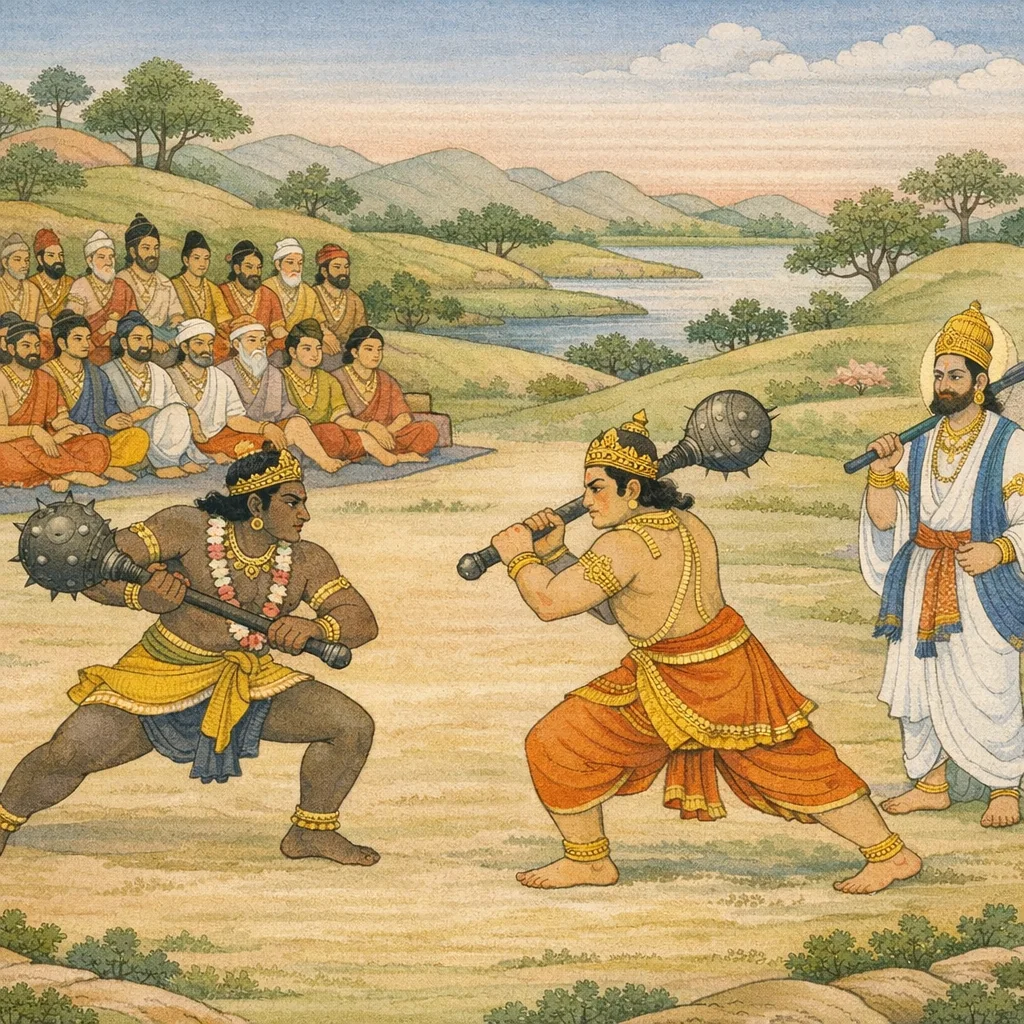
Chapter Arc: धृतराष्ट्र संजय से पूछते हैं—बलराम के सान्निध्य में, गदायुद्ध उपस्थित होने पर, मेरा पुत्र दुर्योधन भीम के सामने कैसे उतरा? → संजय बताता है कि बलराम को निकट पाकर दुर्योधन का उत्साह और युद्ध-लालसा प्रज्वलित हो उठती है। समन्तपञ्चक तीर्थ में राजाओं और पाण्डव-पक्ष सहित सभासदों का विशाल समुदाय बैठता है; दुर्योधन सबको निकट बैठकर निर्णायक द्वंद्व देखने का निमंत्रण देता है। दोनों योद्धा—बलराम के शिष्य—क्रोध से भरे, हाथों में गदा लिए, गजों और अग्नि के समान उग्र दिखते हैं। → भीम और दुर्योधन एक-दूसरे को प्रलयकाल के दो सूर्य-सम तेजस्वी, काल-मृत्यु के समान परंतप रूप में देखते हैं—और समस्त सभा के सामने गदायुद्ध का क्षण उपस्थित हो जाता है, जहाँ दोनों की क्रुद्ध प्रतिज्ञा और कौशल टकराने को तत्पर है। → सभा-व्यवस्था और दर्शक-समूह की स्वीकृति के साथ युद्ध-स्थल का विधान पूर्ण होता है; द्वंद्व को सार्वजनिक, नियमबद्ध और बलराम की छाया में प्रतिष्ठा मिलती है। → दोनों महाबली आमने-सामने खड़े हैं—पहला प्रहार किसका होगा, और किसकी गदा धर्म-यश का निर्णय करेगी?
Shlokas
Verse 1
/ ऑपनआक्रात बछ। आर: 2 पञ्चपज्चाशत्तमो< ध्याय: बलरामजीकी सलाहसे सबका कुरुक्षेत्रके समन््तपंचक तीर्थमें जाना और वहाँ हे तथा दुर्योधनमें गदायुद्धकी या वैशम्पायन उवाच एवं तदभवद् युद्ध तुमुलं जनमेजय । यत्र दुःखान्वितो राजा धृतराष्ट्रोडब्रवीदिदम्,वैशम्पायनजी कहते हैं--जनमेजय! इस प्रकार वह तुमुल युद्ध हुआ, जिसके विषयमें अत्यन्त दुःखी हुए राजा धृतराष्ट्रने इस तरह प्रश्न किया
Vaiśampāyana said: “O Janamejaya, thus there occurred that tumultuous battle—at which King Dhṛtarāṣṭra, overwhelmed with sorrow, spoke these words.” The verse frames the war not as mere spectacle but as a moral catastrophe whose first and most immediate fruit is grief, compelling the blind king to question what has unfolded.
Verse 2
धृतराष्ट्र रवाच राम॑ संनिहितं दृष्टवा गदायुद्ध उपस्थिते । मम पुत्र: कथं भीम॑ प्रत्ययुध्यत संजय,धृतराष्ट्र बोले--संजय! गदायुद्ध उपस्थित होनेपर बलरामजीको निकट आया देख मेरे पुत्रने भीमसेनके साथ किस प्रकार युद्ध किया?
Dhṛtarāṣṭra said: “Sañjaya, when the mace-duel had commenced and I saw Rāma (Balarāma) standing close by, in what manner did my son engage Bhīma in counter-combat?”
Verse 3
संजय उवाच रामसांनिध्यमासाद्य पुत्रो दुर्योधनस्तव । युद्धकामो महाबाहु: समहृष्यत वीर्यवान्,संजयने कहा--राजन्! बलरामजीको निकट पाकर युद्धकी इच्छा रखनेवाला आपका शक्तिशाली पुत्र महाबाहु दुर्योधन बड़ा प्रसन्न हुआ
Sañjaya said: O King, on coming into the presence of Balarāma, your son Duryodhana—mighty-armed and valiant, and eager for battle—was filled with great delight. The verse underscores how the proximity of a revered elder and powerful warrior can embolden a combatant’s resolve, even when the moral stakes of the war remain grave.
Verse 4
दृष्टवा लाडूलिन राजा प्रत्युत्थाय च भारत । प्रीत्या परमया युक्त: समभ्यर्च्य यथाविधि
Sañjaya said: Seeing King Lāḍūlin, O Bhārata, he rose to greet him; filled with the highest goodwill, he honored him duly, in accordance with proper custom. The scene underscores that even amid the harshness of war, the code of respectful reception and right conduct is maintained.
Verse 5
ततो युधिष्छिरं रामो वाक्यमेतदुवाच ह
Sañjaya said: Then Rāma addressed Yudhiṣṭhira with these words—at a decisive moment in counsel amid the moral strain of war, when speech is offered as guidance and restraint rather than mere victory-seeking.
Verse 6
मधुरं धर्मसंयुक्त शूराणां हितमेव च | तब बलरामने युधिष्ठिरसे मधुर वाणीमें शूरवीरोंके लिये हितकर धर्मयुक्त वचन कहा --][५% || मया श्रुतं कथयतामृषीणां राजसत्तम,“नृपश्रेष्ठ! मैंने माहात्म्य-कथा कहनेवाले ऋषियोंके मुखसे यह सुना है कि कुरुक्षेत्र परम पावन पुण्यमय तीर्थ है। वह स्वर्ग प्रदान करनेवाला है। देवता, ऋषि तथा महात्मा ब्राह्मण सदा उसका सेवन करते हैं
Sañjaya said: He spoke words that were sweet in tone, grounded in dharma, and truly beneficial for the warriors—speech meant to guide conduct even amid the harshness of war.
Verse 7
कुरुक्षेत्रं परं पुण्यं पावन स्वर्ग्यमेव च । दैवतैर्ऋषिभिर्जुषं ब्राह्मणैश्व महात्मभि:,“नृपश्रेष्ठ! मैंने माहात्म्य-कथा कहनेवाले ऋषियोंके मुखसे यह सुना है कि कुरुक्षेत्र परम पावन पुण्यमय तीर्थ है। वह स्वर्ग प्रदान करनेवाला है। देवता, ऋषि तथा महात्मा ब्राह्मण सदा उसका सेवन करते हैं
Sañjaya said: “Kurukṣetra is supremely sacred—purifying and truly a giver of heaven. I have heard from sages who recount its greatness that this holy field is continually frequented and cherished by the gods, by seers, and by great-souled brāhmaṇas.”
Verse 8
तत्र वै योत्स्यमाना ये देहं त्यक्ष्यन्ति मानवा: । तेषां स्वर्गे ध्रुवी वास: शक्रेण सह मारिष,“माननीय नरेश! जो मानव वहाँ युद्ध करते हुए अपने शरीरका त्याग करेंगे, उनका निश्चय ही स्वर्गलोकमें इन्द्रके साथ निवास होगा
Sañjaya said: “O venerable one, those men who, fighting there, lay down their bodies will assuredly obtain a fixed abode in heaven, dwelling in the company of Śakra (Indra).”
Verse 9
तस्मात् समन्तपञ्चकमितो याम द्रुतं नूप । प्रथितोत्तरवेदी सा देवलोके प्रजापते:,“अतः नरेश्वर! हम सब लोग यहाँसे शीघ्र ही समन्तपंचक तीर्थमें चलें। वह भूमि देवलोकमें प्रजापतिकी उत्तरवेदीके नामसे प्रसिद्ध है। त्रिलोकीके उस परम पुण्यतम सनातन तीर्थमें युद्ध करके मृत्युको प्राप्त हुआ मनुष्य निश्चय ही स्वर्गलोकमें जायगा”
Sañjaya said: “Therefore, O king, let us go quickly from here to Samantapañcaka. That ground is renowned in the world of the gods as Prajāpati’s ‘northern altar’ (uttaravedī). In that supremely holy and eternal sacred field of the three worlds, a man who meets death in battle is assuredly destined for heaven.”
Verse 10
तस्मिन् महापुण्यतमे त्रैलोक्यस्य सनातने । संग्रामे निधन प्राप्य ध्रुवं स्वर्गे भविष्यति,“अतः नरेश्वर! हम सब लोग यहाँसे शीघ्र ही समन्तपंचक तीर्थमें चलें। वह भूमि देवलोकमें प्रजापतिकी उत्तरवेदीके नामसे प्रसिद्ध है। त्रिलोकीके उस परम पुण्यतम सनातन तीर्थमें युद्ध करके मृत्युको प्राप्त हुआ मनुष्य निश्चय ही स्वर्गलोकमें जायगा”
Sañjaya said: “In that supremely meritorious and eternal sacred region—renowned throughout the three worlds—one who meets death in battle will assuredly attain heaven.”
Verse 11
तथेत्युक्त्वा महाराज कुन्तीपुत्रो युधिष्ठिर: । समन्तपज्चकं वीर: प्रायादभिमुख: प्रभु:,महाराज! तब “बहुत अच्छा”, कहकर वीर राजा कुन्तीपुत्र युधिष्ठिर समन्तपंचक तीर्थकी ओर चल दिये। उस समय अमर्षमें भरा हुआ तेजस्वी राजा दुर्योधन हाथमें विशाल गदा लेकर पाण्डवोंके साथ पैदल ही चला
Sañjaya said: “So be it.” Having spoken thus, O King, the heroic Yudhiṣṭhira, son of Kuntī, the sovereign lord, set out facing toward Samantapañcaka.
Verse 12
ततो दुर्योधनो राजा प्रगृह्म महतीं गदाम् | पदभ्याममर्षी द्युतिमानगच्छत् पाण्डवैः सह,महाराज! तब “बहुत अच्छा”, कहकर वीर राजा कुन्तीपुत्र युधिष्ठिर समन्तपंचक तीर्थकी ओर चल दिये। उस समय अमर्षमें भरा हुआ तेजस्वी राजा दुर्योधन हाथमें विशाल गदा लेकर पाण्डवोंके साथ पैदल ही चला
Sañjaya said: Then King Duryodhana, taking up a massive mace, set out on foot. Burning with resentment yet radiant with martial resolve, he proceeded together with the Pāṇḍavas, O great king.
Verse 13
तथा<<यान्तं गदाहस्तं वर्मणा चापि दंशितम् | अन्तरिक्षचरा देवा: साधु साध्वित्यपूजयन्,गदा हाथमें लिये कवच धारण किये दुर्योधनको इस प्रकार आते देख आकाशमें विचरनेवाले देवता साधु-साधु कहकर उसकी प्रशंसा करने लगे
Sañjaya said: Seeing Duryodhana advancing in that manner—mace in hand and clad in armor—the gods who move through the sky acclaimed him, crying “Well done! Well done!”
Verse 14
वातिकाश्चारणा ये तु दृष्टवा ते हर्षमागता: । स पाण्डवै: परिवृत: कुरुराजस्तवात्मज:
Sañjaya said: Seeing him, those bards and celestial singers were filled with joy. Your son, the king of the Kurus, stood surrounded by the Pāṇḍavas.
Verse 15
मत्तस्येव गजेन्द्रस्य गतिमास्थाय सो5व्रजत् । वातिक और चारण भी उसे देखकर हर्षसे खिल उठे। पाण्डवोंसे घिरा हुआ आपका पुत्र कुरुराज दुर्योधन मतवाले गजराजकी-सी गतिका आश्रय लेकर चल रहा था ।। १४३ || ततः शड्खनिनादेन भेरीणां च महास्वनै:
Sañjaya said: Encircled by the Pāṇḍavas, O King, your son Duryodhana advanced with the gait of a rutting lordly elephant—proud and forceful, proclaiming defiance even while hemmed in by foes. Then, with the blare of conches and the great booming of kettledrums, the battlefield resounded.
Verse 16
ततस्ते तु कुरुक्षेत्रं प्राप्ता नरवरोत्तमा:,तस्मिन् देशे त्वनिरिणे ते तु युद्धमरोचयन् । तदनन्तर वे सभी श्रेष्ठ नरवीर आपके पुत्रके साथ पश्चिमाभिमुख चलकर पूर्वोक्त कुरक्षेत्रमें आ पहुँचे। वह उत्तम तीर्थ सरस्वतीके दक्षिण तटपर स्थित एवं सदगतिकी प्राप्ति करानेवाला था। वहाँ कहीं ऊसर भूमि नहीं थी। उसी स्थानमें आकर सबने युद्ध करना पसंद किया
Sañjaya said: Then those foremost of men reached Kurukṣetra. Finding that region free from barren, saline wasteland and fit for auspicious passage, they chose that very place as the ground for battle—thus letting the war be decided in a terrain deemed proper rather than in a defiled or inauspicious tract.
Verse 17
प्रतीच्यभिमुखं देशं यथोद्दिष्टं सुतेन ते । दक्षिणेन सरस्वत्या: स्वयनं तीर्थमुत्तमम्
Sañjaya said: “(They proceeded) toward the western-facing region, exactly as your son had indicated—along the southern bank of the Sarasvatī—toward Svayana, that most excellent sacred ford.”
Verse 18
ततो भीमो महाकोटिं गदां गृह्माथ वर्मभूत्
Sañjaya said: Then Bhīma seized a massive, razor-edged mace, and, armoured as if he had become a living cuirass, prepared himself for the next violent turn of the battle.
Verse 19
अवबद्धशिरस्त्राण: संख्ये काज्चनवर्म भूत्
Sañjaya said: In the thick of battle, he had his head-guard firmly fastened and was clad in golden armour—an image of deliberate readiness and disciplined resolve amid the moral gravity of war.
Verse 20
वर्मभ्यां संयतो वीरी भीमदुर्योधनावुभौ
Sañjaya said: Both heroes—Bhīma and Duryodhana—were tightly bound in their armour, fully restrained and prepared for combat, as they faced each other in the climactic duel.
Verse 21
रणमण्डलमध्यस्थौ भ्रातरौ तौ नरर्षभौ
Sañjaya said: In the very midst of the battle-array stood those two brothers, bull-like among men—firm at the center of the fray.
Verse 22
तावन्योन्यं निरीक्षेतां क्रुद्धाविव महाद्विपौ
Sañjaya said: The two stood facing one another, fixing their gaze on each other—like two great elephants in rut, enraged and ready to clash.
Verse 23
सम्प्रहष्टमना राजन् गदामादाय कौरव:
Sañjaya said: O King, the Kaurava, his mind exultant, took up his mace—eager for combat, driven by the fierce momentum of war.
Verse 24
सृक्किणी संलिहन् राजन् क्रोधरक्तेक्षण: श्वसन | ततो दुर्योधनो राजन् गदामादाय वीर्यवान्
Sañjaya said: “O King, licking the corners of his mouth, breathing hard, and with eyes reddened by anger, Duryodhana then—mighty in valor—took up his mace.”
Verse 25
भीमसेनमभिप्रेक्ष्य गजो गजमिवादह्दयत् | नरेश्वर! तदनन्तर शक्तिशाली कुरुवंशी राजा दुर्योधन प्रसन्नचित्त हो गदा हाथमें ले क्रोधसे लाल आँखें करके गलफरोंको चाटता और लंबी साँसें खींचता हुआ भीमसेनकी ओर देखकर उसी प्रकार ललकारने लगा, जैसे एक हाथी दूसरे हाथीको पुकार रहा हो ।। अद्विसारमयीं भीमस्तथैवादाय वीर्यवान्
Sañjaya said: Seeing Bhīmasena, Duryodhana challenged him like one elephant calling to another. Then that mighty king of the Kuru line, Duryodhana—his mind set in grim confidence—took up his mace; with eyes reddened by anger, licking his lips and drawing long breaths, he roared at Bhīma as a bull-elephant roars at a rival. And the valiant Bhīma likewise took up his own formidable mace.
Verse 26
तावुद्यतगदापाणी दुर्योधनवृकोदरौ
Sañjaya said: Then those two—Duryodhana and Vṛkodara—stood with maces raised in their hands, poised for combat.
Verse 27
तावुभौ समतिक्रुद्धावुभी भीमपराक्रमौ
Sañjaya said: Both of them, equally inflamed with anger, were warriors of Bhīma-like might—each matching the other in fierce resolve as the battle’s fury rose.
Verse 28
उभौ सदृशकर्माणौ यमवासवयोरिव,महाराज! शत्रुओंको संताप देनेवाले वे दोनों महाबली वीर यमराज, इन्द्र, वरुण, श्रीकृष्ण, बलराम, कुबेर, मधु, कैटभ, सुन्द, उपसुन्द, राम, रावण तथा बालि और सुमग्रीवके समान पराक्रम दिखानेवाले थे तथा काल एवं मृत्युके समान जान पड़ते थे
Sañjaya said: O great king, those two mighty heroes were alike in their deeds, like Yama and Vāsava (Indra). They tormented their enemies, displaying prowess comparable to Yama, Indra, Varuṇa, Kṛṣṇa, Balarāma, and Kubera, and to famed adversaries such as Madhu and Kaiṭabha, Sunda and Upasunda, Rāma and Rāvaṇa, and Bāli and Sugrīva; indeed, they seemed like Time and Death themselves.
Verse 29
तथा सदृशकर्माणौ वरुणस्य महाबलौ । वासुदेवस्य रामस्य तथा वैश्रवणस्य च,महाराज! शत्रुओंको संताप देनेवाले वे दोनों महाबली वीर यमराज, इन्द्र, वरुण, श्रीकृष्ण, बलराम, कुबेर, मधु, कैटभ, सुन्द, उपसुन्द, राम, रावण तथा बालि और सुमग्रीवके समान पराक्रम दिखानेवाले थे तथा काल एवं मृत्युके समान जान पड़ते थे
Sañjaya said: O King, those two mighty heroes, whose deeds were comparable to those of Varuṇa, and likewise to those of Vāsudeva (Kṛṣṇa), Rāma (Balarāma), and Vaiśravaṇa (Kubera), scorched their enemies. They displayed prowess like that of Yama, Indra, Varuṇa, Kṛṣṇa, Balarāma, Kubera, and the famed adversaries Madhu and Kaiṭabha, Sunda and Upasunda, Rāma and Rāvaṇa, and also Bāli and Sugrīva—appearing, as it were, like Time and Death themselves.
Verse 30
सदृशौ तौ महाराज मधुकैटभयोर्युधि । उभौ सदृशकर्माणौ तथा सुन्दोपसुन्दयो:,महाराज! शत्रुओंको संताप देनेवाले वे दोनों महाबली वीर यमराज, इन्द्र, वरुण, श्रीकृष्ण, बलराम, कुबेर, मधु, कैटभ, सुन्द, उपसुन्द, राम, रावण तथा बालि और सुमग्रीवके समान पराक्रम दिखानेवाले थे तथा काल एवं मृत्युके समान जान पड़ते थे
Sanjaya said: O King, those two were alike in battle, like Madhu and Kaitabha; and both were alike in their deeds, like Sunda and Upasunda. In the fury of war they appeared as peerless, enemy-scorching champions, evoking the dread of Time and Death themselves by the measure of their prowess.
Verse 31
रामरावणयोश्रैव वालिसुग्रीवयोस्तथा । तथैव कालस्य समीौ मृत्योश्रैव परंतपौ,महाराज! शत्रुओंको संताप देनेवाले वे दोनों महाबली वीर यमराज, इन्द्र, वरुण, श्रीकृष्ण, बलराम, कुबेर, मधु, कैटभ, सुन्द, उपसुन्द, राम, रावण तथा बालि और सुमग्रीवके समान पराक्रम दिखानेवाले थे तथा काल एवं मृत्युके समान जान पड़ते थे
Sanjaya said: O King, those two heroes, tormentors of their foes, seemed equal to Rama and Ravana, and likewise to Vali and Sugriva; and in the same way they appeared like Time itself and like Death—figures of irresistible might.
Verse 32
अन्योन्यमभिधावन्तौ मत्ताविव महाद्विपौ । वासितासंगमे दृप्ती शरदीव मदोत्कटौ,जैसे शरद-ऋतुमें मैथुनकी इच्छावाली हथिनीसे समागम करनेके लिये दो मतवाले हाथी मदोन्मत्त होकर एक-दूसरेपर धावा करते हों, उसी प्रकार अपने बलका गर्व रखनेवाले वे दोनों वीर एक-दूसरेसे टक्कर लेनेको उद्यत थे। शत्रुओंका दमन करनेवाले वे दोनों योद्धा दो सर्पोके समान प्रज्वलित क्रोधरूपी विषका वमन करते हुए एक-दूसरेको रोषपूर्वक देख रहे थे
Sanjaya said: Like two great elephants, drunk with musth, charging at one another—proud and frenzied as in the autumn season when they rush toward union with a receptive mate—so those two heroes, exulting in their own strength, advanced to collide. Each, a subduer of foes, fixed the other with an angry gaze, as though spewing the blazing poison of wrath like two serpents.
Verse 33
उभौ क्रोधविषं दीप्तं वमन््तावुरगाविव । अन्योन्यमभिसंरब्धौ प्रेक्षमाणावरिंदमौ,जैसे शरद-ऋतुमें मैथुनकी इच्छावाली हथिनीसे समागम करनेके लिये दो मतवाले हाथी मदोन्मत्त होकर एक-दूसरेपर धावा करते हों, उसी प्रकार अपने बलका गर्व रखनेवाले वे दोनों वीर एक-दूसरेसे टक्कर लेनेको उद्यत थे। शत्रुओंका दमन करनेवाले वे दोनों योद्धा दो सर्पोके समान प्रज्वलित क्रोधरूपी विषका वमन करते हुए एक-दूसरेको रोषपूर्वक देख रहे थे
Sanjaya said: Both warriors, like serpents spewing blazing venom, were inflamed with wrath. Locked in mutual fury, those subduers of foes stared each other down, poised to clash.
Verse 34
उभौ भरतशार्दूलौ विक्रमेण समन्वितौ । सिंहाविव दुराधर्षों गदायुद्धविशारदौ,भरतवंशके वे विक्रमशाली सिंह दो जंगली सिंहोंके समान दुर्जय थे और दोनों ही गदायुद्धके विशेषज्ञ माने जाते थे
Sanjaya said: Both those tiger-like scions of Bharata’s line, endowed with valor, were as unassailable as two lions; and both were acknowledged masters in the combat of the mace.
Verse 35
नखदंष्टायुधौ वीरौ व्याप्राविव दुरुत्सहौ । प्रजासंहरणे क्षुब्धौ समुद्राविव दुस्तरी
Sañjaya said: “Those two heroes, armed as if with claws and fangs, were like tigers—fierce and hard to withstand. Stirred up for the destruction of men, they were like two oceans in turmoil, impossible to cross.”
Verse 36
लोहिताज्विव क्रुद्धौ प्रतपन््तोी महारथौ । पंजों और दाढ़ोंसे प्रहार करनेवाले दो व्याप्रोंक समान उन दोनों वीरोंका वेग शत्रुओंके लिये दुः:सह था। प्रलयकालनमें विक्षुब्ध हुए दो समुद्रोंके समान उन्हें पार करना कठिन था। वे दोनों महारथी क्रोधमें भरे हुए दो मंगल ग्रहोंक समान एक-दूसरेको ताप दे रहे थे || ३५६ || पूर्वपश्चिमजौ मेघौ प्रेक्षमाणावरिंदमौ
Sañjaya said: Those two great chariot-warriors, inflamed with wrath, blazed like two red fires. Like a pair of tigers striking with claws and fangs, the rush of those heroes was unbearable to their foes. Like two oceans churned up at the time of dissolution, they were hard to cross. Filled with anger, those two mahārathas scorched one another like two Mars-like planets, each heating the other in mutual fury.
Verse 37
गर्जमानौ सुविषमं क्षरन्तौ प्रावृषीव हि । जैसे वर्षा-ऋतुमें पूर्व और पश्चिम दिशाओंमें स्थित दो वृष्टिकारक मेघ भयंकर गर्जना कर रहे हों, उसी प्रकार शत्रुओंका दमन करनेवाले वे दोनों वीर एक-दूसरेको देखते हुए भयानक सिंहनाद कर रहे थे ।। रश्मियुक्तौ महात्मानौ दीप्तिमन्ती महाबलौ
Sañjaya said: Roaring with a dreadful intensity and pouring forth their energy like the monsoon, those two great-souled, radiant, and mighty warriors—like rain-bearing clouds stationed in the eastern and western quarters—fixed their gaze upon one another and uttered terrifying lion-roars, intent on crushing their foes.
Verse 38
व्यात्राविव सुसंरब्धौ गर्जन्ताविव तोयदौ
Sañjaya said: The two, fiercely enraged, were like tigers; and like rain-bearing clouds they roared—an image of battle-fury swelling into a storm, where wrath and pride drive warriors toward violent confrontation.
Verse 39
गजाविव सुसंरब्धौ ज्वलिताविव पावकौ
Sañjaya said: The two, fiercely enraged, were like elephants in musth; blazing with wrath, they were like fires set alight—an image of how unchecked anger in war turns strength into consuming destruction.
Verse 40
रोषात् प्रस्फुरमाणोष्ठी निरीक्षन्तौ परस्परम्
Sañjaya said: Their lips quivering with anger, the two fixed their gaze upon one another—an outward sign of inner wrath that, in the moral atmosphere of war, foreshadows speech or action driven more by passion than by restraint.
Verse 41
उभौ परमसंदहृष्टावुभी परमसम्मतौ
Sañjaya said: Both of them were exceedingly delighted, and each was held in the highest esteem—an image of mutual exhilaration and recognition amid the harsh moral atmosphere of war.
Verse 42
सदश्चवाविव हेषन्तौ बृहन्ताविव कुञ्जरौ । वृषभाविव गर्जन्तौ दुर्योधनवृकोदरौ
Sañjaya said: “Duryodhana and Vṛkodara (Bhīma) were neighing like spirited steeds, towering like great elephants, and roaring like mighty bulls.” In this war-scene, the poet heightens the moral tension: two champions, driven by pride, wrath, and the burden of past vows, confront one another with animal-like force—suggesting how battle can reduce human deliberation and dharmic restraint to raw, overpowering impulse.
Verse 43
आसन च ददौ तस्मै पर्यपृच्छदनामयम् । भरतनन्दन! हलधरको देखते ही राजा युधिष्ठिर उठकर खड़े हो गये और बड़े प्रेमसे विधिपूर्वक उनकी पूजा करके उन्हें बैठनेके लिये उन्होंने आसन दिया तथा उनके स्वास्थ्यका समाचार पूछा,दैत्याविव बलोन्मत्तौ रेजतुस्तौ नरोत्तमौ । दोनों अत्यन्त हर्ष और उत्साहमें भरे थे। दोनों ही बड़े सम्मानित वीर थे। मनुष्योंमें श्रेष्ठ वे दुर्योधन और भीमसेन हींसते हुए दो अच्छे घोड़ों, चिग्घाड़ते हुए दो गजराजों और हँकड़ते हुए दो साँड़ों तथा बलसे उन्मत्त हुए दो दैत्योंके समान शोभा पाते थे || ४१-४२ ६ || ततो दुर्योधनो राजन्निदमाह युधिष्ठिरम्
Sanjaya said: Yudhishthira, the son of Bharata, rose at once on seeing Haladhara (Balarama). With affectionate reverence he duly honored him, offered him a seat, and inquired after his well-being—an act that upholds dharma through hospitality, respect for elders, and restraint even amid the tensions of war.
Verse 44
भ्रातृभि: सहितं चैव कृष्णेन च महात्मना । रामेणामितवीर्येण वाक््यं शौटीर्यसम्मतम्
Sañjaya said: Accompanied by his brothers, and also by the great-souled Kṛṣṇa, and by Rāma of immeasurable prowess, he spoke words that accorded with bold heroism—speech fit for warriors in the midst of crisis.
Verse 45
केकयै: सृग्जयैर्दप्तं पञ्चालैश्व महात्मभि: । राजन्! तदनन्तर दुर्योधनने अमितपराक्रमी बलराम, महात्मा श्रीकृष्ण, महामनस्वी पांचाल, संजय, केकयगण तथा अपने भाइयोंके साथ खड़े हुए अभिमानी युधिष्ठिरसे इस प्रकार गर्वयुक्त वचन कहा-- ।। ४३-४४ $ ।। इदं व्यवसितं युद्ध मम भीमस्य चोभयो:
Sañjaya said: “O King, after the Kekayas, the Sṛñjayas, and the great-souled Pāñcālas had been roused to ardor, proud Yudhiṣṭhira—standing with Balarāma of immeasurable prowess, the great-souled Śrī Kṛṣṇa, the high-minded Pāñcāla leaders, Sañjaya, the Kekaya host, and his own brothers—spoke these boastful words: ‘This battle has been firmly resolved—between me and Bhīma, for us both.’”
Verse 46
श्र॒त्वा दुर्योधनवच: प्रत्यपद्यन्त तत्तथा,दुर्योधनकी यह बात सुनकर सब लोगोंने उसे स्वीकार कर लिया, फिर तो राजाओंका वह विशाल समूह वहाँ सब ओर बैठ गया। नरेशोंकी वह मण्डली आकाशमें सूर्यमण्डलके समान दिखायी दे रही थी। उन सबके बीचमें भगवान् श्रीकृष्णके बड़े भ्राता तेजस्वी महाबाहु बलरामजी विराजमान हुए। महाराज! सब ओरसे सम्मानित होते हुए नीलाम्बरधारी, गौरकान्ति बलभद्रजी राजाओंके बीचमें वैसे ही शोभा पा रहे थे, जैसे रात्रिमें नक्षत्रोंसे घिरे हुए पूर्ण चन्द्रमा सुशोभित होते हैं
Sañjaya said: Hearing Duryodhana’s words, the assembled kings assented accordingly. Then that vast company of rulers sat down on all sides there. The circle of monarchs appeared like the orb of the sun in the sky. In their midst shone Balarāma—mighty-armed, radiant, the revered elder brother of Lord Śrī Kṛṣṇa. O King, honored from every side, Balabhadra, clad in blue garments and fair in complexion, was splendid among the kings like the full moon at night surrounded by stars.
Verse 47
ततः समुपविष्टं तत् सुमहद्राजमण्डलम् । विराजमान ददृशे दिवीवादित्यमण्डलम्,दुर्योधनकी यह बात सुनकर सब लोगोंने उसे स्वीकार कर लिया, फिर तो राजाओंका वह विशाल समूह वहाँ सब ओर बैठ गया। नरेशोंकी वह मण्डली आकाशमें सूर्यमण्डलके समान दिखायी दे रही थी। उन सबके बीचमें भगवान् श्रीकृष्णके बड़े भ्राता तेजस्वी महाबाहु बलरामजी विराजमान हुए। महाराज! सब ओरसे सम्मानित होते हुए नीलाम्बरधारी, गौरकान्ति बलभद्रजी राजाओंके बीचमें वैसे ही शोभा पा रहे थे, जैसे रात्रिमें नक्षत्रोंसे घिरे हुए पूर्ण चन्द्रमा सुशोभित होते हैं
Sañjaya said: Then that vast circle of kings, having taken their seats, appeared resplendent—like the orb of the sun in the sky.
Verse 48
तेषां मध्ये महाबाहु: श्रीमान् केशवपूर्वज: । उपविष्टो महाराज पूज्यमान: समन्ततः,दुर्योधनकी यह बात सुनकर सब लोगोंने उसे स्वीकार कर लिया, फिर तो राजाओंका वह विशाल समूह वहाँ सब ओर बैठ गया। नरेशोंकी वह मण्डली आकाशमें सूर्यमण्डलके समान दिखायी दे रही थी। उन सबके बीचमें भगवान् श्रीकृष्णके बड़े भ्राता तेजस्वी महाबाहु बलरामजी विराजमान हुए। महाराज! सब ओरसे सम्मानित होते हुए नीलाम्बरधारी, गौरकान्ति बलभद्रजी राजाओंके बीचमें वैसे ही शोभा पा रहे थे, जैसे रात्रिमें नक्षत्रोंसे घिरे हुए पूर्ण चन्द्रमा सुशोभित होते हैं
Sañjaya said: O King, in the midst of them sat the illustrious, mighty-armed elder brother of Keśava (Kṛṣṇa), honored from every side.
Verse 49
शुशुभे राजमध्यस्थो नीलवासा: सितप्रभ: । नक्षत्रैरिव सम्पूर्णो वृतो नेशि निशाकर:,दुर्योधनकी यह बात सुनकर सब लोगोंने उसे स्वीकार कर लिया, फिर तो राजाओंका वह विशाल समूह वहाँ सब ओर बैठ गया। नरेशोंकी वह मण्डली आकाशमें सूर्यमण्डलके समान दिखायी दे रही थी। उन सबके बीचमें भगवान् श्रीकृष्णके बड़े भ्राता तेजस्वी महाबाहु बलरामजी विराजमान हुए। महाराज! सब ओरसे सम्मानित होते हुए नीलाम्बरधारी, गौरकान्ति बलभद्रजी राजाओंके बीचमें वैसे ही शोभा पा रहे थे, जैसे रात्रिमें नक्षत्रोंसे घिरे हुए पूर्ण चन्द्रमा सुशोभित होते हैं
Sañjaya said: In the midst of the kings, the radiant Baladeva—clad in blue garments and shining with a fair brilliance—appeared splendid. Surrounded by the assembled rulers, he was like the full moon in the night, encircled by stars.
Verse 50
तो तथा तु महाराज गदाहस्तौ सुदुःसहौ । अन्योन्यं वाम्भिरुग्राभिस्तक्षमाणौ व्यवस्थितौ,महाराज! हाथमें गदा लिये वे दोनों दुःसह वीर एक-दूसरेको अपने कठोर वचनोंद्वारा पीड़ा देते हुए खड़े थे
Sañjaya said: O King, thus those two irresistible heroes, each with a mace in hand, stood facing one another, wounding each other with harsh and fierce words—an ominous prelude to the violence that was to follow, where pride and anger eclipse restraint even among the mighty.
Verse 51
अप्रियाणि ततो<न्योन्यमुक्त्वा तौ कुरुसत्तमौ । उदीक्षन्तौ स्थितौ तत्र वृत्रशक्रौ यथा55हवे,परस्पर कट वचनोंका प्रयोग करके वे दोनों कुरुकुलके श्रेष्ठतम वीर वहाँ युद्धस्थलमें वृत्रासुर और इन्द्रके समान एक-दूसरेको देखते हुए युद्धके लिये डटे रहे
After hurling harsh and unwelcome words at one another, those two foremost heroes of the Kuru line stood their ground there, fixing their gaze upon each other—like Vṛtra and Indra poised for battle—steadfast and ready to fight.
Verse 54
इस प्रकार श्रीमहाभारत शल्यपर्वके अन्तर्गत गदापव॑नें बलदेवजीकी तीर्थयात्राके प्रसंगमें सारस्वतोपाख्यानविषयक चौवनवाँ अध्याय पूरा हुआ
Thus ends the fifty-fourth chapter of the Śalya Parva of the Śrī Mahābhārata, within the episode of the Gadāparvan, in the context of Baladeva’s pilgrimage, dealing with the narrative known as the Sārasvata Upākhyāna.
Verse 55
इति श्रीमहाभारते शल्यपर्वणि गदापर्वणि युद्धारम्भे पजचपड्चाशत्तमो<5 ध्याय: ।। ५५ || इस प्रकार श्रीमह्याभारत शल्यपर्वके अन्तर्गत गदापर्वमें युद्धका आरम्भविषयक पचपनवाँ अध्याय पूरा हुआ
Sañjaya said: “Thus, in the Śrī Mahābhārata, within the Śalya Parva—specifically in the section concerning the mace-fight—ends the fifty-fifth chapter, describing the commencement of battle.”
Verse 156
सिंहनादैश्व शूराणां दिश: सर्वा: प्रपूरिता: । उस समय शंखोंकी ध्वनि, रणभेरियोंके गम्भीर घोष और शूरवीरोंके सिंहनादोंसे सम्पूर्ण दिशाएँ गूँज उठी थीं
Sañjaya said: With the lion-like battle-cries of the heroes, all the directions were filled and made to resound—an ominous swell of martial fervor that signals the war’s escalation and the collective resolve of fighters poised to stake life for their chosen cause.
Verse 173
तस्मिन् देशे त्वनिरिणे ते तु युद्धमरोचयन् । तदनन्तर वे सभी श्रेष्ठ नरवीर आपके पुत्रके साथ पश्चिमाभिमुख चलकर पूर्वोक्त कुरक्षेत्रमें आ पहुँचे। वह उत्तम तीर्थ सरस्वतीके दक्षिण तटपर स्थित एवं सदगतिकी प्राप्ति करानेवाला था। वहाँ कहीं ऊसर भूमि नहीं थी। उसी स्थानमें आकर सबने युद्ध करना पसंद किया
Sanjaya said: In that region, free from barren and saline ground, they chose to fight. Then all those foremost heroes, together with your son, marched facing west and arrived at the previously mentioned Kurukṣetra. That excellent sacred ford lay on the southern bank of the Sarasvatī and was said to grant a blessed destiny. There was no wasteland anywhere there. Having gathered at that very spot, they all preferred to engage in battle.
Verse 183
बिश्रद्रूपं महाराज सदृशं हि गरुत्मत: । फिर तो भीमसेन कवच पहनकर बहुत बड़ी नोकवाली गदा हाथमें ले गरुडका-सा रूप धारण करके युद्धके लिये तैयार हो गये
Sanjaya said: “O great king, he assumed a splendid, awe-inspiring form, indeed resembling Garuḍa.” Then Bhimasena, donning his armor and taking in hand a massive, sharp-pointed mace, took on a Garuḍa-like aspect and made ready for battle.
Verse 193
रराज राजन पुत्रस्ते काउचन: शैलराडिव । तत्पश्चात् दुर्योधन भी सिरपर टोप लगाये सोनेका कवच बाँधे भीमके साथ युद्धके लिये डट गया। राजन! उस समय आपका पुत्र सुवर्णमय गिरिराज मेरुके समान शोभा पा रहा था
Sanjaya said: O King, your Kaurava son shone like the lord of mountains. Thereafter Duryodhana, placing a headpiece upon his head and fastening a golden cuirass, stood firm, ready to fight Bhima. O King, at that moment your son appeared resplendent—like the golden mountain Meru—radiating the splendor of a mighty peak.
Verse 206
संयुगे च प्रकाशेते संरब्धाविव कुञ्जरी । कवच बाँधे हुए दोनों वीर भीमसेन और दुर्योधन युद्धभूमिमें कुपित हुए दो मतवाले हाथियोंके समान प्रकाशित हो रहे थे
Sanjaya said: In the thick of battle, Bhīmasena and Duryodhana—both mighty heroes, their armor fastened—stood out on the battlefield like two enraged, intoxicated elephants. Their fury and martial splendor made them conspicuous.
Verse 216
अशोभेतां महाराज चन्द्रसूर्याविवोदितौ । महाराज! रणमण्डलके बीचमें खड़े हुए ये दोनों नरश्रेष्ठ भ्राता उदित हुए चन्द्रमा और सूर्यके समान शोभा पा रहे थे
Sanjaya said: “O King, those two shone forth like the newly risen moon and sun. Standing in the midst of the battlefield, the two brother-heroes appeared radiant—like the moon and sun at their rising.”
Verse 226
दहन्तौ लोचनै राजन् परस्परवधैषिणौ । राजन! क्रोधमें भरे हुए दो गजराजोंके समान एक-दूसरेके वधकी इच्छा रखनेवाले वे दोनों वीर परस्पर इस प्रकार देखने लगे, मानो नेत्रोंद्वारा एक-दूसरेको भस्म कर डालेंगे
Sañjaya said: O King, those two heroes—each intent on the other’s death—fixed their gaze upon one another as though they would burn the other to ashes with their very eyes. The scene shows how unbridled wrath turns valor into a consuming fire, until mutual destruction itself seems desirable.
Verse 256
आह्वयामास नृपतिं सिंहं सिंहो यथा वने । उसी प्रकार पराक्रमी भीमसेनने लोहेकी गदा लेकर राजा दुर्योधनको ललकारा, मानो वनमें एक सिंह दूसरे सिंहको पुकार रहा हो
Sañjaya said: Mighty Bhīmasena, taking up an iron mace, challenged King Duryodhana—like one lion calling out another in the forest. The image marks the climactic face-to-face trial of strength and resolve, where royal pride and kṣatriya duty collide under the moral weight of fratricidal war.
Verse 266
संयुगे च प्रकाशेतां गिरी सशिखराविव । दुर्योधन और भीमसेन दोनोंकी गदाएँ ऊपरको उठी थीं। उस समय रणभूमिमें वे दोनों शिखरयुक्त दो पर्वतोंके समान प्रकाशित हो रहे थे
Sañjaya said: In the thick of battle, the two shone forth like twin mountains crowned with peaks. Duryodhana and Bhīmasena had raised their maces aloft, and those uplifted weapons made them seem like towering, radiant masses—an image of martial pride and the terrible resolve driving the war toward its fated end.
Verse 386
जहृषाते महाबाहू सिंहकेसरिणाविव । रोषमें भरे हुए दो व्याप्रों, गरजते हुए दो मेघों और दहाड़ते हुए दो सिंहोंके समान वे दोनों महाबाहु वीर हर्षोत्फुल्ल हो रहे थे
Sañjaya said: The two mighty-armed heroes exulted, their spirits swelling with fierce wrath—like two tigers charged with rage, like two thunderclouds roaring, like two lions bellowing. Their joy was not gentle delight, but the exhilaration of warriors poised for decisive combat.
Verse 396
ददृशाते महात्मानौ सशृज्भाविव पर्वतौ । वे दोनों महामनस्वी योद्धा परस्पर कुपित हुए दो हाथियों, प्रज्वलित हुई दो अग्नियों और शिखरययुक्त दो पर्वतोंके समान दिखायी देते थे
Sañjaya said: Those two great-souled warriors appeared like two horned mountains. Standing face to face in wrath and grandeur, they made their might and resolve manifest as they confronted one another in the midst of war.
Verse 406
तौ समेतौ महात्मानौ गदाहस्तौ नरोत्तमौ । उन दोनोंके ओठ रोषसे फड़क रहे थे। वे दोनों नरश्रेष्ठ एक-दूसरेपर दृष्टिपात करते हुए हाथमें गदा ले परस्पर भिड़नेके लिये उद्यत थे
Sañjaya said: Those two great-souled champions, the best of men, came face to face with maces in hand. Their lips quivered with wrath; fixing their gaze upon one another, each stood poised to clash—anger driving them toward a decisive, violent encounter in the midst of the war’s moral collapse.
Verse 453
उपोपविष्टा: पश्यध्वं सहितैर्नुपपुड़वैः । “वीरो! मेरा और भीमसेनका जो यह युद्ध निश्चित हुआ है, इसे आप लोग सभी श्रेष्ठ नरेशोंके साथ निकट बैठकर देखिये”
Sañjaya said: “Sit close by and watch, together with the foremost of kings. O hero, the duel that has been firmly resolved between me and Bhīmasena—let all of you, along with the best of rulers, sit nearby and witness it.”
Verse 2736
उभौ शिष्यौ गदायुद्धे रोहिणेयस्य धीमत: । दोनों ही अत्यन्त क्रोधमें भरे थे। दोनों भयंकर पराक्रम प्रकट करनेवाले थे और दोनों ही गदायुद्धमें बुद्धिमान् रोहिणीनन्दन बलरामजीके शिष्य थे
Sañjaya said: Both were disciples of the wise Rohiṇeya (Balarāma) in the art of fighting with the mace. Inflamed with intense anger, each displayed fearsome prowess—an image of how martial skill, when driven by wrath, turns into a terrifying force on the battlefield.
Verse 3736
ददृशाते कुरुश्रेष्ठी कालसूर्याविवोदितौ । महामनस्वी महाबली कुरुश्रेष्ठ दुर्योधन और भीमसेन प्रखर किरणोंसे युक्त, प्रलयकालमें उगे हुए दो दीप्तिशाली सूर्योके समान दृष्टिगोचर हो रहे थे
Sanjaya said: The two foremost of the Kurus—Duryodhana and Bhimasena—came into view like two blazing suns risen at the time of dissolution, their fierce rays flaring forth. In that moment the war’s moral weight is sharpened: mighty resolve and strength shine outward, yet the radiance belongs to a scene of ruin, where valor and destruction stand side by side.
Frequently Asked Questions
The dilemma concerns whether end-stage resolution through single-combat can remain aligned with kṣātra-dharma when the combatants’ motivations are shaped by accumulated grievances and the demand for retributive closure.
The chapter frames speech as ethical memory: earlier choices persist as causal forces, and public narratives of justice emerge through explicit recollection of harms, even as duty requires disciplined action rather than prolonged provocation.
No explicit phalaśruti appears here; the meta-function is carried by nimitta imagery and layered narration, signaling interpretive gravity and preparing the listener for consequential resolution rather than offering a stated salvific benefit.