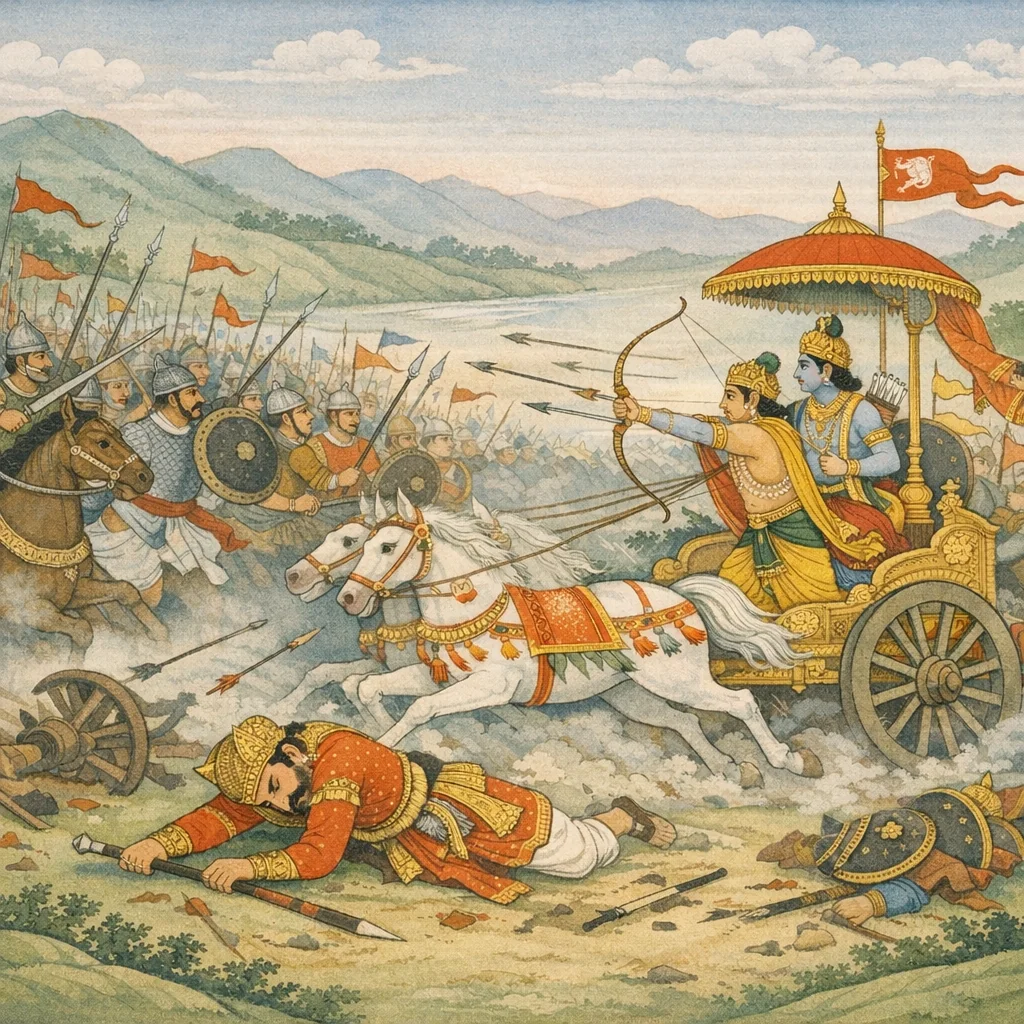
Adhyaya 94
Droṇa-parva Adhyāya 94: Sātyaki–Sudarśana Yuddha (सात्यकि–सुदर्शन युद्ध)
Upa-parva: Sātyaki–Sudarśana Saṃprahāra (Episode: Sātyaki’s advance and duel with Sudarśana)
Sañjaya reports that Sātyaki, having overcome Droṇa’s sector and other Kaurava leaders, speaks with measured confidence to his charioteer, characterizing himself as an instrument while attributing decisive battlefield outcomes to Keśava and Phalguna (Kṛṣṇa and Arjuna). He then advances forcefully through the host, described in solar imagery and as difficult to check. Sudarśana confronts him; a severe chariot engagement follows in which Sudarśana releases dense volleys and Sātyaki counters by cutting down arrows mid-flight, demonstrating technical mastery of interception and rate-of-fire. The duel escalates: Sudarśana wounds Sātyaki and strikes his horses; Sātyaki responds with targeted countermeasures, including the killing of the opponent’s charioteer and then Sudarśana himself by a decisive head-severing strike. The chapter closes with Sātyaki’s renewed movement toward Arjuna’s axis, and observers’ astonishment at his ability to burn through enemies within missile-range, emphasizing momentum, lethality, and the narrative function of exemplary prowess within the broader operational plan.
Chapter Arc: श्वेतवाहन अर्जुन अपनी सत्यप्रतिज्ञा को पूर्ण करने के लिए कौरव-सेना में वज्र की भाँति प्रवेश करता है; उसके बाण सूर्य-किरणों की तरह चमकते हुए समूची पंक्ति को संतप्त कर देते हैं। → अर्जुन के प्रहार से घोड़े विद्ध होते हैं, रथ छिन्न-भिन्न होते हैं, गज-आरूढ़ गिरते हैं और छत्र-ध्वज कटते हैं; इसी उथल-पुथल में वह द्रोणाचार्य की दिशा में बढ़ता हुआ कृतवर्मा और काम्बोजराज सुदक्षिण जैसे महारथियों के प्रतिरोध से घिर जाता है। → कृतवर्मा के तीव्र बाणों से अर्जुन क्षण भर के लिए उलझता है; कृष्ण चिंतित होते हैं कि कहीं विलंब काल-व्यतिक्रम न बन जाए—उसी क्षण अर्जुन गाण्डीव से प्रचण्ड प्रत्युत्तर देकर सुदक्षिण के रथ को तोड़ता है और हृदय-भेदी बाण से उसके संकल्प व पराक्रम को निष्फल कर देता है। → सुदक्षिण का कवच फटता है, अंग शिथिल पड़ते हैं, मुकुट-बाजूबंद गिरते हैं और वह ध्वज की तरह सामने की ओर गिरकर रणभूमि में प्राणहीन शोभित होता है; अर्जुन का मार्ग एक बड़े अवरोध से मुक्त हो जाता है। → द्रोण और कृतवर्मा अभी भी रण में सक्रिय हैं; अर्जुन की प्रतिज्ञा-पूर्ति की दौड़ आगे और घनी टकराहटों की ओर बढ़ती है।
Shlokas
Verse 1
अपन बछ। हक २ >> द्विनवतितमो< ध्याय: अर्जुनका द्रोणाचार्य और कृतवर्माके साथ युद्ध करते | है कौरव-सेनामें प्रवेश तथा श्रुतायुधका अपनी गदासे सुदक्षिणका अर्जुनद्वारा वध संजय उवाच संनिरुद्धस्तु तैः पार्थो महाबलपराक्रम: । द्रुतं समनुयातश्न द्रोणेन रथिनां वर:,संजय कहते हैं--रथियोंमें श्रेष्ठ एवं महान् बल और पराक्रमसे सम्पन्न अर्जुन जब उन कौरव सैनिकोंद्वारा रोक दिये गये, उस समय द्रोणाचार्यने भी तुरंत ही उनका पीछा किया
Sañjaya said: When Pārtha (Arjuna)—endowed with mighty strength and heroic prowess—was checked by those Kaurava warriors, Droṇa, the foremost among chariot-fighters, swiftly pursued him as well.
Verse 2
किरन्निषुगणांस्तीक्ष्णान् स रश्मीनिव भास्कर: । तापयामास तत् सैन्यं देहं व्याधिगणो यथा,जैसे रोगोंका समुदाय शरीरको संतप्त कर देता है, उसी प्रकार अर्जुनने कौरवोंकी उस सेनाको अत्यन्त संताप दिया। जैसे सूर्य अपनी प्रचण्ड किरणोंका प्रसार करते हैं, उसी प्रकार वे तीखे बाणसमूहोंकी वर्षा करने लगे
Sañjaya said: “Pouring forth volleys of sharp arrows, like the Sun sending out its rays, he scorched that army—just as a host of diseases torments and burns the body.”
Verse 3
अश्वो विद्धो रथश्छिन्न: सारोह: पातितो गज: । छत्राणि चापविद्धानि रथाश्षक्रैविना कृता:,उन्होंने घोड़ोंको घायल कर दिया, रथके टुकड़े-टुकड़े कर डाले, गजारोहियोंसहित हाथीको मार गिराया, छत्र इधर-उधर बिखेर दिये तथा रथोंको पहियोंसे सूना कर दिया
Sañjaya said: Horses were struck down, chariots were shattered, and elephants—along with their riders—were felled. Umbrellas were knocked away and scattered, and the chariots were left wheel-less, rendered useless on the battlefield.
Verse 4
विद्रुतानि च सैन्यानि शरारतानि समन्ततः । इत्यासीत् तुमुल॑ युद्ध न प्राज्ायत किज्चन,उनके बाणोंसे पीड़ित होकर सारे सैनिक सब ओर भाग चले। वहाँ इस प्रकार भयंकर युद्ध हो रहा था कि किसीको कुछ भी भान नहीं हो रहा था
Sañjaya said: Struck by the arrows, the troops fled in all directions. Such was the tumult of that dreadful battle that nothing could be clearly discerned by anyone—confusion and panic overwhelmed all sense and judgment amid the violence.
Verse 5
तेषां संयच्छतां संख्ये परस्परमजिह्ागै: । अर्जुनो ध्वजिनीं राजन्नभी क्ष्णं समकम्पयत्,राजन! उस युद्धस्थलमें कौरव-सैनिक एक-दूसरेको काबूमें रखनेका प्रयत्न करते थे और अर्जुन अपने बाणोंद्वारा उनकी सेनाको बारंबार कम्पित कर रहे थे
Sañjaya said: As those warriors strove in the press of battle to restrain and steady one another, Arjuna, O King, again and again shook the Kaurava host—making their ranks tremble under the relentless force of his arrows.
Verse 6
सत्यां चिकीर्षमाणस्तु प्रतिज्ञां सत्यसंगर: । अभ्यद्रवद् रथश्रेष्ठ शोणाश्र श्वेतवाहन:,सत्यप्रतिज्ञ श्वेतवाहन अर्जुनने अपनी प्रतिज्ञा सच्ची करनेकी इच्छासे लाल घोड़ोंवाले रथियोंमें श्रेष्ठ द्रोणाचार्यपर धावा किया
Sañjaya said: Intent on making his vow come true, Arjuna—steadfast in truth and firm in battle—charged forward. That foremost of chariot-warriors, riding a chariot drawn by white steeds with a reddish hue, rushed straight at Droṇācārya.
Verse 7
त॑ द्रोण: पञ्चविंशत्या मर्मभिद्धिरजिद्मगै: । अन्तेवासिनमाचार्यों महेष्वासं समार्पयत्,उस समय आचार्य द्रोणने अपने महाधनुर्धर शिष्य अर्जुनको पचीस मर्मभेदी बाणोंद्वारा घायल कर दिया
Sañjaya said: Then Droṇa, the preceptor, struck his own disciple—the great archer Arjuna—with twenty-five vital-piercing arrows, driving the battle to its harshest edge. In that moment the war’s moral tension sharpened: the teacher, bound to his side’s duty, turned formidable skill against the very student he had once trained, showing how dharma in war can force painful conflicts of loyalty.
Verse 8
त॑ तूर्णमिव बीभत्सु: सर्वशस्त्रभृतां वर: । अभ्यधावदिषूनस्यन्निषुवेगविघातकान्,तब सम्पूर्ण शस्त्रधारियोंमें श्रेष्ठ अर्जुनने भी तुरंत ही उनके बाणोंके वेगका विनाश करनेवाले भल््लोंका प्रहार करते हुए उनपर आक्रमण किया
Sañjaya said: Then Arjuna—Bībhatsu, the foremost among all wielders of weapons—rushed at him as if in a flash, shooting sharp arrows that shattered the force of the enemy’s shafts. In the harsh ethic of battle, he answered attack with disciplined counter-force, aiming not at rage but at neutralizing the opponent’s momentum.
Verse 9
तस्याशुक्षिप्तान् भल्लान् हि भल्लै: संनतपर्वभि: | प्रत्यविध्यदमेयात्मा ब्रह्मास्त्रं समुदीरयन्,अमेय आत्मबलसे सम्पन्न द्रोणाचार्यने अर्जुनके तुरंत चलाये हुए उन भल्ल्लोंको झुकी हुई गाँठवाले भल्लोंद्वारा ही काट दिया और ब्रह्मास्त्र प्रकट किया
Sañjaya said: Drona, whose spirit was unfathomable, instantly countered the bhalla-arrows that Arjuna had swiftly discharged—cutting them down with his own bhallas fitted with bent joints—and, escalating the contest, he invoked the Brahmāstra. The scene underscores how, in the heat of righteous war, mastery and restraint contend with the peril of resorting to supreme weapons whose use carries grave moral weight.
Verse 10
तदद्भुतमपश्याम द्रोणस्याचार्यकं॑ युधि । यतमानो युवा नैनं प्रत्यविध्यद् यदर्जुन:,उस युद्धस्थलमें द्रोणाचार्यकी अद्भुत अस्त्रशिक्षा हमने देखी कि नवयुवक अर्जुन प्रयत्नशील होनेपर भी उन्हें अपने बाणोंद्वारा चोट न पहुँचा सके
Sañjaya said: We witnessed something truly astonishing on the battlefield—the masterly prowess of Droṇa as a teacher in war. Though the young Arjuna strove with all his might, he could not strike him with his arrows. The scene reveals the formidable power of disciplined training and mastery, and also the ethical tension of war where even the most righteous and capable warrior may be checked by a revered elder’s skill.
Verse 11
क्षरत्रिव महामेघो वारिधारा: सहस्रश: । द्रोणमेघ: पार्थशैलं ववर्ष शरवृष्टिभि:,जैसे महान् मेघ झलकी सहमसौरों धाराएँ बरसाता रहता है, उसी प्रकार द्रोणाचार्यरूपी मेघने अर्जुनरूपी पर्वतपर बाणोंकी वर्षा प्रारम्भ कर दी
Sañjaya said: As a great cloud pours down thousands of streams of rain without pause, so did Droṇa—like a cloud in battle—begin to shower Arjuna, the mountain-like Pārtha, with a relentless downpour of arrows. The image underscores the impersonal force of war: mastery and duty expressed through overwhelming martial skill, even when directed against the noblest of opponents.
Verse 12
अर्जुन: शरवर्ष तद् ब्रह्मास्त्रेणेव मारिष । प्रतिजग्राह तेजस्वी बाणैर्बाणान् निशातयन्,पूजनीय नरेश! उस समय अपने बाणोंद्वारा उनके बाणोंको काटते हुए तेजस्वी अर्जुनने भी ब्रह्मास्त्रद्वारा ही आचार्यकी उस बाण-वर्षाको रोका
Sañjaya said: O venerable one, the radiant Arjuna received and checked that shower of arrows as though with the Brahmāstra itself, sharply cutting down arrow after arrow with his own shafts. In the heat of battle, he answers the teacher’s overwhelming assault not with panic or cruelty, but with disciplined mastery—meeting force with measured counter-force, mindful of the grave responsibility that attends the use of divine weapons.
Verse 13
द्रोणस्तु पठ्चविंशत्या श्वेतवाहनमार्दयत् । वासुदेवं च सप्तत्या बाह्वोरुगसि चाशुगै:,तब द्रोणाचार्यने पचीस बाण मारकर श्वेतवाहन अर्जुनको पीड़ित कर दिया। साथ ही श्रीकृष्णकी भुजाओं तथा वक्ष:स्थलमें भी उन्होंने सत्तर बाण मारे
Sañjaya said: Droṇa struck down and sorely harassed Arjuna, the rider of the white steeds, with twenty-five arrows. He also pierced Vāsudeva (Kṛṣṇa) with seventy swift shafts, wounding his arms and chest—showing the fierce, unsparing intensity of battle even against the charioteer who guides dharma through counsel rather than weapons.
Verse 14
पार्थस्तु प्रहसन् धीमानाचार्य सशरौधिणम् | विसृजन्तं शितान् बाणानवारयत त॑ युधि,परम बुद्धिमान् अर्जुनने हँसते हुए ही युद्धस्थलमें तीखे बाणोंकी बौछार करनेवाले द्रोणाचार्यको उनकी बाण-वर्षासहित रोक दिया
Sañjaya said: Then Pārtha—clear-minded and supremely discerning—smiled as he checked the Teacher, Droṇācārya, who was unleashing a dense shower of razor-sharp arrows. In the midst of battle, Arjuna restrained that very onrush of missiles, meeting force with mastery rather than fear.
Verse 15
अथ तौ वध्यमानौ तु द्रोणेन रथसत्तमौ । आवर्जयेतां दुर्धर्ष युगान्ताग्निमिवोत्थितम्,तदनन्तर द्रोणाचार्यके द्वारा घायल किये जाते हुए वे दोनों रथिश्रेष्ठ श्रीकृष्ण और अर्जुन उस समय प्रलयकालकी अग्निके समान उठे हुए उन दुर्धर्ष आचार्यको छोड़कर अन्यत्र चल दिये
Then, though wounded by Droṇa, those two foremost chariot-warriors—Kṛṣṇa and Arjuna—turned their car away to another quarter, leaving that hard-to-withstand Teacher who rose up like the fire at the end of the age.
Verse 16
वर्जयन् निशितान् बाणान् द्रोणचापविनि:सृतान् । किरीटमाली कौन्तेयो भोजानीकं व्यशातयत्,द्रोणाचार्यके धनुषसे छूटे हुए तीखे बाणोंका निवारण करते हुए किरीटधारी कुन्तीकुमार अर्जुनने कृतवर्माकी सेनाका संहार आरम्भ किया
Sañjaya said: As he warded off the sharp arrows released from Droṇa’s bow, the diadem-crowned son of Kuntī—Arjuna—began to cut down the Bhoja host, initiating the destruction of Kṛtavarmā’s forces.
Verse 17
सो<न््तरा कृतवर्माणं काम्बोजं च सुदक्षिणम् । अभ्ययाद् वर्जयन् द्रोणं मैनाकमिव पर्वतम्,वे मैनाक पर्वतकी भाँति अविचल भावसे स्थित द्रोणाचार्यको छोड़ते हुए कृतवर्मा तथा काम्बोजराज सुदक्षिणके बीचसे होकर निकले
Sañjaya said: Passing between Kṛtavarmā and Sudakṣiṇa of Kāmboja, he advanced—deliberately avoiding Droṇācārya, who stood firm and unshaken like Mount Maināka.
Verse 18
ततो भोजो नरव्याप्रो दुर्धर्ष कुरुसत्तमम् | अविध्यत् तूर्णमव्यग्रो दशभि: कड्कपत्रिभि:,तब पुरुषसिंह कृतवर्माने कुरुकुलके श्रेष्ठ एवं दुर्धर्ष वीर अर्जुनको कंकपत्रयुक्त दस बाणोंद्वारा तुरंत ही घायल कर दिया। उस समय उसके मनमें तनिक भी व्यग्रता नहीं हुई
Sañjaya said: Then Kṛtavarmā of the Bhoja line—lion-like among men, hard to withstand—swiftly struck the foremost of the Kurus, Arjuna, with ten arrows fitted with heron-feathers. Even as he wounded him, his mind showed no agitation.
Verse 19
तमर्जुन: शतेनाजौ राजन् विव्याध पत्रिणाम् | पुनश्नान्यैस्त्रिभिर्बाणैमोहयजन्निव सात्वतम्,राजन! अर्जुनने कृतवर्माको उस युद्धस्थलमें सौ बाणोंद्वारा बींध डाला। फिर उसे मोहित-सा करते हुए उन्होंने तीन बाण और मारे
Sañjaya said: O King, in the midst of battle Arjuna pierced that warrior with a hundred feathered arrows. Then, as though bewildering the Sāttvata (Kṛtavarmā), O King, he struck him again with three more shafts.
Verse 20
भोजस्तु प्रहसन् पार्थ वासुदेवं॑ च माधवम् । एकैकं पञ्चविंशत्या सायकानां समार्पयत्,तब कृतवर्माने भी हँसकर कुन्तीकुमार अर्जुन और मधुवंशी भगवान् वासुदेवमेंसे प्रत्येकको पचीस-पचीस बाण मारे
Sañjaya said: Laughing aloud, Bhoja (Kṛtavarmā) shot at Pārtha (Arjuna) and at Vāsudeva Mādhava (Kṛṣṇa), striking each of them with twenty-five arrows.
Verse 21
तस्यार्जुनो धनुश्कछित्त्वा विव्याधैनं त्रिसप्तभि: । शरैरग्निशिखाकारे: क्रुद्धाशीविषसंनिभै:,यह देख अर्जुनने उसके धनुषको काटकर क्रोधमें भरे हुए विषधर सर्पके समान भयंकर और आगकी लपटोंके समान तेजस्वी इक्कीस बाणोंद्वारा उसे भी घायल कर दिया
Sañjaya said: Arjuna cut down his bow and then struck him with twenty-one arrows—blazing like tongues of fire and as dreadful as enraged venomous serpents.
Verse 22
अथान्यद् धनुरादाय कृतवर्मा महारथ: । पज्चभि: सायकैस्तूर्ण विव्याधोरसि भारत
Sañjaya said: Then Kṛtavarmā, that great chariot-warrior, took up another bow and swiftly pierced him in the chest with five arrows, O Bhārata.
Verse 23
भारत! तब महारथी कृतवर्माने दूसरा धनुष लेकर तुरंत ही पाँच बाणोंसे अर्जुनकी छातीमें चोट पहुँचायी ।। पुनश्न निशितैर्बाणै: पार्थ विव्याध पठ्चभि: । त॑ पार्थो नवभिर्बाणैराजघान स्तनान्तरे,फिर पाँच तीखे बाण और मारकर अर्जुनको घायल कर दिया। यह देख अर्जुनने कृतवर्माकी छातीमें नौ बाण मारे
Sañjaya said: Again, with five sharp arrows, Kṛtavarmā pierced Pārtha (Arjuna). Seeing this, Arjuna struck him in the region of the chest with nine arrows.
Verse 24
दृष्टवा विषक्त कौन्तेयं कृतवर्मरथं प्रति । चिन्तयामास वार्ष्णेयो न न: कालात्ययो भवेत्,कुन्तीकुमार अर्जुनको कृतवर्माके रथसे उलझे हुए देखकर भगवान् श्रीकृष्णने मन-ही- मन सोचा कि हमलोगोंका अधिक समय यहीं न व्यतीत हो जाय
Sañjaya said: Seeing Arjuna, son of Kuntī, locked in close engagement against the chariot of Kṛtavarmā, Kṛṣṇa of the Vṛṣṇi line reflected inwardly, “May we not lose too much time here.”
Verse 25
ततः कृष्णो<ब्रवीत् पार्थ कृतवर्मणि मा दयाम् | कुरु सम्बन्धकं हित्वा प्रमथ्यैनं विशातय,तत्पश्चात् श्रीकृष्णने अर्जुनसे कहा--“तुम कृतवर्मापर दया न करो। इस समय सम्बन्धी होनेका विचार छोड़कर इसे मथकर मार डालो”
Then Kṛṣṇa said to Pārtha (Arjuna): “Show no pity toward Kṛtavarmā. Casting aside the thought of kinship and connection, crush him and kill him.”
Verse 26
ततः स कृतवर्माणं मोहयित्वार्जुन: शरै: । अभ्यगाज्जवनैरश्वै:ः काम्बोजानामनीकिनीम्,तब अर्जुन अपने बाणोंद्वारा कृतवर्माको मूर्च्छिंत करके अपने वेगशाली घोड़ोंद्वारा काम्बोजोंकी सेनापर आक्रमण करने लगे
Sañjaya said: Then Arjuna, bewildering Kṛtavarmā with his arrows, swiftly advanced with his fast horses and fell upon the Kāmboja host.
Verse 27
अमर्षितस्तु हार्दिक्य: प्रविष्टे श्वेतवाहने । विधुन्वन् सशरं चाप॑ पाञ्चाल्याभ्यां समागत:,श्वेतवाहन अर्जुनके व्यूहमें प्रवेश कर जानेपर कृतवर्माको बड़ा क्रोध हुआ। वह बाणसहित धनुषको हिलाता हुआ पांचालराजकुमार युधामन्यु और उत्तमौजासे भिड़ गया
Sañjaya said: When Śvetavāhana (Arjuna) entered the battle-formation, Hārdikya (Kṛtavarmā), wrathful at heart, shook his bow already fitted with arrows and closed in to engage the two Pāñcāla warriors.
Verse 28
चक्ररक्षौ तु पाञज्चाल्यावर्जुनस्य पदानुगौ | पर्यवारयदायान्तौ कृतवर्मा रथेषुभि:,वे दोनों पांचाल वीर अर्जुनके चक्ररक्षक होकर उनके पीछे-पीछे जा रहे थे। कृतवर्माने अपने रथ और बाणोंद्वारा वहाँ आते हुए उन दोनों वीरोंको रोक दिया
Sañjaya said: The two Pāñcāla warriors, serving as Arjuna’s wheel-guards and following close behind him, advanced on. Kṛtavarmā, however, checked them as they came forward, opposing them with his chariot and volleys of arrows.
Verse 29
तावविध्यत् ततो भोज: कृतवर्मा शितै: शरै: । त्रिभिरेव युधामन्युं चतुर्भि श्चोत्तमौजसम्,भोजवंशी कृतवर्माने अपने तीन तीखे बाणोंद्वारा युधामन्युको और चार बाणोंसे उत्तमौजाको घायल कर दिया
Sañjaya said: Then the Bhoja warrior Kṛtavarmā struck them with keen arrows—wounding Yudhāmanyu with three shafts and Uttamaujas with four.
Verse 30
तावप्येनं विविधतुर्दशभिर्दशभि: शरैः । त्रिभिरेव युधामन्युरुत्तमौजास्त्रिभिस्तथा,तब उन दोनोंने भी कृतवर्माको दस-दस बाणोंसे बींध दिया। फिर युधामन्युने तीन और उत्तमौजाने भी तीन बाणोंद्वारा उसे चोट पहुँचायी
Sañjaya said: Those two also struck him in diverse ways with ten arrows each. Then Yudhāmanyu pierced him with three more, and Uttamaujas likewise with three.
Verse 31
संचिच्छिदतुरप्यस्य ध्वजं कार्मुकमेव च । अथान्यद् धनुरादाय हार्दिक्य: क्रोधमूर्च्छित:,साथ ही उन्होंने कृतवर्मेके ध्वज और धनुषको भी काट डाला। यह देख कृतवर्मा क्रोधसे मूर्च्छिंत हो उठा और उसने दूसरा धनुष हाथमें लेकर उन दोनों वीरोंके धनुष काट दिये। तत्पश्चात् वह उनपर बाणोंकी वर्षा करने लगा। इसी तरह वे दोनों पांचाल वीर भी दूसरे धनुषोंपर डोरी चढ़ाकर भोजवंशी कृतवर्माको चोट पहुँचाने लगे
Sañjaya said: They cut down even his banner and his bow. Then Hārdikya (Kṛtavarmā), overcome by a surge of wrath, seized another bow and pressed on with the fight.
Verse 32
कृत्वा विधनुषौ वीरौ शरवर्षैरवाकिरत् । तावन्ये धनुषी सज्ये कृत्वा भोजं विजघ्नतु:,साथ ही उन्होंने कृतवर्मेके ध्वज और धनुषको भी काट डाला। यह देख कृतवर्मा क्रोधसे मूर्च्छिंत हो उठा और उसने दूसरा धनुष हाथमें लेकर उन दोनों वीरोंके धनुष काट दिये। तत्पश्चात् वह उनपर बाणोंकी वर्षा करने लगा। इसी तरह वे दोनों पांचाल वीर भी दूसरे धनुषोंपर डोरी चढ़ाकर भोजवंशी कृतवर्माको चोट पहुँचाने लगे
Sañjaya said: Having rendered those two heroes bowless, he showered them with a rain of arrows. Then, stringing other bows, the two struck back at Bhoja, Kṛtavarmā. Thus the battlefield’s ruthless reciprocity is seen: when weapons are cut down, warriors rearm at once, and anger drives escalation rather than restraint.
Verse 33
तेनान्तरेण बीभत्सुर्विवेशामित्रवाहिनीम् । न लेभाते तु तौ द्वारं वारितौ कृतवर्मणा
Meanwhile, Bībhatsu (Arjuna) forced his way into the enemy host. Yet the two of them could not gain the gateway, for they were held back by Kṛtavarman—showing how, in war, even rightful resolve meets deliberate resistance and must be tested by discipline and restraint.
Verse 34
अनीकान्यर्दयन् युद्धे त्वरित: श्वेतवाहन:
Sañjaya said: In the thick of battle, the swift warrior with the white steeds pressed hard upon the opposing battle-formations, crushing and driving them back with urgent speed—an image of relentless martial momentum amid the moral weight of fratricidal war.
Verse 35
त॑ दृष्टवा तु तथा यान्तं शूरो राजा श्रुतायुध:
Sañjaya said: Seeing him advancing in that manner, the valiant king Śrutāyudha took note—his resolve hardening as the battle’s momentum pressed forward. The line underscores how, in war, a leader’s perception of an opponent’s movement can immediately shape intent and action, often tightening the grip of duty and vengeance over restraint.
Verse 36
स पार्थ त्रिभिरानर्छत् सप्तत्या च जनार्दनम्
Sañjaya said: He struck Pārtha with three arrows and Janārdana with seventy—revealing the ruthless arithmetic of battle, where prowess is counted in wounds inflicted rather than in righteousness, even as Kṛṣṇa’s presence beside Arjuna keeps the war’s moral horizon in view.
Verse 37
ततोडअर्जुनो नवत्या तु शराणां नतपर्वणाम्
Then Arjuna struck him with ninety arrows whose joints were bent—an intense, disciplined volley that displays the warrior’s trained restraint and precision amid the moral pressure of battle.
Verse 38
स तन्न ममृषे राजन् पाण्डवेयस्य विक्रमम्
Sañjaya said: O King, he could not endure that display of valor by the son of the Pāṇḍus. Stung by the enemy’s prowess, his mind turned from restraint to retaliation—an inner shift that fuels the next surge of violence in the war.
Verse 39
तस्यार्जुनो धनुश्छित्त्वा शरावापं निकृत्य च
Sañjaya said: Arjuna, having cut down his bow and also severed the quiver of arrows, decisively stripped him of the means to continue the fight—an act that displays mastery in battle while aiming to neutralize rather than merely kill.
Verse 40
आजयपघानोरसि क्रुद्ध: सप्तभिननतपर्वभि: । तब अर्जुनने उनका धनुष काटकर उनके तरकशके भी टुकड़े-टुकड़े कर दिये। फिर कुपित हो झुकी हुई गाँठवाले सात बाणोंद्वारा उनकी छातीपर प्रहार किया ।। अथान्यद् धनुरादाय स राजा क्रोधमूर्च्छित:
Sanjaya said: Arjuna cut down his bow and shattered his quivers as well. Then, in anger, he struck his opponent’s chest with seven arrows whose joints were split. After that, the king—overwhelmed by wrath—took up another bow, determined to continue the fight. The passage underscores how, in the heat of war, skill and retaliation can quickly be driven by anger, clouding judgment and intensifying violence.
Verse 41
ततोअर्जुन: स्मयन्नेव श्रुतायुधमरिंदम:
Sañjaya said: Then Arjuna, smiling, addressed Śrutāyudha—the subduer of foes—signaling calm confidence amid the violence of battle and a measured resolve rather than blind rage.
Verse 42
शरैरनेकसाहसै: पीडयामास भारत | भारत! यह देख शत्रुदमन अर्जुनने मुसकराते हुए ही श्रुतायुधको कई हजार बाण मारकर पीड़ित कर दिया ।। अश्वांश्वास्यावधीत् तूर्ण सारथथिं च महारथ:
Sanjaya said: O Bharata, with many thousands of arrows he grievously harassed him. Seeing this, Arjuna—subduer of foes—still smiling, struck Śrutāyudha with several thousand shafts and tormented him. Then that great chariot-warrior swiftly slew his horses and the charioteer as well.
Verse 43
हताश्चं रथमुस्तृज्य स तु राजा श्रुतायुध:,अभ्यद्रवद् रणे पार्थ गदामुद्यम्य वीर्यवान् । घोड़ोंके, मारे जानेपर पराक्रमी राजा श्रुतायुध उस रथको छोड़कर हाथमें गदा ले समरांगणमें अर्जुनपर टूट पड़े
Sañjaya said: When his horses had been slain, the mighty king Śrutāyudha abandoned his chariot and, lifting his mace, charged in the midst of battle straight at Arjuna.
Verse 44
।। वरुणस्यात्मजो वीर: स तु राजा श्रुतायुध:
Sañjaya said: That heroic king Śrutāyudha—born of Varuṇa—stood forth, marked by divine lineage and royal valor amid the strain of war.
Verse 45
तस्य माताब्रवीद् राजन् वरुण पुत्रकारणात्
Sañjaya said: O King, his mother spoke—because Varuṇa was the cause behind the begetting of that son.
Verse 46
वरुण स्त्वब्रवीत् प्रीतो ददाम्यस्मै वरं हितम्
Sañjaya said: Pleased, Varuṇa spoke, “I grant him a boon that will be for his welfare.”
Verse 47
नास्ति चाप्यमरत्वं वै मनुष्यस्य कथंचन
Sañjaya said: “For a human being, there is truly no immortality—by any means whatsoever.”
Verse 48
दुर्धर्षस्त्वेष शत्रूणां रणेषु भविता सदा
Sañjaya said: “This one will always prove unassailable to his enemies in the battles.”
Verse 49
इत्युक्त्वा वरुण: प्रादाद् गदां मन्त्रपुरस्कृताम्
Sañjaya said: Having spoken thus, Varuṇa bestowed a mace that was sanctified and empowered by sacred mantras.
Verse 50
उवाच चैनं भगवान् पुनरेव जलेश्वर:,गदा देकर भगवान् वरुणने उनसे पुनः कहा--“वत्स! जो युद्ध न कर रहा हो, उसपर इस गदाका प्रहार न करना; अन्यथा यह तुम्हारे ऊपर ही आकर गिरेगी। शक्तिशाली पुत्र! यह गदा प्रतिकूल आचरण करनेवाले प्रयोक्ता पुरुषको भी मार सकती है”
Sañjaya said: Then the blessed Lord of the waters, Varuṇa, once again addressed him. Having bestowed the mace, Varuṇa warned: “My child, do not strike with this mace one who is not fighting; otherwise it will recoil and fall upon you. Mighty son, this mace has the power to slay even the very wielder who acts contrary to right conduct.”
Verse 51
अयुध्यति न मोक्तव्या सा त्वय्येव पतेदिति । हन्यादेषा प्रतीपं हि प्रयोक्तारमपि प्रभो,गदा देकर भगवान् वरुणने उनसे पुनः कहा--“वत्स! जो युद्ध न कर रहा हो, उसपर इस गदाका प्रहार न करना; अन्यथा यह तुम्हारे ऊपर ही आकर गिरेगी। शक्तिशाली पुत्र! यह गदा प्रतिकूल आचरण करनेवाले प्रयोक्ता पुरुषको भी मार सकती है”
Sañjaya said: “This mace should not be hurled at one who is not fighting; otherwise it will fall back upon you yourself. Indeed, O lord, this mace can strike down even its wielder if he acts contrary to what is right.”
Verse 52
न चाकरोत् स ठठद्दाक्यं प्राप्ते काले श्रुतायुध: । स तया वीरघातिन्या जनार्दनमताडयत्,परंतु काल आ जानेपर श्रुतायुधने वरुणदेवके उक्त आदेशका पालन नहीं किया। उन्होंने उस वीरघातिनी गदाके द्वारा भगवान् श्रीकृष्णको चोट पहुँचायी
Sañjaya said: But when the decisive moment arrived, Śrutāyudha did not act in accordance with that instruction. Instead, wielding that hero-slaying mace, he struck Janārdana (Kṛṣṇa). The episode shows how, in the heat of war, disregarding a divinely given restraint becomes an ethical lapse that invites ruin, even for one of formidable power.
Verse 53
प्रतिजग्राह तां कृष्ण: पीनेनांसेन वीर्यवान् | नाकम्पयत शौरिं सा विन्ध्यं गिरिमिवानिल:,पराक्रमी श्रीकृष्णने अपने हृष्ट-पुष्ट कंधेपर उस गदाका आघात सह लिया। परंतु जैसे वायु विन्ध्यपर्वतको नहीं हिला सकती है, उसी प्रकार वह गदा श्रीकृष्णको कम्पित न कर सकी
Sañjaya said: Mighty Kṛṣṇa received that blow upon his broad, well-built shoulder. Yet the mace could not make Śauri tremble—just as the wind cannot shake the Vindhya mountain. The verse praises steadfast courage and self-mastery amid violence: true strength is shown not merely in striking, but in remaining unshaken and protecting the righteous cause.
Verse 54
प्रत्युद्यान्ती तमेवैषा कृत्येव दुरधिष्ठिता । जघान चास्थितं वीरं श्रुतायुधममर्षणम्,जैसे दोषयुक्त आभिचारिक क्रियासे उत्पन्न हुई कृत्या उसका प्रयोग करनेवाले यजमानका ही नाश कर देती है, उसी प्रकार उस गदाने लौटकर वहाँ खड़े हुए अमर्षशील वीर श्रुतायुधको मार डाला
That mace turned back upon him, like an uncontrollable kṛtyā—born of a flawed act of sorcery—that destroys the very patron who set it in motion. In the same way, the mace recoiled and struck down the hot-tempered hero Śrutāyudha as he stood there.
Verse 55
हत्वा श्रुतायुधं वीर॑ धरणीमन्वपद्यत । गदां निवर्तितां दृष्टवा निहतं च श्रुतायुधम्
Sañjaya said: Having slain the heroic Śrutāyudha, he fell down upon the earth. Seeing the mace turned back from its course and Śrutāyudha lying killed, the scene revealed the grim moral of battle: violence, once unleashed, can recoil upon its wielder, and even a valiant warrior is brought to the ground when the conditions of his weapon and conduct are violated.
Verse 56
स्वेनास्त्रेण हतं दृष्टवा श्रुतायुधमरिंदमम्,नरेश्वर! शत्रुदमन श्रुतायुधको अपने ही अस्त्रसे मारा गया देख यह बात ध्यानमें आयी कि श्रुतायुधने युद्ध न करनेवाले श्रीकृष्णपर गदा चलायी है। इसीलिये उस गदाने उन्हींका वध किया है
Sañjaya said: O king, seeing the enemy-subduing Śrutāyudha slain by his own weapon, it became clear why this had happened. He had hurled his mace at Śrī Kṛṣṇa, who was not fighting; therefore that very mace turned back upon him and became the cause of his death. The episode underscores the moral recoil of violence directed at one who stands outside the combat.
Verse 57
अयुध्यमानाय ततः केशवाय नराधिप । क्षिप्ता श्रुतायुधेनाथ तस्मात् तमवधीद् गदा,नरेश्वर! शत्रुदमन श्रुतायुधको अपने ही अस्त्रसे मारा गया देख यह बात ध्यानमें आयी कि श्रुतायुधने युद्ध न करनेवाले श्रीकृष्णपर गदा चलायी है। इसीलिये उस गदाने उन्हींका वध किया है
Sañjaya said: “O king, then Śrutāyudha hurled his mace at Keśava (Śrī Kṛṣṇa), who was not fighting. Because it was cast against one who had laid aside combat, that very mace turned back upon Śrutāyudha and killed him—thus the consequence of violating the rule of righteous warfare fell upon the transgressor himself.”
Verse 58
यथोक्तं वरुणेनाजी तथा स निधनं गत: । व्यसुश्चाप्पपतद् भूमौ प्रेक्षतां सर्वधन्विनाम्,वरुणदेवने जैसा कहा था, युद्धभूमिमें श्रुतायुधकी उसी प्रकार मृत्यु हुई। वे सम्पूर्ण धनुर्धरोंके देखते-देखते प्राणशून्य होकर पृथ्वीपर गिर पड़े
Sañjaya said: “Just as Varuṇa had foretold, so did he meet his end on the battlefield. Before the eyes of all the archers, he fell to the earth bereft of life—an ominous confirmation that in war, a divine condition or curse, once set in motion, ripens inexorably into fate.”
Verse 59
पतमानस्तु स बभौ पर्णाशाया: प्रिय: सुतः । स भग्न इव वातेन बहुशाखो वनस्पति:,गिरते समय पर्णाशाके प्रिय पुत्र श्रुतायुध आँधीके उखाड़े हुए अनेक शाखाओंवाले वृक्षके समान प्रतीत हो रहे थे
Sañjaya said: “As he fell, the beloved son of Parṇāśā appeared like a many-branched tree, snapped and brought down by a violent wind.”
Verse 60
ततः सर्वाणि सैन्यानि सेनामुख्याश्न सर्वश: । प्राद्रवन्त हतं दृष्टवा श्रुतायुधमरिंदमम्,शत्रुसूदन श्रुतायुधको इस प्रकार मारा गया देख सारे सैनिक और सम्पूर्ण सेनापति वहाँसे भाग खड़े हुए
Sañjaya said: “Then, seeing Śrutāyudha—the crusher of foes—slain, all the troops and the leading commanders, in every direction, broke and fled.”
Verse 61
तत: काम्बोजराजस्य पुत्र: शूर: सुदक्षिण: । अभ्ययाज्जवनैरश्वै: फाल्गुनं शत्रुसूदनम्,तत्पश्चात् काम्बोजराजका शूरवीर पुत्र सुदक्षिण वेगशाली अअभ्रोंद्वारा शत्रुसूदन अर्जुनका सामना करनेके लिये आया
Sañjaya said: “Then Sudakṣiṇa, the valiant son of the king of Kāmboja, advanced against Phālguna (Arjuna), the slayer of foes, charging forward with swift Javana horses.”
Verse 62
तस्य पार्थ: शरान् सप्त प्रेषयामास भारत । ते त॑ शूरं विनिर्भिद्य प्राविशनू धरणीतलम्,भारत! अर्जुनने उसके ऊपर सात बाण चलाये। वे बाण उस शूरवीरके शरीरको विदीर्ण करके धरतीमें समा गये
Sañjaya said: Then Pārtha (Arjuna) shot seven arrows at him, O Bhārata. Those shafts, piercing straight through that valiant warrior’s body, sank into the earth—an image of relentless martial resolve and the grim inevitability of battle’s consequences.
Verse 63
सो5तिविद्ध: शरैस्ती&णैगाण्डीवप्रेषितैर्मुथे । अर्जुन प्रतिविव्याध दशभि: कड्कपत्रिभि:,गाण्डीव धनुषद्वारा छोड़े हुए तीखे बाणोंसे अत्यन्त घायल होनेपर सुदक्षिणने उस रणक्षेत्रमें कंककी पाँखवाले दस बाणोंद्वारा अर्जुनको क्षत-विक्षत कर दिया
Sañjaya said: Though struck hard in battle by Arjuna’s sharp arrows shot from the Gāṇḍīva, Sudakṣiṇa retaliated on that field and pierced Arjuna with ten shafts feathered with heron-plumes. The verse underscores the grim reciprocity of war: injury answered by injury, valor entangled with escalating violence.
Verse 64
वासुदेवं त्रिभिविद्ध्वा पुन: पार्थ च पञ्चभि: । तस्य पार्थो धनुश्छित्त्वा केतुं चिच्छेद मारिष,वसुदेवनन्दन श्रीकृष्णको तीन बाणोंसे घायल करके उसने अर्जुनपर पुनः पाँच बाणोंका प्रहार किया। आर्य! तब अर्जुनने उसका धनुष काटकर उसकी ध्वजाके टुकड़े- टुकड़े कर दिये
Sañjaya said: Having pierced Vāsudeva (Kṛṣṇa) with three arrows, he again struck Pārtha (Arjuna) with five. Then Arjuna cut his bow in two and shattered his banner (ketu) into fragments, O venerable one.
Verse 65
भल्लाभ्यां भृशतीक्ष्णाभ्यां तं च विव्याध पाण्डव: । स तु पार्थ त्रिभिविंद्ध्वा सिंहनादमथानदत्,इसके बाद पाण्डुकुमार अर्जुनने दो अत्यन्त तीखे भल््लोंसे सुदक्षिणको बींध डाला। फिर सुदक्षिण भी तीन बाणोंसे पार्थको घायल करके सिंहके समान दहाड़ने लगा
Sañjaya said: With two exceedingly sharp bhalla-arrows, the Pāṇḍava (Arjuna) pierced him. But that warrior, having in turn struck Pārtha with three arrows, roared a lion-like cry—an assertion of valor amid the relentless exchange of blows in the dharmic yet tragic field of war.
Verse 66
सर्वपारशवीं चैव शक्ति शूर: सुदक्षिण: । सघपण्टां प्राहिणोद् घोरां क्रुद्धो गाण्डीवधन्चने,शूरवीर सुदक्षिणने कुपित होकर पूर्णतः लोहेकी बनी हुई घण्टायुक्त भयंकर शक्ति गाण्डीवधारी अर्जुनपर चलायी
Sañjaya said: Enraged, the valiant Sudakṣiṇa hurled at Arjuna, the bearer of the Gāṇḍīva bow, a dreadful śakti—an iron spear-weapon, wholly forged of metal and fitted with a bell. The scene shows how wrath in battle drives warriors to unleash terrifying, specialized arms, deepening the moral weight of violence even within kṣatriya duty.
Verse 67
सा ज्वलन्ती महोल्केव तमासाद्य महारथम् | सविस्फुलिज्ञा निर्भिद्य निपषात महीतले,वह बड़ी भारी उल्काके समान प्रज्वलित होती और चिनगारियाँ बिखेरती हुई महारथी अर्जुनके पास जा उनके शरीरको विदीर्ण करके पृथ्वीपर गिर पड़ी
Sañjaya said: Blazing like a great meteor, it reached the mighty chariot-warrior Arjuna; scattering sparks, it pierced him and then fell upon the earth. The image underscores the war’s ruthless momentum—deadly force unleashed with irresistible speed, where even the foremost heroes are struck, and the battlefield’s violence eclipses all other values.
Verse 68
शक््त्या त्वभिहतो गाढढं मूर्च्डयाभिपरिप्लुत: । समाश्वास्य महातेजा: सृक्किणी परिलेलिहन्,उस शक्तिके द्वारा गहरी चोट खाकर महातेजस्वी अर्जुन मूर्च्छित हो गये, फिर धीरे-धीरे सचेत हो अपने मुखके दोनों कोनोंको जीभसे चाटते हुए अचिन्त्य पराक्रमी पार्थने कंकके पाँखवाले चौदह नाराचोंद्वारा घोड़े, ध्वज, धनुष और सारथिसहित सुदक्षिणको घायल कर दिया
Sañjaya said: Struck hard by the spear-weapon and overwhelmed by swooning, the mighty Arjuna regained his composure; licking the corners of his mouth, he then wounded Sudakṣiṇa—together with his horses, banner, bow, and charioteer—by means of fourteen iron-pointed arrows feathered with heron-plumes. The passage underscores the warrior’s resilience: even after being stunned, he restrains panic, recovers self-mastery, and answers force with measured martial skill within the brutal code of battle.
Verse 69
त॑ चतुर्दशभि: पार्थों नाराचै: कड्कपत्रिभि: | साश्चवध्वजधनु:सूतं विव्याधाचिन्त्यविक्रम:,उस शक्तिके द्वारा गहरी चोट खाकर महातेजस्वी अर्जुन मूर्च्छित हो गये, फिर धीरे-धीरे सचेत हो अपने मुखके दोनों कोनोंको जीभसे चाटते हुए अचिन्त्य पराक्रमी पार्थने कंकके पाँखवाले चौदह नाराचोंद्वारा घोड़े, ध्वज, धनुष और सारथिसहित सुदक्षिणको घायल कर दिया
Sañjaya said: Then the son of Pṛthā—Arjuna of inconceivable prowess—pierced him with fourteen nārāca arrows feathered with heron-plumes, wounding him together with his horses, banner, bow, and charioteer. The verse underscores the relentless escalation of battle: even after being struck down and regaining composure, Arjuna answers injury with precise, comprehensive retaliation aimed at disabling the opponent’s entire war-apparatus rather than merely trading blows.
Verse 70
रथं चान्ये: सुबहुभिश्चक्रे विशकलं शरै: । सुदक्षिणं तं काम्बोजं मोघसंकल्पविक्रमम्
Sañjaya said: Others, with many arrows, shattered his chariot and its wheels into fragments. That Kāmboja warrior Sudakṣiṇa—whose resolve and valor were never in vain—was thus pressed hard amid the clash of arms, as the battle’s ruthless momentum spared neither rank nor reputation.
Verse 71
स भिजन्नवर्मा स्रस्ताड़ प्रभ्रष्टमुकुटाज्द:
Sañjaya said: He was seen with his armour shattered, his limbs slack and weakened, and his crown fallen—an image of a warrior brought low by the violence of battle, reminding that in war even the proud and well-equipped are subject to sudden reversal and the stripping away of outward splendour.
Verse 72
गिरे: शिखरज: श्रीमान् सुशाख: सुप्रतिछ्तित:
Sañjaya said: “He was like a splendid tree born upon a mountain peak—rich in majesty, spreading with many strong branches, and firmly rooted.” The image proclaims steadfastness and stature amid the turmoil of war: a warrior’s established power and unshaken presence even as the battlefield heaves.
Verse 73
निर्भग्न इव वातेन कर्णिकारो हिमात्यये । शेते सम निहतो भूमौ काम्बोजास्तरणोचित:
Sañjaya said: “Like a karṇikāra tree snapped by the wind at the end of winter, he lay slain, stretched evenly upon the ground—one who was fit to be laid upon a Kāmboja blanket.” The image declares how war levels all: even the eminent and richly adorned are brought to the same earth, and worldly honor and comfort cannot shield one from the moral and mortal consequences of battle.
Verse 74
जैसे सर्दी बीतनेके बाद पर्वतके शिखरपर उत्पन्न हुआ सुन्दर शाखाओंसे युक्त, सुप्रतिष्ठित एवं शोभासम्पन्न कनेरका वृक्ष वायुके वेगसे टूटकर गिर जाता है, उसी प्रकार काम्बोजदेशके मुलायम बिछौनोंपर शयन करनेके योग्य सुदक्षिण वहाँ मारा जाकर पृथ्वीपर सो रहा था ।। महाहाभरणोपेत: सानुमानिव पर्वत: । सुदर्शनीयस्ताम्राक्ष: कर्णिना स सुदक्षिण:
Sañjaya said: “Adorned with splendid ornaments and towering like a mountain with its ridges, the handsome, copper-eyed Sudakṣiṇa was struck down by Karṇa. Fit for soft couches in the land of Kāmboja, he now lay upon the earth—his fall likened to a beautiful oleander, well-rooted on a mountain peak, that, when winter has passed, is snapped and cast down by a violent wind.” The verse marks war’s grim reversal: royal comfort and dignity are emptied of meaning when dharma is eclipsed by weapons and fate.
Verse 75
पुत्र: काम्बोजराजस्य पार्थेन विनिपातित: । बहुमूल्य आभूषणोंसे विभूषित एवं शिखरयुक्त पर्वतके समान सुदर्शनीय अरुण नेत्रोंवाले काम्बोज-राजकुमार सुदक्षिणको अर्जुनने एक ही बाणसे मार गिराया था ।। ७४ $ई || धारयन्नग्निसंकाशां शिरसा काज्चनीं स्रजम्
Sañjaya said: “The son of the king of Kāmboja was struck down by Pārtha (Arjuna). Adorned with costly ornaments and splendid to behold—like a mountain crowned with a peak—Sudakṣiṇa, the Kāmboja prince with reddish eyes, was felled by Arjuna with a single arrow, even as he bore upon his head a golden garland shining like fire.”
Verse 76
ततः सर्वाणि सैन्यानि व्यद्रवन्त सुतस्य ते । हतं श्रुतायुधं दृष्टवा काम्बोजं च सुदक्षिणम्,तदनन्तर श्रुतायुध तथा काम्बोजराजकुमार सुदक्षिणको मारा गया देख आपके पुत्रकी सारी सेनाएँ वहाँसे भागने लगीं
Sañjaya said: “Then, seeing Śrutāyudha slain, and also the Kāmboja prince Sudakṣiṇa killed, all the armies belonging to your son broke ranks and fled.” The sight of fallen champions shattered their resolve, and fear overpowered discipline on the battlefield.
Verse 92
इति श्रीमहा भारते द्रोणपर्वणि जयद्रथवधपर्वणि श्रुतायुधसुदक्षिणव थे द्विनवतितमो<ध्याय:
Thus, in the revered Mahābhārata, within the Droṇa Parva, in the section on the slaying of Jayadratha, ends the ninety-second chapter, recounting the deaths of Śrutāyudha and Sudakṣiṇa. This closing formula marks a turn in the war narrative, bearing the moral weight of battlefield outcomes and the inexorable unfolding of fate and dharma amid mounting violence.
Verse 336
धार्तराष्ट्रेष्चनीकेषु यतमानौ नरर्षभौ । इसी बीचमें अवसर पाकर अर्जुन शत्रुओंकी सेनामें घुस गये। परंतु कृतवर्माद्वारा रोक दिये जानेके कारण वे दोनों नरश्रेष्ठ युधामन्यु और उत्तमौजा प्रयत्न करनेपर भी आपके पुत्रोंकी सेनामें प्रवेश करनेका द्वार न पा सके
Sañjaya said: While those two bull-like heroes strove amid the Kaurava divisions, Arjuna, finding an opening, penetrated the enemy host. But because Kṛtavarmā checked them, the two foremost warriors—Yudhāmanyu and Uttamaujas—though exerting themselves, could not find an entryway into your sons’ army.
Verse 346
नावधीत् कृतवर्माणं प्राप्तमप्यरिष्दन: । शत घोड़ोंवाले शत्रुसूदन अर्जुन उस युद्धस्थलमें बड़ी उतावलीके साथ शत्रु-सेनाओंको पीड़ा दे रहे थे। परंतु उन्होंने (सम्बन्धका विचार करके) कृतवर्माको सामने पाकर भी मारा नहीं
Sañjaya said: Though Kṛtavarmā stood before him, Ariṣūdana (Arjuna) did not strike him down. On that battlefield, the foe-slaying Arjuna—mounted on a chariot drawn by a hundred horses—was fiercely harassing the enemy forces with great urgency; yet, mindful of personal ties and obligations, he refrained from killing Kṛtavarmā even when the opportunity arose.
Verse 356
अभ्यद्रवत् सुसंक्रुद्धों विधुन्चानो महद् धनु: । अर्जुनको इस प्रकार आगे बढ़ते देख शूरवीर राजा श्रुतायुध अत्यन्त कुपित हो उठे और अपना विशाल धनुष हिलाते हुए उनपर टूट पड़े
Sañjaya said: Seeing Arjuna advance in this manner, the valiant king Śrutāyudha, inflamed with wrath, rushed forward against him, shaking his great bow.
Verse 363
क्षुरप्रेण सुतीक्ष्णेन पार्थकेतुमताडयत् । उन्होंने अर्जुनको तीन और श्रीकृष्णको सत्तर बाण मारे। फिर अत्यन्त तीखे क्षुरप्रसे अर्जुनकी ध्वजापर प्रहार किया
Sañjaya said: With a razor-edged, exceedingly sharp kṣurapra arrow, he struck Arjuna’s banner. He shot Arjuna with three arrows and Śrī Kṛṣṇa with seventy; then, with kṣurapras of extreme sharpness, he again smote Arjuna’s standard.
Verse 373
आजपघान भशं क्रुद्धस्तोत्रैरिव महाद्विपम् । तब अर्जुनने अत्यन्त कुपित होकर अंकुशोंसे महान् गजराजको पीड़ित करनेकी भाँति झुकी हुई गाँठवाले नब्बे बाणोंसे राजा श्रुतायुधको चोट पहुँचायी
Sañjaya said: Then Arjuna, inflamed with intense anger, struck King Śrutāyudha with ninety arrows whose joints were bent, as though he were goading and tormenting a mighty lord of elephants with sharp hooks. The image underscores the ferocity of the battlefield, where wrath turns skill into relentless pressure and a warrior’s power becomes an instrument of crushing restraint.
Verse 386
अथैनं सप्तसप्तत्या नाराचानां समार्पयत् । राजन्! उस समय राजा श्रुतायुध पाण्डुकुमार अर्जुनके उस पराक्रमको न सह सके। अतः उन्होंने अर्जुनको सतहत्तर बाण मारे
Sañjaya said: Then he assailed him with seventy-seven nārāca arrows. O King, at that moment King Śrutāyudha could not endure the prowess of Arjuna, the son of Pāṇḍu; therefore he struck Arjuna with seventy-seven shafts. The verse highlights how, in the heat of war, wounded pride and inability to bear another’s excellence quickly turn into retaliatory violence.
Verse 406
वासविं नवभिर्बाणैर्बाह्वोरुरसि चार्पयत् । फिर तो राजा श्रुतायुधने क्रोधसे अचेत होकर दूसरा धनुष हाथमें लिया और इन्द्रकुमार अर्जुनकी भुजाओं तथा वक्ष:स्थलमें नौ बाण मारे
Sañjaya said: With nine arrows he struck Arjuna—Indra’s son—planting them into his arms and chest. The scene underscores how, in the heat of battle, anger drives warriors to intensify violence, testing restraint and discernment even among the great.
Verse 423
विव्याध चैनं सप्तत्या नाराचानां महाबल: । साथ ही उन महारथी एवं महाबली वीरने उनके घोड़ों और सारथिको भी शीघ्रतापूर्वक मार डाला और सत्तर नाराचोंसे श्रुतायुधको भी घायल कर दिया
Sañjaya said: The mighty warrior pierced him with seventy nārāca arrows. In the same fierce exchange, that great chariot-fighter swiftly slew his horses and charioteer as well, and with seventy nārācas wounded Śrutāyudha—showing how, in the ruthless logic of battle, disabling a warrior’s mobility and support could be as decisive as striking the warrior himself.
Verse 443
पर्णाशा जननी यस्य शीततोया महानदी । वीर राजा श्रुतायुध वरुणके पुत्र थे। शीतसलिला महानदी पर्णाशा उनकी माता थी
Sañjaya said: “That heroic king Śrutāyudha was the son of Varuṇaka; his mother was the great river Parṇāśā, whose waters run cool.”
Verse 453
अवध्यो<यं भवेल्लोके शत्रूणां तनयो मम । राजन्! उनकी माता पर्णाशा अपने पुत्रके लिये वरुणसे बोली--'प्रभो! मेरा यह पुत्र संसारमें शत्रुओंके लिये अवध्य हो'
Sañjaya said: “O King, may this son of mine be invulnerable in the world to his enemies.” His mother Parṇāśā, seeking a boon for her child, addressed Varuṇa: “Lord, let my son be unkillable in this world by foes.”
Verse 466
दिव्यमस्त्रं सुतस्तेडयं येनावध्यो भविष्यति । तब वरुणने प्रसन्न होकर कहा--“मैं इसके लिये हितकारक वरके रूपमें यह दिव्य अस्त्र प्रदान करता हूँ, जिसके द्वारा तुम्हारा यह पुत्र अवध्य होगा
Sañjaya said: “Here is a divine weapon, by which your son will become invulnerable.” Then Varuṇa, pleased, declared: “For his welfare, as a boon, I grant this divine weapon; by it your son will be beyond being slain.”
Verse 473
सर्वेणावश्यमर्तव्यं जातेन सरितां वरे । 'सरिताओंमें श्रेष्ठ पर्णाशे! मनुष्य किसी प्रकार भी अमर नहीं हो सकता। जिन लोगोंने यहाँ जन्म लिया है, उनकी मृत्यु अवश्यम्भावी है
Sañjaya said: “O best of rivers, one who is born must inevitably die; in this world no human being can become immortal by any means. For all who have taken birth here, death is certain.”
Verse 483
अस्त्रस्यास्य प्रभावाद् वै व्येतु ते मानसो ज्वरः । “तुम्हारा यह पुत्र इस अस्त्रके प्रभावसे रणक्षेत्रमें शत्रुओंके लिये सदा ही दुर्धर्ष होगा। अतः तुम्हारी मानसिक चिन्ता निवृत्त हो जानी चाहिये”
Sañjaya said: “By the power of this weapon, may the fever of anxiety in your mind subside. Your son, strengthened by this missile’s potency, will be ever hard to assail on the battlefield for his enemies; therefore your inner worry should be laid to rest.”
Verse 496
यामासाद्य दुराधर्ष: सर्वलोके श्रुतायुध: । ऐसा कहकर वरुणदेवने श्रुतायुधको मन्त्रोपदेशपूर्वक वह गदा प्रदान की, जिसे पाकर वे सम्पूर्ण जगत्में दुर्जय वीर माने जाते थे
Sañjaya said: Having obtained it, Śrutāyudha became irresistible—indeed, throughout the whole world he was famed as unconquerable. Thus spoke Varuṇa, and, after imparting sacred instruction in mantras, he bestowed that mace upon Śrutāyudha; with it in hand, he was reckoned a warrior hard to defeat in all the world.
Verse 553
हाहाकारो महांस्तत्र सैन्यानां समजायत । वीर श्रुतायुधका वध करके वह गदा धरतीपर जा गिरी। लौटी हुई उस गदाको और उसके द्वारा मारे गये वीर श्रुतायुधको देखकर वहाँ आपकी सेनाओंमें महान् हाहाकार मच गया
Sañjaya said: “A great outcry arose there among the armies. When the hero Śrutāyudha was slain, the very mace he held slipped from his hand and fell to the earth. Seeing that mace return, and seeing the valiant Śrutāyudha struck down by it, a mighty wail of shock and dread spread through your forces—an ominous sign that violence, once unleashed, can recoil upon its wielder.”
Verse 703
बिभेद हृदि बाणेन पृथुधारेण पाण्डव: । फिर दूसरे बहुत-से बाणोंद्वारा उसके रथको टूक-टूक कर दिया और काम्बोजराज सुदक्षिणके संकल्प एवं पराक्रमको व्यर्थ करके पाण्डुपुत्र अर्जुनने मोटी धारवाले बाणसे उसकी छाती छेद डाली
Sañjaya said: “The Pandava (Arjuna) pierced him in the chest with a broad-edged arrow. Then, with many other shafts, he shattered his chariot into pieces and rendered futile the resolve and valor of Sudakṣiṇa, the king of Kāmboja—showing that in the ruthless logic of war, personal determination meets its limit before superior skill and force.”
Verse 713
पपाताभिमुख: शूरो यन्त्रमुक्त इव ध्वज: । इससे उसका कवच फट गया, सारे अंग शिथिल हो गये, मुकुट और बाजूबंद गिर गये तथा शूरवीर सुदक्षिण मशीनसे फेंके गये ध्वजके समान मुँहके बल गिर पड़ा
Sañjaya said: “The heroic warrior fell headlong, like a banner released from its mechanism. His armor split, his limbs went slack, and his crown and armlets dropped away; and the valiant Sudakṣiṇa fell face-first, like a standard flung from a war-engine.”
Verse 753
अशोभत महाबाहुर्व्यसुर्भूमी निपातित: । अपने मस्तकपर अग्निके समान दमकते हुए सुवर्णमय हारको धारण किये महाबाहु सुदक्षिण यद्यपि प्राणशून्य करके पृथ्वीपर गिराया गया था, तथापि उस अवस्थामें भी उसकी बड़ी शोभा हो रही थी
Sañjaya said: “Though the mighty-armed Sudakṣiṇa had been struck down lifeless upon the earth, he still appeared splendid. Wearing upon his head a golden garland blazing like fire, even in death his form retained a striking radiance—an image of warriorly dignity amid the ruin of battle.”
Frequently Asked Questions
The chapter implicitly contrasts personal heroism with distributed responsibility: Sātyaki’s claim of being a mere instrument raises questions about agency and accountability in violent outcomes executed under broader strategic leadership.
It suggests that outcomes in complex action-systems are co-produced by individual effort, leadership, and circumstance; acknowledging “nimitta” status can function as a reflective stance on ego, causality, and the limits of personal control.
No explicit phalaśruti is presented here; the meta-level function is narrative-structural—demonstrating exemplary capability and momentum to explain subsequent battlefield positioning and the audience’s evaluative astonishment.