Adhyaya 145
Śatarudrīya-prabhāva and Rudra’s Supremacy (शतरुद्रीयप्रभावः)
Upa-parva: Śiva-stuti and Śatarudrīya Context (Anuśāsana Parva instructional unit)
Yudhiṣṭhira requests that Vāsudeva explain the knowledge he obtained through Durvāsas’ favor, including the greatness and names of the Mahātman. Vāsudeva responds by offering a reverential account centered on Mahādeva (Śaṅkara/Rudra) as the unsurpassed source of beings across the three worlds. He describes Rudra’s overwhelming presence in conflict imagery (enemies collapsing from mere proximity, the terrifying roar), then recounts a paradigmatic disruption of Dakṣa’s sacrifice where the gods are shaken and seek pacification. The narrative emphasizes that recitation of the Śatarudrīya by the gods leads to Mahādeva’s appeasement and the re-establishment of ritual order, including allocating Rudra’s due share in yajña. A further exemplum describes the destruction of the three asura cities (Tripura), with Rudra’s weaponry symbolically composed of cosmic and Vedic elements. The chapter closes by identifying Durvāsas as a powerful brahminic manifestation associated with Vāsudeva’s household experience, and by presenting an expansive catalog of divine epithets and cosmic identifications for Mahādeva, concluding that his qualities are inexhaustible to speech.
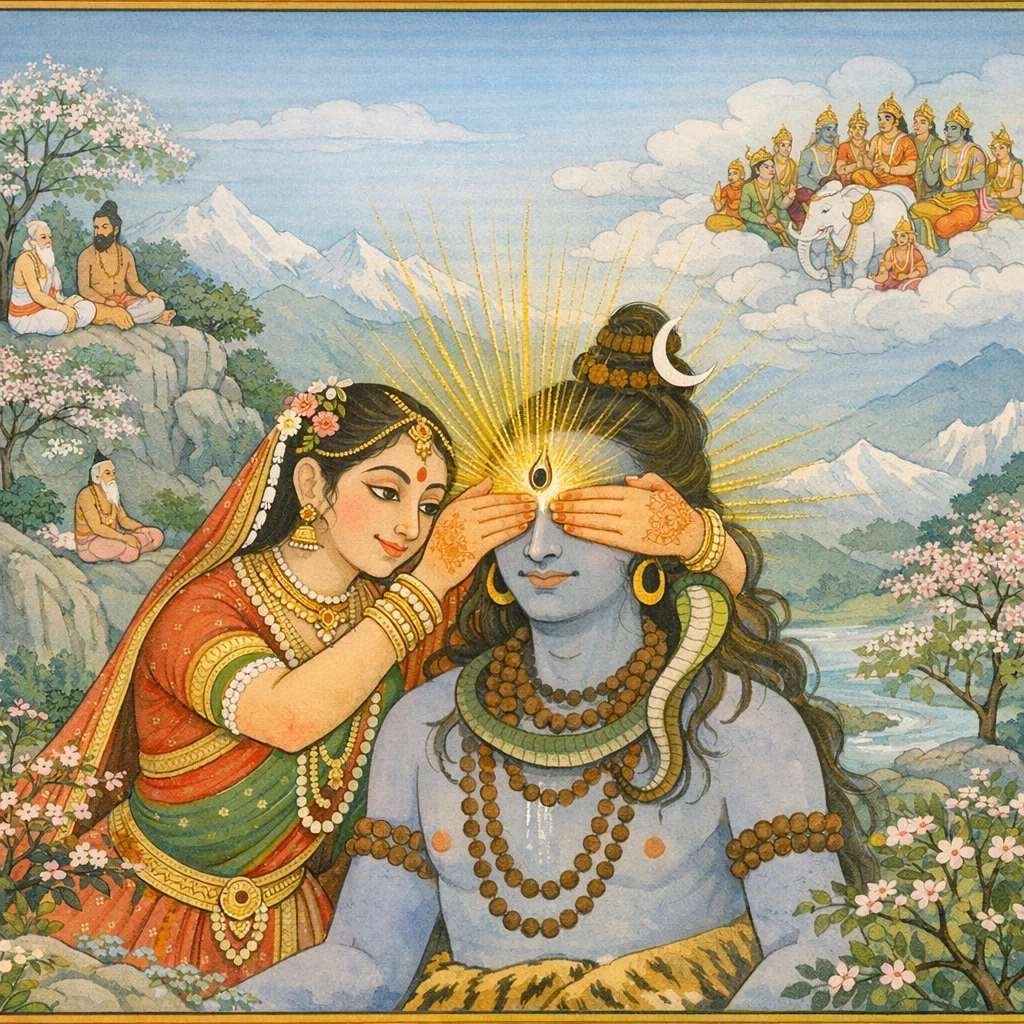
Chapter Arc: नारद हिमालय के पुण्य, सिद्ध-चारण-सेवित प्रदेश का वर्णन करते हुए उस दिव्य स्थल की ओर कथा को मोड़ते हैं जहाँ वृषभध्वज शंकर तप में स्थित हैं। → ऋतुएँ अद्भुत पुष्प-वृष्टि से वातावरण को अलौकिक बनाती हैं; उसी दिव्यता के बीच उमा क्रीड़ा-हास के लिए सहसा शंकर के दोनों नेत्र बंद कर देती हैं—और जगत के प्रकाश का स्रोत क्षणभर को अवरुद्ध हो जाता है। → नेत्र-आवरण के प्रतिउत्तर में शंकर के ललाट से आदित्य-सदृश, युगान्त-प्राय दीप्त तृतीय नेत्र प्रकट होता है; उसकी ज्वाला-तेज से पर्वत तक ‘मथित’/विक्षुब्ध हो उठता है और सृष्टि-स्थितियों का संतुलन डगमगा जाता है। → देव-गण, महाभूत, मरुद्-वसु-साध्य-विश्वेदेव, यक्ष-नाग आदि समवेत होकर भूतनाथ के भयानक-पर-शोभित धाम/सभा में उपस्थित होते हैं; वृषभध्वज भक्तों को अभय देने वाले रूप में प्रतिष्ठित होते हैं और उनका स्थान अद्भुत शोभा पा जाता है। → भयानक रूपधर सभा-स्थल के ‘क्षणभर में’ रूपान्तर के बाद, समवेत देवसमुदाय के समक्ष आगे कौन-सा वर/उपदेश/नियम प्रतिष्ठित होगा—यह उत्कंठा बनी रहती है।
Shlokas
Verse 1
(दाक्षिणात्य अधिक पाठका १ श्लोक मिलाकर कुल ५१ श्लोक हैं) अपने-आप बछ। ्,, चत्वारिशर्दाधिकशततमोब ध्याय: नारदजीके द्वारा हिमालय पर्वतपर भूतगणोंके सहित शिवजीकी शोभाका विस्तृत वर्णन, पार्ववीका आगमन शिवजीकी दोनों आँखोंको अपने हाथोंसे बंद करना और तीसरे नेत्रका प्रकट होना, हिमालयका भस्म होना और पुनः प्राकृत अवस्थामें हो जाना तथा शिव-पार्वतीके धर्मविषयक संवादकी उत्थापना भीष्म उवाच ततो नारायणसुद्न्नारदो भगवानृषि: । शड्करस्योमया सार्ध संवादं प्रत्यभाषत,भीष्मजी कहते हैं--युधिष्ठि! तदनन्तर श्रीनारायणके सुहृद् भगवान् नारदमुनिने शंकरजीका पार्वतीके साथ जो संवाद हुआ था, उसे बताना आरम्भ किया
Bhīṣma said: Then the blessed sage Nārada—dear to Nārāyaṇa—began to recount the dialogue that had taken place between Śaṅkara (Śiva) and Umā (Pārvatī).
Verse 2
नारद उवाच तपश्चचार धर्मात्मा वृषभाड्क: सुरेश्वर: । पुण्ये गिरो हिमवति सिद्धचारणसेविते,नारदजीने कहा--भगवन्! जहाँ सिद्ध और चारण निवास करते है, जो नाना प्रकारकी ओषधियोंसे सम्पन्न तथा भाँति-भाँतिके फूलोंसे व्याप्त होनेके कारण रमणीय जान पड़ता है, जहाँ झुंड-की-झुंड अप्सराएँ भरी रहती हैं और भूतोंकी टोलियाँ निवास करती हैं; उस परम पवित्र हिमालयपर्वतपर धर्मात्मा देवाधिदेव भगवान् शंकर तपस्या कर रहे थे
Narada said: The righteous Lord of the gods, Śiva—marked by the bull—was performing austerities on the holy Himalayan mountain, a sacred region frequented by Siddhas and Cāraṇas. The scene underscores the ideal of divine self-discipline: even the supreme deity upholds dharma through tapas, making the Himalaya a paradigmatic setting for purity, restraint, and spiritual attainment.
Verse 3
नानौषधियुते रम्ये नानापुष्पसमाकुले । अप्सरोगणसंकीर्णे भूतसंघनिषेविते,नारदजीने कहा--भगवन्! जहाँ सिद्ध और चारण निवास करते है, जो नाना प्रकारकी ओषधियोंसे सम्पन्न तथा भाँति-भाँतिके फूलोंसे व्याप्त होनेके कारण रमणीय जान पड़ता है, जहाँ झुंड-की-झुंड अप्सराएँ भरी रहती हैं और भूतोंकी टोलियाँ निवास करती हैं; उस परम पवित्र हिमालयपर्वतपर धर्मात्मा देवाधिदेव भगवान् शंकर तपस्या कर रहे थे
Nārada said: “O Blessed Lord! On that supremely holy Himalayan mountain—where Siddhas and Cāraṇas dwell, which is charming with many kinds of medicinal herbs and thick with diverse flowers, crowded with hosts of Apsarases, and frequented by companies of Bhūtas—there the righteous Lord of gods, Bhagavān Śaṅkara, was engaged in austerity.”
Verse 4
तत्र देवो मुदा युक्तो भूतसंघशतैर्व॑त: । नानारूपैर्विख्पैश्व दिव्यैरद्भुतदर्शनै:,उस स्थानपर महादेवजी सैकड़ों भूतसमुदायोंसे घिरे रहकर बड़ी प्रसन्नताका अनुभव करते थे। उन भूतोंके रूप नाना प्रकारके एवं विकृत थे, किन्हीं-किन्हींके रूप दिव्य एवं अद्भुत दिखायी देते थे
There, the great God (Mahādeva), surrounded by hundreds of companies of bhūtas, rejoiced in gladness. Those attendant beings appeared in many kinds of forms—often grotesque and distorted, yet in some cases radiant and wondrous to behold—marking the awe-inspiring majesty of Śiva’s abode and retinue.
Verse 5
सिंहव्याप्रगजप्रख्यै: सर्वजातिसमन्वितै: । क्रोष्टकद्वीपिवदनैरऋ्रक्षर्ष भमुखैस्तथा,कुछ भूतोंकी आकृति सिंहों, व्याप्रों एवं गजराजोंके समान थी। उनमें सभी जातियोंके प्राणी सम्मिलित थे। कितने ही भूतोंके मुख सियारों, चीतों, रीछों और बैलोंके समान थे
Nārada said: “Some of those beings had forms resembling lions, tigers, and lordly elephants. They appeared as a mingling of creatures of every kind. Many had faces like jackals and leopards, and likewise like bears and bulls.”
Verse 6
उलूकवदनैर्भीमैर्व॒कश्येनमुखैस्तथा । नानावर्णर्मुगमुखै: सर्वजातिसमन्वितै:,कितने ही उल्लू-जैसे मुखवाले थे। बहुत-से भयंकर भूत भेड़ियों और बाजोंके समान मुख धारण करते थे। और कितनोंके मुख हरिणोंके समान थे। उन सबके वर्ण अनेक प्रकारके थे तथा वे सभी जातियोंसे सम्पन्न थे
Narada said: “Some had faces like owls; others, terrifying in appearance, bore faces like wolves and hawks. Still others had faces like deer. Their complexions were of many kinds, and they seemed to embody every sort of species.”
Verse 7
किंनरैर्यक्षगन्धर्व रक्षोभूतगणैस्तथा । दिव्यपुष्पसमाकीर्ण दिव्यज्वालासमाकुलम्,इनके सिवा बहुत-से किन्नरों, यक्षों, गन्धर्वों, राक्षमों तथा भूतगणोंने भी महादेवजीको घेर रखा था। भगवान् शंकरकी वह सभा दिव्य पुष्पोंसे आच्छादित, दिव्य तेजसे व्याप्त, दिव्य चन्दनसे चर्चित और दिव्य धूपकी सुगन्धसे सुवासित थी। वहाँ दिव्य वाद्योंकी ध्वनि गूँजती रहती थी। मृदंग और पणवका घोष छाया रहता था। शंख और भेरियोंके नाद सब ओर व्याप्त हो रहे थे। चारों ओर नाचते हुए भूतसमुदाय और मयूर उसकी शोभा बढ़ाते थे
Nārada said: “It was encircled as well by hosts of Kiṁnaras, Yakṣas, Gandharvas, Rākṣasas, and Bhūtas. That divine assembly of Mahādeva was strewn with celestial flowers and filled on every side with a blaze of heavenly radiance.”
Verse 8
दिव्यचन्दनसंयुक्तं दिव्यधूपेन धूपितम् तत् सदो वृषभाड्कस्य दिव्यवादित्रनादितम्,इनके सिवा बहुत-से किन्नरों, यक्षों, गन्धर्वों, राक्षमों तथा भूतगणोंने भी महादेवजीको घेर रखा था। भगवान् शंकरकी वह सभा दिव्य पुष्पोंसे आच्छादित, दिव्य तेजसे व्याप्त, दिव्य चन्दनसे चर्चित और दिव्य धूपकी सुगन्धसे सुवासित थी। वहाँ दिव्य वाद्योंकी ध्वनि गूँजती रहती थी। मृदंग और पणवका घोष छाया रहता था। शंख और भेरियोंके नाद सब ओर व्याप्त हो रहे थे। चारों ओर नाचते हुए भूतसमुदाय और मयूर उसकी शोभा बढ़ाते थे
Narada said: “That assembly hall of the Bull-bannered Lord (Śiva) was anointed with celestial sandalwood and perfumed with heavenly incense; it resounded continually with the music of divine instruments.”
Verse 9
मृदज़पणवोदघुष्ट शड्खभेरीनिनादितम् | नृत्यद्धिर्भूतसंघैश्व बहिणैश्न समनतत:,इनके सिवा बहुत-से किन्नरों, यक्षों, गन्धर्वों, राक्षमों तथा भूतगणोंने भी महादेवजीको घेर रखा था। भगवान् शंकरकी वह सभा दिव्य पुष्पोंसे आच्छादित, दिव्य तेजसे व्याप्त, दिव्य चन्दनसे चर्चित और दिव्य धूपकी सुगन्धसे सुवासित थी। वहाँ दिव्य वाद्योंकी ध्वनि गूँजती रहती थी। मृदंग और पणवका घोष छाया रहता था। शंख और भेरियोंके नाद सब ओर व्याप्त हो रहे थे। चारों ओर नाचते हुए भूतसमुदाय और मयूर उसकी शोभा बढ़ाते थे
Nārada said: “That divine assembly resounded with the booming of mṛdaṅgas and paṇavas, and was filled on every side with the calls of conches and the roar of kettledrums. It was further adorned by hosts of dancing bhūtas and by peacocks.”
Verse 10
प्रनृत्ताप्सरसं दिव्यं देवर्षिगणसेवितम् । दृष्टिकान्तमनिर्देश्यं दिव्यमद््भुतदर्शनम्,वहाँ अप्सराएँ नृत्य करती थीं, वह दिव्य सभा देवर्षियोंके समुदायोंसे शोभित, देखनेमें मनोहर, अनिर्वचनीय, अलौकिक और अदभुत थी
Narada said: “There, celestial Apsarases danced. That divine assembly-hall, attended by companies of devarṣis, was delightful to behold—indescribable, otherworldly, and wondrous in its appearance.”
Verse 11
स गिरिस्तपसा तस्य गिरिशस्य व्यरोचत । स्वाध्यायपरमैविंप्रैर्ब्रहद्यघोषो निनादित:,भगवान् शंकरकी तपस्यासे उस पर्वतकी बड़ी शोभा हो रही थी। स्वाध्यायपरायण ब्राह्मणोंकी वेद-ध्वनि वहाँ सब ओर गूँज रही थी
Nārada said: “That mountain shone with the austerities performed there for the sake of Girīśa (Śiva). All around it resounded the deep, expansive sound of Vedic recitation, raised by brāhmaṇas devoted to self-study—making the place radiant with disciplined worship and sacred learning.”
Verse 12
षट्पदैरुपगीतैश्व माधवाप्रतिमो गिरि: । तन्महोत्सवसंकाशं भीमरूपधरं तत:
Nārada said: “And then that mountain—resplendent like Mādhava (Viṣṇu)—was celebrated with the humming songs of bees. Thereafter, a formidable being, assuming a terrifying form, appeared, dazzling like a great festival.”
Verse 13
दृष्टवा मुनिगणस्यासीत् परा प्रीतिर्जनार्दन । माधव! वह अनुपम पर्वत भ्रमरोंके गीतोंसे अत्यन्त सुशोभित हो रहा था। जनार्दन! वह स्थान अत्यन्त भयंकर होनेपर भी महान् उत्सवसे सम्पन्न-सा प्रतीत होता था। उसे देखकर मुनियोंके समुदायको बड़ी प्रसन्नता हुई ।। मुनयश्ल महाभागा: सिद्धाश्रैवोर्ध्वरेतस:,वाता: सर्वे महाभूतास्तत्रैवासन् समागता: । महान् सौभाग्यशाली मुनि, ऊर्ध्वरेता सिद्धणण, मरुदगण, वसुगण, साध्यगण, इन्द्रसहित विश्वेदेवगण, यक्ष और नाग, पिशाच, लोकपाल, अग्नि, समस्त वायु और प्रधान भूतगण वहाँ आये हुए थे
Nārada said: “O Janārdana, when the company of sages beheld it, they were filled with supreme delight. O Mādhava, that incomparable mountain was exceedingly beautiful, adorned by the songs of bees. O Janārdana, though the place was extremely fearsome, it appeared as if endowed with the splendor of a great festival. Seeing it, the assembly of sages felt great joy. There, the highly fortunate sages, the Siddhas, and the ascetics of steadfast continence were gathered; the Maruts and the great elemental powers were present as well. The Vasus, the Sādhyas, the Viśvedevas together with Indra, along with Yakṣas and Nāgas, Piśācas, the guardians of the directions, Agni, all the winds, and the principal elemental beings—all had assembled there.”
Verse 14
मरुतो वसव: साध्या विश्वेदेवा: सवासवा: । यक्षा नागा: पिशाचाश्न लोकपाला हुताशना:
Narada said: “The Maruts, the Vasus, the Sādhyas, the Viśvedevas along with Indra, the Yakṣas, the Nāgas, the Piśācas, the guardians of the worlds, and Agni—these divine and semi-divine orders are all present here.”
Verse 15
ऋतव: सर्वपुष्पैश्न व्यकिरन्त महाद्भुतै:ः
Nārada said: “The seasons, as if in joyful accord with righteousness, showered forth all kinds of wondrous flowers, filling the scene with auspicious beauty and signaling a divinely ordered harmony in the world.”
Verse 16
विहज़ाश्च मुदा युक्ता: प्रानृत्यन् व्यनदंश्व ह
Nārada said: “And the birds too, filled with joy, began to dance and, indeed, to cry out loudly.”
Verse 17
तत्र देवो गिरितटे दिव्यधातुविभूषिते
There, upon a mountainside adorned with wondrous mineral splendors, the divine being was present—setting the scene for a sacred encounter in a place marked by natural purity and auspiciousness.
Verse 18
व्याप्रचर्माम्बरधर: सिंहचर्मोत्तरच्छद:,अभय: सर्वभूतानां भक्तानां वृष१भध्वज: । उन्होंने व्याप्रचर्मको ही वस्त्रके रूपमें धारण कर रखा था। सिंहका चर्म उनके लिये उत्तरीय वस्त्र (चादर)का काम देता था। उनके गलेमें सर्पमय यज्ञोपवीत शोभा दे रहा था। वे लाल रंगके बाजूबंदसे विभूषित थे। उनकी मूँछ काली थी, मस्तकपर जटाजूट शोभा पाता था। वे भीमस्वरूप रुद्र देवद्रोहियोंके मनमें भय उत्पन्न करते थे। अपनी ध्वजामें वृषभका चिह्न धारण करनेवाले वे भगवान् शिव भक्तों तथा सम्पूर्ण भूतोंके भयका निवारण करते थे
Nārada said: “He wore a tiger-skin as his garment, and a lion-skin served him as an upper covering. Bearing the bull upon his banner, he was the giver of fearlessness—dispelling dread for his devotees and for all beings.”
Verse 19
व्यालयज्ञोपवीती च लोहिताड्गदभूषण: । हरिश्मश्रुर्जटी भीमो भयकर्ता सुरद्विषाम्
Nārada said: He wore a sacred thread made of serpents, and his ornaments and armlets were red. With tawny beard and matted locks, he appeared terrible—one who inspires fear in the enemies of the gods.
Verse 20
दृष्टवा महर्षय: सर्वे शिरोभिरवरनिं गता:
Nārada said: Having seen it, all the great seers bowed their heads and lowered themselves in reverence—an outward sign of humility and recognition of a higher spiritual authority.
Verse 21
(गीर्भि: परमशुद्धाभिस्तुष्टवुश्च मनोहरम् ।।) विमुक्ता: सर्वपापेभ्य: क्षान्न्ता विगतकल्मषा: | भगवान् शंकरका दर्शन करके उन सभी महर्षियोंने पृथ्वीपर सिर रखकर उन्हें प्रणाम किया और परम शुद्ध वाणीद्वारा उनकी मनोहर स्तुति की। वे सभी ऋषि सम्पूर्ण पापोंसे मुक्त, क्षमाशील और कल्मषरहित थे ।। तस्य भूतपते: स्थानं भीमरूपधरं बभौ
Nārada said: With supremely pure words those sages praised him with a pleasing hymn. Freed from all sins, patient in forbearance, and cleansed of every stain, they bowed to Lord Śaṅkara, placing their heads upon the earth in reverence. Then the abode of that Lord of beings appeared, assuming a formidable, awe-inspiring form.
Verse 22
क्षणेनैवाभवत् सर्वमद्भुतं मधुसूदन
Nārada said: “In a single instant, O Madhusūdana, everything became wondrous.”
Verse 23
तमभ्ययाच्छैलसुता भूतस्त्रीगणसंवृता,उस समय भूतोंकी स्त्रियोंसे घिरी हुई गिरिराज-नन्दिनी उमा सम्पूर्ण तीर्थोके जलसे भरा हुआ सोनेका कलश लिये उनके पास आयीं। उन्होंने भी भगवान् शंकरके समान ही वस्त्र धारण किया था। वे भी उन्हींकी भाँति उत्तम व्रतका पालन करती थीं
Nārada said: Then Umā, the Daughter of the Mountain, surrounded by the wives of the bhūtas, approached him. She came bearing a golden pitcher filled with water gathered from all sacred fords (tīrthas). Like Lord Śaṅkara himself, she wore the same kind of garments and observed an excellent vow with the same steadfast discipline.
Verse 24
हरतुल्याम्बरधरा समानव्रतधारिणी । बिभ्रती कलशं रौक्मं सर्वतीर्थजलोद्धवम्,उस समय भूतोंकी स्त्रियोंसे घिरी हुई गिरिराज-नन्दिनी उमा सम्पूर्ण तीर्थोके जलसे भरा हुआ सोनेका कलश लिये उनके पास आयीं। उन्होंने भी भगवान् शंकरके समान ही वस्त्र धारण किया था। वे भी उन्हींकी भाँति उत्तम व्रतका पालन करती थीं
Nārada said: “Clad in garments of a hue like turmeric, and observing a vow akin to his, she bore a golden water-pot filled with water drawn from all sacred fords.”
Verse 25
गिरिस्रवाभि: सर्वाभि: पृष्ठतो5नुगता शुभा । पुष्पवृष्टयाभिवर्षन्ती गन्धैर्बहुविधैस्तथा । सेवन्ती हिमवत् पार्श्व हरपार्श्वमुपागमत्,उनके पीछे-पीछे उस पर्वतसे गिरनेवाली सभी नदियाँ चल रही थीं। शुभलक्षणा पार्वती फूलोंकी वर्षा करती और नाना प्रकारकी सुगन्ध बिखेरती हुई भगवान् शिवके पास आयीं। वे भी हिमालयके पार्श्रभागका ही सेवन करती थीं
Nārada said: Auspicious Pārvatī advanced with all the mountain-streams following behind her. Showering flowers and spreading many kinds of fragrance, she approached Hara (Śiva). She moved along the very flank of Himavat, coming to the side of the Lord.
Verse 26
ततः स्मयन्ती पाणिभ्यां नर्मार्थ चारुहासिनी । हरनेत्रे शुभे देवी सहसा सा समावृणोत्
Then, smiling—she whose laughter was charming and playful—the Goddess suddenly covered Hara’s two auspicious eyes with her hands, as if in jest.
Verse 27
आते ही मनोहर हास्यवाली देवी उमाने मनोरंजन या हास-परिहासके लिये मुसकराकर अपने दोनों हाथोंसे सहसा भगवान् शंकरके दोनों नेत्र बंद कर लिये ।। संवृताभ्यां तु नेत्रा भ्यां तमोभूतमचेतनम् । निहोॉम निर्वषट््कारं जगद् वै सहसाभवत्,उनके दोनों नेत्रोंके आच्छादित होते ही सारा जगत् सहसा अन्धकारमय, चेतनाशून्य तथा होम और वषट्कारसे रहित हो गया
Nārada said: When the Lord’s two eyes were suddenly covered, the entire world at once was engulfed in darkness, bereft of consciousness and stripped of sacred rites—no fire-offerings were made and no vaṣaṭ-calls were heard.
Verse 28
जनश्न विमना: सर्वो5भवत् त्राससमन्वित: । निमीलिते भूतपतौ नष्टसूर्य इवाभवत्,सब लोग अनमने हो गये, सबके ऊपर त्रास छा गया। भूतनाथके नेत्र बंद कर लेनेपर इस संसारकी वैसी ही दशा हो गयी, मानो सूर्यदेव नष्ट हो गये हैं
Nārada said: Then all the people became downcast, and fear seized them. When the Lord of beings closed his eyes, the world seemed as though the sun itself had vanished—plunged into a darkness born of dread and the loss of protective order.
Verse 29
ततो वितिमिरो लोक: क्षणेन समपद्यत | ज्वाला च महती दीप्ता ललाटात् तस्य नि:सृता,तदनन्तर क्षणभरमें सारे जगत्का अन्धकार दूर हो गया। भगवान् शिवके ललाटसे अत्यन्त दीप्तिशालिनी महाज्वाला प्रकट हो गयी
Then, in an instant, the world became free of darkness. Immediately thereafter, a great blaze—brilliant and overpowering—issued forth from Śiva’s forehead, dispelling obscurity and manifesting divine power that restores order and clarity.
Verse 30
तृतीयं चास्य सम्भूत॑ नेत्रमादित्यसंनिभम् | युगान्तसदृशं दीप्तं येनासौ मथितो गिरि:,उनके ललाटमें आदित्यके समान तेजस्वी तीसरे नेत्रका आविर्भाव हो गया। वह नेत्र प्रलयाग्निके समान देदीप्यमान हो रहा था। उस नेत्रसे प्रकट हुई ज्वालाने उस पर्वतको जलाकर मथ डाला
Then, upon his forehead, there arose a third eye, radiant like the sun. It blazed like the fire of dissolution at the end of an age; and by the flame that issued from that eye, the mountain was burned and crushed to ruin.
Verse 31
ततो गिरिसुता दृष्ट्वा दीप्ताग्निसदृशेक्षणम् । हरं प्रणम्य शिरसा ददर्शायतलोचना,तब महादेवजीको प्रज्वलित अग्निके सदृश तीसरे नेत्रसे युक्त हुआ देख गिरिराजनन्दिनी विशाललोचना उमाने सिरसे प्रणाम करके उनकी ओर चकित दृष्टिसे देखा
Then the Daughter of the Mountain, seeing Hara endowed with a third eye like blazing fire, bowed her head in reverence. Wide-eyed Umā looked up at him in astonishment, beholding his terrible, radiant aspect.
Verse 32
दहामाने वने तस्मिन् ससालसरलठद्रुमे । सचन्दनवरे रम्ये दिव्यौषधिविदीपिते,साल और सरल आदि वृक्षोंसे युक्त, श्रेष्ठ चन्दन-वृक्षसे सुशोभित तथा दिव्य ओषधियोंसे प्रकाशित उस रमणीय वनमें आग लग गयी थी और वह सब ओरसे जल रहा था
Nārada said: In that forest—filled with śāla and sarala and other trees, adorned with excellent sandalwood, and made radiant by divine medicinal herbs—a fire had broken out. The lovely woodland was burning on every side.
Verse 33
मृगयूथैद्रतैर्भीतैर्हरपार्श्वमुपागतै: । शरणं चाप्यविन्दद्धिस्तत् सद: संकुलं बभौ,भयभीत मृगोंके झुंडोंको जब कहीं भी शरण न मिली, तब वे भागते हुए महादेवजीके पास आ पहुँचे। उनसे वह सारा सभास्थल भर गया और उसकी अपूर्व शोभा होने लगी
Nārada said: Terrified herds of deer, fleeing in haste, came close to Hara (Śiva). Finding no refuge elsewhere, they gathered there, and the entire assembly-hall became crowded—taking on an uncommon beauty through the presence of those fear-stricken creatures seeking protection.
Verse 34
ततो नभस्पृशज्वालो विद्युल्लोलाग्निसल्बण: । द्वादशादित्यसदृशो युगान्ताग्निरिवापर:,वहाँ लगी हुई आगकी लपटें आकाशको चूम रही थीं। विद्युतके समान चंचल हुई वह आग बड़ी भयानक प्रतीत हो रही थी, वह बारह सूर्योंके समान प्रकाशित होकर दूसरी प्रलयाग्निके समान प्रतीत होती थी
Then the flames rose skyward, as though they would touch the heavens. Flickering like lightning, the fire looked dreadful—shining like twelve suns, it seemed like another conflagration of the world’s end, like the fire of yugānta.
Verse 35
क्षणेन तेन निर्दग्धो हिमवानभवन्नग: । सधातुशिखराभोगो दीप्तदग्धलतौषधि:
Nārada said: “In that very instant, the mountain Himavān was scorched. Its mineral-bearing peaks and broad ridges were seared, and its creepers and medicinal herbs were left blazing and burnt.”
Verse 36
उसने क्षणभरमें हिमालय पर्वतको धातु और विशाल शिखरोंसहित दग्ध कर डाला। उसकी लताएँ और ओषधियाँ प्रजवलित हो जलकर भस्म हो गयीं ।। त॑ दृष्टवा मथितं शैलं शैलराजसुता तत:ः । भगवन्तं प्रपन्ना वै साउ्जलिप्रग्रहा स्थिता,उस पर्वतको दग्ध हुआ देख गिरिराजकुमारी उमा दोनों हाथ जोड़कर भगवान् शंकरकी शरणमें गयीं
In a single instant, the Himālaya was burned—minerals and mighty peaks alike; its creepers and medicinal herbs flared up and were reduced to ash. Seeing the mountain shattered and scorched, Umā, daughter of the King of Mountains, approached Bhagavān Śaṅkara for refuge, standing with folded hands.
Verse 37
उमां शर्वस्तदा दृष्ट्वा स्त्री भावगतमार्दवाम् । पितुर्देन्यमनिच्छन्ती प्रीत्यापश्यत् तदा गिरिम्,उस समय उमामें नारी-स्वभाववश मृदुता (कातरता) आ गयी थी। वे पिताकी दयनीय अवस्था नहीं देखना चाहती थीं। उनकी ऐसी दशा देख भगवान् शंकरने हिमवान् पर्वतकी ओर प्रसन्नतापूर्ण दृष्टिसे देखा
Seeing Umā softened by the tender vulnerability natural to a woman’s feeling, Śarva (Śiva) perceived that she did not wish to behold her father’s pitiable state. At that moment, with a pleased and gracious glance, he looked toward the mountain Himavān, as if granting compassionate approval and readiness to respond without humiliating the distressed father.
Verse 38
क्षणेन हिमवान् सर्व: प्रकृतिस्थ: सुदर्शन: । प्रहृष्विहगश्नैव सुपुष्पितवनद्रुम:,उनकी दृष्टि पड़नेपर क्षणभरमें सारा हिमालय पर्वत पहली स्थितिमें आ गया। देखनेमें परम सुन्दर हो गया। वहाँ हर्षमें भरे हुए पक्षी कलरव करने लगे। उस वनके वृक्ष सुन्दर पुष्पोंसे सुशोभित हो गये
Nārada said: “In an instant, the entire Himālaya returned to its natural, original condition and became exceedingly beautiful to behold. Birds, filled with joy, began to sing out, and the trees of that forest were adorned with lovely blossoms.”
Verse 39
प्रकृतिस्थं गिरिं दृष्टवा प्रीता देवं महेश्वरम् । उवाच सर्वलोकानां पतिं शिवमनिन्दिता,पर्वतको पूर्वावस्थामें स्थित हुआ देख पतित्रता पार्वती देवी बहुत प्रसन्न हुईं। फिर उन्होंने सम्पूर्ण लोकोंके स्वामी कल्याणस्वरूप महेश्वरदेवसे पूछा
Seeing the mountain restored to its natural, former state, the blameless Pārvatī was filled with joy. Then she addressed Mahādeva—Maheśvara, Śiva, the auspicious Lord and protector of all worlds—reverently seeking further understanding from him.
Verse 40
उमोवाच भगवन् सर्वभूतेश शूलपाणे महाव्रत । संशयो मे महान् जातस्तन्मे व्याख्यातुमहसि
Umā said: “O Blessed Lord—Lord of all beings, bearer of the trident, great in sacred vows—a great doubt has arisen in me. Please explain it to me.”
Verse 41
उमा बोलीं--भगवन! सर्वभूतेश्वर! शूलपाणे! महान् व्रतधारी महेश्वर! मेरे मनमें एक महान् संशय उत्पन्न हुआ है। आप मुझसे उसकी व्याख्या कीजिये ।। किमर्थ ते ललाटे वै तृतीयं नेत्रमुत्थितम् । किमर्थ च गिरि॑ग्ध: सपक्षिगणकानन:
Uma said: “O Lord, Sovereign of all beings, bearer of the trident, great Maheshvara who upholds mighty vows—there has arisen in my mind a serious doubt. Please explain it to me. For what reason did a third eye arise upon your forehead? And for what reason are you called the mountain-vulture, the one who ranges with flocks of winged creatures in the forest?”
Verse 42
किमर्थ च पुनर्देव प्रकृतिस्थस्त्वया कृत: । तथैव द्रुमसंच्छन्न: कृतोडयं ते पिता मम
Nārada said: “For what reason, O divine one, did you cause him to remain in his natural state? And why, in the same way, was my father made to lie hidden beneath the cover of trees?”
Verse 43
क्यों आपके ललाटमें तीसरा नेत्र प्रकट हुआ? किसलिये आपने पक्षियों और वनोंसहित पर्वतको दग्ध किया और देव! फिर किसलिये आपने उसे पूर्वावस्थामें ला दिया। मेरे इन पिताको आपने जो पूर्ववत् वृक्षोंसे आच्छादित कर दिया, इसका क्या कारण है? ।। (एष मे संशयो देव हृदि मे सम्प्रवर्तते । देवदेव नमस्तुभ्यं तन्मे शंसितुमरहसि ।। देवदेव! मेरे हृदयमें यह संदेह विद्यमान है। आप इसका समाधान करनेकी कृपा करें। आपको मेरा सादर नमस्कार है ।। नारद उवाच एवमुक्तस्तथा देव्या प्रीयमाणो<ब्रवीद् भव: ।।) नारदजी कहते हैं--देवी पार्ववीके ऐसा कहने-पर भगवान् शंकर प्रसन्न होकर बोले ।। श्रीमहेश्वर उवाच (स्थाने संशयितु देवि धर्मज्ञे प्रियभाषिणी ।। त्वदते मां हि वै प्रष्टं न शक््यं केनचित प्रिये । श्रीमहेश्वरने कहा--धर्मको जानने तथा प्रिय वचन बोलनेवाली देवि! तुमने जो संशय उपस्थित किया है, वह उचित ही है। प्रिये! तुम्हारे सिवा दूसरा कोई मुझसे ऐसा प्रश्न नहीं कर सकता ।। प्रकाशं यदि वा गुह्ां प्रियार्थ प्रब्रवीम्पहम् ।। शृणु तत् सर्वमखिलमस्यां संसदि भामिनी । भामिनि! प्रकट या गुप्त जो भी बात होगी, तुम्हारा प्रिय करनेके लिये मैं सब कुछ बताऊँगा। तुम इस सभामें मुझसे सारी बातें सुनो ।। सर्वेषामेव लोकानां कूटस्थं विद्धि मां प्रिये ।। मदधीनास्त्रयो लोका यथा विष्णौ तथा मयि | स््रष्टा विष्णुरहं गोप्ता इत्येतद् विद्धि भामिनि ।। प्रिये! सभी लोकोंमें मुझे कूटस्थ समझो। तीनों लोक मेरे अधीन हैं। ये जैसे भगवान् विष्णुके अधीन हैं, उसी प्रकार मेरे भी अधीन हैं। भामिनि! तुम यही जान लो कि भगवान् विष्णु जगतके स्रष्टा हैं और मैं इसकी रक्षा करनेवाला हूँ ।। तस्माद् यदा मां स्पृशति शुभं वा यदि वेतरत् । तथैवेदं जगत् सर्व तत्तद् भवति शोभने ।।) शोभने! इसीलिये जब मुझसे शुभ या अशुभका स्पर्श होता है, तब यह सारा जगत् वैसा ही शुभ या अशुभ हो जाता है ।। नेत्रे मे संवृते देवि त्वया बाल्यादनिन्दिते । नष्टालोकस्तदा लोक: क्षणेन समपद्यत,देवि! अनिन्दिते! तुमने अपने भोलेपनके कारण मेरी दोनों आँखें बंद कर दीं। इससे क्षणभरमें समस्त संसारका प्रकाश तत्काल नष्ट हो गया
Śrī Maheśvara said: “Your doubt is fitting, O goddess—knower of dharma and speaker of gentle words. Beloved, except for you no one could ask me such a question. Whether the matter is open or secret, I shall tell it for your sake. Listen to everything in full here in this assembly, O radiant one. Know me, beloved, as the unshaken inner ground of all worlds. The three worlds depend on me, just as they depend on Viṣṇu. Understand this, O fair one: Viṣṇu is the creator, and I am the protector. Therefore, when something auspicious—or otherwise—touches me, the entire universe becomes correspondingly auspicious or otherwise, O beautiful one. When you, in childish innocence, closed my two eyes, O blameless goddess, the world at once fell into darkness; in a single moment its light was lost.”
Verse 44
नष्टादित्ये तथा लोके तमोभूते नगात्मजे । तृतीयं लोचन दीप्त॑ सृष्टं मे रक्षता प्रजा:,गिरिराजकुमारी! संसारमें जब सूर्य अदृश्य हो गये और सब ओर अन्धकार-ही- अन्धकार छा गया, तब मैंने प्रजाकी रक्षाके लिये अपने तीसरे तेजस्वी नेत्रकी सृष्टि की है
Maheśvara said: “O daughter of the Mountain, when the sun had vanished from the world and darkness spread everywhere, I brought forth my blazing third eye so that I might protect living beings.”
Verse 45
तस्य चाक्ष्णो महत् तेजो येनायं मथितो गिरि: । त्वत्प्रियार्थ च मे देवि प्रकृतिस्थ: पुनः कृत:,उसी तीसरे नेत्रका यह महान् तेज था, जिसने इस पर्वतको मथ डाला। देवि! फिर तुम्हारा प्रिय करनेके लिये मैंने इस गिरिराज हिमवान्को पुनः प्रकृतिस्थ कर दिया है
That mighty radiance of that eye—the third eye—was what churned and shook this mountain. And, O Goddess, for your sake and to please you, I restored this king of mountains, Himavān, once again to its natural, settled state.
Verse 46
उमोवाच भगवन् केन ते वक्त्र चन्द्रवत् प्रियदर्शनम् । पूर्व तथैव श्रीकान्तमुत्तरं पश्चिमं तथा,उमाने कहा--भगवन्! (आपके चार मुख क्यों हैं) आपका पूर्व दिशावाला मुख चन्द्रमाके समान कान्तिमान् एवं देखनेमें अत्यन्त प्रिय है। उत्तर और पश्चिम दिशाके मुख भी पूर्वकी ही भाँति कमनीय कान्तिसे युक्त हैं। परंतु दक्षिण दिशावाला मुख बड़ा भयंकर है। यह अन्तर क्यों? तथा आपके सिरपर कपिल वर्णकी जटाएँ कैसे हुईं? क्या कारण है कि आपका कण्ठ मोरकी पाँखके समान नीला हो गया?
Umā said: “O Blessed Lord, why do you have these faces? Your face turned to the east is moonlike—radiant and exceedingly pleasing to behold. Your northern and western faces are likewise beautiful and endowed with the same charming splendor. But your southern face is very terrible—why this difference? And how did your matted locks become tawny in color? For what reason has your throat turned blue like a peacock’s feather?”
Verse 47
दक्षिणं च मुखं रौद्रं केनोर्ध्धव कपिला जटा: । केन कण्ठश्न ते नीलो बर्हिब्हनिभ: कृत:,उमाने कहा--भगवन्! (आपके चार मुख क्यों हैं) आपका पूर्व दिशावाला मुख चन्द्रमाके समान कान्तिमान् एवं देखनेमें अत्यन्त प्रिय है। उत्तर और पश्चिम दिशाके मुख भी पूर्वकी ही भाँति कमनीय कान्तिसे युक्त हैं। परंतु दक्षिण दिशावाला मुख बड़ा भयंकर है। यह अन्तर क्यों? तथा आपके सिरपर कपिल वर्णकी जटाएँ कैसे हुईं? क्या कारण है कि आपका कण्ठ मोरकी पाँखके समान नीला हो गया?
Maheshvara said: “Why is your southern face fierce and terrible? By what cause are your matted locks above of tawny (kapila) hue? And for what reason has your throat become blue, like the sheen of a peacock’s feather?”
Verse 48
हस्ते देव पिनाक॑ ते सततं केन तिष्ठति । जटिलो ब्रह्माचारी च किमर्थमसि नित्यदा,देव! आपके हाथमें पिनाक क्यों सदा विद्यमान रहता है? आप किसलिये नित्य जटाधारी ब्रह्मचारीके वेशमें रहते हैं?
Mahādeva asks: “O Lord, why does your bow Pināka remain constantly in your hand? And for what reason do you always abide in the guise of a matted-haired ascetic and a lifelong celibate?”
Verse 49
एतनमे संशयं सर्व वक्तुमर्हसि वै प्रभो । सधर्मचारिणी चाहं भक्ता चेति वृषध्वज,प्रभो! वृषध्वज! मेरे इस सारे संशयका समाधान कीजिये; क्योंकि मैं आपकी सहधर्मिणी और भक्त हूँ
O Lord, you are indeed able to resolve this entire doubt of mine. For I am your companion in dharma—your lawful partner in the sacred path—and I am also your devoted worshipper, O Vṛṣadhvaja (Bearer of the Bull).
Verse 50
भीष्म उवाच एवमुक्त: स भगवान् शैलपुत्रया पिनाकधृत् । तस्या धृत्या च बुद्ध्या च प्रीतिमानभवत् प्रभु:,भीष्मजी कहते हैं--राजन्! गिरिराजकुमारी उमाके इस प्रकार पूछनेपर पिनाकधारी भगवान् शिव उनके धैर्य और बुद्धिसे बहुत प्रसन्न हुए
Bhishma said: Thus addressed by the mountain-born maiden, that blessed Lord—Shiva, bearer of the Pinaka bow—became deeply pleased with her, for her steadfastness and her discerning intelligence.
Verse 51
ततस्तामब्रवीद् देव: सुभगे श्रूयतामिति । हेतुभियर्ममतानि रूपाणि रुचिरानने,तत्पश्चात् उन्होंने पार्ववीजीसे कहा--“सुभगे! रुचिरानने! जिन हेतुओंसे मेरे ये रूप हुए हैं, उन्हें बता रहा हूँ, सुनो
Then the god addressed her: “O fortunate one, O fair-faced lady—listen. I shall explain the reasons by which these forms of mine have come to be.”
Verse 139
इस प्रकार श्रीमह्ााभारत अनुशासनपर्वके अन्तर्गत दानधर्मपर्वमें एक सौ उनतालीसवाँ अध्याय पूरा हुआ
Thus ends the one hundred and thirty-ninth chapter of the Dāna-dharma section within the Anuśāsana Parva of the sacred Mahābhārata. This closing colophon marks the completion of a unit devoted to the ethics of giving and righteous conduct.
Verse 140
इति श्रीमहाभारते अनुशासनपर्वणि दानधर्मपर्वणि उमामहेश्वरसंवादो नाम चत्वारिंशदिधिकशततमो< ध्याय:,इस प्रकार श्रीमह्याभारत अनुशासनपर्वके अन्तर्गत दानधर्मपर्वमें उमामहेश्वरसंवादनामक एक सौ चालीसवाँ अध्याय पूरा हुआ
Thus, in the Śrī Mahābhārata, within the Anuśāsana Parva, in the Dāna-dharma section, the one-hundred-and-fortieth chapter—called “The Dialogue of Umā and Maheśvara”—is concluded. (This is a colophon marking the end of the chapter, not a new doctrinal verse.)
Verse 143
वाता: सर्वे महाभूतास्तत्रैवासन् समागता: । महान् सौभाग्यशाली मुनि, ऊर्ध्वरेता सिद्धणण, मरुदगण, वसुगण, साध्यगण, इन्द्रसहित विश्वेदेवगण, यक्ष और नाग, पिशाच, लोकपाल, अग्नि, समस्त वायु और प्रधान भूतगण वहाँ आये हुए थे
Nārada said: There, all the mighty elemental beings and the hosts of wind had assembled. A great and auspicious sage was present, along with the perfected beings; the Maruts, Vasus, and Sādhyas; the Viśvedevas with Indra; as well as Yakṣas and Nāgas, Piśācas, the guardians of the quarters, Agni, and the various winds and chief classes of beings—all had come to that place. The scene underscores a cosmic gathering in which divine and elemental powers bear witness, suggesting that the matter at hand concerns dharma on a universal scale, not merely human interest.
Verse 156
ओषघध्यो ज्वलमानाश्ष द्योतयन्ति सम तद् वनम् | ऋतुएँ वहाँ उपस्थित हो सब प्रकारके अत्यन्त अद्भुत पुष्प बिखेर रही थीं। ओषधियाँ प्रज्वलित हो उस वनको प्रकाशित कर रही थीं
Nārada said: “The medicinal herbs, as though aflame, lit up that forest on every side. The seasons themselves seemed to have arrived there in person, scattering wondrous flowers of every kind.” In this vision-like description, nature appears harmonized and auspicious—suggesting a realm where order (ṛta/dharma) prevails and the environment becomes a sign of spiritual merit and sacred presence.
Verse 166
गिरिपृष्ठेषु रम्येषु व्याहरन्तो जनप्रिया: । वहाँके रमणीय पर्वतशिखरोंपर लोगोंको प्रिय लगनेवाली बोली बोलते हुए पक्षी प्रसन्नतासे युक्त हो नाचते और कलरव करते थे
Nārada said: Upon the lovely mountain ridges, birds—whose calls were pleasing to people—chattered sweetly, filling the heights with joyful movement and resonant cries, evoking the harmony of a serene, dharma-aligned natural order.
Verse 176
पर्यड्क इव विश्राजन्नुपविष्टो महामना: । दिव्य धातुओंसे विभूषित पर्यकके समान उस पर्वतशिखरपर बैठे हुए महामना महादेवजी बड़ी शोभा पा रहे थे
Nārada said: Seated upon that mountain peak, the great-souled Mahādeva shone brilliantly—like a splendid couch—adorned with divine minerals. The scene emphasizes the majesty of ascetic power: true greatness is not mere ornament, but the radiance that naturally attends spiritual eminence.
Verse 193
अभय: सर्वभूतानां भक्तानां वृष१भध्वज: । उन्होंने व्याप्रचर्मको ही वस्त्रके रूपमें धारण कर रखा था। सिंहका चर्म उनके लिये उत्तरीय वस्त्र (चादर)का काम देता था। उनके गलेमें सर्पमय यज्ञोपवीत शोभा दे रहा था। वे लाल रंगके बाजूबंदसे विभूषित थे। उनकी मूँछ काली थी, मस्तकपर जटाजूट शोभा पाता था। वे भीमस्वरूप रुद्र देवद्रोहियोंके मनमें भय उत्पन्न करते थे। अपनी ध्वजामें वृषभका चिह्न धारण करनेवाले वे भगवान् शिव भक्तों तथा सम्पूर्ण भूतोंके भयका निवारण करते थे
Nārada said: He who is the fearlessness of all beings, the protector of devotees, and whose banner bears the bull—Lord Śiva—wore a tiger-skin as his garment, while a lion-skin served him as an upper wrap. A serpent formed his sacred thread, adorning his neck. Red armlets embellished him; his moustache was black, and a mass of matted locks crowned his head. Terrible in form, Rudra struck fear into the hearts of those who are hostile to the gods; yet for devotees and for all creatures he is the remover of fear. The passage presents a moral contrast: the same divine power that chastises impiety becomes refuge and assurance for the faithful and the innocent.
Verse 216
अप्रधृष्यतरं चैव महोरगसमाकुलम् । भगवान् भूतनाथका वह भयानक स्थान बड़ी शोभा पा रहा था। वह अत्यन्त दुर्धर्ष और बड़े-बड़े सर्पोंसे भरा हुआ था
Narada said: “That place appeared exceedingly formidable and awe-inspiring, radiant in its own dreadful grandeur. It was almost impossible to assail, and it teemed with great serpents—an ominous setting that warns of the peril that follows when one enters fearsome domains without due reverence and restraint.”
Verse 223
तत् सदो वृषभाड्कस्य भीमरूपधरं बभौ | मधुसूदन! वृषभध्वजका वह भयानक सभास्थल क्षणभरमें अद्भुत शोभा पाने लगा
Nārada said: “Then that assembly-hall of Vṛṣabhāṅka (Śiva), taking on a terrifying form, appeared in dreadful majesty. O Madhusūdana, the fearsome hall of Vṛṣabhadhvaja (the Bull-bannered Lord) in a mere moment began to shine with an extraordinary splendor.”
Frequently Asked Questions
The chapter asserts Mahādeva’s unsurpassed status as the origin and regulator of beings across the three worlds, illustrating this through ritual-historical exempla and a catalog of cosmic identifications.
The text models disciplined reverence: proper praise and recitation (Śatarudrīya) and acknowledgment of due shares in ritual contexts are presented as means to restore order when institutions become destabilized.
Rather than an explicit phalaśruti, the chapter provides a functional meta-claim: Mahādeva’s qualities and names are portrayed as immeasurable and inexhaustible to narration, implying that contemplation and stuti exceed purely verbal enumeration.