Adhyaya 7
Varāha-uddhāraṇa and the Re-constitution of Bhū-maṇḍala (Earth after Pralaya)
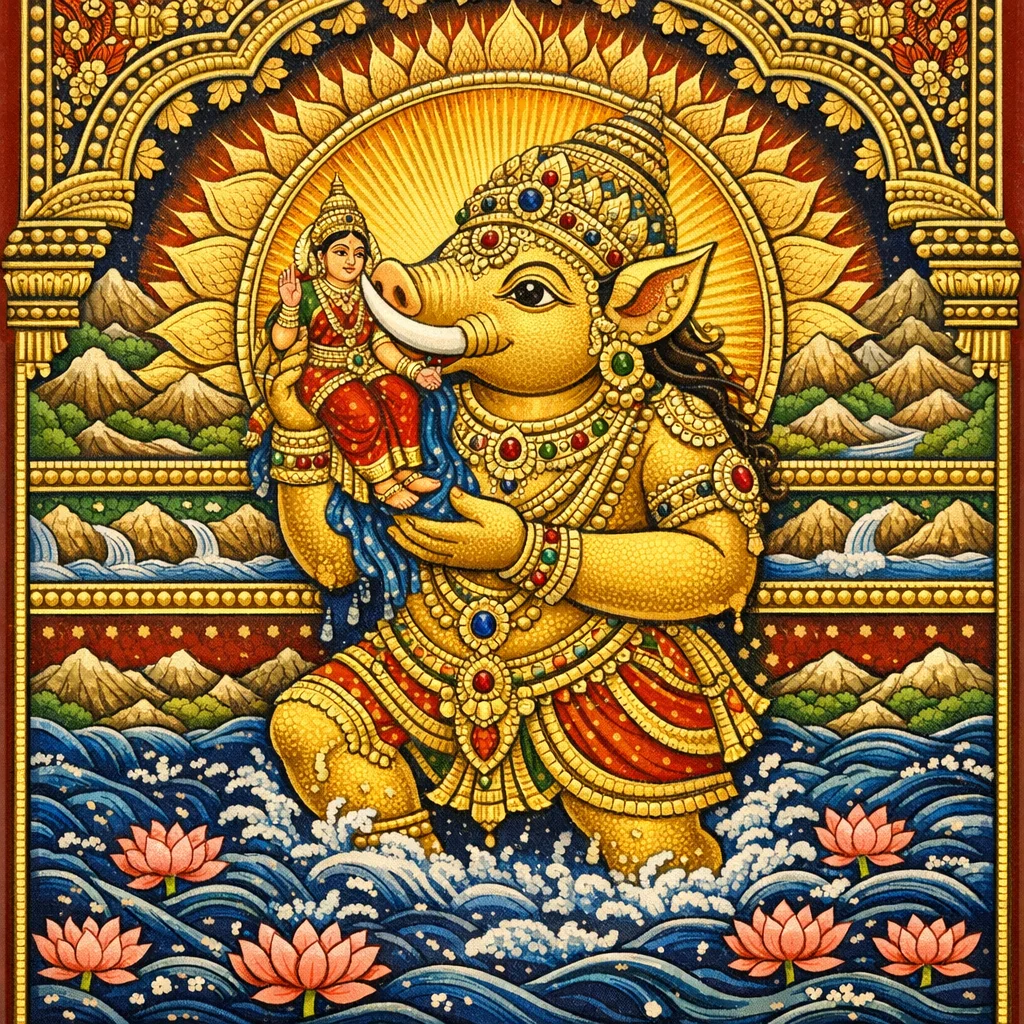
In this Adhyāya, within Sūta’s discourse, a technical cosmogonic episode is told: when Brahmā’s “night” (naiśa kāla), equal to a thousand yugas, ends, creation begins anew. A pralaya-like scene appears—dark waters where moving and unmoving beings have perished or remain unmanifest—followed by Brahmā’s operative power, described as vāyu-like motion within the cosmic ocean. The central act is the recovery of the submerged earth: the deity assumes the Varāha (boar) form, enters the waters, and lifts up the hidden Bhūmi. Once the earth is raised and set in place, the chapter turns to rebuilding the world: oceans and rivers are assigned their domains, and mountains—melted earlier by the saṃvartaka fire—are re-formed and placed, consolidated by wind and deposition. It then points to the standard terrestrial order of Bhū-maṇḍala—seven dvīpas with surrounding oceans—re-establishing habitable, mappable space for later accounts of regions, peoples, and time-cycles.
Shlokas
Verse 1
इति श्रीब्रह्माण्डे महापुराणे वायुप्रोक्ते पूर्वभागे द्वितीये अनुषङ्गापादे कल्पमन्वन्तराख्यानवर्णनं नाम षष्ठो ऽध्यायः सूत उवाच तुल्यं युगसहस्रं वै नैशं कालमुपास्य सः / शर्वर्यंते प्रकुरुते ब्रह्मा तूत्सर्गकारणात्
Thus, in the Śrī Brahmāṇḍa Mahāpurāṇa, proclaimed by Vāyu, in the former section, the sixth chapter called “The Description of the Accounts of Kalpa and Manvantara.” Sūta said: having passed the night-time equal to a thousand yugas, at the end of the night Brahmā sets forth to act, for the cause of releasing creation.
Verse 2
ब्रह्मा तु सलिले तस्मिन् वायुर्भूत्वा तदाचरत् / अन्धकारार्णवे तस्मिन्नष्टे स्थावरजंगमे
In those waters Brahmā moved about, having become the Wind; for in that ocean of darkness all that was immobile and mobile had perished.
Verse 3
जलेन समनुप्लाव्य सर्वतः पृथिवीतले / प्रविभागेन भूतेषु सत्यमात्रे स्थितेषु वा
Water flooded the face of the earth on every side; and though beings were apportioned by distinctions, they stood only in Truth alone.
Verse 4
निशयामिव खद्योतः प्रावृट् काले ततस्तदा / तदा कामेन तरसामन्यामानःस्वयं धिया
Like a firefly in the night of the rainy season, so at that time, driven by the force of desire, he searched elsewhere by his own discernment.
Verse 5
सोप्युपायं प्रतिष्ठायां मार्गमाणस्तदा भुवम् / ततस्तु सलिले तस्मिन् ज्ञात्वा त्वन्तर्गतो महीम्
He too, taking refuge in a means, then searched for the earth; and when he knew that within those waters the earth had withdrawn inside, he entered there.
Verse 6
अन्धमन्यतमं बुद्धा भूमेरुद्धरणक्षमः / चकार तं तु देवो ऽथ पूर्वकल्पादिषु स्मृतः
Knowing it to be a place of deepest darkness, that Deva—remembered from former kalpas—who was able to raise up the earth, performed that deed.
Verse 7
सत्यं रूपं वराहस्य कृत्वाभो ऽनुप्रविश्य च / अद्भिः संछादितामिच्छन् पृथिवीं स प्रजापतिः
That Prajapati assumed the true form of Varaha and entered the waters, seeking the earth that lay covered by them.
Verse 8
उद्धृत्योर्वीमथ न्यस्ता सापत्यांतामतिन्यसत् / सामुद्राश्च समुद्रेषु नादेयाश्च नदीषु च
Having lifted up the earth, he set her in her proper place and firmly established her with her boundaries; the ocean-waters he placed in the seas, and the river-waters in the rivers.
Verse 9
पृथक्तास्तु समीकृत्य पृथिव्यां सो ऽचिनोद्गिरीन् / प्राक्सर्गे दह्यमाने तु पुरा संवर्त काग्निना
He gathered what had been separated and set the mountains upon the earth—when, in the ancient pre-creation, the Saṃvarta fire was burning all things.
Verse 10
तेनाग्निना विलीनास्ते पर्वता भुवि सर्वशः / शैल्यादेकार्णवे तस्मिन्वायुना ये तु संहिताः
By that fire the mountains everywhere on earth were melted away; and in that single ocean, the rocky masses were gathered together by the wind.
Verse 11
निषिक्ता यत्र यत्रासंस्तत्रतत्राचलो ऽभवत् / स्कन्धाचलत्वादचलाः पर्वभिः पर्वताः स्मृताः
Wherever they were poured out, there an Acala—an unmoving mountain—came to be. Unshaken like a skandha they are called ‘acala’, and because they bear ‘parva’ (joints) they are remembered as ‘parvata’.
Verse 12
गिरयो हि निगीर्णत्वादयनात्तु शिलोच्चयाः / तत स्तावासमुद्धृत्य क्षितिमंतर्जलात्प्रभुः
Because they had been swallowed up they were called giri, and because they were lofty heaps of stone, śiloccaya. Then the Lord lifted them and drew the earth up from the waters within.
Verse 13
सप्तसप्त तु वर्षाणि तस्या द्वीपेषु सप्तसु / विषमाणि समीकृत्य शिलाभिरभितो गिरीन्
For seven times seven years, upon her seven continents, he leveled the uneven places and, with stones all around, made the mountains firm.
Verse 14
द्वीपेषु तेषु वर्षाणि चत्वारिंशत्तथैव तु / तावंतः पर्वताश्चैव वर्षांते समवस्थिताः
In those continents there are forty varṣas (regions); and at the end of each varṣa, an equal number of mountains stand established.
Verse 15
स्वर्गादौ कांतिविष्टास्ते स्वभावेनैव नान्यथा / सप्तद्वीपा समुद्राश्च अन्योन्यस्यानुमंडलम्
They shine in heaven and the other realms by their very nature, not otherwise; the seven dvīpas and the oceans encircle one another in concentric rings.
Verse 16
सन्निविष्टाः स्वभावेन समावृत्य परस्परम् / भूराद्याश्चतुरो लोकाश्चंद्रादित्यौ ग्रहैः सह
They are arranged by their own nature, each enclosing the other; and so too are the four worlds beginning with Bhū, together with the Moon and Sun and the planets.
Verse 17
पूर्ववन्निर्ममे ब्रह्मा स्थावराणीह सर्वशः / कल्पस्य चास्य ब्रह्मा चासृजद्यः स्थानिनः सुरान्
As before, Brahmā fashioned here on every side the sthāvaras, the unmoving beings; and in this kalpa Brahmā also created the gods who abide in their appointed stations.
Verse 18
आपोग्निं पृथिवीं वायुमंतरिक्षं दिवं तथा / स्वर्गं दिशः समुद्रांश्च नदीः सर्वांस्तु पर्वतान्
Brahmā created the waters, fire, earth, wind, the mid-space, and the heavens; also svarga, the directions, the oceans, all rivers, and the mountains.
Verse 19
ओषधीनामात्मनश्च आत्मनो वृक्षवीरुधाम् / लवकाष्ठाः कलाश्चैव मुहुर्त्तान्संधिरात्र्यहान्
He ordained the essence of medicinal herbs, of the Self, and of the self within trees and creepers; and also the measures lava and kāṣṭha, the kalās, the muhūrtas, the junctures, the nights and the days.
Verse 20
अर्द्धमासांश्च मासांश्च अयनाब्दान् युगानि च / स्थानाभिमानिनश्चैव स्थानानिच पृथक्पृथक्
He set in order the half-months and months, the ayanas and years, and the yugas; and also the presiding lords of each station (sthānābhimānin) and the stations themselves, each distinct.
Verse 21
स्थानात्मनस्तु सृष्ट्वा च युगावस्था विनिर्ममे / कृतं त्रेता द्वापरं च तिष्यं चैव तथा युगम्
Having created the very nature of the stations, he fashioned the conditions of the yugas: Kṛta, Tretā, Dvāpara, and likewise the Tiṣya (Kali) yuga.
Verse 22
कल्पस्यादौ कृतयुगे प्रथमं सो ऽसृजत्प्रजाः / प्रागुक्ताश्च मया तुभ्यं पूर्व्वे कल्पे प्रजास्तु ताः
At the beginning of the kalpa, in the Kṛta-yuga, he first created the beings (prajā). They are the very same prajā of whom I spoke to you in the former kalpa.
Verse 23
तस्मिन्संवर्त माने तु कल्पे दग्धास्तदग्निना / अप्राप्तायास्तपोलोकं पृथिव्यां याः समासत
In that kalpa as it moved into saṃvarta (cosmic dissolution), those who had not reached Tapoloka and remained upon the earth were burned by that fire.
Verse 24
आवर्तन्ते पुनः सर्गे वीक्षार्थं ता भवन्ति हि / वीक्ष्यार्थं ताः स्थितास्तत्र पुनः सर्गस्य कारणात्
They return again at the time of renewed creation; indeed they come into being for the sake of being beheld. By the very cause of re-creation, they remain there to be seen.
Verse 25
ततस्ताः सृज्यमानास्तु सन्तानार्थं भवन्ति हि / धर्म्मार्थ काममोक्षाणामिह ताः साधिताः स्मृताः
Then, when they are brought forth, they exist for the sake of progeny and continuity. Here they are remembered as the means for accomplishing dharma, artha, kama, and moksha.
Verse 26
देवाश्च पितरश्चैव क्रमशो मानवास्तथा / ततस्ते तपसा युक्ताः स्थानान्यापूरयन्पुरा
The gods and the Pitris, and in due order human beings as well—then, endowed with tapas, they of old filled their appointed stations.
Verse 27
ब्राह्मणो मनवस्ते वै सिद्धात्मानो भवन्ति हि / आसंगद्वेषयुक्तेन कर्मणा ते दिवं गताः
Those Manus become truly brahmanic in nature, perfected in spirit. By actions attended by attachment and aversion, they went to the heavenly realm.
Verse 28
आवर्तमानास्ते देहे संभवन्ति युगे युगे / स्वकर्म्मफलशेषेण ख्याताश्चैव तदात्मकाः
Returning again into embodied existence, they are born in age after age. By the remaining residue of the fruits of their own karma, they become renowned and take on that very nature.
Verse 29
संभवन्ति जने लोकाः कल्पागमनिबन्धनाः / अप्सु यः कारणं तेषां बोधयन्कर्म्मणा तु सः
Worlds arise among beings, bound to the coming of the kalpas. He who is their cause within the waters makes them understand through karma.
Verse 30
कर्म्मभिस्तैस्तु जायन्ते जनलोकाच्छुभाशुभैः / गृह्णन्ति ते शरीराणि नानारूपाणि योनिषु
By those deeds—auspicious and inauspicious—they are born from Janaloka. In various wombs they take on bodies of many forms.
Verse 31
देवाद्याः स्थावरांतास्तु आपद्यन्ते परस्परम् / तेषां मेध्यानि कर्म्माणि प्रायशः प्रतिपेदिरे
From the gods down to the immobile beings, they fall into one another’s states. For the most part, they attain the pure and fitting deeds allotted to them.
Verse 32
तस्माद्यन्नांमरूपाणि तान्येव प्रतिपेदिरे / पुनः पुनस्ते कल्पेषु जायन्ते नामरूपेणः
Therefore they regain those very names and forms. Again and again, in each kalpa, they are born with the same name and form.
Verse 33
ततः सर्गो ह्युपसृष्टिं सिसृक्षोर्ब्रह्मणस्तु वै / ताः प्रजा ध्यायतस्तस्य सत्याभिध्यायिनस्तदा
Then creation arose from the secondary emanation of Brahmā, who longed to bring forth. At that time, as he contemplated, the beings became endowed with true resolve (satya-saṅkalpa).
Verse 34
मिथुनानां सहस्रं तु मुखात्समभवत्किल / जनास्ते ह्युपपद्यन्ते सत्त्वोद्रिक्ताः सुतेजसः
From the mouth, it is said, a thousand pairs came forth. Those beings manifested, rich in sattva and radiant with noble tejas.
Verse 35
चक्षुषो ऽन्यत्सहस्रं तु मिथुनानां ससर्ज्ज ह / ते सर्वे रजसोद्रिक्ताः शुष्मिणश्चाप्यमर्षिणः
From the eyes he created yet another thousand pairs. All of them were rajas-dominant—forceful, proud, and quick to anger.
Verse 36
सहस्रमन्यदसृजद् बाहूनामसतां पुनः / रजस्तमोभ्यासुद्धिक्ता गृहशीलास्ततः स्मृताः
Then from the arms he fashioned another thousand. Mixed with rajas and tamas, they were remembered as inclined to the ways of the household.
Verse 37
आयुषोंऽते प्रसूयंते मिथुनान्येव वासकृत् / कूटकाकूटकाश्चैव उत्पद्यंते मुमूर्षुणाम्
At the end of life, from Vāsakṛt are born only pairs; and for those nearing death, kūṭaka and akūṭaka also arise.
Verse 38
कुतः कुलमथोत्पाद्य ताः शरीराणि तत्यजुः / ततः प्रभृति कल्पे ऽस्मिन्मैथुनानां च संभवः
Then, having brought forth lineages, they cast off their bodies. From that time onward, in this kalpa, the coming-to-be of pairs has continued.
Verse 39
ध्यानेन मनसा तासां प्रजानां जायते कृते / शब्दादिविषयः शुद्धः प्रत्येकं पञ्चलक्षणम्
In the Kṛta Yuga, those beings arise from the mind absorbed in meditation; the objects beginning with sound are pure, and in each the five marks are present.
Verse 40
इत्येवं मानसैर्भावैः प्रेष्ठं तिष्ठंति चाप्रजाः / तथान्वयास्तु संभूता यैरिदं पूरितं जगत्
Thus, by mental states, they abide steadfast in a beloved form; and from them arose the lines of descent by which this world was filled.
Verse 41
सरित्सरःसमुद्रांश्च सेवंते पर्वतानपि / तदा ता ह्यल्पसंतोषायुद्धे तस्मिंश्चरंति वै
They resort to rivers, lakes, and oceans, and even to the mountains; then, for scant satisfaction, they wander within that conflict.
Verse 42
पृथ्वी रसवती नाम आहारं व्याहरंति च / ताः प्रजाः कामचारिण्यो मानसीं सिद्धिमिच्छतः
On the earth called Rasavatī, they speak of food by mere utterance; those beings move as they will, seeking the attainment of the mind.
Verse 43
तुल्यमायुः सुखं रूपं तासामासीत्कृते युगे / धर्माधर्मौं तदा न स्तः कल्पादौ प्रथमे युगे
In the Kṛta Yuga, their lifespan, happiness, and form were alike; in that first age at the beginning of the kalpa, neither dharma nor adharma existed.
Verse 44
स्वेनस्वेनाधि कारेण जज्ञिरे तु युगेयुगे / चत्वारि तु सहस्राणि वर्षाणां दिव्यसंख्यया
By their own respective offices and authority, beings were born in every yuga. By the divine reckoning, the years are counted as four thousand.
Verse 45
आदौ कृतयुगं प्राहुः संध्यांशौ च चतुःशतौ / ततः सहस्रशस्तास्तु प्रजासु प्रथितास्विह
At the beginning they spoke of the Kṛta Yuga, with its twilight and its after-twilight each of four hundred. Thereafter this was proclaimed among beings here in thousands of ways.
Verse 46
न तासां प्रतिघातो ऽस्ति न द्वंद्वं नापि च क्रमः / पर्वतोदधिवासिन्यो ह्यनिकेताश्रयास्तु ताः
For them there was no obstruction, no duality, nor any bondage of order. They dwelt on mountains and by the ocean, taking refuge without a fixed home.
Verse 47
विशोकाः सत्त्वबहुला एकांतसुखिनः प्रजाः / ताश्शश्वत् कामचरिण्यो नित्यं मुदितमानसाः
The people were free from sorrow, rich in sattva, and happy in solitary bliss. Ever they moved as they wished, their hearts always filled with joy.
Verse 48
पशवः पक्षिणश्चैव न तदासन्सरीसृपाः / नोद्विजा नोत्कटाश्चैव धर्मस्य प्रक्रिया तु सा
Then there were beasts and birds, but no creeping reptiles. None were fearsome, none were fierce; such was the very course of dharma in that age.
Verse 49
समूल फलपुष्पाणि वर्त्तनाय त्वशेषतः / सर्वैकान्तसुखः कालो नात्यर्थं ह्युष्णशीतलः
Fruits and blossoms, roots and all, arise unceasingly in full abundance. There time is wholly blissful—neither excessively hot nor excessively cold.
Verse 50
मनो ऽभिलषितः काम स्तासां सर्वत्र सर्वदा / उत्तिष्ठंति पृथिव्यां वै तेषां ध्यानै रसातलात्
Whatever their hearts desire is fulfilled everywhere, at all times. By the power of their contemplation, even from Rasātala things arise and appear upon the earth.
Verse 51
बलवर्णकरी तेषां जरारोगप्रणाशिनी / असंस्कार्यैः शरीरैस्तु प्रजास्ताः स्थिरयौवनाः
It increases their strength and radiance and destroys old age and disease. Their bodies arise without rites of consecration, and the people abide in steadfast youth.
Verse 52
तासां विना तु संकल्पाज्जायंते सिथुनात्प्रजाः / समं जन्म च रूपं च प्रीयंते चैव ताः समाः
Among them, by mere resolve—without the union of a pair—offspring are born. Birth and form are alike, and all are equally dear to one another.
Verse 53
तदा सत्यमलोभश्च संतुष्टिश्च च सुखं दमः / निर्विशेषाश्च ताः सर्वा रूपायुःशिल्पचेष्टितैः
Then truth, freedom from greed, contentment, joy, and self-restraint (dama) prevail. In beauty, lifespan, skill, and conduct, all are alike, without distinction.
Verse 54
अबुद्धिपूर्विका पृत्तिः प्रजानां भवति स्वयम् / अप्रवृत्तिः कृतद्वारे कर्मणः शुभपापयोः
Among beings, an impulse arises of itself, preceded by lack of discernment; and though the gates of karma—auspicious and sinful—are set, there remains a turning away from action.
Verse 55
वर्णाश्रमव्यवस्थाश्च न तदासन्न तत्कराः / अनिच्छाद्वेषयुक्तास्ता वर्त्तयन्ति परस्परम्
Then there was no ordering of varṇa and āśrama, nor any who observed it; bound with reluctance and aversion, they dealt with one another.
Verse 56
तुल्यरूपायुषः सर्वा अधमोत्तमवर्जिताः / सुखप्राया विशोकाश्च उत्पद्यंते कृते युगे
In the Kṛta Yuga all are alike in form and span of life, free from the divide of low and high; they are born mostly in happiness and without sorrow.
Verse 57
लाभालाभौ न वा स्यातां मित्रामित्रौ प्रियाप्रियौ / मनसा विषयस्तासां निरीहाणां प्रवर्तते
There was neither gain nor loss, neither friend nor foe, neither dear nor hateful; for those without craving, objects moved only within the mind.
Verse 58
नाति हिंसति वान्योन्यं नानुगृङ्णंति वै तदा
Then they did not greatly harm one another, nor did they bestow special favor upon one another.
Verse 59
ज्ञानं परं कृतयुगे त्रेतायां यज्ञ उच्यते / पवृत्तं द्वापरे युद्धं स्तेयमेव कलौ युगे
In the Kṛtayuga, supreme knowledge is praised; in the Tretāyuga, yajña is declared foremost. In the Dvāpara, war becomes prevalent; in the Kali age, theft alone predominates.
Verse 60
सत्त्वं कृतं रजस्त्रेता द्वापरं तु रजस्तमः / कलिस्तमस्तु विज्ञेयं गुणवृत्तं गुमेषु तत्
Kṛtayuga is of sattva; Tretāyuga is of rajas. Dvāpara is rajas mixed with tamas; Kali is to be known as tamas-dominant—such is the course of the guṇas through the ages.
Verse 61
कालः कृतयुगे त्वेष तस्य सन्ध्यां निबोधत / चत्वारि तु सहस्राणि वर्षाणां तत्कृतं युगम्
This is the measure of time for the Kṛtayuga; know also its sandhyā, the twilight junction. The Kṛtayuga consists of four thousand years.
Verse 62
साध्यांशौ तस्य दिव्यानि शतान्यष्टौ तु संख्यया / चत्वार्यैव सहस्राणि वर्षाणां मोनुषाणि तु
The sandhyā portion of that yuga is eight hundred in divine years. In human years, it is reckoned as four thousand (in equivalent measure).
Verse 63
तदा तासु भवंत्याशु नोत्क्रोशाच्च विपर्ययाः / ततः कृत्युगे तस्मिन् ससंध्यांशे गते तदा
Then, in those times, no sudden reversals (viparyaya) arise merely from an ‘outcry’ (utkrośa). Thereafter, when that Kṛtayuga has passed along with its sandhyā portion, then…
Verse 64
पादावशिष्टो भवति युगधर्मस्तु सर्वशः / सन्ध्यायास्तु व्यतीतायाः सांध्यः कालो युगस्य सः
The dharma of the yuga, in every way, remains only as a single quarter. When the sandhyā has passed, that very time is the sāṃdhya (twilight) of the yuga.
Verse 65
पादमिश्रावशिष्टेन संध्याधर्मे पुनः पुनः / एवं कृतयुगे तस्मिन्निश्शेषेंतर्दधे तदा
From the mixed remainder of the portions, the dharma of the sandhyā arises again and again. Thus, when that Kṛtayuga was exhausted without remainder, it vanished then.
Verse 66
तस्यां च सन्धौ नष्टायां मानसी चाभवत्प्रजा / सिद्धिरन्ययुगे तस्मिंस्त्रेताख्ये ऽनंतरे कृतात्
When that junction (sandhi) was lost, the beings became mānasī—born of the mind. In the next yuga, called Tretā, following upon the Kṛta, siddhi manifested.
Verse 67
सर्गादौ या मयाष्टौ तु मानस्यो वै प्रकीर्तिताः / अष्टौ ताः क्रमयोगेन सिद्धयो यांति संक्षयम्
At the beginning of creation, the eight mānasī siddhis that I have declared—those eight, in due sequence, pass into decline.
Verse 68
कल्पादौ मानसी ह्येका सिद्धिर्भवति सा कृते / मन्वंतरेषु सर्वेषु चतुर्युगविभागशः
At the beginning of a kalpa, in the Kṛtayuga, there is indeed a single mānasī siddhi. In all manvantaras, it is so according to the division of the four yugas.
Verse 69
वर्णाश्रमाचारकृतः कर्मसिद्ध्युद्भवः कृतः / संध्या कृतस्य पादेन संक्षेपेण वशात्ततः
From deeds performed in accord with the disciplines of varṇa and āśrama arose the attainment of siddhi. But at the twilight of the Kṛta Yuga, it was reduced in brief to but a single quarter, coming under constraint.
Verse 70
कृतसंध्यांशका ह्येते त्रीनादाय परस्परम् / हीयंते युगधर्मास्ते तपःश्रुतबलायुषः
These three take up, in turn, the portions of the twilight of the Kṛta Yuga. The dharmas of the ages decline—tapas, śruti, strength, and lifespan all diminish.
Verse 71
कृते कृताशे ऽतीते तु वभूव तदनन्तरम् / त्रेतायुगसमुत्पत्तिः सांशा च ऋषिसत्तमाः
When the portion of the Kṛta Yuga had passed away, immediately thereafter the Tretā Yuga arose; and, O best of ṛṣis, it too was possessed of portions.
Verse 72
तस्मिन् क्षीणे कृतांशे वै तासु शिष्टासु सप्तसु / कल्पादौ संप्रवृत्तायास्त्रेतायाः प्रसुखे तदा
When the portion of the Kṛta Yuga had waned and remained among those seven residual states, then, at the beginning of the kalpa, the Tretā Yuga that commenced was a time of ease and well-being.
Verse 73
प्रणश्यति तदा सिद्धिः कालयोगेन नान्यथा / तस्यां सिद्धौ प्रनष्टायामन्या सिद्धिरजायत
Then siddhi perishes only through the conjunction with Time (kāla-yoga), and not otherwise. When that siddhi was lost, another siddhi was born.
Verse 74
अपांशौ तौ प्रतिगतौ तदा मेघात्माना तु वै / मेघेभ्यः स्तनयितृभ्यः प्रवृत्तं पृष्टिसर्जनम्
When those two portions of water returned, they indeed became of the nature of clouds; and from the thunder-bearing clouds began the outpouring of waters, as though from a mighty back.
Verse 75
सकृदेव तया वृष्ट्या संसिद्धे पृषिवीतले / प्रजा आसंस्ततस्तासां वृक्षश्च गृह संज्ञिताः
By that single rain the face of the earth was made complete; then beings arose, and for them the trees themselves were known as ‘homes’.
Verse 76
सर्वः प्रत्युपभोगस्तु तासां तेभ्यो व्यजायत / वर्त्तयंतेस्म तेभ्यस्तास्त्रेतायुगमुखे प्रजाः
All their means of enjoyment and sustenance arose from those very sources; and at the dawn of the Tretā Yuga, those beings lived on, supported by them.
Verse 77
ततः कालेन महता तासामेव विपर्ययात् / संगलोलात्मको भावस्तदा ह्याकस्मिको ऽभवत्
Then, after a great span of time, through a reversal within them, a restless and wavering condition suddenly arose.
Verse 78
यत्तद्भवति नारीणां जीवितांते तदार्तवम् / तदा तद्वै न भवति पुनर्युगबलेन तु
That which comes upon women as ‘ārtava’ at life’s end did not occur in that time; yet by the power of the Yuga it later changed again.
Verse 79
तासां पुनः प्रवृत्तं तन्मासिमासि तदार्तवम् / ततस्तेनैव योगेन वर्त्तते मैथुनं तदा
Thus their season returned again, month after month; and by that very conjunction, at that time, the act of union (maithuna) also took place.
Verse 80
तेषां तत्का लभावित्वान्मासिमास्युपगच्छताम् / अकाले चार्तवोत्पत्त्या गर्भोत्पत्तिस्तदाभवत्
As that law of time came upon them month by month, and as the season arose even out of due time, conception occurred then.
Verse 81
विपर्ययेण तेषां तु तेन तत्काल भाविता / प्रणश्यंति ततः सर्वे वृक्षास्ते गृहसंज्ञिताः
But by a reversal, under that same influence of time, all those trees known as ‘gṛha’ perished.
Verse 82
ततस्तेषु प्रनष्टेषु विभ्रांता व्याकुलेन्द्रियाः / अभिध्यायंति ताः सिद्धिं सत्याभिध्यायिनस्तदा
When those had perished, the contemplators of truth were bewildered, their senses distressed; then they meditated upon that siddhi (attainment).
Verse 83
प्रादुर्बभूवुस्तेषां तु वृक्षास्ते गृहसंज्ञिताः / वस्त्राणि च प्रसूयंते फलान्याभरणानि च
Then those trees known as ‘gṛha’ appeared again for them; and they brought forth garments, fruits, and ornaments as well.
Verse 84
तथैव जायते तेषां गन्धर्वाणां रसान्वितम् / आन्वीक्षिकं महावीर्यं पुटके पुटके मधु
So likewise, for those Gandharvas there arises honey rich with savor; in each little vessel are revealed great potency and the power of ānvīkṣikī.
Verse 85
तेन ता वर्त्तयन्ति स्ममुखे त्रेतायुगस्य वै / त्दृष्टपुष्टास्तया सिद्ध्या प्रजास्ता विगतज्वराः
By that they sustained themselves at the very opening of the Tretā Yuga; nourished by that siddhi, the beings became free from fever.
Verse 86
ततः कालांतरेप्येवं पुनर्लोभावृताः प्रजाः / वृक्षांस्ताः पर्यगृह्णंत मधु वा माक्षिकं बलात्
Then, after some time, the beings were again veiled by greed; they surrounded the trees and seized by force the honey, even the bees’ honey.
Verse 87
तासां तेनापचारेण पुनर्लोभकृतेन वै / प्रनष्टा प्रभुणा सार्द्धं कल्पवृक्षाः क्वचित्क्वचित्
By that transgression and by greed renewed, in certain places the wish-fulfilling kalpa trees perished, together with the Lord who presided over them.
Verse 88
तस्यामेवाल्पशिष्टायां सिद्ध्यां कालवशात्तदा / वर्त्तंते चानया तासां द्वंद्वान्यत्युत्थितानि तु
Under the sway of time, only a small remnant of that siddhi then remained; and because of it, fierce pairs of opposites—conflicts—arose powerfully among them.
Verse 89
शीतवातातपास्तीव्रास्ततस्ता दुःखिता भृशम् / द्वंद्वैस्तैः पीड्यमानास्तु चुक्रुशुरावृणानि वा
Pressed by the harsh opposites of cold, wind, and scorching sun, they became grievously afflicted. In anguish they cried out pitifully, even showing their wounds.
Verse 90
कृत्वा द्वन्द्वप्रतीयातं निकेतानि विचेतसः / पूर्व निकामचारास्ते ह्यनिकेता यथाभवन्
To ward off those opposing hardships, they made dwellings, yet their minds grew unsettled. Those who once roamed as they pleased became, in truth, as if without shelter, as before.
Verse 91
यथायोगं यथाप्रीति निकेतेष्ववसन्पुरा / मधुधुन्वत्सु निष्ठेषु पर्वतेषु नदीषु च
Formerly they dwelt in abodes as suited them and as they delighted—among honey-rich places, upon mountains, and along the rivers as well.
Verse 92
संश्रयंति च दुर्गाणि धन्वपावर्तमौदकम् / यथाजोषं यथाकामं समेषु विषमेषु च
They also took refuge in hard-to-reach strongholds—amid deserts, near swirling waters, and in water-bound fortresses—according to what pleased them and what they desired, on level ground and on rugged land alike.
Verse 93
आरब्धास्तान्निकेतान्वै कर्तुं शीतोष्णवारणात् / ततस्तान्निर्मयामासुः खेटानि च पुराणि च
To keep off cold and heat, they set about making those dwellings. Thereafter they fashioned villages and even ancient towns.
Verse 94
ग्रामांश्चैव यथाभागं तथैव नगराणि च / तेषामायामविष्कंभाः सन्निवेशांतराणि च
They apportioned the villages according to their due share, and likewise the cities; they also determined their length, breadth, and the various modes of settlement.
Verse 95
चक्रुस्तदा यथाज्ञानं मीत्वामीत्वात्मनोगुलैः / मानार्थानि प्रमाणानि तदा प्रभृति चक्रिरे
Then, according to their understanding, they measured again and again with their own fingers and established standards for measurement; from that time onward those measures came into use.
Verse 96
ययांगुलप्रदेशांस्त्रीन्हस्तः किष्कुं धनूंषि च / दश त्वंगुलपर्वाणि प्रादेश इति संज्ञितः
By this, from three finger-sections (aṅgula-pradeśa) measures such as hasta, kiṣku, and dhanuṣ were set; and ten finger-joints were designated as prādeśa.
Verse 97
अंगुष्ठस्य प्रदेशिन्या व्यासप्रादेश उच्यते / तालः स्मृतो मध्यमया गोकर्णश्चाप्यनामया
The measure formed by the thumb and the forefinger is called vyāsa-prādeśa; by the middle finger it is remembered as tāla, and by the ring finger as gokarṇa as well.
Verse 98
कनिष्ठया वितस्तिस्तु द्वादशांगुल उच्यते / रत्निरंगुलपर्वाणि संख्यया त्वेकविशतिः
Vitasti, measured by the little finger, is said to be twelve aṅgula; and ratni, by the count of finger-joints, is twenty-one.
Verse 99
चत्वारि विंशतिश्चैव हस्तः स्यादंगुलानि तु / किष्कुः स्मृतो द्विरत्निस्तु द्विचत्वारिंशदंगुलः
A hasta is remembered as twenty-four aṅgulas. The kiṣku, called dviratni, is said to be forty-two aṅgulas.
Verse 100
चतुर्हस्तो धनुर्द्दंडो नालिका युगमेव च / धनुःसहस्त्रे द्वे तत्र गव्यूतिस्तौः कृता तदा
A dhanurdaṇḍa measures four hastas; nālikā and yuga are also measures. For a thousand bows, two gavyūtis are set down there.
Verse 101
अष्टौ धनुःसहस्राणि योजनं तैर्विभावितम् / एतेन योजनेनेह सन्निवेशास्ततः कृताः
Eight thousand bows are reckoned as one yojana. By this yojana-measure, settlements were laid out here.
Verse 102
चतुर्णामथ दुर्गाणां स्वयमुत्थानि त्रीणि च / चतुर्थ कृतिमं दुग तस्य वक्ष्यामि निर्णयम्
There are four kinds of fortresses (durga); three arise of themselves, being natural. The fourth is an artificial fortress—its definition I shall declare.
Verse 103
सोत्सेधरंध्रप्राकारं सर्वतः खातकावृतम् / रुचकः प्रतिकद्वारं कुमारीपुरमेव च
A fortress whose rampart has raised works and openings, and is encircled on all sides by a moat, is called Rucaka; Pratikadvāra and Kumārīpura are also (types of fortresses).
Verse 104
द्विहस्तः स्रोतसां श्रेष्ठं कुमारीपुरमञ्चतान् / हस्तस्रोतो दशश्रेष्ठो नवहस्तोष्ट एव च
Among the streams, Dvihasta is praised as the finest, flowing near Kumārīpura. In the Hastasrota, the ten-hasta measure is supreme; the nine-hasta and eight-hasta are also spoken of.
Verse 105
खेटानां च पुराणां च ग्रामाणां चैव सर्वशः / त्रिविधानां च दुर्गाणां पर्वतोदकधन्विनाम्
It speaks of kheṭas, cities, and villages in every place; and of three kinds of fortresses—those of mountains, of waters, and of dhanu (forest or wasteland).
Verse 106
कृत्रिमाणां च दुर्गाणां विष्कम्भायाममेव च / योजनादर्द्धविष्कम्भमष्टभागाधिकायतम्
Even for man-made fortresses, the rule of breadth and length is this: the breadth is half a yojana, and the length exceeds it by one eighth.
Verse 107
परमार्द्धार्द्धमायामं प्रागुदक्प्लवनं पुरम् / छिन्नकर्णविकर्णं च व्यजनाकृतिसंस्थितम्
Let the city’s length be according to the measure called paramārddhārddha, and let its ground slope toward the east and the north. Let some corners be cut away and others broadened, so that it stands arranged in the form of a fan.
Verse 108
वृत्तं वज्रं च दीर्घ च नगरं न प्रशस्यते / चतुरस्रयुतं दिव्यं प्रशस्तं तैः पुरं कृतम्
A city that is round, vajra-shaped, or overly long is not commended. They built a city of four sides—divine, auspicious, and worthy of praise.
Verse 109
चतुर्विंशत्परं ह्रस्वं वास्तु वाष्टशतं परम् / अत्र मध्यं प्रशंसंति ह्रस्वं काष्ठविवर्ज्जितम्
A dwelling of measure less than twenty‑four is called “hrasva,” while up to eight hundred is deemed an excellent “vāstu.” Here they praise the central portion—small and free from timber.
Verse 110
अथ किष्कुशतान्यष्टौ प्राहुर्मुख्यं निवेशनम् / नगरादर्द्धविषकंभः खेटं पानं तदूर्द्धतः
Next it is said that a measure of eight hundred kiṣku constitutes the chief settlement. A “kheṭa” is half the city’s diameter, and above that is the higher grade called “pāna.”
Verse 111
नगराद्योजनं खेटं खेटाद्गामोर्द्धयोजनम् / द्विक्रोशः परमा सीमा क्षेत्रसीमा चतुर्द्धनुः
From the city up to one yojana is called a “kheṭa,” and from the kheṭa up to half a yojana is a “gāma” (village). Two krośa is the utmost boundary, and a field’s boundary is four dhanu.
Verse 112
विंशद्धनूंषि विस्तीर्णो दिशां मार्गस्तु तैः कृतः / विंशद्धनुर्ग्राममार्गः सीमामार्गो दशैव तु
They laid out the directional roads with a breadth of twenty dhanu. The village road is likewise twenty dhanu, but the boundary road is only ten dhanu.
Verse 113
धनूंषि दश विस्तीर्णः श्रीमान् राजपथः कृतः / नृवाजिरथनागानामसंबाधस्तु संचरः
A splendid royal highway, ten dhanu wide, was made, so that men, horses, chariots, and elephants might move along without congestion.
Verse 114
धनूंषि चापि चत्वारि शाखारथ्याश्च तैर्मिताः / त्रिका रथ्योपरथ्याः स्युर्द्विका श्चाप्युपरत्यकाः
By the measure of four bows the branch-streets (śākhā-rathyā) were set. The upper streets (rathyoparathyā) are of three bows, and the upper lanes (uparatyakā) of two bows.
Verse 115
जंघापथश्चतुष्पादस्त्रिपदं च गृहांतरम् / धृतिमार्गस्तूर्द्धषष्ठं क्रमशः पदिकः स्मृतः
The jaṃghāpatha is four pādas, and the space between houses is said to be three pādas. The dhṛtimārga is reckoned as ‘ūrdhva-ṣaṣṭha’—raised by the sixth part; in due order it is called padika.
Verse 116
अवस्कारपरीवारः पादमात्रं समंततः / कृतेषु तेषु स्थानेषु पुनर्गेहगृहाणि वै
The surrounding avaskāra (courtyard enclosure) was left as only one pāda on every side. When those places were thus prepared, houses and dwellings were built again.
Verse 117
यथा ते पूर्वमासंश्च वृक्षास्तु गृह संस्थिताः / तथा कर्तुं समारब्धाश्चिंतयित्वा पुनः पुनः
Just as the trees had formerly stood established within the houses, so they set about to do it again, having pondered it over and over.
Verse 118
वृक्षस्यार्वाग्गताः शाखा इतश्चैवापरा गताः / अत ऊर्द्ध गताश्चान्या एवं तिर्यग्गताः परा
Some branches of the tree bent downward; others spread to this side and to that. Some rose upward, and others extended outward in slanting, sideways reach.
Verse 119
बुद्ध्यान्विष्य यथान्यायं वृक्षशाखा गता यथा / यथा कृतास्तु तैः शाखास्त स्माच्छालास्तु ताः स्मृताः
When one inquires with discernment according to proper rule, as the branches of a tree extend; so too the branch-like structures made by them were remembered as “śālā”.
Verse 120
एवं प्रसिद्धाः शाखाभ्यः शालोश्चैव गृहाणि च / तस्मात्ताश्च स्मृताः शालाः शालात्वं तासु तत्स्मृतम्
Thus from the branches the term “śālā” became well known, and from “śālā” the meaning of houses too arose; therefore they are remembered as “śālā”, and in them the state of being a śālā is acknowledged.
Verse 121
प्रसीदंति यतस्तेषु ततः प्रासादसंज्ञितः / तस्माद् गृहाणि शालाश्च प्रासादाश्चैव संज्ञिता
Because within them the mind becomes serene and pleased, they are called “prāsāda”; therefore houses, śālā, and prāsāda are all designated by such names.
Verse 122
कृत्वा द्वंद्वाभिघातास्तान्त्वार्तोपायमचिंतयान् / नष्टेषु मधुना सार्द्धं कल्पवृक्षेषु वै तदा
Then, when the wish-fulfilling kalpa trees together with their honey were lost, they endured the blows of opposing forces and pondered a remedy for their distress.
Verse 123
विषादव्याकुलास्ता वै प्रजाः सृष्टास्तु दर्शिताः / ततः प्रादुर्बभौ तासां सिद्धिस्त्रेतायुगे तदा
Those beings were created and shown forth, shaken by sorrow; then, at that time in the Tretāyuga, their siddhi—true attainment—manifested.
Verse 124
सर्वार्थसाधका ह्यन्या वृष्टिस्तासां निकामतः / तासां वृष्ट्युदकानीह यानि मिष्टगतानि च
Among them there was another rain, fulfilling every purpose, falling wholly according to their desire. Here appeared the waters of that rain, and also what had become sweet, nectar-like essence.
Verse 125
एवं नयः प्रवृत्तस्तु द्वितीये वृष्टिसर्जने / ये परस्तादपां स्तोकाः संपाताः पुथिवीतले
Thus this order proceeded in the second creation of rain: the drops of water that thereafter fell upon the surface of the earth.
Verse 126
अपां भूमेस्तु संयोगादोषध्यस्तास्तदाभवन् / पुष्पमूलफलिन्यस्तु ओषध्यस्ता हि जज्ञिरे
From the union of water and earth, medicinal herbs arose at that time; indeed, those herbs were born endowed with flowers, roots, and fruits.
Verse 127
अफालकृष्टाश्चानुप्ता ग्राभ्यारम्याश्चतुर्द्दश / ऋतुपुष्पफलाश्चैव वृक्षा गुल्माश्च जज्ञिरे
Unploughed and unsown, there arose fourteen kinds—rustic and delightful. And trees and shrubs were born as well, bearing flowers and fruits in their proper seasons.
Verse 128
प्रादुर्भूतास्तु त्रेतायां मायायामौषधस्य वा / तदौषधेन वर्तंते प्रजास्त्रेता मुखे तदा
In the Tretā Yuga they manifested through the māyā of medicinal herbs; then, at the dawn of Tretā, beings lived sustained by those very herbs.
Verse 129
ततः पुनरभूत्तासां रागो लोभस्तु सर्वदा / अवश्यभाविनार्थेन त्रेतायुगवशेन च
Then in them again arose, ever, attachment and greed—by an inevitable cause and under the sway of the Tretā Yuga.
Verse 130
ततस्ते पर्यगृह्णंस्तु नदीक्षेत्राणि पर्वतान् / वृक्षगुल्मौषधीश्चैव प्रसह्य तु यथाबलम्
Then they encircled and seized rivers, fields, and mountains; and, by force as their strength allowed, they took trees, shrubs, and healing herbs as well.
Verse 131
सिद्धात्मानस्तु ये पूर्वं व्याख्याता वः कृते मया / ब्रह्मणो मानसास्ते वै उत्पन्ना ये जनादिह
Those perfected souls (siddhātmans) I earlier explained to you are indeed Brahmā’s mind-born sons, who arose here in the beginning.
Verse 132
शांता ये शुष्मिणश्चैव कर्मिणो दुःखितास्तथा / तत आवर्त्तमानास्ते त्रेतायां जज्ञिरे पुनः
The serene, the valiant, the doers of deeds, and likewise the sorrowful—returning in the cycle from there, they were born again in the Tretā Yuga.
Verse 133
ब्राह्मणाः क्षत्रिया वैश्याःशूद्रा द्रोहजनास्तथा / भाविताः पूर्वजातीषु ख्यात्या ते शुभपापयोः
Brāhmaṇas, Kṣatriyas, Vaiśyas, Śūdras, and even those born to treachery—were shaped in former births according to their renown for virtue and for sin.
Verse 134
ततस्ते प्रबला ये तु सत्यशीला अहिंसकाः / वीतलोभा जितात्मानो निवसंति स्मृतेषु वै
Then the strong among them—truthful in conduct, devoted to non‑violence, free from greed, and self‑controlled—dwelt in accordance with the sacred Smṛtis.
Verse 135
परिग्रहं न कुर्वंति वदंतस्तु उपस्थिताः / तेषां कर्माणि कुर्वंति तेभ्यश्चैवाबलाश्च ये
They stood by and spoke instruction, yet they did not hoard possessions; and those who were weaker carried out their duties on their behalf.
Verse 136
परिचर्यासु वर्त्तन्ते तेभ्यश्चान्ये ऽल्पतेजसः / एवं विप्रतिपन्नेषु प्रपन्नेषु परस्परम्
Others of lesser splendor remained engaged in their service; thus, mutually dependent upon one another, they fell into discord and confusion among themselves.
Verse 137
तेन दोषेण वै शांता ओषध्यो नितरां तदा / प्रनष्टा गृह्यमाणा वै मुष्टिभ्यां सिकता यथा
By that fault, the once-placid medicinal herbs then greatly declined and seemed to vanish—like sand slipping away when grasped in one’s fists.
Verse 138
अथास्य तु युगबलाद्गाम्यारण्याश्चतुर्द्दश / फलैर्गृह्णंति पुष्पैश्च तथा मूलैश्च ताः पुनः
Then, by the power of that yuga, the fourteen kinds—both those of the village and those of the forest—were again obtained through their fruits, their flowers, and also their roots.
Verse 139
ततस्तासु प्रनष्टासु विभ्रांतास्ताः प्रजास्तदा / क्षुधाविष्टास्तदा सर्वा जग्मुस्ता वै स्वयम्भुवम्
When those had vanished, the beings were bewildered; seized by hunger, they all went to Svayambhū Brahmā.
Verse 140
वृत्त्यर्थमभिलिप्संत्यो ह्यादौ त्रेतायुगस्य ताः / ब्रह्मा स्वयंभूर्भगवान् ज्ञात्वा तासां मनीषितम्
At the dawn of the Tretā Yuga, they came seeking livelihood; Bhagavān Svayambhū Brahmā understood their intent.
Verse 141
पुष्टिप्रत्यक्षदृष्टेन दर्शनेन विचार्य सः / ग्रस्ताः पृथिव्या त्वोषध्यो ज्ञात्वा प्रत्यरूहत्पुनः
Considering with direct, nourishing insight, he knew that the Earth had swallowed the herbs; then they sprang forth again.
Verse 142
कृत्वा वत्सं समेरुं तु दुदोह पृथिवीमिमाम् / दुग्धेयं गौस्तदा तेन बीजानि वसुधातले
Making Sumeru the calf, he milked this Earth; thus the cow-like Earth was milked by him, and seeds appeared upon the ground.
Verse 143
जज्ञिरे तानि बीजानि ग्रामारण्यास्तु ताः प्रभुः / ओषध्यः फलपाकाताः क्षणसप्तवशास्तु ताः
Those seeds were born; the Lord manifested the herbs of village and forest—enduring until the fruit ripened, yet bound to a brief span of seven moments.
Verse 144
व्रीहयश्च यवाश्चैव गोधूमाश्चणकास्तिलाः / प्रियंगव उदारास्ते कोरदुष्टाः सवामकाः
Among grains are rice, barley, wheat, chickpea, and sesame; also priyangu, udāra, koraduṣṭa, and savāmaka—such are the kinds declared.
Verse 145
माषा मुद्गा मसूरास्तु नीवाराः सकुलत्थकाः / हरिकाश्चरकाश्चैव गमः सप्तदश स्मृताः
Māṣa, mudga, masūr, nīvāra, and kulattha; also harikā and carakā—these are remembered as seventeen kinds called ‘gama’.
Verse 146
इत्येता ओषधीनां तु ग्राम्याणां जातयः स्मृताः / श्यामाकाश्चैव नीवारा जर्तिलाः सगवेधुकाः
Thus are remembered the kinds of cultivated (village) food-plants: śyāmāka, nīvāra, jartilā, together with gavedhuka.
Verse 147
कुरुविंदो वेणुयवास्ता मातीर्काटकाः स्मृताः / ग्रामारण्याः स्मृता ह्येता ओषध्यस्तु चतुर्दश
Kuruviṃda, veṇuyava, and mātīrkāṭaka are also remembered; these food-plants of village and forest are said to be fourteen in all.
Verse 148
उत्पन्नाः प्रथमस्यैता आदौ त्रेतायुगस्य ह / अफालकृष्टास्ताः सर्वा ग्राम्यारण्यश्चतुर्द्दश
These fourteen grains of village and forest arose first at the dawn of the Tretāyuga; all of them sprang up of themselves, without being tilled by plough.
Verse 149
वृक्षगुल्मलतावल्ल्यो वीरुधस्तृणजातयः / मूलैः फलैश्च रोहैश्चगृह्णन्पुष्टाश्च यत्फलम्
Trees, shrubs, creepers and vines, herbs and grasses—taking in roots, fruits, and shoots—are nourished and thus bring forth their fruit.
Verse 150
पृथ्वी दुग्धा तु बीजानि यानि पूर्वं स्वयंभुवा / ऋतुपुष्पफलास्ता वै ओषध्यो जज्ञिरे त्विह
The Earth was once milked by Svayambhū for the seeds; from those very seeds arose here the healing herbs, bearing flowers and fruits in their seasons.
Verse 151
यदा प्रसृष्टा ओषध्यो न प्रथंतीह याः पुनः / ततस्तासां च पृत्त्यर्थै वार्तोपायं चकार ह
When the herbs that had been created did not flourish here, then for their sustenance he devised the means of livelihood called vārta.
Verse 152
तासां स्वयंभूर्भगवान् हस्तसिद्धिं स्वकर्मजाम् / ततः प्रभृति चौषध्यः कृष्टपच्यास्तु जज्ञिरे
For them, the Blessed Svayambhū revealed hastasiddhi—hand-skill born of his own work; from that time onward the herbs arose as crops to be tilled and fit to be cooked.
Verse 153
संसिद्धकायो वार्तायां ततस्तासां प्रजापतिः / मर्यादां स्थापयामास ययारक्षत्परस्परम्
When he had attained bodily perfection in vārta, Prajāpati then established a maryādā—sacred bounds—by which they protected one another.
Verse 154
ये वै परिग्रहीतारस्तासामासन्बलीयसः / इतरेषां कृतत्राणान् स्थापयामास क्षत्रियान्
Those who took them under their charge were the stronger; and, having granted protection to the rest, he established them as Kṣatriyas.
Verse 155
उपतिष्ठंति तावंतो यावन्तो निर्मितास्तथा / सत्यं बूत यथाभूतं ध्रुवं वो ब्रह्मणास्तु ताः
As many as were thus fashioned, so many stand present; speak the truth as it truly was—by Brahmā may it be made certain for you.
Verse 156
ये चान्ये ह्यबलास्तेषां संरक्षाकर्म्मणि स्थिताः / क्रीतानि नाशयंति स्म पृथिव्यां ते व्यवस्थिताः
And the others, the weak, were set to the work of protection; established upon the earth, they destroyed the bondage that had been bought.
Verse 157
वैश्यानित्येव तानाहुः कीनाशान्वृत्तिसाधकान् / सेवंतश्च द्रवंतश्च परिचर्यासु ये रताः
These indeed are ever called Vaiśyas—husbandmen who secure their livelihood; those who serve, who hasten about, and who delight in acts of attendance.
Verse 158
निस्तेजसो ऽल्पवीर्याश्च शूद्रांस्तानब्रवीच्च सः / तेषां कर्माणि धर्मांश्च ब्रह्मा तु व्यदधात्प्रभुः
Those devoid of splendor and of little strength he called Śūdras; and their duties and their dharma were ordained by Brahmā, the Lord.
Verse 159
संस्थित्यां तु कृतायां हि यातुर्वर्ण्यस्य तेन वै / पुनः प्रजास्तु ता मोहाद्धर्म्मं तं नान्वपालयन्
Though the proper order had been established, those people, deluded by bewilderment, did not again uphold that Dharma.
Verse 160
वर्णधर्मैश्च जीवंत्यो व्यरुद्ध्यंत परस्परम् / ब्रह्मा बुद्धा तु तत्सर्वं याथातथ्येन स प्रभुः
Though living by the duties of the varṇas, they opposed one another; Lord Brahmā perceived it all exactly as it was.
Verse 161
क्षत्रियाणां बलं दंडं युद्धमाजीव्यमादिशत् / याजनाध्यापने ब्रह्मा तथा दानप्रतिग्रहम्
Brahmā ordained for the kṣatriyas strength, the rod of punishment, and warfare as their livelihood; and he also set forth the rites of sacrifice, the duty of teaching, and the receiving of gifts.
Verse 162
ब्राह्मणानां विभुस्तेषां कर्माण्येता न्यथादिशत् / पाशुपाल्यं च वाणिज्यं कृषिं चैव विशां ददौ
Thus did the Lord prescribe these duties for the brāhmaṇas; and to the vaiśyas he granted cattle-tending, trade, and agriculture.
Verse 163
शिल्पाजीवभृतां चैव शूद्राणां व्यदधात्पुनः / सामान्यानि च कर्माणि ब्रह्मक्षत्रविशां पुनः
Then he assigned to the śūdras a livelihood through crafts and skilled arts; and again he laid down certain common duties for brāhmaṇas, kṣatriyas, and vaiśyas.
Verse 164
यजनाध्यापने दानं सामान्यानीतरेषु च / कर्माजीवं तु वै दत्त्वा तेषामिह परस्परम्
To perform sacrifice, to teach the Veda, and to give in charity are duties held in common; and by granting livelihood through one’s work, they support one another here.
Verse 165
तेषां लोकांतरे मूर्ध्नि स्थानानि विदधे पुनः / प्राजापत्यं द्विजातीनां स्मृतं स्थानं क्रियावताम्
For them he again appointed abodes upon the summit of the other world; the station of the twice-born who are steadfast in sacred rites is remembered as Prajāpatya.
Verse 166
स्थानमैद्रं क्षत्रियाणां संग्रामेष्वपलायिनाम् / वैश्यानां मारुतं स्थानं स्वस्वकर्मोपजीविनाम्
The station of kṣatriyas who do not flee in battle is Aindra; the station of vaiśyas who live by their own proper work is Māruta.
Verse 167
गांधर्वं शूद्रजातीनां परिचर्ये च तिष्ठताम् / स्थानान्येतानि वर्णानां योग्याचारवतां सताम्
The station of śūdras who abide in service is Gāndharva; these are the abodes of the varṇas who are virtuous and of fitting conduct.
Verse 168
संस्थित्यां सुकृतायां वै चातुर्वर्ण्यस्य तस्य तत् / वर्णास्तु दंडभयतः स्वेस्वे वर्ण्ये व्यवस्थिताः / ततः स्थितेषु वर्णेषु स्थापयामास ह्याश्रमान्
When the order of the four varṇas had been well established, the varṇas, fearing punishment, remained within their own duties; and once the varṇas were settled, he then instituted the āśramas.
Verse 169
गृहस्थो ब्रह्मचारी च वानप्रस्थो यतिस्तथा / आश्रमाश्चतुरो ह्येतान्पूर्ववत्स्थापयन्प्रभुः
Householder, brahmacārī, vānaprastha, and yati—these are the four āśramas; the Lord established them as of old.
Verse 170
वर्णकर्माणि ये केचित्तेषामिह चतुर्भवः / कृतकर्म्म कृतावासा आश्रमादुपभुञ्जते
Whatever duties belong to the varṇas, here they yield fourfold results; having fulfilled their works and dwelt rightly, people partake of them through the āśrama.
Verse 171
ब्रह्मा तान्स्थापयामास आश्रमान् भ्रामतामतः / निर्द्दिदेश ततस्तेषां ब्रह्मा धर्मान्प्रभा षते
Brahmā established those āśramas as a guidance for minds that wander; then Brahmā proclaimed and ordained the dharmas proper to them.
Verse 172
प्रस्थानानि तु तेषां च यमान्सनियमांस्तथा / चतुर्वर्णात्मकः पूर्वं गृहस्थस्याश्रमः स्थितः
Their paths of progression, along with the yamas and niyamas, were also set forth; and in the beginning the householder’s āśrama stood embracing all four varṇas.
Verse 173
त्रयाणा माश्रमाणां च वृत्तियोनीति चैव हि / यथाक्रमं च वक्ष्यामि व्रतैश्च नियमैस्तथा
The ways of life and guiding norms of the three āśramas as well—I shall declare them in due order, together with their vows and disciplines.
Verse 174
दाराग्नयश्चातिथय इष्टाः श्राद्धक्रियाः प्रजाः / इत्येष वै गृहस्थस्य समासाद्धर्मसंग्रहः
Wife, tending of the sacred fires, honoring guests, sacrifices, śrāddha rites, and the care of one’s people—this is the concise compendium of the householder’s dharma.
Verse 175
ढंडी च मेखली चैव अधःशायी तथाजिनी / गुरुशुश्रूषणं भैक्ष्यंविद्यार्थी ब्रह्मचारिणः
Bearing the staff and the mekhalā, sleeping on the ground and wearing a skin; serving the guru, living on alms, and pursuing learning—these are the duties of the brahmacārin.
Verse 176
चीरपत्राजिनानि स्युर्वनमूलफलौषधैः / उभे संध्ये वगाहश्च होमश्चारण्यवासिनाम्
Let them wear bark-cloth, leaf-garments, and skins, living on forest roots, fruits, and herbs. At both sandhyās, let there be bathing and homa—such is the rule for forest-dwellers.
Verse 177
विपन्नमुसले भैक्ष्यमास्तेयं शौचमेव च / अप्रमादो ऽव्यवायश्च दया भूतेषु च क्षमा
Even in hardship, live by alms; do not steal; keep purity. Be vigilant, practice continence, show compassion to all beings, and cultivate forgiveness.
Verse 178
श्रवणं गुरुशुश्रूषा सत्यं च दशमं स्मृतम् / दशलक्षणको ह्येष धर्मः प्रोक्तः स्वयंभूवा
Listening, service to the guru, and truthfulness—this is remembered as the tenth mark. This dharma, bearing ten characteristics, was taught by Svayambhū.
Verse 179
भिक्षोर्व्रतानि पंचात्र भैक्ष्यवेदव्रतानि च / तेषां स्थानान्यशुष्मिं च संस्थिताना मचष्ट सः
Here are spoken the five vows of the bhikṣu, and also the vows of the Bhaiṣya-Veda; and he declared their abodes, and those who stand established in the state called aśuṣmin.
Verse 180
अष्टाशीतिसहस्राणि ऋषीणामूर्ध्वरेतसाम् / स्मृतं तेषां तु यत् स्थानं तदेव गुरुवासिनाम्
The ṛṣis of uplifted seed (ūrdhvaretas) are remembered as eighty-eight thousand; and the abode assigned to them is the very same for those who dwell with the Guru.
Verse 181
सप्तर्षीणा तु यत्स्थानं स्मृतं तद्वै वनौकसाम् / प्राजापत्यं गृहस्थानां न्यासिनां ब्रह्मणःक्षयम्
The abode remembered for the Saptarṣis is indeed that of the forest-dwelling ascetics; for householders there is the Prajāpatya world, and for the renunciants (nyāsins) the dissolution (kṣaya) into Brahman.
Verse 182
योगिनामकृतं स्थानं तानाजित्बा न विद्यते / स्थानान्याश्रमिणस्तानि ब्रह्मस्थानस्थितानि तु
The yogins’ ‘unwrought’ (akṛta) abode is not attained without conquering it through practice; and those abodes of the āśramins are truly established in the Brahma-sthāna.
Verse 183
चत्वार एव पंथानो देवयानानि निर्मिताः / पंथानः पितृयानास्तु समृताश्चत्वार एव ते
Only four paths are ordained as the Devayāna; and the paths of the Pitṛyāna too are remembered as four alone.
Verse 184
ब्रह्मणां लोकतन्त्रेण आद्ये मन्वन्तरे पुरा / पंथानो देवयाना ये तेषां द्वारं रंविः स्मृतः / तथैव पितृयानानां चन्द्रमा द्वारमुच्यते
By Brahmā’s ordinance of the worlds, in the ancient first Manvantara, the gate of the paths called Devayāna is remembered to be Ravi, the Sun; likewise, the gate of the paths called Pitṛyāna is said to be Candramā, the Moon.
Verse 185
एवं वर्णाश्रमाणां च प्रविभागे कृते तदा / यदा प्रजा ना वर्द्धंत वर्णधर्मसमासिकाः
Thus, even after the divisions of varṇa and āśrama were made, there came a time when the people—though abiding in the dharma of their varṇa—did not grow and prosper.
Verse 186
ततो ऽन्यां मानसीं स्वां वै त्रेतामध्ये ऽसृजत्प्रजाः / आत्मनस्तु शरीरेभ्यस्तुल्याश्चैवात्मना तु ताः
Then, in the midst of the Tretāyuga, he created another progeny of his own, mind-born; they arose from his bodies, and in their very nature they were like unto him.
Verse 187
तस्मिस्त्रेतायुगे त्वाद्ये मध्यं प्राप्ते क्रमेण तु / ततो ऽन्यां मानसीं सो ऽथ प्रजाः स्रष्टुं प्रचक्रमे
In that primal Tretāyuga, when in due course the middle time was reached, he then set about creating yet another mind-born progeny, to bring forth beings.
Verse 188
ततः सत्त्वरजोद्रिक्ताः प्रजाः सह्यसृजत्प्रभुः / धर्मार्थकाममोक्षाणां वार्त्तानां साधकाश्च याः
Then the Lord created beings in whom sattva and rajas were strong—those who would pursue dharma, artha, kāma, and mokṣa, and who would also uphold the affairs and duties of worldly life.
Verse 189
देवाश्च पितरश्चैव ऋषयो मनवस्तथा / युगानुरूपा धर्मेण यैरिमा वर्द्धिताः प्रजाः
The Devas, the Pitṛs (ancestors), the Ṛṣis, and the Manus—by Dharma suited to each Yuga—nurtured and increased these beings.
Verse 190
उपस्थिते तदा तस्मिन् सृष्टिवर्गे स्वयंभुवः / अभिध्याय प्रजा ब्रह्मा नानावीर्याः स्वमानसीः
When that class of creation had come forth, Brahmā the Self-born, contemplating the beings, brought forth from his own mind manifold progeny of varied power.
Verse 191
पूर्वोक्ता या मया तुभ्यं जनानीकं समाश्रिताः / कल्पे ऽतीते पुराण्यासीद्देवाद्यास्तु प्रजा इह
Those beings of whom I spoke to you before, dwelling among the hosts of peoples, were the ancients in the past Kalpa; but in this Kalpa, the Devas and the rest are the progeny here.
Verse 192
ध्यायतस्तस्य तानीह संभूत्यर्थमुपस्तिताः / मन्वंतरक्रमेणेह कनिष्ठाः प्रथमेन ताः
As he contemplated, they appeared here for the sake of coming into being; and in the sequence of the Manvantaras, in the first Manvantara they were the kaniṣṭhas—the youngest, the last in order.
Verse 193
ख्यातास्तु वंश्यैरेतैस्तु पूर्वं यैरिह भाविताः / कुशलाकुशलैः कंदैरक्षीणैस्तैस्तदा युताः
These lineages were famed from of old through those who shaped them here; and then they were joined to unfailing roots—the seeds of karma, both auspicious and inauspicious.
Verse 194
तत्कर्मफलदोषेण ह्युपबाधाः प्रजज्ञिरे / देवासुरपितॄंश्चैव यक्षैर्गन्धर्वमानुषैः
Through the fault in the fruit of that karma, many afflictions arose—among Devas, Asuras, the Pitṛs, and also among Yakṣas, Gandharvas, and humankind.
Verse 195
राक्षसैस्तु पिशाचैस्तैः पशुपक्षिसरीसृपैः / वृक्षनारककीटाद्यैस्तैस्तैः सर्वैरुपस्थिताः / आहारार्थं प्रजानां वै विदात्मानो विनिर्ममे
Rākṣasas and Piśācas, beasts and birds and creeping things, trees, hell-born beings, insects and the rest—all gathered there; for the sustenance of creatures, the Ordainer fashioned them.
Frequently Asked Questions
Srishti dominates: the chapter focuses on post-pralaya re-creation, especially the retrieval and stabilization of Earth and the reallocation of oceans, rivers, and mountains.
Varaha is the mechanism of terrestrial restoration: the boar-form enters the cosmic waters, raises the submerged earth, and enables the re-ordering of geography into a habitable, structured world.
Yes. It explicitly points to the re-formation of mountains and the arrangement of waters, culminating in the saptadvipa-and-oceans schema that underlies later detailed geographic catalogues.