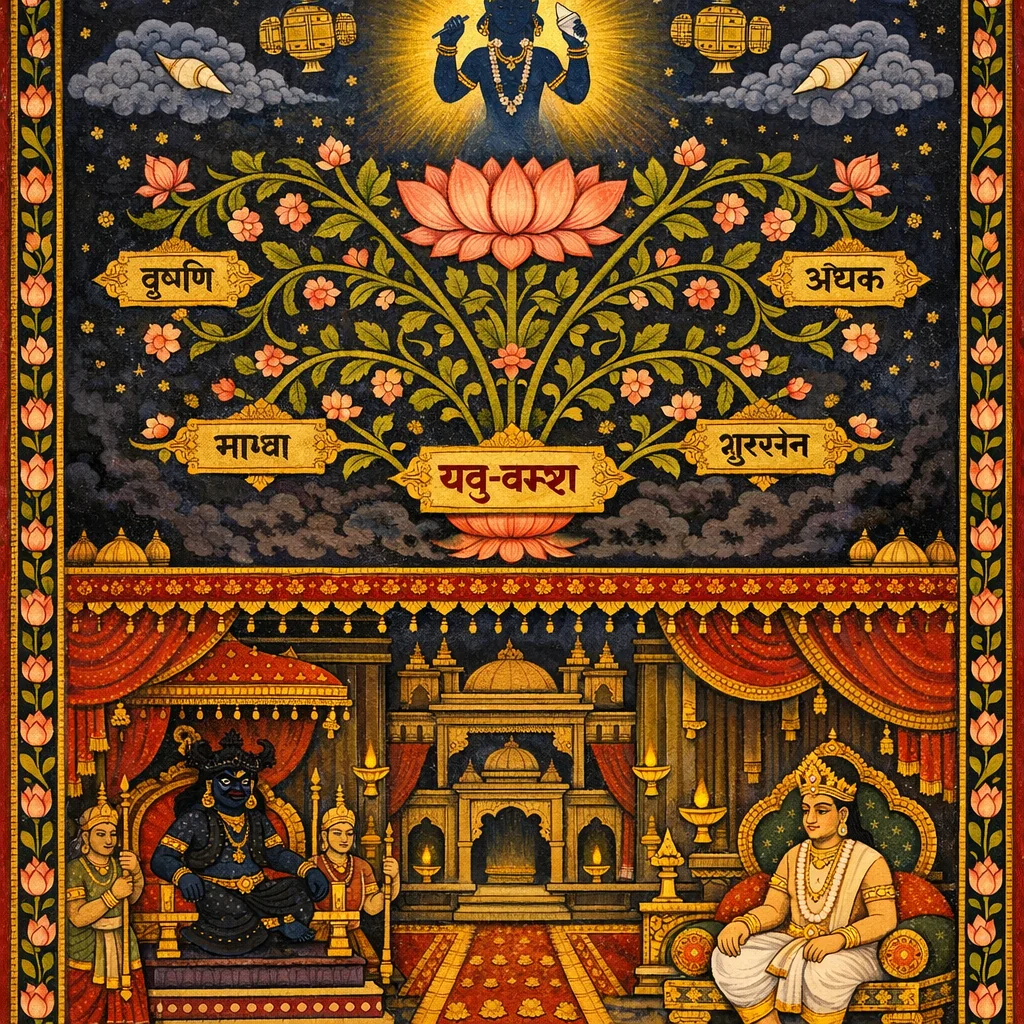
Adhyaya 24
The Yadu–Vṛṣṇi–Andhaka Genealogies and the Purpose of Kṛṣṇa’s Advent
This adhyāya continues Yadu’s dynastic line, listing major branches—Vidarbha’s line, the Kratha–Kunti–Vṛṣṇi succession, and the Sātvata progeny—thus mapping the family matrix from which the Vṛṣṇis, Bhojas, Andhakas, and Śūrasenas arise. Devāvṛdha and Babhru are praised in traditional stuti-verses, linking lineage with spiritual merit and even liberation for descendants. It then recounts prominent Yādava lines (Śini, Satyaka, Yuyudhāna) and the Akrūra branch, before focusing on the Andhaka line culminating in Āhuka, Devaka, and Ugrasena, introducing Kaṁsa and the political setting of Śrī Kṛṣṇa’s birth. The Śūra–Māriṣā lineage is expanded to Vasudeva (Ānakadundubhi) and his siblings, and Kuntī’s boon from Durvāsā leads to Karṇa’s birth, bridging Bhāgavata genealogy with Mahābhārata history. The chapter ends with a theological pivot: Kṛṣṇa appears by His own will, not driven by karma; He descends to lighten the earth’s burden, protect devotees, and make liberation accessible through hearing and remembrance—shifting from “who begot whom” to “why Bhagavān comes.”
Shlokas
Verse 1
श्रीशुक उवाच तस्यां विदर्भोऽजनयत् पुत्रौ नाम्ना कुशक्रथौ । तृतीयं रोमपादं च विदर्भकुलनन्दनम् ॥ १ ॥
Śukadeva Gosvāmī said: From the womb of the girl brought by his father, Vidarbha begot three sons—Kuśa, Kratha, and the third, Romapāda. Romapāda was especially dear within the Vidarbha dynasty.
Verse 2
रोमपादसुतो बभ्रुर्बभ्रो: कृतिरजायत । उशिकस्तत्सुतस्तस्माच्चेदिश्चैद्यादयो नृपा: ॥ २ ॥
Romapāda’s son was Babhru, and from Babhru came a son named Kṛti. Kṛti’s son was Uśika, and Uśika’s son was Cedi. From Cedi were born the king known as Caidya and other rulers.
Verse 3
क्रथस्य कुन्ति: पुत्रोऽभूद्वृष्णिस्तस्याथ निर्वृति: । ततो दशार्हो नाम्नाभूत् तस्य व्योम: सुतस्तत: ॥ ३ ॥ जीमूतो विकृतिस्तस्य यस्य भीमरथ: सुत: । ततो नवरथ: पुत्रो जातो दशरथस्तत: ॥ ४ ॥
Kratha’s son was Kunti; Kunti’s son was Vṛṣṇi; Vṛṣṇi’s son was Nirvṛti; and Nirvṛti’s son was known as Daśārha. From Daśārha came Vyoma; from Vyoma, Jīmūta; from Jīmūta, Vikṛti; from Vikṛti, Bhīmaratha; from Bhīmaratha, Navaratha; and from Navaratha, Daśaratha.
Verse 4
क्रथस्य कुन्ति: पुत्रोऽभूद्वृष्णिस्तस्याथ निर्वृति: । ततो दशार्हो नाम्नाभूत् तस्य व्योम: सुतस्तत: ॥ ३ ॥ जीमूतो विकृतिस्तस्य यस्य भीमरथ: सुत: । ततो नवरथ: पुत्रो जातो दशरथस्तत: ॥ ४ ॥
Kratha’s son was Kunti; Kunti’s son was Vṛṣṇi; Vṛṣṇi’s son was Nirvṛti; and Nirvṛti’s son was known as Daśārha. From Daśārha came Vyoma; from Vyoma, Jīmūta; from Jīmūta, Vikṛti; from Vikṛti, Bhīmaratha; from Bhīmaratha, Navaratha; and from Navaratha, Daśaratha.
Verse 5
करम्भि: शकुने: पुत्रो देवरातस्तदात्मज: । देवक्षत्रस्ततस्तस्य मधु: कुरुवशादनु: ॥ ५ ॥
From Daśaratha came a son named Śakuni, and from Śakuni came Karambhi. Karambhi’s son was Devarāta, whose son was Devakṣatra. Devakṣatra’s son was Madhu, whose son was Kuruvaśa, and from Kuruvaśa was born Anu.
Verse 6
पुरुहोत्रस्त्वनो: पुत्रस्तस्यायु: सात्वतस्तत: । भजमानो भजिर्दिव्यो वृष्णिर्देवावृधोऽन्धक: ॥ ६ ॥ सात्वतस्य सुता: सप्त महाभोजश्च मारिष । भजमानस्य निम्लोचि: किङ्कणो धृष्टिरेव च ॥ ७ ॥ एकस्यामात्मजा: पत्न्यामन्यस्यां च त्रय: सुता: । शताजिच्च सहस्राजिदयुताजिदिति प्रभो ॥ ८ ॥
The son of Anu was Puruhotra; Puruhotra’s son was Ayu; and Ayu’s son was Sātvata. O noble king, Sātvata had seven sons—Bhajamāna, Bhaji, Divya, Vṛṣṇi, Devāvṛdha, Andhaka, and Mahābhoja. From Bhajamāna, by one wife, were born Nimloci, Kiṅkaṇa, and Dhṛṣṭi; and by another wife were born Śatājit, Sahasrājit, and Ayutājit.
Verse 7
पुरुहोत्रस्त्वनो: पुत्रस्तस्यायु: सात्वतस्तत: । भजमानो भजिर्दिव्यो वृष्णिर्देवावृधोऽन्धक: ॥ ६ ॥ सात्वतस्य सुता: सप्त महाभोजश्च मारिष । भजमानस्य निम्लोचि: किङ्कणो धृष्टिरेव च ॥ ७ ॥ एकस्यामात्मजा: पत्न्यामन्यस्यां च त्रय: सुता: । शताजिच्च सहस्राजिदयुताजिदिति प्रभो ॥ ८ ॥
The son of Anu was Puruhotra; Puruhotra’s son was Ayu; and Ayu’s son was Sātvata. O noble king, Sātvata had seven sons—Bhajamāna, Bhaji, Divya, Vṛṣṇi, Devāvṛdha, Andhaka, and Mahābhoja. From Bhajamāna, by one wife, were born Nimloci, Kiṅkaṇa, and Dhṛṣṭi; and by another wife were born Śatājit, Sahasrājit, and Ayutājit.
Verse 8
पुरुहोत्रस्त्वनो: पुत्रस्तस्यायु: सात्वतस्तत: । भजमानो भजिर्दिव्यो वृष्णिर्देवावृधोऽन्धक: ॥ ६ ॥ सात्वतस्य सुता: सप्त महाभोजश्च मारिष । भजमानस्य निम्लोचि: किङ्कणो धृष्टिरेव च ॥ ७ ॥ एकस्यामात्मजा: पत्न्यामन्यस्यां च त्रय: सुता: । शताजिच्च सहस्राजिदयुताजिदिति प्रभो ॥ ८ ॥
The son of Anu was Puruhotra; Puruhotra’s son was Ayu; and Ayu’s son was Sātvata. O noble king, Sātvata had seven sons—Bhajamāna, Bhaji, Divya, Vṛṣṇi, Devāvṛdha, Andhaka, and Mahābhoja. From Bhajamāna, by one wife, were born Nimloci, Kiṅkaṇa, and Dhṛṣṭi; and by another wife were born Śatājit, Sahasrājit, and Ayutājit.
Verse 9
बभ्रुर्देवावृधसुतस्तयो: श्लोकौ पठन्त्यमू । यथैव शृणुमो दूरात् सम्पश्यामस्तथान्तिकात् ॥ ९ ॥
Devāvṛdha’s son was Babhru. Concerning Devāvṛdha and Babhru, two renowned hymns of praise are recited, sung by the forefathers. Just as we heard of them from afar, so even nearby we behold the same virtues.
Verse 10
बभ्रु: श्रेष्ठो मनुष्याणां देवैर्देवावृध: सम: । पुरुषा: पञ्चषष्टिश्च षट् सहस्राणि चाष्ट च ॥ १० ॥ येऽमृतत्त्वमनुप्राप्ता बभ्रोर्देवावृधादपि । महाभोजोऽतिधर्मात्मा भोजा आसंस्तदन्वये ॥ ११ ॥
It was concluded that among men Babhru is the foremost, and that Devāvṛdha is equal to the devas. By the association of Babhru and Devāvṛdha, all their descendants—14,065 in number—attained immortality and liberation (mokṣa). In the line of the exceedingly righteous King Mahābhoja, the Bhoja kings appeared.
Verse 11
बभ्रु: श्रेष्ठो मनुष्याणां देवैर्देवावृध: सम: । पुरुषा: पञ्चषष्टिश्च षट् सहस्राणि चाष्ट च ॥ १० ॥ येऽमृतत्त्वमनुप्राप्ता बभ्रोर्देवावृधादपि । महाभोजोऽतिधर्मात्मा भोजा आसंस्तदन्वये ॥ ११ ॥
Those who attained immortality and mokṣa—14,065 men—did so through the connection of Babhru and Devāvṛdha, all belonging to that line. In the lineage of the exceedingly righteous King Mahābhoja, there were kings known as the Bhojas.
Verse 12
वृष्णे: सुमित्र: पुत्रोऽभूद् युधाजिच्च परन्तप । शिनिस्तस्यानमित्रश्च निघ्नोऽभूदनमित्रत: ॥ १२ ॥
O King Parīkṣit, subduer of foes, Vṛṣṇi had two sons, Sumitra and Yudhājit. From Yudhājit were born Śini and Anamitra, and from Anamitra came a son named Nighna.
Verse 13
सत्राजित: प्रसेनश्च निघ्नस्याथासतु: सुतौ । अनमित्रसुतो योऽन्य: शिनिस्तस्य च सत्यक: ॥ १३ ॥
Nighna had two sons, Satrājita and Prasena. Anamitra also had another son named Śini, and Śini’s son was Satyaka.
Verse 14
युयुधान: सात्यकिर्वै जयस्तस्य कुणिस्तत: । युगन्धरोऽनमित्रस्य वृष्णि: पुत्रोऽपरस्तत: ॥ १४ ॥
Satyaka’s son was Yuyudhāna (Sātyaki), and his son was Jaya. From Jaya came Kuṇi, and from Kuṇi came Yugandhara. Anamitra also had another son named Vṛṣṇi.
Verse 15
श्वफल्कश्चित्ररथश्च गान्दिन्यां च श्वफल्कत: । अक्रूरप्रमुखा आसन् पुत्रा द्वादश विश्रुता: ॥ १५ ॥
From Vṛṣṇi were born the sons Śvaphalka and Citraratha. From Śvaphalka, by his wife Gāndinī, was born Akrūra; Akrūra was the eldest, and there were twelve other sons as well, all widely renowned.
Verse 16
आसङ्ग: सारमेयश्च मृदुरो मृदुविद् गिरि: । धर्मवृद्ध: सुकर्मा च क्षेत्रोपेक्षोऽरिमर्दन: ॥ १६ ॥ शत्रुघ्नो गन्धमादश्च प्रतिबाहुश्च द्वादश । तेषां स्वसा सुचाराख्या द्वावक्रूरसुतावपि ॥ १७ ॥ देववानुपदेवश्च तथा चित्ररथात्मजा: । पृथुर्विदूरथाद्याश्च बहवो वृष्णिनन्दना: ॥ १८ ॥
The names of those twelve were Āsaṅga, Sārameya, Mṛdura, Mṛduvit, Giri, Dharmavṛddha, Sukarmā, Kṣetropekṣa, Arimardana, Śatrughna, Gandhamāda, and Pratibāhu. They also had a sister named Sucārā. From Akrūra came two sons, Devavān and Upadeva. Citraratha too had many sons, headed by Pṛthu and Vidūratha, all renowned as scions of the Vṛṣṇi line.
Verse 17
आसङ्ग: सारमेयश्च मृदुरो मृदुविद् गिरि: । धर्मवृद्ध: सुकर्मा च क्षेत्रोपेक्षोऽरिमर्दन: ॥ १६ ॥ शत्रुघ्नो गन्धमादश्च प्रतिबाहुश्च द्वादश । तेषां स्वसा सुचाराख्या द्वावक्रूरसुतावपि ॥ १७ ॥ देववानुपदेवश्च तथा चित्ररथात्मजा: । पृथुर्विदूरथाद्याश्च बहवो वृष्णिनन्दना: ॥ १८ ॥
The names of those twelve were Āsaṅga, Sārameya, Mṛdura, Mṛduvit, Giri, Dharmavṛddha, Sukarmā, Kṣetropekṣa, Arimardana, Śatrughna, Gandhamāda, and Pratibāhu. They also had a sister named Sucārā. From Akrūra came two sons, Devavān and Upadeva. Citraratha too had many sons, headed by Pṛthu and Vidūratha, all renowned as scions of the Vṛṣṇi line.
Verse 18
आसङ्ग: सारमेयश्च मृदुरो मृदुविद् गिरि: । धर्मवृद्ध: सुकर्मा च क्षेत्रोपेक्षोऽरिमर्दन: ॥ १६ ॥ शत्रुघ्नो गन्धमादश्च प्रतिबाहुश्च द्वादश । तेषां स्वसा सुचाराख्या द्वावक्रूरसुतावपि ॥ १७ ॥ देववानुपदेवश्च तथा चित्ररथात्मजा: । पृथुर्विदूरथाद्याश्च बहवो वृष्णिनन्दना: ॥ १८ ॥
The names of those twelve were Āsaṅga, Sārameya, Mṛdura, Mṛduvit, Giri, Dharmavṛddha, Sukarmā, Kṣetropekṣa, Arimardana, Śatrughna, Gandhamāda, and Pratibāhu. They also had a sister named Sucārā. From Akrūra came two sons, Devavān and Upadeva. Citraratha too had many sons, headed by Pṛthu and Vidūratha, all renowned as scions of the Vṛṣṇi line.
Verse 19
कुकुरो भजमानश्च शुचि: कम्बलबर्हिष: । कुकुरस्य सुतो वह्निर्विलोमा तनयस्तत: ॥ १९ ॥
Andhaka had four sons—Kukura, Bhajamāna, Śuci, and Kambalabarhiṣa. Kukura’s son was Vahni, and Vahni’s son was Vilomā.
Verse 20
कपोतरोमा तस्यानु: सखा यस्य च तुम्बुरु: । अन्धकाद् दुन्दुभिस्तस्मादविद्योत: पुनर्वसु: ॥ २० ॥
Vilomā’s son was Kapotaromā. His son was Anu, whose friend was Tumburu. From Anu came Andhaka; from Andhaka, Dundubhi; from Dundubhi, Avidyota; and from Avidyota was born a son named Punarvasu.
Verse 21
तस्याहुकश्चाहुकी च कन्या चैवाहुकात्मजौ । देवकश्चोग्रसेनश्च चत्वारो देवकात्मजा: ॥ २१ ॥ देववानुपदेवश्च सुदेवो देववर्धन: । तेषां स्वसार: सप्तासन् धृतदेवादयो नृप ॥ २२ ॥ शान्तिदेवोपदेवा च श्रीदेवा देवरक्षिता । सहदेवा देवकी च वसुदेव उवाह ता: ॥ २३ ॥
Punarvasu had a son and a daughter, named Āhuka and Āhukī. Āhuka had two sons, Devaka and Ugrasena. Devaka had four sons—Devavān, Upadeva, Sudeva, and Devavardhana—and seven daughters: Dhṛtadevā (the eldest), Śāntidevā, Upadevā, Śrīdevā, Devarakṣitā, Sahadevā, and Devakī. Vasudeva, the father of Śrī Kṛṣṇa, married all these sisters.
Verse 22
तस्याहुकश्चाहुकी च कन्या चैवाहुकात्मजौ । देवकश्चोग्रसेनश्च चत्वारो देवकात्मजा: ॥ २१ ॥ देववानुपदेवश्च सुदेवो देववर्धन: । तेषां स्वसार: सप्तासन् धृतदेवादयो नृप ॥ २२ ॥ शान्तिदेवोपदेवा च श्रीदेवा देवरक्षिता । सहदेवा देवकी च वसुदेव उवाह ता: ॥ २३ ॥
Punarvasu had a son and a daughter, named Āhuka and Āhukī. Āhuka had two sons, Devaka and Ugrasena. Devaka had four sons—Devavān, Upadeva, Sudeva, and Devavardhana—and seven daughters: Dhṛtadevā (the eldest), Śāntidevā, Upadevā, Śrīdevā, Devarakṣitā, Sahadevā, and Devakī. Vasudeva, the father of Śrī Kṛṣṇa, married all these sisters.
Verse 23
तस्याहुकश्चाहुकी च कन्या चैवाहुकात्मजौ । देवकश्चोग्रसेनश्च चत्वारो देवकात्मजा: ॥ २१ ॥ देववानुपदेवश्च सुदेवो देववर्धन: । तेषां स्वसार: सप्तासन् धृतदेवादयो नृप ॥ २२ ॥ शान्तिदेवोपदेवा च श्रीदेवा देवरक्षिता । सहदेवा देवकी च वसुदेव उवाह ता: ॥ २३ ॥
Punarvasu had a son and a daughter, named Āhuka and Āhukī. Āhuka had two sons, Devaka and Ugrasena. Devaka had four sons—Devavān, Upadeva, Sudeva, and Devavardhana—and seven daughters: Dhṛtadevā (the eldest), Śāntidevā, Upadevā, Śrīdevā, Devarakṣitā, Sahadevā, and Devakī. Vasudeva, the father of Śrī Kṛṣṇa, married all these sisters.
Verse 24
कंस: सुनामा न्यग्रोध: कङ्क: शङ्कु: सुहूस्तथा । राष्ट्रपालोऽथ धृष्टिश्च तुष्टिमानौग्रसेनय: ॥ २४ ॥
The sons of Ugrasena were Kaṁsa, Sunāmā, Nyagrodha, Kaṅka, Śaṅku, Suhū, Rāṣṭrapāla, Dhṛṣṭi, and Tuṣṭimān.
Verse 25
कंसा कंसवती कङ्का शूरभू राष्ट्रपालिका । उग्रसेनदुहितरो वसुदेवानुजस्त्रिय: ॥ २५ ॥
Kaṁsā, Kaṁsavatī, Kaṅkā, Śūrabhū, and Rāṣṭrapālikā were daughters of Ugrasena, and they became the wives of Vasudeva’s younger brothers.
Verse 26
शूरो विदूरथादासीद् भजमानस्तु तत्सुत: । शिनिस्तस्मात् स्वयंभोजो हृदिकस्तत्सुतो मत: ॥ २६ ॥
The son of Citraratha was Vidūratha; Vidūratha’s son was Śūra; and Śūra’s son was Bhajamāna. Bhajamāna’s son was Śini; Śini’s son was Bhoja; and Bhoja’s son was Hṛdika.
Verse 27
देवमीढ: शतधनु: कृतवर्मेति तत्सुता: । देवमीढस्य शूरस्य मारिषा नाम पत्न्यभूत् ॥ २७ ॥
Hṛdika had three sons—Devamīḍha, Śatadhanu, and Kṛtavarmā. Devamīḍha’s son was Śūra, whose wife was named Māriṣā.
Verse 28
तस्यां स जनयामास दश पुत्रानकल्मषान् । वसुदेवं देवभागं देवश्रवसमानकम् ॥ २८ ॥ सृञ्जयं श्यामकं कङ्कं शमीकं वत्सकं वृकम् । देवदुन्दुभयो नेदुरानका यस्य जन्मनि ॥ २९ ॥ वसुदेवं हरे: स्थानं वदन्त्यानकदुन्दुभिम् । पृथा च श्रुतदेवा च श्रुतकीर्ति: श्रुतश्रवा: ॥ ३० ॥ राजाधिदेवी चैतेषां भगिन्य: पञ्च कन्यका: । कुन्ते: सख्यु: पिता शूरो ह्यपुत्रस्य पृथामदात् ॥ ३१ ॥
Through Māriṣā, King Śūra begot ten sons, all spotless and pious—Vasudeva, Devabhāga, Devaśravā, Ānaka, Sṛñjaya, Śyāmaka, Kaṅka, Śamīka, Vatsaka, and Vṛka. At Vasudeva’s birth the devas resounded the ānaka-kettledrums; thus, because he became the worthy shelter for the advent of Śrī Hari Kṛṣṇa, Vasudeva was also famed as Ānakadundubhi. Śūra’s five daughters—Pṛthā, Śrutadevā, Śrutakīrti, Śrutaśravā, and Rājādhidevī—were Vasudeva’s sisters. Śūra gave Pṛthā to his childless friend Kunti, and therefore Pṛthā was also known as Kuntī.
Verse 29
तस्यां स जनयामास दश पुत्रानकल्मषान् । वसुदेवं देवभागं देवश्रवसमानकम् ॥ २८ ॥ सृञ्जयं श्यामकं कङ्कं शमीकं वत्सकं वृकम् । देवदुन्दुभयो नेदुरानका यस्य जन्मनि ॥ २९ ॥ वसुदेवं हरे: स्थानं वदन्त्यानकदुन्दुभिम् । पृथा च श्रुतदेवा च श्रुतकीर्ति: श्रुतश्रवा: ॥ ३० ॥ राजाधिदेवी चैतेषां भगिन्य: पञ्च कन्यका: । कुन्ते: सख्यु: पिता शूरो ह्यपुत्रस्य पृथामदात् ॥ ३१ ॥
Through Māriṣā, King Śūra begot ten sons, all spotless and pious—Vasudeva, Devabhāga, Devaśravā, Ānaka, Sṛñjaya, Śyāmaka, Kaṅka, Śamīka, Vatsaka, and Vṛka. At Vasudeva’s birth the devas resounded the ānaka-kettledrums; thus, because he became the worthy shelter for the advent of Śrī Hari Kṛṣṇa, Vasudeva was also famed as Ānakadundubhi. Śūra’s five daughters—Pṛthā, Śrutadevā, Śrutakīrti, Śrutaśravā, and Rājādhidevī—were Vasudeva’s sisters. Śūra gave Pṛthā to his childless friend Kunti, and therefore Pṛthā was also known as Kuntī.
Verse 30
तस्यां स जनयामास दश पुत्रानकल्मषान् । वसुदेवं देवभागं देवश्रवसमानकम् ॥ २८ ॥ सृञ्जयं श्यामकं कङ्कं शमीकं वत्सकं वृकम् । देवदुन्दुभयो नेदुरानका यस्य जन्मनि ॥ २९ ॥ वसुदेवं हरे: स्थानं वदन्त्यानकदुन्दुभिम् । पृथा च श्रुतदेवा च श्रुतकीर्ति: श्रुतश्रवा: ॥ ३० ॥ राजाधिदेवी चैतेषां भगिन्य: पञ्च कन्यका: । कुन्ते: सख्यु: पिता शूरो ह्यपुत्रस्य पृथामदात् ॥ ३१ ॥
Through Māriṣā, King Śūra begot ten spotless sons—Vasudeva, Devabhāga, Devaśravā, Ānaka, Sṛñjaya, Śyāmaka, Kaṅka, Śamīka, Vatsaka, and Vṛka. At Vasudeva’s birth the devas of heaven sounded sacred kettledrums; and because he became the pure abode for the advent of Śrī Hari Kṛṣṇa, he was also famed as Ānakadundubhi. King Śūra’s five daughters—Pṛthā, Śrutadevā, Śrutakīrti, Śrutaśravā, and Rājādhidevī—were Vasudeva’s sisters. Śūra gave Pṛthā to his childless friend Kuntī; therefore Pṛthā was also known as Kuntī.
Verse 31
तस्यां स जनयामास दश पुत्रानकल्मषान् । वसुदेवं देवभागं देवश्रवसमानकम् ॥ २८ ॥ सृञ्जयं श्यामकं कङ्कं शमीकं वत्सकं वृकम् । देवदुन्दुभयो नेदुरानका यस्य जन्मनि ॥ २९ ॥ वसुदेवं हरे: स्थानं वदन्त्यानकदुन्दुभिम् । पृथा च श्रुतदेवा च श्रुतकीर्ति: श्रुतश्रवा: ॥ ३० ॥ राजाधिदेवी चैतेषां भगिन्य: पञ्च कन्यका: । कुन्ते: सख्यु: पिता शूरो ह्यपुत्रस्य पृथामदात् ॥ ३१ ॥
Through Māriṣā, King Śūra begot ten spotless sons—Vasudeva, Devabhāga, Devaśravā, Ānaka, Sṛñjaya, Śyāmaka, Kaṅka, Śamīka, Vatsaka, and Vṛka. At Vasudeva’s birth the devas of heaven sounded sacred kettledrums; and because he became the pure abode for the advent of Śrī Hari Kṛṣṇa, he was also famed as Ānakadundubhi. King Śūra’s five daughters—Pṛthā, Śrutadevā, Śrutakīrti, Śrutaśravā, and Rājādhidevī—were Vasudeva’s sisters. Śūra gave Pṛthā to his childless friend Kuntī; therefore Pṛthā was also known as Kuntī.
Verse 32
साप दुर्वाससो विद्यां देवहूतीं प्रतोषितात् । तस्या वीर्यपरीक्षार्थमाजुहाव रविं शुचि: ॥ ३२ ॥
Pṛthā pleased the sage Durvāsā by devoted service and thus received a mystic art called Devahūtī-vidyā, by which she could summon any deva. To test the power of that gift, the pure-hearted Kuntī at once invoked the sun-god.
Verse 33
तदैवोपागतं देवं वीक्ष्य विस्मितमानसा । प्रत्ययार्थं प्रयुक्ता मे याहि देव क्षमस्व मे ॥ ३३ ॥
No sooner had Kuntī invoked the sun-god than he appeared before her, and she was struck with wonder. She said, “I only sought to test the efficacy of this mystic power. O deva, forgive me for calling you without need; please return.”
Verse 34
अमोघं देवसन्दर्शमादधे त्वयि चात्मजम् । योनिर्यथा न दुष्येत कर्ताहं ते सुमध्यमे ॥ ३४ ॥
The sun-god said: “O fair-waisted Pṛthā, a meeting with a deva cannot be in vain. Therefore I shall place my seed within your womb, and you will bear a son. Though you are an unmarried maiden, I will arrange that your virgin purity remains untouched.”
Verse 35
इति तस्यां स आधाय गर्भं सूर्यो दिवं गत: । सद्य: कुमार: सञ्जज्ञे द्वितीय इव भास्कर: ॥ ३५ ॥
Having spoken thus, the sun-god placed his radiant seed within Pṛthā’s womb and returned to the celestial realm. At once Kuntī gave birth to a son, like a second sun.
Verse 36
तं सात्यजन्नदीतोये कृच्छ्राल्लोकस्य बिभ्यती । प्रपितामहस्तामुवाह पाण्डुर्वै सत्यविक्रम: ॥ ३६ ॥
Fearing the world’s reproach, Kuntī, with great anguish, renounced her affection for the child. Unwillingly she placed him in a basket and set him afloat upon the river’s waters. O Mahārāja Parīkṣit, later your great-grandfather, the pious and valiant King Pāṇḍu, married Kuntī.
Verse 37
श्रुतदेवां तु कारूषो वृद्धशर्मा समग्रहीत् । यस्यामभूद् दन्तवक्र ऋषिशप्तो दिते: सुत: ॥ ३७ ॥
Vṛddhaśarmā, the king of Karūṣa, married Śrutadevā, Kuntī’s sister, and from her womb Dantavakra was born. Cursed by the sages headed by Sanaka, Dantavakra had formerly taken birth as Diti’s son named Hiraṇyākṣa.
Verse 38
कैकेयो धृष्टकेतुश्च श्रुतकीर्तिमविन्दत । सन्तर्दनादयस्तस्यां पञ्चासन्कैकया: सुता: ॥ ३८ ॥
Dhṛṣṭaketu, the king of Kekaya, married Śrutakīrti, another sister of Kuntī. From Śrutakīrti were born five sons, headed by Santardana.
Verse 39
राजाधिदेव्यामावन्त्यौ जयसेनोऽजनिष्ट ह । दमघोषश्चेदिराज: श्रुतश्रवसमग्रहीत् ॥ ३९ ॥
From the womb of Rājādhidevī, another sister of Kuntī, Jayasena begot two sons named Vinda and Anuvinda. Likewise, Damaghoṣa, the king of Cedi, married Śrutaśravā.
Verse 40
शिशुपाळ: सुतस्तस्या: कथितस्तस्य सम्भव: । देवभागस्य कंसायां चित्रकेतुबृहद्बलौ ॥ ४० ॥
The son of Śrutaśravā was Śiśupāla, whose birth has been described earlier. Devabhāga, Vasudeva’s brother, begot two sons by his wife Kaṁsā—Citraketu and Bṛhadbala.
Verse 41
कंसवत्यां देवश्रवस: सुवीर इषुमांस्तथा । बक: कङ्कात् तु कङ्कायां सत्यजित्पुरुजित् तथा ॥ ४१ ॥
By Kaṁsavatī, Devaśravā begot two sons—Suvīra and Iṣumān. Kaṅka, by his wife Kaṅkā, begot three sons—Baka, Satyajit, and Purujit.
Verse 42
सृञ्जयो राष्ट्रपाल्यां च वृषदुर्मर्षणादिकान् । हरिकेशहिरण्याक्षौ शूरभूम्यां च श्यामक: ॥ ४२ ॥
King Sṛñjaya, by his wife Rāṣṭrapālikā, begot sons headed by Vṛṣa and Durmarṣaṇa. King Śyāmaka, by his wife Śūrabhūmi, begot two sons—Harikeśa and Hiraṇyākṣa.
Verse 43
मिश्रकेश्यामप्सरसि वृकादीन् वत्सकस्तथा । तक्षपुष्करशालादीन् दुर्वाक्ष्यां वृक आदधे ॥ ४३ ॥
Thereafter King Vatsaka, by his wife Miśrakeśī, an Apsarā, begot sons headed by Vṛka. Vṛka, by his wife Durvākṣī, begot Takṣa, Puṣkara, Śāla, and others.
Verse 44
सुमित्रार्जुनपालादीन् समीकात्तु सुदामनी । आनक: कर्णिकायां वै ऋतधामाजयावपि ॥ ४४ ॥
From Samīka, by his wife Sudāmanī, came Sumitra, Arjunapāla, and other sons. King Ānaka, by his wife Karṇikā, begot two sons—Ṛtadhāmā and Jaya.
Verse 45
पौरवी रोहिणी भद्रा मदिरा रोचना इला । देवकीप्रमुखाश्चासन् पत्न्य आनकदुन्दुभे: ॥ ४५ ॥
Devakī, Pauravī, Rohiṇī, Bhadrā, Madirā, Rocanā, Ilā and others were all wives of Ānakadundubhi (Vasudeva); among them, Devakī was the foremost.
Verse 46
बलं गदं सारणं च दुर्मदं विपुलं ध्रुवम् । वसुदेवस्तु रोहिण्यां कृतादीनुदपादयत् ॥ ४६ ॥
By his wife Rohiṇī, Vasudeva begot sons such as Bala, Gada, Sāraṇa, Durmada, Vipula, Dhruva, Kṛta and others.
Verse 47
सुभद्रो भद्रबाहुश्च दुर्मदो भद्र एव च । पौरव्यास्तनया ह्येते भूताद्या द्वादशाभवन् ॥ ४७ ॥ नन्दोपनन्दकृतकशूराद्या मदिरात्मजा: । कौशल्या केशिनं त्वेकमसूत कुलनन्दनम् ॥ ४८ ॥
From Pauravī’s womb came twelve sons headed by Bhūta, including Subhadra, Bhadrabāhu, Durmada and Bhadra. From Madirā were born Nanda, Upananda, Kṛtaka, Śūra and others. Kauśalyā (Bhadrā) bore only one son, named Keśī.
Verse 48
सुभद्रो भद्रबाहुश्च दुर्मदो भद्र एव च । पौरव्यास्तनया ह्येते भूताद्या द्वादशाभवन् ॥ ४७ ॥ नन्दोपनन्दकृतकशूराद्या मदिरात्मजा: । कौशल्या केशिनं त्वेकमसूत कुलनन्दनम् ॥ ४८ ॥
From Pauravī’s womb came twelve sons headed by Bhūta, including Subhadra, Bhadrabāhu, Durmada and Bhadra. From Madirā were born Nanda, Upananda, Kṛtaka, Śūra and others. Kauśalyā (Bhadrā) bore only one son, named Keśī.
Verse 49
रोचनायामतो जाता हस्तहेमाङ्गदादय: । इलायामुरुवल्कादीन् यदुमुख्यानजीजनत् ॥ ४९ ॥
By Rocanā, Vasudeva begot sons such as Hasta and Hemāṅgada; and by Ilā he begot sons headed by Uruvalka, all eminent leaders within the Yadu dynasty.
Verse 50
विपृष्ठो धृतदेवायामेक आनकदुन्दुभे: । शान्तिदेवात्मजा राजन् प्रशमप्रसितादय: ॥ ५० ॥
From the womb of Dhṛtadevā, one of Ānakadundubhi Vasudeva’s queens, a single son was born, named Vipṛṣṭha. From another wife, Śāntidevā, O king, were born sons such as Praśama, Prasita, and others.
Verse 51
राजन्यकल्पवर्षाद्या उपदेवासुता दश । वसुहंससुवंशाद्या: श्रीदेवायास्तु षट् सुता: ॥ ५१ ॥
Through Upadevā, Vasudeva had ten sons, headed by Rājanya, Kalpa, and Varṣa. Through another wife, Śrīdevā, he had six sons, such as Vasu, Haṁsa, and Suvaṁśa.
Verse 52
देवरक्षितया लब्धा नव चात्र गदादय: । वसुदेव: सुतानष्टावादधे सहदेवया ॥ ५२ ॥
In the womb of Devarakṣitā, by Vasudeva’s seed, nine sons were born, headed by Gadā. Vasudeva, the very embodiment of dharma, also begot eight sons through Sahadevā, headed by Śruta and Pravara.
Verse 53
प्रवरश्रुतमुख्यांश्च साक्षाद् धर्मो वसूनिव । वसुदेवस्तु देवक्यामष्ट पुत्रानजीजनत् ॥ ५३ ॥ कीर्तिमन्तं सुषेणं च भद्रसेनमुदारधी: । ऋजुं सम्मर्दनं भद्रं सङ्कर्षणमहीश्वरम् ॥ ५४ ॥ अष्टमस्तु तयोरासीत् स्वयमेव हरि: किल । सुभद्रा च महाभागा तव राजन् पितामही ॥ ५५ ॥
The eight sons of Sahadevā—Pravara, Śruta, and the rest—were direct manifestations of the eight Vasus in the heavenly realms. And through Devakī, Vasudeva begot eight most worthy sons: Kīrtimān, Suṣeṇa, Bhadrasena, Ṛju, Sammardana, Bhadra, and Saṅkarṣaṇa, the mighty Lord in His serpent incarnation. The eighth son was Hari Himself—Śrī Kṛṣṇa. And the single daughter, the greatly fortunate Subhadrā, O king, was your grandmother.
Verse 54
प्रवरश्रुतमुख्यांश्च साक्षाद् धर्मो वसूनिव । वसुदेवस्तु देवक्यामष्ट पुत्रानजीजनत् ॥ ५३ ॥ कीर्तिमन्तं सुषेणं च भद्रसेनमुदारधी: । ऋजुं सम्मर्दनं भद्रं सङ्कर्षणमहीश्वरम् ॥ ५४ ॥ अष्टमस्तु तयोरासीत् स्वयमेव हरि: किल । सुभद्रा च महाभागा तव राजन् पितामही ॥ ५५ ॥
The eight sons of Sahadevā—Pravara, Śruta, and the rest—were direct manifestations of the eight Vasus in the heavenly realms. And through Devakī, Vasudeva begot eight most worthy sons: Kīrtimān, Suṣeṇa, Bhadrasena, Ṛju, Sammardana, Bhadra, and Saṅkarṣaṇa, the mighty Lord in His serpent incarnation. The eighth son was Hari Himself—Śrī Kṛṣṇa. And the single daughter, the greatly fortunate Subhadrā, O king, was your grandmother.
Verse 55
प्रवरश्रुतमुख्यांश्च साक्षाद् धर्मो वसूनिव । वसुदेवस्तु देवक्यामष्ट पुत्रानजीजनत् ॥ ५३ ॥ कीर्तिमन्तं सुषेणं च भद्रसेनमुदारधी: । ऋजुं सम्मर्दनं भद्रं सङ्कर्षणमहीश्वरम् ॥ ५४ ॥ अष्टमस्तु तयोरासीत् स्वयमेव हरि: किल । सुभद्रा च महाभागा तव राजन् पितामही ॥ ५५ ॥
The eight sons of Sahadevā—Pravara, Śruta and the rest—were in the heavenly realms direct incarnations of the eight Vasus. Vasudeva too, through the womb of Devakī, begot eight sons endowed with rare virtues: Kīrtimān, Suṣeṇa, Bhadrasena, Udāradhī, Ṛju, Sammardana, Bhadra, and Saṅkarṣaṇa, the great Lord, the incarnation of Śeṣa. Their eighth son was indeed Śrī Hari Himself—Kṛṣṇa; and the single daughter, the most fortunate Subhadrā, O King, was your grandmother.
Verse 56
यदा यदा हि धर्मस्य क्षयो वृद्धिश्च पाप्मन: । तदा तु भगवानीश आत्मानं सृजते हरि: ॥ ५६ ॥
Whenever dharma declines and sin and irreligion rise, then the Supreme Controller, Bhagavān Śrī Hari, manifests Himself by His own will.
Verse 57
न ह्यस्य जन्मनो हेतु: कर्मणो वा महीपते । आत्ममायां विनेशस्य परस्य द्रष्टुरात्मन: ॥ ५७ ॥
O King, the Lord’s appearance, disappearance, and deeds have no cause in karma. He is the Paramātmā, the supreme Witness; apart from His own will and His yoga-māyā, nothing can affect Him.
Verse 58
यन्मायाचेष्टितं पुंस: स्थित्युत्पत्त्यप्ययाय हि । अनुग्रहस्तन्निवृत्तेरात्मलाभाय चेष्यते ॥ ५८ ॥
Through His māyā, the Supreme Lord carries out creation, maintenance, and dissolution of the cosmos; this is His compassion—to halt the living being’s birth and death and the flow of material life, granting self-realization and a return to God’s abode.
Verse 59
अक्षौहिणीनां पतिभिरसुरैर्नृपलाञ्छनै: । भुव आक्रम्यमाणाया अभाराय कृतोद्यम: ॥ ५९ ॥
When asuras—lords of vast armies—though bearing the marks of kings, overrun the earth, by God’s arrangement they wage war upon one another, and thus the heavy burden of demons upon the earth is reduced.
Verse 60
कर्माण्यपरिमेयाणि मनसापि सुरेश्वरै: । सहसङ्कर्षणश्चक्रे भगवान् मधुसूदन: ॥ ६० ॥
With the cooperation of Saṅkarṣaṇa, Balarāma, Bhagavān Madhusūdana—Śrī Kṛṣṇa—performed immeasurable deeds, beyond the mental grasp even of Brahmā and Śiva.
Verse 61
कलौ जनिष्यमाणानां दु:खशोकतमोनुदम् । अनुग्रहाय भक्तानां सुपुण्यं व्यतनोद् यश: ॥ ६१ ॥
To bestow mercy upon the devotees who would be born in Kali-yuga, Bhagavān Śrī Kṛṣṇa spread His supremely pious fame, by whose remembrance alone sorrow, suffering, and darkness are dispelled.
Verse 62
यस्मिन् सत्कर्णपीयुषे यशस्तीर्थवरे सकृत् । श्रोत्राञ्जलिरुपस्पृश्य धुनुते कर्मवासनाम् ॥ ६२ ॥
By hearing even once the Lord’s glories—supreme pilgrimage and nectar for purified ears—the devotee at once shakes off karmic impressions and the grip of material desire.
Verse 63
भोजवृष्ण्यन्धकमधुशूरसेनदशार्हकै: । श्लाघनीयेहित: शश्वत् कुरुसृञ्जयपाण्डुभि: ॥ ६३ ॥ स्निग्धस्मितेक्षितोदारैर्वाक्यैर्विक्रमलीलया । नृलोकं रमयामास मूर्त्या सर्वाङ्गरम्यया ॥ ६४ ॥
Aided by the descendants of Bhoja, Vṛṣṇi, Andhaka, Madhu, Śūrasena, Daśārha, Kuru, Sṛñjaya, and Pāṇḍu, Lord Śrī Kṛṣṇa performed ever-praiseworthy deeds; by His gentle smiles, affectionate glances, noble words, and heroic līlās such as lifting Govardhana, appearing in a transcendental form beautiful in every limb, He delighted all human society.
Verse 64
भोजवृष्ण्यन्धकमधुशूरसेनदशार्हकै: । श्लाघनीयेहित: शश्वत् कुरुसृञ्जयपाण्डुभि: ॥ ६३ ॥ स्निग्धस्मितेक्षितोदारैर्वाक्यैर्विक्रमलीलया । नृलोकं रमयामास मूर्त्या सर्वाङ्गरम्यया ॥ ६४ ॥
Aided by the descendants of Bhoja, Vṛṣṇi, Andhaka, Madhu, Śūrasena, Daśārha, Kuru, Sṛñjaya, and Pāṇḍu, Lord Śrī Kṛṣṇa performed ever-praiseworthy deeds; by His gentle smiles, affectionate glances, noble words, and heroic līlās such as lifting Govardhana, appearing in a transcendental form beautiful in every limb, He delighted all human society.
Verse 65
यस्याननं मकरकुण्डलचारुकर्ण-भ्राजत्कपोलसुभगं सविलासहासम् । नित्योत्सवं न ततृपुर्दृशिभि: पिबन्त्योनार्यो नराश्च मुदिता: कुपिता निमेश्च ॥ ६५ ॥
Śrī Kṛṣṇa’s face, adorned with makara-shaped earrings, is blessed with beautiful ears, radiant cheeks, and a playful smile that enchants all. To behold Him is a perpetual festival; though women and men drink His beauty with their eyes, they are never satisfied, and the devotees grow angry with the creator for the obstruction of a moment’s blinking.
Verse 66
जातो गत: पितृगृहाद् व्रजमेधितार्थोहत्वा रिपून् सुतशतानि कृतोरुदार: । उत्पाद्य तेषु पुरुष: क्रतुभि: समीजेआत्मानमात्मनिगमं प्रथयञ्जनेषु ॥ ६६ ॥
The Supreme Lord Śrī Kṛṣṇa, the līlā-puruṣottama, though born as Vasudeva’s son, at once left His father’s home for Vraja to expand loving intimacy with His confidential devotees. There He slew many asuras; then, returning to Dvārakā, He married the finest women according to Vedic law, begot hundreds of sons, and performed sacrifices for His own worship, establishing the dharma of household life.
Verse 67
पृथ्व्या: स वै गुरुभरं क्षपयन् कुरूणा-मन्त:समुत्थकलिना युधि भूपचम्व: । दृष्टया विधूय विजये जयमुद्विघोष्यप्रोच्योद्धवाय च परं समगात् स्वधाम ॥ ६७ ॥ येऽन्येऽरविन्दाक्ष विमुक्तमानिन-स्त्वय्यस्तभावादविशुद्धबुद्धय: । आरुह्य कृच्छ्रेण परं पदं तत:पतन्त्यधोऽनादृतयुष्मदङ्घ्रय: ॥
Thereafter, to lessen the earth’s burden, Lord Śrī Kṛṣṇa stirred dissension among the Kurus, born of Kali. On Kurukṣetra He destroyed the demoniac kings by His mere glance and had Arjuna’s victory proclaimed with cries of triumph. At last He instructed Uddhava in transcendental life and bhakti, and then returned to His own abode in His original form. O lotus-eyed Lord, those who deem themselves liberated yet lack devotion to You have impure understanding; though with great hardship they rise to the supreme position, they fall again for neglecting Your feet.
Frequently Asked Questions
Sātvata is a key ancestor in the Yadu line whose seven sons generate major Yādava branches (including Vṛṣṇi, Andhaka, and Mahābhoja). These clans form the social and political network that supports Kṛṣṇa’s earthly līlā—providing both devotees (for intimate exchanges) and antagonistic forces (for dharma-restoration and bhū-bhāra-haraṇa).
The stuti tradition signals that lineage is evaluated not only by power but by guṇa and bhakti-saṁskāra. By highlighting Devāvṛdha as “equal to the devas” and Babhru as “best among humans,” the Bhāgavata teaches that spiritual excellence sanctifies dynastic history; association with such exalted figures becomes a cause for upliftment—even described here as leading many descendants to liberation.
It states that Bhagavān appears by His own desire (svatantra-icchā), not due to karma or external causation. His descent is compassionate: to protect devotees, to reduce the earth’s burden by orchestrating the downfall of demoniac rulers, and to establish a path where future beings—especially in Kali-yuga—can be freed through śravaṇa (hearing) and smaraṇa (remembering) His glories.
Ānakadundubhi is Vasudeva’s epithet meaning “kettledrums (dundubhi) resounded.” The chapter notes that when Vasudeva was born, devas sounded celestial drums—an auspicious omen marking him as the chosen shelter through whom the Supreme Personality of Godhead, Śrī Kṛṣṇa, would manifest.
The Bhāgavata integrates Itihāsa-linked dynastic threads to show continuity between Purāṇic and Mahābhārata worlds. Kuntī’s mantra (a siddhi obtained through service to Durvāsā) and the birth of Karṇa demonstrate how divine arrangements unfold within human ethics and social constraints, and how key Mahābhārata actors arise within the broader Yādava-linked kinship network.