Adhyaya 22
Bali Mahārāja’s Surrender, Prahlāda’s Praise, and the Lord’s Mercy (Sutala and Future Indrahood)
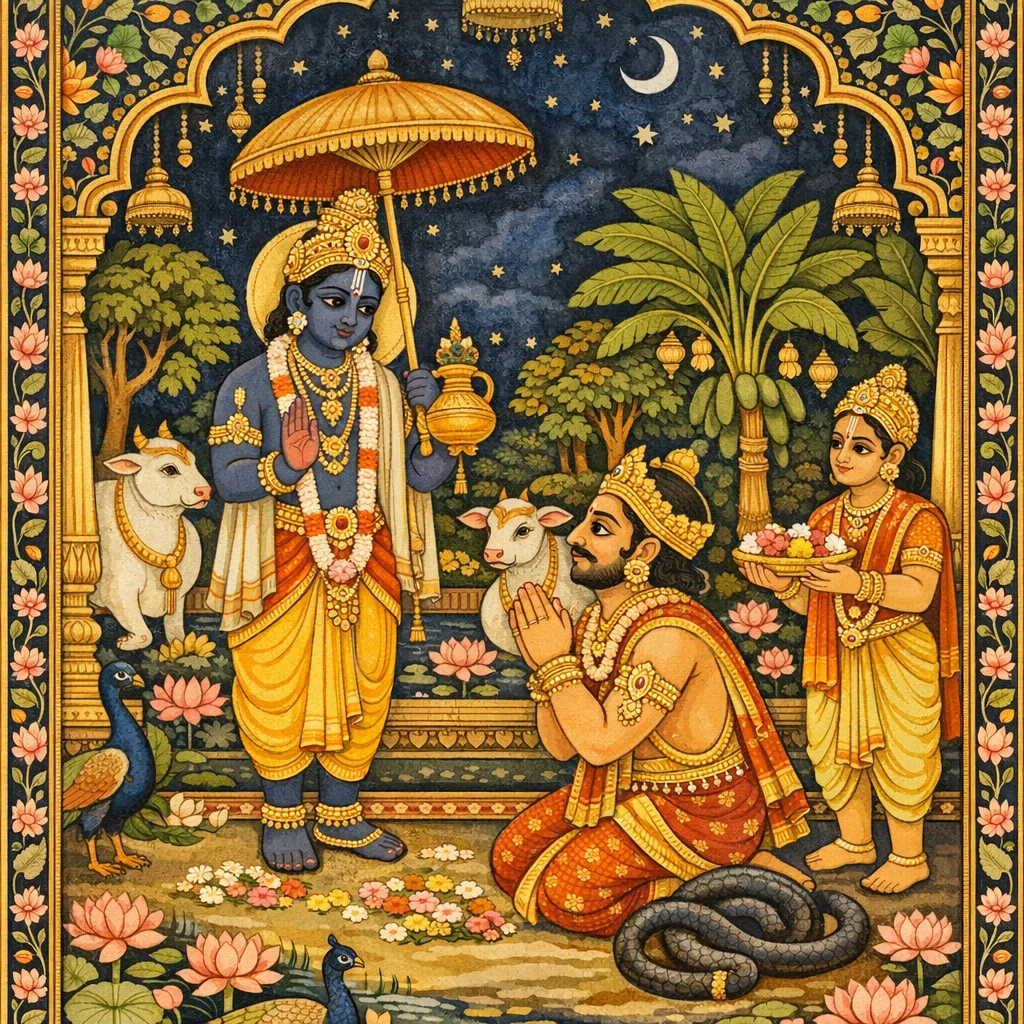
Continuing from the Vāmana-yajña, where Bali is bound by Varuṇa’s ropes after offering the three steps, this chapter turns from outward struggle to inward resolve. Though seemingly “cheated,” Bali insists his dāna-vrata must be fulfilled and asks the Lord to place the third step upon his head, declaring he fears infamy more than loss, hell, or punishment. He reads the Lord’s chastisement as hidden benevolence toward the asuras, recalling Prahlāda’s steadfast refuge in Bhagavān amid persecution. As Bali laments the futility of bodily and familial attachments when they obstruct bhagavat-sevā, Prahlāda arrives, worships the Lord, and teaches that both granting opulence and taking it away are equally beautiful when they awaken knowledge. Vindhyāvalī rebukes false proprietorship, and Brahmā petitions for Bali’s release. The Lord then states a core bhakti principle: He especially favors the proud by removing their possessions to awaken them; He praises Bali’s truthfulness despite defeat and curse. Granting Bali Sutala—built by Viśvakarmā and protected by the Lord—He promises Bali’s future rise as Indra in the Sāvarṇi Manvantara, with the Lord ever present as his guardian. The narrative thus moves toward Bali’s settled kingship in Sutala and the restoration of cosmic order beyond the sacrifice scene.
Shlokas
Verse 1
श्रीशुक उवाच एवं विप्रकृतो राजन् बलिर्भगवतासुर: । भिद्यमानोऽप्यभिन्नात्मा प्रत्याहाविक्लवं वच: ॥ १ ॥
Śukadeva Gosvāmī said: O King, though the Bhagavān seemed to deal mischievously with Bali Mahārāja, Bali remained unwavering. Feeling his promise still unfulfilled, he spoke these steady words.
Verse 2
श्रीबलिरुवाच यद्युत्तमश्लोक भवान् ममेरितं वचो व्यलीकं सुरवर्य मन्यते । करोम्यृतं तन्न भवेत् प्रलम्भनं पदं तृतीयं कुरु शीर्ष्णि मे निजम् ॥ २ ॥
Bali Mahārāja said: O Uttamaśloka, most worshipable Lord of the devas, if You deem my promise to have become untrue, I shall surely make it true. I will not let my vow become deceit; therefore place Your third lotus step upon my head.
Verse 3
बिभेमि नाहं निरयात् पदच्युतो न पाशबन्धाद् व्यसनाद् दुरत्ययात् । नैवार्थकृच्छ्राद् भवतो विनिग्रहा- दसाधुवादाद् भृशमुद्विजे यथा ॥ ३ ॥
I do not fear losing my position, falling into hell, being bound by Varuṇa’s ropes, suffering insurmountable distress, enduring poverty, or even being punished by You; I fear most of all disgrace and defamation.
Verse 4
पुंसां श्लाघ्यतमं मन्ये दण्डमर्हत्तमार्पितम् । यं न माता पिता भ्राता सुहृदश्चादिशन्ति हि ॥ ४ ॥
Among men, I deem most praiseworthy the punishment bestowed by the most worshipable Lord. A mother, father, brother, or friend may chastise out of goodwill, yet they do not punish a subordinate like this; but because You are the supreme Lord, I regard Your punishment as most exalted.
Verse 5
त्वं नूनमसुराणां न: परोक्ष: परमो गुरु: । यो नोऽनेकमदान्धानां विभ्रंशं चक्षुरादिशत् ॥ ५ ॥
Indeed, You are for us demons the supreme guru and greatest well-wisher, though acting indirectly. Blinded by many kinds of pride, we are corrected by Your chastisement, and You grant us the eyes to see the righteous path.
Verse 6
यस्मिन् वैरानुबन्धेन व्यूढेन विबुधेतरा: । बहवो लेभिरे सिद्धिं यामु हैकान्तयोगिन: ॥ ६ ॥ तेनाहं निगृहीतोऽस्मि भवता भूरिकर्मणा । बद्धश्च वारुणै: पाशैर्नातिव्रीडे न च व्यथे ॥ ७ ॥
Even many asuras, bound to You by unbroken enmity, attained the perfection of the one-pointed yogīs. O Lord, You accomplish many purposes through a single act; therefore, though You have punished me in various ways, I feel neither shame at being bound by Varuṇa’s ropes nor any grievance.
Verse 7
यस्मिन् वैरानुबन्धेन व्यूढेन विबुधेतरा: । बहवो लेभिरे सिद्धिं यामु हैकान्तयोगिन: ॥ ६ ॥ तेनाहं निगृहीतोऽस्मि भवता भूरिकर्मणा । बद्धश्च वारुणै: पाशैर्नातिव्रीडे न च व्यथे ॥ ७ ॥
The Lord who grants siddhi even to those daityas who hate Him fulfills many aims through a single deed. Therefore, though I have been restrained by Your varied punishments, I feel no shame or sorrow at being bound by Varuṇa’s noose.
Verse 8
पितामहो मे भवदीयसम्मत: प्रह्लाद आविष्कृतसाधुवाद: । भवद्विपक्षेण विचित्रवैशसं सम्प्रापितस्त्वं परम: स्वपित्रा ॥ ८ ॥
My grandfather Prahlāda Mahārāja is honored by all Your devotees and renowned as a saint. Though his father Hiraṇyakaśipu, Your enemy, subjected him to many strange torments, he remained steadfast, taking shelter of Your lotus feet.
Verse 9
किमात्मनानेन जहाति योऽन्तत: किं रिक्थहारै: स्वजनाख्यदस्युभि: । किं जायया संसृतिहेतुभूतया मर्त्यस्य गेहै: किमिहायुषो व्यय: ॥ ९ ॥
What use is this material body, which at life’s end inevitably abandons its owner? What use are so-called relatives, who are like thieves that carry off wealth meant for the Lord’s service? What use is a wife who becomes a cause of deeper saṁsāra? Attachment to home and family merely wastes the mortal’s precious life-energy.
Verse 10
इत्थं स निश्चित्य पितामहो महा- नगाधबोधो भवत: पादपद्मम् । ध्रुवं प्रपेदे ह्यकुतोभयं जनाद् भीत: स्वपक्षक्षपणस्य सत्तम ॥ १० ॥
Thus resolved, my grandfather— a great soul of unfathomable wisdom—certainly took firm shelter of Your lotus feet. O best of the saintly, he feared even the common people of this world, having seen You destroy his own party; therefore he sought the fearless refuge found only at Your feet.
Verse 11
अथाहमप्यात्मरिपोस्तवान्तिकं दैवेन नीत: प्रसभं त्याजितश्री: । इदं कृतान्तान्तिकवर्ति जीवितं ययाध्रुवं स्तब्धमतिर्न बुध्यते ॥ ११ ॥
O conqueror of the enemy within! By providence I have been forcibly brought near Your lotus feet and stripped of all opulence. Bewildered by the illusion of temporary wealth, people—though living at every moment on the verge of death—do not understand that this life is impermanent.
Verse 12
श्रीशुक उवाच तस्येत्थं भाषमाणस्य प्रह्लादो भगवत्प्रिय: । आजगाम कुरुश्रेष्ठ राकापतिरिवोत्थित: ॥ १२ ॥
Śukadeva Gosvāmī said: O best of the Kurus, as Bali Mahārāja spoke in this way of his good fortune, Prahlāda Mahārāja—most dear to the Lord—appeared there, like the moon rising in the night.
Verse 13
तमिन्द्रसेन: स्वपितामहं श्रिया विराजमानं नलिनायतेक्षणम् । प्रांशुं पिशङ्गाम्बरमञ्जनत्विषं प्रलम्बबाहुं शुभगर्षभमैक्षत ॥ १३ ॥
Then Bali Mahārāja saw his grandfather Prahlāda Mahārāja, radiant with auspicious fortune, his eyes like lotus petals. Tall and graceful, clad in yellow garments, his dark luster resembled collyrium; his arms were long, and he was pleasing and dear to all.
Verse 14
तस्मै बलिर्वारुणपाशयन्त्रित: समर्हणं नोपजहार पूर्ववत् । ननाम मूर्ध्नाश्रुविलोललोचन: सव्रीडनीचीनमुखो बभूव ह ॥ १४ ॥
Bound by Varuṇa’s ropes, Bali Mahārāja could not honor Prahlāda Mahārāja as he had before. He only bowed his head in obeisance; his eyes trembled, flooded with tears, and his face lowered in shame.
Verse 15
स तत्र हासीनमुदीक्ष्य सत्पतिं हरिं सुनन्दाद्यनुगैरुपासितम् । उपेत्य भूमौ शिरसा महामना ननाम मूर्ध्ना पुलकाश्रुविक्लव: ॥ १५ ॥
Seeing the Supreme Lord Hari seated there, surrounded and worshiped by His intimate associates such as Sunanda, the great Prahlāda Mahārāja was overwhelmed with tears of joy. He approached, fell to the ground, and offered obeisances with his head to the Lord.
Verse 16
श्रीप्रह्लाद उवाच त्वयैव दत्तं पदमैन्द्रमूर्जितं हृतं तदेवाद्य तथैव शोभनम् । मन्ये महानस्य कृतो ह्यनुग्रहो विभ्रंशितो यच्छ्रिय आत्ममोहनात् ॥ १६ ॥
Prahlāda said: My Lord, You alone bestowed upon Bali the mighty opulence of Indra’s post, and today You alone have taken it away. To me, both acts are equally beautiful. Since that splendor was casting him into the darkness of delusion, by removing his opulence You have shown him great mercy.
Verse 17
यया हि विद्वानपि मुह्यते यत- स्तत् को विचष्टे गतिमात्मनो यथा । तस्मै नमस्ते जगदीश्वराय वै नारायणायाखिललोकसाक्षिणे ॥ १७ ॥
Material opulence is so bewildering that it can make even a learned, self-controlled man forget the goal of self-realization. But Nārāyaṇa, the Lord of the universe and witness of all worlds, sees everything by His own will. Therefore I offer my respectful obeisances unto Him.
Verse 18
श्रीशुक उवाच तस्यानुशृण्वतो राजन् प्रह्लादस्य कृताञ्जले: । हिरण्यगर्भो भगवानुवाच मधुसूदनम् ॥ १८ ॥
Śukadeva Gosvāmī continued: O King Parīkṣit, as Prahlāda Mahārāja stood nearby with folded hands, listening, the blessed Hiraṇyagarbha Brahmā began to speak to Madhusūdana, the Supreme Personality of Godhead.
Verse 19
बद्धं वीक्ष्य पतिं साध्वी तत्पत्नी भयविह्वला । प्राञ्जलि: प्रणतोपेन्द्रं बभाषेऽवाङ्मुखी नृप ॥ १९ ॥
O King, seeing her husband bound, Bali’s chaste wife was shaken with fear and grief. With folded hands she bowed to Upendra, Lord Vāmanadeva, and, with her face lowered, spoke as follows.
Verse 20
श्रीविन्ध्यावलिरुवाच क्रीडार्थमात्मन इदं त्रिजगत् कृतं ते स्वाम्यं तु तत्र कुधियोऽपर ईश कुर्यु: । कर्तु: प्रभोस्तव किमस्यत आवहन्ति त्यक्तह्रियस्त्वदवरोपितकर्तृवादा: ॥ २० ॥
Śrīmatī Vindhyāvalī said: O my Lord, You created these three worlds for the delight of Your own divine pastimes, yet foolish men claim proprietorship for material enjoyment. Shameless unbelievers impose upon themselves a false sense of doership, thinking, “We can give charity and we can enjoy.” You are the independent creator, maintainer, and destroyer—what good could such people ever bring to You?
Verse 21
श्रीब्रह्मोवाच भूतभावन भूतेश देवदेव जगन्मय । मुञ्चैनं हृतसर्वस्वं नायमर्हति निग्रहम् ॥ २१ ॥
Lord Brahmā said: O benefactor and master of all beings, O God of the gods, O all-pervading Supreme Lord—this man has been punished enough, for You have taken everything from him. Now release him; he does not deserve further restraint.
Verse 22
कृत्स्ना तेऽनेन दत्ता भूर्लोका: कर्मार्जिताश्च ये । निवेदितं च सर्वस्वमात्माविक्लवया धिया ॥ २२ ॥
Bali Mahārāja has already given You everything—this earth, the worlds earned by his pious deeds, and all his possessions; with an unshaken mind he has even offered his own body.
Verse 23
यत्पादयोरशठधी: सलिलं प्रदाय दूर्वाङ्कुरैरपि विधाय सतीं सपर्याम् । अप्युत्तमां गतिमसौ भजते त्रिलोकीं दाश्वानविक्लवमना: कथमार्तिमृच्छेत् ॥ २३ ॥
Even one who, with an undeceitful mind, offers at Your lotus feet only water, fresh dūrvā shoots, or flower buds—and worships You in truth—attains the highest destination. Bali Mahārāja, without duplicity, has offered everything in the three worlds; how, then, could he deserve the suffering of arrest?
Verse 24
श्रीभगवानुवाच ब्रह्मन् यमनुगृह्णामि तद्विशो विधुनोम्यहम् । यन्मद: पुरुष: स्तब्धो लोकं मां चावमन्यते ॥ २४ ॥
The Supreme Lord said: My dear Brahmā, when I show someone special mercy, I first strip away his material opulence; for intoxicated by wealth, a foolish man becomes arrogant, scorning the three worlds and even defying Me.
Verse 25
यदा कदाचिज्जीवात्मा संसरन् निजकर्मभि: । नानायोनिष्वनीशोऽयं पौरुषीं गतिमाव्रजेत् ॥ २५ ॥
The living soul, driven by his own karma, wanders again and again through the cycle of birth and death in many species, helpless and dependent; only sometimes, by good fortune, does he attain a human birth. This human life is exceedingly rare.
Verse 26
जन्मकर्मवयोरूपविद्यैश्वर्यधनादिभि: । यद्यस्य न भवेत् स्तम्भस्तत्रायं मदनुग्रह: ॥ २६ ॥
If a person is endowed with noble birth, fine deeds, youth, beauty, learning, and wealth, yet feels no pride in these opulences, know that this is the special mercy of the Supreme Lord, Bhagavān.
Verse 27
मानस्तम्भनिमित्तानां जन्मादीनां समन्तत: । सर्वश्रेय:प्रतीपानां हन्त मुह्येन्न मत्पर: ॥ २७ ॥
Although noble birth and similar opulences can hinder devotion by breeding false prestige and pride, they never disturb a pure devotee who is wholly devoted to the Supreme Lord.
Verse 28
एष दानवदैत्यानामग्रणी: कीर्तिवर्धन: । अजैषीदजयां मायां सीदन्नपि न मुह्यति ॥ २८ ॥
Bali Mahārāja has become the most renowned among the dānava and daitya; though stripped of all material opulence, he conquered the seemingly unconquerable māyā and remains fixed in bhakti.
Verse 29
क्षीणरिक्थश्च्युत: स्थानात् क्षिप्तो बद्धश्च शत्रुभि: । ज्ञातिभिश्च परित्यक्तो यातनामनुयापित: ॥ २९ ॥ गुरुणा भर्त्सित: शप्तो जहौ सत्यं न सुव्रत: । छलैरुक्तो मया धर्मो नायं त्यजति सत्यवाक् ॥ ३० ॥
Though stripped of wealth, fallen from his post, defeated and bound by enemies, scorned and abandoned by kinsmen, made to suffer, and even rebuked and cursed by his spiritual master, Bali Mahārāja—steadfast in his vow—did not abandon truthfulness. I spoke of dharma with guile, yet he, true to his word, did not forsake dharma.
Verse 30
क्षीणरिक्थश्च्युत: स्थानात् क्षिप्तो बद्धश्च शत्रुभि: । ज्ञातिभिश्च परित्यक्तो यातनामनुयापित: ॥ २९ ॥ गुरुणा भर्त्सित: शप्तो जहौ सत्यं न सुव्रत: । छलैरुक्तो मया धर्मो नायं त्यजति सत्यवाक् ॥ ३० ॥
Though stripped of wealth, fallen from his post, defeated and bound by enemies, scorned and abandoned by kinsmen, made to suffer, and even rebuked and cursed by his spiritual master, Bali Mahārāja—steadfast in his vow—did not abandon truthfulness. I spoke of dharma with guile, yet he, true to his word, did not forsake dharma.
Verse 31
एष मे प्रापित: स्थानं दुष्प्रापममरैरपि । सावर्णेरन्तरस्यायं भवितेन्द्रो मदाश्रय: ॥ ३१ ॥
The Lord said: Because of his great forbearance, I have granted him a station difficult to attain even for the demigods. In the manvantara of Sāvarṇi Manu, sheltered by Me, he will become Indra of heaven.
Verse 32
तावत् सुतलमध्यास्तां विश्वकर्मविनिर्मितम् । यदाधयो व्याधयश्च क्लमस्तन्द्रा पराभव: । नोपसर्गा निवसतां सम्भवन्ति ममेक्षया ॥ ३२ ॥
Until Bali Mahārāja attains the post of king of heaven, he shall dwell on Sutala, fashioned by Viśvakarmā at My command. Guarded by My special protection, it is free from mental and bodily misery, fatigue, dizziness, defeat, and all other disturbances.
Verse 33
इन्द्रसेन महाराज याहि भो भद्रमस्तु ते । सुतलं स्वर्गिभि: प्रार्थ्यं ज्ञातिभि: परिवारित: ॥ ३३ ॥
O Bali Mahārāja (Indrasena), go now; may auspiciousness be yours. Dwell peacefully on Sutala, desired even by the demigods, surrounded by your friends and relatives.
Verse 34
न त्वामभिभविष्यन्ति लोकेशा: किमुतापरे । त्वच्छासनातिगान् दैत्यांश्चक्रं मे सूदयिष्यति ॥ ३४ ॥
On Sutala, not even the ruling deities of the worlds—what to speak of ordinary beings—will be able to conquer you. And any demons who transgress your rule will be slain by My Sudarśana disc.
Verse 35
रक्षिष्ये सर्वतोऽहं त्वां सानुगं सपरिच्छदम् । सदा सन्निहितं वीर तत्र मां द्रक्ष्यते भवान् ॥ ३५ ॥
O mighty hero, I shall protect you in every way, along with your followers and all your paraphernalia. I will always be present there, and you will be able to behold Me continually.
Verse 36
तत्र दानवदैत्यानां सङ्गात्ते भाव आसुर: । दृष्ट्वा मदनुभावं वै सद्य: कुण्ठो विनङ्क्ष्यति ॥ ३६ ॥
There you will behold My supreme prowess, and at once your asuric disposition and material anxieties—born of association with the Dānavas and Daityas—will be vanquished.
Frequently Asked Questions
Bali sees dāna as a sacred vrata that must be completed without duplicity. Since the Lord has already covered all worlds with two steps, Bali offers his own body as the remaining ‘space,’ requesting the third step on his head. This expresses śaraṇāgati and satya: preserving one’s word to Bhagavān is valued above life, wealth, or social standing.
The Lord explains that material opulence often produces pride, dullness, and defiance even toward divine authority. Therefore, He shows ‘special favor’ by removing possessions to dismantle false prestige and restore humility, making the heart fit for bhakti. Prahlāda echoes this: both granting and withdrawing opulence are beautiful when they rescue the soul from ignorance.
Prahlāda, Vindhyāvalī, and Brahmā each speak in Bali’s favor. Vindhyāvalī attacks the illusion of proprietorship; Brahmā argues Bali has already offered everything—including his body—without duplicity, and thus further punishment is unnecessary. Their defense frames Bali’s act as genuine surrender rather than mere political charity.
Sutala is a subterranean heavenly realm constructed by Viśvakarmā on the Lord’s order. It is uniquely protected by Bhagavān—free from common miseries and unconquerable by other planetary rulers. Theologically, it signifies that the devotee may lose external empire yet gain a superior, divinely guarded domain and the Lord’s direct companionship.
The Lord acknowledges that high birth, beauty, education, and wealth can obstruct bhakti by fueling false prestige; yet these opulences do not disturb a pure devotee. The chapter’s practical teaching is diagnostic: humility amid advantage indicates divine favor, while pride signals the need for corrective mercy.