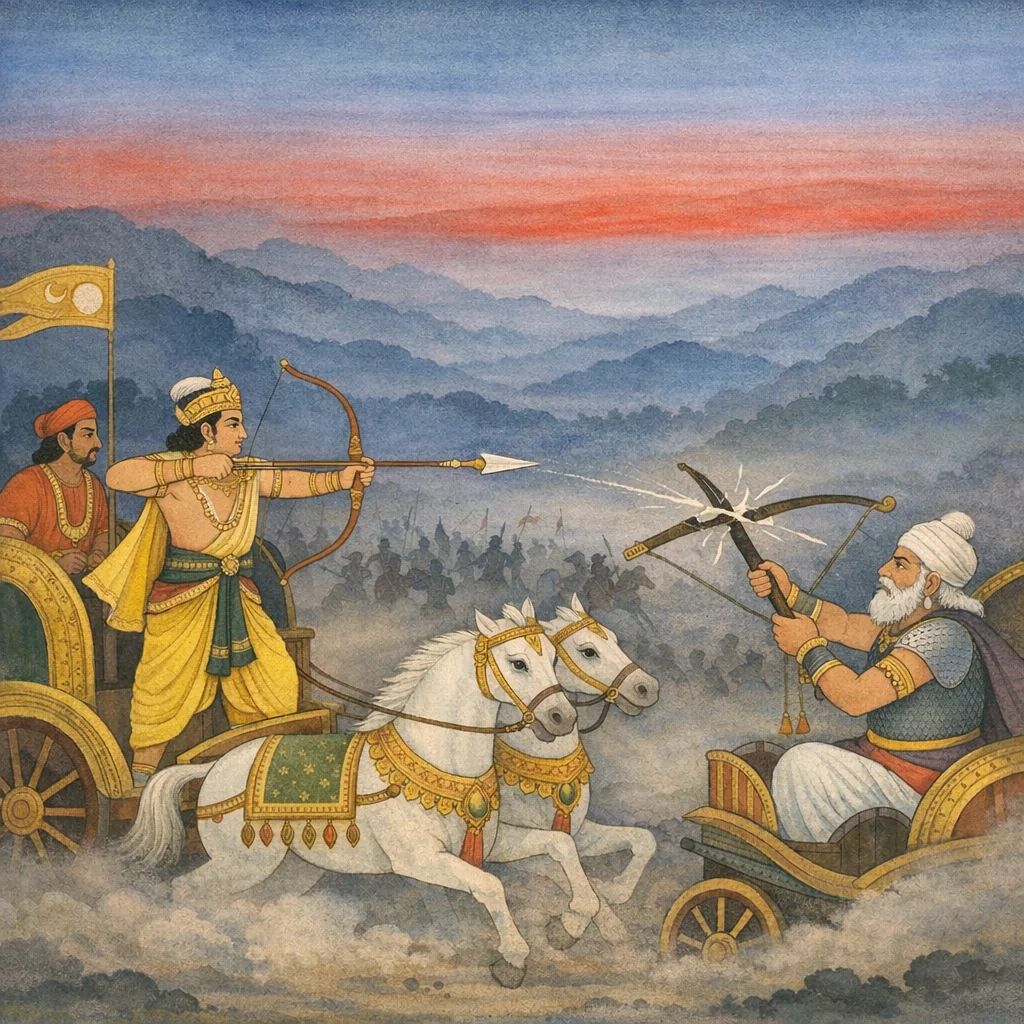
Adhyaya 164
Droṇavadha-saṃniveśaḥ — The Convergence Toward Droṇa’s Fall (Book 7, Chapter 164)
Upa-parva: Droṇavadha (The Death of Droṇa) — Adhyāya 164 Context Unit
Sañjaya describes a dense battlefield sequence during severe losses of men, horses, and elephants. Dhṛṣṭadyumna repels Duḥśāsana and moves toward Droṇa; Kṛtavarmā and allied warriors attempt to contain the advance while the twin brothers guard Dhṛṣṭadyumna’s rear. Parallel duels intensify: Duryodhana and Sātyaki engage in a close contest marked by a brief, reflective exchange recalling childhood camaraderie even as they reaffirm the inevitability of war; Karṇa moves to support Duryodhana, prompting Bhīma to counter. Droṇa’s use of high-grade weaponry devastates Pāñcāla and allied ranks, producing panic among the Pāṇḍavas. Kṛṣṇa advises that Droṇa cannot be checked by ordinary combat and proposes a psychological means: proclaiming Aśvatthāmā as slain. Bhīma kills an elephant named Aśvatthāmā and announces the name; Yudhiṣṭhira, pressured by strategic necessity, utters an ambiguous statement (“Aśvatthāmā is slain… the elephant”), which Droṇa hears as confirmation. Droṇa’s composure breaks under grief and doubt; Dhṛṣṭadyumna presses in, and the chapter closes amid continued tactical exchanges and the coalition’s attempt to capitalize on Droṇa’s destabilized resolve.
Chapter Arc: रणभूमि में सात्यकि का प्रण गूँज उठता है—“सूत! जब तक महाबली सोमदत्त का वध न कर दूँ, मैं युद्ध से लौटूँगा नहीं।” उसी क्षण रथवान् सारथि शंख-श्वेत, मनोवेग से दौड़ने वाले घोड़ों को साधकर उसे ऐसे ले चलता है जैसे इन्द्र को हरि-घोड़े दैत्य-वध हेतु ले चले हों। → यात्रियुद्ध का कोलाहल बढ़ता जाता है—रथों की घर्घराहट पृथ्वी को कंपाती है, दिशाएँ मेघ-गर्जन की भाँति नादित होती हैं। एक ओर सात्यकि सोमदत्त की ओर टूटता है; दूसरी ओर युधिष्ठिर द्रोणाचार्य के सम्मुख निर्भय होकर अस्त्र-प्रतिस्त्र का जाल बुनते हैं। संध्या-समय में भीम शत्रुओं को रौंदता है और द्रोण पाण्डव-पाञ्चाल सेना को दबाते हैं। → युधिष्ठिर, असम्भ्रान्त होकर, द्रोण के प्रचण्ड अस्त्र को अपने अस्त्र से स्तम्भित करते हैं और फिर तीक्ष्ण भल्लों से आचार्य के विशाल धनुष को भी काट डालते हैं—क्षण भर को गुरु-शिष्य, धर्मराज-आचार्य का यह सामना समस्त सेना की दृष्टि का केन्द्र बन जाता है। → युद्ध का प्रवाह थमता नहीं, पर संतुलन बदलता है—युधिष्ठिर की निर्भीक प्रतिरोध-शक्ति से द्रोण की गति क्षणिक रूप से अवरुद्ध होती है; उधर सात्यकि का प्रण उसे सोमदत्त-वध की ओर और तीव्रता से धकेलता है। संध्या के धूसर प्रकाश में दोनों पक्ष पुनः पंक्तियाँ सँभालते हैं। → सात्यकि का प्रण अभी अधूरा है—क्या वह सोमदत्त को रण में ढूँढ़कर वध कर पाएगा, और क्या द्रोण के सामने युधिष्ठिर का यह प्रतिरोध अगले प्रहार को रोक सकेगा?
Shlokas
Verse 1
न२््््स्शितास् श््यु नी नत्तज्स द्विषष्ट्यांधेकशततमो< ध्याय: सात्यकिद्वारा सोमदत्तका वध, द्रोणाचार्य और युधिष्ठिरका युद्ध तथा भगवान् श्रीकृष्णका युधिष्ठिरको द्रोणाचार्यसे दूर रहनेका आदेश संजय उवाच सोमदत्तं तु सम्प्रेक्ष्य विधुन्वानं महद् धनु: । सात्यकि: प्राह यन्तारं सोमदत्ताय मां वह,संजय कहते हैं--राजन्! सोमदत्तको अपना विशाल धनुष हिलाते देख सात्यकिने अपने सारथिसे कहा--“मुझे सोमदत्तके पास ले चलो
Sañjaya said: “O King, seeing Somadatta brandishing his great bow, Sātyaki spoke to his charioteer: ‘Drive me toward Somadatta.’”
Verse 2
न हाहत्वा रणे शत्रुं सोमदत्तं महाबलम् । निवर्तिष्ये रणात् सूत सत्यमेतद् वचो मम,'सूत! आज मैं रणभूमिमें अपने महाबली शत्रु सोमदत्तका वध किये बिना वहाँसे पीछे नहीं लौटूँगा। मेरी यह बात सत्य है"
Sañjaya said: “O charioteer, I will not withdraw from this battlefield until I have slain my enemy Somadatta, the mighty. This is the truth—such is my resolve.”
Verse 3
ततः सम्प्रैषयद् यन्ता सैन्धवांस्तान् मनोजवान् | तुरज़्माज्छड्खवर्णान् सर्वशब्दातिगान् रणे,तब सारथिने शंखके समान श्वेतवर्णवाले तथा सम्पूर्ण शब्दोंका अतिक्रमण करनेवाले मनके समान वेगशाली सिंधी घोड़ोंको रणभूमिमें आगे बढ़ाया
Sañjaya said: Then the charioteer urged on those Sindhu-bred horses—swift as the mind, white as a conch, and seeming to outstrip all sounds—driving them forward upon the battlefield. The verse underscores the relentless momentum of war, where human intent and skill harness speed and power toward violent ends, pressing ethical choices into moments of irreversible action.
Verse 4
तेडवहन् युयुधानं तु मनोमारुतरंहस: । यथेन्द्रं हरयो राजन् पुरा दैत्यवधोद्यतम्
Sañjaya said: O King, they bore Yuyudhāna (Sātyaki) forward with the speed of mind and wind—just as, in ancient times, Indra was borne by his tawny steeds when he set out to slay the Dānavas. The image underscores the righteous urgency of a warrior’s charge in a crisis, likening human valor in battle to a divine mission against forces of disorder.
Verse 5
राजन्! मन और वायुके समान वेगशाली वे घोड़े युयुधानको उसी प्रकार ले जाने लगे, जैसे पूर्वकालमें दैत्य-वधके लिये उद्यत देवराज इन्द्रको उनके घोड़े ले गये थे ।। तमापततन्तं सम्प्रेक्ष्य सात्वतं रभसं रणे । सोमदत्तो महाबाहुरसम्भ्रान्तो न्यवर्तत,वेगशाली सात्यकिको रणभूमिमें अपनी ओर आते देख महाबाहु सोमदत्त बिना किसी घबराहटके उनकी ओर लौट पड़े
Sañjaya said: O King, those horses—swift as mind and wind—carried Yuyudhāna forward, just as in ancient times Indra’s steeds bore the lord of the gods when he set out to slay the demons. Seeing the impetuous Sātvata (Sātyaki) rushing toward him on the battlefield, the mighty-armed Somadatta, unshaken and without confusion, turned back to face him.
Verse 6
विमुज्चञ्छरवर्षाणि पर्जन्य इव वृष्टिमान् । छादयामास शैनेयं जलदो भास्करं यथा
Sañjaya said: “Pouring forth showers of arrows like a rain-laden cloud, he covered Śaineya (Sātyaki), just as a cloud veils the sun.”
Verse 7
वर्षा करनेवाले मेघकी भाँति बाणसमूहोंकी वृष्टि करते हुए सोमदत्तने, जैसे बादल सूर्यको ढक लेता है, उसी प्रकार शिनिपौत्र सात्यकिको आच्छादित कर दिया ।। असम्भ्रान्तश्न समरे सात्यकि: कुरुपुड्रवम् । छादयामास बाणौचै: समनन््ताद् भरतर्षभ,भरतश्रेष्ठ) उस समरांगणमें सम्भ्रमरहित सात्यकिने भी अपने बाणसमूहोंद्वारा सब ओरसे कुरुप्रवर सोमदत्तको आच्छादित कर दिया
Sanjaya said: Somadatta, pouring forth volleys of arrows like a rain-bearing cloud, covered Shini’s son Satyaki as a cloud veils the sun. Yet Satyaki, unshaken amid the clash of arms, answered in kind—enveloping the foremost Kuru, Somadatta, on every side with a flood of arrows. The passage highlights steadiness under pressure and the warrior’s ethic of measured, reciprocal response in battle.
Verse 8
सोमदत्तस्तु तं षष्ट्या विव्याधोरसि माधवम् | सात्यकिश्चापि तं राजन्नविध्यत् सायकैः शितै:,राजन्! फिर सोमदत्तने सात्यकिकी छातीमें साठ बाण मारे और सात्यकिने भी उन्हें तीखे बाणोंसे क्षत-विक्षत कर दिया
Sañjaya said: Somadatta pierced Mādhava (Kṛṣṇa) in the chest with sixty arrows. And Sātyaki too, O King, struck Somadatta with sharp shafts, wounding and tearing him—each warrior answering the other in the fierce code of battle.
Verse 9
तावन्योन्यं शरै: कृत्तौ व्यराजेतां नरर्षभौ । सुपुष्पौ पुष्पसमये पुष्पिताविव किंशुकौ,वे दोनों नरश्रेष्ठ एक-दूसरेके बाणोंसे घायल होकर वसनन््त-ऋतुमें सुन्दर पुष्पवाले दो विकसित पलाशवृक्षोंके समान शोभा पा रहे थे
Sañjaya said: The two bull-like heroes, each cut and wounded by the other’s arrows, shone brilliantly—like two kiṃśuka (flame-of-the-forest) trees in the season of flowering, laden with beautiful blossoms. Even amid mutual injury, their martial splendor and steadfastness in battle remained manifest.
Verse 10
रुधिरोक्षितसर्वाड्री कुरुवृष्णियशस्करौ । परस्परमवेक्षेतां दहन्ताविव लोचनै:,कुरुकुल और वृष्णिवंशके यश बढ़ानेवाले उन दोनों वीरोंके सारे अंग खूनसे लथपथ हो रहे थे। वे नेत्रोंद्वारा एक-दूसरेको जलाते हुए-से देख रहे थे
Sañjaya said: Both those heroes—whose deeds enhanced the fame of the Kurus and the Vṛṣṇis—had all their limbs drenched in blood. They fixed their gaze upon one another as though burning each other with their eyes, unwavering in the fierce code of battle.
Verse 11
रथमण्डलमार्गेषु चरन्तावरिमर्दनौ । घोररूपौ हि तावास्तां वृष्टिमन्ताविवाम्बुदौ,रथ मण्डलके मार्गोंपर विचरते हुए वे दोनों शत्रुमर्दन वीर वर्षा करनेवाले दो बादलोंके समान भंयकर रूप धारण किये हुए थे
Sañjaya said: Moving along the circular courses traced by their chariots, those two enemy-crushing warriors appeared in a dreadful aspect—like two rain-laden storm-clouds, heavy with the power to pour down destruction. The image underscores how martial prowess, when unleashed in war, becomes an overwhelming force that inspires fear and reshapes the field of dharma into a test of restraint and duty.
Verse 12
शरसम्भिन्नगात्रौ तु सर्वतः शकलीकृतौ । श्वाविधाविव राजेन्द्र दृश्येतां शरविक्षतौ,राजेन्द्र! उनके शरीर बाणोंसे क्षत-विक्षत होकर सब ओरसे खण्डित-से हो बाणविद्ध हिंसक पशुओंके समान दिखायी दे रहे थे
Sanjaya said: “O king, their bodies, torn open by arrows and shattered on every side, appeared like wounded beasts—pierced through by shafts.” The verse underscores the brutal visibility of war’s consequences: when dharma collapses into violence, the human form itself is reduced to a spectacle of suffering, meant to sober the listener rather than glorify slaughter.
Verse 13
सुवर्णपुड्खैरिषुभिराचितौ तौ व्यराजताम् । खटद्योतैरावृती राजन् प्रावषीव वनस्पती,राजन! सुवर्णमय पंखवाले बाणोंसे व्याप्त होकर वे दोनों योद्धा वर्षाकालमें जुगनुओंसे व्याप्त हुए दो वृक्षोंक समान सुशोभित हो रहे थे
Sañjaya said: O King, those two warriors, covered all over with arrows whose fletchings were of gold, shone brilliantly—like two trees in the rainy season, wrapped in a swarm of fireflies. The image underscores the grim splendor of battle: even as bodies are pierced, valor and steadfastness can appear radiant, while the very beauty is born from violence.
Verse 14
सम्प्रदीपितसर्वाज्ञी सायकैस्तैर्महारथौ । अदृश्येतां रणे क्रुद्धावुल्काभिरिव कुज्जरी,उन दोनों महारथियोंके सारे अंग उन बाणोंसे उद्धासित हो रहे थे; इसीलिये वे दोनों, रणक्षेत्रमें उल्काओंसे प्रकाशित एवं क्रोधमें भरे हुए दो हाथियोंके समान दिखायी देते थे
Verse 15
ततो युधि महाराज सोमदत्तो महारथ: । अर्धचन्द्रेण चिच्छेद माधवस्य महद् धनु:,महाराज! तदनन्तर युद्धस्थलमें महारथी सोमदत्तने अर्धचन्द्राकार बाणसे सात्यकिके विशाल धनुषको काट दिया
Sañjaya said: Then, in the midst of battle, O great king, Somadatta—the great chariot-warrior—severed Mādhava’s mighty bow with a crescent-headed arrow. The episode underscores how, in war, even renowned heroes face sudden reversals through an opponent’s skill, testing steadiness and resolve amid the harsh demands of kṣatriya duty.
Verse 16
अथैनं पञ्चविंशत्या सायकानां समार्पयत् । त्वरमाणस्त्वराकाले पुनश्न दशभि: शरै:,और तत्काल ही उनपर पचीस बाणोंका प्रहार किया। शीघ्रताके अवसरपर शीघ्रता करनेवाले सोमदत्तने सात्यकिको पुनः दस बाणोंसे घायल कर दिया
Sañjaya said: Then, seizing the moment, he struck him with twenty-five arrows. And, acting with speed when speed was required, he again wounded him with ten more shafts. The verse underscores the battlefield ethic of alertness and timely action—swift initiative becomes decisive amid the pressure of war.
Verse 17
अथान्यद् धनुरादाय सात्यकिर्वेगवत्तरम् । पज्चभि: सायकैस्तूर्ण सोमदत्तमविध्यत,तदनन्तर सात्यकिने अत्यन्त वेगशाली दूसरा धनुष हाथमें लेकर तुरंत ही पाँच बाणोंसे सोमदत्तको बींध डाला
Sañjaya said: Then Sātyaki, taking up another bow of even greater speed, swiftly pierced Somadatta with five arrows. The narration underscores the relentless momentum of battle—skill and resolve driving each exchange—while also reminding that in war, prowess is measured in controlled, purposeful action rather than mere fury.
Verse 18
ततो5परेण भल्लेन ध्वजं चिच्छेद काउ्चनम् | बाह्लीकस्य रणे राजन् सात्यकि: प्रहसन्निव,राजन! फिर सात्यकिने हँसते हुए-से रणभूमिमें एक दूसरे भल्लके द्वारा बाह्लीकपुत्र सोमदत्तके सुवर्णमय ध्वजको काट दिया
Sañjaya said: Then, O King, with another broad-headed arrow Sātyaki, as if smiling, cut down the golden banner of Bāhlīka in the midst of battle. The act signals not mere display of skill but a deliberate blow to the enemy’s prestige and morale—an ethical tactic within the harsh codes of war, where symbols of honor are targeted to unnerve the opposing side without directly striking the person.
Verse 19
सोमदत्तस्त्वसम्भ्रान्तो दृष्टवा केतुं निपातितम् । शैनेयं पञचविंशत्या सायकानां समाचिनोत्,ध्वजको गिराया हुआ देख सम्भ्रमरहित सोमदत्तने सात्यकिके शरीरमें पचीस बाण चुन दिये
Sañjaya said: Seeing his banner toppled, Somadatta—remaining unshaken and free from panic—shot Śaineya (Sātyaki) with twenty-five arrows. The verse highlights a warrior’s steadiness under loss of honor-symbols (the fallen standard) and the relentless escalation of violence on the battlefield.
Verse 20
सात्वतो5पि रणे क्रुद्ध: सोमदत्तस्य धन्विन: । धनुश्विच्छेद भल््लेन क्षुरप्रेण शितेन ह
Sañjaya said: Even the Sātvata warrior, inflamed with wrath in the thick of battle, severed the bow of Somadatta the archer with a sharp, razor-edged arrow. The episode underscores how, amid the moral strain of war, mastery and restraint are shown not only by killing but by disabling an opponent’s means of harm.
Verse 21
तब रणक्षेत्रमें कुपित हुए सात्यकिने भी तीखे क्षुरप्र नामक भल्लसे धनुर्धर सोमदत्तके धनुषको काट दिया ।। अथैनं रुक्मपुड्खानां शतेन नतपर्वणाम् | आचिनोद् बहुधा राजन् भग्नदंष्टमिव द्विपम्,राजन! तत्पश्चात् उन्होंने झुकी हुई गाँठ और सुवर्णमय पंखवाले सौ बाणोंसे टूटे दाँतवाले हाथीके समान सोमदत्तके शरीरको अनेक बार बींध दिया
Sañjaya said: Then Sātyaki, enraged on the battlefield, struck Somadatta again and again with a hundred arrows—gold-feathered and jointed so as to bend—piercing him repeatedly, like an elephant whose tusks have been broken. The image underscores the brutal momentum of war: even a renowned warrior, once his strength is compromised, becomes a target for relentless assault, revealing how anger and martial duty can harden into merciless violence.
Verse 22
अथान्यद् धनुरादाय सोमदत्तो महारथ: । सात्यकिं छादयामास शरवृष्टया महाबल:
Sañjaya said: Then Somadatta, that great chariot-warrior of mighty strength, took up another bow and covered Sātyaki with a rain of arrows—pressing the attack with relentless martial force amid the moral turbulence of the battlefield.
Verse 23
इसके बाद महारथी महाबली सोमदत्तने दूसरा धनुष लेकर सात्यकिको बाणोंकी वर्षासे ढक दिया ।। सोमदत्तं तु संक्रुद्धो रणे विव्याध सात्यकि: । सात्यकि शरजालेन सोमदत्तो5प्यपीडयत्,उस युद्धमें क़ुद्ध हुए सात्यकिने सोमदत्तको गहरी चोट पहुँचायी और सोमदत्तने भी अपने बाणसमूहद्वारा सात्यकिको पीड़ित कर दिया
Sañjaya said: Enraged in the thick of battle, Sātyaki struck Somadatta with piercing arrows. Somadatta, in turn, pressed Sātyaki hard by covering him with a net-like shower of shafts. Thus, amid the relentless ethics of kṣatriya warfare, each answered the other’s assault with equal resolve and martial skill.
Verse 24
दशभि: सात्वतस्यार्थे भीमो5हन् बाह्लिकात्मजम् | सोमदत्तो5प्यसम्भ्रान्तो भीममार्च्छच्छितै: शरै:,उस समय भीमसेनने सात्यकिकी सहायताके लिये सोमदत्तको दस बाण मारे। इससे सोमदत्तको तनिक भी घबराहट नहीं हुई। उन्होंने भी तीखे बाणोंसे भीमसेनको पीड़ित कर दिया
Sañjaya said: For the sake of Sātvata (Sātyaki), Bhīma struck Bāhlika’s son Somadatta with ten arrows. Yet Somadatta did not lose his composure; in return, he assailed Bhīma with keen shafts, wounding him. The passage highlights steadfastness under attack and the relentless reciprocity of violence on the battlefield.
Verse 25
ततस्तु सात्वतस्यार्थे भीमसेनो नवं दृढम् । मुमोच परिघं घोरं सोमदत्तस्य वक्षसि,तत्पश्चात् सात्यकिकी ओरसे भीमसेनने सोमदत्तकी छातीको लक्ष्य करके एक नूतन सुदृढ़ एवं भयंकर परिघ छोड़ा
Sañjaya said: Then, for the sake of the Sātvata (Sātyaki), Bhīmasena hurled a new, firm, and dreadful iron club straight at Somadatta’s chest. The scene underscores the battlefield ethic of protecting one’s ally and acting decisively in defense of a comrade amid the brutal demands of war.
Verse 26
तमापततन्तं वेगेन परिघं घोरदर्शनम् । द्विधा चिच्छेद समरे प्रहसन्निव कौरव:,समरांगणमें बड़े वेगसे आते हुए उस भयंकर परिघके कुरुवंशी सोमदत्तने हँसते हुए-से दो टुकड़े कर डाले
Sañjaya said: As that dreadful, iron club—terrifying to behold—came hurtling in with great speed, the Kaurava (Somadatta) in the thick of battle, as if smiling, cleft it into two. The scene underscores the grim skill of war: courage and composure can turn even a fearsome weapon into something powerless, yet the very ease of destruction also reveals how battle normalizes violence and hardens the heart.
Verse 27
स पपात द्विधा छिन्न आयस: परिघो महान् । महीधरस्येव महच्छिखरं वज़दारितम्,लोहेका वह महान् परिघ दो खण्डोंमें विभक्त होकर वज्रसे विदीर्ण किये गये महान् पर्ववशिखरके समान पृथ्वीपर गिर पड़ा
Sañjaya said: The great iron club, split into two pieces, fell to the earth—like a lofty mountain-peak shattered by a thunderbolt. The image underscores the irresistible force unleashed in battle and the sudden collapse of even the mightiest weapon when struck by superior power.
Verse 28
ततस्तु सात्यकी राजन् सोमदत्तस्य संयुगे । धनुश्विच्छेद भल्लेन हस्तावापं च पञठ्चभि:,राजन! तदनन्तर संग्रामभूमिमें सात्यकिने एक भल्लसे सोमदत्तका धनुष काट दिया और पाँच बाणोंसे उनके दस्ताने नष्ट कर दिये
Sañjaya said: Then, O King, in the thick of battle Sātyaki struck Somadatta—severing his bow with a sharp bhalla-arrow, and with five more arrows he shattered the protective gear upon his hands. The scene underscores the ruthless precision of war, where skill is used not for display but to disable an opponent’s capacity to fight.
Verse 29
ततश्नतुर्भिश्न शरैस्तूर्ण तांस्तुरगोत्तमान् । समीपं प्रेषयामास प्रेतराजस्य भारत,भारत! फिर तत्काल ही चार बाणोंसे उन्होंने सोमदत्तके उन उत्तम घोड़ोंको प्रेतराज यमके समीप भेज दिया
Sañjaya said: Then, swiftly striking with four arrows, he dispatched those excellent horses to the very presence of Yama, the lord of the departed—thus sending them to death in the midst of battle, O Bhārata.
Verse 30
सारथेश्न शिर: कायाद् भल्लेन नतपर्वणा । जहार नरशार्दूल: प्रहसज्छिनिपुड्रव:,इसके बाद पुरुषसिंह शिनिप्रवर सात्यकिने हँसते हुए झुकी हुई गाँठवाले भल्लसे सोमदत्तके सारथिका सिर धड़से अलग कर दिया
Sañjaya said: Then the tiger among men, Sātyaki—the foremost of the Śini line—laughing as he fought, severed with a bhalla arrow (whose joints were bent) the charioteer’s head from his body. In the brutal ethics of battlefield duty, this act shows the relentless execution of a kṣatriya’s war-task: disabling the enemy’s capacity to fight by striking down the chariot’s support, even as the violence remains stark and unsparing.
Verse 31
ततः शरं महाघोरं ज्वलन्तमिव पावकम् | मुमोच सात्वतो राजन् स्वर्णपुड्खं शिलाशितम्,राजन! तत्पश्चात् सात्वतवंशी सात्यकिने प्रजवलित पावकके समान एक महाभयंकर, सुवर्णमय पंखवाला और शिलापर तेज किया हुआ बाण सोमदत्तपर छोड़ा
Sañjaya said: Then, O King, the Sātvata warrior released a most dreadful arrow—blazing like fire—its fletching of gold and its point honed upon stone. The image underscores the relentless escalation of battle, where skill and resolve are turned into instruments of destruction, testing the bounds of kṣatriya-duty amid overwhelming violence.
Verse 32
स विमुक्तो बलवता शैनेयेन शरोत्तम: । घोरस्तस्योरसि विभो निपपाताशु भारत,भरतनन्दन! प्रभो! शिनिवंशी बलवान् सात्यकिके द्वारा छोड़ा हुआ वह श्रेष्ठ एवं भयंकर बाण शीघ्र ही सोमदत्तकी छातीपर जा पड़ा
Sañjaya said: Released with great force by Śaineya (Sātyaki), that foremost arrow—terrible in its impact—swiftly struck Somadatta upon the chest. The verse underscores the grim inevitability of battlefield consequences: skill and resolve, once set in motion, culminate in immediate and irreversible results, reminding the listener of the heavy ethical weight carried by every martial act in the war.
Verse 33
सो5तिविद्धों महाराज सात्वतेन महारथ: । सोमदत्तो महाबाहुर्निपपात ममार च,महाराज! सात्यकिके चलाये हुए उस बाणसे अत्यन्त घायल होकर महारथी महाबाहु सोमदत्त पृथ्वीपर गिरे और मर गये
Sañjaya said: O King, struck through and grievously wounded by the Sātvata (Sātyaki), the great chariot-warrior Somadatta, mighty-armed, fell to the earth and died. The moment underscores the inexorable moral weight of battle: prowess and lineage offer no refuge when one’s chosen side and actions culminate in the fatal consequences of war.
Verse 34
त॑ दृष्टवा निहतं तत्र सोमदत्तं महारथा: । महता शरवर्षेण युयुधानमुपाद्रवन्,सोमदत्तको मारा गया देख आपके बहुसंख्यक महारथी बाणोंकी भारी वृष्टि करते हुए वहाँ सात्यकिपर टूट पड़े
Sañjaya said: Seeing Somadatta slain there, the great chariot-warriors, in a surge of wrath and grief, rushed upon Yuyudhāna (Sātyaki), showering him with a mighty rain of arrows. The scene underscores the war’s relentless chain of retaliation—each fall immediately provoking a collective counterattack, where personal loyalty and clan-duty drive the next violent turn.
Verse 35
छाद्यमानं शरैर्दृष्टवा युयुधानं युधिष्ठिर: । पाण्डवाश्न महाराज सह सर्व: प्रभद्रकै: । महत्या सेनया सार्ध द्रोणानीकमुपाद्रवन्,महाराज! उस समय सात्यकिको बाणोंद्वारा आच्छादित होते देख युधिष्ठिर तथा अन्य पाण्डवोंने समस्त प्रभद्रकोंसहित विशाल सेनाके साथ द्रोणाचार्यकी सेनापर धावा किया
Sanjaya said: Seeing Yuyudhāna (Sātyaki) being covered by volleys of arrows, Yudhiṣṭhira—O great king—together with the other Pāṇḍavas and all the Prabhadrakas, advanced in a powerful mass with a great army and charged at Droṇa’s battle-formation. The moment underscores a dharmic impulse of protection and solidarity: comrades do not abandon a warrior overwhelmed, even amid the brutal necessities of war.
Verse 36
ततो युधिष्ठिर: क्रुद्धस्तावकानां महाबलम् | शरैरविद्रावयामास भारद्वाजस्य पश्यत:,तदनन्तर क्रोधमें भरे हुए राजा युधिष्ठिरने अपने बाणोंकी मारसे आपकी विशाल वाहिनीको द्रोणाचार्यके देखते-देखते खदेड़ना आरम्भ किया
Then Yudhiṣṭhira, inflamed with anger, began to drive back your mighty host with volleys of arrows—doing so in full view of Bhāradvāja’s son (Droṇa). The scene underscores how even the ordinarily restrained king, pressed by the brutal necessities of war, is drawn into fierce retaliation before the very teacher who commands the opposing ranks.
Verse 37
सैन्यानि द्रावयन्तं तु द्रोणो दृष्टवा युधिष्ठिरम् । अभिदुद्राव वेगेन क्रोधसंरक्तलोचन:,द्रोणाचार्यने देखा कि युधिष्ठिर मेरे सैनिकोंको खदेड़ रहे हैं, तब वे क्रोधसे लाल आँखें करके बड़े वेगसे उनकी ओर दौड़े
Sanjaya said: Seeing Yudhiṣṭhira driving his troops into flight, Droṇa—his eyes reddened with anger—rushed straight at him with great speed. The moment underscores how battlefield success provokes personal wrath and escalates the conflict, drawing commanders into direct, ethically charged confrontations.
Verse 38
ततः सुनिशितैर्बाणै: पार्थ विव्याध सप्तभि: । युधिष्ठिरो5पि संक्रुद्ध: प्रतिविव्याध पठचभि:
Sañjaya said: Then, with seven razor-sharp arrows, Yudhiṣṭhira pierced Pārtha (Arjuna). Arjuna too, angered in return, struck back and pierced him with five arrows—each answering blow intensifying the fierce reciprocity of battle, where restraint and duty struggle against rising wrath.
Verse 39
फिर उन्होंने सात तीखे बाणोंसे कुन्तीकुमार युधिष्ठिरको घायल कर दिया। अत्यन्त क्रोधमें भरे हुए युधिष्ठिरने भी उन्हें पाँच बाणोंसे बींधकर बदला चुकाया ।। सो5तिविद्धों महाबाहुः सृक्किणी परिसंलिहन् । युधिष्ठटिरस्य चिच्छेद ध्वजं कार्मुकमेव च,तब अत्यन्त घायल हुए महाबाहु द्रोणाचार्य अपने दोनों गलफर चाटने लगे। उन्होंने युधिष्ठिरके ध्वज और धनुषको भी काट दिया। शीघ्रताके समय शीघ्रता करनेवाले नृपश्रेष्ठ युधिष्ठिरने समरांगणमें धनुष कट जानेपर दूसरे सुदृढ़ धनुषको वेगपूर्वक हाथमें ले लिया
Sañjaya said: Though pierced again and again, the mighty-armed Droṇa, licking the corners of his mouth in grim resolve, cut down Yudhiṣṭhira’s banner and also his bow. The episode underscores how, in the fury of battle, even grievous wounds do not halt a seasoned warrior’s purpose—yet the stripping of a banner and bow is also a pointed humiliation, testing a king’s steadiness and dharma under pressure.
Verse 40
स च्छिन्नधन्वा त्वरितस्त्वराकाले नृपोत्तम: । अन्यदादत्त वेगेन कार्मुक॑ समरे दृढम्,तब अत्यन्त घायल हुए महाबाहु द्रोणाचार्य अपने दोनों गलफर चाटने लगे। उन्होंने युधिष्ठिरके ध्वज और धनुषको भी काट दिया। शीघ्रताके समय शीघ्रता करनेवाले नृपश्रेष्ठ युधिष्ठिरने समरांगणमें धनुष कट जानेपर दूसरे सुदृढ़ धनुषको वेगपूर्वक हाथमें ले लिया
Sañjaya said: When his bow had been cut, the best of kings (Yudhiṣṭhira), swift at the very moment that demanded swiftness, quickly seized another firm bow on the battlefield. The scene underscores a kṣatriya’s duty to remain steady under sudden loss, responding without panic and continuing the fight with disciplined resolve.
Verse 41
ततः शरसहस्रेण द्रोणं विव्याध पार्थिव: । साश्वसूतध्वजरथं तदद्भुतमिवाभवत्,फिर सहस्रों बाणोंकी वर्षा करके राजाने घोड़े, सारथि, रथ और ध्वजसहित द्रोणाचार्यको बींध डाला। वह अद्भुत-सा कार्य हुआ
Sañjaya said: Then the king struck Droṇa with a thousand arrows, piercing him along with his horses, charioteer, chariot, and banner. It appeared like a wondrous feat on the battlefield—an overwhelming display of martial power amid the grim duties of war.
Verse 42
ततो मुहूर्त व्यथितः शरपातप्रपीडित: । निषसाद रथोपस्थे द्रोणो भरतसत्तम,भरतश्रेष्ठ! उन बाणोंके आघातसे अत्यन्त पीड़ित एवं व्यथित होकर द्रोणाचार्य दो घड़ीतक रथके पिछले भागमें बैठे रहे
Sañjaya said: Then Droṇa, shaken for a while and grievously oppressed by the shower of arrows, sat down upon the rear part of his chariot—O best of the Bharatas. The scene underscores how even the mightiest warrior-teacher is subject to bodily suffering in war, and how the battlefield reduces greatness to endurance amid pain.
Verse 43
प्रतिलभ्य ततः संज्ञां मुहूर्ताद् द्विजसत्तम: । क्रोधेन महता5<विष्टो वायव्यास्त्रमवासृजत्,तत्पश्चात् सचेत होनेपर द्विजश्रेष्ठ द्रोणने महान् क्रोधमें भरकर वायव्यास्त्रका प्रयोग किया
Sañjaya said: After a brief while, the best of Brahmins regained consciousness. Then, seized by intense anger, Droṇa unleashed the Vāyavya weapon—an invocation of the wind’s force—escalating the battle through wrath rather than restraint.
Verse 44
असम्भ्रान्तस्ततः पार्थो धनुराकृष्य वीर्यवान् ततस्तदस्त्रमस्त्रेण सतम्भयामास भारत,भरतनन्दन! तदनन्तर पराक्रमी युधिष्ठिरने सम्भ्रमरहित हो धनुष खींचकर उनके उस अस्त्रको अपने दिव्यास्त्र-द्वारा कुण्ठित कर दिया
Sañjaya said: Then Pārtha, unshaken and full of prowess, drew his bow. Thereupon, O Bhārata, O joy of the Bharatas, he checked and blunted that missile by countering it with his own weapon. The scene underscores the warrior’s discipline: steadiness of mind and measured force, not panic, becomes the means by which destructive power is restrained in the midst of war.
Verse 45
चिच्छेद च भर्नुर्दीर्घ ब्राह्मणस्य च पाण्डव: । ततोथन्यद् धनुरादत्त द्रोण: क्षत्रियमर्दन:
Sañjaya said: The Pāṇḍava cut the long bow of Droṇa, the Brāhmaṇa. Thereupon Droṇa—crusher of warriors—took up another bow. The scene underscores how, even amid relentless combat, mastery and resolve answer injury with renewed effort, and how the clash of duties (a Brāhmaṇa fighting as a Kṣatriya) intensifies the moral tension of the war.
Verse 46
ततोअब्रवीद् वासुदेव: कुन्तीपुत्रं युधिष्ठिरम्,तदनन्तर वसुदेवनन्दन भगवान् श्रीकृष्णने कुन्तीपुत्र युधिष्ठिससे कहा--“महाबाहु युधिष्ठिर! मैं तुमसे जो कह रहा हूँ, उसे सुनो। भरतश्रेष्ठ! तुम युद्धमें द्रोणाचार्यसे अलग रहो
Sañjaya said: Then Vāsudeva—Bhagavān Śrī Kṛṣṇa, the son of Vasudeva—addressed Kuntī’s son Yudhiṣṭhira: “Mighty-armed Yudhiṣṭhira, listen to what I am telling you. Best of the Bharatas, in this battle keep yourself apart from Droṇācārya.” The counsel frames a moment of wartime prudence: Kṛṣṇa urges restraint and strategic distance from a formidable teacher-warrior, implying that dharma in war includes knowing when not to engage directly and how to protect the righteous leadership of the Pāṇḍavas.
Verse 47
युधिष्ठिर महाबाहो यच्त्वां वक्ष्यामि तच्छृणु । उपारमस्व युद्धे त्वं द्रोणाद् भरतसत्तम,तदनन्तर वसुदेवनन्दन भगवान् श्रीकृष्णने कुन्तीपुत्र युधिष्ठिससे कहा--“महाबाहु युधिष्ठिर! मैं तुमसे जो कह रहा हूँ, उसे सुनो। भरतश्रेष्ठ! तुम युद्धमें द्रोणाचार्यसे अलग रहो
Verse 48
यतते हि सदा द्रोणो ग्रहणे तव संयुगे । नानुरूपमहं मन्ये युद्धमस्य त्वयवा सह,क्योंकि द्रोणाचार्य युद्धस्थलमें सदा तुम्हें कैद करनेके प्रयत्नमें रहते हैं; अतः तुम्हारे साथ इनका युद्ध होना मैं उचित नहीं मानता
Sañjaya said: “Droṇa is always striving, in the midst of battle, to seize you. Therefore I do not judge it fitting or proper that you should engage in combat with him.”
Verse 49
यो<स्य सृष्टो विनाशाय स एवैनं हनिष्यति । परिवर्ज्य गुरुं याहि यत्र राजा सुयोधन:,“जो इनके विनाशके लिये उत्पन्न हुआ है, वही इन्हें मारेगा। तुम अपने गुरुदेवको छोड़कर जहाँ राजा दुर्योधन हैं, वहाँ जाओ
Sañjaya said: “He who has been brought forth for this man’s destruction—he alone will slay him. Therefore, leaving your teacher behind, go to where King Suyodhana (Duryodhana) is.” The statement frames the killing as an outcome already set in motion by destiny and by the moral logic of the war, while also urging a pragmatic shift of allegiance from the guru’s command to the king’s immediate need.
Verse 50
राजा राज्ञा हि योद्धव्यो नाराज्ञा युद्धमिष्यते । तत्र त्वं गच्छ कौन्तेय हस्त्यश्वरथसंवृत:,“क्योंकि राजाको राजाके ही साथ युद्ध करना चाहिये। जो राजा नहीं है, उसके साथ उसका युद्ध अभीष्ट नहीं है। अतः कुन्तीनन्दन! तुम हाथी, घोड़े और रथोंकी सेनासे घिरे रहकर वहीं जाओ
Verse 51
यावन्मात्रेण च मया सहायेन धनंजय: । भीमश्च रथशार्दूलो युध्यते कौरवै: सह
Sañjaya said: “So long as I am able, as his helper, Dhanañjaya (Arjuna) continues to fight; and Bhīma too—lion among charioteers—battles on together with him against the Kauravas.”
Verse 52
“तबतक मेरे साथ रहकर अर्जुन तथा रथियोंमें सिंहके समान पराक्रमी भीमसेन कौरवोंके साथ युद्ध करते हैं" ।। वासुदेववच: श्रुत्वा धर्मराजो युधिष्ठिर: । मुहूर्त चिन्तयित्वा तु ततो दारुणमाहवम्,भगवान् श्रीकृष्णका यह वचन सुनकर धर्मराज युधिष्ठिरने दो घड़ीतक उस दारुण युद्धके विषयमें सोचा। फिर वे तुरंत वहाँ चले गये, जहाँ शत्रुओंका संहार करनेवाले भीमसेन आपके योद्धाओंका वध करते हुए मुँह फैलाये यमराजके समान खड़े थे
Sanjaya said: “Meanwhile, staying with me, Arjuna and Bhimasena—lion-like among chariot-warriors—continue to fight the Kauravas.” Hearing Vasudeva’s words, King Yudhishthira reflected for a while on the dreadful battle. Then he hurried to the place where Bhimasena, destroyer of foes, stood like Yama with gaping mouth, cutting down your warriors—an image of war’s inexorable justice and terror.
Verse 53
प्रायाद् द्रुतममित्रघ्नो यत्र भीमो व्यवस्थित: । विनिष्नंस्तावकान् योधान् व्यादितास्य इवान्तक:,भगवान् श्रीकृष्णका यह वचन सुनकर धर्मराज युधिष्ठिरने दो घड़ीतक उस दारुण युद्धके विषयमें सोचा। फिर वे तुरंत वहाँ चले गये, जहाँ शत्रुओंका संहार करनेवाले भीमसेन आपके योद्धाओंका वध करते हुए मुँह फैलाये यमराजके समान खड़े थे
Sañjaya said: The slayer of foes hastened quickly to the place where Bhīma stood firm—cutting down your warriors, gaping like Antaka (Death) himself. Hearing Śrī Kṛṣṇa’s words, Dharmarāja Yudhiṣṭhira reflected for a short while on that dreadful battle, and then at once set out to where Bhīmasena, like Yama with open jaws, was destroying your troops.
Verse 54
रथघोषेण महता नादयन् वसुधातलम् । पर्जन्य इव घर्मान्ति नादयन् वै दिशो दश
Sañjaya said: “With a mighty roar of chariots he made the surface of the earth resound; like thunderclouds at the close of the hot season, he indeed caused all ten directions to echo.”
Verse 55
भीमस्य निष्नतः शत्रून् पार्ष्णि जग्राह पाण्डव: । द्रोणो5पि पाण्डुपज्चालान् व्यधमद् रजनीमुखे
Sañjaya said: While Bhīma was engaged in slaying the foes, the Pāṇḍava (Arjuna) seized the enemy by the heel. And Droṇa too, as night was falling, struck down the Pāṇḍavas and the Pañcālas. The verse underscores the grim reciprocity of battlefield skill—individual feats occur amid a wider tide of violence, where prowess and duty-driven combat intensify as darkness approaches.
Verse 161
इस प्रकार श्रीमह्ााभारत द्रोणपर्वके अन्तर्गत घटोत्कचवधपर्वमें यात्रियुद्धके अवसरपर संकुलयुद्धविषयक एक सौ इकसठवाँ अध्याय पूरा हुआ
Thus ends the one hundred and sixty-first chapter of the Drona Parva in the Śrī Mahābhārata, within the section on the slaying of Ghaṭotkaca, describing the confused and densely entangled fighting that arose on the occasion of the night-battle. The colophon marks the close of this unit, emphasizing the moral gravity of warfare when order collapses into chaos and combat becomes indiscriminate.
Verse 162
पाण्डुनन्दन युधिष्ठिर अपने रथकी भारी घर्घराहटसे भूतलको उसी प्रकार प्रतिध्वनित कर रहे थे, जैसे वर्षाकालमें गर्जना करता हुआ मेघ दसों दिशाओंको गुँजा देता है। उन्होंने शत्रुओंका संहार करनेवाले भीमसेनके पार्श्चभागकी रक्षाका भार ले लिया। उधर द्रोणाचार्य भी रात्रिके समय पाण्डव तथा पांचाल सैनिकोंका संहार करने लगे ।। इति श्रीमहाभारते द्रोणपर्वणि घटोत्कचवधपर्वणि रात्रियुद्धे द्विषष्ट्यधिकशततमो<ध्याय:
Sañjaya said: Yudhiṣṭhira, the son of Pāṇḍu, made the earth resound with the heavy rumble of his chariot, like a thundercloud in the rainy season that fills all ten directions with its roar. He took upon himself the responsibility of guarding the rear and flank of Bhīmasena, that destroyer of enemies. Meanwhile, Droṇācārya too, in the darkness of night, began to slaughter the forces of the Pāṇḍavas and the Pāñcālas. The scene underscores how, in night-battle, protection of comrades and ruthless tactical violence proceed side by side, testing the boundaries of kṣatriya duty and the ethics of warfare.
Verse 453
तदप्यस्य शितैर्भल्लैश्विच्छेद कुरुपुड्व: । इतना ही नहीं, उन पाण्डुकुमारने विप्रवर द्रोणाचार्यके विशाल धनुषको भी काट दिया। फिर क्षत्रियोंका मान-मर्दन करनेवाले द्रोणाचार्यने दूसरा धनुष हाथमें लिया। परंतु कुरुप्रवर युधिष्ठिरने अपने तीखे भल्लोंसे उसको भी काट दिया
Sañjaya said: The foremost of the Kurus (Yudhiṣṭhira) cut that bow as well with sharp bhalla-arrows. Not only that—Pāṇḍu’s son even severed the great bow of the eminent Brahmin, Droṇācārya. Then Droṇa, famed for humbling the pride of kṣatriyas, took up another bow; but the best of the Kurus, Yudhiṣṭhira, again cut that one too with his keen bhallas. The episode highlights disciplined skill used to check a formidable teacher-warrior without needless excess, in the harsh constraints of dharma-bound warfare.
Frequently Asked Questions
The dilemma centers on whether a leader renowned for truth (Yudhiṣṭhira) may employ an intentionally ambiguous statement to avert imminent collective defeat, balancing satya against the protective duty owed to allies under existential threat.
The chapter illustrates that dharma in crisis is experienced as competing obligations—truth, protection, loyalty, and restraint—where choices may preserve life yet still generate ethical remainder, reinforcing the epic’s concern with responsibility beyond immediate outcomes.
No explicit phalaśruti appears in this chapter; the meta-commentary is implicit, conveyed through narrative consequences (Droṇa’s psychological collapse and the moral cost to Yudhiṣṭhira’s reputation and inner stability) within the epic’s broader soteriological and ethical frame.