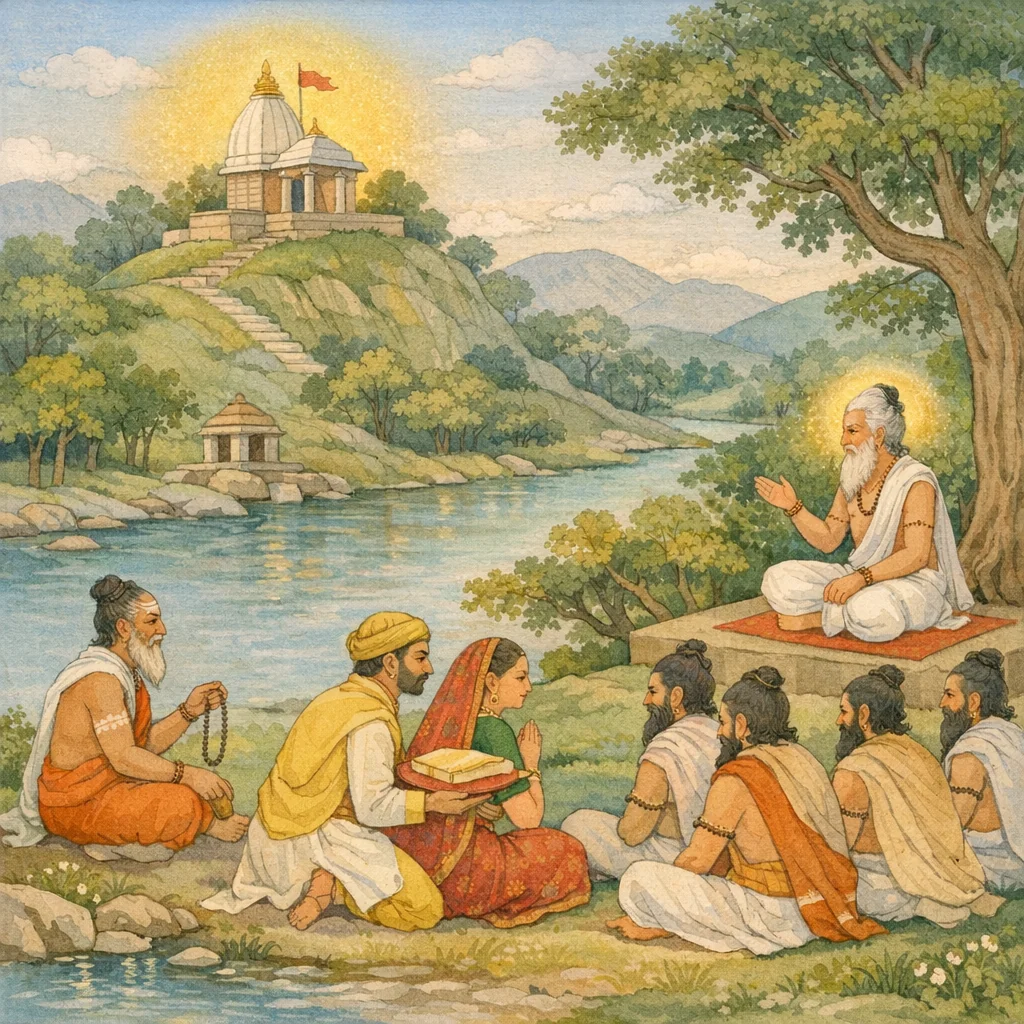
Śivakṣetra–Tīrtha–Māhātmya (The Salvific Function of Shiva’s Sacred Domains)
Adhyāya 12, in Sūta’s discourse to the ṛṣis, proclaims Śiva’s sacred domains (Śiva-kṣetra and tīrtha) as «vimukti-dam», bestowers of liberation. It first grounds cosmic stability in Śiva’s ājñā, affirming that worldly order is Śiva-governed. The kṣetras are then described as deliberate works of grace, “kalpita” by the Lord for the mokṣa of those who dwell there, with a typology that includes svayaṃbhū (self-manifest) sites and other established loci meant for loka-rakṣā. Proper conduct in tīrtha/kṣetra is mandated—snāna, dāna, and japa—while neglect is linked to roga, dāridrya, and impairment. An ethical intensification is stressed: pāpa committed in a kṣetra becomes «dṛḍha» (hardened), so even subtle wrongdoing must be avoided in a puṇya-kṣetra. The chapter finally gestures to a mapped pilgrimage network along the Sindhu and the Sarasvatī and Gaṅgā systems, citing Kāśī and other sacred fields, culminating in brahma-pada, the highest state.
Shlokas
Verse 1
सूत उवाच । शृणुध्वमृषयः प्राज्ञाः शिवक्षेत्रं विमुक्तिदम् । तदागमांस्ततो वक्ष्ये लोकरक्षार्थमेव हि
Sūta said: “Listen, O wise sages, to the sacred field of Śiva—the giver of liberation. Therefore I shall now proclaim its traditions and teachings, indeed for the very purpose of safeguarding the world.”
Verse 2
पंचाशत्कोटिविस्तीर्णा सशैलवनकानना । शिवाज्ञया हि पृथिवी लोकं धृत्वा च तिष्ठति
Spread across fifty crores in extent, adorned with mountains, forests, and groves—this Earth, by Śiva’s command alone, bears the worlds and remains steadfast.
Verse 3
तत्र तत्र शिवक्षेत्रं तत्र तत्र निवासिनाम् । मोक्षार्थं कृपया देवः क्षेत्रं कल्पितवान्प्रभुः
In every place there is a sacred kṣetra of Śiva for the dwellers of that place. For the sake of liberation, the Lord, out of compassion, has established such holy fields.
Verse 4
परिग्रहादृषीणां च देवानां परिग्रहात् । स्वयंभूतान्यथान्यानि लोकरक्षार्थमेव हि
Indeed, through the endowments granted to the ṛṣis and the prerogatives bestowed upon the gods, various provisions arise—of themselves and by other appointed means—solely for the protection and maintenance of the worlds.
Verse 5
तीर्थे क्षेत्रे सदाकार्यं स्नानदानजपादिकम् । अन्यथा रोगदारिद्र य्मूकत्वाद्याप्नुयान्नरः
At a tīrtha (holy ford) and within a kṣetra (sacred domain), one should ever perform such rites as purifying bath, charitable giving, and mantra-recitation (japa), and the like. Otherwise, a person may fall into afflictions—disease, poverty, even dumbness, and similar woes.
Verse 6
अथास्मिन्भारते वर्षे प्राप्नोति मरणं नरः । स्वयंभूस्थानवासेन पुनर्मानुष्यमाप्नुयात्
Now, if a man meets death in this land of Bhārata, then by dwelling at the Svayambhū-sthāna—the self-manifest abode of Śiva—he attains human birth again, returning to embodiment fit for renewed spiritual striving.
Verse 7
क्षेत्रे पापस्य करणं दृढं भवति भूसुराः । पुण्यक्षेत्रे निवासे हि पापमण्वपि नाचरेत्
O brahmins, in a sacred place the doing of sin becomes a fault that binds with great firmness. Therefore, while dwelling in a holy field of merit (puṇya-kṣetra), one should not commit even the slightest sin.
Verse 8
येन केनाप्युपायेन पुण्यक्षेत्रे वसेन्नरः । सिंधोः शतनदीतीरे संति क्षेत्राण्यनेकशः
By whatever means possible, a person should dwell in a sacred pilgrimage-region (puṇya-kṣetra). On the bank of the Sindhu, at Śatanadī-tīra, there are many such holy kṣetras.
Verse 9
सरस्वती नदी पुण्या प्रोक्ता षष्टिमुखा तथा । तत्तत्तीरे वसेत्प्राज्ञः क्रमाद्ब्रह्मपदं लभेत्
The sacred Sarasvatī River is proclaimed supremely meritorious and is also said to have sixty “mouths” (branches and streams). The wise one who, in due order, dwells successively upon her various banks attains the state of Brahman, the highest liberating station.
Verse 10
हिमवद्गिरिजा गंगा पुण्या शतमुखा नदी । तत्तीरे चैव काश्यादिपुण्यक्षेत्राण्यनेकशः
The Gaṅgā, born of the Himālaya, is a supremely holy river with a hundred streams. Upon her banks there are indeed many sacred pilgrimage-places—beginning with Kāśī—bestowing merit and purity.
Verse 11
तत्र तीरं प्रशस्तं हि मृगे मृगबृहस्पतौ । शोणभद्रो दशमुखः पुण्योभीष्टफलप्रदः
There indeed lies a most praised sacred riverbank, linked with the lunar sign Mṛga and the asterism Mṛga-bṛhaspati. That holy place—Śoṇabhadrā, “the Ten-faced”—is supremely meritorious and bestows upon devotees the fruits they desire.
Verse 12
तत्र स्नानोपवासेन पदं वैनायकं लभेत् । चतुर्वींशमुखा पुण्या नर्मदा च महानदी
There, by bathing and observing a fast, one attains the sacred station associated with Vaināyaka (Lord Gaṇeśa). The holy Narmadā, the great river, is supremely meritorious and is praised as “twenty-four-mouthed,” endowed with manifold sanctifying approaches.
Verse 13
तस्यां स्नानेन वासेन पदं वैष्णवमाप्नुयात् । तमसा द्वादशमुखा रेवा दशमुखा नदी
By bathing in her waters and dwelling there, one attains the Vaiṣṇava state, the blessed realm of Viṣṇu. The Tamasā river is said to be “twelve-mouthed,” and the Revā (Narmadā) a “ten-mouthed” river, branching into many streams.
Verse 14
गोदावरी महापुण्या ब्रह्मगोवधनाशिनी । एकविंशमुखा प्रोक्ता रुद्र लोकप्रदायिनी
The Godāvarī is supremely holy, destroying the sin of brahma-slaying and cow-slaying. She is declared to be “twenty-one-mouthed,” and she bestows the world (abode) of Rudra (Lord Śiva).
Verse 15
कृष्णवेणी पुण्यनदी सर्वपापक्षयावहा । साष्टादशमुखाप्रोक्ता विष्णुलोकप्रदायिनी
The Kṛṣṇaveṇī is a sacred river, the destroyer of all sins. She is declared to have eighteen mouths (branches), and she bestows attainment of Viṣṇu’s heavenly realm.
Verse 16
तुंगभद्रा दशमुखा ब्रह्मलोकप्रदायिनी । सुवर्णमुखरी पुण्या प्रोक्ता नवमुखा तथा
Tuṅgabhadrā is spoken of as “ten-mouthed,” granting attainment of Brahmaloka. Suvarṇamukharī, the holy river, is likewise proclaimed to be “nine-mouthed.”
Verse 17
तत्रैव सुप्रजायंते ब्रह्मलोकच्युतास्तथा । सरस्वती च पंपा च कन्याश्वेतनदी शुभा
There itself, those who had fallen from Brahmaloka are born again in a most auspicious manner. There too arise the sacred rivers—Sarasvatī, Pampā, and the blessed Kanyā-Śvetanadī.
Verse 18
एतासां तीरवासेन इंद्र लोकमवाप्नुयात् । सह्याद्रि जा महापुण्या कावेरीति महानदी
By dwelling on the banks of these sacred waters, one may attain Indra’s heavenly realm. Born of the Sahya mountains, that supremely meritorious great river is known as Kāverī.
Verse 19
सप्तविंशमुखा प्रोक्ता सर्वाभीष्टं प्रदायिनी । तत्तीराः स्वर्गदाश्चैव ब्रह्मविष्णुपदप्रदाः
She is declared to have twenty-seven “faces” (aspects) and to bestow all desired boons. The sacred tīrthas on her banks grant heaven, and even confer the exalted state attained by Brahmā and Viṣṇu.
Verse 20
शिवलोकप्रदा शैवास्तथाऽभीष्टफलप्रदाः । नैमिषे बदरे स्नायान्मेषगे च गुरौ रवौ
These Śaiva observances grant the realm of Śiva (Śivaloka) and also bestow the desired fruits. One should bathe at Naimiṣa and at Badarī, and also when the Sun is in Meṣa, and on a Sunday that coincides with a Thursday.
Verse 21
ब्रह्मलोकप्रदं विद्यात्ततः पूजादिकं तथा । सिंधुनद्यां तथा स्नानं सिंहे कर्कटगे रवौ
Know that such worship, together with its attendant rites, bestows attainment of Brahmā’s world. Likewise, bathing in the Sindhu River when the Sun is in Siṃha (Leo) and (the Moon) in Karkaṭa (Cancer) is proclaimed to be of great merit.
Verse 22
केदारोदकपानं च स्नानं च ज्ञानदं विदुः । गोदावर्यां सिंहमासे स्नायात्सिंहबृहस्पतौ
The wise know that both drinking the sacred water of Kedāra and bathing in it bestow spiritual knowledge. Likewise, one should bathe in the Godāvarī during the month of Siṃha (Leo), especially when Bṛhaspati (Jupiter) is in Siṃha, for such a bath is highly meritorious.
Verse 23
शिवलोकप्रदमिति शिवेनोक्तं तथा पुरा । यमुनाशोणयोः स्नायाद्गुरौ कन्यागते रवौ
Thus, long ago, Śiva declared it to be a bestower of Śiva’s own realm. One should bathe at the confluence of the Yamunā and the Śoṇa when Bṛhaspati (Jupiter) is in Kanyā (Virgo) and the Sun has entered Kanyā—an act praised as leading the soul toward Śiva’s abode.
Verse 24
धर्मलोके दंतिलोके महाभोगप्रदं विदुः । कावेर्यां च तथास्नायात्तुलागे तु रवौ गुरौ
They declare that a sacred bath and observance performed in Dharmaloka and in Dantiloka bestows great enjoyments and auspicious rewards. Likewise, one should bathe in the river Kāverī—especially when the Sun and Jupiter (Guru) are in Libra—for such a bath becomes highly meritorious.
Verse 25
विष्णोर्वचनमाहात्म्यात्सर्वाभीष्टप्रदं विदुः । वृश्चिके मासि संप्राप्ते तथार्के गुरुवृश्चिके
They know that, by the greatness of Viṣṇu’s utterance, it becomes a bestower of every desired blessing—especially when the month of Vṛścika has arrived, and when both the Sun and Jupiter (Guru) are in Vṛścika.
Verse 26
नर्मदायां नदीस्नानाद्विष्णुलोकमवाप्नुयात् । सुवर्णमुखरीस्नानं चापगे च गुरौ रवौ
By bathing in the river Narmadā, one attains the heavenly realm of Viṣṇu (Viṣṇu-loka). And by bathing at Suvarṇamukharī, and likewise in the sacred river (Gaṅgā), especially on Thursday (Guru’s day) and Sunday (Ravi’s day), one gains the merit that has been proclaimed.
Verse 27
शिवलोकप्रदमिति ब्राह्मणो वचनं यथा । मृगमासि तथा स्नायाज्जाह्नव्यां मृगगे गुरौ
Just as the Brāhmaṇa’s statement declares this rite to be a bestower of Śiva’s world (Śiva-loka), so too—when the Sun is in Mṛga, one should bathe in the Jāhnavī (Gaṅgā) on a Thursday when the Moon is also in Mṛga; such observance leads the devotee toward Śiva-loka.
Verse 28
शिवलोकप्रदमिति ब्रह्मणो वचनं यथा । ब्रह्मविष्ण्वोः पदे भुक्त्वा तदंते ज्ञानमाप्नुयात्
Just as Brahmā’s statement declares it to be “that which bestows Śiva-loka,” so too—having enjoyed the exalted station of Brahmā and Viṣṇu, one finally attains true liberating knowledge (jñāna) at the end. Śiva’s grace culminates not merely in high heavenly status, but in wisdom that transcends bondage.
Verse 29
गंगायां माघमासे तु तथाकुंभगते रवौ । श्राद्धं वा पिंडदानं वा तिलोदकमथापिवा
In the Gaṅgā, especially in the month of Māgha, and also when the Sun is in Aquarius (Kumbha), whether one performs śrāddha, offers piṇḍas, or even gives sesame-water libations—these acts become highly meritorious.
Verse 30
वंशद्वयपितृणां च कुलकोट्युद्धरं विदुः । कृष्णवेण्यां प्रशंसंति मीनगे च गुरौ रवौ
The wise declare it to be a means of uplifting the Pitṛs of both lineages and of redeeming crores of families. It is especially praised when the Moon is in Kṛṣṇā-veṇī, and when the Sun is in Pisces while Jupiter (Guru/Bṛhaspati) is in its own sign.
Verse 31
तत्तत्तीर्थे च तन्मासि स्नानमिंद्र पदप्रदम् । गंगां वा सह्यजां वापि समाश्रित्य वसेद्बुधः
Bathing at the proper tīrtha in its appointed sacred month bestows the station of Indra. A wise devotee should dwell in refuge on the bank of the Gaṅgā, or on the bank of the river born of the Sahya mountains, living there in disciplined devotion to Śiva.
Verse 32
तत्कालकृतपापस्य क्षयो भवति निश्चितम् । रुद्र लोकप्रदान्येव संति क्षेत्राण्यनेकशः
The destruction of sins committed up to that very time is assured. Indeed, there are many sacred kṣetras that grant attainment of Rudra’s world (Rudra-loka).
Verse 33
ताम्रपर्णी वेगवती ब्रह्मलोकफलप्रदे । तयोस्तीरे हि संत्येव क्षेत्राणि स्वर्गदानि च
The rivers Tāmraparṇī and Vegavatī bestow the fruit of attaining Brahmaloka. Indeed, upon their banks are sacred kṣetras that grant heaven as well.
Verse 34
संति क्षेत्राणि तन्मध्ये पुण्यदानि च भूरिशः । तत्र तत्र वसन्प्राज्ञस्तादृशं च फलं लभेत्
Within it are many sacred pilgrimage-places (kṣetra), bestowing abundant merit. The wise person who dwells in those places, each in its own way, attains the corresponding fruit—according to the sanctity and discipline of that holy kṣetra.
Verse 35
सदाचारेण सद्वृत्त्या सदा भावनयापि च । वसेद्दयालुः प्राज्ञो वै नान्यथा तत्फलं लभेत्
By good conduct, by noble character, and by constant right contemplation, the compassionate and discerning person should live. In no other way does one obtain that spiritual fruit.
Verse 36
पुण्यक्षेत्रे कृतं पुण्यं बहुधा ऋद्धिमृच्छति । पुण्यक्षेत्रे कृतं पापं महदण्वपि जायते
Merit performed in a holy kṣetra grows and yields manifold increase; likewise, even a minute sin committed in a holy place becomes greatly magnified.
Verse 37
तत्कालं जीवनार्थश्चेत्पुण्येन क्षयमेष्यति । पुण्यमैश्वर्यदं प्राहुः कायिकं वाचिकं तथा
If one seeks livelihood only for the immediate moment, such a life is exhausted by (mere) merit. The wise declare that merit indeed grants prosperity—whether performed through the body or through speech.
Verse 38
मानसं च तथा पापं तादृशं नाशयेद्द्विजाः । मानसं वज्रलेपं तु कल्पकल्पानुगं तथा
O twice-born ones, just as outward wrongdoing is destroyed, so too is sin that is mental. Yet the mind’s “adamant coating,” hardened through age after age, must likewise be dissolved—only by sustained Shiva-oriented discipline and grace.
Verse 39
ध्यानादेव हि तन्नश्येन्नान्यथा नाशमृच्छति । वाचिकं जपजालेन कायिकं कायशोषणात्
Indeed, it is only through meditation that it is destroyed; by no other means does it come to an end. Verbal sin is destroyed by a network of japa, and bodily sin by the disciplining austerity that dries up the body through self-restraint.
Verse 40
दानाद्धनकृतं नश्येन्नाऽन्यथाकल्पकोटिभिः । क्वचित्पापेन पुण्यं च वृद्धिपूर्वेण नश्यति
Wealth that has been amassed is truly exhausted only through giving (dāna)—not otherwise, even over millions of aeons. Yet, in some cases, merit (puṇya) too is destroyed by sin; it perishes after first swelling up (appearing to increase).
Verse 41
बीजांशश्चैव वृद्ध्यंशो भोगांशः पुण्यपापयोः । ज्ञाननाश्यो हि बीजांशो वृद्धिरुक्तप्रकारतः
With respect to merit and demerit, there is a “seed-portion,” a “growth-portion,” and a “portion of experience.” The seed-portion is destroyed by liberating knowledge (jñāna), while the growth-portion proceeds in the manner already described.
Verse 42
भोगांशो भोगनाश्यस्तु नान्यथा पुण्यकोटिभिः । बीजप्ररोहे नष्टे तु शेषो भोगाय कल्पते
That portion of karma which has begun to ripen into experience (bhoga) is exhausted only by being experienced—never otherwise, even by crores of meritorious deeds. But when the seed and sprout of karma are destroyed, whatever remains is fit only to be “spent” as residual experience, without generating further bondage.
Verse 43
देवानां पूजया चैव ब्रह्मणानां च दानतः । तपोधिक्याच्च कालेन भोगः सह्यो भवेन्नृणाम् । तस्मात्पापमकृत्वैव वस्तव्यं सुखमिच्छता
By worship of the gods, by giving gifts to the brāhmaṇas, and by the growth of tapas over time, worldly enjoyments become bearable for human beings. Therefore, one who seeks true happiness should live without committing sin.
Frequently Asked Questions
It anchors sacred geography in Śiva’s sovereignty: the earth and its stability are upheld by Śiva’s ājñā, and kṣetras are instituted by the Lord as intentional mechanisms of grace for mokṣa and for loka-rakṣā.
The chapter implies that sacred space amplifies moral causality: because kṣetra is a concentrated field of sanctity and vow-bound practice, violations harden karmic residues rather than dissipate them, making ethical restraint an intrinsic component of kṣetra-based liberation.
River systems and their banks are foregrounded—Sindhu with many kṣetras, Sarasvatī described as multi-mouthed, and Gaṅgā arising from Himavat with many sacred domains including Kāśī—signifying a networked pilgrimage map where residence/observance along tīras is portrayed as a progressive route toward brahma-pada.