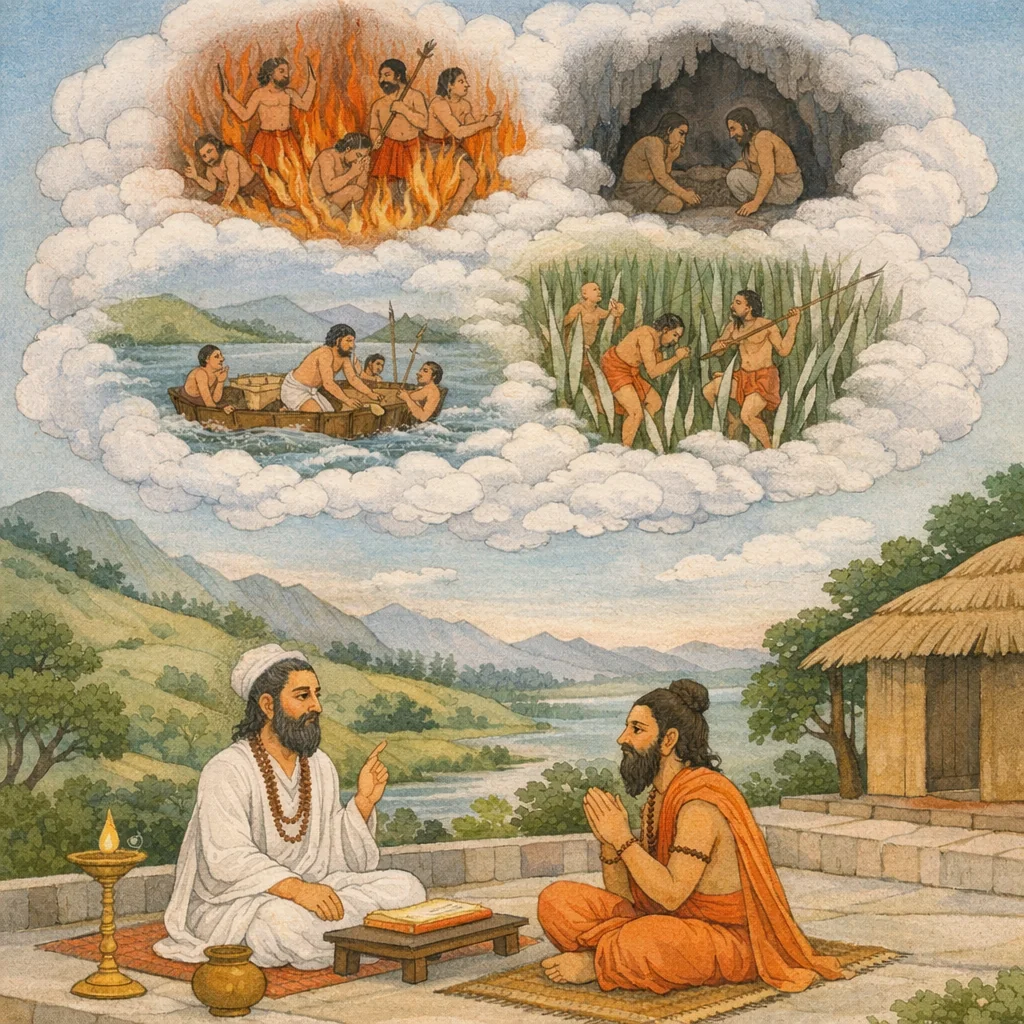
नरकनामनिर्णयः (Catalogue of Narakas and Karmic Causes)
Adhyāya 16 is an instructional catalogue in dialogue: Sanatkumāra teaches Vyāsa that many hell-realms (narakas) exist “above” the regions described earlier, then lists them—Raurava, Tāmisra-like darkness realms, Vaitaraṇī, Asipatravana, and others—as a mapped taxonomy of punitive afterlife spaces. The chapter then shifts from topography to causality, assigning specific moral and legal violations to specific narakas and stressing that punishment is the ripening (vipāka) of pāpa, not arbitrary divine wrath. It highlights social-ritual faults (false testimony, habitual lying), grave crimes (killing and theft), complicity and association with offenders, and exploitative or impure livelihoods. Esoterically, this knowledge of naraka serves as negative instruction to awaken vairāgya, truthfulness, and restraint, turning the seeker toward dharma and Śiva-bhakti as protective refuge.
Shlokas
Verse 1
सनत्कुमार उवाच । तेषां मूर्द्धोपरिष्टाद्वै नरकांस्ताञ्छृणुष्व च । मत्तो मुनिवरश्रेष्ठ पच्यंते यत्र पापिनः
Sanatkumāra said: “Above their heads indeed are those hells—hear of them as well. O best of sages, there the sinful are tormented, as it were ‘cooked’ by their own demerit.”
Verse 2
रौरवश्शूकरो रोधस्तालो विवसनस्तथा । महाज्वालस्तप्तकुंभो लवणोपि विलोहितः
“(There are) Raurava, Śūkara, Rodhas, Tāla, and also Vivasana; likewise Mahājvāla, Taptakumbha, Lavaṇa, and Vilohita.”
Verse 3
वैतरणी पूयवहा कृमिणः कृमिभोजनः । असिपत्रवनं घोरं लालाभक्षश्च दारुणः
There is the Vaitaraṇī, the river of torment; the Pūyavahā, the river that carries filth; the realm of worms and the hell where worms are eaten; the dreadful forest of sword-like leaves; and the cruel state where one is made to feed on saliva—terrible indeed.
Verse 4
तथा पूयवहः प्रायो बहिर्ज्वालो ह्यधश्शिराः । संदंशः कालसूत्रश्च तमश्चावीचिरो धनः
Likewise there are hells named Pūyavaha, Prāya, Bahirjvāla, and Adhaśśiras; and also Saṃdaṃśa, Kālasūtra, Tamas, and Avīci—dreadful abodes of torment, born of one’s own bondage to impurity and karma.
Verse 5
श्वभोजनोऽथ रुष्टश्च महारौरवशाल्मली । इत्याद्या बहवस्तत्र नरका दुःखदायकाः
There, in the realms of punishment, are many hells that bring suffering—Śvabhojana, Ruṣṭa, Mahāraurava, Śālmalī, and others of that kind.
Verse 6
पच्यंते तेषु पुरुषाः पापकर्मरतास्तु ये । क्रमाद्वक्ष्ये तु तान् व्यास सावधानतया शृणु
In those hells, men devoted to sinful deeds are tormented. I shall now describe them to you in due order, O Vyāsa—listen with careful attention.
Verse 7
कूटसाक्ष्यं तु यो वक्ति विना विप्रान् सुरांश्च गाः । सदाऽनृतं वदेद्यस्तु स नरो याति रौरवम्
But the man who gives false testimony—disregarding the brāhmaṇas, the gods, and the cows—and who habitually speaks untruth, goes to the Raurava hell.
Verse 8
भ्रूणहा स्वर्णहर्ता च गोरोधी विश्वघातकः । सुरापो ब्रह्महंता च परद्रव्यापहारकः
“A slayer of an unborn child, a stealer of gold, one who obstructs (or harms) cows, a destroyer of living beings, a drinker of intoxicants, a killer of a brāhmaṇa, and one who steals another’s property.”
Verse 9
यस्तत्संगी स वै याति मृतो व्यास गुरोर्वधात् । ततः कुंभे स्वसुर्मातुर्गोश्चैव दुहितुस्तथा
O Vyāsa, whoever keeps company with him—on dying—surely goes to the same fate arising from the slaying of one’s guru. Thereafter, he falls into the ‘Kumbha’ hell—(a torment) meant for one who violates the mother-in-law, and likewise for one who violates a cow, and also for one who violates a daughter.
Verse 10
साध्व्या विक्रयकृच्चाथ वार्द्धकी केशविक्रयी । तप्तलोहेषु पच्यंते यश्च भक्तं परित्यजेत्
A woman who lives by selling herself, one who practices prostitution, one who sells hair, and whoever forsakes a devotee—such persons are declared to be cooked in red‑hot iron.
Verse 11
अवमंता गुरूणां यः पश्चाद्भोक्ता नराधमः । देवदूषयिता चैव देवविक्रयिकश्च यः
Whoever insults the gurus, and whoever eats only after others in a selfish and disgraceful way—that lowest of men; and whoever reviles the Devas and even traffics in them, turning worship into a commodity—is condemned by dharma and falls from the path of Śiva.
Verse 12
अगम्यगामी यश्चांते याति सप्तबलं द्विज । चौरो गोघ्नो हि पतितो मर्यादादूषकस्तथा
O twice-born, one who goes to the forbidden (illicit union) and, in the end, proceeds to the “sevenfold power”—such a one is to be known as a thief, a slayer of a cow, a fallen person (patita), and likewise a corrupter of sacred boundaries and social-religious order.
Verse 13
देवद्विजपितृद्वेष्टा रत्नदूषयिता च यः । स याति कृमिभक्षं वै कृमीनत्ति दुरिष्टकृत्
Whoever bears hatred toward the Devas, the Dvija (Brahmanas), and the Pitṛs, and who corrupts or defiles precious gems—such a doer of evil rites indeed goes to the state of being eaten by worms, and there he himself eats worms.
Verse 14
पितृदेवसुरान् यस्तु पर्यश्नाति नराधमः । लालाभक्षं स यात्यज्ञो यश्शस्त्रकूटकृन्नरः
That vilest of men who, in arrogance and ignorance of dharma, eats first (or encroaches upon) the offerings meant for the Pitṛs, the Devas, and the Suras—he goes to the state of one who feeds on spittle; likewise does the man who forges counterfeit, deceitful weapons.
Verse 15
यश्चांत्यजेन संसेव्यो ह्यसद्ग्राही तु यो द्विजः । अयाज्ययाजकश्चैव तथैवाभक्ष्य भक्षकः
That twice-born who keeps company with an outcaste, accepts what is unlawful, performs sacrifices for those unfit to be sacrificed for, and likewise eats what ought not to be eaten—such a person falls away from righteous conduct.
Verse 16
इति श्रीशिवमहापुराणे पञ्चम्यामुमासंहितायां ब्रह्माण्डवर्णने नरकोद्धारवर्णनं नाम षोडशोऽध्यायः
Thus, in the Śrī Śiva Mahāpurāṇa—within the fifth book, the Umāsaṃhitā, in the section describing the cosmos (Brahmāṇḍa)—ends the sixteenth chapter, entitled “The Account of Deliverance from Hell.”
Verse 17
नवयौवनमत्ताश्च मर्यादाभेदिनश्च ये । ते कृत्यं यांत्यशौचाश्च कुलकाजीविनश्च ये
Those intoxicated by the pride of fresh youth, who shatter the bounds of propriety, fall into impure conduct, and live by disgracing their lineage—such people move toward “kṛtyā,” destructive and inauspicious consequences.
Verse 18
असिपत्रवनं याति वृक्षच्छेदी वृथैव यः । क्षुरभ्रका मृगव्याधा वह्निज्वाले पतंति ते
He who senselessly fells trees goes to Asipatravana, the forest of sword-like leaves. Those cruel hunters, moving amid razor-edged thickets, fall into blazing fires. Thus violence done without dharma binds the soul in fierce suffering, far from the grace of Pati (Śiva).
Verse 19
भ्रष्टाचारो हि यो विप्रः क्षत्रियो वैश्य एव च । यात्यंते द्विज तत्रैव यः श्वपाकेषु वह्निदः
A Brahmin fallen from right conduct—and likewise a Kshatriya or a Vaishya—goes, O twice-born, to the same end as one who kindles the funeral fire among the “śvapāka” (outcastes).
Verse 20
व्रतस्य लोपका ये च स्वाश्रमाद्विच्युताश्च ये । संदंशयातनामध्ये पतंति भृशदारुणे
Those who destroy or abandon their sacred vows (vrata), and those who fall away from the discipline of their own āśrama, plunge into the terribly cruel torment called “Sandaṃśa,” a hell of relentless suffering.
Verse 21
वीर्यं स्वप्नेषु स्कंदेयुर्ये नरा ब्रह्मचारिणः । पुत्रा नाध्यापिता यैश्च ते पतंति श्वभोजने
Those men who have undertaken the vow of brahmacarya yet let their vīrya (semen) fall even in dreams—and those who do not instruct their sons in sacred discipline—fall into the state called “śvabhojana,” a degraded condition likened to feeding among dogs.
Verse 22
एते चान्ये च नरकाः शतशोऽथ सहस्रशः । येषु दुष्कृतकर्माणः पच्यते यातनागताः
These and many other hells—by the hundreds and even by the thousands—exist; in them, those who commit evil deeds, having fallen into states of punishment, are “cooked” in torment. From the Shaiva standpoint, such suffering arises from pāśa (bondage) forged by one’s own karma, until the soul turns toward Pati (Lord Śiva) and the path of purification.
Verse 23
तथैव पापान्येतानि तथान्यानि सहस्रशः । भुज्यंते यानि पुरुषैर्नरकांतरगोचरैः
In the same way, these sins—and thousands of other kinds as well—are truly undergone in their results by human beings who become bound to the many regions of hell.
Verse 24
वर्णाश्रमविरुद्धं च कर्म कुर्वंति ये नराः । कर्मणा मनसा वाचा निरये तु पतंति ते
Those who perform actions contrary to their varṇa and āśrama duties—by deed, by thought, and by speech—surely fall into hell. From the Shaiva standpoint, such disorder binds the paśu (soul) more tightly in pāśa (bondage), obstructing the path of purity and Shiva-realization.
Verse 25
अधश्शिरोभिर्दृश्यंते नारका दिवि दैवतैः । देवानधोमुखान्सर्वानधः पश्यंति नारकाः
In heaven, the gods behold the denizens of hell as though they were upside down. And the hell-bound, seeing all the gods as turned downward, look up at them from below.
Verse 26
स्थावराः कृमिपाकाश्च पक्षिणः पशवो मृगाः । धार्मिकास्त्रिदशास्तद्वन्मोक्षिणश्च यथाक्रमम्
In due order come the immobile beings (sthāvara), then worms and insects, then birds, then domestic animals and wild beasts; after them the righteous human beings, then the gods—and likewise, in that very sequence, those who attain liberation (mokṣa).
Verse 27
यावंतो जंतवस्स्वर्गे तावंतो नरकौकसः । पापकृद्याति नरकं प्रायश्चित्तपराङ्मुखः
As many beings as there are in heaven, so many dwell in hell as well. A doer of sin goes to hell when he turns away from expiation (prāyaścitta).
Verse 28
गुरूणि गुरुभिश्चैव लघूनि लघुभिस्तथा । प्रायश्चित्तानि कालेय मनुस्स्वायम्भुवोऽब्रवीत्
O Kāleya, Svāyambhuva Manu taught that grave faults are to be atoned for by grave expiations, and light faults likewise by light expiations—each in proper measure and at the proper time.
Verse 29
यानि तेषामशेषाणां कर्मार्ण्युक्तानि तेषु वै । प्रायश्चित्तमशेषेण हरानुस्मरणं परम्
Whatever acts have been spoken of regarding all people without exception—among them, the supreme and wholly complete atonement is the constant remembrance of Hara (Lord Śiva).
Verse 30
प्रायश्चित्तं तु यस्यैव पापं पुंसः प्रजायते । कृते पापेऽनुतापोऽपि शिवसंस्मरणं परम्
For the very sin that arises in a person, the true expiation is this: even after the sin is done, remorse—together with supreme remembrance of Lord Śiva—is the highest remedy.
Verse 31
माहेश्वरमवाप्नोति मध्याह्नादिषु संस्मरन् । प्रातर्निशि च संध्यायां क्षीणपापो भवेन्नरः
By remembering Maheśvara (Śiva) at midday and at the other sacred junctions of time—at dawn, at night, and at twilight—a person attains the state of Maheśvara; his sins are worn away and he becomes purified.
Verse 32
मुक्तिं प्रयाति स्वर्गं वा समस्तक्लेशसंक्षयम । शिवस्य स्मरणादेव तस्य शंभोरुमापतेः
By the mere remembrance of Śiva—Śambhu, the Lord of Umā—one attains liberation, or else heaven, and the complete destruction of all afflictions.
Verse 33
पापन्तरायो विप्रेन्द्र जपहोमार्चनादि च । भवत्येव न कुत्रापि त्रैलोक्ये मुनिसत्तम
O best of Brahmins, O foremost of sages: for one engaged in japa, homa, worship, and the like, an obstructing force born of sin indeed arises—there is no place in the three worlds where it does not occur.
Verse 34
महेश्वरे मतिर्यस्य जपहोमार्चनादिपु । यत्पुण्यं तत्कृतं तेन देवेन्द्रत्वादिकं फलम्
Whoever keeps the mind fixed on Mahādeva while performing disciplines such as mantra‑japa, homa (oblations into the sacred fire), worship (arcana), and the like—whatever merit arises from those acts is truly fulfilled by that person, and it bears fruits such as attaining the rank of Indra and other exalted divine attainments.
Verse 35
पुमान्न नरकं याति यः स्मरन्भक्तितो मुने । अहर्निशं शिवं तस्मात्स क्षीणाशेषपातकः
O sage, the man who remembers Śiva with devotion does not go to hell. Therefore, by remembering Śiva day and night, he becomes one whose remaining sins are completely exhausted.
Verse 36
नरकस्वर्गसंज्ञाये पापपुण्ये द्विजोत्तम । ययोस्त्वेकं तु दुःखायान्यत्सुखायोद्भवाय च
O best of the twice-born, sin and merit are known respectively as “hell” and “heaven”: of the two, the one results in suffering, while the other gives rise to happiness.
Verse 37
तदेव प्रीतये भूत्वा पुनर्दुःखाय जायते । तत्स्याद्दुःखात्मकं नास्ति न च किंचित्सुखात्मकम्
That very thing which first arises for one’s delight later becomes a cause of sorrow again. Indeed, in this world there is nothing that is purely made of suffering, and nothing whatsoever that is purely made of happiness.
Verse 38
मनसः परिणामोऽयं सुखदुःखोपलक्षणः । ज्ञानमेव परं ब्रह्म ज्ञानं तत्त्वाय कल्पते
This transformation of the mind is recognized by the marks of pleasure and pain. Knowledge alone is the Supreme Brahman; it is knowledge that truly becomes the realization of Reality (tattva).
Verse 39
ज्ञानात्मकमिदं विश्वं सकलं सचराचरम् । परविज्ञानतः किंचिद्विद्यते न परं मुने
This entire universe—everything moving and unmoving—is of the very nature of consciousness (knowledge). O sage, beyond the Supreme Knowledge, nothing whatsoever exists as higher.
Verse 40
एवमेतन्मयाख्यातं सर्वं नरकमण्डलम् । अत ऊर्ध्वं प्रवक्ष्यामि सांप्रतं मंडलं भुवः
Thus have I explained to you in full the entire sphere of the hell-realms. Now, going further upward, I shall presently describe the sphere of Bhū, the earth-world.
Frequently Asked Questions
Rather than a single mythic episode, the chapter advances a theological-ethical argument: narakas are real cosmological jurisdictions where sinners undergo suffering proportionate to specific actions; the text supports a law-like karmic order by naming realms and correlating them with defined transgressions.
The catalogue works as a negative sādhanā (apophatic ethics): by contemplating the differentiated consequences of falsehood, violence, theft, and complicity, the listener cultivates fear of adharma, steadiness in satya, and detachment—conditions that stabilize bhakti and redirect the will toward liberation-oriented conduct.
No distinct iconographic manifestation is foregrounded in the sampled material; the chapter’s emphasis is administrative-cosmological (naraka taxonomy) and ethical (karmic causality). Any Shaiva framing is implicit: moral order is intelligible within Śiva’s overarching governance of the cosmos rather than through a specific avatāra or mūrti description.