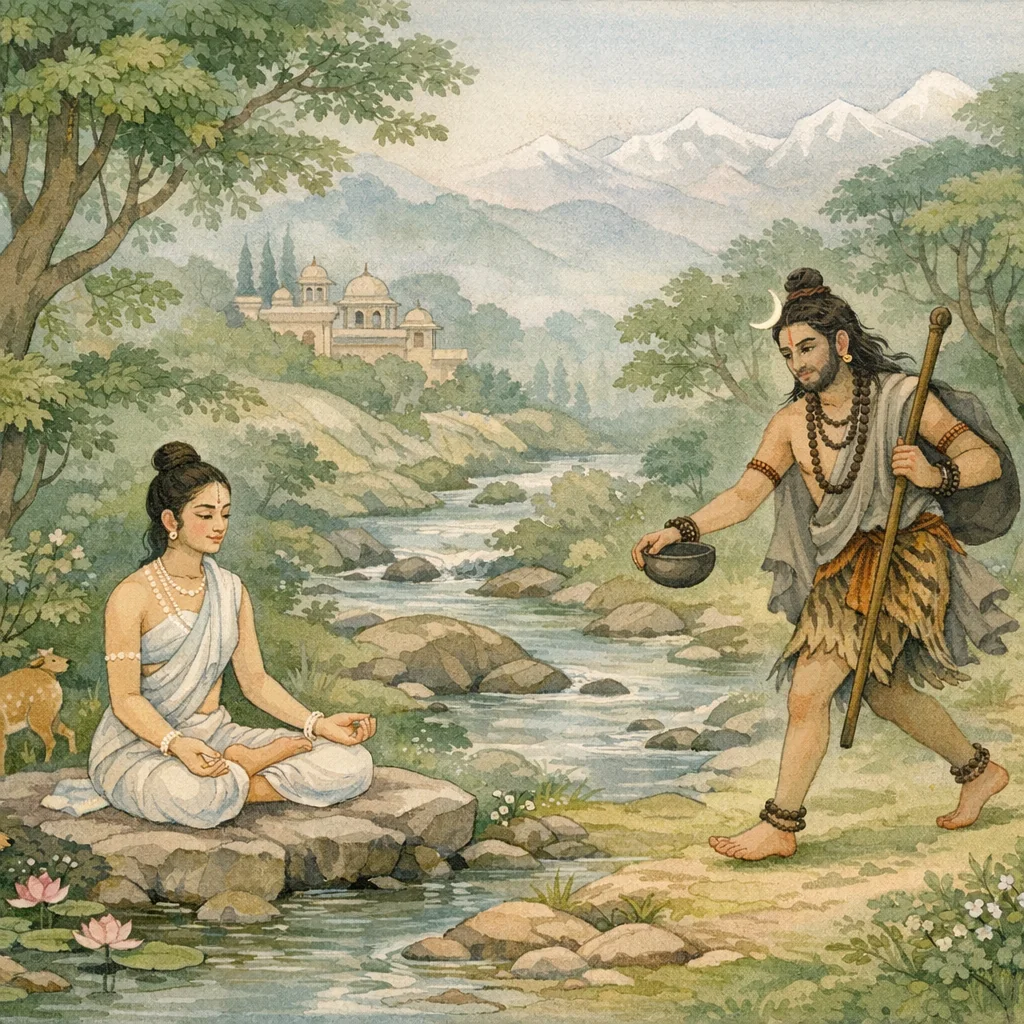
Sunartaka-Naṭa Avatāra and Pārvatī’s Boon-Request (Śiva as the Testing Benefactor)
This adhyāya, taught by Nandīśvara to Sanatkumāra, recounts Śiva’s avatāra as Sunartaka-Naṭa. Pārvatī (Kālikā, daughter of Himavat) performs pure tapas in the forest to attain Śiva. Pleased, Śiva appears both to grant a boon and to test the steadfastness of her observance (tapas-parīkṣā). Revealing his form, he invites her to choose a boon. Pārvatī asks, in a concrete dhārmic and ritual manner, that Śiva become her husband: that he go with due permission and propriety to her father’s house, formally seek her as a bhikṣu (mendicant) while spreading auspicious renown, and complete the marriage by prescribed rites for divine purposes. The chapter teaches a sacred sequence—tapas culminating in darśana, darśana leading to boon—while showing that Śiva’s unaffectedness (nirvikāratva) coexists with tender care for devotees (bhaktavatsalatā).
Shlokas
Verse 1
नन्दीश्वर उवाच । सनत्कुमार सर्वज्ञ शिवस्य परमात्मनः । अवतारं शृणु विभोस्सुनर्तकनटाह्वयम्
Nandīśvara said: “O Sanatkumāra, O all-knowing one—hear of the descent (avatāra) of Śiva, the Supreme Self, the all-pervading Lord, renowned by the name Sunartaka, the Divine Dancer.”
Verse 2
यदा हि कालिका देवी पार्वती हिमवत्सुता । तेपे तपस्तुविमलं वनं गत्वा शिवाप्तये
When the Goddess Kālikā—Pārvatī, the daughter of Himavān—went to the forest, she undertook stainless austerities in order to attain Lord Śiva.
Verse 3
तदा शिवः प्रसन्नो भूत्तस्यास्सुतपसो मुने । तद्वृत्तसुपरीक्षार्थं वरं दातुम्मुदा ययौ
Then Lord Śiva was pleased by that sage’s noble austerity; and, to thoroughly test the steadiness of his conduct, Śiva joyfully went forth to grant him a boon.
Verse 4
स्वरूपन्दर्शयामास तस्यै सुप्रीतमानसः । वरम्ब्रूहीति चोवाच तां शिवां शंकरो मुने
O sage, Śaṅkara, his heart wholly pleased, revealed his true form to that auspicious goddess and said to her, “Speak—choose a boon.”
Verse 5
तच्छ्रुत्वा शम्भुवचनं दृष्ट्वा तद्रूपमुत्तमम् । सुजहर्ष शिवातीव प्राह तं सुप्रणम्य सा
Hearing Śambhu’s words and beholding His most excellent form, she became exceedingly delighted in Śiva; and, after bowing to Him with deep reverence, she spoke to Him.
Verse 6
पार्वत्युवाच । यदि प्रसन्नो देवेश मह्यं देयो वरो यदि । पतिर्भव ममेशान कृपां कुरु ममोपरि
Pārvatī said: “O Lord of the gods, if You are pleased and if a boon is to be granted to me, then, O Īśāna, become my husband; show Your grace upon me.”
Verse 7
पितुर्गृहे मया सम्यग्गम्यते त्वदनुज्ञया । गन्तव्यम्भवता नाथ मत्पितुः पार्श्वतः प्रभो
With your permission, I shall duly go to my father’s house. But you too, O Lord and Master, O Prabhu, should go and remain by my father’s side.
Verse 8
याचस्व मान्ततो भिक्षुः ख्यापयंश्च यशः शुभम् । पितुर्मे सफलं सर्वं कुरु प्रीत्या गृहा श्रमम्
Then, O holy mendicant, beg alms from me and proclaim your auspicious fame. Out of affection, make my father’s entire householder life and all his efforts truly fruitful.
Verse 9
ततो यथोक्तविधिना कर्तुमर्हसि भो प्रभो । विवाहं त्वं महेशान देवानां कार्य्यसिद्धये
Therefore, O Lord, perform the marriage according to the prescribed rite, O Maheśāna, so that the gods’ purpose may be fulfilled.
Verse 10
कामं मे पूरय विभो निर्विकारो भवान्सदा । भक्तवत्सलनामा हि तव भक्तास्म्यमहं सदा
O all-pervading Lord, fulfill my heart’s desire. You are ever changeless, untouched by modification. Indeed, You are famed as the One tender to His devotees; therefore I am always Your devotee.
Verse 11
नन्दीश्वर उवाच । इत्युक्तस्स तया शंभुर्महेशो भक्तवत्सलः । तथास्त्विति वचः प्रोच्यान्तर्हितस्स्वगिरिं ययौ
Nandīśvara said: Thus addressed by her, Śambhu—Maheśa, ever tender toward His devotees—replied, “So be it.” Having spoken these words, He vanished from sight and went to His own mountain abode.
Verse 12
पार्वत्यपि ततः प्रीत्या स्वसखीभ्यां वयोन्विता । जगाम स्वपितुर्गेहं रूपं कृत्वा तु सार्थकम्
Then Pārvatī too—joyful at heart and now come of age—went with her two close companions to her father’s home, having made her beauty and form fully auspicious and fitting for her divine purpose.
Verse 13
पार्वत्यागमनं श्रुत्वा मेनया स हिमाचलः । परिवारयुतो द्रष्टुं स्वसुतां तां ययौ मुदा
Hearing from Menā that Pārvatī had arrived, Himācala (Himālaya), accompanied by his attendants and family, joyfully went to see his own daughter.
Verse 14
दृष्ट्वा तां सुप्रसन्नास्यामानयामासतुर्गृहम् । कारयामासतुः प्रीत्या महानन्दी महोत्सवम्
Seeing her face radiant with joy, they brought her into the home. Then, out of loving devotion, they had a great festival of rejoicing celebrated.
Verse 15
धनन्ददौ द्विजादिभ्यो मेनागिरिवरस्तथा । मंगलं कारयामास सवेदध्वनिमादरात्
Then the noble lord of Mount Menā (Himālaya) bestowed wealth and gifts upon the brāhmaṇas and other honored guests, and with reverent care he had auspicious rites performed, accompanied by the resounding chant of the Vedas.
Verse 16
ततः स्वकन्यया सार्द्धमुवास प्रांगणे मुदा । मेना च हिमवाञ्छैलः स्नातुं गंगां जगाम सः
Then he dwelt joyfully in the courtyard together with his own daughter. And Menā, along with Himavān—the lordly mountain—went to the Gaṅgā to bathe.
Verse 17
एतस्मिन्नन्तरे शम्भुः सुलीलो भक्तवत्सलः । सुनर्तकनटो भूत्वा मेनकासन्निधिं ययौ
Meanwhile, Śambhu—playful in His divine līlā and tenderly devoted to His devotees—assumed the form of an excellent dancer-actor and went into the presence of Menakā.
Verse 18
शृंगं वामे करे धृत्वा दक्षिणे डमरुन्तथा । पृष्ठे कन्थां रक्तवासा नृत्यगानविशारदः
Holding a horn in His left hand and likewise a ḍamaru in His right, with a cloak upon His back and clad in red garments, He was supremely skilled in dance and song.
Verse 19
ततस्तु नटरूपोऽसौ मेनकाप्रांगणे मुदा । चक्रे स नृत्यं विविधं गानञ्चाति मनोहरम्
Thereafter, He—assuming the form of Natarāja, the supreme Dancer—joyfully performed in Menakā’s courtyard many kinds of dances, along with exceedingly enchanting song.
Verse 20
शृंगञ्च डमरुन्तत्र वादयामास सुध्वनिम् । महोतिं विविधाम्प्रीत्या स चकार मनोहराम्
There He joyfully sounded the horn and the ḍamaru, producing a sweet resonance; and with loving delight He performed many splendid, captivating festive rites.
Verse 21
तन्द्रष्टुं नागरास्सर्वे पुरुषाश्च स्त्रियस्तथा । आजग्मुस्सहसा तत्र बाला वृद्धा अपि ध्रुवम्
To behold Him, all the townspeople—men and women alike—hurriedly gathered there; surely even children and the elderly came as well.
Verse 22
श्रुत्वा संगीतं तन्दृष्ट्वा सुनृत्यं च मनोहरम् । सहसा मुर्मुहुः सर्वे मेनापि च तदा मुने
O sage, hearing the music and seeing that exquisitely graceful and enchanting dance, everyone was suddenly overwhelmed and swooned—Mēnā too at that time.
Verse 23
ततो मेनाशु रत्नानि स्वर्णपात्रस्थितानि च । तस्मै दातुं ययौ प्रीत्या तदूतिप्री तमानसा
Then Mēnā quickly gathered the jewels kept in golden vessels and, with a heart delighted by that auspicious occasion, went joyfully to offer them to him.
Verse 24
तानि न स्वीचकारासौ भिक्षां चेते शिवां च ताम् । पुनस्तु नृत्यं गानं च कौतुकात्कर्तुमुद्यतः
He did not accept those offerings; instead, he begged alms from the auspicious Lady Śivā. Then again, out of playful curiosity, he set about dancing and singing.
Verse 25
मेना तद्वचनं श्रुत्वा चुकोपाति सुविस्मिता । भिक्षुकम्भर्त्सयामास बहिष्कर्तुमियेष सा
Hearing those words, Menā—utterly astonished—became enraged. She rebuked the mendicant and resolved to drive him out of the house.
Verse 26
एतस्मिन्नन्तरे तत्र गंगातो गिरिराड्ययौ । ददर्श पुरतो भिक्षुं प्रांगणस्थं नराकृतिम्
Just then, the king of mountains arrived there from the Gaṅgā. In front of him he saw a mendicant—human in form—standing in the courtyard.
Verse 27
श्रुत्वा मेनामुखाद्वृत्तन्तत्सर्वं सुचुकोप सः । आज्ञां चकारानुचरान्बहिः कर्तुं च भिक्षुकम्
Hearing from Menā’s own mouth the entire account of what had happened, he became exceedingly enraged. He then commanded his attendants to drive that mendicant out.
Verse 28
महाग्निमिव दुःस्पर्शं प्रज्वलन्तं सुतेजसम् । न शशाक बहिः कर्तुं कोऽपि तं मुनिसत्तम
O best of sages, he blazed with splendid radiance—untouchable like a great fire; and no one was able to drive him out or remove him from there.
Verse 29
ततः स भिक्षुकस्तात नानालीलाविशारदः । दर्शयामास शैलाय स्वप्रभावमनन्तकम्
Then that mendicant—skilled in many divine play-acts—revealed to the Mountain (Himālaya), O dear one, His own boundless majesty and power.
Verse 30
शैलो ददर्श तन्तत्र विष्णुरूपधरन्द्रुतम् । ततो ब्रह्मस्वरूपं च सूर्य्यरूपं ततः क्षणात्
There Śaila beheld Him swiftly assuming the form of Viṣṇu; then, in an instant, He appeared as Brahmā, and immediately thereafter as the Sun. Thus did the Supreme Lord reveal His manifold, limitless forms.
Verse 31
ततो ददर्श तं तात रुद्ररूपं महाद्भुतम् । पार्वती सहितं रम्यं विहसन्तं सुतेजसम्
Then, dear one, he beheld that wondrous Rudra-form—most beautiful and radiant—laughing gently, and seated in delight together with Pārvatī.
Verse 32
एवं सुबहुरूपाणि तस्य तत्र ददर्श सः । सुविस्मितो बभूवाशु परमानन्दसंप्लुतः
Thus, he beheld there the Lord’s exceedingly many forms. Instantly he was filled with wonder and became immersed in supreme bliss.
Verse 33
अथासौ भिक्षुवर्यो हि तस्मात्तस्याश्च सूतिकृत् । भिक्षां ययाचे दुर्गान्तान्नान्यज्जग्राह किञ्चन
Then that foremost mendicant—who had performed the childbirth rites for her—begged alms from him and from her, only as much as would suffice to reach the next difficult stretch of the journey; he accepted nothing else whatsoever.
Verse 34
इति श्रीशिवमहापुराणे तृतीयायां शतरुद्रसंहितायां सुनर्तकनटाह्वशिवावतारवर्णनंनाम चतुस्त्रिंशोध्यायः
Thus, in the Śrī Śiva Mahāpurāṇa, in the Third Book, within the Śatarudra Saṃhitā, ends the thirty-fourth chapter entitled “The Description of Lord Śiva’s incarnation known as Sunartaka (the Divine Dancer/Actor).”
Verse 35
तदा बभूव सुज्ञानं मेनाशैलेशयोरपि । आवां शिवो वञ्चयित्वा गतवान्स्वालयं विभुः
Then true understanding arose even in Menā and the Lord of the mountain: “Having outwitted us, the all-pervading Lord Śiva has gone to His own abode.”
Verse 36
अस्मै देया स्वकन्येयं पार्वती सुतप स्विनी । एवं विचार्य च तयोः शिवेभक्तिरभूत्परा
“This very daughter of ours—Pārvatī, the great ascetic—should be given to him (in marriage).” Having thus deliberated, both of them became supremely devoted to Lord Śiva.
Verse 37
अतो रुद्रो महोतीश्च कृत्वा भक्तमुदावहम् । विवाहं कृतवान्प्रीत्या पार्वत्या स विधानतः
Thereafter, Rudra—the great Lord—having made His devotee’s auspicious welfare manifest, joyfully performed the marriage with Pārvatī, duly in accordance with sacred rite and proper ordinance.
Verse 38
इति प्रोक्तस्तु ते तात सुनर्तकनटाह्वयः । शिवावतारो हि मया शिवावाक्यप्रपूरकः
Thus have I told you, dear child, of the one named Sunartaka, also called Naṭa. He is indeed an incarnation of Śiva, brought forth by me to fulfill the very word and intention of Lord Śiva.
Verse 39
इदमाख्यानमनघं परमं व्याहृतम्मया । य एतच्छृणुयात्प्रीत्या स सुखी गतिमाप्नुयात्
I have thus proclaimed this stainless and supreme sacred account. Whoever listens to it with loving devotion becomes happy and attains the blessed higher state—drawing near to Śiva’s liberating path.
Frequently Asked Questions
The episode presents Pārvatī’s austerities culminating in Śiva’s pleased approach, framed explicitly as both boon-giving and conduct-testing (parīkṣārtha). The theological argument is that authentic tapas and devotion mature into divine encounter (darśana) and structured grace (vara), not as arbitrary favor but as recognition of spiritual qualification.
The forest-tapas setting signifies withdrawal from social identity into concentrated interiority; Śiva’s self-revelation (svarūpa-darśana) signifies truth disclosed to purified consciousness. The ‘bhikṣu’ motif (Śiva as mendicant suitor) encodes divine freedom from worldly status, while simultaneously sanctifying social rite (vivāha-vidhi) as a cosmic instrument rather than mere convention.
Śiva is highlighted in the form/avatāra named Sunartaka-Naṭa, suggesting a divine modality associated with performance/naṭa (a revelatory, pedagogic presence). Gaurī is highlighted as Pārvatī under the epithet Kālikā, depicted as the ascetic devotee whose unwavering tapas authorizes her request for Śiva as husband.