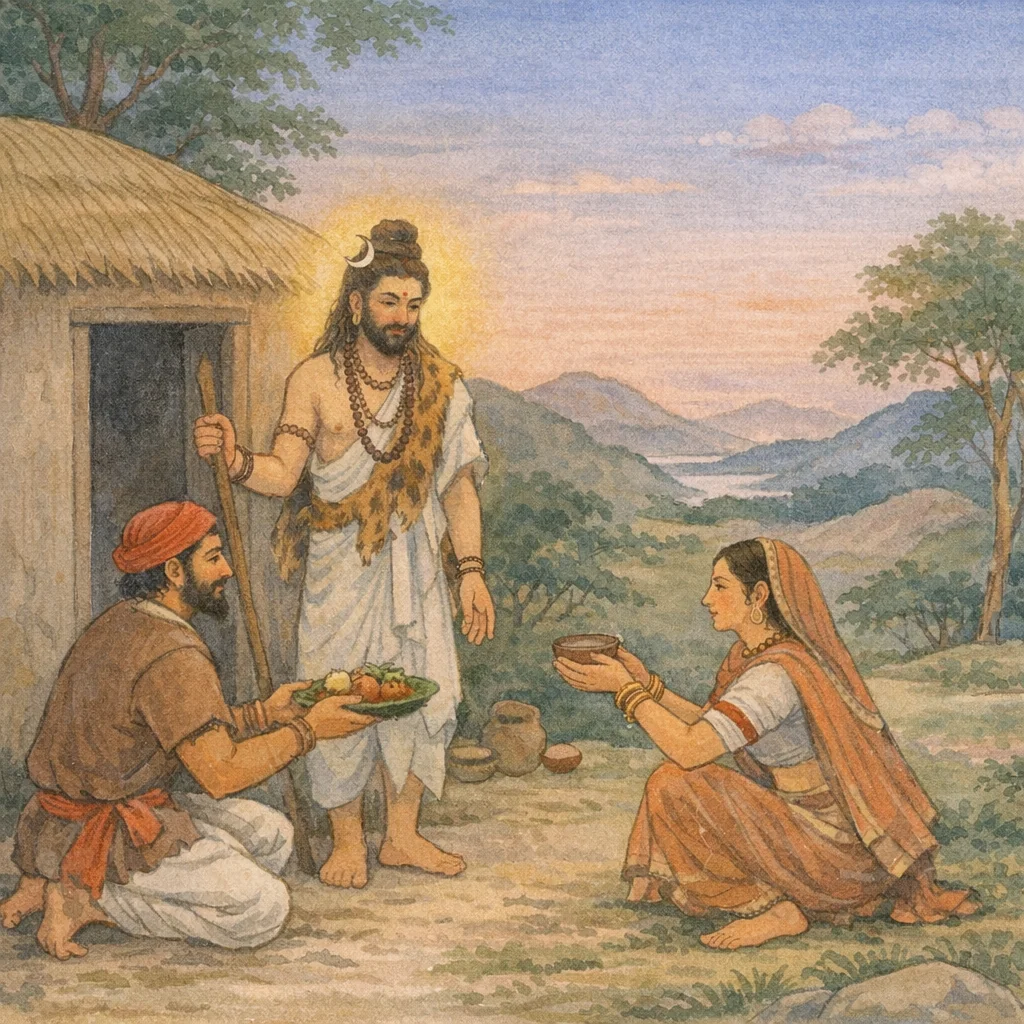
Yatinātha-līlā: Śiva’s Test of the Bhilla Devotees at Arbuda Mountain
Adhyāya 28 is framed as Nandīśvara’s narration to a sage, introducing an avatāra-like manifestation of Śiva called Yatinātha. At Arbuda Mountain, a Bhilla devotee and his wife are portrayed as mahāśaiva, steadfast in śiva-pūjā. While the Bhilla goes far to seek food, Śaṅkara arrives at their home at evening in the form of an ascetic (yati-vapuḥ), explicitly for the purpose of testing (parīkṣārtha). The encounter probes hospitality, reverence for ascetic sanctity, and the willingness to receive the divine guest despite scarcity. The chapter teaches that service to a guest (atithi-sevā) is itself worship, and that the smallness of resources is outweighed by the greatness of intention (bhāva). Thus Śiva’s test is not to reject but to reveal and deepen devotion, turning the household into a place of grace and liberation-oriented merit.
Shlokas
Verse 1
नन्दीश्वर उवाच । शृणु प्राज्ञ प्रवक्ष्यामि शिवस्य परमात्मनः । अवतारं पुरानन्दं यातिनाथाह्वयं मुने
Nandīśvara said: O wise one, listen. I shall declare the incarnation of Śiva, the Supreme Self—an ancient descent that bestows ānanda, known as Yātinātha, O sage.
Verse 2
अर्बुदाचलसंज्ञे तु पर्वते भिल्लवंशजः । आहुकश्च तदभ्याशे वसतिस्म मुनीश्वर
O lord among sages, on the mountain known as Arbuda there lived a man born in the Bhilla lineage, named Āhuka; he dwelt in that very vicinity.
Verse 3
तत्पत्नी ह्याहुका नाम बभूव किल सुव्रता । उभावपि महाशैवावास्तान्तौ शिवपूजकौ
His wife, it is said, was named Āhukā—steadfast in sacred vows. Both of them were great Śaiva devotees, abiding as dedicated worshippers of Lord Śiva.
Verse 4
कस्मिंश्चित्समये भिल्लः शिवभक्तिरतः सदा । आहारार्थं स्वपत्न्याश्च सुदूरं स गतो मुने
At a certain time, O sage, that Bhilla—ever devoted in bhakti to Lord Śiva—went far away to procure food for himself and for his wife.
Verse 5
एतस्मिन्नन्तरे तत्र गेहे भिल्लस्य शङ्करः । भूत्वा यतिवपुः सायं परीक्षार्थं समाययौ
Meanwhile, there in the Bhilla’s house, Śaṅkara arrived at evening, assuming the form of an ascetic in order to test him.
Verse 6
तस्मिन्नवसरे तत्राजगाम स गृहाधिपः । पूजनं च यतीशस्य चकार प्रेमतः सुधीः
At that very moment the master of the house arrived there; the wise man, filled with loving devotion, performed worship of the Lord of ascetics (Śiva).
Verse 7
तद्भावस्य परीक्षार्थं यतिरूपस्स शंकरः । महालीलातरः प्रीत्या भीतं प्रोवाच दीनगीः
To test the true disposition of his heart, Śaṅkara assumed the form of an ascetic. Delighting in His great līlā, the Supreme Lord affectionately spoke to the frightened one in humble, plaintive words.
Verse 8
यतिनाथ उवाच । अद्य स्थलं निवासार्थं देहि मे प्रातरेव हि । यास्यामि सर्वथा भिल्ल स्वस्ति स्यात्तव सर्वदा
Yatinātha said: “Grant me a place to stay for today; indeed, I shall depart in the morning. O Bhilla, I will certainly go—may auspiciousness ever be yours.”
Verse 9
भिल्ल उवाच । त्यम्प्रोक्तं त्वया स्वामिञ्शृणु मद्वचनं च ते । अति स्वल्पं स्थलं मे हि स्यान्निवासः कथन्तव
The Bhilla said: “O master, I have understood what you have spoken. Now hear my words as well. My dwelling is indeed very small—how could you reside there?”
Verse 10
नन्दीश्वर उवाच । इत्युक्तस्स यतिस्तेन गमनाय मतिन्दधे । तावद्भिल्ल्या वचः प्रोक्तं स्वामिनं संविचार्य्य वै
Nandīśvara said: Thus addressed by him, the ascetic resolved to depart. Just then, the Bhil woman—having reflected upon her lord—spoke these words.
Verse 11
भिल्ल्युवाच । स्वामिन्देहि यतेःस्थानं विमुखं कुरु मातिथिम् । गृहधर्मं विचार्य्य त्वमन्यथा धर्मसंक्षयः
Bhilli said: “O master, assign a proper place for the ascetic, and turn away the guest. Consider the duties of a householder; otherwise, there will be a decline of dharma.”
Verse 12
स्थीयतान्ते गृहाभ्यंतः सुखेन यतिना सह । अहं बहिः स्थितिं कुर्य्यामायुधानि बृहन्त्यपि
“Remain comfortably inside the house along with the ascetic. I shall keep watch outside—even though the weapons are mighty.”
Verse 13
नन्दीश्वर उवाच । तस्यास्तद्वचनं श्रुत्वा भिल्ल्या धर्मान्वितं शिवम् । स्वपत्न्या मनसा तेन भिल्लेन च विचारितम्
Nandīśvara said: Having heard her words, that Bhilla (hunter), together with his wife, reflected in his mind upon Śiva—the Lord who is united with Dharma.
Verse 14
स्त्रियं बहिश्च निष्कास्य कथं स्थेयं मया बहे । यतेरन्यत्र गमनमधर्म्मकरमात्मनः
Having driven the woman out, how am I to remain outside? For a yati, a renunciate, going elsewhere than the place of his vow becomes a cause of adharma for his own self.
Verse 15
द्वयमप्युचितं नैव सर्वथा गृहमेधिनः । यद्भावि तद्भवेदेव मया स्थेयं गृहाद्बहिः
These two courses are never truly fitting for a householder in any circumstance. Whatever is destined will indeed come to pass; therefore, I shall remain outside the home, detached from household entanglements.
Verse 16
इत्याग्रहन्तदा कृत्वा गृहान्तः स्थाय तौ मुदा । स्वायुधानि च संस्थाप्य भिल्लोऽतिष्ठद्गृहाद्बहिः
Having thus made the request at that time, the two remained joyfully within the house. The Bhilla, after setting his own weapons in place, stood outside the house.
Verse 17
रात्रौ तम्पशवः क्रूरा हिंसकाः समपीडयन् । तेनापि च यथाशक्ति कृतो यत्नो महांस्तदा
At night, those fierce and violent creatures tormented him greatly; even so, he then exerted a mighty effort, to the best of his ability.
Verse 18
एवं यत्नं प्रकुर्वाण स भिल्लो बलवानपि । प्रारब्धात्प्रेरितैर्हिंस्रैर्बलादासीच्च भक्षितः
Even while making such efforts, that hunter—though strong—was, by force, set upon and devoured by fierce beasts driven onward by his own prārabdha (ripened karma).
Verse 19
प्रातरुत्थाय स यतिर्दृष्ट्वा हिंस्रैश्च भक्षितम् । भिल्लं वने चरंतं वै दुःखितोऽभूदतीव हि
Rising early in the morning, that ascetic, seeing that (one) had been devoured by fierce beasts, and seeing the Bhilla roaming in the forest, became deeply distressed indeed.
Verse 20
दुखितं तं यतिन्दृष्ट्वा भिल्ली सा दुःखितापि हि । धैर्यात्स्वदुःखं संहृत्य वचनं चेदमब्रवीत्
Seeing that ascetic in sorrow, Bhillī—though herself distressed—steadied herself with courage, restrained her own grief, and spoke these words to him.
Verse 21
भिल्ल्युवाच । किमर्थं क्रियते दुःखं भद्रं जातं यतेऽधुना । धन्योयं कृतकृत्यश्च यज्जातो मृत्युरीदृशः
Bhilli said: “Why is sorrow being expressed, O ascetic? Just now something auspicious has occurred. Blessed indeed is this one, and fulfilled of purpose, for such a death has come to him.”
Verse 22
अहं चैनं गमिष्यामि भस्म भूत्वानले यते । चितां कारय सुप्रीत्या स्त्रीणां धर्मः सनातनः
“I too shall go with him—becoming ash in the fire, O ascetic. Arrange the funeral pyre with loving care; this is the eternal dharma of women.”
Verse 23
इति तद्वचनं श्रुत्वा हितं मत्वा स्वयं यतिः । चितां व्यरचयत्सा हि प्रविवेश स्वधर्मतः
Hearing those words, the ascetic—deeming them wholesome and beneficial—personally prepared the funeral pyre and then entered it, acting in accordance with the dharma she understood as her own.
Verse 24
एतस्मिन्नन्तरे साक्षात्पुरः प्रादुरभूच्छिवः । धन्ये धन्ये इति प्रीत्या प्रशंसस्तां हरोऽब्रवीत्
Just then, Śiva Himself manifested directly before her. Pleased, Hara praised her with affection, saying, “Blessed—blessed are you!”
Verse 25
हर उवाच । वरं ब्रूहि प्रसन्नोस्मि त्वदाचरणतोऽनघे । तवादेयं न वै किंचिद्वश्योऽहं ते विशेषतः
Hara said: “Speak your boon; I am pleased by your conduct, O sinless one. Truly there is nothing of yours that I must take in return—indeed, I am especially gracious toward you.”
Verse 26
नन्दीश्वर उवाच । तच्छुत्वा शम्भुवचनं परमानन्ददायकम् । सुखं प्राप्तं विशेषेण न किंचित्स्मरणं ययौ
Nandīśvara said: Having heard Śambhu’s words, bestowers of supreme bliss, he attained a special peace and entered a state in which no other thought or recollection remained.
Verse 27
तस्यास्तद्गतिमालक्ष्य सुप्रसन्नो हरोऽभवत् । उवाच च पुनः शम्भुर्वरं ब्रूहीति ताम्प्रभुः
Observing her conduct and the course she had taken, Hara (Lord Śiva) became exceedingly pleased. Then the Lord Śambhu spoke to her again: “Speak—choose a boon.”
Verse 28
इति श्रीशिवमहापुराणे तृ० शतरुद्रसंहि० यतिनाथब्रह्महंसाह्वयशिवावतारचरितवर्णनं नामाष्टाविंशोऽध्यायः
Thus ends the twenty-eighth chapter of the third section of the Śrī Śiva Mahāpurāṇa, in the Śatarudra Saṃhitā, entitled “The description of the life of Śiva’s incarnation known as Yatinātha (also called Brahmahaṃsa).”
Verse 29
भिल्लश्च वीरसेनस्य नैषधे नगरे वरे । महान्पुत्रो नलो नाम भविष्यति न संशयः
And in the excellent city of Niṣadha, Vīrasena shall indeed have a great son named Nala—of this there is no doubt.
Verse 30
त्वं सुता भीमराजस्य वैदर्भे नगरेऽनघे । दमयन्ती च विख्याता भविष्यसि गुणान्विता
O sinless one, you will be the daughter of King Bhīma in the city of Vidarbha; and you will become renowned as Damayantī, endowed with noble virtues.
Verse 31
युवां चोभौ मिलित्वा च राजभोगं सुविस्तरम् । भुक्त्वा मुक्तिं च योगीन्द्रेर्लप्स्येथे दुर्लभां ध्रुवम्
United together, you two shall enjoy an expansive share of royal pleasures; and thereafter you will surely attain steadfast mukti—liberation that even the foremost yogins find difficult to obtain.
Verse 32
नन्दीश्वर उवाच । इत्युक्त्वा च स्वयं शम्भुर्लिङ्गरूपोऽभवत्तदा । तस्मान्न चलितो धर्मादचलेश इति स्मृतः
Nandīśvara said: “Having spoken thus, Śambhu Himself then assumed the form of the Liṅga. Therefore, since He does not deviate from Dharma, He is remembered as ‘Acaleśa’—the Unmoving Lord.”
Verse 33
स भिल्ल आहुकश्चापि वीरसेनसुतोऽभवत् । नैषधे नगरे तात नलनामा महानृपः
That Bhilla became Āhuka as well, and was born as the son of Vīrasena. In the city of Niṣadha, dear one, he became the great king named Nala.
Verse 34
आहुका सा महाभिल्ली भीमस्य तनयाऽभवत् । वैदर्भे नगरे राज्ञो दमयन्तीति विश्रुता
That great Bhillī woman, Āhukā, became the daughter of King Bhīma; in the city of Vidarbha she became renowned as Damayantī.
Verse 35
यतिनाथाह्वयस्सोपि हंसरूपोऽभवच्छिवः । विवाहं कारयामास दमयन्त्या नलेन वै
He who was known by the name Yatinātha was none other than Śiva Himself, who assumed the form of a swan. Indeed, He brought about the marriage of Damayantī with Nala.
Verse 36
पूर्वसत्काररूपेण महापुण्येन शंकरः । हंसरूपं विधायैव ताभ्यां सुखमदात्प्रभुः
In return for their earlier reverent hospitality—an act of great merit—Lord Śaṅkara, the Supreme Master, assumed the form of Haṃsa, the swan, and bestowed happiness and well-being upon them both.
Verse 37
शिवो हंसावतारो हि नानावार्ताविचक्षणः । दमयन्त्या नलस्यापि परमानन्ददायकः
Indeed, Śiva assumed the incarnation of the Swan (Haṃsa), discerning in many narratives and subtle instructions; and to Damayantī and to Nala as well, He became the giver of supreme bliss.
Verse 38
इदं चरितं परमं पवित्रं शिवावतारस्य पवित्रकीर्तेः । यतीशसंज्ञस्य महाद्भुतं हि हंसाह्वयस्यापि विमुक्तिदं हि
This sacred narrative is supremely purifying—of that Śiva-incarnation whose fame itself is holy. It is the wondrous account of the One known as Yatīśa, also called Haṃsa; indeed, it bestows liberation.
Verse 39
यतीशब्रह्महंसाख्यावतारचरितं शुभम् । शृणुयाच्छ्रावयेद्यो हि स लभेत परां गतिम्
Whoever listens to—or causes others to hear—this auspicious account of Śiva’s incarnation known as Yatīśa (the Lord of ascetics) and Brahmahaṁsa, attains the supreme state (final liberation).
Verse 40
इदमाख्यानमनघं सर्वकामफलप्रदम् । स्वर्ग्यं यशस्यमायुष्यं भक्तिवर्धनमुत्तमम्
O sinless one, this sacred narrative bestows the fruits of all righteous desires. It grants heavenly merit, fame, and long life, and—supremely—causes devotion to Lord Śiva to increase.
Verse 41
श्रुत्वैतच्चचरितं शम्भोर्यतिहंसस्वरूपयोः । इह सर्वसुखम्भुक्त्वा सोऽन्ते शिवपुरं व्रजेत्
Having heard this sacred account of Lord Śambhu in His ascetic and haṁsa-like forms, one enjoys all happiness in this world and, in the end, attains Śivapura—the supreme abode of Śiva.
Frequently Asked Questions
Śiva (Śaṅkara) arrives at a Bhilla devotee’s home on Arbudācala disguised as an ascetic named Yatinātha, explicitly to test (parīkṣārtha) the devotees’ sincerity, hospitality, and devotional disposition.
The yati-form functions as a theological instrument: it collapses the boundary between transcendent divinity and social ethics, teaching that reverence to sanctity (and hospitality to the guest) is not merely moral but a direct mode of encountering Śiva’s immanent presence.
Śiva is highlighted as Yatinātha—an ascetic guise adopted by Śaṅkara—framed as an avatāra-like intervention that tests and then validates the devotee’s bhakti through lived ritual-ethics.