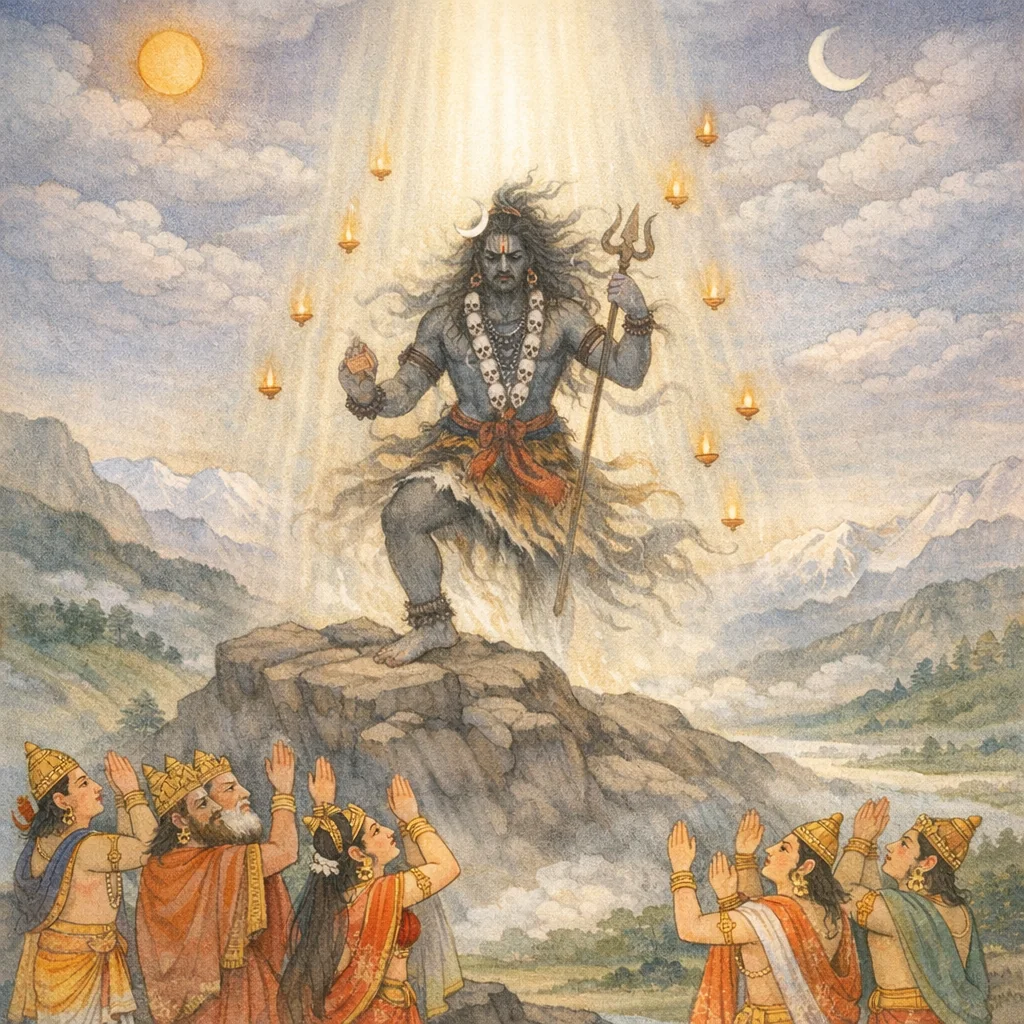
संहाररूप-प्रादुर्भावः (Manifestation of Śiva’s Saṃhāra-Form)
Adhyāya 12 unfolds as a dialogue: Sanatkumāra asks Nandīśvara to recount the ensuing events with clarity and compassion. A crisis then erupts in wrath and imminent seizure, as a fierce, sky-pervading, unassailable manifestation arises, explicitly born of Śaiva tejas, Śiva’s divine radiance. The text denies ordinary comparisons: it is neither sun nor fire, unlike lightning or moonlight, and all other lights are said to dissolve into Śaṅkara. Thus, even the cosmos’ terrifying immediacy is shown to point to the one Lord alone. Thereafter Parameśvara becomes manifest in a saṃhāra-form before the assembled devas amid victory-cries and auspicious acclamations. The iconography intensifies—thousand-armed, matted-haired, crescent-crested, with dreadful fangs and vajra-like claws, fiery aspects, and a yugānta-like thunderous presence—teaching that dissolution is a divine mode, not a void. The esoteric lesson re-reads fear as protection: all rival radiances and agencies are subordinated to the single tejas of Śiva’s sovereignty.
Shlokas
Verse 1
सनत्कुमार उवाच । नन्दीश्वर महाप्राज्ञ विज्ञातन्तदनन्तरम् । ममोपरि कृपां कृत्वा प्रीत्या त्वन्तद्वदाधुना
Sanatkumāra said: O Nandīśvara, greatly wise one—having understood what followed thereafter—now, out of affection, show me compassion and tell me that matter.
Verse 2
नन्दीश्वर उवाच । इत्युक्तो वीरभद्रेण नृसिंहः क्रोधविह्वलः । निनदन्ननु वेगेन तं ग्रहीतुम्प्रचक्रमे
Nandīśvara said: Thus addressed by Vīrabhadra, Narasiṃha—overwhelmed by wrath—roared aloud and, in a sudden burst of speed, rushed forth to seize him.
Verse 3
अत्रान्तरे महाघोरं प्रत्यक्षभयकारणम् । गगनव्यापि दुर्धर्षं शैवतेजस्समुद्भवम्
Just then there appeared a most terrifying presence—an immediate cause of fear—pervading the sky, irresistible to oppose, born of the radiant Śaiva power of Śiva.
Verse 4
वीरभद्रस्य तद्रूमदृश्यन्तु ततः क्षणात् । तद्वै हिरण्मयं सौम्यं न सौरन्नाग्निसम्भवम्
Then, in an instant, they beheld that wondrous radiance connected with Vīrabhadra. It was truly golden and gentle—neither born of the sun’s brilliance nor produced by fire.
Verse 5
न तडिच्चन्द्रसदृशमनौपम्यम्महेश्वरम् । तदा तेजांसि सर्वाणि तस्मिंल्लीनानि शंकरे
Mahādeva, the incomparable Lord Maheśvara, was not like lightning or the moon in brilliance; rather, at that time all lights and radiances were absorbed and dissolved into Śaṅkara Himself.
Verse 6
न तद्व्योम महत्तेजो व्यक्तान्तश्चाभवत्ततः । रुद्रसाधारणं चैव चिह्नितं विकृताकृति
Then that vast sky became a mighty blaze of radiance, and from it there arose a manifest limit—a defined form. It bore the mark of belonging to Rudra alone, displaying a wondrous and uncommon appearance.
Verse 7
ततस्संहाररूपेण सुव्यक्तं परमेश्वरः । पश्यतां सर्वदेवानां जयशब्दादिमंगलैः
Then Parameśvara, the Supreme Lord, manifested with perfect clarity in His Saṃhāra-form—the Dissolver—while all the gods looked on, amid auspicious cries of “Victory!” and other benedictory acclamations.
Verse 8
सहस्रबाहुर्जटिलश्चन्द्रार्द्धकृतशेखरः । समृद्धोग्रशरीरेण पक्षाभ्याञ्चञ्चुना द्विजः
He appeared as the Thousand-armed One, matted-haired, with the crescent moon set upon His crown. With a body both magnificent and formidable, He also manifested as a winged, beaked “twice-born” (dvija)—a bird-form—revealing yet another of Rudra’s countless saguṇa embodiments.
Verse 9
अतितीक्ष्णो महादंष्ट्रो वज्रतुल्यनखायुधः । कण्ठे कालो महाबाहुश्चतुष्पाद्वह्निसन्निभः
He is exceedingly fierce, with great fangs; His claws are weapons like vajra-thunderbolts. Upon His throat is the mark of Kāla (Time/Death); He is mighty-armed, four-footed, and radiant like fire—an awe-inspiring saguṇa manifestation of Lord Śiva.
Verse 10
युगान्तोद्यतजीमूतभीमगम्भीरनिस्वनः । महाकुपितकृत्याग्निव्यावृत्तनयनत्रयः
His roar was fearsome and deep, like the thunder of clouds rising at the end of an age; and His three eyes, blazing and rolling, were as though transformed into the fierce fire of a greatly enraged act of destruction—Rudra in His awe-inspiring saguṇa form.
Verse 11
स्पष्टदंष्ट्राधरोष्ठश्च हुंकारसंयुतो हरः । ईदृग्विधस्वरूपश्च ह्युग्र आविर्बभूव ह
Hara—His fangs and His lower and upper lips clearly visible, accompanied by the thunderous syllable “huṃ”—manifested in just such a form, indeed as the Fierce One, Ugra.
Verse 12
इति श्रीशिवमहापुराणे तृतीयायां शतरुद्रसंहितायां शरभावतारवर्णनं नाम द्वादशोऽध्यायः
Thus, in the Śrī Śiva Mahāpurāṇa, in the Third Book—the Śatarudra Saṃhitā—ends the twelfth chapter, entitled “The Description of Śarabha, the Incarnation of Lord Śiva.”
Verse 13
अथ विभ्रम्य पक्षाभ्यां नाभिपादान्विदारयन् । पादान्बबंध पुच्छेन बाहुभ्याम्बाहु मण्डलम्
Then, whirling about with his two wings, he tore open the region from the navel down to the feet. With his tail he bound the feet, and with his arms he seized and constricted the circle of the opponent’s arms.
Verse 14
भिन्दन्नुरसि बाहुभ्यान्निजग्राह हरो हरिम् । ततो जगाम गगनन्देवैस्सह महर्षिभिः
Rending him in the chest, Hara seized Hari with His arms. Thereafter, accompanied by the gods and the great sages, He moved through the sky.
Verse 15
सहसैवाभयाद्विष्णुं स हि श्येन इवोरगम् । उत्क्षिप्योत्क्षिप्य संगृह्य निपात्य च निपात्य च
Out of sudden fear, he violently seized Vishnu—like a hawk seizing a serpent—repeatedly lifting him up, gripping him, and again and again hurling him down.
Verse 16
उड्डीयोड्डीय भगवान्पक्षघातविमोहितम् । हरीं हरस्तं वृषभं विवेशानन्त ईश्वरः
Leaping again and again, the Blessed Lord Hara—Ananta, the Supreme Īśvara—entered that bull, while Hari (Viṣṇu) stood bewildered, as though his wings had been struck down.
Verse 17
अनुयान्तं सुरास्सर्वे नमोवाक्येन तुष्टुवुः । प्रणेमुस्सादरं प्रीत्या ब्रह्माद्याश्च मुनीश्वराः
As He proceeded onward, all the gods praised Him with words of salutation. With reverent devotion and joy, Brahmā and the other great sages bowed down to Him.
Verse 18
नीयमानः परवशो दीनवक्त्रः कृताञ्जलिः । तुष्टाव परमेशानं हरिस्तं ललिताक्षरैः
Being led away, helpless and subdued, with downcast face and hands folded in reverence, Hari praised that Supreme Lord, Parameśāna, in gentle and graceful words.
Verse 19
नाम्नामष्टशतेनैव स्तुत्वा ताम्मृडमेव च । पुनश्च प्रार्थयामास नृसिंहः शरभेश्वरम्
Having praised that very Mr̥ḍa—the benevolent Lord Śiva—with the eight hundred names, Narasiṁha once again entreated Śarabheśvara, the supreme Lord who assumes the form of Śarabha.
Verse 20
यदायदा ममाज्ञेयं मतिस्स्याद्गर्वदूषिता । तदातदाऽपनेतव्या त्वयैव परमेश्वर
Whenever my understanding grows clouded and my mind is tainted by pride, then at those very times, O Parameśvara, You alone must remove that delusion.
Verse 21
नन्दीश्वर उवाच । एवं विज्ञापयन्प्रीत्या शङ्करं नरकेसरी । नत्वाऽशक्तोऽभवद्विष्णु जीवितान्त पराजितः
Nandīśvara said: Thus, having addressed Śaṅkara with loving devotion, Narakeśarī bowed in reverence. Then Viṣṇu became powerless—utterly defeated, as though his very life-breath had reached its end.
Verse 22
तद्वक्त्रं शेषगात्रान्तं कृत्वा सर्वस्वविग्रहम् । शक्तियुक्तं तदीयांगं वीरभद्रः क्षणात्ततः
Then Vīrabhadra, in an instant, shaped that head together with the remaining limbs into a complete form, and infused that very body with divine śakti, empowering it.
Verse 23
नन्दीश्वर उवाच । अथ ब्रह्मादयो देवाश्शारभं रूपमास्थितम् । तुष्टुवुः शंकरं देवं सर्वलोकैकशंकरम्
Nandīśvara said: Then Brahmā and the other gods, having assumed the form of Śārabha, praised Lord Śaṅkara—the auspicious Deva, the sole benefactor of all the worlds.
Verse 24
देवा ऊचुः । ब्रह्मविष्ण्विन्द्रचन्द्रादिसुराः सर्वे महर्षयः । दितिजाद्याः सम्प्रसूतास्त्वत्तस्सर्वे महेश्वर
The Devas said: “O Maheśvara, Brahmā, Viṣṇu, Indra, Candra, and all the other gods—indeed all the great ṛṣis—and even the races born of Diti and the rest: all of them have arisen from You alone.”
Verse 25
ब्रह्मविष्णुमहेन्द्राश्च सूर्याद्यानसुरान्सुराम् । त्वं वै सृजसि पास्यत्सि त्वमेव सकलेश्वरः
You indeed bring forth Brahmā, Viṣṇu, and Mahendra, as well as Sūrya and the other gods, the asuras, and the devas. You alone create and sustain them; truly, You alone are the Lord of all.
Verse 26
यतो हरसि संसारं हर इत्युच्यते बुधैः । निगृहीतो हरिर्यस्माद्धर इत्युच्यते बुधैः
Because You remove the bondage of saṃsāra, the wise call You “Hara.” And because even Lord Hari is restrained and governed by You, the wise again call You “Hara.”
Verse 27
यतो बिभर्षि सकलं विभज्य तनुमष्टधा । अतोऽस्मान्पाहि भगवन् सुरादानैरभीप्सितैः
Since You uphold the entire universe by dividing Your own body into an eightfold form, therefore protect us, O Bhagavān, with the desired gifts and boons that even the gods seek.
Verse 28
त्वं महापुरुषः शम्भुः सर्वेशस्सुरनायकः । निःस्वात्मा निर्विकारात्मा परब्रह्म सतां गतिः
You are the Mahāpuruṣa, Śambhu—the Lord of all and the leader of the gods. You are the Self beyond ego, the Self untouched by change; You are the Supreme Brahman, the final refuge and goal of the righteous.
Verse 29
दीनबन्धुर्दया सिन्धुऽरद्भुतोतिः परात्मदृक् । प्राज्ञो विराट्विभुस्सत्यः सच्चिदानन्दलक्षणः
He is the friend of the lowly and the refuge of the helpless; an ocean of compassion whose splendor is wondrous. He beholds the Supreme Self; He is the Wise One—cosmic in form, all-pervading, and the very Truth—whose essential nature is Existence, Consciousness, and Bliss (Sat–Cit–Ānanda).
Verse 30
नन्दीश्वर उवाच । इत्याकर्ण्य वचः शम्भुर्देवानां परमेश्वरः । उवाच तान् सुरान्देवमहर्षींश्च पुरातनान्
Nandīśvara said: Having thus heard those words, Śambhu—the Supreme Lord of the gods—addressed those deities and the ancient divine great seers.
Verse 31
यथा जलं जले क्षिप्तं क्षीरे क्षीरं घृते घृतम् । एक एव तदा विष्णुः शिवे लीनो न चान्यथा
Just as water poured into water becomes one, as milk into milk and ghee into ghee become indistinguishable, so at that time Viṣṇu alone merged into Śiva—never otherwise.
Verse 32
एको विष्णुर्नृसिंहात्मा सदर्पश्च महाबलः । जगत्संहारकरणे प्रवृत्तो नरकेसरी
Viṣṇu alone, assuming the nature of Narasiṁha—proud and of immense might, the Lion among men—set himself in motion to bring about the dissolution of the world.
Verse 33
प्रार्थनीयो नमस्तस्मै मद्भक्तैस्सिद्धिकारिभिः । मद्भक्तप्रवरश्चैव मद्भक्तवर दायकः
He is to be earnestly prayed to and reverently saluted—by My devotees who bestow siddhis, spiritual attainments. He is foremost among My devotees, and indeed the giver of boons to My devotees.
Verse 34
नन्दीश्वर उवाच । एतावदुक्त्वा भगवान् पक्षिराजो महाबलः । पश्यतां सर्वदेवानान्तत्रैवान्तरधीयत
Nandīśvara said: Having said only this much, the blessed king of birds—mighty in power—vanished right there, even as all the gods looked on.
Verse 35
वीरभद्रोऽपि भगवान्गणाध्यक्षो महाबलः । नृसिंहकृत्तिं निष्कृष्य समादाय ययौ गिरिम्
Then Vīrabhadra also—revered and immensely powerful, the commander of Śiva’s gaṇas—tore away the lion-skin garment, took it up, and went to the mountain.
Verse 36
नृसिंहकृत्तिवसनस्तदाप्रभृति शंकरः । तद्वक्त्रं मुण्डमालायां नायकत्वेन कल्पितम्
From that time onward, Śaṅkara wore the hide of the Man-Lion as His garment; and that (lion’s) face was appointed as the foremost emblem in His garland of skulls.
Verse 37
ततो देवा निरातङ्का कीर्त्तयन्तः कथामिमाम् । विस्मयोत्फुल्लनयना जग्मुः सर्वे यथागतम्
Then the gods, freed from fear, kept recounting this sacred account. Their eyes wide with wonder, they all departed, each returning as they had come.
Verse 38
य इदम्परमाख्यानं पुण्यं वेदरसान्वितम् । पठति शृणुयाच्चैव सर्व्वान्कामानवाप्नुयात्
Whoever reads—or even merely hears—this supreme and holy account, imbued with the essence of the Vedas, attains the fulfillment of all worthy desires by the grace of Lord Śiva.
Verse 39
धन्यं यशस्यमायुष्यमारोग्यम्पुष्टिवर्द्धनम् । सर्वविघ्रप्रशमनं सर्वव्याधिविनाशनम्
It bestows blessedness, fame, longevity, health, and the increase of strength and nourishment; it pacifies all obstacles and destroys all diseases.
Verse 40
दुःखप्रशमनं वाञ्छासिद्धिदं मंगलालयम् । अपमृत्युहरं बुद्धिप्रदं शत्रुविनाशनम्
It is the pacifier of sorrow, the fulfiller of cherished wishes, and the very abode of auspiciousness; it removes untimely death, grants true discernment, and destroys enemies.
Verse 41
इदन्तु शरभाकारं परं रूपम्पिनाकिनः । प्रकाशनीयं भक्तेषु शंकरस्य चरेषु वै
This, indeed, is the supreme form of the Pināka-bearing Lord—Śaṅkara in the shape of Śarabha. It should be revealed only among devotees, and truly only to those who walk in Śaṅkara’s path, living by his conduct and discipline.
Verse 42
तैरेव पठितव्यं च श्रोतव्यं च शिवात्मभिः । नवधा भक्तिदं दिव्यमन्तःकरणबुद्धिदम्
Therefore, by those devoted to Śiva, it alone should be studied and listened to; it is divine, it bestows ninefold devotion, and it grants purity and right understanding to the inner instrument (mind) and intellect.
Verse 43
शिवोत्सवेषु सर्वेषु चतुर्दश्यष्टमीषु च । पठेत्प्रतिष्ठाकाले तु शिवसन्निधिकारणम्
At all festivals of Śiva, and on the fourteenth and eighth lunar days as well, one should recite this—especially at the time of pratiṣṭhā (consecration); for such recitation becomes the cause of Śiva’s immediate presence.
Verse 44
चौरव्याघ्रनृसिंहात्मकृत राजभयेषु च । अन्येषूत्पातभूकम्पदस्य्वादिपांसुवृष्टिषु
In fears arising from thieves, tigers, and the man-lion (Nṛsiṃha), and in terrors caused by kings as well; and likewise in other calamities—portents, earthquakes, attacks by robbers and the like, and even showers of dust—(remembrance of Rudra and taking refuge in Him removes fear and grants protection).
Verse 45
उल्कापाते महावाते विनावृष्ट्यतिवृष्टिषु । पठेद्यः प्रयतो विद्वाञ् शिवभक्तो दृढव्रतः
When meteors fall, when great winds arise, and in times of drought or excessive rain—whoever, disciplined and learned, a steadfast devotee of Śiva firm in vow, recites this is spiritually protected by the Lord’s grace.
Verse 46
यः पठेच्छृणुयाद्वापि निष्कामो व्रतमैश्वरम् । रुद्रलोकं समासाद्य रुद्रस्यानुचरो भवेत्
Whoever, free from selfish desire, recites or even listens to this divine vow of the Lord, attains Rudra’s world and becomes an attendant in the service of Rudra (Śiva).
Verse 47
रुद्रलोकमनुप्राप्य रुद्रेण सह मोदते । ततस्सायुज्यमाप्नोति शिवस्य कृपया मुने
Having reached Rudra’s divine realm, he rejoices in the company of Rudra. Thereafter, by Śiva’s grace, O sage, he attains sāyujya—union with Śiva.
Frequently Asked Questions
A crisis sequence culminates in the sudden emergence of a mahāghora, sky-pervading Śaiva tejas and the clear manifestation of Parameśvara in saṃhāra-form before the devas, arguing that all radiance and agency resolve into Śiva rather than standing as independent powers.
The repeated negations (not solar, not fire-born; incomparable to lightning/moon) and the claim that all lights merge into Śaṅkara encode non-dual theological priority: the many forms of power are derivative, while the terrifying form signifies protective sovereignty and cosmic regulation through saṃhāra.
Śiva is highlighted as Parameśvara in a distinctly saṃhāra-oriented manifestation—marked by immense, multi-armed, jātā-bearing, crescent-crested, fierce iconographic traits—presented as the visible consolidation of all tejas into the Lord.