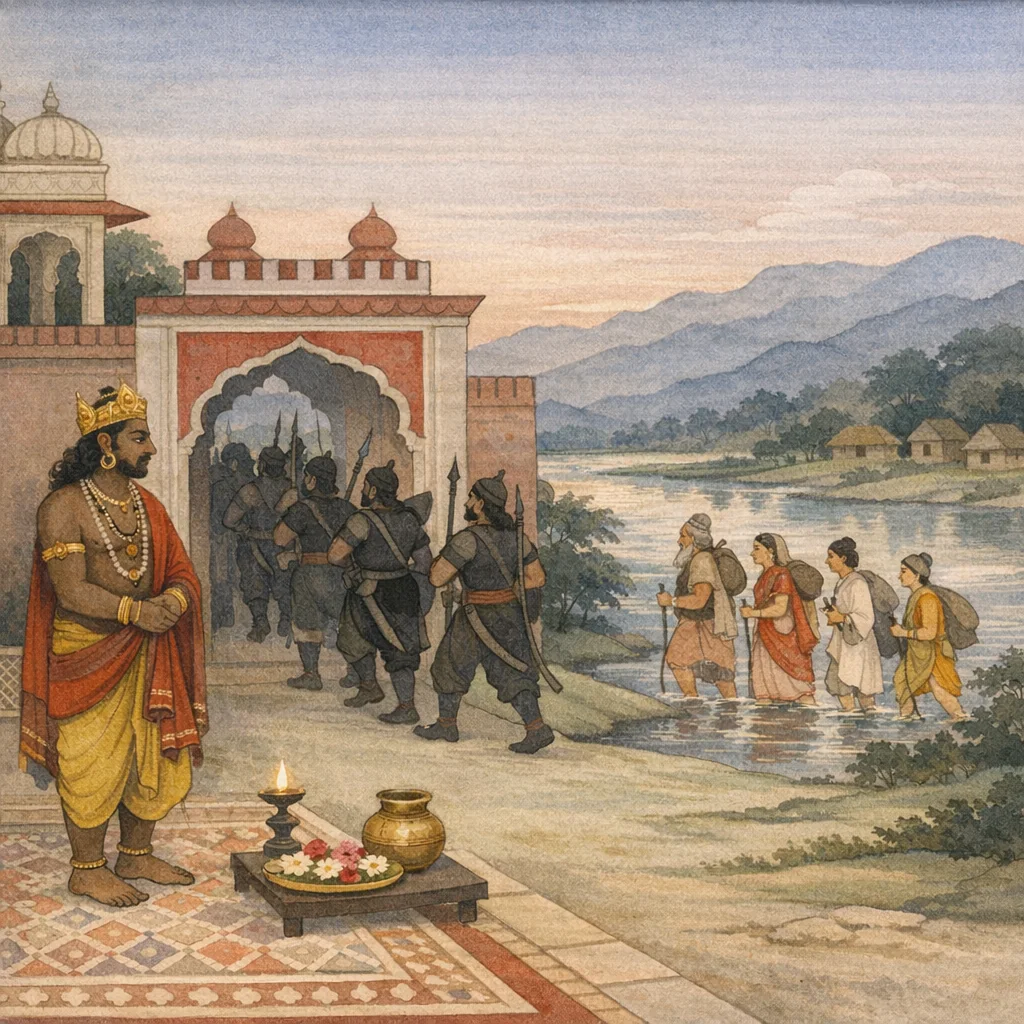
हिरण्यकशिपोः क्रोधः तथा देवप्रजाकदनम् — Hiraṇyakaśipu’s Wrath and the Affliction of Devas and Beings
Adhyāya 43 is taught in a question-and-answer setting: Vyāsa asks Sanatkumāra what happened after Hari, in the form of Varāha, slew the deva-hostile asura (Hiraṇyākṣa). Sanatkumāra relates that the elder brother Hiraṇyakaśipu, overcome with grief and wrath, performs the funerary and condolence rites such as karodaka for the dead, and then turns his sorrow into a resolve for revenge. He commands valiant asuras, portrayed as fond of slaughter, to afflict the devas and all beings. The world is thrown into turmoil; the devas abandon heaven and live on earth in disguise, showing a temporary breakdown of cosmic order and the need for higher intervention. The chapter thus serves as a hinge between the prior divine victory and the next phase of conflict—Hiraṇyakaśipu’s persecution and the devas’ appeal to a supreme authority like Brahmā as the crisis deepens.
Shlokas
Verse 1
अथ विज्ञापितो देवैर्व्यास तैरात्मभूर्विधिः । परीतो भृगुदक्षाद्यैर्ययौ दैत्येश्वराश्रमम्
Then, having been informed by those gods, the self-born Lord Brahmā (Vidhi) set out—surrounded by Bhṛgu, Dakṣa, and others—and went to the hermitage of the lord of the Daityas.
Verse 2
कुतूहलमिति श्रोतुं ममाऽतीह मुनीश्वर । तच्छ्रावय कृपां कृत्वा ब्रह्मपुत्र नमोस्तु ते
“O lord among sages, I am exceedingly eager to hear this out of sacred curiosity. Please, out of compassion, narrate it to me. O son of Brahmā, salutations to you.”
Verse 3
ततो गृहीतस्स मृगाधिपेन भुजैरनेकैर्गिरिसारवद्भि । निधाय जानौ स भुजांतरेषु नखांकुरैर्दानवमर्मभिद्भिः
Then the Lord of beasts seized him with many arms, firm as the essence of a mountain. Placing the demon across his knees and between his arms, he tore into the vital spots with the tips of his nails, rending the Daitya’s marma-points.
Verse 4
सनत्कुमार उवाच । भ्रातर्येवं विनिहते हरिणा क्रोडमूर्तिना । हिरण्यकशिपुर्व्यास पर्यतप्यद्रुषा शुचा
Sanatkumāra said: O Vyāsa, when his brother had thus been slain by Hari in the form of a Boar, Hiraṇyakaśipu was scorched within—burning with wrath and grief.
Verse 5
ततः प्रजानां कदनं विधातुं कदनप्रियान् । निर्दिदेशाऽसुरान्वीरान्हरि वैरप्रियो हि सः
Then Hari—who was indeed fond of hostility—commanded the heroic asuras, who delighted in slaughter, to set about the destruction of the people.
Verse 6
अथ ते भर्तृसंदेशमादाय शिरसाऽसुराः । देवप्रजानां कदनं विदधुः कदनप्रियाः
Then those asuras, taking upon their heads the command of their lord, began to wreak destruction upon the hosts and subjects of the devas—being ever fond of slaughter.
Verse 7
ततो विप्रकृते लोकेऽसुरैस्तेर्दुष्टमानसैः । दिवं देवाः परित्यज्य भुवि चेरुरलक्षिताः
Then, when the world had been thrown into disorder by those evil‑minded Asuras, the Devas abandoned heaven and moved about on the earth, remaining unrecognized and concealed.
Verse 8
हिरण्यकशिपुर्भ्रातुस्संपरेतस्य दुःखितः । कृत्वा करोदकादीनि तत्कलत्राद्यसांत्वयत्
Grieving over his brother who had departed this life, Hiraṇyakaśipu performed the customary funeral rites beginning with the water-offering, and then consoled his brother’s wife and the other bereaved family members.
Verse 9
ततस्स दैत्यराजेन्द्रो ह्यजेयमजरामरम् । आत्मानमप्र तिद्वंद्वमेकराज्यं व्यधित्सत
Then that lord of the Daityas resolved to establish himself as the unconquerable, ageless, deathless sovereign—without any rival—ruling alone as the one supreme king.
Verse 10
स तेपे मंदरद्रोण्यां तपः परमदारुणम् । ऊर्द्ध्वबाहुर्नभोदृष्टिः षादांगुष्ठाश्रितावनिः
There, in the Mandara valley, he performed austerity of the most severe kind—standing with arms uplifted, gaze fixed upon the sky, and remaining on the earth supported only by his six toes—steadfast in fierce tapas for the sake of Shiva’s grace.
Verse 11
तस्मिंस्तपस्तप्यमाने देवास्सर्वे बलान्विताः । दैत्यान्सर्वान्विनिर्जित्य स्वानि स्थानानि भेजिरे
While that asceticism was being performed, all the gods, newly strengthened, defeated all the Daityas and returned to their own abodes—by the restoring power that arises when the divine order is upheld through tapas.
Verse 12
तस्य मूर्द्ध्नस्समुद्भूतः सधूमोग्निस्तपोमयः । तिर्यगूर्द्ध्वमधोलोकानतपद्विष्वगीरितः
From his head there arose a smoke-laden fire, formed of austerity itself; spreading in all directions, it scorched the worlds—across, above, and below.
Verse 13
तेन तप्ता दिवं त्यक्त्वा ब्रह्मलोकं ययुस्सुराः । धात्रे विज्ञापयामासुस्तत्तपोविकृताननाः
Tormented by the heat of that austerity, the gods abandoned heaven and went to Brahmā’s world. Their faces altered by the distress caused by that tapas, they submitted their plea to the Creator (Dhātṛ).
Verse 15
प्रताप्य लोकानखिलांस्ततोऽसौ समागतं पद्मभवं ददर्श । वरं हि दातुं तमुवाच धाता वरं वृणीष्वेति पितामहोपि । निशम्य वाचं मधुरां विधातुर्वचोऽब्रवीदेव ममूढबुद्धिः
After subduing all the worlds by his prowess, he saw Padmabhava (Brahmā) arrive. Wishing to grant a boon, the Creator—Pitāmaha himself—said to him, “Choose a boon.” Hearing the sweet words of the Ordainer (Brahmā), that deluded-minded one replied.
Verse 16
हिरण्यकशिपुरुवाच । मृत्योर्भयं मे भगवन्प्रजेश पितामहाभून्न कदापि देव । शास्त्रास्त्रपाशाशनिशुष्कवृक्षगिरीन्द्रतोयाग्निरिपुप्रहारैः
Hiraṇyakaśipu said: “O Blessed Lord, O Prajāpati, O divine Grandsire—never at any time has fear of death arisen in me, whether from sacred ordinances or weapons, from nooses, thunderbolts, dry trees, mountains, water, fire, or from the blows of enemies.”
Verse 17
देवैश्च दैत्यैर्मुनिभिश्च सिद्धैस्त्वत्सृष्टजीवैर्बहुवाक्यतः किम् । स्वर्गे धरण्यां दिवसे निशायां नैवोर्द्ध्वतो नाप्यधतः प्रजेश
O Lord of creatures, what need is there for many words? Among the gods, the Daityas, the sages, and the Siddhas—indeed among all beings created by You—whether in heaven or on earth, by day or by night, there is none equal to You, neither above nor below, O Prajāpati.
Verse 18
सनत्कुमार उवाच । तस्यैतदीदृग्वचनं निशम्य दैत्येन्द्र तुष्टोऽस्मि लभस्व सर्वम् । प्रणम्य विष्णुं मनसा तमाह दयान्वितोऽसाविति पद्मयोनिः
Sanatkumāra said: Hearing those words spoken in that manner, the lord of the Daityas was pleased: “I am satisfied—receive everything.” Then Padmayoni (Brahmā), inwardly bowing to Viṣṇu in his mind, spoke to him, perceiving him to be compassionate.
Verse 19
अलं तपस्ते परिपूर्ण कामस्समाः सहस्राणि च षण्णवत्य । उत्तिष्ठ राज्यं कुरु दानवानां श्रुत्वा गिरं तत्सुमुखो बभूव
“Enough of your austerities—your desire has been fully accomplished, even after a thousand and ninety-six years. Arise now and take up the kingship of the Dānavas.” Hearing these words, he became radiant and pleased of countenance.
Verse 20
राज्याभिषिक्तः प्रपितामहेन त्रैलोक्यनाशाय मतिं चकार । उत्साद्य धर्मान् सकलान्प्रमत्तो जित्वाहवे सोपि सुरान्समस्तान्
Consecrated to kingship by the Grandsire (Brahmā), he resolved upon the destruction of the three worlds. Maddened with pride, he overthrew all forms of dharma and, in battle, he conquered all the devas as well.
Verse 21
ततो भयादिंद्रमुखाश्च देवाः पितामहाज्ञां समवाप्य सर्वे । उपद्रुता दैत्यवरेण जाताः क्षीरोदधिं यत्र हरिस्तु शेते
Then, out of fear, all the gods—led by Indra—having received the command of the Grandsire (Brahmā), and being harassed by that foremost of demons, went to the Ocean of Milk, where Hari (Viṣṇu) lies in repose.
Verse 22
आराधयामासुरतीव विष्णुं स्तुत्वा वचोभित्सुखदं हि मत्वा । निवेदयामासुरथो प्रसन्नं दुःखं स्वकीयं सकलं हि तेते
Then they worshipped Viṣṇu with intense devotion. Having praised him with words they deemed truly consoling, they approached him in a glad and receptive mood and disclosed to him in full all their sorrow.
Verse 23
श्रुत्वा तदीयं सकलं हि दुःखं तुष्टो रमेशः प्रददौ वरांस्तु । उत्थाय तस्माच्छयनादुपेन्द्रो निजानुरूपैर्विविधैर्वचोभिः
Hearing his affliction in full, Rameśa (Viṣṇu), pleased, granted him boons. Then Upendra (Viṣṇu), rising from that couch, spoke many words of various kinds, suited to the moment and to the petitioner.
Verse 24
आश्वास्य देवानखिलान्मुनीन्वा उवाच वैश्वानरतुल्यतेजाः । दैत्यं हनिष्ये प्रसभं सुरेशाः प्रयात धामानि निजानि तुष्टाः
Having reassured all the gods and the sages, he whose splendor was like blazing fire spoke: “O lords of the devas, I shall forcibly slay the Daitya. Depart now, satisfied, to your own abodes.”
Verse 25
श्रुत्वा रमेशस्य वचस्सुरेशाः शक्रादिकास्ते निखिलाः सुतुष्टाः । ययुः स्वधामानि हिरण्यनेत्रानुजं च मत्वा निहतं मुनीश
O great sage, hearing the words of Rameśa (Lord Śiva), all the lords of the gods—Indra and the rest—became fully satisfied. Concluding that Hiraṇyanetra’s younger brother had been slain, they departed to their own celestial abodes.
Verse 26
आश्रित्य रूपं जटिलं करालं दंष्ट्रायुधं तीक्ष्णनखं सुनासम् । सैंहं च नारं सुविदारितास्यं मार्तंडकोटिप्रतिमं सुघोरम्
Assuming a dreadful, matted-haired form—armed with fangs, with razor-sharp claws, and a well-shaped nose—lion-like and man-like, with a fearfully gaping mouth, and blazing with the terror of ten million suns, he appeared exceedingly terrible.
Verse 27
युगांतकालाग्निसमप्रभावं जगन्मयं किं बहुभिर्वचोभिः । अस्तं रवौसोऽपि हि गच्छतीशो गतोऽसुराणां नगरीं महात्मा
His splendor was like the fire at the end of an age, and he pervaded the whole universe—what need is there for many words? When the sun set, that mighty lord too set forth, and the great-souled one went to the city of the Asuras.
Verse 28
कृत्वा च युद्धं प्रबलैस्स दैत्यैर्हत्वाथ तान्दैत्यगणान्गृहीत्वा । बभ्राम तत्राद्रुतविक्रमश्च बभंज तांस्तानसुरान्नृसिंहः
After engaging in battle with the mighty Dāityas, Nṛsiṃha slew those hosts of demons and seized them. Then, with swift and irresistible valor, he roamed there and shattered those Asuras one after another.
Verse 29
दृष्टस्स दैत्यैरतुलप्रभावस्ते रेभिरे ते हि तथैव सर्वे । सिंहं च तं सर्वमयं निरीक्ष्य प्रह्लादनामा दितिजेन्द्रपुत्रः । उवाच राजानमयं मृगेन्द्रो जगन्मयः किं समुपागतश्च
When the Daityas beheld that being of incomparable might, they all roared as one. Gazing upon that lion who seemed the very embodiment of all existence, Prahlāda—the son of the Daitya-king—spoke: “What is this lion, formed of the sovereign principle and pervading the universe, that has now arrived?”
Verse 30
प्रह्लाद उवाच । एष प्रविष्टो भगवाननंतो नृसिंहमात्रो नगरं त्वदंतः । निवृत्य युद्धाच्छ रणं प्रयाहि पश्यामि सिंहस्य करालमूर्त्तिम्
Prahlāda said: “Behold—Bhagavān Ananta has entered your city in the form of Narasiṃha. Turn back from this battle and withdraw from the battlefield. I see the lion’s terrible, awe-inspiring form.”
Verse 31
यस्मान्न योद्धा भुवनत्रयेऽपि कुरुष्व राज्यं विनमन्मृगेन्द्रम् । श्रुत्वा स्वपुत्रस्य वचो दुरात्मा तमाह भीतोऽसि किमत्र पुत्र
“Since in the three worlds there is no warrior fit to face him, establish your rule by humbling that lion among men.” Hearing his own son’s words, that wicked one said, “Son, are you afraid? What is there to fear here?”
Verse 32
उक्त्वेति पुत्रं दितिजाधिनाथो दैत्यर्षभान्वीरवरान्स राजा । गृह्णंतु वै सिंहममुं भवंतो वीरा विरूपभ्रुकुटीक्षणं तु
Having spoken thus to his son, the king—the lord of the Dānavas—addressed the bull-like chiefs among the Daityas, the foremost of heroes: “O valiant ones, seize this lion-like foe—terrible to behold, with a distorted frown and a fearsome gaze.”
Verse 33
तस्याज्ञया दैत्यवरास्ततस्ते ग्रहीतुकामा विविशुर्मृगेन्द्रम् । क्षणेन दग्धाश्शलभा इवाग्निं रूपाभिलाषात्प्रविविक्षवो वै
At his command, those foremost Daityas, longing to seize the Lion-Lord, rushed in. In an instant they were burnt up—like moths entering a flame—for, driven by craving for that form, they sought to penetrate it.
Verse 34
दैत्येषु दग्धेष्वपि दैत्यराजश्चकार युद्धं स मृगाधिपेन । शस्त्रैस्समग्रैरखिलैस्तथास्त्रैश्श क्त्यर्ष्टिपाशांकुशपावकाद्यैः
Even after the Daityas had been burned, the king of the Daityas still waged war against the Lord of Beasts (Śiva), assailing Him with every kind of weapon and missile—spears, lances, nooses, goads, fire, and the like.
Verse 35
संयुध्यतोरेव तयोर्जगाम ब्राह्मं दिनं व्यास हि शस्त्रपाण्योः । प्रवीरयोर्वीररवेण गर्जतोः परस्परं क्रोधसुयुक्तचेतसोः
O Vyāsa, as those two mighty warriors—both bearing weapons—fought on, a full ‘day of Brahmā’ passed; and with heroic roars they thundered at one another, their minds bound fast in wrath.
Verse 36
ततः स दैत्यस्सहसा बहूंश्च कृत्वा भुजाञ्छस्त्रयुतान्निरीक्ष्य । नृसिंहरूपं प्रययौ मृगेन्द्र संयुध्यमानं सहसा समंतात्
Then that demon, suddenly multiplying himself into many forms and beholding his arms furnished with weapons, rushed forth at once in the form of a man-lion, like a lion among beasts, battling fiercely on every side.
Verse 37
ततस्सुयुद्धं त्वतिदुस्सहं तु शस्त्रैस्समस्तैश्च तथाखिलास्त्रैः । कृत्वा महादैत्यवरो नृसिंहं क्षयं गतैश्शूल धरोऽभ्युपायात्
Then, after waging a most unbearable and intense battle—using every kind of weapon and all manner of missiles—the foremost of the great demons brought Narasiṃha to destruction. Thereupon Śiva, the Bearer of the Trident, approached (the scene) when (the foe) had been brought to ruin.
Verse 39
नखास्त्रहृत्पद्ममसृग्विमिश्रमुत्पाद्य जीवाद्विगतः क्षणेन । त्यक्तस्तदानीं स तु काष्ठभूतः पुनः पुनश्चूर्णितसर्वगात्रः
When the weapon of nails tore open his heart-lotus and blood mixed with marrow gushed forth, his life departed in an instant. Cast aside then, he became like a piece of wood—again and again his entire body was crushed to fragments.
Verse 40
तस्मिन्हते देवरिपौ प्रसन्नः प्रह्लादमामंत्र्य कृतप्रणामम् । राज्येऽभिषिच्याद्भुतवीर्यविष्णुस्ततः प्रयातो गतिमप्रतर्क्याम्
When the enemy of the gods had been slain, the wondrously mighty Lord Viṣṇu, pleased at heart, took leave of Prahlāda—who had bowed in reverence—installed him upon the throne, and then departed to his own inscrutable, inconceivable state.
Verse 41
ततोऽतिहृष्टास्सकलास्सुरेशाः प्रणम्य विष्णुं दिशि विप्र तस्याम् । ययुः स्वधामानि पितामहाद्याः कृतस्वकार्यं भगवंतमीड्यम्
Then all the lords of the gods, greatly rejoicing, bowed down to Viṣṇu in that very direction, O brāhmaṇa. Brahmā and the other deities, their purpose fulfilled, departed to their own abodes, praising the adorable Lord (Viṣṇu) who had accomplished the needed task.
Verse 42
प्रवर्णितं त्वंधकजन्म रुद्राद्धिरण्यनेत्रस्य मृतिर्वराहात् । नृसिंहतस्तत्सहजस्य नाशः प्रह्लादराज्याप्तिरिति प्रसंगात्
In this connection it has been recounted: Andhaka was born from Rudra; Hiraṇyākṣa met his death at the hands of Varāha; by Nṛsiṃha, Hiraṇyakaśipu—his own brother—was destroyed; and thus Prahlāda attained the kingdom.
Verse 43
इति श्रीशिवमहापुराणे द्वितीयायां रुद्रसंहितायां पञ्चमे युद्धखंडे गणाधिपत्यप्राप्त्यंधकजन्म हिरण्यनेत्रहिरण्यकशिपुवधवर्णनं नाम त्रिचत्वारिंशोऽध्यायः
Thus, in the Śrī Śiva Mahāpurāṇa—within the Second, the Rudra Saṃhitā, in the Fifth section called the Yuddha Khaṇḍa—ends the forty-third chapter, entitled “The attainment of Gaṇādhipatya, the birth of Andhaka, and the account of the slaying of Hiraṇyanetra and Hiraṇyakaśipu.”
Frequently Asked Questions
The chapter looks to the aftermath of an asura hostile to the devas being slain by Hari in ‘kroḍa’ (Varāha/boar) form—setting up Hiraṇyakaśipu’s retaliatory turn.
It signals a temporary inversion of cosmic order under adharma: when violence and persecution dominate, even devas adopt restraint and strategy, awaiting a lawful restoration rather than mere escalation.
Hari/Viṣṇu is highlighted as Varāha (kroḍamūrti) as the slayer of the asura; Brahmā appears as the invoked authority (Ātmabhū/Vidhi), and Sanatkumāra functions as the transmitting sage.