देवपराजयः — शङ्करशरणागमनं स्कन्दकालीयुद्धं च | Devas’ Defeat, Refuge in Śaṅkara, and the Battle of Skanda and Kālī
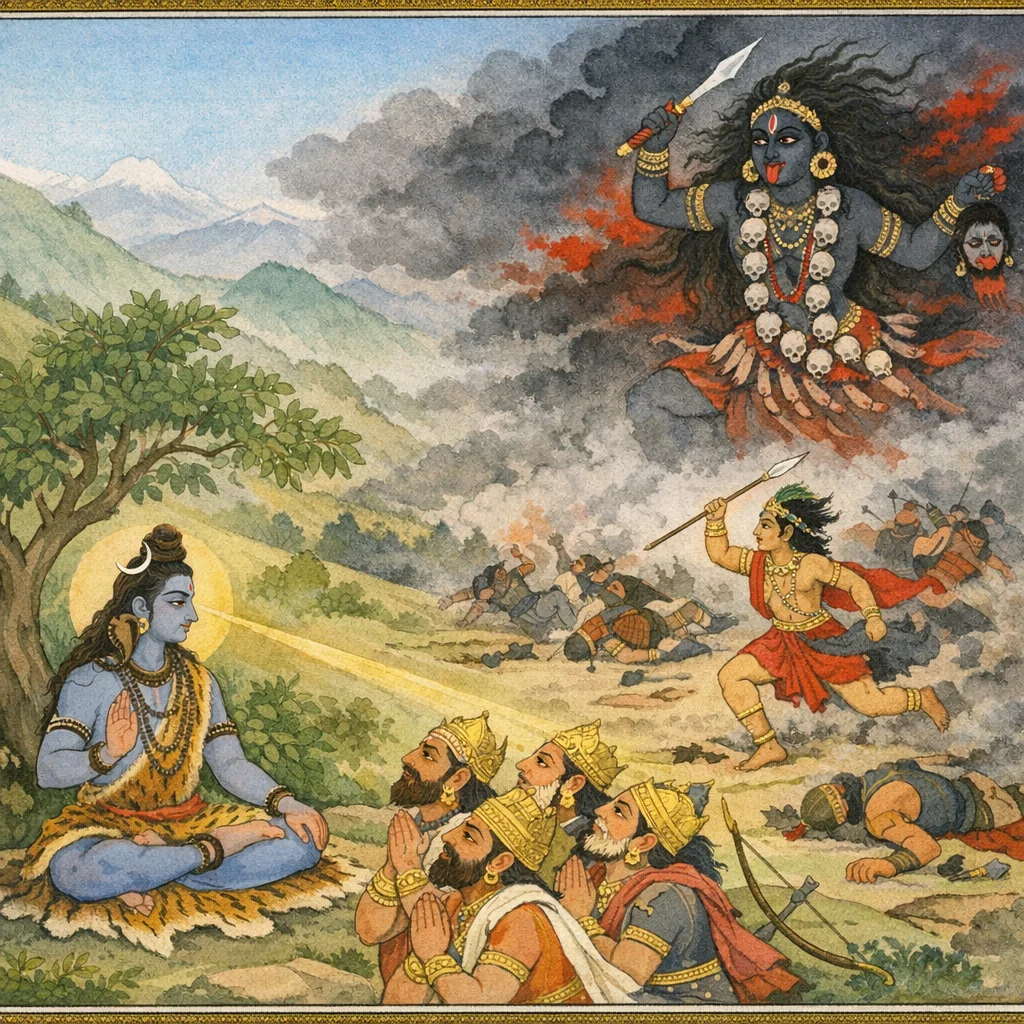
Adhyāya 37 begins with Sanatkumāra describing the devas’ defeat by the dānavas: the gods flee in terror, their bodies wounded by weapons. Turning back, they approach Viśveśa Śaṅkara (Śiva) as their supreme refuge, crying for protection. Seeing their rout and hearing their trembling plea, Śiva is roused to wrath against the hostile powers, yet with a compassionate glance he grants them abhaya (fearlessness) and increases the strength and radiance of his gaṇas. By Śiva’s command, Skanda (Harātmaja, Tārakāntaka) enters the battlefield without fear and shatters vast enemy formations. At the same time, Kālī’s ferocity is portrayed in stark martial imagery—drinking blood and severing heads—spreading dread among suras and dānavas alike. The chapter moves from the collapse of the divine armies to surrender to Śiva, then divine empowerment and an overwhelming counter-assault, affirming Śiva as the decisive source of protection and victory.
Shlokas
Verse 1
सनत्कुमार उवाच । तदा देवगणास्सर्वे दानवैश्च पराजिताः । दुद्रुवुर्भयभीताश्च शस्त्रास्त्रक्षतविग्रहाः
Sanatkumāra said: Then all the hosts of the gods, defeated by the Dānavas, fled in terror, their bodies wounded and torn by weapons and missiles.
Verse 2
ते परावृत्य विश्वेशं शंकरं शरणं ययुः । त्राहि त्राहीति सर्वेशेत्यू चुर्विह्वलया गिरा
Turning back, they sought refuge in Śaṅkara, the Lord of the universe; and with voices trembling in distress they cried, “Save us, save us, O Sarveśa, Lord of all!”
Verse 3
दृष्ट्वा पराजयं तेषां देवादीनां स शंकरः । सभयं वचनं श्रुत्वा कोपमुच्चैश्चकार ह
Seeing the defeat of those gods and the others, Śaṅkara, on hearing their fear-laden words, became fiercely and intensely wrathful.
Verse 4
निरीक्ष्य स कृपादृष्ट्या देवेभ्यश्चाभयं ददौ । बलं च स्वगणानां वै वर्द्धयामास तेजसा
Beholding them with a compassionate gaze, he granted the Devas abhaya—fearlessness. And by his own tejas, his spiritual radiance, he increased the strength of his attendant hosts, the gaṇas.
Verse 5
शिवाज्ञप्तस्तदा स्कन्दो दानवानां गणैस्सह । युयुधे निर्भयस्संख्ये महावीरो हरात्मजः
Then Skanda, under Śiva’s command, fought amid the battle together with the hosts of the Dānavas—fearless in the fray, that great hero, the son of Hara.
Verse 6
कृत्वा क्रोधं वीरशब्दं देवो यस्तारकांतकः । अक्षौहिणीनां शतकं समरे स जघान ह
Roused to wrath and uttering a heroic battle-cry, that divine Lord—Tārakāntaka—slew in the war a hundred akṣauhiṇīs of armies.
Verse 7
रुधिरं पातयामास काली कमललोचना । तेषां शिरांसि संछिद्य बभक्ष सहसा च सा
Lotus-eyed Kālī made their blood flow; and, severing their heads, she suddenly devoured them.
Verse 8
पपौ रक्तानि तेषां च दानवानां समं ततः । युद्धं चकार विविधं सुरदानवभीषणम्
Then, at once, he drank the blood of those Dānavas; thereafter he waged a many-formed battle, terrifying to both the Devas and the Dānavas.
Verse 9
शतलक्षं गजेन्द्राणां शतलक्षं नृणां तथा । समादायैकहस्तेन मुखे चिक्षेप लीलया
A hundred thousand lordly elephants, and likewise a hundred thousand men—gathering them up with a single hand, he cast them into his mouth playfully, as a mere sport.
Verse 10
कबंधानां सहस्रं च सन्ननर्त रणे बहु । महान् कोलाहलो जातः क्लीबानां च भयंकरः
In the battlefield, thousands of headless trunks reeled and danced about in many ways. A tremendous uproar arose—terrifying to the faint-hearted and cowardly.
Verse 11
पुनः स्कंदः प्रकुप्योच्चैः शरवर्षाञ्चकार ह । पातयामास क्षयतः कोटिशोऽसुरनायकान्
Then Skanda, again becoming fiercely enraged, raised a mighty shower of arrows; and, bringing about their destruction, he caused the leaders of the asuras to fall by the crores.
Verse 12
दानवाः शरजालेन स्कन्दस्य क्षतविग्रहाः । भीताः प्रदुद्रुवुस्सर्वे शेषा मरणतस्तदा
Wounded in their bodies by Skanda’s net of arrows, the Dānavas were terrified; and the remaining ones all fled at that time, fearing death.
Verse 13
वृषपर्वा विप्रचित्तिर्दंडश्चापि विकंपनः । स्कंदेन युयुधुस्सार्द्धं तेन सर्वे क्रमेण च
Vṛṣaparvā, Vipracitti, Daṇḍa, and also Vikaṃpana—each of them, in due order, fought together with Skanda (Kārttikeya).
Verse 14
महामारी च युयुधे न बभूव पराङ्मुखी । बभूवुस्ते क्षतांगाश्च स्कंदशक्तिप्रपीडिताः
Mahāmārī too fought on, never turning away from the battle. Yet those warriors, crushed by Skanda’s śakti—the divine spear-power—were wounded in their limbs.
Verse 15
महामारीस्कंदयोश्च विजयोभूत्तदा मुने । नेदुर्दुंदुभयस्स्वर्गे पुष्पवृष्टिः पपात ह
O sage, at that time victory came to Mahāmārī and Skanda. In heaven the dundubhi drums resounded, and a rain of flowers fell.
Verse 16
स्कंदस्य समरं दृष्ट्वा महारौद्रं तमद्भुतम् । दानवानां क्षयकरं यथाप्रकृतिकल्पकम्
Beholding Skanda’s battle—wondrous and fiercely terrible—the onlookers saw that it brought destruction upon the Dānavas, shaping events exactly according to the ordained course of nature.
Verse 17
महामारीकृतं तच्चोपद्रवं क्षयहेतुकम् । चुकोपातीव सहसा सनद्धोभूत्स्वयं तदा
That calamity, like a great plague and a cause of ruin, arose there. Then he, as though suddenly struck by a storm of wrath, at once armed himself fully by his own will.
Verse 18
वरं विमानमारुह्य नानाशस्त्रास्त्रसंयुतम् । अभयं सर्ववीराणां नानारत्नपरिच्छदम्
Mounting an excellent aerial chariot, furnished with many kinds of weapons and missiles—granting fearlessness to all heroic warriors—and adorned with ornaments set with many varieties of gems.
Verse 19
महावीरैश्शंखचूडो जगाम रथमध्यतः । धनुर्विकृष्य कर्णान्तं चकार शरवर्षणम्
Then Śaṅkhacūḍa, surrounded by mighty warriors, advanced into the midst of the chariots; drawing his bow back to his ear, he unleashed a rain of arrows.
Verse 20
तस्य सा शरवृष्टिश्च दुर्निवार्य्या भयंकरी । महाघोरांधकारश्च वधस्थाने बभूव ह
From him there burst forth a shower of arrows—irresistible and terrifying; and upon the field of slaughter there arose a most dreadful darkness.
Verse 21
देवाः प्रदुद्रुवुः सर्वे येऽन्ये नन्दीश्वरादयः । एक एव कार्त्तिकेयस्तस्थौ समरमूर्द्धनि
All the gods fled in haste, along with the others beginning with Nandīśvara; but Kārttikeya alone stood firm at the very forefront of the battle.
Verse 22
पर्वतानां च सर्पाणां नागानां शाखिनां तथा । राजा चकार वृष्टिं च दुर्निवार्या भयंकरीम्
Then the king unleashed a rain-storm—irresistible and terrifying—so that it struck mountains, serpents, nāgas, and even the trees.
Verse 23
तद्दृष्ट्या प्रहतः स्कन्दो बभूव शिवनन्दनः । नीहारेण च सांद्रेण संवृतौ भास्करौ यथा
Struck by that (divine) glance, Skanda—the beloved son of Śiva—was stunned and overcome, just as the two suns would be veiled when covered by dense mist.
Verse 24
नानाविधां स्वमायां च चकार मयदर्शिताम् । तां नाविदन् सुराः केपि गणाश्च मुनिसत्तम
O best of sages, he then fashioned many kinds of his own māyā, just as I have described, and displayed it. Yet none of the gods, nor even the gaṇas, could truly recognize or fathom that illusion.
Verse 25
तदैव शङ्खचूडश्च महामायी महाबलः । शरेणैकेन दिव्येन धनुश्चिच्छेद तस्य वै
At that very moment, Śaṅkhacūḍa—endowed with great māyā and immense strength—severed his bow with a single divine arrow.
Verse 26
बभंज तद्रथं दिव्यं चिच्छेद रथपीडकान् । मयूरं जर्जरीभूतं दिव्यास्त्रेण चकार सः
He shattered that celestial chariot, cut down the chariot’s harassing assailants, and—by a divine missile—reduced the peacock mount to a broken, mangled state.
Verse 27
शक्तिं चिक्षेप सूर्याभां तस्य वक्षसि घातिनीम् । मूर्च्छामवाप सहसा तत्प्रहारेण स क्षणम्
He hurled a śakti-spear blazing like the sun, a deadly weapon aimed at his chest. Struck by that blow, he suddenly fell into a faint for a moment.
Verse 28
पुनश्च चेतनां प्राप्य कार्तिकः परवीरहा । रत्नेन्द्रसारनिर्माणमारुरोह स्ववाहनम्
Then, regaining full consciousness, Kārtikeya—slayer of the enemy’s champions—mounted his own mount, fashioned from the essence of the lord of jewels.
Verse 29
स्मृत्वा पादौ महेशस्य साम्बिकस्य च षण्मुखः । शस्त्रास्त्राणि गृहीत्वैव चकार रणमुल्बणम्
Remembering the lotus-feet of Maheśa and of Sāmbikā, Ṣaṇmukha took up his weapons and divine missiles, and made the battle fiercely tumultuous.
Verse 30
सर्प्पांश्च पर्वतांश्चैव वृक्षांश्च प्रस्तरांस्तथा । सर्वांश्चिच्छेद कोपेन दिव्या स्त्रेण शिवात्मजः
Enraged, the son of Śiva cut down serpents, mountains, trees, and rocks as well—cleaving them all apart with his divine missile.
Verse 31
वह्निं निवारयामास पार्जन्येन शरेण ह । रथं धनुश्च चिच्छेद शंखचूडस्य लीलया
He checked the blazing fire with a rain-bearing arrow; and, as if in playful ease, he shattered Śaṅkhacūḍa’s chariot and bow.
Verse 32
सन्नाहं सर्ववाहांश्च किरीटं मुकुटोज्ज्वलम् । वीरशब्दं चकारासौ जगर्ज च पुनः पुनः
He donned his armor and readied all his mounts; his crown shone brilliantly. Then, raising the cry of a hero, he roared again and again.
Verse 33
चिक्षेप शक्तिं सूर्याभां दानवेन्द्रस्य वक्षसि । तत्प्रहारेण संप्राप मूर्च्छां दीर्घतमेन च
He hurled a spear (śakti), radiant like the sun, into the chest of the lord of the Dānavas. Struck by that blow, the demon-king fell into a very long swoon.
Verse 34
मुहूर्तमात्रं तत्क्लेशं विनीय स महाबलः । चेतनां प्राप्य चोत्तस्थौ जगर्ज हरिवर्च सः
Enduring that affliction for only a brief moment, the mighty one regained consciousness; rising up again, he roared—his splendor shining like that of Hari.
Verse 35
शक्त्या जघान तं चापि कार्तिकेयं महाबलम् । स पपात महीपृष्ठेऽमोघां कुर्वन्विधिप्रदाम्
With his spear (śakti) he struck even that mighty Kārtikeya. Kārtikeya fell upon the surface of the earth, yet he did not let the divinely ordained power go in vain—he ensured that the decree of fate took effect.
Verse 36
काली गृहीत्वा तं क्रोडे निनाय शिवसन्निधौ । ज्ञानेन तं शिवश्चापि जीवयामास लीलया
Kālī lifted him onto her lap and carried him into Śiva’s presence. Thereupon Śiva, by the power of spiritual knowledge (jñāna), revived him effortlessly, as though it were but a divine play (līlā).
Verse 37
इति श्रीशिवमहापुराणे द्वितीयायां रुद्रसहितायां पञ्चमे युद्धखंडे शंखचूडवधे ससैन्यशंखचूडयुद्धवर्णनं नाम सप्तत्रिंशोऽध्यायः
Thus, in the Śrī Śiva Mahāpurāṇa—within the Second section, the Rudra Saṃhitā, in the Fifth, the Yuddha-khaṇḍa—during the account of the slaying of Śaṅkhacūḍa, ends the thirty-seventh chapter, entitled “The Description of the Battle of Śaṅkhacūḍa together with his army.”
Verse 38
एतस्मिन्नंतरे वीरो वीरभद्रो महाबलः । शंखचूडेन युयुधे समरे बलशालिना
Meanwhile, the hero Vīrabhadra, endowed with immense strength, engaged in battle on the battlefield with the mighty Śaṅkhacūḍa.
Verse 39
ववर्ष समरेऽस्त्राणि यानियानि च दानवः । चिच्छेद लीलया वीरस्तानितानि निजैश्शरैः
In the midst of battle, whatever missiles the Dānava rained down, the heroic warrior effortlessly cut each and every one of them apart with his own arrows.
Verse 40
दिव्यान्यस्त्राणि शतशो मुमुचे दानवेश्वरः । तानि चिच्छेद तं बाणैर्वीरभद्रः प्रतापवान्
The lord of the Dānavas loosed hundreds of celestial weapons. Yet mighty Vīrabhadra, blazing with valor, cut them down with his arrows and struck him with his shafts.
Verse 41
अथातीव चुकोपोच्चैश्शंखचूडः प्रतापवान् । शक्त्या जघानोरसि तं स चकंपे पपात कौ
Then the mighty and valorous Śaṅkhacūḍa blazed forth in fierce wrath. With his śakti-spear he struck him in the chest; the warrior trembled and fell upon the battlefield.
Verse 42
क्षणेन चेतनां प्राप्य समुत्तस्थौ गणेश्वरः । जग्राह च धनुर्भूयो वीरभद्रो गणाग्रणीः
In a moment the Lord of the Gaṇas regained consciousness and rose up. And Vīrabhadra—foremost leader of Śiva’s hosts—once again seized his bow.
Verse 43
एतस्मिन्नंतरे काली जगाम समरं पुनः । भक्षितुं दानवान् स्वांश्च रक्षितुं कार्तिकेच्छया
Meanwhile, Kālī again entered the battlefield—intending to devour the Dānavas, and, in accordance with Kārtikeya’s wish, to protect her own forces.
Verse 44
वीरास्तामनुजग्मुश्च ते च नन्दीश्वरादयः । सर्वे देवाश्च गंधर्वा यक्षा रक्षांसि पन्नगाः
Those heroic attendants followed her; and Nandīśvara and the others as well. All the gods too—along with the Gandharvas, Yakṣas, Rākṣasas, and the serpent-beings (Nāgas)—joined in and followed.
Verse 45
वाद्यभांडाश्च बहुशश्शतशो मधुवाहकाः । पुनः समुद्यताश्चासन् वीरा उभयतोऽखिलाः
Many musical instruments resounded, and hundreds upon hundreds of honey-bearers were present. Then again, on both sides, all the heroic warriors rose up, fully prepared for battle.
Frequently Asked Questions
The devas, defeated by dānavas, take refuge in Śiva; Śiva grants fearlessness and empowers his forces, after which Skanda and Kālī unleash a decisive counter-offensive in the war.
The chapter encodes a Śaiva soteriology of crisis: fear and defeat culminate in śaraṇāgati; Śiva’s abhaya signifies inner stabilization, while the ensuing battle symbolizes the subjugation of chaotic forces by awakened divine power.
Skanda (as Harātmaja/Tārakāntaka) represents Śiva’s commanded martial agency, while Kālī embodies fierce śakti—terror and purification—operating to dismantle hostile forces.