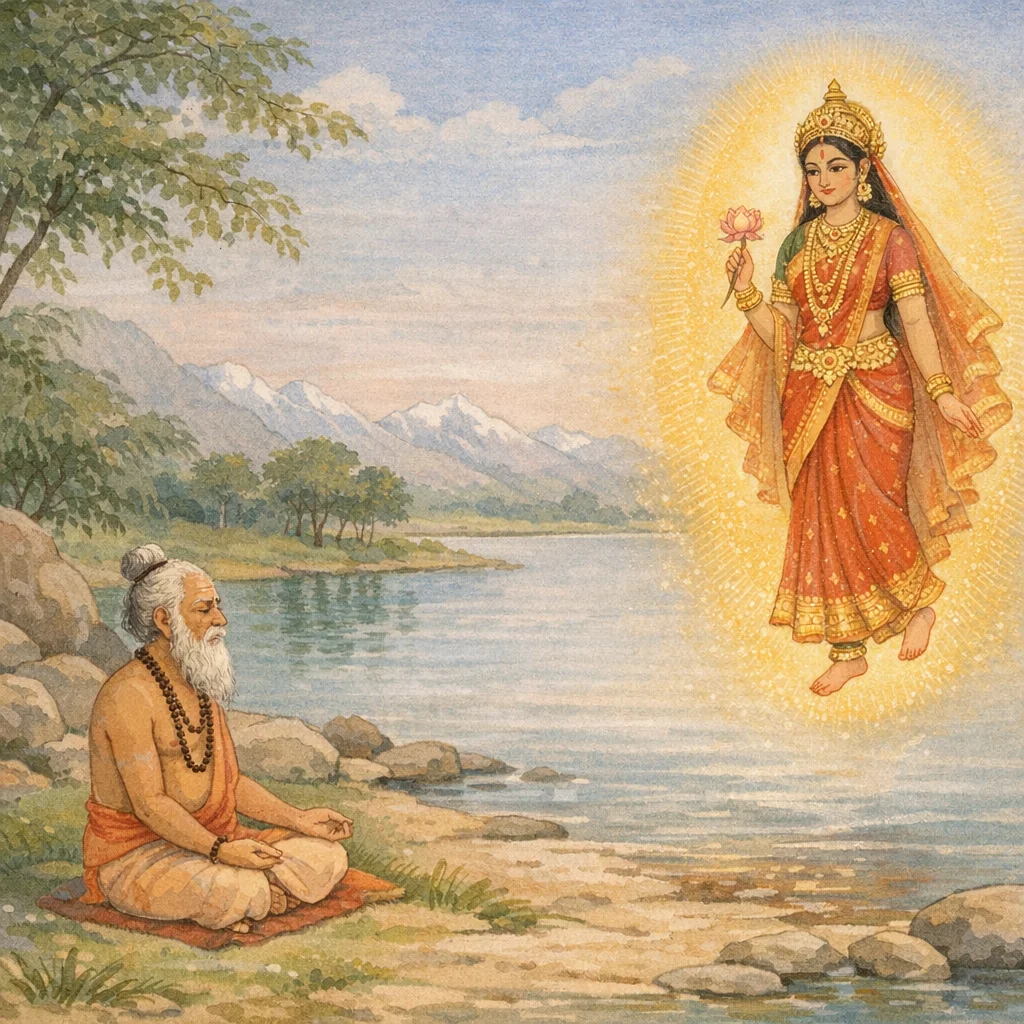
दक्षस्य तपः तथा जगदम्बायाः प्रत्यक्षता — Dakṣa’s Austerities and the Direct Manifestation of Jagadambā
Adhyāya 12 unfolds as a dialogue: Nārada asks Brahmā to explain how Dakṣa, after firm vows (dṛḍha-vrata) and tapas, received a boon, and how the Goddess Jagadambā became Dakṣa’s daughter (Dakṣajā). Brahmā recounts Dakṣa’s divinely sanctioned resolve to obtain Jagadambā, his steady contemplation of her as abiding in his heart (hṛdayasthitā), and his place of practice near the northern shore of the Kṣīroda. The chapter describes a graded ascetic discipline—three thousand divine years, increasing austerities (mārutāśī, nirāhāra, jalāhāra, parṇabhuk), and sustained Durgā-dhyāna supported by yama/niyama. At the climax the Goddess/Śivā becomes directly manifest (pratyakṣa) to the worshipping Dakṣa, who realizes his purpose is fulfilled (kṛtakṛtya). The remaining verses typically state the boon’s terms and frame the Goddess’s descent as Dakṣa’s offspring, linking tapas (human striving) with anugraha (divine grace).
Shlokas
Verse 1
नारद उवाच । ब्रह्मन् शंभुवर प्राज्ञ सम्यगुक्तं त्वयानघ । शिवाशिवचरित्रं च पावितं जन्म मे हितम्
Nārada said: “O Brahman, O wise one, foremost among the devotees of Śambhu, O sinless one—you have spoken rightly. By hearing the sacred account of Śiva and Satī, my very birth has been purified and has become truly fruitful.”
Verse 2
इदानीं वद दक्षस्तु तपः कृत्वा दृढव्रतः । कं वरं प्राप देव्यास्तु कथं सा दक्षजाऽभवत्
Now tell: after performing austerities with steadfast vows, what boon did Dakṣa obtain? And how did the Goddess come to be born as Dakṣa’s daughter?
Verse 3
ब्रह्मोवाच । शृणु नारद धन्यस्त्वं मुनिभिर्भक्तितोखिलैः । यथा तेपे तपो दक्षो वरं प्राप च सुव्रतः
Brahmā said: “Listen, O Nārada. You are blessed—honored by all the sages for your devotion. I shall tell you how Dakṣa, steadfast in his sacred observances, performed austerities and obtained a boon.”
Verse 4
मदाज्ञप्तस्सुधीर्दक्षस्समाधाय महाधिपः । अपाद्यष्टुं च तां देवीं तत्कामो जगदंबिकाम्
Thus commanded by me, the wise Dakṣa—the great lord—composed his mind and established it in samādhi; and, driven by that desire, he sought to obtain that Goddess, Jagadambikā, the Mother of the world, as his own (as his daughter).
Verse 5
क्षीरोदोत्तरतीरस्थां तां कृत्वा हृदयस्थिताम् । तपस्तप्तुं समारेभे द्रुष्टुं प्रत्यक्षतोम्बिकाम्
Placing within his own heart her who abides on the northern shore of the Kṣīroda, he began to undertake austerities, longing to behold Ambikā directly, face to face.
Verse 6
दिव्यवर्षेण दक्षस्तु सहस्राणां त्रयं समाः । तपश्चचार नियतस्सं यतात्मा दृढव्रतः
Dakṣa then performed austerities for three thousand divine years, abiding in strict discipline—self-controlled, inwardly restrained, and steadfast in his vow.
Verse 7
मारुताशी निराहारो जलाहारी च पर्णभुक् । एवं निनाय तं कालं चिंतयन्तां जगन्मयीम्
Living at times on air, at times fasting completely, at times sustaining herself only on water, and at times eating merely leaves—thus did Satī, the very embodiment of the universe, pass that period in unwavering contemplation (of Lord Śiva).
Verse 8
दुर्गाध्यानसमासक्तश्चिरं कालं तपोरतः । नियमैर्बहुभिर्देवीमाराधयति सुव्रतः
Absorbed in meditation on Durgā, devoted to austerity for a long time, and steadfast in sacred vows, she worshipped the Goddess through many disciplines and observances.
Verse 9
ततो यमादियुक्तस्य दक्षस्य मुनिसत्तम । जगदम्बा पूजयतः प्रत्यक्षमभवच्छिवा
Then, O best of sages, as Dakṣa—endowed with yama and the other disciplines—was worshipping Jagadambā, Śivā, the Divine Mother and consort of Śiva, became manifest before him in visible form.
Verse 10
ततः प्रत्यक्षतो दृष्ट्वा जगदम्बां जगन्मयीम् । कृतकृत्यमथात्मानं मेने दक्षः प्रजापतिः
Then, beholding with his own eyes the Mother of the universe—she who pervades the whole cosmos—Prajāpati Dakṣa considered himself fulfilled, thinking his life’s purpose had been accomplished.
Verse 11
सिंहस्थां कालिकां कृष्णां चारुवक्त्रां चतुर्भुजाम् । वरदाभयनीलाब्जखड्गहस्तां मनोहराम्
One should contemplate the Goddess as Kālīkā—dark-hued and seated upon a lion—beautiful of face and four-armed, enchanting in form, with hands bestowing boons and fearlessness, and holding a blue lotus and a sword.
Verse 12
आरक्तनयनां चारुमुक्तकेशीं जगत्प्रसूम् । तुष्टाव वाग्भिश्चित्राभिः सुप्रणम्याथ सुप्रभाम्
Then, after bowing with deep reverence, he praised that radiant Goddess—her eyes tinged with red, her loosened tresses beautiful, the universal Mother—using wondrous and varied words of eulogy.
Verse 13
दक्ष उवाच । जगदेव महामाये जगदीशे महेश्वरि । कृपां कृत्वा नमस्तेस्तु दर्शितं स्ववपुर्मम
Dakṣa said: O Divine One of the universe—O Great Māyā, O Sovereign Lady of the worlds, O Maheśvarī—out of compassion you have accepted my salutation. Reverence to you, for you have revealed your own form to me.
Verse 14
प्रसीद भगवत्याद्ये प्रसीद शिवरूपिणम् । प्रसीद भक्तवरदे जगन्माये नमोस्तु ते
Be gracious, O primordial Goddess; be gracious, O You whose very form is Śiva. Be gracious, O Giver of boons to devotees—O Māyā that pervades the worlds, salutations to You.
Verse 15
ब्रह्मोवाच । इति स्तुता महेशानी दक्षेण प्रयतात्मना । उवाच दक्षं ज्ञात्वापि स्वयं तस्येप्सितं मुने
Brahmā said: Thus praised by Dakṣa, earnest in mind, Maheśānī (Satī) spoke to him, O sage; though she already knew Dakṣa well, she herself addressed what he desired.
Verse 16
देव्युवाच । तुष्टाहं दक्ष भवतस्सद्भक्त्या ह्यनया भृशम् । वरं वृणीष्व स्वाभीष्टं नादेयं विद्यते तव
The Goddess said: “O Dakṣa, I am exceedingly pleased with you because of this sincere devotion of yours. Choose a boon according to your heart’s desire; for you there is nothing that I will not grant.”
Verse 17
ब्रह्मोवाच । जगदम्बावचश्श्रुत्वा ततो दक्षः प्रजापतिः । सुप्रहृष्टतरः प्राह नामं नामं च तां शिवाम्
Brahmā said: Having heard the words of Jagadambā, Dakṣa the Prajāpati became exceedingly delighted; and, with great joy, he addressed that auspicious goddess again and again by name.
Verse 18
दक्ष उवाच । जगदम्बा महामाये यदि त्वं वरदा मम । मद्वचः शृणु सुप्रीत्या मम कामं प्रपूरय
Dakṣa said: “O Mother of the universe, O great Māyā—if you are indeed the giver of boons to me, then listen to my words with gracious delight and fulfill my desired intention.”
Verse 19
मम स्वामी शिवो यो हि स जातो ब्रह्मणस्तुतः । रुद्रनामा पूर्णरूपावतारः परमात्मनः
My Lord is Shiva, who manifested and was praised by Brahmā. He is called Rudra—the complete and perfect incarnation of the Supreme Self (Paramātman).
Verse 20
तवावतारो नो जातः का तत्पत्नी भवेदतः । तं मोहय महेशानमवतीर्य क्षितौ शिवे
“Your incarnation has not yet taken place; who, then, could become his wife? Therefore descend upon the earth, O auspicious one, and by your divine power enchant Mahēśāna (Shiva).”
Verse 21
त्वदृते तस्य मोहाय न शक्तान्या कदाचन । तस्मान्मम सुता भूत्वा हरजायाभवाऽधुना
Apart from you, no other power can ever delude him. Therefore become my daughter, and now become the wife of Hara (Shiva).
Verse 22
इत्थं कृत्वा सुलीला च भव त्वं हर मोहिनी । ममैवैष वरो देवि सत्यमुक्तं तवाग्रतः
“Having thus acted, O Devī of graceful līlā, become Mohinī, the enchantress who captivates even Hara (Śiva). This boon is mine alone to grant, O Goddess; before you I have spoken the truth.”
Verse 23
केवलं स्वार्थमिति च सर्वेषां जगतामपि । ब्रह्मविष्णुशिवानां च ब्रह्मणा प्रेरितो ह्यहम्
“(Thinking) ‘it is only for one’s own self-interest’—so it is in all the worlds. Even regarding Brahmā, Viṣṇu, and Śiva, I too am indeed impelled by Brahmā to act.”
Verse 24
ब्रह्मोवाच । इत्याकर्ण्य प्रजेशस्य वचनं जगदम्बिका । प्रत्युवाच विहस्येति स्मृत्वा तं मनसा शिवम्
Brahmā said: Having thus heard the words of Prajāpati, Jagadambikā replied with a gentle smile, inwardly remembering Śiva within her mind.
Verse 25
देव्युवाच । तात प्रजापते दक्ष शृणु मे परमं वचः । सत्यं ब्रवीमि त्वद्भक्त्या सुप्रसन्नाखिलप्रदा
The Goddess said: “Dear child, O Prajāpati Dakṣa, listen to my supreme word. I speak the truth: through your devotion I am fully pleased, and in my grace I bestow all blessings.”
Verse 26
अहं तव सुता दक्ष त्वज्जायायां महेश्वरी । भविष्यामि न संदेहस्त्वद्भक्तिवशवर्तिनी
O Dakṣa, I shall indeed become your daughter—Maheśvarī born through your wife. Of this there is no doubt, for I am moved by your devotion and respond to it.
Verse 27
तथा यत्नं करिष्यामि तपः कृत्वा सुदुस्सहम् । हरजाया भविष्यामि तद्वरं प्राप्य चानघ
Therefore I shall truly strive, performing an exceedingly arduous austerity. O sinless one, having obtained that boon, I shall become the consort of Hara (Lord Śiva).
Verse 28
नान्यथा कार्यसिद्धिर्हि निर्विकारी च स प्रभुः । विधेर्विष्णोश्च संसेव्यः पूर्ण एव सदाशिवः
Indeed, the accomplishment of all aims is attained in no other way, for that Lord is changeless. That complete Sadāśiva alone is to be revered and served—even by Brahmā (Vidhē) and by Viṣṇu.
Verse 29
अहं तस्य सदा दासी प्रिया जन्मनि जन्मनि । मम स्वामी स वै शंभुर्नानारूपधरोपि ह
I am ever His servant and beloved, birth after birth. My Lord is truly Śambhu, even though He assumes many forms.
Verse 30
वरप्रभावाद्भ्रुकुटेरवतीर्णो विधेस्म च । अहं तद्वरतोपीहावतरिष्ये तदाज्ञया
By the power of that boon, I indeed descended from the brow of the Creator (Brahmā). And I too, in accordance with that very boon, will incarnate here, by his command.
Verse 31
गच्छ स्वभवनं तात मया ज्ञाता तु दूतिका । हरजाया भविष्यामि भूता ते तनयाचिरात्
Go to your own home, dear one; I have understood your message as a messenger. In time I shall become the wife of Hara (Śiva), and before long I shall become your daughter.
Verse 32
इत्युक्त्वा सद्वचो दक्षं शिवाज्ञां प्राप्य चेतसि । पुनः प्रोवाच सा देवी स्मृत्वा शिवपदाम्बुजम्
Having thus spoken those truthful and well-spoken words to Daksha, the Goddess—receiving within her heart the command of Śiva—again addressed him, after remembering the lotus-feet of Lord Śiva.
Verse 33
परन्तु पण आधेयो मनसा ते प्रजापते । श्रावयिष्यामि ते तं वै सत्यं जानीहि नो मृषा
But, O Prajāpati, a pledge has been taken by your own mind. I shall make you hear that very truth—know it to be true, not false.
Verse 34
यदा भवान् मयि पुनर्भवेन्मंदादरस्तपा । देहं त्यक्ष्ये निजं सत्यं स्वात्मन्यस्म्यथ वेतरम्
O ascetic, when you again become indifferent toward me, then, truly, I shall abandon this very body. In that case I shall remain established in my own Self—or else I shall depart elsewhere.
Verse 35
एष दत्तस्तव वरः प्रतिसर्गं प्रजापते । अहं तव सुता भूत्वा भविष्यामि हरप्रिया
O Prajāpati, this boon is granted to you in every cycle of creation. Becoming your daughter, I shall be born again and become the beloved of Hara (Lord Śiva).
Verse 36
ब्रह्मोवाच एवमुक्त्वा महेशानी दक्षं मुख्यप्रजापतिम् । अंतर्दधे द्रुतं तत्र सम्यग् दक्षस्य पश्यतः
Brahmā said: Having thus spoken to Dakṣa, the foremost of the Prajāpatis, Maheśānī (Satī), even as Dakṣa looked on, at once vanished from that place.
Verse 37
अंतर्हितायां दुर्गायां स दक्षोपि निजाश्रमम् । जगाम च मुदं लेभे भविष्यति सुतेति सा
When Durgā had vanished from sight, Dakṣa too returned to his own hermitage; and he felt great joy, thinking, “She will indeed become my daughter.”
Frequently Asked Questions
Dakṣa performs prolonged austerities and worship to obtain Jagadambā; the Goddess becomes directly manifest (pratyakṣa) and grants a boon that leads toward her becoming Dakṣa’s daughter (Satī/Dakṣajā).
The chapter encodes a sādhana-template: desire is purified through yama/niyama and sustained dhyāna until grace converts the sought deity from concept (hṛdayasthitā) into direct realization (pratyakṣa).
Jagadambā is presented as jaganmayī (cosmic pervasion) and as Śivā who becomes visible to the devotee; Durgā-dhyāna is named as the contemplative form anchoring Dakṣa’s practice.