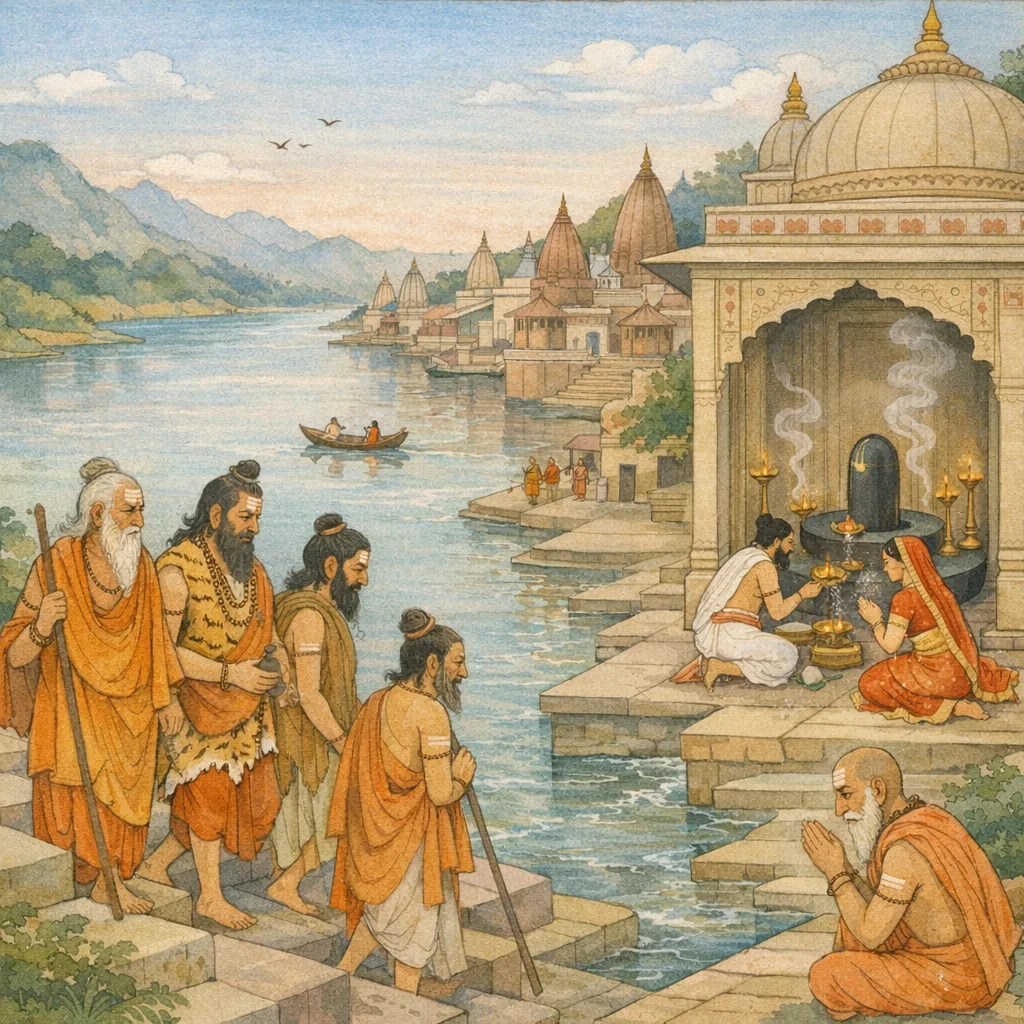
व्यासशौनकादिसंवादः | Vyāsa–Śaunaka and the Sages: Opening Dialogue of the Kailāsa-saṃhitā
Adhyāya 1 sets the textual frame of the Kailāsa-saṃhitā through a Purāṇic dialogue. It opens with a Śaiva maṅgala/namaskāra, praising Śiva as Sāmbā (with Umā), attended by gaṇas, and as the supreme cause of creation, preservation, and dissolution. A colophon-like marker names the chapter “Vyāsa–Śaunaka-ādi-saṃvāda.” The sages request the Kailāsa-saṃhitā, extol earlier narrative richness, and seek deeper understanding of Śiva-tattva; Vyāsa promises a divine exposition centered on Śiva-tattva, spoken with affectionate authority. The narrative then follows ascetic sages from the Himālaya who resolve to go to Vārāṇasī; in Kāśī they reach Maṇikarṇikā and perform ritual bathing. They proceed to darśana and worship of Viśveśa/Tridaśeśvara (Śiva as Lord of the universe and the gods), offering Vedic-style stuti akin to the Śatarudrīya, and attain a sense of completion (kṛtārthatā) through Śiva-prīti. Finally, Sūta appears within the pañcakrośa; the sages greet him and, after honoring Devadeva Umāpati, enter the Mukti-maṇḍapa together, grounding the Saṃhitā’s authority in speaker-lineage and Kāśī’s liberation-topography.
Shlokas
Verse 1
नमः शिवाय साम्बाय सगणाय ससूनवे । प्रधानपुरुषेशाय सर्गस्थितत्यन्तहेतवे
Salutations to Śiva—Sāmba, united with Ambā (the Divine Mother), attended by His gaṇas and accompanied by His son—Lord of Pradhāna (primordial Nature) and Puruṣa (conscious spirit), the ultimate cause of creation, preservation, and dissolution.
Verse 2
ऋषय ऊचुः । श्रुतोमासंहिता रम्या नानाख्यानसमन्विता । कैलाससंहिताम्ब्रूहि शिवतत्त्वविवर्द्धिनीम्
The sages said: “We have heard the delightful Śrutomā-saṃhitā, rich with many sacred narratives. Now, please expound the Kailāsa-saṃhitā—she who increases the understanding of Śiva-tattva, the true reality of Lord Śiva.”
Verse 3
व्यास उवाच । शृणुत प्रीतितो वत्साः कैलासाख्यां हि संहिताम् । शिवतत्त्वपरान्दिव्यां वक्ष्ये वः स्नेहतः पराम्
Vyāsa said: “Listen with joy, dear children, to this compilation known as the Kailāsa-saṃhitā. Divine and devoted to the supreme truth of Śiva-tattva, I shall expound it to you with affection—this highest teaching.”
Verse 4
हिमवच्छिखरे पूर्व्वं तपस्यन्तो महौजसः । वाराणसीङ्गन्तुकामा मुनयः कृतसम्विदः
Formerly, upon the peaks of the Himalayas, mighty and radiant sages were engaged in austerities (tapas). Having formed a firm resolve among themselves, those sages became desirous of going to Vārāṇasī.
Verse 5
निर्गत्य तस्मात्सम्प्राप्य गिरेः काशीं समाहिताः । स्नातव्यमेवेति तदा ददृशुर्मणिकर्णिकाम्
Departing from that place, they reached Kāśī upon the mountain, their minds composed. With the firm resolve that they must bathe, they then beheld Maṇikarṇikā, the sacred bathing place.
Verse 6
तत्र स्नात्वा सुसन्तप्य देवादीनथ जाह्नवीम् । दृष्ट्वा स्नात्वा मुनीशास्ते विश्वेशं त्रिदशेश्वरम्
There, after bathing and then performing earnest austerity, the sages beheld the river Jāhnavī (Gaṅgā), a refuge even for the gods. Having seen her, they bathed again and those lordly sages approached Viśveśa—Śiva, Lord of the worlds and sovereign of the thirty-three gods.
Verse 7
नमस्कृत्याथ सम्पूज्य भक्त्या परमयान्विताः । शतरुद्रादिभिः स्तुत्वा स्तुतिभिर्व्वेदपारगाः
Then, having bowed down and duly worshipped, filled with supreme devotion, those sages well-versed in the Vedas praised Śiva with hymns such as the Śatarudrīya and other Vedic eulogies.
Verse 8
आत्मानं मेनिरे सर्वे कृतार्था वयमित्युत । शिवप्रीत्या सुपूर्णार्थाश्शिवभक्तिरतास्सदा
All of them then considered themselves truly fulfilled, saying, “We have attained our purpose.” For by pleasing Śiva, their aims were completely accomplished, and they remained forever devoted to Śiva-bhakti.
Verse 10
तस्मिन्नवसरे सूतं पञ्चक्रोशदिदृक्षया । गत्वा समागतं वीक्ष्य मुदा ते तं ववन्दिरे । सोपि विश्वेश्वरं साक्षाद्देवदेवमुमापतिम् । नमस्कृत्याथ तैस्साकम्मुक्तिमण्डपमाविशत्
At that very time, Sūta arrived, desiring to behold the sacred region extending for five krośas. Seeing him come, they joyfully bowed to him. Sūta too—after offering reverence to Viśveśvara, the manifest Lord of the universe, the God of gods, Umā’s consort—then entered the Mukti-maṇḍapa, the Hall of Liberation, together with them.
Verse 11
तत्रासीनम्महात्मानं सूतम्पौराणिकोत्तमम् । अर्घ्यादिभिस्तदा सर्व्वे मुनयस्समुपाचरन्
There, seated in the assembly, was the great-souled Sūta—foremost among the Purāṇic narrators. Then all the sages approached and duly honored him with offerings such as arghya and other rites of reverent reception.
Verse 12
ततः सूतः प्रसन्नात्मा मुनीनालोक्य सुव्रतान् । पप्रच्छ कुशलान्तेपि प्रोचुः कुशलमात्मनः
Then Sūta, serene in heart, seeing those sages of noble vows, asked after their well-being; and they too replied that they themselves were well.
Verse 13
ते तु संहृष्टहृदयं ज्ञात्वा तं वै मुनीश्वराः । प्रणवार्थावगत्यर्थमूचुः प्रास्ताविकं वचः
But those lordly sages, perceiving that he was inwardly delighted, spoke introductory words—so that the meaning of the Praṇava (Oṃ) might be properly understood.
Verse 14
मुनय ऊचुः । व्यासशिष्य महाभाग सूत पौराणिकोत्तम । धन्यस्त्वं शिवभक्तो हि सर्वविज्ञान सागरः
The sages said: “O Sūta, illustrious disciple of Vyāsa, foremost among the Purāṇic narrators—blessed indeed are you. For you are a devotee of Śiva, truly an ocean of all sacred knowledge.”
Verse 15
भवन्तमेव भगवान्व्यासस्सर्वजगद्गुरुः । अभिषिच्य पुराणानां गुरुत्वे समयोजयत्
Bhagavān Vyāsa—the preceptor of the whole world—consecrated you alone and appointed you to the position of preeminence among the Purāṇas.
Verse 16
तस्मात्पौराणिकी विद्या भवतो हृदि संस्थिता । पुराणानि च सर्वाणि वेदार्थम्प्रवदन्ति हि
Therefore, the Purāṇic wisdom is firmly established in your heart; for indeed, all the Purāṇas proclaim the very meaning of the Vedas—revealing it in a form fit to be understood and lived, leading the soul toward Śiva, the Supreme Pati.
Verse 17
वेदाः प्रणवसम्भूताः प्रणवार्थो महेश्वरः । अतो महेश्वरस्थानं त्वयि धिष्ण्यम्प्रतिष्ठितम्
The Vedas arise from the Praṇava (Oṁ), and the true meaning of that Praṇava is Maheśvara Himself. Therefore, Maheśvara’s sacred seat—His own abode—stands established in you as His consecrated dwelling-place.
Verse 18
त्वन्मुखाब्जपरिस्यन्दन्मकरंदे मनोहरम् । प्रणवार्थामृतं पीत्वा भविष्यामो गतज्वराः
Having drunk the nectar of the meaning of the Praṇava (Oṁ)—sweet and captivating like the honey that flows from the lotus of Your mouth—we shall be free from fever, our inner torment wholly stilled.
Verse 19
विशेषतो गुरुस्त्वं हि नान्योऽस्माकं महामते । परं भावं महेशस्य परया कृपया वद
O great-souled one, you alone are truly our Guru—there is no other for us. Out of your supreme compassion, please tell us the highest inner reality of Maheśa (Lord Śiva).
Verse 20
इति तेषां वचः श्रुत्वा सूतो व्यासप्रियस्सुधीः । गणेशं षण्मुखं साक्षान्महेशानं महेश्वरीम्
Having thus heard the words of those sages, Sūta—wise and dear to Vyāsa—first bowed in reverence to Gaṇeśa and to Ṣaṇmukha, and then to Maheśāna (Lord Śiva) Himself and to Maheśvarī (Goddess Pārvatī).
Verse 21
शिलादतनयं देवं नन्दीशं सुयशापतिम् । सनत्कुमारं व्यासं च प्रणिपत्येदमब्रवीत्
Having bowed down, he spoke these words after paying reverence to the divine Nandīśa—son of Śilāda and lord of noble fame—along with Sanatkumāra and Vyāsa.
Verse 22
सूत उवाच । साधुसाधु महाभागा मुनयः क्षीणकल्मषाः । मतिर्दृढतरा जाता दुर्लभा सापि दुष्कृताम्
Sūta said: “Well done—well done, O greatly fortunate sages whose impurities have been worn away. In you a firmer spiritual resolve has arisen; such steadfast understanding is indeed rare for those burdened by evil deeds.”
Verse 23
पाराशर्येण गुरुणा नैमिषारण्यवासिनाम् । मुनीनामुपदिष्टं यद्वक्ष्ये तन्मुनिपुंगवाः
O foremost of sages, I shall now speak that very teaching which the venerable son of Parāśara imparted to the sages dwelling in Naimiṣāraṇya.
Verse 24
यस्य श्रवणमात्रेण शिवभक्तिर्भवेन्नृणाम् । सावधाना भवन्तोद्य शृण्वन्तु परया मुदा
By merely hearing this sacred account, devotion to Lord Śiva arises in people. Therefore, all of you, be attentive today and listen with supreme joy.
Verse 25
स्वारोचिषेन्तरे पूर्वं तपस्यंतो दृढव्रताः । ऋषयो नैमिषारण्ये सर्वसिद्धनिषेविते
In the ancient time, in the Svārociṣa Manvantara, steadfast sages—firm in their vows—were performing tapas in the Naimiṣa forest, a holy place frequented by all perfected beings.
Verse 26
दीर्घसत्रं वितन्वन्तो रुद्रमध्वरनायकम् । प्रीणयन्तः परं भावमैश्वर्य्यं ज्ञातुमिच्छवः
Wishing to know the supreme sovereignty (aiśvarya), they prolonged a great sacrificial session, appointing Rudra as the presiding Lord of the rite; and with the highest inner devotion they sought to delight Him.
Verse 27
निवसन्ति स्म ते सर्वे व्यासदर्शनकांक्षिणः । शिवभक्तिरता नित्यं भस्मरुद्राक्षधारिणः
All of them dwelt there, yearning for the darśana of Vyāsa; ever absorbed in bhakti to Śiva, they continually wore bhasma (sacred ash) and Rudrākṣa beads.
Verse 28
तेषां भावं समालोक्य भगवान्बादरायणः । प्रादुर्बभूव सर्वात्मा पराशरतपःफलम्
Seeing the inner disposition of those seekers, the Blessed Bādarāyaṇa—indwelling Self of all—manifested; he appeared as the fruit of Parāśara’s austerities.
Verse 29
तं दृष्ट्वा मुनयस्सर्वे प्रहृष्टवदनेक्षणाः । अभ्युत्थानादिभिस्सर्वैरुपचारैरुपाचरन्
Seeing him, all the sages—faces and eyes bright with joy—rose up and honored him with every courtesy, beginning with standing to receive him and other respectful services.
Verse 30
सत्कृत्य प्रददुस्तस्मै सौवर्णं विष्टरं शुभम् । सुखोपविष्टः स तदा तस्मिन्सौवर्णविष्टरे । प्राह गंभीरया वाचा पाराशर्य्यो महामुनिः
Having duly honored him, they offered him an auspicious golden seat. Seated at ease upon that golden throne, the great sage Pārāśarya then spoke in a deep and steady voice.
Verse 31
व्यास उवाच । कुशलं किं नु युष्माकम्प्रब्रूतास्मिन्महामखे । अर्चितं किं नु युष्माभिस्सम्यगध्वरनायकः
Vyāsa said: “Tell me—are you all well in this great sacrifice? And has the Lord, the presiding Master of this sacred rite, been properly worshipped by you?”
Verse 32
किमर्थमत्र युष्माभिरध्वरे परमेश्वरः । स्वर्चितो भक्तिभावेन साम्बस्संसारमोचकः
“For what purpose, in this sacrifice, have you worshipped the Supreme Lord—Sāmba (Śiva united with Umā)—with a spirit of devotion, He who is the liberator from saṃsāra?”
Verse 33
युष्मत्प्रवृत्तिर्मे भाति शुश्रूषा पूर्वमेव हि । परभावे महेशस्य मुक्तिहेतोश्शिवस्य च
Your present conduct appears to me as service and attentive devotion, existing indeed from former births. For through such higher-oriented devotion to Maheśa—Śiva, the very cause of liberation—one attains release.
Verse 34
एवमुक्ता मुनीन्द्रेण व्यासेनामिततेजसा । मुनयो नैमिषारण्यवासिनः परमौजसः
Thus addressed by the lord among sages—Vyāsa of immeasurable spiritual splendor—the supremely vigorous sages dwelling in Naimiṣāraṇya listened attentively and prepared to respond.
Verse 35
प्रणिपत्य महात्मानं पाराशशर्य्यं महामुनिम् । शिवानुरागसंहृष्टमानसं च तमब्रुवन्
Having bowed down in reverence to that great-souled sage, the mighty seer Pārāśarya, whose mind was gladdened through loving devotion to Śiva, they then addressed him.
Verse 36
मुनय ऊचुः । भगवन्मुनिशार्दूल साक्षान्नारायणांशज । कृपानिधे महाप्राज्ञ सर्वविद्याधिप प्रभो
The sages said: “O revered one—tiger among sages—manifestly born of a portion of Nārāyaṇa! O ocean of compassion, O greatly wise one, O Lord, master of all branches of knowledge!”
Verse 37
त्वं हि सर्वजगद्भर्तुर्महा देवस्य वेधसः । साम्बस्य सगणस्यास्य प्रसादानां निधिस्स्वयम्
Indeed, you are yourself the very treasury of the gracious boons of that Great God—the Creator and Sustainer of the entire world—Śambhu, who is ever attended by his gaṇas.
Verse 38
त्वत्पादाब्जरसास्वादमधुपायितमानसाः । कृतार्था वयमद्यैव भवत्पादाब्जदर्शनात्
Our minds, made like honey by tasting the nectar of Your lotus-feet, are fulfilled. Truly, today itself we have attained our purpose, simply by beholding Your lotus-feet.
Verse 39
त्वदीयचरणाम्भोजदर्शनं खलु पापिनाम् । दुर्लभं लब्धमस्माभिस्त्वस्मात्सुकृतिनो वयम्
Truly, for sinners the vision of Your lotus-feet is hard to attain. Yet we have obtained it; therefore, because of You, we are indeed meritorious and blessed.
Verse 40
अस्मिन्देशे महाभाग नैमिषारण्यसंज्ञके । दीर्घसत्रान्वितास्सर्वे प्रणवार्थप्रकाशकाः
O noble one, in this land known as Naimiṣāraṇya, they all are engaged in long sacrificial sessions, illuminating the inner meaning of the sacred syllable Oṁ (Praṇava).
Verse 41
श्रोतव्यः परमेशान इति कृत्वा विनिश्चिताः । परस्परं चिन्तयन्तः परं भावं महेशितु
Having firmly concluded, “Parameśāna, the Supreme Lord, must indeed be listened to,” they reflected together—mutually contemplating the highest state and inner intent of Mahādeva.
Verse 42
अज्ञातवन्त एवैते वयं तस्माद्भवान्प्रभो । छेत्तुमर्हति तान्सर्वान्संशयानल्पचेतसाम्
Truly we are people without real understanding; therefore, O Lord, you alone should cut away all these doubts of ours—doubts arising in minds of limited discernment.
Verse 43
त्वदन्यः संशयस्यास्यच्छेत्ता न हि जगत्त्रये । तस्मादपारगंभीरव्यामोहाब्धौ निमज्जतः
Other than You, there is no one in the three worlds who can cut through this doubt. Therefore, sinking into the shoreless, deep ocean of delusion, I seek refuge in You.
Verse 44
तारयस्व शिवज्ञानपोतेनास्मान्दयानिधे । शिवसद्भक्तितत्त्वार्थं ज्ञातुं श्रद्धालवो वयम्
O ocean of compassion, ferry us across by the boat of Śiva-knowledge. We are faithful seekers, longing to know the true meaning and inner purport of genuine devotion to Śiva.
Verse 45
एवमभ्यर्थितस्त मुनिभिर्वेदपारगैः । सर्ववेदार्थविन्मुख्यः शुकतातो महामुनिः । वेदान्तसारसर्वस्वं प्रणवं परमेश्वरम्
Thus entreated by sages who had crossed to the far shore of the Vedas, the great sage—Śuka’s father, foremost among those who know the meaning of all the Vedas—began to expound the Praṇava, the supreme Lord Parameśvara, who is the quintessence and the all-in-all of the essence of Vedānta.
Verse 46
ध्यात्वा हृत्कर्णिकामध्ये साम्बं संसारमोचकम् । प्रहृष्टमानसो भूत्वा व्याजहार महामुनि
Having meditated upon Sāmba—Śiva united with Śakti—abiding in the lotus of the heart, the Liberator from worldly bondage, the great sage became filled with joy and then began to speak.
Frequently Asked Questions
Rather than a single mythic ‘leelā,’ the chapter’s primary argument is structural and theological: it authorizes the Kailāsa-saṃhitā by establishing a dialogue lineage (sages → Vyāsa → Sūta context) and by grounding Śiva’s supremacy as the causal principle of sarga-sthiti-laya, validated through Kāśī-based ritual encounter.
They encode liberation as ‘mapped’ sacred space: Maṇikarṇikā functions as a purification-and-transition node (snāna + darśana), pañcakrośa signals the bounded sacred jurisdiction of Kāśī, and the Mukti-maṇḍapa symbolizes institutionalized salvation discourse—where correct praise, worship, and teaching converge into a formal soteriological gateway.
Śiva appears as Sāmbā/Umāpati (relational completeness with Umā), Viśveśa (cosmic lordship), and Tridaśeśvara (sovereignty over the devas). Together these titles link metaphysics (supreme cause) to ritual accessibility (worship-worthy Lord encountered in Kāśī).