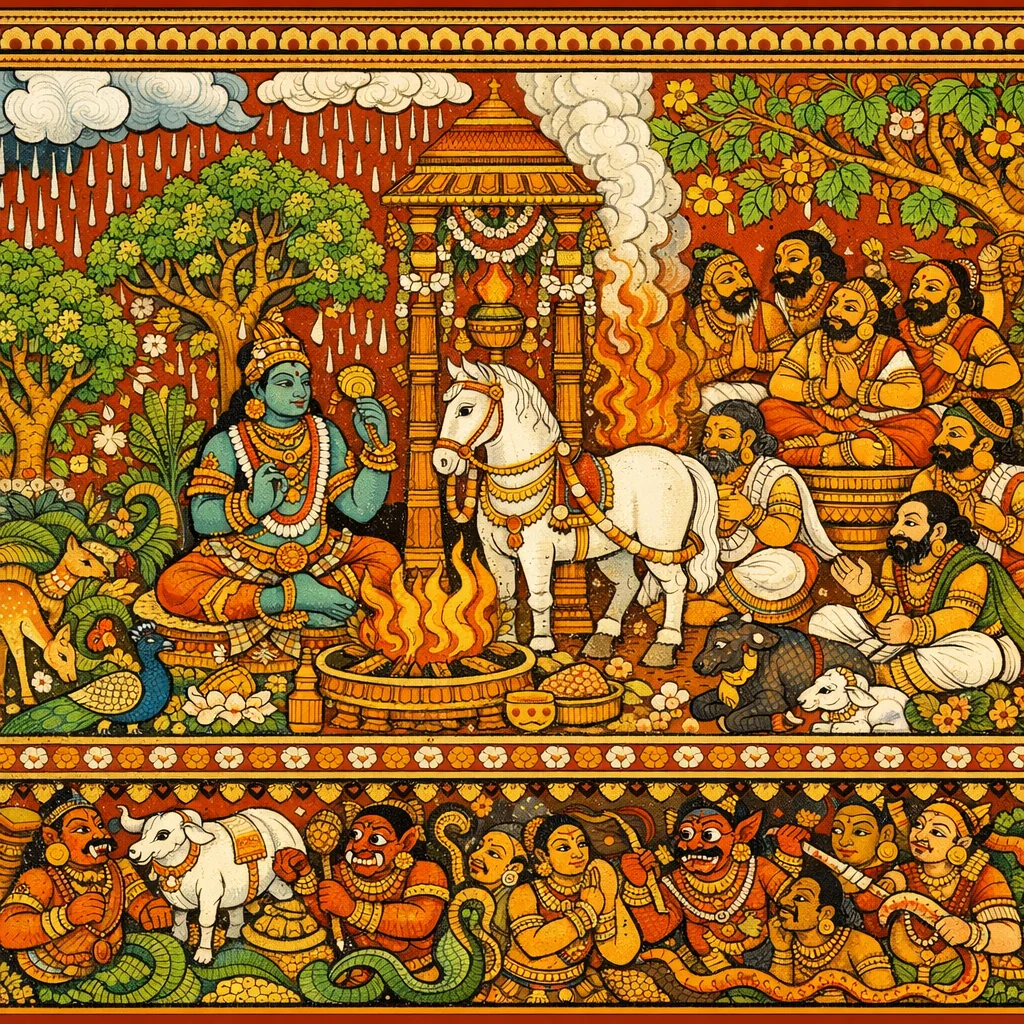
Adhyaya 143: The Origin of Yajña in Tretā Yuga and the Debate on Animal Sacrifice vs. Non-violence
यज्ञप्रवर्तन-विवादः (हिंसायज्ञ-निषेधः)
Speaker: Ṛṣis, Sūta, Indra (Viśvabhuk), King Vasu (Khacara; Auttānapāda line)
The ṛṣis ask how yajña was first “set in motion” at the dawn of Tretāyuga, echoing the precedent of the Svāyambhuva Manvantara. Sūta describes the world’s cosmic and social readiness (the end of Kṛta and the onset of Kāla; herbs, rains, vārttā; the varṇa–āśrama order; the arrangement of the Saṃhitās) and tells how Indra inaugurated sacrifice with correct mantras, performing an Aśvamedha attended by sages and officiants. During the rite, some sages object to the implied violence, calling it adharma and urging a śāstra-grounded dharma. A formal dispute follows: should offerings be jangama (living beings) or sthāvara (plants)? The assembly consults King Vasu, who rules that yajña inherently entails hiṃsā and that both animal and plant offerings may be valid when duly offered; he challenges the sages to stand by their own mantra-authority. The sages, deeming him bound to inevitability, curse him and he falls to Rasātala. The chapter concludes that dharma is subtle and multi-streamed, requiring the authority of gods, sages, and Manu; non-violent yajña and tapas-based virtues lead to heaven and higher states, and tapas is proclaimed superior to yajña as the root of creation and the paths to liberation.
Key Concepts
Shlokas in Adhyaya 143
Verse 1
*ऋषय ऊचुः कथं त्रेतायुगमुखे यज्ञस्यासीत्प्रवर्तनम् पूर्वे स्वायम्भुवे सर्गे यथावत्प्रब्रवीहि नः //
The sages said: “How, at the very beginning of the Tretā Yuga, was the institution of sacrifice (yajña) set in motion? Explain it to us properly, just as it occurred in the earlier creation of Svāyambhuva (Manu).”
Verse 2
अन्तर्हितायां संध्यायां सार्धं कृतयुगेन हि कालाख्यायां प्रवृत्तायां प्राप्ते त्रेतायुगे तदा //
When the twilight-junction (saṃdhyā) had disappeared along with the Kṛta Yuga, and the phase called “Kāla” had begun to operate, then the Tretā Yuga was attained.
Verse 3
ओषधीषु च जातासु प्रवृत्ते वृष्टिसर्जने प्रतिष्ठितायां वार्त्तायां ग्रामेषु च पुरेषु च //
When medicinal herbs and plants had sprung forth, when the sending of rains had begun, and when vārttā—the livelihood based on agriculture and trade—had become established, both in villages and in cities.
Verse 4
वर्णाश्रमप्रतिष्ठानं कृत्वा मन्त्रैश्च तैः पुनः संहितास्तु सुसंहृत्य कथं यज्ञः प्रवर्तितः एतच्छ्रुत्वाब्रवीत्सूतः श्रूयतां तत्प्रचोदितम् //
After establishing the proper order of the varṇas and āśramas, and again applying those mantras, and having carefully compiled and arranged the Saṃhitās—how, then, was the sacrifice (yajña) set in motion? Hearing this, Sūta said: “Listen to what is prompted by that inquiry.”
Verse 5
*सूत उवाच मन्त्रान्वै योजयित्वा तु इहामुत्र च कर्मसु तथा विश्वभुगिन्द्रस्तु यज्ञं प्रावर्तयत्प्रभुः //
Sūta said: Having duly applied the mantras to ritual acts—both for this world and the next—Viśvabhuk, the lord of the gods (Indra), then set the sacrifice (yajña) in motion.
Verse 6
दैवतैः सह संहृत्य सर्वसाधनसंवृतः तस्याश्वमेधे वितते समाजग्मुर्महर्षयः //
Having gathered all requisites together along with the deities, and being fully furnished with every means and implement, when his Aśvamedha sacrifice was set in motion, the great sages assembled there.
Verse 7
यज्ञकर्मण्यवर्तन्त कर्मण्यग्रे तथर्त्विजः हूयमाने देवहोत्रे अग्नौ बहुविधं हविः //
The priests (ṛtvij) were fully engaged in the sacrificial rite, standing at the forefront of the ritual acts; and as oblations (havis) were poured into the fire—consecrated for the gods—many kinds of offerings were made.
Verse 8
सम्प्रतीतेषु देवेषु सामगेषु च सुस्वरम् परिक्रान्तेषु लघुषु अध्वर्युपुरुषेषु च //
When the deities have been duly invoked, when the Sāma-chanters (sāmaga) sing with a clear and auspicious tone, and when the swift-moving officiants—especially the Adhvaryu priests—make their rounds and perform their duties around the altar, the rite proceeds in its proper order.
Verse 9
आलब्धेषु च मध्ये तु तथा पशुगणेषु वै आहूतेषु च देवेषु यज्ञभुक्षु ततस्तदा //
And at that time—when the offerings had been duly taken up, when the animals intended for the rite had been arranged in proper order, and when the gods, the enjoyers of the sacrifice, had been invoked—then the ritual proceeded further according to rule.
Verse 10
य इन्द्रियात्मका देवा यज्ञभागभुजस्तु ते तान्यजन्ति तदा देवाः कल्यादिषु भवन्ति ये //
Those deities who are of the very nature of the senses, and who partake of their allotted share in the yajña—when duly worshipped, those very deities become manifest in the worshipper’s life as auspicious powers and the like.
Verse 11
अध्वर्युप्रैषकाले तु व्युत्थिता ऋषयस्तथा महर्षयश्च तान्दृष्ट्वा दीनान्पशुगणांस्तदा विश्वभुजं ते त्वपृच्छन् कथं यज्ञविधिस्तव //
But when the Adhvaryu gave the ritual signal, the ṛṣis and great seers rose. Seeing the herds of sacrificial animals then in a pitiable state, they questioned Viśvabhuj: “How is your procedure of sacrifice to be carried out?”
Verse 12
अधर्मो बलवानेष हिंसा धर्मेप्सया तव नवः पशुविधिस्त्विष्टस् तव यज्ञे सुरोत्तम //
This violence is powerful indeed—and it is adharma. Yet, seeking what you think is “dharma,” you have devised a new rule for animal-offering in your sacrifice, O best of the gods.
Verse 13
अधर्मो धर्मघाताय प्रारब्धः पशुभिस्त्वया नायं धर्मो ह्यधर्मो ऽयं न हिंसा धर्म उच्यते आगमेन भवान्धर्मं प्रकरोतु यदीच्छति //
This is adharma, begun by you through animals—through their killing—for the very destruction of dharma. This is not dharma; indeed, it is adharma. Violence is not called dharma. If you truly wish, establish dharma in accordance with the Āgamas, the authoritative scriptures.
Verse 14
विधिदृष्टेन यज्ञेन धर्मेणाव्यसनेन तु यज्ञबीजैः सुरश्रेष्ठ त्रिवर्गपरिमोषितैः //
O best of the gods, by a yajña performed according to the ordained rule—through dharma and a life free from vice—and by employing the “seeds of sacrifice,” namely the proper ritual means that secure the three aims of life, one attains the full fruit of dharma, artha, and kāma.
Verse 15
एष यज्ञो महानिन्द्रः स्वयम्भुविहितः पुरा एवं विश्वभुगिन्द्रस्तु ऋषिभिस्तत्त्वदर्शिभिः उक्तो न प्रतिजग्राह मानमोहसमन्वितः //
“This yajña is the great ‘Indra’—a sovereign and exalted rite—ordained long ago by Svayambhū (Brahmā). Yet Viśvabhuk Indra, though thus addressed by seers who beheld the truth, did not accept their counsel, being overcome by pride and delusion.”
Verse 16
तेषां विवादः सुमहाञ् जज्ञे इन्द्रमहर्षीणाम् जङ्गमैः स्थावरैः केन यष्टव्यमिति चोच्यते //
A very great dispute arose among them—among Indra and the great sages—about whether sacrifice should be performed with moving (living) offerings or with stationary (plant-based) offerings; and it was asked, “By which is one to sacrifice?”
Verse 17
ते तु खिन्ना विवादेन शक्त्या युक्ता महर्षयः संधाय सममिन्द्रेण पप्रच्छुः खचरं वसुम् //
But those great sages—wearied by the dispute yet endowed with spiritual power—having conferred together along with Indra, questioned Vasu, who moved through the sky.
Verse 18
*ऋषय ऊचुः महाप्राज्ञ त्वया दृष्टः कथं यज्ञविधिर्नृप औत्तानपादे प्रब्रूहि संशयं नस्तुद प्रभो //
The sages said: “O greatly wise one, O king—how did you see and come to know the procedure of sacrifice (yajña-vidhi) in the line of Auttānapāda? O Lord, explain it to us; remove the doubt that troubles us.”
Verse 19
*सूत उवाच श्रुत्वा वाक्यं वसुस्तेषाम् अविचार्य बलाबलम् वेदशास्त्रमनुस्मृत्य यज्ञतत्त्वमुवाच ह //
Sūta said: Hearing the words of those Vasus, and without weighing their strength or weakness, he recalled the Veda and the śāstras and then expounded the true principle of sacrifice (yajña-tattva).
Verse 20
यथोपनीतैर्यष्टव्यम् इति होवाच पार्थिवः यष्टव्यं पशुभिर्मेध्यैर् अथ मूलफलैरपि //
The king said: “One should perform the sacrifice with whatever has been duly brought and presented. The rite may be carried out with pure (fit-for-sacrifice) animals, and also, when appropriate, with roots and fruits.”
Verse 21
हिंसा स्वभावो यज्ञस्य इति मे दर्शनागमः तथैते भाविता मन्त्रा हिंसालिङ्गा महर्षिभिः //
“Violence is intrinsic to sacrifice”—such is the doctrine I have received through my tradition of teaching. Accordingly, the great sages have also formulated these mantras so that they bear the mark (indication) of violence.
Verse 22
दीर्घेण तपसा युक्तैस् तारकादिनिदर्शिभिः तत्प्रमाणं मया चोक्तं तस्माच्छमितुम् अर्हथ //
Endowed with long austerities and skilled in observing signs such as the stars, I have stated that authoritative standard of measurement; therefore, you should now be at peace (and let the matter rest).
Verse 23
यदि प्रमाणं स्वान्येव मन्त्रवाक्याणि वो द्विजाः तथा प्रवर्ततां यज्ञो ह्य् अन्यथा मानृतं वचः //
If, O twice-born, your own mantra-statements are indeed the valid authority, then let the sacrifice proceed accordingly; for otherwise your speech would amount to falsehood.
Verse 24
एवं कृतोत्तरास्ते तु युज्यात्मानं ततो धिया अवश्यम्भाविनं दृष्ट्वा तमधो ह्यशपंस्तदा //
Thus, having given their reply, they composed their minds with discernment; but seeing him as one bound to the inevitability of fate, they then cursed him to fall down to a lower state.
Verse 25
इत्युक्तमात्रो नृपतिः प्रविवेश रसातलम् ऊर्ध्वचारी नृपो भूत्वा रसातलचरो ऽभवत् //
No sooner had this been spoken than the king entered Rasātala. Though becoming a ruler able to move upward at will, he became one who roamed through Rasātala, the nether regions.
Verse 26
वसुधातलचारी तु तेन वाक्येन सो ऽभवत् धर्माणां संशयछेत्ता राजा वसुरधोगतः //
By that statement, he became one who moved upon the surface of the earth; King Vasu became a remover of doubts concerning dharma—yet Vasu went downward to the lower realms.
Verse 27
तस्मान्न वाच्यो ह्येकेन बहुज्ञेनापि संशयः बहुधारस्य धर्मस्य सूक्ष्मा दुरनुगा गतिः //
Therefore, even a very learned person should not try to settle a doubt all by himself; for the course of dharma, which runs in many streams, is subtle and difficult to follow.
Verse 28
तस्मान्न निश्चयाद्वक्तुं धर्मः शक्यो हि केनचित् देवानृषीनुपादाय स्वायम्भुवमृते मनुम् //
Therefore, no one can definitively declare what dharma is—unless one takes as authority the gods and the sages, and above all Manu Svāyambhuva.
Verse 29
तस्मान्न हिंसा यज्ञे स्याद् यदुक्तमृषिभिः पुरा ऋषिकोटिसहस्राणि स्वैस्तपोभिर्दिवं गताः //
Therefore, in a yajña there should be no violence—so it was proclaimed by the sages of old; for countless crores and thousands of ṛṣis attained heaven through their own tapas (austerity).
Verse 30
तस्मान्न हिंसायज्ञं च प्रशंसन्ति महर्षयः उञ्छं मूलं फलं शाकम् उदपात्रं तपोधनाः //
Therefore the great ṛṣis—rich in tapas—commend yajñas free from violence, and also the ascetic’s simple supports: gleaned grains (uñcha), roots, fruits, vegetables, and a single water-vessel.
Verse 31
एतद्दत्त्वा विभवतः स्वर्गलोके प्रतिष्ठिताः अद्रोहश्चाप्यलोभश्च दमो भूतदया शमः //
Having given this according to one’s means, they become firmly established in the heavenly world. Non-malice, freedom from greed, self-restraint, compassion toward all beings, and inner calm—these are the virtues that uphold that state.
Verse 32
ब्रह्मचर्यं तपः शौचम् अनुक्रोशं क्षमा धृतिः सनातनस्य धर्मस्य मूलमेव दुरासदम् //
Brahmacarya (celibate self-restraint), tapas (austerity), purity, compassion, forgiveness, and steadfastness—these alone are the difficult-to-attain root of Sanātana Dharma.
Verse 33
द्रव्यमन्त्रात्मको यज्ञस् तपश्च समतात्मकम् यज्ञैश्च देवानाप्नोति वैराजं तपसा पुनः //
Yajña is constituted of offerings (dravya) and mantras, while tapas is constituted of equanimity (samatā). By yajñas one attains the gods; but by tapas one again attains the Vairāja state—the cosmic station akin to Brahmā.
Verse 34
ब्रह्मणः कर्मसंन्यासाद् वैराग्यात्प्रकृतेर्लयम् ज्ञानात्प्राप्नोति कैवल्यं पञ्चैता गतयः स्मृताः //
Through renunciation of action (karma-saṃnyāsa) one attains Brahman; through dispassion (vairāgya) one attains dissolution into Prakṛti; through knowledge (jñāna) one attains Kaivalya. These five courses (gati) are remembered in the tradition.
Verse 35
एवं विवादः सुमहान् यज्ञस्यासीत्प्रवर्तने ऋषीणां देवतानां च पूर्वे स्वायम्भुवे ऽन्तरे //
Thus, a very great dispute arose between the sages (ṛṣi) and the gods concerning the commencement of the sacrifice (yajña), in the former Svāyambhuva Manvantara.
Verse 36
ततस्ते ऋषयो दृष्ट्वा हृतं धर्मं बलेन तु वसोर्वाक्यमनादृत्य जग्मुस्ते वै यथागतम् //
Then the sages, seeing that dharma had been seized by sheer force, disregarded Vasu’s words and departed, returning by the very way they had come.
Verse 37
गतेषु ऋषिसंघेषु देवा यज्ञमवाप्नुयुः श्रूयन्ते हि तपःसिद्धा ब्रह्मक्षत्रादयो नृपाः //
When the assemblies of seers had departed, the gods obtained their share of the sacrifice (yajña). Indeed, it is heard that there were kings—beginning with the Brahma-kṣatriyas—who became perfected through austerity (tapas).
Verse 38
प्रियव्रतोत्तानपादौ ध्रुवो मेधातिथिर्वसुः सुधामा विरजाश्चैव शङ्खपाद्राजसस्तथा //
Priyavrata and Uttānapāda; Dhruva; Medhātithi; Vasu; Sudhāmā; Virajā; and also Śaṅkhapāda and Rājasa—these are enumerated in this lineage.
Verse 39
प्राचीनबर्हिः पर्जन्यो हविर्धानादयो नृपाः एते चान्ये च बहवस् ते तपोभिर्दिवं गताः //
King Prācīnabarhi, King Parjanya, Havirdhāna and others—these rulers, and many more besides, attained heaven through the power of their austerities (tapas).
Verse 40
राजर्षयो महात्मानो येषां कीर्तिः प्रतिष्ठिता तस्माद्विशिष्यते यज्ञात् तपः सर्वैस्तु कारणैः //
Those royal sages—great-souled men—whose fame stands firmly established: therefore, for every reason, austerity (tapas) is held to excel even sacrifice (yajña).
Verse 41
ब्रह्मणा तपसा सृष्टं जगद्विश्वमिदं पुरा तस्मान्नाप्नोति तद्यज्ञात् तपोमूलमिदं स्मृतम् //
In ancient times Brahmā created this entire universe through austerity (tapas). Therefore, that supreme attainment is not gained merely by sacrifice (yajña); it is remembered that all this has austerity as its very root.
Verse 42
यज्ञप्रवर्तनं ह्येवम् आसीत्स्वायम्भुवे ऽन्तरे तदाप्रभृति यज्ञो ऽयं युगैः सार्धं प्रवर्तितः //
Thus, the establishment of sacrificial worship (yajña) took place in the Svāyambhuva Manvantara; from that time onward, this yajña has continued to be carried on, age after age.
Frequently Asked Questions
The chapter teaches that while yajña was inaugurated with full Vedic procedure at the dawn of Tretāyuga, dharma cannot be reduced to forceful custom: violence in sacrifice is challenged as adharma, dharma is subtle and must be grounded in recognized authority (gods, sages, Manu), and non-violent sacrifice together with tapas and virtues like compassion, self-restraint, and inner calm is praised—tapas ultimately being declared superior to yajña.
This adhyāya is primarily Dharma/ritual-ethics (yajña-vidhi, ahiṃsā, authority in deciding dharma). It includes Puranic genealogy by referencing King Vasu and the Auttānapāda line and listing royal sages (Priyavrata, Uttānapāda, Dhruva, etc.). It does not teach Vastu-śāstra or temple dimensions in this chapter.
It links yajña’s beginning to the post-Kṛtayuga transition: Kāla begins operating, herbs and rains appear, vārttā (agrarian-trade livelihood) becomes established, and varṇa–āśrama order and Saṃhitās/mantras are arranged—after which Indra (Viśvabhuk) sets yajña in motion, exemplified by an Aśvamedha with proper priestly roles and chants.
The dispute is whether yajña should be performed with jangama (living/animal offerings) or sthāvara (plant-based offerings). The sages argue that violence is not dharma and promote non-violent offerings; King Vasu asserts that violence is intrinsic to yajña and that both animal and plant offerings can be valid when duly presented.
After Vasu authoritatively defends a model of yajña that includes hiṃsā and challenges the sages to uphold their mantra-based authority, the sages judge him as ‘avashyaṃ-bhāvin’ (bound to inevitability) and curse him; he immediately descends to Rasātala, becoming a ruler/roamer there.
No. It acknowledges yajña’s ritual power (yajña leads to the gods) but elevates tapas as a higher root-principle (tapas leads to the Vairāja state and is said to be the basis of creation itself). The chapter’s thrust is ethical purification of dharma—praising non-violent sacrifice and ascetic virtues—rather than abolishing yajña.