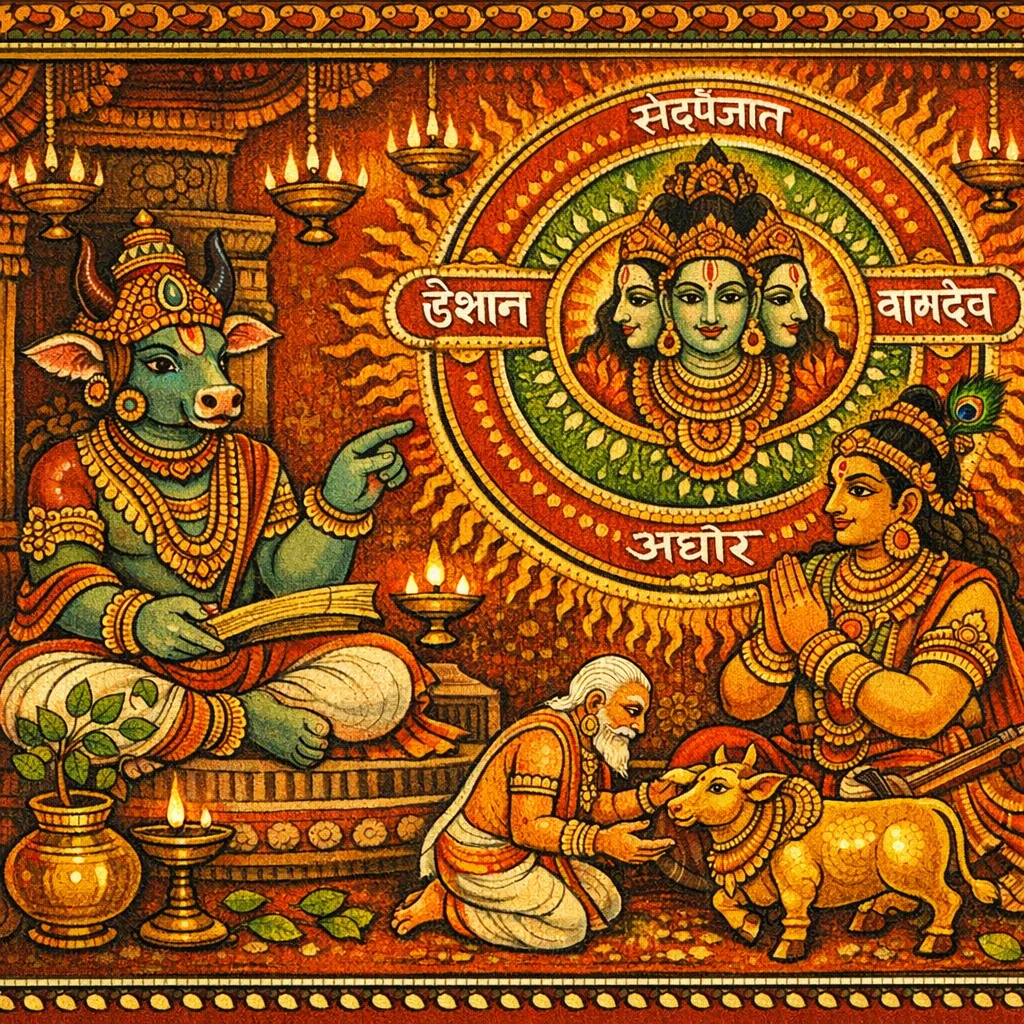
Adhyaya 95: The Maheshvara Vow: Śiva-Caturdaśī Vrata (Fourteenth-Day Observance for Śiva)
शिवचतुर्दशी-माहेश्वरव्रतवर्णनम्
Speaker: Nārada, Śambhu (Śiva), Nandikeśvara (Nandī), Matsya (narrator)
Nārada asks Śiva to repeat a teaching that grants both worldly benefit and liberation. Śiva extols Nandī as a master of sacred speech and Purāṇic learning, declares him Dharma in the form of a bull, and appoints him to teach the Māheśvara dharmas; then Śiva vanishes. Nārada approaches Nandikeśvara and requests the Māheśvara vow. Nandī explains the Śiva-caturdaśī observance: the preparatory day with a single meal, the fasting day with Śiva–Umā pūjā, nyāsa and limb-epithet worship, and the concluding gifts—especially a golden bull—along with Brahmin hospitality, sleeping on the ground, and repeating the rite on kṛṣṇa-caturdaśī as well. He adds month-by-month mantras, prescribed ritual ingestibles and floral offerings, special Kārttika charities, rules for worthy recipients (guru/śrotriya), and the vast phala: destruction of grave sins, long life and health, heavenly gaṇa-status, and final union with Śiva’s supreme abode. Hearing or reciting it also yields merit, and devoted women may perform it with proper consent.
Key Concepts
Shlokas in Adhyaya 95
Verse 1
*नारद उवाच भगवन्भूतभव्येश तथान्यदपि यच्छ्रुतम् भुक्तिमुक्तिफलायालं तत्पुनर् वक्तुमर्हसि //
Narada said: O Blessed Lord, O Ruler of what has been and what is to come—whatever else I have heard from you, fully capable of granting the fruits of worldly enjoyment and liberation, please be pleased to speak of that again.
Verse 2
एवमुक्तो ऽब्रवीच्छम्भुर् अयं वाङ्मयपारगः मत्समस्तपसा ब्रह्मन् पुराणश्रुतिविस्तरैः //
Thus addressed, Śambhu replied: “O Brahman, this one is a master of sacred speech and literature, equal to me in the full range of austerities, and expansive in his knowledge of the Purāṇic tradition and scriptural recitation.”
Verse 3
धर्मो ऽयं वृषरूपेण नन्दी नाम गणाधिपः धर्मान्माहेश्वरान् वक्ष्यत् यतःप्रभृति नारद //
This very Dharma, taking the form of a bull, is Nandī, the lord of Śiva’s attendants. From this point onward, O Nārada, he will expound the Maheśvara-dharmas—the duties and observances pertaining to Lord Maheśvara.
Verse 4
*मत्स्य उवाच इत्युक्त्वा देवदेवेशस् तत्रैवान्तरधीयत नारदो ऽपि हि शुश्रूषुर् अपृच्छन्नन्दिकेश्वरम् आदिष्टस्त्वं शिवेनेह वद माहेश्वरं व्रतम् //
Matsya said: Having spoken thus, the Lord of the gods vanished right there. Then Nārada too, eager to serve and to learn, questioned Nandikeśvara: “You have been commissioned here by Śiva—therefore, tell me about the Māheśvara vow.”
Verse 5
*नन्दिकेश्वर उवाच शृणुष्वावहितो ब्रह्मन् वक्ष्ये माहेश्वरं व्रतम् त्रिषु लोकेषु विख्याता नाम्ना शिवचतुर्दशी //
Nandikeśvara said: “Listen attentively, O Brahman; I shall explain the Māheśvara vow. It is renowned throughout the three worlds by the name ‘Śiva-caturdaśī’—the fourteenth day sacred to Śiva.”
Verse 6
मार्गशीर्षत्रयोदश्यां सितायामेकभोजनः प्रार्थयेद्देवदेवेशं त्वामहं शरणं गतः //
On the bright (waxing) thirteenth day (Trayodaśī) of Mārgaśīrṣa, taking only a single meal, one should pray to the Lord of gods: “You are my refuge; to you I have surrendered.”
Verse 7
चतुर्दश्यां निराहारः सम्यगभ्यर्च्य शंकरम् सुवर्णवृषभं दत्त्वा भोक्ष्यामि च परे ऽहनि //
On the fourteenth lunar day, fasting without food, having duly worshipped Śaṅkara (Śiva), I shall give a golden bull as a gift, and then I shall eat on the following day.
Verse 8
एवं नियमकृत्सुप्त्वा प्रातरुत्थाय मानवः कृतस्नानजपःपश्चाद् उमया सह शंकरम् पूजयेत्कमलैः शुभ्रैर् गन्धमाल्यानुलेपनैः //
Thus, having slept after observing the prescribed restraints, a person should rise at dawn; and, after bathing and performing japa, he should then worship Śaṅkara together with Umā using white lotuses, fragrances, garlands, and unguents.
Verse 9
पादौ नमः शिवायेति शिरः सर्वात्मने नमः त्रिनेत्रायेति नेत्राणि ललाटं हरये नमः //
To the feet: “obeisance to Śiva.” To the head: “obeisance to the All-Self.” To the eyes: “obeisance to the Three-eyed One.” To the forehead: “obeisance to Hara.”
Verse 10
मुखमिन्दुमुखायेति श्रीकण्ठायेति कंधराम् सद्योजाताय कर्णौ तु वामदेवाय वै भुजौ //
One should assign (by nyāsa) the face to Indumukha; the neck to Śrīkaṇṭha; the ears to Sadyojāta; and the arms to Vāmadeva.
Verse 11
अघोरहृदयायेति हृदयं चाभिपूजयेत् स्तनौ तत्पुरुषायेति तथेशानाय चोदरम् //
Reciting “(obeisance) to Aghora—(the) Heart,” one should worship (touch and consecrate) the heart; reciting “(obeisance) to Tatpuruṣa,” one should (consecrate) the two breasts; and likewise, reciting “(obeisance) to Īśāna,” one should (consecrate) the abdomen.
Verse 12
पार्श्वौ चानन्तधर्माय ज्ञानभूताय वै कटिम् ऊरू चानन्तवैराग्यसिंहायेत्यभिपूजयेत् //
One should worship the Lord’s two sides as Infinite Dharma; the waist as the very embodiment of Knowledge (Jñāna); and the thighs as the lion-like power of Infinite Dispassion (Vairāgya).
Verse 13
अनन्तैश्वर्यनाथाय जानुनी चार्चयेद्बुधः प्रधानाय नमो जङ्घे गुल्फौ व्योमात्मने नमः //
A wise worshipper should adore the knees as belonging to the Lord of endless sovereignty. Salutation to the shanks as Pradhāna (the primordial principle); and salutation to the ankles as the One whose essence is the sky, the all-pervading ether.
Verse 14
व्योमकेशात्मरूपाय केशान्पृष्ठं च पूजयेत् नमः पुष्ट्यै नमस्तुष्ट्यै पार्वतीं चापि पूजयेत् //
One should worship the hair and the back as the very form of Vyomakeśa. Saying, “Homage to Puṣṭi; homage to Tuṣṭi,” one should also worship Pārvatī.
Verse 15
ततस्तु वृषभं हैमम् उदकुम्भसमन्वितम् शुक्लमाल्याम्बरधरं पञ्चरत्नसमन्वितम् भक्ष्यैर्नानाविधैर्युक्तं ब्राह्मणाय निवेदयेत् //
Then one should present to a Brāhmaṇa a golden bull, accompanied by a water-pot, adorned with white garlands and white garments, furnished with the five gems, and supplied with various kinds of food offerings.
Verse 16
प्रीयतां देवदेवो ऽत्र सद्योजातः पिनाकधृक् ततो विप्रान्समाहूय तर्पयेद्भक्तितः शुभान् पृषदाज्यं च संप्राश्य स्वपेद्भूमावुदङ्मुखः //
“May the God of gods—Sadyōjāta, the bearer of the Pināka—be pleased here.” Then, having summoned auspicious brāhmaṇas, one should honour and satisfy them with devotion. Having also partaken of pṛṣadājya (a ghee preparation), one should sleep upon the ground, facing north.
Verse 17
पञ्चदश्यां च सम्पूज्य विप्रान्भुञ्जीत वाग्यतः तद्वत्कृष्णचतुर्दश्याम् एतत्सर्वं समाचरेत् //
On the fifteenth lunar day (Pañcadaśī), having duly worshipped and honored the Brahmanas, one should feed them while restraining one’s speech; likewise, on the fourteenth day of the dark fortnight (Kṛṣṇa‑caturdaśī), one should perform all these same observances.
Verse 18
चतुर्दशीषु सर्वासु कुर्यात्पूर्ववदर्चनम् ये तु मासे विशेषाः स्युस् तान्निबोध क्रमादिह //
On every Caturdaśī (the fourteenth lunar day), one should perform worship exactly as previously described. Now, as for the special distinctions that arise month by month, understand them here in proper sequence.
Verse 19
मार्गशीर्षादिमासेषु क्रमादेतदुदीरयेत् शंकराय नमस्ते ऽस्तु नमस्ते करवीरक //
Beginning with the month of Mārgaśīrṣa and proceeding through the months in order, one should recite this formula: “Salutations to Śaṅkara! May reverence be offered to you; salutations to you, O Karavīraka.”
Verse 20
त्र्यम्बकाय नमस्ते ऽस्तु महेश्वरमतः परम् नमस्ते ऽस्तु महादेव स्थाणवे च ततः परम् //
Salutations to Tryambaka, the Three‑eyed One. Salutations, beyond all measure, to Maheśvara. Salutations to Mahādeva; and salutations, beyond all measure, to Sthāṇu, the Immovable Lord.
Verse 21
नमः पशुपते नाथ नमस्ते शम्भवे पुनः नमस्ते परमानन्द नमः सोमार्धधारिणे //
Salutations to Paśupati, the Lord; salutations to you again, O Śambhu. Salutations to you, O Paramānanda, the Supreme Bliss; salutations to the bearer of the half‑moon.
Verse 22
नमो भीमाय इत्येवं त्वामहं शरणं गतः गोमूत्रं गोमूयं क्षीरं दधि सर्पिः कुशोदकम् //
Saying, “Homage to Bhīma,” I have thus taken refuge in you. (In the rite) one should employ cow’s urine, cow-dung, milk, curd, ghee, and water sanctified with kuśa grass.
Verse 23
पञ्चगव्यं ततो बिल्वं कर्पूरं चागुरुं यवाः तिलाः कृष्णाश्च विधिवत् प्राशनं क्रमशः स्मृतम् प्रतिमासं चतुर्दश्योर् एकैकं प्राशनं स्मृतम् //
First, pañcagavya is to be taken; thereafter bilva, camphor, and aguru; then barley, sesame, and black gram—this is remembered as the proper sequence for ritual ingestion. Each month, on the two caturdaśī days (the fourteenth lunar days), one of these is to be taken, one item at a time.
Verse 24
मन्दारमालतीभिश्च तथा धत्तूरकैरपि सिन्दुवारैरशोकैश्च मल्लिकाभिश्च पाटलैः //
Also with mandāra and mālatī, and likewise with dhattūra; with sinduvāra and aśoka, and with mallikā and pāṭala—(the sacred precinct should be adorned and supplied) with such flowers and trees.
Verse 25
अर्कपुष्पैः कदम्बैश्च शतपत्त्र्या तथोत्पलैः एकैकेन चतुर्दश्योर् अर्चयेत्पार्वतीपतिम् //
With arka-flowers, kadamba blossoms, the śatapatrī (hundred-petalled flower), and also lotuses, on the caturdaśī day one should worship Pārvatī’s Lord (Śiva), offering them one by one.
Verse 26
पुनश्च कार्त्तिके मासे प्राप्ते संतर्पयेद्द्विजान् अन्नैर् नानाविधैर् भक्ष्यैर् वस्त्रमाल्यविभूषणैः //
And again, when the month of Kārttika arrives, one should fully satisfy the dvija (the twice-born, i.e., Brāhmaṇas) with food of many kinds, with diverse edibles, and with gifts of garments, garlands, and ornaments.
Verse 27
कृत्वा नीलवृषोत्सर्गं श्रुत्युक्तविधिना नरः उमामहेश्वरं हैमं वृषभं च गवा सह //
Having performed the rite of releasing a blue bull according to the procedure taught in the Vedas, a man attains Umā and Maheśvara, along with a golden bull and cows.
Verse 28
मुक्ताफलाष्टकयुतं सितनेत्रपटावृताम् सर्वोपस्करसंयुक्तां शय्यां दद्यात् सकुम्भकाम् //
According to one’s means, one should donate a bed furnished with eight pearls, covered with a white cloth as a bedspread, complete with all accessories, and accompanied by a water-pot (kumbha).
Verse 29
ताम्रपात्रोपरि पुनः शालितण्डुलसंयुतम् स्थाप्य विप्राय शान्ताय वेदव्रतपराय च //
Again, placing the offering upon a copper vessel together with grains of rice, one should present it to a peaceful brāhmaṇa—one devoted to Vedic observances and sacred vows.
Verse 30
ज्येष्ठसामविदे देयं नवकव्रतिने क्वचित् गुणज्ञे श्रोत्रिये दद्याद् आचार्ये तत्त्ववेदिनि //
It should be given to a foremost knower of the Sāma-veda, and at times to one observing the Nava-ka vow. One should give to a discerning man of merit, to a learned Vedic scholar (śrotriya), and to a teacher who knows the truth (tattva).
Verse 31
अव्यङ्गाङ्गाय सौम्याय सदा कल्पाणकारिणे सपत्नीकाय सम्पूज्य वस्त्रमाल्यविभूषणैः //
One should duly worship the gentle Lord—whose limbs are flawless and who ever brings auspicious well-being—together with His consort, offering garments, garlands, and ornaments.
Verse 32
गुरौ सति गुरोर्देयं तदभावे द्विजातये न वित्तशाठ्यं कुर्वीत कुर्वन्दोषात्पतत्यधः //
When the guru is alive, the gift should be given to the guru; in his absence, it should be given to a dvijāti, a qualified brāhmaṇa. One should not practice deceit regarding wealth; whoever does so falls downward because of that fault.
Verse 33
अनेन विधिना यस्तु कुर्याच्छिवचतुर्दशीम् सो ऽश्वमेधसहस्रस्य फलं प्राप्नोति मानवः //
Whoever performs the Śiva-caturdaśī observance according to this prescribed method attains a reward equivalent to that of a thousand Aśvamedha sacrifices.
Verse 34
ब्रह्महत्यादिकं किंचिद् यदत्रामुत्र वा कृतम् पितृभिर्भ्रातृभिर्वापि तत्सर्वं नाशमाप्नुयात् //
Any sin—beginning with brahmahatyā, the slaying of a brāhmaṇa—whether committed here (in this life) or in another existence, whether by one’s fathers/ancestors or even by one’s brothers, all of it would be destroyed, completely annulled.
Verse 35
दीर्घायुरारोग्यकुलान्नवृद्धिर् अत्राक्षयामुत्र चतुर्भुजत्वम् गणाधिपत्यं दिवि कल्पकोटिशतान्युषित्वा पदमेति शम्भोः //
Here (in this life) he gains long life, freedom from disease, and increase of family and sustenance (prosperity); here he becomes undecaying, and hereafter he attains a four-armed form. Having dwelt in heaven for hundreds of crores of kalpas as a lord of Śiva’s gaṇas, he finally reaches the supreme abode of Śambhu (Śiva).
Verse 36
न बृहस्पतिरप्यनन्तमस्याः फलमिन्दो न पितामहो ऽपि वक्तुम् न च सिद्धगणो ऽप्यलं न चाहं यदि जिह्वायुतकोटयो ऽपि वक्त्रे //
Even Bṛhaspati cannot fully speak of its endless fruit; nor can Indu (the Moon), nor even Pitāmaha (Brahmā) describe it. Not even the hosts of Siddhas are equal to it—nor could I, even if my mouth possessed tens of millions of tongues.
Verse 37
भवत्यमरवल्लभः पठति यः स्मरेद्वा सदा शृणोत्यपि विमत्सरः सकलपापनिर्मोचनीम् इमां शिवचतुर्दशीममरकामिनीकोटयः स्तुवन्ति तमनिन्दितं किमु समाचरेद्यः सदा //
O beloved of the gods, whoever—free from envy—recites, remembers, or even continually hears this Śiva-caturdaśī, the remover of all sins, becomes worthy of praise; millions of celestial maidens extol that blameless person—how much more, then, one who always practices it in full?
Verse 38
या वाथ नारी कुरुते ऽतिभक्त्या भर्तारमापृच्छ्य सुतान्गुरून्वा सापि प्रसादात्परमेश्वरस्य परं पदं याति पिनाकपाणेः //
And whatever woman performs (this observance) with great devotion—having first sought the permission of her husband, her sons, or her elders/teachers—she too, by the grace of the Supreme Lord (Parameśvara), attains the highest state, the supreme abode of Pinākapāṇi (Śiva, bearer of the bow Pināka).
Frequently Asked Questions
Adhyāya 95 instructs the Śiva-caturdaśī (Māheśvara) vrata as taught by Nandikeśvara to Nārada: prepare on trayodaśī with moderation, fast on caturdaśī, perform dawn bathing and japa, worship Śiva with Umā using a structured nyāsa/limb-consecration and offerings, then complete the vow through dāna (notably a golden bull with ritual items) and feeding worthy Brāhmaṇas, repeating the observance across each caturdaśī with month-specific variations.
This chapter is primarily Dharma-focused—specifically vrata-dharma and Śaiva ritual theology. It does not address Vāstu-śāstra, temple dimensions, or genealogical lineages; instead it details fasting rules, nyāsa-based pūjā, gift-giving protocols (recipient qualifications like guru/śrotriya), monthly ritual variations, and the phala (merit) of Śiva devotion.