Adhyaya 64: The Ārdrānandakarī Tṛtīyā Vrata: Ritual Procedure, Mantra-Aṅga Nyāsa, and Phala (Fruits)
आर्द्रानन्दकरी तृतीया-व्रतविधानम्
Speaker: Īśvara (the Lord, instructing the observance), Implied listener within the Purāṇic samvāda (Sūta narrating to Ṛṣis / disciples receiving the Lord’s teaching)
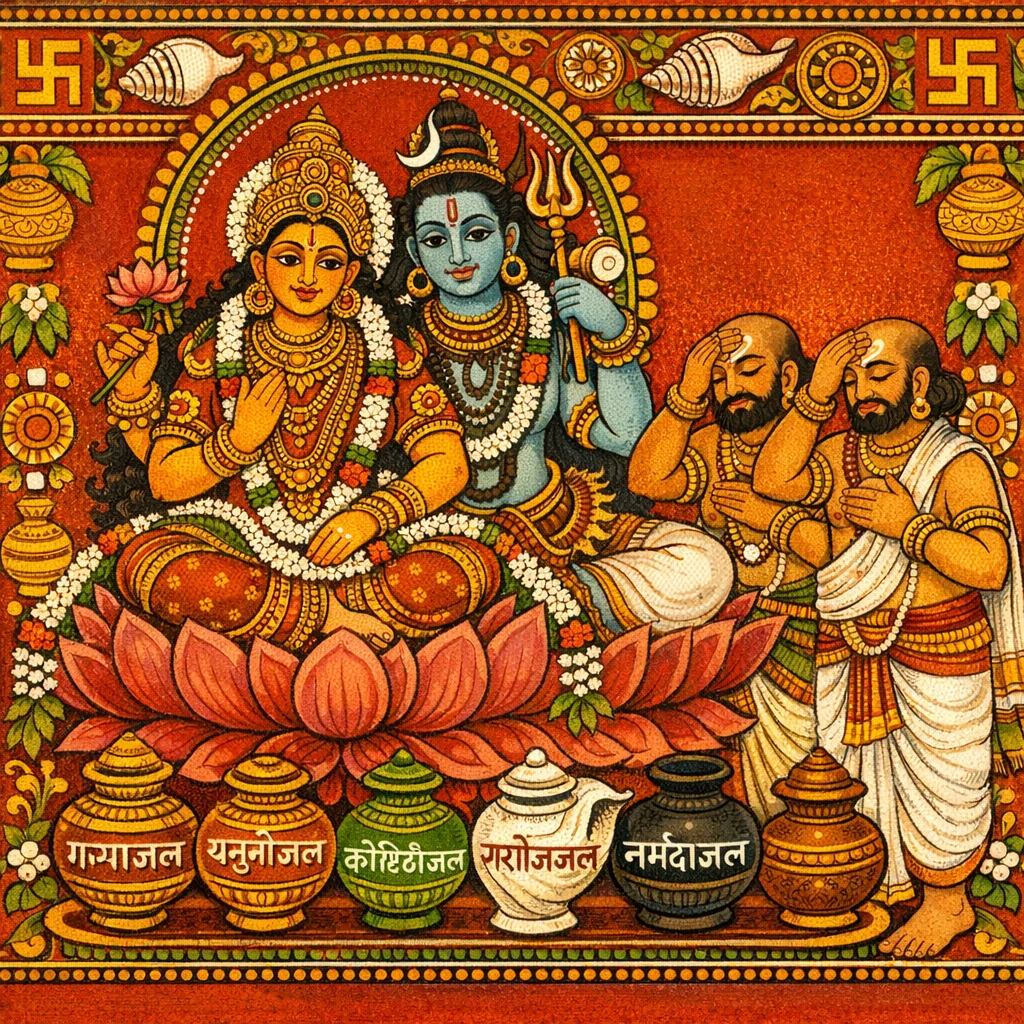
Continuing the teachings on vratas, the Lord proclaims the world-renowned “third-day” observance called Ārdrānandakarī. He states when it is most potent (Śukla Tṛtīyā joined with select nakṣatras) and sets out the rite: a purificatory bath with kuśa and scented waters; wearing white garments, garlands, and fragrances; and worship of Bhavānī with white flowers while meditating on her seated with Mahādeva. The worship proceeds through an ordered sequence of salutations that assign divine epithets to the limbs and features of Śivā–Śiva (mantra-aṅga nyāsa), culminating in a universal-form hymn to Pārvatī and Parameśvara. The practitioner then makes auspicious symbols and offers periodic dāna (ghee with gold, a water-pot with food, and seasonal additions of saktu and tila), using the enumerated cleansing waters. A recurring mantra is prescribed for daily worship and gifting. The chapter ends with annual concluding gifts (salt, a jaggery-jar, sarjikā, sandal, an eye-cloth, gold, lotus; and a golden Umā–Maheśvara with sugarcane fruits and a bed) and declares the fruits for men and women alike—joy, prosperity, longevity, health, and the hard-to-return attainment of Rudrāṇī/Śiva’s world; even hearing or reciting brings celestial honor.
Key Concepts
Shlokas in Adhyaya 64
Verse 1
*ईश्वर उवाच तथैवान्यां प्रवक्ष्यामि तृतीयां पापनाशिनीम् नाम्ना च लोके विख्याताम् आर्द्रानन्दकरीमिमाम् //
The Lord said: “In the same manner, I shall now explain another—this third-day observance that destroys sin, renowned in the world by name, and which bestows tender (devotional) joy.”
Verse 2
यदा शुक्लतृतीयायाम् आषाढर्क्षं भवेत्क्वचित् ब्रह्मर्क्षं वा मृगर्क्षं वा हस्तो मूलमथापि वा दर्भगन्धोदकैः स्नानं तदा सम्यक्समाचरेत् //
Whenever, on the third lunar day of the bright fortnight (Śukla Tṛtīyā), the nakṣatra happens to be Āṣāḍhā, or Brahmā’s star Rohiṇī, or Mṛga (Mṛgaśīrṣa), or Hasta, or Mūla, then one should duly perform the ritual bath with kuśa-grass and fragrant water.
Verse 3
शुक्लमाल्याम्बरधरः शुक्लगन्धानुलेपनः भवानीमर्चयेद्भक्त्या शुक्लपुष्पैः सुगन्धिभिः महादेवेन सहिताम् उपविष्टां महासने //
Wearing a white garland and white garments, and anointed with white fragrance, one should worship Bhavānī with devotion using sweet-smelling white flowers—meditating on her as seated upon a great throne together with Mahādeva.
Verse 4
वासुदेव्यै नमः पादौ शंकराय नमो हरम् जङ्घे शोकविनाशिन्यै आनन्दाय नमः प्रभो //
Salutations to the feet—as Vāsudevī. Salutations to Śaṅkara, to Hara. Salutations to the shanks that destroy sorrow. Salutations to Ānanda, O Lord.
Verse 5
रम्भायै पूजयेदूरू शिवाय च पिनाकिनः अदित्यै च कटिं देव्याः शूलिनः शूलपाणये //
One should worship the Goddess’s thighs (ūrū) as Rambhā, and also worship Śivā and the Lord who bears the Pināka. One should likewise worship the Goddess’s waist as Aditi, and worship Śūlin—Śiva, the trident-bearer.
Verse 6
माधव्यै च तथा नाभिम् अथ शम्भोर्भवाय च स्तनावानन्दकारिण्यै शंकरस्येन्दुधारिणे //
Salutations to Mādhavī, and likewise to the Navel (nābhi), the cosmic source; and to Bhava, who is Śambhu. Salutations to Her who brings bliss through the breasts—the nurturing Mother—and to Śaṅkara, the bearer of the moon.
Verse 7
उत्कण्ठिन्यै नमः कण्ठं नीलकण्ठाय वै हरम् करावुत्पलधारिण्यै रुद्राय च जगत्पते बाहू च परिरम्भिण्यै त्रिशूलाय हरस्य च //
Salutations to the Goddess who yearns in devotion; salutations to the throat, and indeed to Hara, Nīlakaṇṭha, the Blue-throated One. Salutations to Her whose hands bear the lotus; and to Rudra, Lord of the universe. Salutations to Her who embraces (Him) with her arms; and also to the trident of Hara.
Verse 8
देव्या मुखं विलासिन्यै वृषेशाय पुनर्विभोः स्मितं सस्मेरलीलायै विश्ववक्त्राय वै विभो //
The Goddess’s face is for the One who delights in sacred play; and again, O Lord, Your smile is for the Bull-bannered Lord (Vṛṣeśa), Śiva. O all-pervading One, You are the very face of the universe—indeed, the Lord of all.
Verse 9
नेत्रे मदनवासिन्यै विश्वधाम्ने त्रिशूलिनः भ्रुवौ नृत्यप्रियायै तु ताण्डवेशाय शूलिनः //
To the Trident-bearing Lord whose abode is the universe: His two eyes are assigned to the Goddess in whom Kāma (desire) dwells; and His two brows, indeed, to the dance-loving one—to the Lord of Tāṇḍava, Śiva, the Spear-bearing One.
Verse 10
देव्या ललाटमिन्द्राण्यै हव्यवाहाय वै विभोः स्वाहायै मुकुटं देव्या विभोर्गङ्गाधराय वै //
The Goddess’s forehead-mark is assigned to Indrāṇī; and a feature of the Lord is assigned to Havyavāha (Agni). The Goddess’s crown is given to Svāhā; and an ornament/attribute of the Lord to Gaṅgādhara (Śiva, bearer of the Gaṅgā).
Verse 11
विश्वकायौ विश्वमुखौ विश्वपादकरौ शिवौ प्रसन्नवदनौ वन्दे पार्वतीपरमेश्वरौ //
I bow to Pārvatī and Parameśvara (Śiva)—whose bodies are the universe, whose faces are the universe, whose hands and feet are the universe—ever auspicious, with serene and gracious countenances.
Verse 12
एवं सम्पूज्य विधिवद् अग्रतः शिवयोः पुनः पद्मोत्पलानि रजसा नानावर्णेन कारयेत् //
Thus, having duly completed the worship according to rite, one should again, before Śiva and Śivā, arrange lotus and blue-lotus flowers, using colored powders of various hues.
Verse 13
शङ्खचक्रे सकटके स्वस्तिकाङ्कुशचामरान् यावन्तः पांसवस्तत्र रजसः पतिता भुवि तावद्वर्षसहस्राणि शिवलोके महीयते //
Whoever makes (or causes to be made) the conch and discus, the cart (sakaṭa), the svastika, the goad, and the fly-whisk—by as many thousands of years as there are grains of dust and particles of earth that fall upon the ground there, he is honored and exalted in Śiva’s world.
Verse 14
चत्वारि घृतपात्राणि सहिरण्यानि शक्तितः दत्त्वा द्विजाय करकम् उदकान्नसमन्वितम् प्रतिपक्षं चतुर्मासं यावदेतन्निवेदयेत् //
Having given, according to one’s means, four vessels of ghee together with gold to a twice-born (brāhmaṇa), one should also present a water-pot (karaka) along with water and food, and continue offering this every fortnight throughout the four-month season, for as long as this observance is maintained.
Verse 15
ततस्तु चतुरो मासान् पूर्ववत्करकोपरि चत्वारि सक्तुपात्राणि तिलपात्राण्यतः परम् //
Then, for four months, in the same manner as before, upon the water-pot (karaka) one should place four bowls of roasted barley-flour (saktu); and after that, bowls filled with sesame (tila).
Verse 16
गन्धोदकं पुष्पवारि चन्दनं कुङ्कुमोदकम् अपक्वं दधि दुग्धं च गोशृङ्गोदकमेव च //
Scented water, flower-infused water, sandalwood (water or paste), saffron-water (kuṅkuma), uncooked curd, milk, and likewise water kept in (or poured from) a cow’s horn—these are the items to be used.
Verse 17
पिष्टोदकं तथा वारि कुष्ठचूर्णान्वितं पुनः उशीरसलिलं तद्वद् यवचूर्णोदकं पुनः //
Likewise, water mixed with paste (flour-water), and again water combined with powdered kuṣṭha; similarly, water infused with uśīra (vetiver); and again water mixed with barley-flour—these are the prescribed cleansing waters.
Verse 18
तिलोदकं च संप्राश्य स्वपेन्मार्गशिरादिषु मासेषु पक्षद्वितयं प्राशनं समुदाहृतम् //
Having duly sipped sesame-water (tilodaka), one should observe the prescribed regimen in the months beginning with Mārgaśīrṣa; this intake (prāśana) is declared to be performed for two fortnights.
Verse 19
सर्वत्र शुक्लपुष्पाणि प्रशस्तानि सदार्चने दानकाले च सर्वत्र मन्त्रमेतमुदीरयेत् //
Everywhere, white flowers are commended for regular worship; and at the time of giving gifts as well, one should in all cases recite this very mantra.
Verse 20
गौरी मे प्रीयतां नित्यम् अघनाशाय मङ्गला सौभाग्यायास्तु ललिता भवानी सर्वसिद्धये //
May Goddess Gaurī be ever pleased with me; may Maṅgalā (the Auspicious One) destroy my sins; may Lalitā grant me good fortune; and may Bhavānī bestow complete success in all attainments.
Verse 21
संवत्सरान्ते लवणं गुडकुम्भं च सर्जिकाम् चन्दनं नेत्रपट्टं च सहिरण्याम्बुजेन तु //
At the end of the year, one should give salt, a jar filled with jaggery, alkaline salt (sarjikā), sandalwood, and a cloth for covering the eyes—together with gold and a lotus (offering).
Verse 22
उमामहेश्वरं हैमं तद्वदिक्षुफलैर्युतम् सतूलावरणां शय्यां सविश्रामां निवेदयेत् सपत्नीकाय विप्राय गौरी मे प्रीयतामिति //
One should present a golden image of Umā and Maheśvara, together with sugarcane fruits, and offer a bed furnished with cotton coverings, complete with a place of rest. This is to be given to a brāhmaṇa along with his wife, saying: “May Gaurī be pleased with me.”
Verse 23
आर्द्रानन्दकरी नाम्ना तृतीयैषा सनातनी यामुपोष्य नरो याति शम्भोर्यत्परमं पदम् //
The third observance is the eternal vow known as Ārdrānandakarī. By fasting in accordance with it, a man attains the supreme abode that belongs to Śambhu (Śiva).
Verse 24
इह लोके सदानन्दम् आप्नोति धनसम्पदः आयुरारोग्यसम्पत्त्या न कश्चिच्छोकमाप्नुयात् //
In this very world, one attains abiding joy through the wealth of prosperity; and endowed with the riches of long life and good health, no one should fall into sorrow.
Verse 25
नारी वा कुरुते या तु कुमारी विधवा च या सापि तत्फलमाप्नोति देव्यनुग्रहलालिता //
Any woman who performs it—whether a maiden or a widow—also attains that very fruit, cherished by the Goddess’s grace.
Verse 26
प्रतिपक्षमुपोष्यैवं मन्त्रार्चनविधानवित् रुद्राणीलोकमभ्येति पुनरावृत्तिदुर्लभम् //
Thus, by fasting on each fortnight and being well-versed in the proper procedure of mantra-recitation and ritual worship, one attains Rudrāṇī’s world—a state from which return (to rebirth) is difficult to occur.
Verse 27
य इदं शृणुयान्नित्यं श्रावयेद्वापि मानवः शक्रलोके स गन्धर्वैः पूज्यते ऽपि युगत्रयम् //
Whoever regularly listens to this teaching, or causes it to be recited for others, is honored by the Gandharvas in Indra’s world for three yugas.
Verse 28
आनन्ददां सकलदुःखहरां तृतीयां या स्त्री करोत्यविधवा विधवाथ वापि सा स्वे गृहे सुखशतान्यनुभूय भूयो गौरीपदं सदयिता दयिता प्रयाति //
Any woman—whether not widowed or even widowed—who observes this joy-bestowing, sorrow-dispelling Tṛtīyā experiences hundreds of happinesses in her own home; and thereafter, together with her beloved, she attains the state of Gaurī (Pārvatī).
Frequently Asked Questions
It prescribes the Ārdrānandakarī Śukla Tṛtīyā Vrata: take a ritual bath with kuśa and scented waters when Tṛtīyā aligns with specified nakṣatras, worship Bhavānī with white garments, white fragrances, and white flowers while meditating on her with Mahādeva, recite the limb-wise salutations/mantra sequence, perform prescribed symbolic designs and gifts, and maintain fortnightly observance with concluding annual dāna.
This adhyāya is primarily Vrata-Dharma and Śaiva-Śākta ritual theology. It does not teach Vāstu-śāstra measurements, rājadharma/statecraft, sṛṣṭi (creation) cosmogony, or dynastic genealogy; its focus is on calendrical timing, pūjā procedure, mantra/nyāsa-style worship, purification waters, dāna, and phala.
The text highlights Śukla Tṛtīyā when the nakṣatra is Āṣāḍhā, Rohiṇī (called Brahmā’s star), Mṛgaśīrṣa (Mṛga), Hasta, or Mūla.
It promises destruction of sin, sustained joy and prosperity in this world, long life and health, and ultimately attainment of Rudrāṇī’s/Śambhu’s realm described as difficult to return from (i.e., liberation-oriented merit). It also states that listening to or sponsoring recitation yields honor in Indra’s world.
Yes. The chapter explicitly states that women who perform it—whether maidens (kumārī) or widows (vidhavā)—attain the same fruit by the Goddess’s grace, including household happiness and eventual attainment of Gaurī’s state.