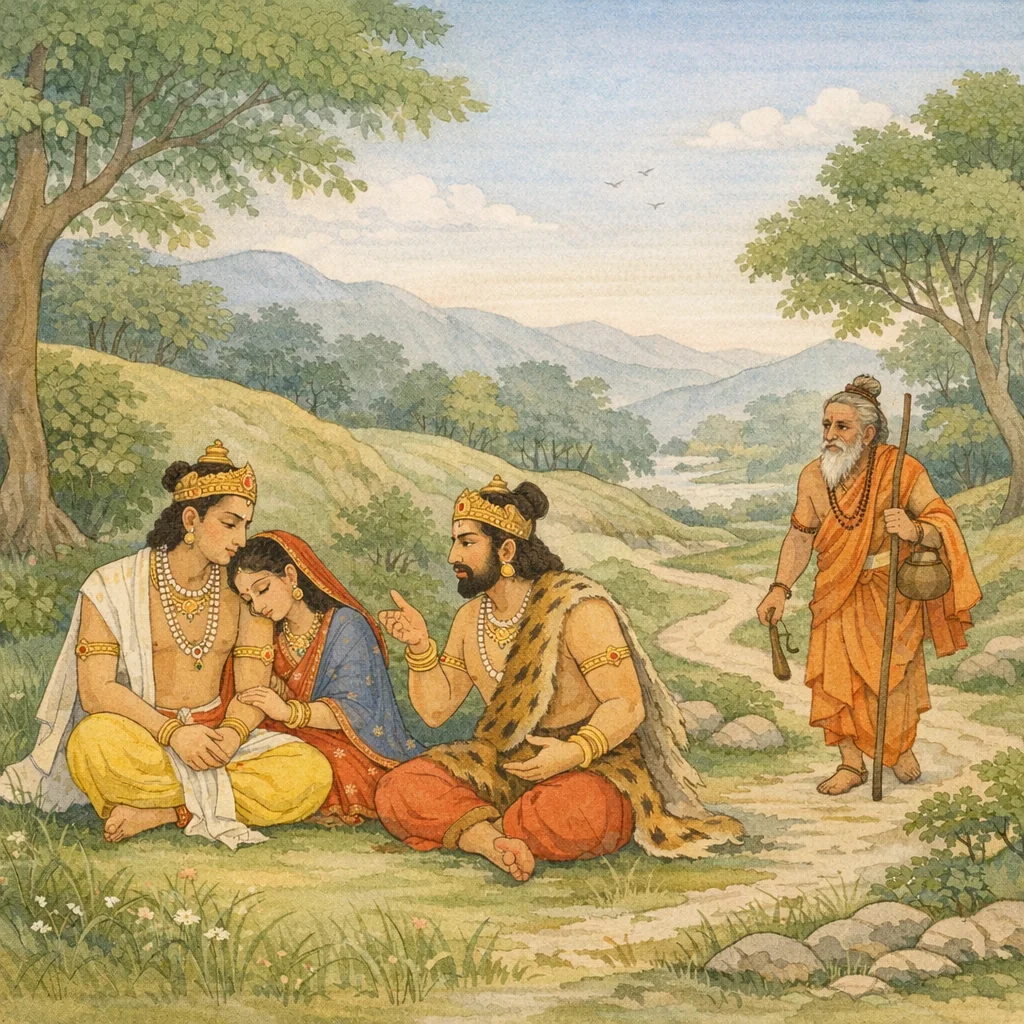
Adhyaya 52
Nala’s Embassy to Damayantī and the Gods’ Proposal (नलस्य दूतत्वं देवप्रस्तावश्च)
Upa-parva: Nala–Damayantī Upākhyāna (Episode of Nala and Damayantī)
Bṛhadaśva narrates that Nala, having promised service, asks the visitors’ identities and the nature of his task. Indra replies, identifying himself along with Agni, Varuṇa, and Yama, stating that the lokapālas have come seeking Damayantī and instructing Nala to inform her and invite her to choose one of them as husband. Nala expresses reluctance to serve a single shared purpose that conflicts with his own inclination, but the gods insist on his prior commitment; he raises a practical concern about entering a heavily guarded palace. Indra assures him entry is possible, and Nala proceeds, entering unobserved by divine power. He sees Damayantī among companions, described with heightened radiance and composure; Nala experiences desire yet restrains it to preserve truthfulness. The women are awed and silent; Damayantī addresses Nala directly, asking who he is and how he entered unnoticed. Nala identifies himself as a divine messenger and relays the gods’ proposal, explicitly presenting her choice.
Chapter Arc: अस्त्र-विद्या के हेतु अर्जुन के इन्द्रलोक गमन के बाद, काम्यक वन में द्रौपदी सहित पाण्डवों का निवास—और एकान्त में युधिष्ठिर का भीतर-भीतर जलता शोक प्रकट होने लगता है। → एकान्त शाद्वल भूमि पर युधिष्ठिर-द्रौपदी बैठते हैं; राज्य-भ्रंश, वनवास और अर्जुन-वियोग की पीड़ा से युधिष्ठिर का मन क्षत्रिय-धर्म और राजधर्म के प्रश्नों में उलझता है। भीम का स्वर कठोर होकर उभरता है—‘राज्य ही क्षत्रिय का परम धर्म है’—और वह युधिष्ठिर को ‘धर्म’ के नाम पर निष्क्रियता से सावधान करता है। → युधिष्ठिर अर्जुन के पुनरागमन की उत्कट प्रतीक्षा व्यक्त करते हैं—‘कदा द्रक्ष्यामि बीभत्सुं कृतास्त्रं पुनरागतम्’—और उसी भाव-उभार के बीच एक आगन्तुक (बृहदश्व) उपस्थित होकर कथा-श्रवण की भूमिका बनाता है; युधिष्ठिर उससे अपने समान संकटग्रस्त राजा की कथा सुनाने का आग्रह करते हैं। → बृहदश्व युधिष्ठिर को धैर्य देता है—तुम्हारे साथ देवतुल्य भाई और ब्रह्मकल्प द्विज हैं, अतः शोक में डूबना उचित नहीं—और नलोपाख्यान का आरम्भ करता है: निषध के वीरसेन-पुत्र नल का परिचय, उसके धर्मार्थ-कोविद स्वरूप का संकेत, तथा आगे आने वाले पतन की छाया। → नल का वैभव और गुण कहकर बृहदश्व उस बिन्दु तक ले आता है जहाँ नल के जीवन में विपर्यय का बीज पड़ने वाला है—श्रोता अगले अध्याय में उसके पतन-प्रसंग की प्रतीक्षा में ठहर जाते हैं।
Shlokas
Verse 1
हि >> आय न [हुक है 7-2 (नलोपाख्यानपर्व) द्विपञ्चाशत्तमो<5 ध्याय: भीमसेन-युधिष्ठटिर-संवाद
Janamejaya said: “O brāhmaṇa, when the great-souled Pārtha (Arjuna) had gone to Śakra’s world in order to obtain celestial weapons, what did the Pāṇḍavas—led by Yudhiṣṭhira—do?”
Verse 2
वैशम्पायन उवाच अस्त्रहेतोर्गते पार्थे शक्रलोक॑ महात्मनि । आवसन् कृष्णया सार्धथ काम्यके भरतर्षभा:
Vaiśampāyana said: “O king, when the great-souled Pārtha (Arjuna) had gone to Śakra’s world to obtain celestial weapons, the Pāṇḍavas—bull-like heroes of the Bharata line—dwelt in the Kāmyaka forest together with Kṛṣṇā (Draupadī).”
Verse 3
तत: कदाचिदेकान्ते विविक्त इव शाद्वले | दुःखार्ता भरतश्रेष्ठा निषेदु: सह कृष्णया
Then, on one occasion, in a secluded spot—on a quiet grassy patch—the foremost of the Bharata line, afflicted by sorrow, sat down together with Kṛṣṇā (Draupadī). Anxious for Dhanañjaya (Arjuna), their voices choked with tears, they spoke only of him; and all the Pāṇḍavas, tormented by separation from Arjuna, were as though drowned beneath the waves of a sea of grief.
Verse 4
धनंजयं शोचमाना: साश्रुकण्ठा: सुदुःखिता: । तद्वियोगार्दितान् सर्वाउ्छोक: समभिपुप्लुवे
Vaiśampāyana said: “Overwhelmed with grief for Dhanañjaya (Arjuna), their throats choked with tears and their hearts deeply afflicted, the Pāṇḍavas—tormented by separation from him—were entirely flooded by sorrow, as though a sea of grief had risen over them.”
Verse 5
धनंजयवियोगाच्च राज्य भ्रंशाच्च दु:खिता: । अथ भीमो महाबाहुर्युधिष्ठटिमभाषत,पाण्डव राज्य छिन जानेसे तो दुःखी थे ही। अर्जुनके विरहसे वे और भी क्लेशमें पड़ गये थे। उस समय महाबाहु भीमने युधिष्ठिससे कहा--
Vaiśampāyana said: Grieved both by separation from Dhanañjaya (Arjuna) and by the loss of their kingdom, the Pāṇḍavas were in distress. Then Bhīma, the mighty-armed, addressed Yudhiṣṭhira—framing their suffering not merely as personal sorrow, but as the moral and political consequence of dispossession and exile.
Verse 6
निदेशात् ते महाराज गतो5सौ भरतर्षभ: । अर्जुन: पाण्डुपुत्राणां यस्मिन् प्राणा: प्रतिक्ठिता:,“महाराज! आपकी आज्ञासे भरतवंशका रत्न अर्जुन तपस्याके लिये चला गया। हम सब पाण्डवोंके प्राण उसीमें बसते हैं
Vaiśampāyana said: “O great king, by your command that bull among the Bharatas—Arjuna—has departed for the practice of austerities. For us, the sons of Pāṇḍu, our very life-breaths are anchored in him.”
Verse 7
यस्मिन् विनष्टे पाड्चाला: सह पुत्रैस्तथा वयम् | सात्यकिर्वासुदेवश्च विनश्येयुर्न संशय:
Vaiśampāyana said: “If he (Arjuna) were to perish, then the Pāñcālas along with their sons, we ourselves (the Pāṇḍavas), Sātyaki, and Vāsudeva’s son Kṛṣṇa would all be ruined—of this there is no doubt.”
Verse 8
योडसौ गच्छति धर्मात्मा बहून् क्लेशान् विचिन्तयन् । भवतन्नियोगाद् बीभत्सुस्ततो दुःखतरं नु किम्
Vaiśampāyana said: “That righteous-souled one—Bībhatsu (Arjuna)—has gone forth to perform austerities at your command, turning over many hardships in his mind. What sorrow could be greater than that?”
Verse 9
यस्य बाहू समाश्रित्य वयं सर्वे महात्मन: । मन्यामहे जितानाजोौ परानू प्राप्तां च मेदिनीम्
Vaiśampāyana said: “Relying on the mighty arms of that great-souled hero, we all deem that in battle we have already conquered our foes, and that the earth itself has come under our rightful sway.”
Verse 10
यस्य प्रभावान्न मया सभामध्ये धनुष्मत: । नीता लोकममुं सर्वे धार्तराष्ट्रा: ससौबला:
Vaiśampāyana said: “Overawed by the might of that bow-bearing hero, I did not, there in the midst of the royal assembly, send all the sons of Dhṛtarāṣṭra—together with Śakuni—to that other world, the realm of Yama, at once.”
Verse 11
ते वयं बाहुबलिन: क्रोधमुत्थितमात्मन: । सहामहे भवन्न्मूलं वासुदेवेन पालिता:
“We are men of mighty arms; yet, though anger rises within us—an anger provoked because of you—we endure it in silence, since we are protected and restrained under the guardianship of Vāsudeva.”
Verse 12
वयं हि सह कृष्णेन हत्वा कर्णमुखान् परान् | स्वबाहुविजितां कृत्स्नां प्रशासेम वसुन्धराम्
Vaiśampāyana said: “Indeed, with Kṛṣṇa at our side, after slaying the enemy host led by Karṇa, we could rule the entire earth—won by the strength of our own arms.”
Verse 13
भवतो द्यूतदोषेण सर्वे वयमुपप्लुता: । अहीनपौरुषा बाला बलिभिबलवत्तरा:
Vaiśampāyana said: “Because of your fault in gambling, all of us have been overwhelmed and brought low. Though our manly strength has not truly failed, we have become as helpless as children; while those powerful men, enriched by the wealth won from us, have now grown even stronger.”
Verse 14
क्षात्रं धर्म महाराज त्वमवेक्षितुमहसि । न हि धर्मो महाराज क्षत्रियस्यथ वनाश्रय:,“महाराज! आप क्षत्रियरधर्मकी ओर तो देखिये। इस प्रकार वनमें रहना कदापि क्षत्रियोंका धर्म नहीं है
Vaiśampāyana said: “O great king, you ought to look to the dharma proper to the warrior estate. For, O great king, taking refuge in the forest—living as a forest-dweller—is not the dharma of a kṣatriya.”
Verse 15
राज्यमेव पर धर्म क्षत्रियस्य विदुर्बुधा: । स क्षत्रधर्मविद् राजा मा धर्म्यान्नीनश: पथ:
Vaiśampāyana said: “The wise know that the highest duty of a kṣatriya is kingship itself—rule upheld and protection given. You are a king who understands the kṣatriya’s code; do not deviate from the righteous path.”
Verse 16
प्राग् द्वादशसमा राजन् धार्तराष्ट्रानू निहन्महि । निवर्त्य च वनात् पार्थमानाय्य च जनार्दनम्
Vaiśaṃpāyana said: “O King, even before the completion of the twelve years, we could strike down the sons of Dhṛtarāṣṭra—by bringing Pārtha (Arjuna) back from the forest and summoning Janārdana (Kṛṣṇa).”
Verse 17
व्यूढानीकान् महाराज जवेनैव महामते । धार्तराष्ट्राममुं लोकं गमयामि विशाम्पते
Vaiśaṃpāyana said: “O king, O wise one—though the sons of Dhṛtarāṣṭra may marshal their forces in tight battle-array, I shall swiftly send them to that other world, O lord of the people.”
Verse 18
सर्वानहं हनिष्यामि धार्तराष्ट्रानूस सौबलान् । दुर्योधनं च कर्ण च यो वान्य: प्रतियोत्स्यते
Vaiśampāyana said: “I will slay them all—the sons of Dhṛtarāṣṭra, along with the Saubalas. And Duryodhana and Karṇa as well—whoever else dares to stand and fight against me.”
Verse 19
मया प्रशमिते पश्चात् त्वमेष्यसि वनात् पुनः । एवं कृते न ते दोषा भविष्यन्ति विशाम्पते
Vaiśampāyana said: “After I have subdued and brought to an end the hostile forces, you shall return again from the forest. If you act in this manner, O lord of the people, no fault or blame will attach to you.”
Verse 20
यज्ैश्न विविधैस्तात कृतं पापमरिंदम | अवधूय महाराज गच्छेम स्वर्गमुत्तमम्,“तात! शत्रुदमन! महाराज! हम नाना प्रकारके यज्ञोंका अनुष्ठान करके अपने किये हुए पापको धो-बहाकर उत्तम स्वर्गलोकमें चलेंगे
Vaiśampāyana said: “Dear son—O subduer of foes, O great king—having performed many kinds of sacrificial rites, we shall wash away the sin we have committed and then depart to the highest heaven.”
Verse 21
एवमेतद् भवेद् राजन् यदि राजा न बालिश: । अस्माकं दीर्घसूत्र: स्याद् भवान् धर्मपरायण:,“राजन! यदि ऐसा हो तो आप हमारे धर्मपरायण राजा अविवेकी और दीर्घसूत्री नहीं समझे जायूँगे
“So it would indeed be so, O King—if the king were not foolish. Then you, devoted to dharma, would not be judged by us to be one who is slow to act and overly procrastinating.”
Verse 22
निकृत्या निकृतिप्रज्ञा हन्तव्या इति निश्चय: । न हि नैकृतिकं हत्वा निकृत्या पापमुच्यते
“Those who practice deceit and are skilled in deceit should be slain by deceit—this is the settled rule. For in killing a deceiver through deception, no sin is said to arise.”
Verse 23
तथा भारत धर्मेषु धर्मज्शैरिह दृश्यते । अहोरात्रं महाराज तुल्यं संवत्सरेण ह,“भरतवंशी महाराज! धर्मशास्त्रमें इसी प्रकार धर्मपरायण धर्मज्ञ पुरुषोंद्वारा यहाँ एक दिन-रात एक संवत्सरके समान देखा जाता है
Vaiśampāyana said: “So it is, O descendant of Bharata: in matters of dharma, the wise and dharma‑devoted perceive things here in this way—one day and one night, O great king, are regarded as equal to a full year.”
Verse 24
तथैव वेदवचन श्रूयते नित्यदा विभो । संवत्सरो महाराज पूर्णो भवति कृच्छृत:,'प्रभो! महाराज! इसी प्रकार सदा यह वैदिक वचन सुना जाता है कि कृच्छृव्रतके अनुष्ठानसे एक वर्षकी पूर्ति हो जाती है
Vaiśampāyana said: “So too, O mighty one—O great king—this Vedic saying is heard at all times: by undertaking the Kṛcchra observance, a full year is, as it were, completed (in merit).”
Verse 25
यदि वेदा: प्रमाणास्ते दिवसादूर्ध्वमच्युत । त्रयोदश समा: कालो ज्ञायतां परिनिष्ठित:,“अच्युत! यदि आप वेदको प्रमाण मानते हैं तो तेरहवें दिनके बाद ही तेरह वर्षोंका समय बीत गया, ऐसा समझ लीजिये
Vaiśampāyana said: “O Acyuta, if you accept the Vedas as authoritative, then know this as firmly established: once the thirteenth day is completed, the full span of thirteen years has elapsed.”
Verse 26
कालो दुर्योधन हन्तुं सानुबन्धमरिंदम । एकाग्रां पृथिवीं सर्वा पुरा राजन् करोति सः:
Vaiśampāyana said: “O subduer of foes, the time has come to strike down Duryodhana together with all his allies and kin. O King, this must be done before he succeeds in bringing the whole earth under a single, unified rule.”
Verse 27
द्यूतप्रियेण राजेन्द्र तथा तद् भवता कृतम् | प्रायेणाज्ञातचर्यायां वयं सर्वे निपातिता:
Vaiśampāyana said: “O best of kings, because you were fond of gambling, you acted in that way. By it, you have almost cast all of us into the perilous condition of living in concealment (incognito).”
Verse 28
नतं देशं प्रपश्यामि यत्र सो5स्मान् सुदुर्जन: । न विज्ञास्यति दुष्टात्मा चारैरिति सुयोधन:
Vaiśampāyana said: “I see no land, no refuge, where that thoroughly wicked man—Duryodhana—will not discover us through his spies. Once that vile, corrupt-minded prince learns our hidden dwelling, he will again, by deceitful policy, contrive to thrust us back into this very forest-exile.”
Verse 29
अधिगम्य च सर्वान् नो वनवासमिमं ततः । प्रत्राजयिष्यति पुनर्निकृत्याधमपूरुष:
Vaiśampāyana said: “After discovering everything about our present forest-exile, that vile and deceitful wretch will again contrive—by treachery—to drive us back into this very banishment.”
Verse 30
यद्यस्मानभिगच्छेत पाप: स हि कथंचन । अज्ञातचर्यामुत्तीर्णान् दृष्टवा च पुनराह्ययेत्
Vaiśampāyana said: “If that wicked man should somehow come to know that we have completed our period of living incognito, then, seeing us after it is over, he would again summon you to play at dice.”
Verse 31
द्यूतेन ते महाराज पुनर्दययूतमवर्तत । भवांश्व पुनराहूतो द्यूते नैवापनेष्यति
Vaiśampāyana said: “O King, after being rescued once from the peril of gambling, you again turned back to the dice. Therefore I understand that if you are summoned once more to a game, you will not withdraw from it.”
Verse 32
स तथाक्षेषु कुशलो निश्चितो गतचेतन: । चरिष्यसि महाराज वनेषु वसती: पुनः
Vaiśampāyana said: “Thus, though skilled at the dice, you have become fixed in your resolve, your mind no longer swayed by that obsession. Therefore, O great king, you will once again live in the forests, dwelling there in exile.”
Verse 33
“नरेश्वर! वह विवेकशून्य शकुनि जूआ फेंकनेकी कलामें कितना कुशल है, यह आप अच्छी तरह जानते हैं, फिर तो उसमें हारकर आप पुनः वनवास ही भोगेंगे ।।
Vaiśampāyana said: “O king! You know well how that undiscerning Śakuni is supremely skilled in casting the dice. If you lose to him, you will once again be forced to endure life in the forest. If, great king, you truly mean to reduce us to wretchedness, then for as long as life remains, keep your gaze fixed on the complete observance of all duties enjoined by the Veda.”
Verse 34
निकृत्या निकृतिप्रज्ञो हन्तव्य इति निश्चय: । अनुज्ञातस्त्वया गत्वा यावच्छक्ति सुयोधनम्
Vaiśampāyana said: “My settled conviction is this: a deceitful man, skilled in deceit, should be slain by deceit itself. If you grant me leave, I will go and, to the full extent of my power, kill Suyodhana (Duryodhana)—as fire cast into a heap of dry grass, taking support from the wind, reduces it to ashes.”
Verse 35
यथैव कक्षमुत्सृष्टो दहेदनिलसारथि: । हनिष्यामि तथा मन्दमनुजानातु मे भवान्
Vaiśampāyana said: “Just as fire, once set into a heap of dry brushwood and driven by the wind, burns it to ashes, so too—if you grant me leave—I will go and, to the extent of my power, strike down that dull-witted Duryodhana. Please permit me.”
Verse 36
वैशम्पायन उवाच एवं ब्रुवाणं भीम॑ तु धर्मराजो युधिष्ठिर: । उवाच सान्त्वयन् राजा मूर्ध्न्युपात्राय पाण्डवम्
Vaiśampāyana said: As Bhīma spoke in this manner, Dharma-rāja Yudhiṣṭhira addressed him. The king, seeking to console the Pāṇḍava, bent to smell (kiss) his head and spoke—an intimate gesture of affection meant to steady Bhīma’s turbulent emotions and restore him to dharmic composure.
Verse 37
असंशयं महाबाहो हनिष्यसि सुयोधनम् । वर्षात् त्रयोदशादूर्ध्व सह गाण्डीवधन्चना,“महाबाहो! इसमें तनिक भी संदेह नहीं है कि तुम तेरहवें वर्षके बाद गाण्डीवधारी अर्जुनके साथ जाकर युद्धमें सुयोधनको मार डालोगे
Vaiśampāyana said: “O mighty-armed one, there is no doubt at all: after the thirteenth year has passed, you will slay Suyodhana, going forth to battle together with the wielder of the Gāṇḍīva.” The statement affirms an assured moral and narrative outcome: the long discipline of exile and restraint will culminate in a decisive confrontation where justice, delayed but not denied, is executed through rightful strength and alliance.
Verse 38
यत् त्वमाभाषसे पार्थ प्राप्त: काल इति प्रभो । अनृतं नोत्सहे वक्तुं न होतन्मम विद्यते
Vaiśampāyana said: “O Pārtha, mighty lord, what you are asserting—‘the time (for Suyodhana’s slaying) has arrived’—is not correct. I cannot bring myself to speak falsehood; such a tendency does not exist in me.”
Verse 39
अन्तरेणापि कौन्तेय निकृतिं पापनिश्चयम् । हन्ता त्वमसि दुर्धर्ष सानुबन्धं सुयोधनम्
Vaiśampāyana said: “O son of Kuntī, even without resorting to deceit, you—an unassailable hero—are capable of slaying Suyodhana, whose resolve is fixed on sinful intent, together with all who are bound to him.”
Verse 40
एवं ब्रुवति भीम॑ तु धर्मराजे युधिष्ठिरे । आजगाम महाभागो बृहदश्वो महानृषि:,धर्मराज युधिष्ठिर जब भीमसेनसे ऐसी बातें कह रहे थे, उसी समय महाभाग महर्षि बृहदश्व वहाँ आ पहुँचे
As Bhīma was speaking thus to Dharmarāja Yudhiṣṭhira, at that very moment the illustrious great sage Bṛhadaśva arrived there.
Verse 41
तमभिप्रेक्ष्य धर्मात्मा सम्प्राप्तं धर्मचारिणम् । शास्त्रवन्मधुपर्केण पूजयामास धर्मराट्
Seeing that righteous, dharma-observing person arrive, King Yudhiṣṭhira—himself devoted to dharma—honoured him in accordance with scriptural injunctions by offering the madhuparka.
Verse 42
आश्चस्तं चैनमासीनमुपासीनो युधिष्ठिर: । अभिप्रेक्ष्य महाबाहुः कृपणं बह्वदभाषत
When he had sat down and regained his composure from fatigue, Yudhiṣṭhira—the mighty-armed—sat close by him. Fixing his gaze upon him, he spoke many words in a tone of deep distress.
Verse 43
अक्षद्यूते च भगवन् धन राज्यं च मे हृतम् | आहूय निकृतिप्रज्जै: कितवैरक्षकोविदै:
“O venerable one, in the dice-game my wealth and my kingdom were taken from me. Having summoned me, deceitful gamblers—clever in fraud and skilled in the art of casting dice—robbed me of everything.”
Verse 44
अनक्षज्ञस्य हि सतो निकृत्या पापनिश्चयै: । भार्या च मे सभां नीता प्राणेभ्योडपि गरीयसी
“Though I was no expert in the subtleties of dice, those men—fixed in sinful resolve and acting through deceit—dragged my wife, dearer to me even than my own life, into the crowded royal assembly.”
Verse 45
पुनर्ययतेन मां जित्वा वनवासं सुदारुणम् । प्रावत्राजयन् महारण्यमजिनै: परिवारितम्
Though I had once escaped the peril of that dice-game, they arranged the gambling again and defeated me anew. Then, clothing me in deer-skins, they drove me into this great forest to endure the most cruel hardship of exile in the wilds.
Verse 46
अहं वने दुर्वसतीर्वसन् परमदु:खित: । अक्षद्यूताधिकारे च गिर: शृण्वन् सुदारुणा:
I dwell in the forest in harsh conditions, overwhelmed with the deepest sorrow. And in the hall where the dice-game was conducted, I had to listen to exceedingly cruel words spoken by the opposing men. The sting of those memories remains lodged in my heart; recalling them, I pass the night absorbed in anxious reflection.
Verse 47
आततंतानां सुहृदां वाचो द्यूतप्रभूति शंसताम् । अहं हदि श्रिता: स्मृत्वा सर्वरात्रीविचिन्तयन्
Vaiśaṃpāyana said: “Recalling the words of my well-wishers—words spoken in anguish, recounting the calamity that began with the gambling match—I keep them lodged within my heart. Remembering them again and again, I spend the whole night absorbed in anxious reflection.”
Verse 48
यस्मिंश्नैव समस्तानां प्राणा गाण्डीवधन्चनि । विना महात्मना तेन गतसत्त्व इवाभवम्
Vaiśampāyana said: “He in whom the very life-breath of all of us resides—Arjuna, the great-souled bearer of the Gāṇḍīva bow—has been separated from us. Without that noble Arjuna, I have become as if bereft of vitality.”
Verse 49
कदा द्रक्ष्यामि बीभत्सुं कृतास्त्रं पुनरागतम् । प्रियवादिनमक्षुद्रं दयायुक्तमतन्द्रित:
Vaiśampāyana said: “When shall I see Bībhatsu (Arjuna) again—returned after mastering the science of weapons—gentle in speech, noble and unpetty in conduct, endowed with compassion, and ever vigilant? I keep thinking of him with unwearied longing, wishing to behold him to my heart’s content.”
Verse 50
अस्ति राजा मया कश्चिदल्पभाग्यतरो भुवि | भवता दृष्टपूर्वो वा श्रुतपूर्वोडपि वा क्वचित् | न मत्तो दुःखिततर: पुमानस्तीति मे मति:
Vaiśaṃpāyana said: “There is a certain king known to me, most ill-fated upon the earth. Have you ever, anywhere, seen—or even heard of—one like him? For it is my settled conviction that no man is more afflicted with sorrow than I.”
Verse 51
इस प्रकार श्रीमह्ा भारत वनपवके अन्तर्गत इन्रलोकाभिगमनपर्वमें धृतराष्टरविलापविषयक इकक््यावनवाँ अध्याय पूरा हुआ
Bṛhadaśva said: “O great king, Pāṇḍava, you declare that nowhere is there anyone more unfortunate than you. If you deem yourself the most ill-fated, I shall relate to you an ancient account—of a king on this earth who was even more afflicted than you.”
Verse 52
अत्र ते वर्णयिष्यामि यदि शुश्रूषसे5नघ । यस्त्वत्तो दु:खिततरो राजा55सीत् पृथिवीपते
“If you are willing to listen, O sinless one, I shall describe it to you here: there once was a king, O lord of the earth, who was even more afflicted by sorrow than you.”
Verse 53
वैशम्पायन उवाच अथैनमब्रवीद् राजा ब्रवीतु भगवानिति | इमामवस्थां सम्प्राप्तं श्रोतुमिच्छामि पार्थिवम्
Vaiśampāyana said: Then the king addressed him, saying, “Let the venerable one speak. I wish to hear of that ruler who has fallen into a plight like this.”
Verse 54
ब॒हृदश्च उवाच शृणू राजन्नवहित: सह भ्रातृभिरच्युत । यस्त्वत्तो द:खिततरो राजा55सीत् पृथिवीपते
Bṛhadaśva said: “Listen attentively, O King, together with your brothers, O unwavering one. On this earth there once was a king even more afflicted by sorrow than you, O lord of the land; I shall tell you who he was.”
Verse 55
निषधेषु महीपालो वीरसेन इति श्रुत: । तस्य पुत्रो5भवन्नाम्ना नलो धर्मार्थकोविद:,निषधदेशमें वीरसेन नामसे प्रसिद्ध एक भूपाल हो गये हैं। उन्हींके पुत्रका नाम नल था। जो धर्म और अर्थके तत्त्वज्ञ थे
In the land of the Niṣadhas there was a king renowned by the name Vīrasena. His son was Nala, celebrated for his discerning knowledge of dharma and artha—one who understood both righteous conduct and prudent governance.
Verse 56
स निकृत्या जितो राजा पुष्करेणेति न: श्रुतम् वनवासं सुदुःखार्तों भार्यया न्यवसत् सह
Bṛhadaśva said: “We have heard that King Nala was defeated at Puṣkara’s hands through deceit in the game of dice. Overwhelmed by intense sorrow, he then endured the hardship of exile in the forest together with his wife.”
Verse 57
न तस्य दासा न रथो न भ्राता न च बान्धवा: । वने निवसतो राजज्ल्िष्यन्ते सम कदाचन,राजन्! उनके साथ न सेवक थे न रथ, न भाई थे न बान्धव। वनमें रहते समय उनके पास ये वस्तुएँ कदापि शेष नहीं थीं
Bṛhadaśva said: “He had no servants, no chariot, no brother, and no kinsmen. While dwelling in the forest, O King, such supports never remained with him at any time.”
Verse 58
भवान् हि संवृतो वीरैर्भ्रातृभिदेवसम्मितै: । ब्रह्मकल्पैर्द्धिजाग्रयैश्व तस्मान्नाहसि शोचितुम्
You are indeed surrounded and supported by heroic brothers who are the equals of the gods, and also by foremost Brahmins whose stature is like that of Brahmā. Therefore, you ought not to grieve.
Verse 59
तुम तो देवतुल्य पराक्रमी वीर भाइयोंसे घिरे हुए हो। ब्रह्माजीके समान तेजस्वी श्रेष्ठ ब्राह्मण तुम्हारे चारों ओर बैठे हुए हैं। अतः तुम्हें शोक नहीं करना चाहिये ।।
Yudhiṣṭhira said: “I am surrounded by heroic brothers whose prowess is like that of the gods. Eminent Brahmins, radiant like Brahmā himself, sit all around me. Therefore I should not give way to grief. O best of speakers, I wish to hear in full detail the life-story of the great-souled King Nala. Please be so gracious as to recount it to me.”
Frequently Asked Questions
Nala must honor a prior promise to act as messenger for divine suitors while personally experiencing attraction to Damayantī; the dilemma is how to execute dūta-duty truthfully without manipulating her choice or violating self-restraint.
The chapter models that ethical action is defined by fidelity to truth and role-obligation under internal pressure; desire is acknowledged as a force but is governed through restraint and transparent communication.
No explicit phalaśruti appears in the provided verses; the meta-significance is implicit—this unit functions as an exemplum within the parva, illustrating how satya and disciplined agency stabilize narrative and moral order.
Read Mahabharata in the Vedapath app
Scan the QR code to open this directly in the app, with audio, word-by-word meanings, and more.