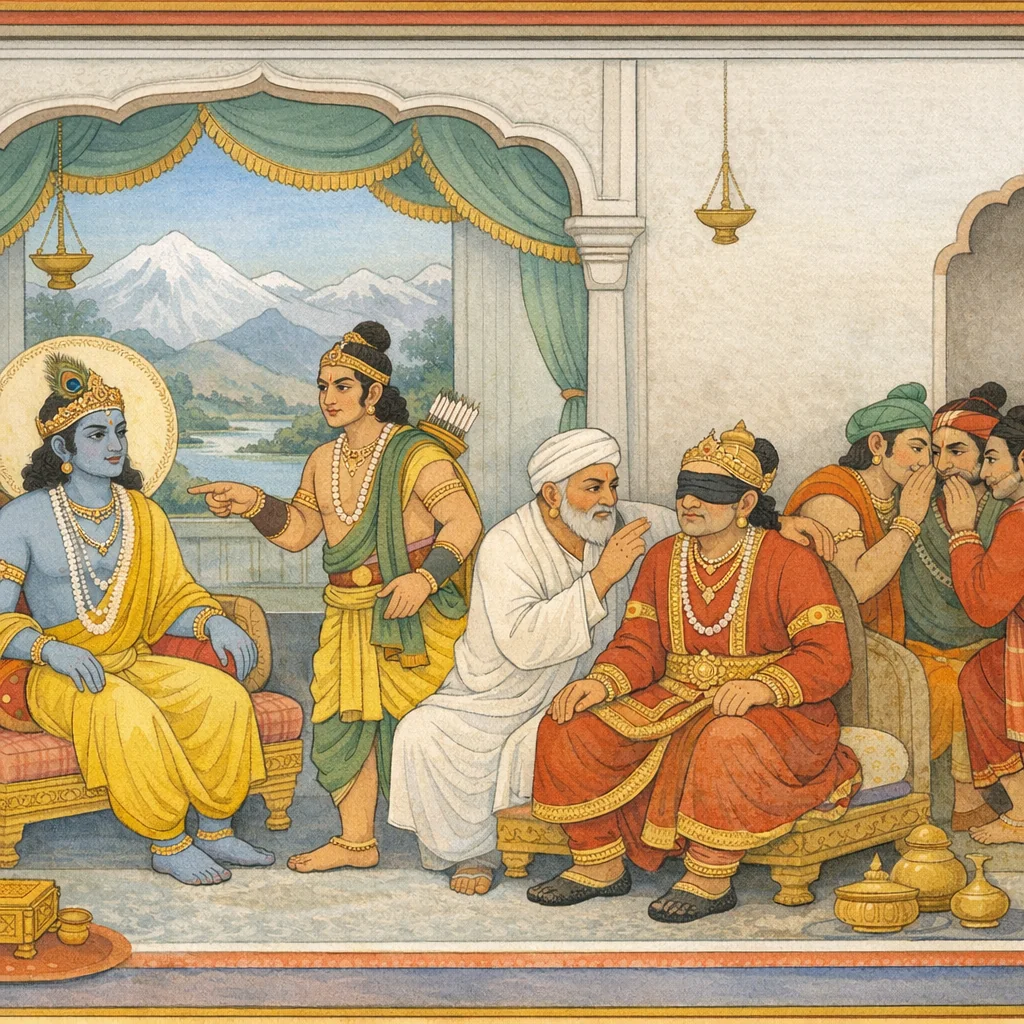
Adhyaya 129
उद्योगपर्व (अध्याय १२९) — केशवस्य वैभवप्रदर्शनम् / Krishna’s Theophanic Display in the Kuru Assembly
Upa-parva: Kṛṣṇa–Duryodhana Saṃvāda (Kuru-sabhā episode: Viśvarūpa-darśana and departure)
Vaiśaṃpāyana narrates that after Vidura’s remarks, Krishna addresses Duryodhana’s delusion that Krishna stands alone and can be forcibly taken. Krishna then manifests a formidable, cosmic form: divine beings and orders (Ādityas, Rudras, Vasus, Sādhyas, Aśvins, Maruts, Viśvedevas), along with yakṣa-gandharva-rākṣasa forms, appear as aspects within or around him. Brahmā is described at his forehead, Rudra at his chest, Lokapālas on his arms, and Agni from his mouth; luminous fire-like rays emerge from pores, eyes, and ears. Saṃkarṣaṇa (Balarāma) and Arjuna appear at his sides; Bhīma, Yudhiṣṭhira, and the Mādrī sons are positioned behind, with Andhakas and Vṛṣṇis led by Pradyumna. Krishna’s weapons are seen raised across many arms. Most kings, overwhelmed, close their eyes; Krishna grants divine sight to select witnesses (including Bhīṣma, Droṇa, Vidura, Saṃjaya, and ascetics) so the event can be apprehended. Celestial drums sound, flowers fall, and the earth and ocean are said to tremble, emphasizing the disclosure’s cosmic register. Krishna then withdraws the manifestation, departs with Sātyaki and Kṛtavarmā with sages’ permission, and is followed by prominent Kuru figures. Dhṛtarāṣṭra addresses Krishna, presenting himself as seeking peace and urging Krishna not to suspect him, while Krishna notes that the assembly has directly witnessed the destabilizing conduct. The chapter concludes with Krishna leaving in a resplendent chariot to meet Pṛthā (Kuntī).
Chapter Arc: सभा से निकलते ही दुर्योधन अपने भीतर की घबराहट को षड्यन्त्र का कवच पहनाता है—और शकुनि के साथ गुप्त मन्त्रणा आरम्भ करता है कि कृष्ण को कैसे ‘शीघ्र’ और ‘चतुराई’ से वश में किया जाए। → दुर्योधन, कर्ण, शकुनि और दुःशासन—चारों एक ही धुरी पर घूमते हैं: कृष्ण को पकड़कर पाण्डवों का मनोबल तोड़ देना, उन्हें ‘भग्नदंष्ट’ सर्पों-सा निरुत्साह कर देना। सभा के भीतर यह योजना धीरे-धीरे हवा पकड़ती है; धृतराष्ट्र के सामने भी संकेत उभरते हैं कि क्रोध और लोभ नीति का मुखौटा बन रहे हैं। → सात्यकि द्वारा षड्यन्त्र का भंडाफोड़ होते ही सभा का छद्म टूटता है; और श्रीकृष्ण सिंहगर्जना के साथ अपने तेज से कौरव-सभा को चेतावनी देते हैं—यह बताकर कि अधर्म की चालें धर्म के प्रकाश में टिक नहीं सकतीं। → विदुर दूरदर्शी वाणी में धृतराष्ट्र को स्पष्ट कहते हैं कि यह कर्म अशक्य और अयशस्कर है—सभा जिस दिशा में जा रही है, वह विनाश की ओर है। कृष्ण भी यह संकेत देते हैं कि वे क्रोधज, पापबुद्धिजन्य निन्दित कर्म का आरम्भ धृतराष्ट्र के सान्निध्य में नहीं करेंगे—पर अधर्म को सहना भी नहीं है। → षड्यन्त्र उजागर हो चुका है, पर दुर्योधन का हठ शान्त नहीं—सभा अब निर्णय के मुहाने पर खड़ी है: समझौता या युद्ध।
Shlokas
Verse 1
ऑपन-माज बछ। असि-छऋाल जा त्रेशर्दाधिकशततमो<्ध्याय: दुर्योधनके षड्यन्त्रका सात्यकिद्वारा भंडाफोड़, श्रीकृष्णकी सिंहगर्जना तथा धृतराष्ट्र और विदुरका दुर्योधनको पुन: समझाना वैशम्पायन उवाच तत् तु वाक्यमनादृत्य सो<र्थवन्मातृभाषितम् । पुन: प्रतस्थे संरम्भात् सकाशमकृतात्मनाम्,वैशम्पायनजी कहते हैं--जनमेजय! माताके कहे हुए उस नीतियुक्त वचनका अनादर करके दुर्योधन पुनः क्रोधपूर्वक वहाँसे उठकर उन्हीं अजितात्मा मन्त्रियोंक पास चला गया
Vaiśampāyana said: Disregarding the meaningful and prudent counsel spoken by his mother, Duryodhana, driven once more by anger, set out and went to the presence of those ministers who lacked self-mastery.
Verse 2
ततः सभाया निर्गम्य मन्त्रयामास कौरव: । सौबलेन मताक्षेण राज्ञा शकुनिना सह,तत्पश्चात् सभाभवनसे निकलकर दुर्योधनने द्यूतविद्याके जानकार सुबलपुत्र राजा शकुनिके साथ गुप्तरूपसे मन्त्रणा की
Then the Kaurava (Duryodhana), leaving the assembly hall, held a secret consultation with King Śakuni, the son of Subala, a master of the dice-game and one whose judgment was fixed on deceit.
Verse 3
दुर्योधनस्य कर्णस्य शकुने: सौबलस्य च । दुःशासनचतुर्थानामिदमासीद् विचेष्टितम्,उस समय दुर्योधन, कर्ण, सुबलपुत्र शकुनि तथा दुःशासन--इन चारोंका निश्चय इस प्रकार हुआ
Vaiśampāyana said: This was the course of action resolved upon by four men—Duryodhana, Karṇa, Śakuni the son of Subala, and Duḥśāsana.
Verse 4
पुरायमस्मान् गृलह्नाति क्षिप्रकारी जनार्दन: । सहितो धृतराष्ट्रेण राज्ञा शान्तनवेन च,वे परस्पर कहने लगे--'शीघ्रतापूर्वक प्रत्येक कार्य करनेवाले श्रीकृष्ण राजा धृतराष्ट्र और भीष्मके साथ मिलकर जबतक हमें कैद करें, उसके पहले हमलोग ही बलपूर्वक इन पुरुषसिंह हृषीकेशको बन्दी बना लें। ठीक उसी तरह, जैसे इन्द्रने विरोचनपुत्र बलिको बाँध लिया था
Vaiśampāyana said: “This swift-acting Janārdana (Kṛṣṇa) will soon seize us—supported by King Dhṛtarāṣṭra and the Śāntanava (Bhīṣma). Therefore, before he imprisons us, let us ourselves overpower and take this lion among men, Hṛṣīkeśa, into custody—just as Indra once bound Bali, the son of Virocana.”
Verse 5
वयमेव हृषीकेशं निगृह्लीम बलादिव । प्रसहा पुरुषव्याप्रमिन्द्रो वैरोचनिं यथा,वे परस्पर कहने लगे--'शीघ्रतापूर्वक प्रत्येक कार्य करनेवाले श्रीकृष्ण राजा धृतराष्ट्र और भीष्मके साथ मिलकर जबतक हमें कैद करें, उसके पहले हमलोग ही बलपूर्वक इन पुरुषसिंह हृषीकेशको बन्दी बना लें। ठीक उसी तरह, जैसे इन्द्रने विरोचनपुत्र बलिको बाँध लिया था
Vaiśampāyana said: “Let us ourselves seize Hṛṣīkeśa by force. Before swift-acting Kṛṣṇa, in concert with King Dhṛtarāṣṭra and Bhīṣma, can imprison us, we should overpower this lion among men and take him captive—just as Indra once bound Bali, the son of Virocana.”
Verse 6
श्र॒त्वा गृहीतं वाष्णेयं पाण्डवा हतचेतस: । निरुत्साहा भविष्यन्ति भग्नदंष्टा इवोरगा:
Vaiśampāyana said: “On hearing that Vāṣṇeya (Kṛṣṇa) has been seized, the Pāṇḍavas will lose heart and become dispirited—like serpents whose fangs have been broken.”
Verse 7
'श्रीकृष्णको कैद हुआ सुनकर पाण्डव दाँत तोड़े हुए सर्पोोके समान अचेत और हतोत्साह हो जायँगे ।। अयं ह्वोषां महाबाहु: सर्वेषां शर्म वर्म च | अस्मिन् गृहीते वरदे ऋषभे सर्वसात्वताम्
Vaiśaṃpāyana said: “Hearing that Śrī Kṛṣṇa has been seized and held captive, the Pāṇḍavas will become like fangs-broken serpents—stunned, powerless, and stripped of all resolve. For he, the mighty-armed one, is their refuge and their armor alike, the very source of safety for them all. If that boon-giving bull among all the Sāttvatas is taken, their protection and confidence will collapse.”
Verse 8
तस्माद् वयमिहैवैनं केशवं क्षिप्रकारिणम्,क्रोशतो धृतराष्ट्रस्य बद्ध्वा योत्स्यामहे रिपून् । “इसलिये हम यहीं शीघ्रतापूर्वक कार्य करनेवाले केशवको राजा धृतराष्ट्रके चीखने- चिल्लानेपर भी कैद करके शत्रुओंके साथ युद्ध करें"
“Therefore, right here we shall seize Keśava—swift in action—and, even if King Dhṛtarāṣṭra cries out in protest, bind him and then fight the enemy.”
Verse 9
।। तेषां पापमभिप्रायं पापानां दुष्टचेतसाम्
Vaiśampāyana said: “I perceived (or declared) the sinful intention of those sinful men, whose minds were corrupted.”
Verse 10
तदर्थमभिनिष्क्रम्य हार्दिक्येन सहास्थित:,फिर उसके प्रतीकारके लिये वे सभासे बाहर निकलकर कृतवर्मासे मिले और इस प्रकार बोले--“तुम शीघ्र ही अपनी सेनाको तैयार कर लो और स्वयं भी कवच धारण करके व्यूहाकार खड़ी हुई सेनाके साथ सभाभवनके द्वारपर डटे रहो
Vaiśampāyana said: “With that purpose in mind, he went out from the assembly and, standing together with Hārdikya (Kṛtavarman), addressed him—urging him to quickly ready his troops, don his armor himself, and remain stationed at the doorway of the assembly hall with the army drawn up in battle formation.”
Verse 11
अब्रवीत् कृतवर्माणि क्षिप्रं योजय वाहिनीम् । व्यूढानीक: सभाद्वारमुपतिष्ठस्व दंशित:,फिर उसके प्रतीकारके लिये वे सभासे बाहर निकलकर कृतवर्मासे मिले और इस प्रकार बोले--“तुम शीघ्र ही अपनी सेनाको तैयार कर लो और स्वयं भी कवच धारण करके व्यूहाकार खड़ी हुई सेनाके साथ सभाभवनके द्वारपर डटे रहो
Vaiśampāyana said: He addressed Kṛtavarmā at once, “Quickly marshal the troops. With the army drawn up in battle formation, and you yourself fully armed, stand firm at the doorway of the assembly hall.”
Verse 12
यावदाख्याम्यहं चैतत् कृष्णायाक्लिष्टकारिणे । “तबतक मैं अनायास ही महान् कर्म करनेवाले भगवान् श्रीकृष्णको कौरवोंके षड़यन्त्रकी सूचना दिये देता हूँ।' स प्रविश्य सभां वीर: सिंहो गिरिगुहामिव
Vaiśampāyana said: “Before I finish relating all this, I will, without delay, inform Śrī Kṛṣṇa—who accomplishes great deeds without strain—about the Kauravas’ conspiracy.” Having resolved thus, the hero entered the assembly hall like a lion entering a mountain cave.
Verse 13
आचरष्ट तमभिप्रायं केशवाय महात्मने । धृतराष्ट्र ततश्वैव विदुरं चान्वभाषत
Vaiśampāyana said: Having thus carried out that resolve in relation to the great-souled Keśava (Kṛṣṇa), Dhṛtarāṣṭra then also addressed Vidura.
Verse 14
ऐसा कहकर वीर सात्यकिने सभामें प्रवेश किया, मानो सिंह पर्वतकी कन्दरामें घुस रहा हो। वहाँ जाकर उन्होंने महात्मा केशवसे कौरवोंका अभिप्राय बताया। फिर धृतराष्टर और विदुरको भी इसकी सूचना दी ।। तेषामेतमभिप्रायमाचचक्षे स्मयन्निव | धर्मादर्थाच्च कामाच्च कर्म साधुविगर्हितम्
As if with a faint, knowing smile, he disclosed to them that very intention: a course of action censured by the good—one that had swerved from dharma, from rightful gain, and from legitimate desire.
Verse 15
पुरा विकुर्वते मूढा: पापात्मान: समागता:
Vaiśampāyana said: “Formerly, deluded men of sinful disposition, having gathered together, set about acting perversely—distorting what is right and behaving in a crooked, harmful way.”
Verse 16
इमं हि पुण्डरीकाक्षं जिघृक्षन्त्यल्पचेतस:
Vaiśampāyana said: “For these men of little understanding are truly seeking to seize this Lotus-eyed one—an act born of folly, for they do not grasp his real stature nor the grave moral peril of such aggression.”
Verse 17
सात्यकेस्तद् वच: श्रुत्वा विदुरो दीर्घदर्शिवान्,अशक्यमयशस्यं च कर्तु कर्म समुद्यता: । सात्यकिका यह वचन सुनकर दूरदर्शी विदुरने कौरवसभामें महाबाहु धृतराष्ट्रसे कहा --'परंतप नरेश! जान पड़ता है, आपके सभी पुत्र सर्वथा कालके अधीन हो गये हैं। इसीलिये वे यह अकीर्तिकारक और असम्भव कर्म करनेको उतारू हुए हैं
Vaiśampāyana said: Hearing Sātyaki’s words, Vidura—far-sighted and discerning—spoke out, warning that the Kauravas were setting themselves to a deed both impossible to accomplish and certain to bring disgrace. In dharmic terms, Vidura frames their resolve as a collapse of judgment: driven by fate, anger, and delusion, one chooses actions that violate dharma and reap infamy rather than true success.
Verse 18
धृतराष्ट्र महाबाहुमब्रवीत् कुरुसंसदि । राजन् परीतकालास्ते पुत्रा: सर्वे परंतप
Vaiśampāyana said: In the assembly of the Kurus, he addressed mighty-armed Dhṛtarāṣṭra: “O King, the time has turned against you; all your sons, O scorcher of foes, stand at the brink of their destined end.”
Verse 19
इमं हि पुण्डरीकाक्षमभिभूय प्रसहु च
For, having overpowered this lotus-eyed one—indeed, by sheer force—(he acted thus). The line marks an ethically charged moment: the “lotus-eyed” figure, emblem of nobility and restraint, is met not with persuasion or dharma-guided conduct but with coercive might, exposing the tension between rightful counsel and the impulse to dominate.
Verse 20
निग्रहीतुं किलेच्छन्ति सहिता वासवानुजम् | इमं पुरुषशार्दूलमप्रधृष्यं दुरासदम्
Vaiśaṃpāyana said: United together, they indeed wish to restrain Vāsava’s younger brother—this tiger among men, one who cannot be overpowered and is difficult to approach. The line underscores the moral tension of confronting a formidable, righteous hero through collective force, hinting at the gravity and consequences of attempting to curb such a person.
Verse 21
आसाद्य न भविष्यन्ति पतड़ा इव पावकम् | 'सुननेमें आया है कि वे सब संगठित होकर इन पुरुषसिंह कमलनयन श्रीकृष्णको तिरस्कृत करके हठपूर्वक कैद करना चाहते हैं। ये भगवान् कृष्ण इन्द्रके छोटे भाई और दुर्धर्ष वीर हैं। इन्हें कोई भी पकड़ नहीं सकता। इनके पास आकर सभी विरोधी जलती आगमें गिरनेवाले फतिंगोंके समान नष्ट हो जायँगे ।। १९-२० है ।। अयमिच्छन् हि तान् सर्वान् युध्यमानाज्जनार्दन:
Vaiśampāyana said: Approaching him, they will not survive—like moths rushing into a blazing fire. For Janārdana (Kṛṣṇa), even while engaged in battle, would be ready to confront them all; those who, out of obstinacy and contempt, attempt to seize him only hasten their own ruin.
Verse 22
न त्वयं निन्दितं कर्म कुर्यात् पापं कथंचन
Vaiśaṃpāyana said: “You should never, under any circumstance, commit a blameworthy deed—any sinful act at all.”
Verse 23
(यथा वाराणसी दग्धा साश्वा सरथकुंजरा । सानुबन्धस्तु कृष्णेन काशीनामृषभो हतः ।। तथा नागपुरं दग्ध्वा शड्खचक्रगदाधर: । स्वयं कालेश्वरो भूत्वा नाशयिष्यति कौरवान् ।। श्रीकृष्णने जिस प्रकार घोड़े, रथ और हाथियोंसहित वाराणसी नगरी जला दी और काशिराजको उनके सगे-सम्बन्धियोंसहित मार डाला, उसी प्रकार ये शंख, चक्र और गदा धारण करनेवाले भगवान् श्रीकृष्ण स्वयं कालेश्वर होकर हस्तिनापुरको दग्ध करके कौरवोंका नाश कर डालेंगे। पारिजातहरं होनमेक॑ यदुसुखावहम् । नाभ्यवर्तत संरब्धो वृत्रहा वसुभि: सह ।। “यदुकुलको सुख पहुँचानेवाले श्रीकृष्ण जब अकेले पारिजातका अपहरण करने लगे, उस समय अत्यन्त कोपमें भरे हुए इन्द्रने इनके ऊपर वसुओंके साथ आक्रमण किया। परंतु वे भी इन्हें पराजित न कर सके। प्राप्प निर्मोचने पाशान् षट् सहस्रांस्तरस्विन: । हृतास्ते वासुदेवेन हुपसंक्रम्य मौरवान् ।। “निर्मोचन नामक स्थानमें मुर दैत्यने छ: हजार शक्तिशाली पाश लगा रखे थे, जिन्हें इन वसुदेवनन्दन श्रीकृष्णने निकट जाकर काट डाला। द्वारमासाद्य सौभस्य विधूय गदया गिरिम् । द्युमत्सेन: सहामात्य: कृष्णेन विनिपातित: ।। “इन्हीं श्रीकृष्णने सौभके द्वारपर पहुँचकर अपनी गदासे पर्वतको विदीर्ण करते हुए मन्त्रियोंसहित द्युमत्सेनको मार गिराया था। शेषवत्त्वात् कुरूणां तु धमपिक्षी तथाच्युत: । क्षमते पुण्डरीकाक्ष: शक्त: सन् पापकर्मणाम् ।। एते हि यदि गोविन्दमिच्छन्ति सह राजशि: । अद्यैवातिथय: सर्वे भविष्यन्ति यमस्य ते ।। “अभी कौरवोंकी आयु शेष है, इसीलिये सदा धर्मपर ही दृष्टि रखनेवाले कमलनयन भगवान् श्रीकृष्ण इन पापाचारियोंको दण्ड देनेमें समर्थ होकर भी अभी क्षमा करते जा रहे हैं। यदि ये कौरव अपने सहयोगी राजाओंके साथ गोविन्दको बन्दी बनाना चाहते हैं तो सब- के-सब आज ही यमराजके अतिथि हो जायँगे। यथा वायोस्तृणाग्राणि वशं यान्ति बलीयस: । तथा चक्रभृतः सर्वे वशमेष्यन्ति कौरवा: ।। ) 'जैसे तिनकोंके अग्रभाग सदा महाबलवान् वायुके वशमें होते हैं, उसी प्रकार समस्त कौरव चक्रधारी श्रीकृष्णके अधीन हो जायाँगे'। विदुरेणैवमुक्ते तु केशवो वाक्यमब्रवीत्
Vaiśaṃpāyana said: “Just as Kṛṣṇa once burned the city of Vārāṇasī—together with its horses, chariots, and elephants—and slew the bull-like lord of Kāśī along with his allies and kinsmen, so too will this bearer of conch, discus, and mace, becoming himself the very Lord of Time, burn Hastināpura and bring the Kauravas to destruction.”
Verse 24
धृतराष्ट्रमभिप्रेक्ष्य सुह्दां शृण्वतां मिथ: । राजन्नेते यदि क्ुद्धा मां निगृह्लीयुरोजसा
Looking toward Dhṛtarāṣṭra, while friends listened among themselves, he said: “O King, if these men, angered, were to seize and restrain me by force…”
Verse 25
एते वा मामहं वैनाननुजानीहि पार्थिव । विदुरके ऐसा कहनेपर भगवान् केशवने समस्त सुहृदोंके सुनते हुए राजा धुृतराष्ट्रकी ओर देखकर कहा--'राजन! ये दुष्ट कौरव यदि कुपित होकर मुझे बलपूर्वक पकड़ सकते हों तो आप इन्हें आज्ञा दे दीजिये। फिर देखिये, ये मुझे पकड़ पाते हैं या मैं इन्हें बन्दी बनाता हूँ || २३-२४ ह || एतान् हि सर्वान् संरब्धान् नियन्तुमहमुत्सहे
Vaiśampāyana said: “I am indeed able to restrain all of these men when they are inflamed with anger.” In context, this underlines that brute force and wrath cannot prevail over rightful authority and self-mastery; the speaker asserts the capacity to check violent escalation and prevent adharma from overrunning the assembly.
Verse 26
न त्वहं निन्दितं कर्म कुर्या पापं कथंचन । यद्यपि क्रोधमें भरे हुए इन समस्त कौरवोंको मैं बाँध लेनेकी शक्ति रखता हूँ, तथापि मैं किसी प्रकार भी कोई निन्दित कर्म अथवा पाप नहीं कर सकता ।। पाण्डवार्थ हि लुभ्यन्तः स्वार्थान् हास्यन्ति ते सुता:
Vaiśaṃpāyana said: “I will never perform a blameworthy deed—never commit sin in any way. Even if I have the power to bind all these Kauravas, swollen with anger, still I cannot bring myself to do anything censurable or sinful. For, coveting what belongs to the Pāṇḍavas, those sons will end up forfeiting their own true interests.”
Verse 27
अद्यैव हाहमेनांश्व ये चैनाननु भारत
Vaiśaṃpāyana said: “Even today—alas!—both these men and those who follow them, O Bhārata….”
Verse 28
इदं तु न प्रवर्तेयं निन्दितं कर्म भारत
But, O Bhārata, I would not set this in motion—this deed is censured and blameworthy.
Verse 29
एष दुर्योधनो राजन् यथेच्छति तथास्तु तत्
Vaiśaṃpāyana said: “O King, here is Duryodhana; let it be exactly as he wishes.”
Verse 30
अहं तु सर्वास्तनयाननुजानामि ते नृप । “नरेश्वर! यह दुर्योधन जैसा चाहता है, वैसा ही हो। मैं आपके सभी पुत्रोंको इसके लिये आज्ञा देता हूँ ।। एतच्छुत्वा तु विदुरं धृतराष्ट्रो3भ्यभाषत । क्षिप्रमानय तं पापं राज्यलुब्धं सुयोधनम्,यह सुनकर धृतराष्ट्रने विदुरसे कहा--“तुम उस पापात्मा राज्यलोभी दुर्योधनको उसके मित्रों, मन्त्रियों, भाइयों तथा अनुगामी सेवकोंसहित शीघ्र मेरे पास बुला लाओ। यदि पुनः उसे सन्मार्गपर उतार सकूँ तो अच्छा होगा”
Vaiśaṃpāyana said: “O king, I grant permission to all your sons—let it be exactly as Duryodhana desires.” Hearing this, Dhṛtarāṣṭra addressed Vidura: “Quickly bring here that sinful Suyodhana, greedy for the kingdom. Bring him with his friends, ministers, brothers, and attendant followers. If I can yet turn him back onto the right path, it would be well.”
Verse 31
सहमित्र॑ सहामात्यं ससोदर्य सहानुगम् | शकनुयां यदि पन््थानमवतारयितुं पुन:,यह सुनकर धृतराष्ट्रने विदुरसे कहा--“तुम उस पापात्मा राज्यलोभी दुर्योधनको उसके मित्रों, मन्त्रियों, भाइयों तथा अनुगामी सेवकोंसहित शीघ्र मेरे पास बुला लाओ। यदि पुनः उसे सन्मार्गपर उतार सकूँ तो अच्छा होगा”
Vaiśaṃpāyana said: “Bring Duryodhana to me quickly—together with his friends, ministers, brothers, and all his followers. If I can once again lead him back onto the right path, that would be best.”
Verse 32
ततो दुर्योधन क्षत्ता पुनः प्रावेशयत् सभाम् | अकामं भ्रातृभि: सार्थ राजभि: परिवारितम्,तब विदुरजी राजाओंसे घिरे हुए दुर्योधनको उसकी इच्छा न होते हुए भी भाइयोंसहित पुनः सभामें ले आये
Then Vidura, the chamberlain, again had Duryodhana brought into the assembly hall—though Duryodhana was unwilling—together with his brothers, while surrounded by the kings.
Verse 33
अथ दुर्योधन राजा धृतराष्ट्रो5भ्यभाषत । कर्णदु:शासनाभ्यां च राजभिश्चापि संवृतम्,उस समय कर्ण, दुःशासन तथा अन्य राजाओंसे भी घिरे हुए दुर्योधनसे राजा धृतराष्ट्रने कहा--
Then King Dhṛtarāṣṭra addressed King Duryodhana, who was surrounded by Karṇa, Duḥśāsana, and other kings.
Verse 34
नृशंस पापभूयिष्ठ क्षुद्रकर्मसहायवान् । पापै: सहाये: संहत्य पाप॑ कर्म चिकीर्षसि,“नृशंस महापापी! नीच कर्म करनेवाले ही तेरे सहायक हैं। तू उन पापी सहायकोंसे मिलकर पापकर्म ही करना चाहता है
Vaiśampāyana said: “You are cruel, steeped in sin, and supported by helpers who engage in base deeds. Having joined together with such sinful allies, you are intent only on committing a sinful act.”
Verse 35
अशक्यमयशस्यं च सद्धिश्वापि विगर्हितम् | यथा त्वादृशको मूढो व्यवस्थेत् कुलपांसन:,“वह कर्म ऐसा है, जिसकी साधु पुरुषोंने सदा निन््दा की है। वह अपयशकारक तो है ही, तू उसे कर भी नहीं सकता; परंतु तेरे-जैसा कुलांगार और मूर्ख मनुष्य उसे करनेकी चेष्टा करता है
“That deed is impossible to accomplish and brings only disgrace; even the righteous have always condemned it. Yet a fool like you—a stain upon your lineage—still tries to set it in motion.”
Verse 36
त्वमिमं पुण्डरीकाक्षमप्रधृष्यं दुरासदम् । पापै: सहायै: संहत्य निग्रहीतुं किलेच्छसि,'सुनता हूँ, तू अपने पापी सहायकोंसे मिलकर इन दुर्धर्ष एवं दुर्जय वीर कमलनयन श्रीकृष्णको कैद करना चाहता है
Vaiśampāyana said: “So you intend, it seems, to seize and restrain this lotus-eyed Kṛṣṇa—one who is unassailable and impossible to overpower—by banding together with your sinful accomplices. The very thought reveals both your moral blindness and your reckless hostility toward righteousness.”
Verse 37
यो न शक्यो बलात् कर्तु देवैरपि सवासवै: । त॑ त्वं प्रार्थयसे मन्द बालबश्रन्द्रमसं यथा,'ओ मूढ़! इन्द्रसहित सम्पूर्ण देवता भी जिन्हें बलपूर्वक अपने वशमें नहीं कर सकते, उन्हींको तू बंदी बनाना चाहता है। तेरी यह चेष्टा वैसी ही है, जैसे कोई बालक चन्द्रमाको पकड़ना चाहता हो
Vaiśaṃpāyana said: “O foolish one, those whom even the gods—Indra included—cannot subdue by force, you are seeking to seize and bind. Your attempt is as futile as a child trying to catch the moon.”
Verse 38
देवैर्मनुष्यैर्गन्धर्वैरसुरैरुरगैश्व यः । न सोढुं समरे शक््यस्तं न बुद्धयसि केशवम्,“देवता, मनुष्य, गन्धर्व, असुर और नाग भी संग्रामभूमिमें जिनका वेग नहीं सह सकते, उन भगवान् श्रीकृष्णको तू नहीं जानता
Vaiśaṃpāyana said: “Even the gods, humans, Gandharvas, Asuras, and Nāgas cannot withstand his onrush in battle. Yet you do not truly understand Keśava (Kṛṣṇa).”
Verse 39
दुर्ग्राह्माः पाणिना वायुर्दुःस्पर्श: पाणिना शशी । दुर्धरा पृथिवी मूर्ध्ना दु्ग्राह्मू: केशवो बलात्,“जैसे वायुको हाथसे पकड़ना दुष्कर है, चन्द्रमाको हाथसे छूना कठिन है और पृथ्वीको सिरपर धारण करना असम्भव है, उसी प्रकार भगवान् श्रीकृष्णको बलपूर्वक पकड़ना दुष्कर है”
Vaiśampāyana said: “Just as the wind cannot be seized in one’s hand, the moon cannot truly be grasped by touch, and the earth cannot be borne upon one’s head, so too Keśava (Śrī Kṛṣṇa) cannot be forcibly held or restrained.”
Verse 40
इत्युक्ते धृतराष्ट्रेण क्षत्तापि विदुरो5ब्रवीत् । दुर्योधनमभिप्रेत्य धार्तराष्ट्रममर्षणम्
When Dhṛtarāṣṭra had spoken thus, Vidura too replied—keeping Duryodhana in mind, that unenduring son of Dhṛtarāṣṭra.
Verse 41
धृतराष्ट्रके ऐसा कहनेपर विदुरने भी अमर्षमें भरे हुए धृतराष्ट्रपुत्र दुर्योधनके पास जाकर इस प्रकार कहा ।। विदुर उवाच दुर्योधन निबोधेदं वचन मम साम्प्रतम् । सौभद्वारे दानवेन्द्रो द्विविदो नाम नामतः । शिलावर्षेण महता छादयामास केशवम्,विदुर बोले--दुर्योधन! इस समय मेरी बातपर ध्यान दो। सौभद्वारमें द्विविद नामसे प्रसिद्ध एक वानरोंका राजा रहता था, जिसने एक दिन पत्थरोंकी बड़ी भारी वर्षा करके भगवान् श्रीकृष्णको आच्छादित कर दिया
Vidura said: “Duryodhana, attend now to my words. At Saubhadvāra there lived a mighty lord among the Dānavas, named Dvivida. Once, by hurling a great shower of stones, he covered Keśava (Kṛṣṇa).”
Verse 42
ग्रहीतुकामो विक्रम्य सर्वयत्नेन माधवम् । ग्रहीतुं नाशकच्चैन त॑ त्वं प्रार्थथसे बलात्,वह पराक्रम करके सभी उपायोंसे श्रीकृष्णको पकड़ना चाहता था, परंतु इन्हें कभी पकड़ न सका। उन्हीं श्रीकृष्णको तुम बलपूर्वक अपने वशमें करना चाहते हो!
Vidura said: “Though he strove with all his might and every possible effort to seize Mādhava (Śrī Kṛṣṇa), he could never capture Him. Yet you now seek to bring that very Kṛṣṇa under your control by sheer force!”
Verse 43
प्राग्ज्योतिषगतं शौरिं नरक: सह दानवै: । ग्रहीतुं नाशकत तत्र त॑ त्वं प्रार्थथसे बलात्,पहलेकी बात है, प्राग्ज्योतिषपुरमें गये हुए श्रीकृष्णको दानवोंसहित नरकासुरने भी वहाँ बन्दी बनानेकी चेष्टा की; परंतु वह भी वहाँ सफल न हो सका। उन्हींको तुम बलपूर्वक अपने वशमें करना चाहते हो
Vidura said: “Even Narakāsura, together with his host of Dānavas, could not seize Śauri (Śrī Kṛṣṇa) when He had gone to Prāgjyotiṣa. Yet you now seek to bring that very Kṛṣṇa under your control by sheer force.”
Verse 44
अनेकयुगवर्षायुर्निहत्य नरक॑ मृथे । नीत्वा कन््यासहसत्राणि उपयेमे यथाविधि
Vidura said: “Having slain Naraka in battle—one whose life-span extended over many ages—he carried away thousands of maidens and then married them in due form, according to the prescribed rites.”
Verse 45
अनेक युगों तथा असंख्य वर्षोकी आयुवाले नरकासुरको युद्धमें मारकर श्रीकृष्ण उसके यहाँसे सहस्रों राजकन्याओंको (उद्धार करके) ले गये और उन सबके साथ उन्होंने विधिपूर्वक विवाह किया ।। निर्मोचने षट् सहस्रा: पाशैर्बद्धा महासुरा: । ग्रहीतुं नाशकंश्रैनं त॑ त्वं प्रार्थथसे बलात्
Vidura said: “At the time of their release, six thousand mighty demons were bound fast in nooses, yet they could not seize him. And you now seek to take him by force.”
Verse 46
निर्मोचनमें छः हजार बड़े-बड़े असुरोंको भगवानने पाशोंमें बाँध लिया। वे असुर भी जिन्हें बंदी न बना सके, उन्हींको तुम बलपूर्वक वशमें करना चाहते हो ।। अनेन हि हता बाल्ये पूतना शकुनी तथा । गोवर्धनो धारितश्ष गवार्थे भरतर्षभ,भरतश्रेष्ठ! इन्होंने ही बाल्यावस्थामें बकी पूतनाका वध किया था और गौओंकी रक्षाके लिये अपने हाथपर गोवर्धन पर्वतको धारण किया था
Vidura reminds Dhṛtarāṣṭra that the Lord once bound six thousand mighty asuras with His nooses. Even those demons whom others could not capture were subdued by Him—yet you now wish, by sheer force, to bring under control the very one who accomplished such feats. For it was He who, in His childhood, slew Pūtanā and Śakaṭāsura, and who, for the protection of the cattle, lifted and held aloft Mount Govardhana. The ethical thrust is a warning against arrogant miscalculation and unjust coercion: power used without discernment and dharma invites ruin, especially when directed against the divinely protected.
Verse 47
अरिष्टो धेनुकश्चैव चाणूरश्व महाबल: । अश्वराजश्न निहत: कंसश्चारिष्टमाचरन्,अरिष्टासुर, धेनुक, महाबली चाणूर, अश्वराज केशी और कंस भी लोकहितके विरुद्ध आचरण करनेपर श्रीकृष्णके ही हाथसे मारे गये थे
Vidura said: Ariṣṭa, Dhenuka, the mighty Cāṇūra, the horse-demon Keśin, and even Kaṃsa—because they acted against the welfare of the world and against righteousness—were slain by Śrī Kṛṣṇa himself. The point is clear: power and position do not protect those who persist in harmful, unrighteous conduct; such behavior inevitably meets its due consequence.
Verse 48
जरासंधश्च वक्रश्न शिशुपालश्न वीर्यवान् । बाणश्न निहतः संख्ये राजानश्न निषूदिता:,जरासंध, दंतवक्र, पराक्रमी शिशुपाल और बाणासुर भी इन्हींके हाथसे मारे गये हैं तथा अन्य बहुत-से राजाओंका भी इन्होंने ही संहार किया है
Vidura said: “Jarāsandha, Dantavakra, the mighty Śiśupāla, and Bāṇa too were slain by him in battle; and many other kings have likewise been destroyed by his hand.”
Verse 49
वरुणो निर्जितो राजा पावकश्नामितौजसा । पारिजातं च हरता जित: साक्षाच्छचीपति:,अमित तेजस्वी श्रीकृष्णने राजा वरुणपर विजय पायी है। इन्होंने अग्निदेवको भी पराजित किया है और पारिजातहरण करते समय साक्षात् शचीपति इन्द्रको भी जीता है
Vidura declares Śrī Kṛṣṇa’s proven supremacy through celebrated deeds: he overcame King Varuṇa, subdued Agni (the Fire-god) despite his immeasurable might, and—when carrying off the celestial Pārijāta tree—defeated even Indra himself, the lord of Śacī. The ethical force of the statement is to remind the Kuru court that opposing such a protector of dharma is not merely imprudent but morally misguided, for Kṛṣṇa’s power is aligned with righteous purpose and has already prevailed over divine adversaries.
Verse 50
एकार्णवे च स्वपता निहतौ मधुकैटभौ । जन्मान्तरमुपागम्य हयग्रीवस्तथा हत:
Vidura says: “Even in the single cosmic ocean, while (the Lord) lay in yogic sleep, Madhu and Kaiṭabha were slain. And later, taking another birth, Hayagrīva too was likewise killed.” The point is that even mighty beings who rise through power or circumstance meet destruction when they oppose the divine order; strength without dharma does not secure lasting victory.
Verse 51
इन्होंने एकार्णवके जलमें सोते समय मधु और कैटभ नामक दैत्योंको मारा था और दूसरा शरीर धारण करके हयग्रीव नामक राक्षसका भी इन्होंने ही वध किया था ।। अयं कर्ता न क्रियते कारणं चापि पौरुषे । यद् यदिच्छेदयं शौरिस्तत् तत् कुर्यादयत्नत:,ये ही सबके कर्ता हैं, इनका दूसरा कोई कर्ता नहीं है। सबके पुरुषार्थके कारण भी यही हैं। ये भगवान् श्रीकृष्ण जो-जो इच्छा करें, वह सब अनायास ही कर सकते हैं
Vidura declares that this very Lord—who once, while resting upon the waters of the cosmic ocean, slew the demons Madhu and Kaiṭabha, and who again, assuming another form, killed the rākṣasa named Hayagrīva—is the true agent behind all action. No other maker stands above Him; He is also the inner cause that makes human effort effective. Whatever Śauri (Śrī Kṛṣṇa) wills, that He can accomplish effortlessly.
Verse 52
तं न बुद्धयसि गोविन्द घोरविक्रममच्युतम् । आशीविषमिव क्ुद्धं तेजोराशिमनिन्दितम्,अपनी महिमासे कभी च्युत न होनेवाले इन भगवान् गोविन्दका पराक्रम भयंकर है। तुम इन्हें अच्छी तरह नहीं जानते। ये क्रोधमें भरे हुए विषधर सर्पके समान भयानक हैं। ये सत्पुरुषोंद्वारा प्रशंसित एवं तेजकी राशि हैं
Vidura warns that you do not truly understand Govinda, the unfailing Acyuta, whose prowess is terrible when roused. In anger he is like a venomous serpent—fearsome and unstoppable—yet he is a blameless mass of splendor, praised by the good.
Verse 53
प्रधर्षयन् महाबाहुं कृष्णमक्लिष्टकारिणम् | पतड्रोे5ग्निमिवासाद्य सामात्यो न भविष्यसि,अनायास ही महान् पराक्रम करनेवाले महाबाहु भगवान् श्रीकृष्णका तिरस्कार करनेपर तुम अपने मन्त्रियोंसहित उसी प्रकार नष्ट हो जाओगे, जैसे पतंग आगमें पड़कर भस्म हो जाता है
If you insult and provoke Kṛṣṇa, the mighty-armed one who accomplishes great deeds without strain, you and your ministers will be destroyed like a moth that flies into fire and is reduced to ash.
Verse 76
निरुद्यमा भविष्यन्ति पाण्डवा: सोमकै: सह । “ये महाबाहु श्रीकृष्ण ही समस्त पाण्डवोंके कल्याणसाधक और कवचकी भाँति रक्षा करनेवाले हैं। सम्पूर्ण यदुवंशियोंके शिरोमणि तथा वरदायक इस श्रीकृष्णके बन्दी बना लिये जानेपर सोमकोंसहित सब पाण्डव उद्योगशून्य हो जायँगे
If Śrī Kṛṣṇa—who secures the welfare of all the Pāṇḍavas and protects them like armor, the crown-jewel of the Yadu line and a giver of boons—were taken captive, then all the Pāṇḍavas together with the Somakas would become bereft of initiative and unable to act.
Verse 96
इज्वितज्ञ: कवि: क्षिप्रमन्वबुद्धयत सात्यकि: । विद्वान् सात्यकि इशारेसे ही दूसरोंके मनकी बात समझ लेनेवाले थे। वे उन दुष्टचित पापियोंके उस पापपूर्ण अभिप्रायको शीघ्र ही ताड़ गये
Vaiśampāyana said: Sātyaki—keen in discernment and quick-witted—at once understood their intention. Being wise and able to read what lay in others’ minds, he swiftly detected the sinful design of those wicked-hearted men.
Verse 130
इति श्रीमहाभारते उद्योगपर्वणि भगवद्यानपर्वणि विदुरवाक्ये त्रिंशयवधिकशततमो<ध्याय:
Thus, in the Śrī Mahābhārata, within the Udyoga Parva—specifically in the section on the Lord’s diplomatic mission—ends the one-hundred-and-thirtieth chapter, called “Vidura’s Speech.” This closing colophon casts Vidura’s counsel as a moral and political warning at a decisive hour, offered to avert catastrophe and uphold dharma before war becomes unavoidable.
Verse 146
मन्दा: कर्तुमिहेच्छन्ति न चावाप्यं कथंचन । सात्यकिने किंचित् मुसकराते हुए-से उन कौरवोंके इस अभिप्रायको इस प्रकार बताया --'सभासदो! कुछ मूर्ख कौरव एक ऐसा नीच कर्म करना चाहते हैं, जो धर्म, अर्थ और काम सभी दृष्टियोंसे साधुपुरुषोंद्वारा निन्दित है। यद्यपि इस कार्यमें उन्हें किसी प्रकार सफलता नहीं प्राप्त हो सकती
Vaiśampāyana said: “Some foolish men here desire to carry out a base deed; yet they will not attain success in it by any means.” In context, the intent is portrayed as ethically reprehensible—condemned by the good as contrary to dharma, artha, and kāma—and ultimately futile.
Verse 156
धर्षिता: काममन्युभ्यां क्रोधलो भवशानुगा: । “क्रोध और लोभके वशीभूत हो काम एवं रोषसे तिरस्कृत होकर कुछ पापात्मा एवं मूढ़ मानव यहाँ आकर भारी बखेड़ा पैदा करना चाहते हैं
Vaiśampāyana said: Overpowered by desire and wrath, and following the sway of anger and greed, certain sinful and deluded men—driven on by passion and resentment—come here intending to stir up a grave disturbance.
Verse 163
पटेनाग्निं प्रजवबलितं यथा बाला यथा जडा: । “जैसे बालक और जड बुद्धिवाले लोग जलती आगको कपड़ेमें बाँधना चाहें, उसी प्रकार ये मन्दबुद्धि कौरव इन कमलनयन भगवान् श्रीकृष्णको यहाँ कैद करना चाहते हैं!
Vaiśampāyana said: Just as foolish children or dull-witted people might try to wrap a blazing fire in cloth, so these misguided Kauravas seek to imprison here Śrī Kṛṣṇa, the lotus-eyed Lord—an act as impossible as it is morally blind.
Verse 186
अशक्यमयशस्यं च कर्तु कर्म समुद्यता: । सात्यकिका यह वचन सुनकर दूरदर्शी विदुरने कौरवसभामें महाबाहु धृतराष्ट्रसे कहा --'परंतप नरेश! जान पड़ता है, आपके सभी पुत्र सर्वथा कालके अधीन हो गये हैं। इसीलिये वे यह अकीर्तिकारक और असम्भव कर्म करनेको उतारू हुए हैं
“They have set themselves to do a deed that is both impossible and disgraceful.” Hearing Sātyaki’s words, the far-sighted Vidura addressed the mighty-armed Dhṛtarāṣṭra in the Kuru assembly: “O king, subduer of foes! It appears that all your sons have wholly fallen under the power of Time (fate). That is why they are bent on undertaking a deed that will bring infamy and cannot truly be accomplished.”
Verse 216
सिंहो नागानिव क्रुद्धो गमयेद् यमसादनम् । 'जैसे क्रोधमें भरा हुआ सिंह हाथियोंको नष्ट कर देता है, उसी प्रकार ये भगवान् श्रीकृष्ण यदि चाहें तो क़्रुद्ध होनेपर समस्त विपक्षी योद्धाओंको यमलोक पहुँचा सकते हैं
Vaiśampāyana said: “Just as an enraged lion can drive elephants to their death, so too—if he so wills—Bhagavān Śrī Kṛṣṇa, when roused to wrath, is capable of sending all the opposing warriors to Yama’s abode.”
Verse 226
न च धर्मादपक्रामेदच्युत: पुरुषोत्तम: । 'परंतु ये पुरुषोत्तम श्रीकृष्ण किसी प्रकार भी निन्दित अथवा पापकर्म नहीं कर सकते और न कभी धर्मसे ही पीछे हट सकते हैं
Vaiśampāyana said: Nor would Acyuta—the Supreme Person—ever turn away from dharma. Being beyond blame and incapable of sinful action, Śrī Kṛṣṇa does not deviate from righteousness even in the pressures of political crisis and impending war.
Verse 266
एते चेदेवमिच्छन्ति कृतकार्यो युधिष्ठिर: । “आपके पुत्र पाण्डवोंका धन लेनेके लिये लुभाये हुए हैं, परंतु इन्हें अपने धनसे भी हाथ धोना पड़ेगा। यदि ये ऐसा ही चाहते हैं, तब तो युधिष्ठिरका काम बन गया
Vaiśaṃpāyana said: “If they truly desire it in this way, then Yudhiṣṭhira’s purpose is accomplished.” In context, the remark points to a moral and strategic irony: those driven by greed to seize the Pāṇḍavas’ wealth may end up forfeiting even what they already possess, and by their own choice they clear the path for Yudhiṣṭhira’s rightful aim.
Verse 276
निगृहा राजन् पार्थेभ्यो दद्यां कि दुष्कृतं भवेत् । भारत! मैं आज ही इन कौरवों तथा इनके अनुगामियोंको कैद करके यदि कुन्तीपुत्रोंके हाथमें सौंप दूँ तो क्या बुरा होगा?
Vaiśaṃpāyana said: “O King, what wrongdoing would there be if I were to seize these Kauravas along with their followers today itself, imprison them, and hand them over into the hands of Kuntī’s sons? O descendant of Bharata, what harm or sin would lie in that?”
Verse 286
संनिधौ ते महाराज क्रोधजं पापबुद्धिजम् । 'परंतु भारत! महाराज! आपके समीप मैं क्रोध अथवा पापबुद्धिसे होनेवाला यह निन्दित कर्म नहीं प्रारम्भ करूँगा
In your very presence, O great king, I will not set in motion this blameworthy deed—one born of anger and sprung from sinful intent.
Frequently Asked Questions
The chapter dramatizes whether political power may override ethical norms of counsel and safe conduct: Duryodhana’s impulse to coerce a mediator collides with the expectation of restraint and lawful governance.
Human authority is shown as contingent within a larger moral-cosmic order; the display functions as a corrective to epistemic arrogance, suggesting that policy built on delusion and intimidation is inherently unstable.
No formal phalaśruti is stated; the meta-function is achieved narratively by restricting full perception to those granted divya-cakṣus, emphasizing disciplined witnessing as necessary for understanding extraordinary claims.