Adhyaya 342
धर्मद्वारबहुत्वविमर्शः — Reflection on the Many ‘Doors’ of Dharma (Śānti-parva 342)
Upa-parva: Mokṣa-dharma (Liberation Teachings) — Dialogues on plural paths of dharma
Chapter 342 presents a compact ethical-philosophical exchange. A brāhmaṇa speaker addresses an interlocutor respectfully, stating that after completing gṛhastha-dharma oriented toward offspring and household continuity, he now seeks the “highest dharma” and asks for the proper path. He expresses a desire to abide in the self (ātman), free from binding common guṇas, and to gather a ‘pāralaukika’ provision—an otherworldly preparation—before life passes. Observing worldly disturbance and the scattering of the ‘banner and garland of dharma’ over people, he reports diminished attachment to enjoyment and requests guidance grounded in discernment. Bhīṣma then reports the guest’s response: even the wise are perplexed because the heavens appear ‘many-doored,’ with diverse praised routes—mokṣa, sacrifice-fruit, forest-dwelling, householdership, kingly duty, self-cultivation, service to a teacher, restraint under yama-like discipline. The chapter enumerates socially validated exemplars: service to parents, non-violence, truthfulness, valor in battle, gleaning-vows, Vedic study, contentment, sense-control, and straightforwardness—concluding that the mind becomes unsettled by the plurality of open dharma-gates.
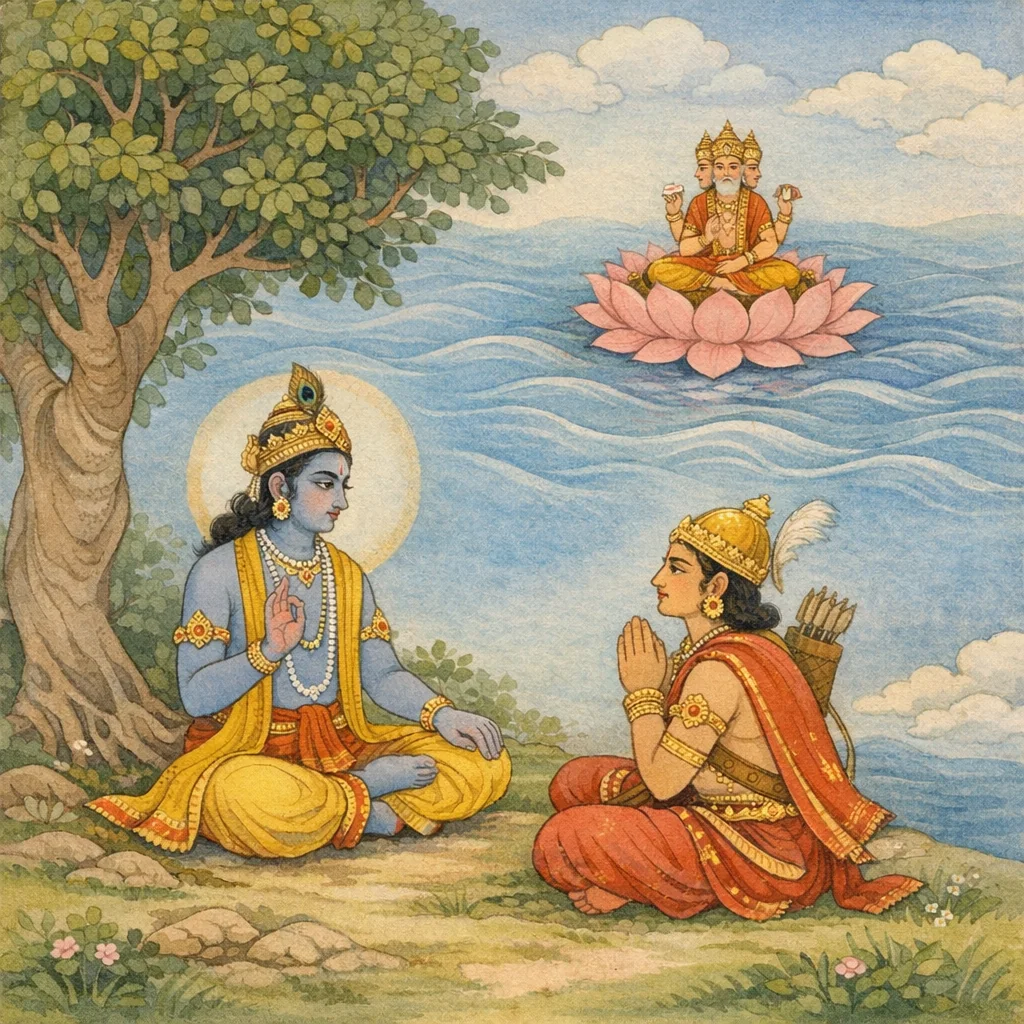
Chapter Arc: जनमेजय जिज्ञासा प्रकट करते हैं—व्यास ने शिष्यों सहित जिन विविध नामों, गुणों और कर्मों से प्रजापतिपति हरि का वर्णन किया, उसका रहस्य क्या है; वह ऐसा श्रवण चाहते हैं जो उन्हें ‘शरच्चन्द्र’ की भाँति निर्मल कर दे। → वैशम्पायन आरम्भ करते हैं: अर्जुन के प्रति श्रीहरि प्रसन्न होकर अपने नामों की ‘निरुक्ति’ (उत्पत्ति-व्याख्या) और गुण-कर्म-सम्बन्धी अर्थ खोलते हैं—प्रलय-रात्रि के पार से सृष्टि-प्रवाह, अनिरुद्ध-प्रसाद, पद्म-प्राकट्य और ब्रह्मा की उत्पत्ति तक। श्रोता के सामने प्रश्न उभरता है: एक ही सनातन सत्ता कैसे निवृत्ति-धर्म और अभ्युदय-धर्म—दोनों का आधार है? → नारायण-तत्त्व का निर्णायक उद्घोष: ‘आपो नारा’—जल ‘नार’ कहलाता है और वही मेरा ‘अयन’ है, इसलिए मैं नारायण हूँ; साथ ही यह भी कि जगत् के प्रकाश (सूर्य-अग्नि-चन्द्र) की किरणें ‘केश’ हैं—इससे केशव नाम का रहस्य और सर्वव्यापकता का बोध चरम पर पहुँचता है। → श्रीहरि स्वयं को एकमात्र सनातन मार्ग बताते हैं—निवृत्ति (मोक्षाभिमुख) और अभ्युदय (लोक-धारण) दोनों धर्मों का आश्रय; अर्जुन को वरद, शरणद, हव्य-कव्य-भुज विष्णु को नमस्कार करने का उपदेश देकर कथा श्रद्धा-समर्पण में स्थिर होती है। → मानव-तनु में भारावतरण हेतु प्रवेश और नर-नारायण-ऋषि-तत्त्व की ओर संकेत—अर्जुन और कृष्ण की एकात्म-परम्परा का रहस्य आगे और गहराने का द्वार खोल देता है।
Shlokas
Verse 1
अपन का छा | अप्-७#रात जा - पशुवधसे यहाँ क्या अभिप्राय है, ठीक समझमें नहीं आया। एकचत्वारिशदधिकत्रिशततमो< ध्याय: भगवान् श्रीकृष्णका अर्जुनको अपने प्रभावका वर्णन करते हुए अपने नामोंकी व्युत्पत्ति एवं माहात्म्य बताना जनमेजय उवाच अस्तौषीद् यैरिमं व्यास: सशिष्यो मधुसूदनम् । नामभिवीविधैरेषां निरुक्ते भगवन् मम,जनमेजयने कहा--भगवन्! शिष्योंसहित महर्षि व्यासने जिन नाना प्रकारके नामोंद्वारा इन मधुसूदनका स्तवन किया था, उनका निर्वचन (व्युत्पत्ति) मुझे बतानेकी कृपा करें। मैं प्रजापतियोंके पति भगवान् श्रीहरिके नामोंकी व्याख्या सुनना चाहता हूँ; क्योंकि उन्हें सुनकर मैं शरच्चन्द्रके समान निर्मल एवं पवित्र हो जाऊँगा
Janamejaya said: “O Blessed One, please explain to me the derivations and intended meanings of those many different names by which the sage Vyāsa, together with his disciples, praised Madhusūdana. I wish to hear the elucidation of the names of Lord Hari, the sovereign of the Prajāpatis; for by hearing them I shall become pure and spotless, like the autumn moon.”
Verse 2
वक्तुमर्हसि शुश्रूषो: प्रजापतिपतेह॑रे: । श्रुत्वा भवेयं यत् पूत: शरच्चन्द्र इवामल:,जनमेजयने कहा--भगवन्! शिष्योंसहित महर्षि व्यासने जिन नाना प्रकारके नामोंद्वारा इन मधुसूदनका स्तवन किया था, उनका निर्वचन (व्युत्पत्ति) मुझे बतानेकी कृपा करें। मैं प्रजापतियोंके पति भगवान् श्रीहरिके नामोंकी व्याख्या सुनना चाहता हूँ; क्योंकि उन्हें सुनकर मैं शरच्चन्द्रके समान निर्मल एवं पवित्र हो जाऊँगा
Janamejaya said: “Please explain it to me, for I am eager to listen about Hari, the Lord of the Prajāpatis. By hearing (the meanings of) his names, I may become purified—spotless and clear like the autumn moon.”
Verse 3
वैशम्पायन उवाच शृणु राजन् यथा<<चष्ट फाल्गुनस्य हरि: प्रभु: । प्रसन्नात्मा55त्मनो नाम्नां निरुक्त गुणकर्मजम्,वैशम्पायनजीने कहा--राजन्! भगवान् श्रीहरिने अर्जुनपर प्रसन्न होकर उनसे गुण और कर्मके अनुसार स्वयं अपने नामोंकी जैसी व्याख्या की थी, वही तुम्हें सुना रहा हूँ, सुनो
Vaiśampāyana said: “O King, listen. I shall recount to you exactly how the Lord Hari, the sovereign, with a gracious and serene heart, explained the meanings of His own names to Phālguna (Arjuna) in accordance with His qualities and deeds.”
Verse 4
नामश्रि: कीर्तितिस्तस्य केशवस्य महात्मन: । पृष्टवान् केशवं राजन् फाल्गुन: परवीरहा,नरेश्वर! जिन नामोंके द्वारा उन महात्मा केशवका कीर्तन किया जाता है, शत्रुवीरोंका संहार करनेवाले अर्जुनने श्रीकृष्णसे उनके विषयमें इस प्रकार पूछा
Vaiśampāyana said: “O king, the auspicious names and renown by which that great-souled Keśava is celebrated—about these, Phālguna (Arjuna), the slayer of hostile champions, questioned Keśava, O lord of men.”
Verse 5
अर्जुन उवाच भगवन् भूतभव्येश सर्वभूतसृगव्यय । लोकधाम जगन्नाथ लोकानामभयप्रद
Arjuna said: “O Blessed Lord, sovereign of past and future, creator of all beings and yet imperishable; O abode of the worlds, Lord of the universe—grantor of fearlessness to all worlds.”
Verse 6
यानि नामानि ते देव कीर्तितानि महर्षिभि: | वेदेषु सपुराणेषु यानि गुह्मानि कर्मभि:
Arjuna said: “O divine one, those names of yours that have been celebrated by the great seers—those secret names spoken of in the Vedas and the Purāṇas, and those connected with hidden rites and sacred acts—(please declare them to me).”
Verse 7
तेषां निरुक्त त्वत्तो5हं श्रोतुमिच्छामि केशव । न हान्यो वर्ण येन्नाम्नां निरुक्तं त्वामृते प्रभो
Arjuna said: “O Keśava, I wish to hear from you the true derivations and explanations of those names. No other speaker can properly state the meaning and etymology of these names apart from you, O Lord.”
Verse 8
अर्जुन बोले--भूत, वर्तमान और भविष्य--तीनों कालोंके स्वामी, सम्पूर्ण भूतोंके स्रष्टा, अविनाशी, जगदाधार तथा सम्पूर्ण लोकोंको अभय देनेवाले जगन्नाथ, भगवन्, नारायणदेव! महर्षियोंने आपके जो-जो नाम कहे हैं तथा पुराणों और वेदोंमें कर्मानुसार जो-जो गोपनीय नाम पढ़े गये हैं, उन सबकी व्याख्या मैं आपके मुहसे सुनना चाहता हूँ। प्रभो! केशव! आपके सिवा दूसरा कोई उन नामोंकी व्युत्पत्ति नहीं बता सकता || ५-- ७ || श्रीभगवानुवाच ऋग्वेदे सयजुर्वेदे तथैवाथर्वसामसु । पुराणे सोपनिषदे तथैव ज्यौतिषेडर्जुन,श्रीभगवान्ने कहा--अर्जुन! ऋग्वेद, यजुर्वेद, सामवेद, अथर्ववेद, उपनिषद्, पुराण, ज्योतिष, सांख्यशास्त्र, योगशास्त्र तथा आयुर्वेदमें महर्षियोंने मेरे बहुत-से नाम कहे हैं
Arjuna said: “O Lord of the three times—past, present, and future; Creator of all beings; imperishable One; support of the universe; Jagannātha who grants fearlessness to all worlds—O blessed Nārāyaṇa! The sages have spoken many names of You, and in the Purāṇas and the Vedas there are also secret names taught according to the law of action and its fruits. I wish to hear from Your own mouth the explanation of them all. O Master, Keśava—no one other than You can state the true derivations and meanings of those names.” The Blessed Lord said: “O Arjuna, in the Ṛgveda, the Yajurveda, the Sāmaveda and Atharvaveda; in the Purāṇas together with the Upaniṣads; and likewise in Jyotiṣa, Sāṅkhya, Yoga, and Āyurveda—the great seers have proclaimed many names of Mine.”
Verse 9
सांख्ये च योगशास्त्रे च आयुर्वेदे तथैव च | बहूनि मम नामानि कीर्तितानि महर्षिभि:,श्रीभगवान्ने कहा--अर्जुन! ऋग्वेद, यजुर्वेद, सामवेद, अथर्ववेद, उपनिषद्, पुराण, ज्योतिष, सांख्यशास्त्र, योगशास्त्र तथा आयुर्वेदमें महर्षियोंने मेरे बहुत-से नाम कहे हैं
The Blessed Lord said: “In Sāṅkhya, in the treatises on Yoga, and likewise in Āyurveda, the great seers have celebrated many names of Mine.”
Verse 10
गौणानि तत्र नामानि कर्मजानि च कानिचित् । निरुक्त कर्मजानां त्वं शृणुष्व प्रयतो5नघ,उनमें कुछ नाम तो गुणोंके अनुसार हैं और कुछ कर्मोंसे हुए हैं। निष्पाप अर्जुन! तुम पहले एकाग्रचित होकर मेरे कर्मजनित नामोंकी व्याख्या सुनो
“There, some names are secondary—arising from qualities—while some others arise from deeds. O sinless one, listen with focused attention as I first explain the names that are born of actions.”
Verse 11
कथ्यमानं मया तात त्वं हि मे<र्थ स्मृत: पुरा । नमो5तियशसे तस्मै देहिनां परमात्मने
Arjuna said: “As I speak, dear father-like one, it is you who comes to my mind as the true meaning remembered from earlier. Salutations to that supremely glorious Supreme Self of embodied beings.”
Verse 12
यस्य प्रसादजो ब्रह्मा रुद्रश्न क्रोधसम्भव:
Arjuna said: “From whose gracious favor Brahmā is born, and from whose wrath Rudra arises—(that Supreme being is the source of both creative order and destructive force).”
Verse 13
अष्टादशगुणं यत् तत् सत्त्वं सत्तववतां वर,बुद्धिमानोंमें श्रेष्ठ अर्जुन! अठारह- गुणोंवाला जो सत्त्व है अर्थात् आदिपुरुष है, वही मेरी परा प्रकृति है। पृथ्वी और आकाशकी आत्मस्वरूपा वह योगबलसे समस्त लोकोंको धारण करनेवाली है। वही ऋता (कर्मफलभूत गतिस्वरूपा), सत्या (त्रिकालाबाधित ब्रह्मरूपा) अमर, अजेय तथा सम्पूर्ण लोकोंकी आत्मा है
Arjuna said: “O best among the virtuous, that ‘sattva’ endowed with eighteen qualities—indeed the primal Person—is my higher Nature. As the very self of earth and space, it upholds all worlds by the power of yoga. It is Ṛtā, the cosmic order that yields the fruits of action; it is Satyā, the truth never contradicted in any of the three times—immortal and unconquerable, the inner Self of all beings and all realms.”
Verse 14
प्रकृति: सा परा महां रोदसी योगधारिणी । ऋता सत्यामराजय्या लोकानामात्मसंज्ञिता,बुद्धिमानोंमें श्रेष्ठ अर्जुन! अठारह- गुणोंवाला जो सत्त्व है अर्थात् आदिपुरुष है, वही मेरी परा प्रकृति है। पृथ्वी और आकाशकी आत्मस्वरूपा वह योगबलसे समस्त लोकोंको धारण करनेवाली है। वही ऋता (कर्मफलभूत गतिस्वरूपा), सत्या (त्रिकालाबाधित ब्रह्मरूपा) अमर, अजेय तथा सम्पूर्ण लोकोंकी आत्मा है
Arjuna said: “That supreme Prakṛti is vast—the very inner essence of earth and sky—upholding all worlds through the power of yoga. She is Ṛtā, the ordered course by which deeds mature into their results; she is Satyā, the truth uncontradicted in all three times. Immortal and unconquerable, she is known as the Self of all beings in all the worlds.”
Verse 15
तस्मात् सर्वा: प्रवर्तन्ते सर्गप्रलयविक्रिया: । तपो यज्ञश्न यष्टा च पुराण: पुरुषो विराट
Therefore, from Him proceed all transformations—creation and dissolution. He is austerity itself, the sacrifice, and the sacrificer; the Ancient Person, the all-pervading Cosmic Being.
Verse 16
ब्राह्मे रात्रिक्षये प्राप्ते तस्य हुमिततेजस:,जब प्रलयकी रात व्यतीत हुई थी, उस समय उन अमित तेजस्वी अनिरुद्धकी कृपासे एक कमल प्रकट हुआ। कमलनयन अर्जुन! उसी कमलसे ब्रह्माजीका प्रादुर्भाव हुआ। वे ब्रह्मा भगवान् अनिरुद्धके प्रसादसे ही उत्पन्न हुए हैं
When the cosmic night of Brahmā had come to its end, by the grace of the immeasurably radiant Aniruddha a lotus manifested. From that very lotus Brahmā came forth; thus Brahmā’s emergence is said to be due to Aniruddha’s favor.
Verse 17
प्रसादात् प्रादुरभवत् पद्म पद्मनिभेक्षण । ततो ब्रह्मा समभवत् स तस्यैव प्रसादज:,जब प्रलयकी रात व्यतीत हुई थी, उस समय उन अमित तेजस्वी अनिरुद्धकी कृपासे एक कमल प्रकट हुआ। कमलनयन अर्जुन! उसी कमलसे ब्रह्माजीका प्रादुर्भाव हुआ। वे ब्रह्मा भगवान् अनिरुद्धके प्रसादसे ही उत्पन्न हुए हैं
Arjuna said: “By his grace a lotus appeared, O lotus-eyed one. From that lotus Brahmā came into manifestation; that Brahmā was born solely from the grace of that very Lord.”
Verse 18
अद्न: क्षये ललाटाच्च सुतो देवस्य वै तथा । क्रोधाविष्टस्य संजज्ञे रुद्र: संहारकारक:,ब्रह्माका दिन बीतनेपर क्रोधके आवेशमें आये हुए उस देवके ललाटसे उनके पुत्ररूपमें संहारकारी रुद्र प्रकट हुए
Arjuna said: “When the day came to its end, from the forehead of that god—overwhelmed by anger—there arose, as it were his son, Rudra, the agent of destruction. The passage underscores how unchecked wrath, even in a divine being, precipitates forces of dissolution, warning that anger ungoverned by dharma becomes a cause of ruin.”
Verse 19
एतौ द्वौ विबुधश्रेष्ठी प्रसादक्रो धजावुभौ । तदादेशितपन्थानौ सृष्टिसंहारकारकौ,ये दोनों श्रेष्ठ देवता--ब्रह्मा और रुद्र भगवानके प्रसाद और क्रोधसे प्रकट हुए हैं तथा उन्हींके बताये हुए मार्गका आश्रय ले सृष्टि और संहारका कार्य पूर्ण करते हैं
Arjuna said: “These two foremost among the gods—Brahmā and Rudra—are manifested through His grace and His wrath. Following the path ordained by Him, they carry out the works of creation and dissolution.”
Verse 20
निमित्तमात्रं तावत्र सर्वप्राणिवरप्रदौ । कपर्दी जटिलो मुण्ड: श्मशानगृहसेवक:,समस्त प्राणियोंको वर देनेवाले वे दोनों देवता सृष्टि और प्रलयके निमित्तमात्र हैं। (वास्तवमें तो वह सब कुछ भगवान्की इच्छासे ही होता है।) इनमेंसे संहारकारी रुद्रके कपर्दी (जटाजूटधारी), जटिल, मुण्ड, श्मशानगृहका सेवन करनेवाले, उग्र व्रतका आचरण करनेवाले, रुद्र, योगी, परम दारुण, दक्षयज्ञ-विध्वंसक तथा भगनेत्रहारी आदि अनेक नाम हैं
Arjuna said: “In this matter, those two deities—bestowers of boons upon all living beings—are only instrumental causes in creation and dissolution. Among them, the destructive Rudra is known by many epithets: the matted-haired (kapardī), the ascetic with tangled locks (jaṭila), the shaven-headed (muṇḍa), the dweller in cremation-grounds (śmaśānagṛha-sevaka), the observer of fierce vows, the yogin, the exceedingly terrible one, the destroyer of Dakṣa’s sacrifice, and the remover of Bhaga’s eye—indicating that cosmic events unfold under the supreme will, while even great gods function as instruments within that order.”
Verse 21
उग्रव्रतचरो रुद्रो योगी परमदारुण: । दक्षक्रतुहरश्चैव भगनेत्रहरस्तथा,समस्त प्राणियोंको वर देनेवाले वे दोनों देवता सृष्टि और प्रलयके निमित्तमात्र हैं। (वास्तवमें तो वह सब कुछ भगवान्की इच्छासे ही होता है।) इनमेंसे संहारकारी रुद्रके कपर्दी (जटाजूटधारी), जटिल, मुण्ड, श्मशानगृहका सेवन करनेवाले, उग्र व्रतका आचरण करनेवाले, रुद्र, योगी, परम दारुण, दक्षयज्ञ-विध्वंसक तथा भगनेत्रहारी आदि अनेक नाम हैं
Arjuna said: “Rudra is famed as the fierce observer of austere vows—an ascetic yogin of terrifying aspect. He is also known as the destroyer of Dakṣa’s sacrificial rite and as the one who tore out Bhaga’s eye.”
Verse 22
नारायणात्मको ज्ञेय: पाण्डवेय युगे युगे । तस्मिन् हि पूज्यमाने वै देवदेवे महेश्वरे
Arjuna said: “O descendant of the Pāṇḍus, know him to be of the very nature of Nārāyaṇa, in every age. For when that Lord of lords, Maheśvara, is duly worshipped, (the highest divine principle is honored through him).”
Verse 23
अहमात्मा हि लोकानां विश्वेषां पाण्डुनन्दन
O son of Pāṇḍu, I am indeed the very Self of all beings in all the worlds.
Verse 24
यद्य॒हं नार्चयेयं वै ईशानं वरदं शिवम्
Arjuna said: “If I were not to worship Īśāna—Śiva, the auspicious Lord who grants boons—then I would be failing in the reverence owed to the divine source of protection and grace.”
Verse 25
मया प्रमाणं हि कृतं लोक: समनुवर्तते
“I have indeed set the standard; the world follows in accordance with it.”
Verse 26
प्रमाणानि हि पूज्यानि ततस्तं पूजयाम्यहम् । यस्तं वेत्ति स मां वेत्ति योडनुतं स हि मामनु
Arjuna said: “Authoritative standards are indeed worthy of reverence; therefore I revere him. Whoever truly knows him, knows me; and whoever follows him, in truth follows me as well.”
Verse 27
मेरे किये हुए कार्यको प्रमाण या आदर्श मानकर सब लोग उसका अनुसरण करते हैं। जिनकी पूजनीयता वेदशास्त्रोंद्वारा प्रमाणित है, उन्हीं देवताओंकी पूजा करनी चाहिये। ऐसा सोचकर ही मैं रुद्रदेवकी पूजा करता हूँ। जो रुद्रको जानता है, वह मुझे जानता है। जो उनका अनुगामी है, वह मेरा भी अनुगामी है ।। रुद्रो नारायणश्लैव सत्त्वमेकं द्विधाकृतम् । लोके चरति कौन्तेय व्यक्तिस्थं सर्वकर्मसु,कुन्तीनन्दन! रुद्र और नारायण दोनों एक ही स्वरूप हैं, जो दो स्वरूप धारण करके भिन्न-भिन्न व्यक्तियोंमें स्थित हो संसारमें यज्ञ आदि सब कर्मामें प्रवृत्त होते हैं
Arjuna said: “People take my actions as a standard and follow them. Therefore, thinking that only those deities whose venerability is affirmed by the Vedas and the śāstras should be worshipped, I worship Lord Rudra. Whoever truly knows Rudra knows me; whoever follows him follows me as well. For Rudra and Nārāyaṇa are in truth one and the same Reality, appearing in two forms. O son of Kuntī, that single essence moves through the world, present in distinct persons, and engaged in all actions—such as sacrifices and other sacred rites.”
Verse 28
न हि मे केनचिद् देयो वर: पाण्डवनन्दन । इति संचिन्त्य मनसा पुराणं रुद्रमी श्वरम्
Arjuna said: “O joy of the Pāṇḍavas, there is no boon that anyone can grant me.” Having thus reflected within his mind, he turned his thought toward the ancient Rudra—Īśvara himself—knowing that true refuge and the highest gift lie not in human favor, but in the divine source of power and dharma.
Verse 29
न हि विष्णु: प्रणमति कस्मैचिद् विबुधाय च
Arjuna said: “For Viṣṇu does not bow down to anyone—nor even to any celestial being.” In context, the line underscores Viṣṇu’s supreme, independent status, implying that ultimate reverence is due to the highest principle rather than to subordinate powers.
Verse 30
सब्रह्यका: सरद्राश्न सेन्द्रा देवा: सहर्षिभि:
Arjuna said: “Even the gods—together with Brahmā, with Indra, and accompanied by the seers (ṛṣis)—are present.” This indicates that what is being discussed is not merely human, but is weighed against a cosmic and ethical horizon, where divine and ṛṣi authority frames the standards of dharma.
Verse 31
भविष्यतां वर्ततां च भूतानां चैव भारत
O Bhārata, this concerns beings yet to come, those presently existing, and those that have already been—spanning all times and all creatures within the moral order.
Verse 32
सर्वेषामग्रणीर्विष्णु: सेव्य: पूज्यश्न नित्यश: । भरतनन्दन! भूत, भविष्य और वर्तमान तीनों कालोंमें होनेवाले समस्त पुरुषोंके भगवान् विष्णु ही अग्रगण्य हैं; अतः सबको सदा उन्हींकी सेवा-पूजा करनी चाहिये ।। ३१ कल नमस्व हव्यदं विष्णुं तथा शरणदं नम
Arjuna declares that among all beings and persons—across past, future, and present—Lord Viṣṇu stands foremost. Therefore, he says, it is a constant duty for everyone to honor Him with devoted service and worship, recognizing Him as the supreme source and guide of dharma.
Verse 33
चतुर्विधा मम जना भक्ता एव हि मे श्रुतम्
Arjuna said: “I have heard that my people are of four kinds, and that they are indeed devoted to me.”
Verse 34
तेषामेकान्तिन: श्रेष्ठा ये चैवानन्यदेवता: । अहमेव गतिस्तेषां निराशी: कर्मकारिणाम्
Among them, the best are those of single-pointed commitment—those who acknowledge no other deity. For such persons, who perform their duties without expectation, I alone am their refuge and final goal.
Verse 35
तुमने मुझसे सुना है कि आर्त, जिज्ञासु, अर्थार्थी और ज्ञानी--ये चार प्रकारके मनुष्य मेरे भक्त हैं। इनमें जो एकान्ततः मेरा ही भजन करते हैं, दूसरे देवताओंको अपना आराध्य नहीं मानते हैं, वे सबसे श्रेष्ठ हैं। निष्कामभावसे समस्त कर्म करनेवाले उन भक्तोंकी परमगति मैं ही हूँ ।। ये च शिष्टास्त्रयो भक्ता: फलकामा हि ते मता: । सर्वे च्यवनधर्मस्ति प्रतिबुद्धस्तु श्रेष्ठभाक्,जो शेष तीन प्रकारके भक्त हैं, वे फलकी इच्छा रखनेवाले माने गये हैं। अतः वे सभी नीचे गिरनेवाले होते हैं--पुण्यभोगके अनन्तर स्वर्गादिलोकोंसे च्युत हो जाते हैं, परंतु ज्ञानी भक्त सर्वश्रेष्ठ फल (भगवत्प्राप्ति)का भागी होता है
Arjuna said: “I have heard from you that there are four kinds of devotees—those distressed, those who seek to know, those who seek gain, and the wise. Among them, those who worship you alone with single-minded devotion, not accepting other deities as their chosen object of worship, are the highest. For those devotees who perform all actions without desire for reward, you alone are the supreme goal. As for the remaining three types of devotees, they are regarded as motivated by the desire for results; therefore they are subject to falling away—after enjoying the fruits of merit, they slip from heaven and other worlds. But the awakened, wise devotee partakes of the most excellent fruit: attainment of the Lord.”
Verse 36
ब्रह्माणं शितिकण्ठं च याश्षान्या देवता: स्मृता: । प्रबुद्धचर्या: सेवन्तो मामेवैष्यन्ति यत् परम्,ज्ञानी भक्त ब्रह्मा, शिव तथा दूसरे देवताओंकी निष्काम भावसे सेवा करते हुए भी अन्तमें मुझ परमात्माको ही प्राप्त होते हैं
Arjuna said: “Those who, with awakened discipline of conduct, worship Brahmā, Śitikaṇṭha (Śiva), and whatever other deities are spoken of, even while serving them in a selfless spirit, ultimately attain Me alone—the Supreme.”
Verse 37
भक्तं प्रति विशेषस्ते एष पार्थनुकीर्तित: । त्वं चैवाहं च कौन्तेय नरनारायणौ स्मृती
Arjuna said: “This distinction of yours toward a devoted follower has now been clearly stated, O descendant of Pritha. And you and I, O son of Kunti, are remembered in tradition as Nara and Nārāyaṇa.”
Verse 38
जानाम्यध्यात्मयोगांश्ष॒ यो5हं यस्माच्च भारत,भारत! मैं अध्यात्मयोगोंको जानता हूँ तथा मैं कौन हूँ और कहाँसे आया हूँ--इस बातका भी मुझे ज्ञान है। लौकिक अभ्युदयका साधक प्रवृत्तिधर्म ओर नि:श्रेयस प्रदान करनेवाला निवृत्तिधर्म भी मुझसे अज्ञात नहीं है। एकमात्र मैं सनातन पुरुष ही सम्पूर्ण मनुष्योंका सुविख्यात आश्रयभूत नारायण हूँ
O Bhārata, I know the disciplines of yoga that lead to spiritual realization; and I know who I am and from where I have come. The dharma of engagement that brings worldly prosperity, and the dharma of renunciation that grants the highest good—neither is unknown to me. Indeed, I alone am the eternal Person, Nārāyaṇa, renowned as the refuge of all human beings.
Verse 39
निवृत्तिलक्षणो धर्मस्तथा5< भ्युदयिको5पि च । नराणामयनं ख्यातमहमेक: सनातन:,भारत! मैं अध्यात्मयोगोंको जानता हूँ तथा मैं कौन हूँ और कहाँसे आया हूँ--इस बातका भी मुझे ज्ञान है। लौकिक अभ्युदयका साधक प्रवृत्तिधर्म ओर नि:श्रेयस प्रदान करनेवाला निवृत्तिधर्म भी मुझसे अज्ञात नहीं है। एकमात्र मैं सनातन पुरुष ही सम्पूर्ण मनुष्योंका सुविख्यात आश्रयभूत नारायण हूँ
I alone am the eternal One, the well-known refuge and final resort of all human beings. I am not ignorant of dharma characterized by renunciation (nivṛtti) that leads to the highest good, nor of dharma characterized by worldly engagement (pravṛtti) that brings prosperity and uplift.
Verse 40
आपो नारा इति प्रोक्ता आपो वै नरसूनव: । अयनं मम तत् पूर्वमतो नारायणो हाहम्,नरसे उत्पन्न होनेके कारण जलको नार कहा गया है। वह नार (जल) पहले मेरा अयन (निवासस्थान) था; इसलिये ही मैं “नारायण” कहलाता हूँ
Waters are called “Nārā”, for waters are indeed the offspring of Nara. Formerly, those Nārā—the primordial waters—were my ayana, my resting place and abode; therefore I am called Nārāyaṇa.
Verse 41
छादयामि जगदू विश्व भूत्वा सूर्य इवांशुभि: । सर्वभूताधिवास श्च वासुदेवस्ततो हाहम्,(जो सबमें व्याप्त हो अथवा जो किसीका निवासस्थान हो, उसे “वासु” कहते हैं) मैं ही सूर्यरूप धारण करके अपनी किरणोंसे सम्पूर्ण जगत्को व्याप्त करता हूँ तथा मैं ही सम्पूर्ण प्राणियोंका वासस्थान हूँ; इसलिये मेरा नाम “वासुदेव” है
Assuming the form of the sun, I pervade and cover the entire universe with my rays; and I am also the abiding dwelling-place of all beings. Therefore I am called Vāsudeva—He who pervades all and in whom all creatures find their residence.
Verse 42
गतिश्न सर्वभूतानां प्रजनश्वापि भारत । व्याप्ता मे रोदसी पार्थ कान्तिशक्षा भ्यधिका मम,भारत! मैं सम्पूर्ण प्राणियोंकी गति ओर उत्पत्तिका स्थान हूँ। पार्थ! मैंने आकाश और पृथ्वीको व्याप्त कर रखा है। मेरी कान्ति सबसे बढ़कर है। भरतनन्दन! समस्त प्राणी अन्तकालनमें जिस ब्रह्मको पानेकी इच्छा करते हैं, वह भी मैं ही हूँ। कुन्तीकुमार! मैं सबका अतिक्रमण करके स्थित हूँ। इन सभी कारणोंसे मेरा नाम “विष्णु” हुआ है
O Bhārata, I am the course and final destination of all beings, and I am also the source from which they arise. O Pārtha, I pervade both heaven and earth; my radiance surpasses all. O best of the Bharatas, the Brahman that all creatures long to attain at the time of death—that too is none other than I. O son of Kuntī, I stand beyond all, transcending everything. For all these reasons, my name is Viṣṇu—the All-pervading.
Verse 43
अधिभूतानि चान्तेषु तदिच्छंश्वास्मि भारत । क्रमणाच्चाप्यहं पार्थ विष्णुरित्यभिसंज्ञित:,भारत! मैं सम्पूर्ण प्राणियोंकी गति ओर उत्पत्तिका स्थान हूँ। पार्थ! मैंने आकाश और पृथ्वीको व्याप्त कर रखा है। मेरी कान्ति सबसे बढ़कर है। भरतनन्दन! समस्त प्राणी अन्तकालनमें जिस ब्रह्मको पानेकी इच्छा करते हैं, वह भी मैं ही हूँ। कुन्तीकुमार! मैं सबका अतिक्रमण करके स्थित हूँ। इन सभी कारणोंसे मेरा नाम “विष्णु” हुआ है
Arjuna said: “O Bhārata, I wish to understand what pertains to embodied beings at the time of life’s end. And, O Pārtha, since I pervade all by my all-surpassing stride and presence, I am therefore known by the name ‘Viṣṇu.’”
Verse 44
दमात् सिद्धि परीप्सन्तो मां जना:कामयन्ति ह । दिवं चोर्वीं च मध्यं च तस्माद् दामोदरो हाहम्,मनुष्य दम (इन्द्रियसंयम) के द्वारा सिद्धि पानेकी इच्छा करते हुए मुझे पाना चाहते हैं तथा दमके द्वारा ही वे पृथ्वी, स्वर्ग एवं मध्यवर्ती लोकोंमें ऊँची स्थिति पानेकी अभिलाषा करते हैं, इसलिये मैं “दामोदर” कहलाता हूँ (“दम एव दाम: तेन उदीर्यति--उन्न्तिं प्राप्नोति यस्मात् स दामोदर:“--यह दामोदर शब्दकी व्युत्पत्ति है)
People who seek attainment through self-restraint desire to reach Me; and by that same discipline they aspire to elevated states in the earth, the heaven, and the intermediate worlds. Therefore I am called “Dāmodara,” for it is through dama (control of the senses) that one rises to higher attainment.
Verse 45
पृश्रिरित्युच्यते चान्नं वेद आपो$मृतं तथा । ममैतानि सदा गर्भ: पृश्चिगर्भस्ततो हाहम्
Arjuna said: “Food is spoken of as ‘pṛśri’; the Veda likewise declares the waters to be nectar. These are ever within me as a womb—therefore I am ‘pṛści-garbha’.”
Verse 46
अन्न, वेद, जल और अमृतको पृश्रनि कहते हैं। ये सदा मेरे गर्भमें रहते हैं; इसलिये मेरा नाम (पृश्निगर्भ” है ।। ऋषय: प्राहुरेवं मां त्रितं कृपनिपातितम् । पृश्चिगर्भ त्रितं पाहीत्येकतद्धितपातितम्,जब त्रितमुनि अपने भाइयोंद्वारा कुएँमें गिरा दिये गये, उस समय ऋषियोंने मुझसे इस प्रकार प्रार्थना की--'पृश्चिगर्भ! आप एकत और द्वितके गिराये हुए त्रितको डूबनेसे बचाइये।” उस समय मेरे पृश्चिगर्भ नामका बारंबार कीर्तन करनेसे ब्रह्माजीके आदि पुत्र ऋषिप्रवर त्रित उस कुएँसे बाहर हो गये
“Food, the Veda, water, and nectar are called the ‘Pṛśnis’. They always abide within my womb; therefore my name is ‘Pṛśnigarbha’ (He in whose womb the Pṛśnis dwell). The sages once addressed me about Trita, who had been cruelly cast down: ‘O Pṛśnigarbha, save Trita—thrown into the well by Ekata and Dvita!’ When the sage Trita was hurled into a well by his own brothers, the seers prayed to me in this way: ‘O Pṛśnigarbha, rescue Trita, cast down by Ekata and Dvita, from drowning.’ Then, through the repeated invocation of my name “Pṛśnigarbha,” the eminent sage Trita—Brahmā’s primeval son—rose out of that well.”
Verse 47
ततः स ब्रह्मणः पुत्र आद्यो हषिवरस्त्रित: । उत्ततारोदपानाद् वै पृश्चिगर्भानुकीर्तनात्,जब त्रितमुनि अपने भाइयोंद्वारा कुएँमें गिरा दिये गये, उस समय ऋषियोंने मुझसे इस प्रकार प्रार्थना की--'पृश्चिगर्भ! आप एकत और द्वितके गिराये हुए त्रितको डूबनेसे बचाइये।” उस समय मेरे पृश्चिगर्भ नामका बारंबार कीर्तन करनेसे ब्रह्माजीके आदि पुत्र ऋषिप्रवर त्रित उस कुएँसे बाहर हो गये
Then Trita, the foremost of sages and the primeval son of Brahmā, rose up out of the well—indeed, through the repeated invocation of the name “Pṛśnigarbha.” When the sage Trita had been cast into a well by his brothers, the seers appealed to me in this manner: “O Pṛśnigarbha, save Trita, whom Ekata and Dvita have thrown down, from drowning.” Thereupon, by the continual chanting of my name “Pṛśnigarbha,” that ancient sage Trita came forth from the well. The episode underscores the ethical contrast between fraternal jealousy and the rescuing power of truthful remembrance and divine aid.
Verse 48
सूर्यस्य तपतो लोकानग्ने: सोमस्य चाप्युत । अंशवो यत् प्रकाशन्ते ममैते केशसंज्ञिता:
Arjuna said: “From the blazing Sun that heats the worlds, from Fire, and also from the Moon—those rays that shine forth: are these, in truth, called ‘my hairs’?”
Verse 49
सर्वज्ञा: केशवं तस्मान्मामाहुर्द्धिजसत्तमा: । जगत्को तपानेवाले सूर्यकी तथा अग्नि और चन्द्रमाकी जो किरणें प्रकाशित होती हैं, वे सब मेरा केश कहलाती हैं। उस केशसे युक्त होनेके कारण सर्वज्ञ द्विजश्रेष्ठ मुझे "केशव" कहते हैं ।। ४८ $ || एवं हि वरदं नाम केशवेति ममार्जुन | देवानामथ सर्वेषामृषीणां च महात्मनाम्
“Thus, O Arjuna, the name ‘Keśava’ has indeed become a boon-conferring epithet for me—so acknowledged among all the gods and among the great-souled seers.”
Verse 50
अर्जुन! इस प्रकार मेरा “केशव” नाम सम्पूर्ण देवताओं और महात्मा ऋषियोंके लिये वरदायक है ।। अग्नि: सोमेन संयुक्त एकयोनित्वमागत: । अग्नीषोममयं तस्माज्जगत् कृत्स्नं चराचरम्,अग्नि सोमके साथ संयुक्त हो एक योनिको प्राप्त हुए, इसलिये सम्पूर्ण चराचर जगत् अग्नि-सोममय है
Arjuna says: “When Agni is united with Soma, they become as though of a single womb; therefore the entire universe—moving and unmoving—is pervaded by the joint principle of Agni and Soma.”
Verse 51
अपि हि पुराणे भवति एकयोन्यात्मकावग्नीषोमौ देवाश्लाग्निमुखा इति एकयोनित्वाच्च परस्परमर्हन्तो लोकान् धारयन्त इति,पुराणमें यह कहा गया है कि अग्नि और सोम एकयोनि हैं तथा सम्पूर्ण देवताओंके मुख अग्नि हैं। एकयोनि होनेके कारण ये एक-दूसरेको आनन्द प्रदान करते और समस्त लोकोंको धारण करते हैं
Arjuna said: “Indeed, the ancient tradition declares that Agni and Soma arise from a single source, and that for all the gods Agni is the ‘mouth’ through which offerings are received. Because they share one origin, Agni and Soma mutually sustain and gladden one another, and by their reciprocal support they uphold the worlds.”
Verse 113
नारायणाय विश्वाय निर्गुणाय गुणात्मने । तात! मैं तुमसे उन नामोंकी व्युत्पत्ति बताता हूँ, क्योंकि पूर्वकालसे ही तुम मेरे आधे शरीर माने गये हो। जो समस्त देहधारियोंके उत्कृष्ट आत्मा हैं, उन महायशस्वी, निर्मुण सगुणरूप विश्वात्मा भगवान् नारायणदेवको नमस्कार है
Salutations to Nārāyaṇa—the All-pervading Universal One, beyond qualities (nirguṇa) yet the very essence of qualities (guṇātmā), the World-Self.
Verse 126
योअसौ योनिर्हि सर्वस्य स्थावरस्य चरस्य च । जिनके प्रसादसे ब्रह्मा और क्रोधसे रुद्र प्रकट हुए हैं, वे श्रीहरि ही सम्पूर्ण चराचर जगतकी उत्पत्तिके कारण हैं
Arjuna said: He alone is truly the womb and source of all existence—of the immovable and the moving. By his grace Brahmā comes forth, and from his wrath Rudra arises. That Śrī Hari alone is the cause of the origin of the entire universe, of all that moves and all that does not.
Verse 156
अनिरुद्ध इति प्रोक्तो लोकानां प्रभवाप्यय: । उसीसे सृष्टि और प्रलय आदि सम्पूर्ण विकार प्रकट होते हैं। वही तप, यज्ञ और यजमान है, वही पुरातन विराट पुरुष है, उसे ही अनिरुद्ध कहा गया है। उसीसे लोकोंकी सृष्टि और प्रलय होते हैं
Arjuna said: He is called “Aniruddha”—the source from whom the worlds arise and into whom they dissolve. From him proceed creation and dissolution and all the transformations of existence; he is the austerity, the sacrifice, and the sacrificer, the ancient cosmic Person (Virāṭ) who upholds the order of the world.
Verse 223
सम्पूजितो भवेत् पार्थ देवो नारायण: प्रभु: । पाण्डुनन्दन! इन भगवान् रुद्रको नारायणस्वरूप ही जानना चाहिये। पार्थ! प्रत्येक युगमें उन देवाधिदेव महेश्वरकी पूजा करनेसे सर्वसमर्थ भगवान् नारायणकी ही पूजा होती है
Arjuna said: “O Partha, the sovereign Lord Narayana is truly honored when worship is offered in the right spirit. O son of Pandu, understand this revered Rudra to be none other than a manifestation of Narayana. O Partha, in every age, by worshipping Maheshvara—the God above the gods—one in fact worships Narayana, the all-powerful Lord.”
Verse 233
तस्मादात्मानमेवाग्रे रुद्रं सम्पूजयाम्यहम् | पाण्डुकुमार! मैं सम्पूर्ण जगत्का आत्मा हूँ। इसलिये मैं पहले अपने आत्मारूप रुद्रकी ही पूजा करता हूँ
Therefore, I first worship Rudra as my very own Self. O son of Pandu, I am the inner Self of the entire universe; hence, at the outset I honor Rudra in the form of my own indwelling essence.
Verse 243
आत्मानं नार्चयेत् कश्चिदिति मे भावितात्मन: । यदि मैं वरदाता भगवान् शिवकी पूजा न करूँ तो दूसरा कोई भी उन आत्मरूप शंकरका पूजन नहीं करेगा, ऐसी मेरी धारणा है
Arjuna said: “It has become my settled conviction, born of a disciplined mind, that if I do not worship Lord Śiva—the divine giver of boons—then no one else will worship that Śaṅkara who is the very Self.”
Verse 283
पुत्रार्थभाराधितवानहमात्मानमात्मना | पाण्डवोंको आनन्दित करनेवाले अर्जुन! मुझे दूसरा कोई वर नहीं दे सकता; यही सोचकर मैंने पुत्र-प्राप्तिके लिये स्वयं ही अपने आत्मस्वरूप पुराणपुरुष जगदीश्वर रुद्रकी आराधना की थी
Arjuna said: “Seeking the boon of a son, I undertook a weighty act of worship by my own resolve. Thinking, ‘No one else can grant me this boon,’ I worshipped Rudra—who is the ancient Person, the Lord of the universe, and in truth my own Self—so that I might obtain a son.”
Verse 296
ऋते आत्मानमेवेति ततो रुद्रं भजाम्यहम् | विष्णु अपने आत्मस्वरूप रुद्रके सिवा किसी दूसरे देवताको प्रणाम नहीं करते; इसलिये मैं रुद्रका भजन करता हूँ
Arjuna said: “Except for the Self alone—so it is understood. Therefore I worship Rudra. For Viṣṇu, recognizing Rudra as his own very Self, does not bow to any other deity; hence I devote myself to Rudra.”
Verse 306
अर्चयन्ति सुरश्रेष्ठ देव नारायणं हरिम् | ब्रह्मा, रुद्र, इन्द्र तथा ऋषियोंसहित सम्पूर्ण देवता सुरश्रेष्ठ नारायणदेव श्रीहरिकी अर्चना करते हैं
Arjuna said: “The foremost among the gods worship Nārāyaṇa, Hari. Brahmā, Rudra, Indra, and all the deities together with the sages offer reverent worship to that supreme Lord Nārāyaṇa, Śrī Hari.”
Verse 326
वरदं नमस्व कौन्तेय हव्यकव्यभुजं नम | कुन्तीकुमार! तुम हव्यदाता विष्णुको नमस्कार करो, शरणदाता श्रीहरिको शीश झुकाओ, वरदाता विष्णुकी वन्दना करो तथा हव्यकव्यभोक्ता भगवान्को प्रणाम करो
Arjuna said: “O son of Kuntī, bow to Viṣṇu, the giver of boons. Offer reverence to the Lord who receives the sacrificial oblations (havis) and the ancestral offerings (kavya). Pay homage to Śrīhari, the refuge of all, and honor the divine sustainer who accepts worship and grants protection.”
Verse 341
इति श्रीमहाभारते शान्तिपर्वणि मोक्षधर्मपर्वणि नारायणीये एकचत्वारिंशदधिकत्रिशततमो< ध्याय:,इस प्रकार श्रीमहाभारत शान्तिपर्वके अन्तर्गत गोक्षधर्मपर्वमें नारययणकी महिमाविषयक तीन सौ इकतालीसवाँ अध्याय पूरा हुआ
Thus ends, in the Śānti Parva of the Śrī Mahābhārata—within the Mokṣa-dharma section—the Nārāyaṇīya portion: the three-hundred-and-forty-first chapter, which proclaims the greatness of Nārāyaṇa, is concluded.
Verse 373
भारावतरणार्थ तु प्रविष्टी मानुषीं तनुम् । पार्थ! यह मैंने तुमसे भक्तोंका अन्तर बतलाया है। कुन्तीनन्दन! तुम और मैं दोनों ही नर-नारायण नामक ऋषि हैं और पृथ्वीका भार उतारनेके लिये हमने मानव-शरीरमें प्रवेश किया है
For the purpose of lightening the earth’s burden, we have entered a human body. O Pārtha, what I have explained to you is the inner distinction among devotees. O son of Kuntī, you and I are in truth the sages known as Nara and Nārāyaṇa; and in order to remove the weight of the earth, we have taken on human embodiment.
Frequently Asked Questions
The dilemma is epistemic and practical: after fulfilling household obligations, which path should one choose as ‘paramaka dharma’ when multiple respected routes (ritual, renunciation, service ethics, study, restraint) are simultaneously praised and socially validated?
The chapter teaches that dharma operates through multiple legitimate disciplines; therefore, the seeker must cultivate discernment, reduce attachment to pleasure, and align practice with inner disposition and ethical clarity rather than assuming a single universally sufficient method.
No explicit phalaśruti is stated in these verses; the meta-point functions indirectly: recognizing the plurality of dharma-gates and the resulting mental agitation is itself part of the inquiry that motivates deeper mokṣa-dharma instruction.