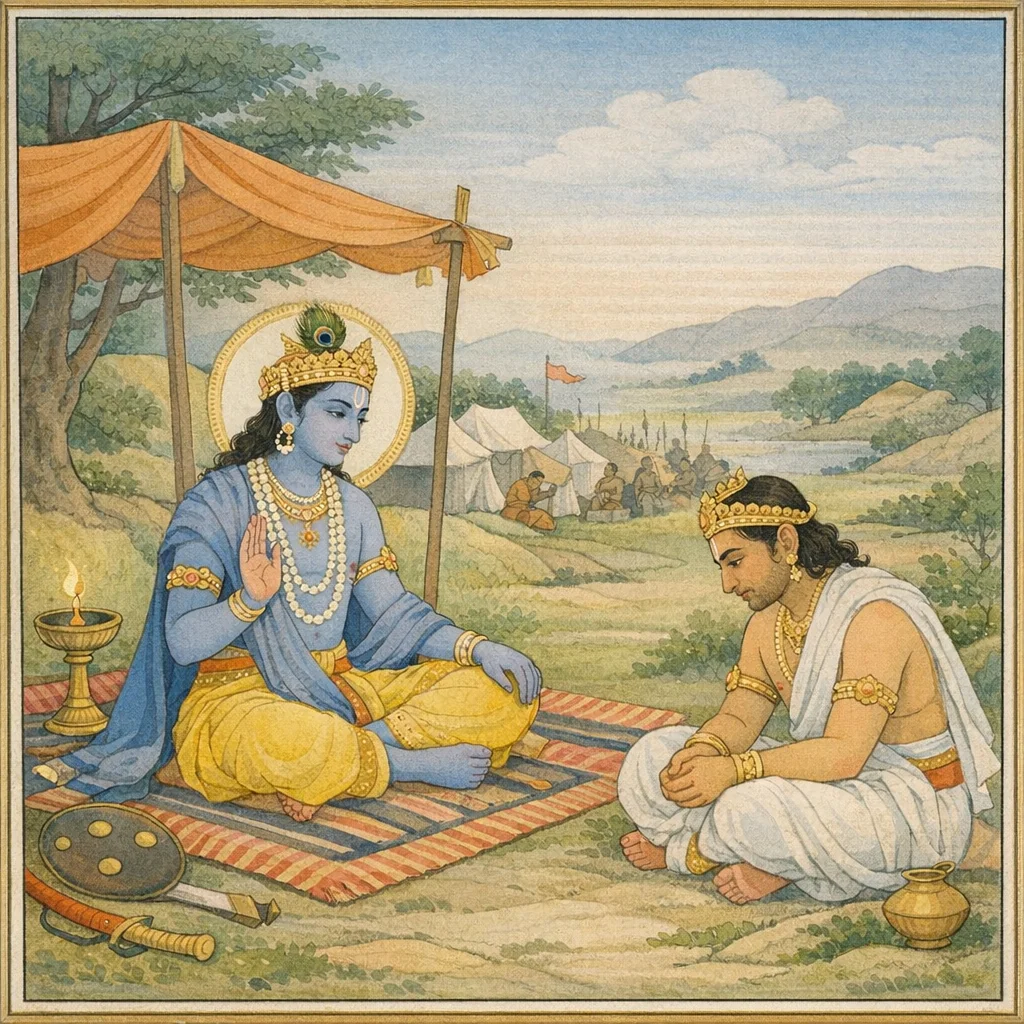
Adhyaya 185
Chapter Arc: धृतराष्ट्र, संजय से उस ‘एकघ्नी’ शक्ति का रहस्य पूछते हैं—जो देवताओं के लिए भी असह्य और अनिवार्य कही गई—कि वह कर्ण के हाथ रहते हुए भी कृष्ण या अर्जुन पर पहले क्यों न चली। → संजय के वर्णन में युद्ध-नीति और भाग्य का जाल कसता है: कर्ण की शक्ति का भय, उसे बचाकर रखने का कारण, और उधर युधिष्ठिर का शोक-क्रोध—जो कर्ण-वध की उत्कट इच्छा में बदलता है। कृष्ण धर्मराज को उठ खड़े होने, धैर्य बाँधने और युद्ध-धुरा सँभालने को प्रेरित करते हैं। → कृष्ण का तीक्ष्ण उपदेश: ‘उत्तिष्ठ राजन् युद्धयस्व’—युधिष्ठिर के भीतर शोक से कर्म की ओर संक्रमण; साथ ही कृष्ण का अर्जुन से कहना कि धर्मराज कर्ण-वध हेतु क्रोधावेश में हैं और युद्ध का निर्णय अब भावुकता नहीं, नीति से होना चाहिए। → व्यास के वचन से दृष्टि स्पष्ट होती है—अर्जुन का जीवित लौटना सौभाग्य है, क्योंकि कर्ण की ‘सव्यसाची-वध’ हेतु सुरक्षित शक्ति अभी तक चली नहीं; इससे पाण्डव-पक्ष को क्षणिक आश्वासन और आगे की रणनीति का आधार मिलता है। → यदि वह शक्ति अब तक न चली, तो वह किस पर और कब चलेगी—और क्या पाण्डव उसे निष्फल कर पाएँगे?
Shlokas
Verse 1
भीकम (2 अमान त्रयशीर्त्याधिकशततमोब< ध्याय: धृतराष्ट्रका पश्चात्ताप, संजयका उत्तर एवं राजा युधिष्ठिरका शोक और भगवान् श्रीकृष्ण तथा महर्षि व्यासद्वारा उसका निवारण धृतराष्ट उवाच कर्णदुर्योधनादीनां शकुने: सौबलस्य च । अपनीतं महत् तात तव चैव विशेषत:ः
Dhṛtarāṣṭra said: “O dear one, a great calamity has befallen Karṇa, Duryodhana, and the others—also Śakuni, the son of Subala—and, most especially, you as well.”
Verse 2
यदि जानीथ तां शक्तिमेकघ्नीं सततं रणे । अनिवार्यामसहांं च देवैरपि सवासवै:
Dhṛtarāṣṭra said: If you know of that spear-weapon—ever deadly in battle, capable of slaying with a single strike, irresistible and unbearable even to the gods together with Indra—then tell me of it.
Verse 3
सा किमर्थ तु कर्णेन प्रवृत्ते समरे पुरा । न देवकीसुते मुक्ता फाल्गुने वापि संजय
Dhṛtarāṣṭra said: “Sañjaya, for what reason was it not released earlier—when Karṇa had already entered the battle—either against Devakī’s son (Kṛṣṇa) or against Phālguna (Arjuna)?”
Verse 4
धृतराष्ट्र बोले--तात संजय! कर्ण, दुर्योधन और सुबलपुत्र शकुनिका तथा विशेषतः तुम्हारा इस विषयमें महान् अन्याय है। यदि तुम लोग जानते थे कि यह शक्ति रणभूमिमें सदा किसी एक ही वीरको मार सकती है तथा इन्द्रसहित सम्पूर्ण देवता भी न तो इसे रोक सकते हैं और न इसका आघात ही सह सकते हैं, तब तुम्हारे सुझानेसे युद्ध आरम्भ होनेपर कर्णने पहले ही देवकीनन्दन श्रीकृष्ण अथवा अर्जुनपर वह शक्ति क्यों नहीं छोड़ी? ।। १-- ३ ।। संजय उवाच संग्रामाद् विनिवृत्तानां सर्वेषां नो विशाम्पते । रात्रौ कुरुकुलश्रेष्ठ मन्त्रोड<यं समजायत,संजयने कहा--प्रजानाथ! कुरुकुलश्रेष्ठ! प्रतिदिन संग्रामसे लौटनेपर रात्रिमें हमलोगोंकी यही सलाह हुआ करती थी कि “कर्ण! तुम कल सबेरा होते ही श्रीकृष्ण अथवा अर्जुनपर यह शक्ति चला देना'
Dhṛtarāṣṭra said: “My son Sañjaya! In this matter a great wrong has been done to Karṇa, Duryodhana, and Śakuni the son of Subala—and most of all to you. If you knew that this Śakti, on the battlefield, can ever slay only a single hero, and that even all the gods with Indra can neither check it nor endure its blow—then why, at your counsel, when the war began, did Karṇa not hurl it at once against Śrī Kṛṣṇa, Devakī’s son, or against Arjuna?” Sañjaya said: “O lord of the people, O best of the Kuru line! Each night, when all of us had returned from the day’s battle, this was the counsel that arose among us: ‘Karna, at dawn tomorrow, unleash that infallible missile upon Kṛṣṇa or upon Arjuna.’”
Verse 5
प्रभातमात्रे श्वोभूते केशवायार्जुनाय वा । शक्तिरेषा हि मोक्तव्या कर्ण कर्णेति नित्यश:,संजयने कहा--प्रजानाथ! कुरुकुलश्रेष्ठ! प्रतिदिन संग्रामसे लौटनेपर रात्रिमें हमलोगोंकी यही सलाह हुआ करती थी कि “कर्ण! तुम कल सबेरा होते ही श्रीकृष्ण अथवा अर्जुनपर यह शक्ति चला देना'
Sañjaya said: “O lord of men, O best of the Kuru line! Each day, when we returned from battle, our constant counsel through the night was this: ‘Karna, at daybreak tomorrow, you must release this divine śakti missile—either at Keśava (Kṛṣṇa) or at Arjuna.’”
Verse 6
ततः प्रभातसमये राजन् कर्णस्य दैवतै: । अन््येषां चैव योधानां सा बुद्धिनश्यिते पुन:,परंतु राजन्। प्रातःकाल आनेपर देवतालोग कर्ण तथा अन्य योद्धाओंके उस विचारको पुनः नष्ट कर देते थे
Sañjaya said: “Then, at daybreak, O King, that resolve of Karṇa—and likewise of the other warriors—was once again undone by the gods.”
Verse 7
दैवमेव परं मन्ये यत् कर्णो हस्तसंस्थया । न जघान रणे पार्थ कृष्णं वा देवकीसुतम्,मैं तो दैव (प्रारब्ध)-को ही सबसे बड़ा मानता हूँ, जिससे कर्णने हाथमें आयी हुई शक्तिके द्वारा रणभूमिमें कुन्तीकुमार अर्जुन अथवा देवकीनन्दन श्रीकृष्णका वध नहीं किया
Sañjaya said: “I regard destiny alone as supreme, for it was by destiny that Karṇa—though he had the śakti weapon already in his grasp—did not slay Pārtha (Arjuna) in battle, nor Kṛṣṇa, the son of Devakī.”
Verse 8
तस्य हस्तस्थिता शक्ति: कालरात्रिरिवोद्यता । दैवोपहतबुद्धित्वान्न तां कर्णो विमुक्तवान्,कर्णके हाथमें स्थित हुई वह शक्ति कालरात्रिके समान शत्रुवधके लिये उद्यत थी; परंतु दैवके द्वारा बुद्धि मारी जानेके कारण देवमायासे मोहित हुए कर्णने इन्द्रकी दी हुई उस शक्तिको देवकीनन्दन श्रीकृष्ण अथवा इन्द्रके समान पराक्रमी अर्जुनपर उनके वधके लिये नहीं छोड़ा
The śakti poised in his hand stood ready for slaughter, like Kālarātri herself risen to strike. Yet Karṇa, his judgment struck down by fate, did not release that weapon—given by Indra—against Devakī’s son Śrī Kṛṣṇa, nor against Arjuna, Indra’s equal in prowess, for their destruction.
Verse 9
कृष्णे वा देवकीपुत्रे मोहितो देवमायया । पार्थे वा शक्रकल्पे वै वधार्थ वासवीं प्रभो,कर्णके हाथमें स्थित हुई वह शक्ति कालरात्रिके समान शत्रुवधके लिये उद्यत थी; परंतु दैवके द्वारा बुद्धि मारी जानेके कारण देवमायासे मोहित हुए कर्णने इन्द्रकी दी हुई उस शक्तिको देवकीनन्दन श्रीकृष्ण अथवा इन्द्रके समान पराक्रमी अर्जुनपर उनके वधके लिये नहीं छोड़ा
Sañjaya said: “Deluded by divine illusion, O lord, Karṇa did not hurl the Vāsavī-śakti (Indra’s spear) with the intent to kill—neither at Kṛṣṇa, the son of Devakī, nor at Pārtha (Arjuna), who was like Indra in prowess.”
Verse 10
धृतराष्ट उवाच दैवेनोपहता यूय॑ स्वबुद्धया केशवस्य च । गता हि वासवी हत्वा तृणभूतं घटोत्कचम्,धृतराष्ट्र बोले--संजय! निश्चय ही तुमलोग दैवके द्वारा मारे गये थे। श्रीकृष्णकी अपनी बुद्धिसे वह इन्द्रकी शक्ति तिनकेके समान घटोत्कचका वध करके चली गयी
Dhṛtarāṣṭra said: “Sañjaya, you were surely struck down by fate—and also by Keśava’s own strategy. For Indra’s divine missile, after killing Ghaṭotkaca who had been made as insignificant as a blade of grass, has now been spent and is gone.”
Verse 11
कर्णश्न मम पुत्राश्न सर्वे चान्ये च पार्थिवा: | तेन वै दुष्प्रणीतेन गता वैवस्वतक्षयम्,अब तो मैं समझता हूँ कि उस दुर्नीतिके कारण कर्ण, मेरे सभी पुत्र तथा अन्य भूपाल यमलोकमें जा पहुँचे
Dhṛtarāṣṭra said: “Now I understand that because of that man’s evil guidance and misrule, Karṇa, all my sons, and the other kings as well have gone to Vaivasvata’s abode—death’s domain.”
Verse 12
भूय एव तु मे शंस यथा युद्धमवर्तत । कुरूणां पाण्डवानां च हैडिम्बे निहते तदा,अब घटोत्कचके मारे जानेपर कौरवों तथा पाण्डवोंमें पुनः: जिस प्रकार युद्ध आरम्भ हुआ, उसीका मुझसे वर्णन करो
Dhṛtarāṣṭra said: “Tell me again, in full, how the battle unfolded—how the fighting resumed between the Kurus and the Pāṇḍavas at that time, after the Haiḍimba (Ghaṭotkaca) had been slain.”
Verse 13
ये च ते<भ्यद्रवन् द्रोणं व्यूढानीका: प्रहारिण: । सृञ्जया: सह पज्चालैस्ते5प्यकुर्वन् कथं रणम्,प्रहार करनेमें कुशल जिन सूंजयों और पांचालोंने अपनी सेनाका व्यूह बनाकर द्रोणाचार्यपर धावा किया था, उन्होंने किस प्रकार संग्राम किया?
Dhṛtarāṣṭra said: “And those Sṛñjayas, together with the Pāñcālas—skilled in striking blows—who, having arrayed their forces in battle-formation, charged at Droṇa: how did they too conduct themselves in the fight?”
Verse 14
सौमदत्तेरवधाद् द्रोणमायान्तं सैन्धवस्य च । अमर्षाज्जीवितं त्यक्त्वा गाहमानं वरूथिनीम्,भूरिश्रवा तथा जयद्रथके वधसे कुपित हो जब द्रोणाचार्य आये और जीवनका मोह छोड़कर पाण्डव-सेनामें उसका मन््थन करते हुए प्रवेश करने लगे, उस समय जँभाई लेते हुए व्याप्र तथा मुँह बाये हुए यमराजके समान बाण-वर्षा करते हुए द्रोणाचार्यके सम्मुख पाण्डव और सृंजय योद्धा कैसे आ सके?
Dhṛtarāṣṭra said: “After the slaying of Saumadatta (Bhūriśravas) and of the Sindhu prince (Jayadratha), Droṇa came forward in wrath. Casting aside all regard for his own life, he plunged into the battle-array, churning the opposing host with his assault. How, then, were the Pāṇḍava and Sṛñjaya warriors able to stand before Droṇa—who, like Death itself with gaping jaws, poured down a storm of arrows?”
Verse 15
जृम्भमाणमिव व्याप्र॑ व्यात्ताननमिवान्तकम् | कथं प्रत्युद्ययुद्रोणमस्यन्तं पाण्डुसूजजया:,भूरिश्रवा तथा जयद्रथके वधसे कुपित हो जब द्रोणाचार्य आये और जीवनका मोह छोड़कर पाण्डव-सेनामें उसका मन््थन करते हुए प्रवेश करने लगे, उस समय जँभाई लेते हुए व्याप्र तथा मुँह बाये हुए यमराजके समान बाण-वर्षा करते हुए द्रोणाचार्यके सम्मुख पाण्डव और सृंजय योद्धा कैसे आ सके?
Dhṛtarāṣṭra said: “When Droṇa, casting off all attachment to life, entered the Pāṇḍava host and churned it with his onslaught—showering arrows like a yawning tiger and like Death himself with gaping mouth—how did the Pāṇḍavas and the Sṛñjayas find the courage to advance against him?”
Verse 16
आचार्य ये च ते5रक्षन् दुर्योधनपुरोगमा: । द्रौणिकर्णकृपास्तात ते वाकुर्वन् किमाहवे,तात! अभश्वत्थामा, कर्ण, कृपाचार्य तथा दुर्योधन आदि जो महारथी रणभूमिमें आचार्य द्रोणकी रक्षा करते थे, उन्होंने वहाँ क्या किया?
Dhṛtarāṣṭra said: “O dear one, those warriors who protected the Teacher—led by Duryodhana, namely Aśvatthāmā, Karṇa, and Kṛpa—what did they do there in the battle? What response or action did they make on the field?”
Verse 17
भारद्वाजं जिघांसन्तौ सव्यसाचिवृकोदरौ । समार्च्छन् मामका युद्धे कं संजय शंस मे,संजय! द्रोणाचार्यको मार डालनेकी इच्छावाले अर्जुन और भीमसेनपर युद्धस्थलमें मेरे सैनिकोंने किस प्रकार आक्रमण किया? यह मुझे बताओ
Dhṛtarāṣṭra said: “When Arjuna (the ambidextrous archer) and Bhīma (the wolf-bellied), intent on slaying Bhāradvāja’s son Droṇa, advanced in battle, how did my warriors assail them? Tell me, Sañjaya.”
Verse 18
सिन्धुराजवधेनेमे घटोत्कचवधेन ते । अमर्षिता: सुसंक्रुद्धा रणं चक्र: कथं निशि,सिंधुराज जयद्रथके वधसे अमर्षमें भरे हुए कौरवों तथा घटोत्कचके मारे जानेसे अत्यन्त कुपित हुए पाण्डवोंने रात्रिमें किस प्रकार युद्ध किया?
Dhṛtarāṣṭra said: “After the slaying of the king of Sindhu (Jayadratha) and after the killing of Ghaṭotkaca, how did the Pāṇḍavas—burning with resentment and inflamed with fierce anger—carry on the battle during the night?”
Verse 19
संजय उवाच हते घटोत्कचे राजन् कर्णेन निशि राक्षसे | प्रणदत्सु च हृष्टेषु तावकेषु युयुत्सुषु,संजयने कहा--राजन्! जब रातमें कर्णके द्वारा राक्षस घटोत्कच मारा गया, आपके सैनिक हर्षमें भरकर युद्धकी इच्छासे गर्जना करते हुए वेगपूर्वक आक्रमण करने लगे तथा पाण्डव-सेना मारी जाने लगी, उस समय प्रगाढ़ रजनीमें राजा युधिष्ठिर अत्यन्त दीन एवं दुःखी हो गये
Sañjaya said: O King, when the rākṣasa Ghaṭotkaca was slain at night by Karṇa, your warriors—exultant and eager for battle—raised loud cries and surged forward to attack. In that deep darkness, as the Pāṇḍava host began to be cut down, King Yudhiṣṭhira became utterly dejected and grief-stricken.
Verse 20
आपतत्सु च वेगेन वध्यमाने बले5पि च । विगाढायां रजन्यां च राजा दैन्यं परं गत:,संजयने कहा--राजन्! जब रातमें कर्णके द्वारा राक्षस घटोत्कच मारा गया, आपके सैनिक हर्षमें भरकर युद्धकी इच्छासे गर्जना करते हुए वेगपूर्वक आक्रमण करने लगे तथा पाण्डव-सेना मारी जाने लगी, उस समय प्रगाढ़ रजनीमें राजा युधिष्ठिर अत्यन्त दीन एवं दुःखी हो गये
Sañjaya said: “O King, as the warriors rushed in with great speed, and even as the army was being cut down, in that deep and dark night the king (Yudhiṣṭhira) fell into extreme despondency.”
Verse 21
अब्रवीच्च महाबाहुर्भीमसेनमिदं वच: । आवारय महाबाहो धार्तराष्ट्स्य वाहिनीम्
Sañjaya said: Then the mighty-armed warrior addressed Bhīmasena with these words: “O mighty-armed one, hold back the army of Dhṛtarāṣṭra’s sons.”
Verse 22
एवं भीम॑ समादिश्य स्वरथे समुपाविशत्,इस प्रकार भीमको आदेश देकर राजा युधिष्ठिर बारंबार सिसकते हुए अपने रथपर जा बैठे। उस समय उनके मुखपर आँसुओंकी धारा बह रही थी। वे कर्णका पराक्रम देखकर घोर चिन्तामें डूब गये थे
Sañjaya said: Having thus instructed Bhīma, King Yudhiṣṭhira mounted his own chariot. Again and again he sobbed; streams of tears ran down his face. Seeing Karṇa’s prowess, he sank into a grim and anxious contemplation.
Verse 23
अश्रुपूर्णमुखो राजा निःश्वसंश्व पुनः पुनः । कश्मलं प्राविशद् घोरं दृष्टवा कर्णस्य विक्रमम्,इस प्रकार भीमको आदेश देकर राजा युधिष्ठिर बारंबार सिसकते हुए अपने रथपर जा बैठे। उस समय उनके मुखपर आँसुओंकी धारा बह रही थी। वे कर्णका पराक्रम देखकर घोर चिन्तामें डूब गये थे
The king, his face filled with tears, sighed again and again. Seeing Karṇa’s valor, he was seized by a dreadful confusion.
Verse 24
त॑ तथा व्यथितं दृष्टवा कृष्णो वचनमत्रवीत् । मा व्यथां कुरु कौन्तेय नैतत् त्वय्युपपद्यते
Sañjaya said: Seeing him so shaken with distress, Kṛṣṇa spoke these words: “Do not give way to grief, O son of Kuntī; such dejection does not befit you.”
Verse 25
उत्तिष्ठ राजन् युद्धयस्व वह गुर्वी धुरं विभो
Sañjaya said: “Rise, O King; enter the battle. O mighty one, bear the heavy burden that has fallen upon you.”
Verse 26
श्रुत्वा कृष्णस्य वचन धर्मराजो युधिष्ठिर:
Sañjaya said: Having heard Kṛṣṇa’s words, Yudhiṣṭhira—the king devoted to dharma—responded.
Verse 27
विमृज्य नेत्रे पाणिभ्यां कृष्णं वचनमब्रवीत् । श्रीकृष्णमका कथन सुनकर धर्मराज युधिष्ठिरने दोनों हाथोंसे अपनी आँखें पोंछकर उनसे इस प्रकार कहा-- ।। विदिता मे महाबाहो धर्माणां परमा गति:
Sañjaya said: Wiping his eyes with both hands, he spoke to Kṛṣṇa: “O mighty-armed one, I understand the highest course and final refuge of dharma.”
Verse 28
अस्माकं हि वनस्थानां हैडिम्बेन महात्मना
Sañjaya said: “For us, who were then living in the forest, it was by the great-souled Haiḍimba…”
Verse 29
अस्त्रहेतोर्गत॑ ज्ञात्वा पाण्डवं श्वेतवाहनम्,“श्रीकृष्ण! श्वेतवाहन अर्जुनको अस्त्र-प्राप्तिके लिये अन्यत्र गया हुआ जानकर महाधनुर्धर घटोत्कच काम्यकवनमें मेरे पास आया और जबतक अर्जुन लौट नहीं आये तबतक हमारे साथ ही रहा
Sañjaya said: Knowing that the Pāṇḍava Arjuna—he whose chariot bears white horses—had gone elsewhere to obtain celestial weapons, the mighty bowman Ghaṭotkaca came to me in the Kāmyaka forest. And until Arjuna returned, he remained there with us.
Verse 30
असोौ कृष्ण महेष्वास: काम्यके मामुपस्थित: । उषितश्न सहास्माभियावन्नासीद् धनंजय:,“श्रीकृष्ण! श्वेतवाहन अर्जुनको अस्त्र-प्राप्तिके लिये अन्यत्र गया हुआ जानकर महाधनुर्धर घटोत्कच काम्यकवनमें मेरे पास आया और जबतक अर्जुन लौट नहीं आये तबतक हमारे साथ ही रहा
Sañjaya said: “O Kṛṣṇa, that great archer came to me in the Kāmyaka forest. He stayed there with us until Dhanañjaya (Arjuna) returned.”
Verse 31
गन्धमादनयात्रायां दुर्गेभ्य श्व॒ सम तारिता: । पाञ्चाली च परिश्रान्ता पृष्ठेनोढा महात्मना,“गन्धमादनकी यात्रामें उसने बड़े-बड़े संकटोंसे हमें बचाया है, पांचालराजकुमारी द्रौपदी जब थक गयी तो उस महाकाय वीरने उन्हें अपनी पीठपर बिठाकर ढोया
Sañjaya said: “On the journey to Gandhamādana, he brought us safely through perilous, hard-to-cross places. And when Pāñcālī (Draupadī) grew exhausted, that great-souled hero carried her upon his back.”
Verse 32
आरम्भाच्चैव युद्धानां यदेष कृतवान् प्रभो । मदर्थे दुष्करं कर्म कृतं तेन महाहवे,'प्रभो! युद्धके आरम्भसे ही इसने मेरा बहुत सहयोग किया है, इसने महायुद्धमें मेरे लिये दुष्कर कर्म कर दिखाया है
Sañjaya said: “O lord, from the very outset of the battles, this one has rendered me great assistance. In the great war, for my sake, he has accomplished a deed exceedingly difficult.”
Verse 33
स्वभावाद् या च मे प्रीति: सहदेवे जनार्दन । सैव मे परमा प्रीती राक्षसेन्द्रे घटोत्कचे,'जनार्दन! सहदेवपर जो मेरा स्वाभाविक प्रेम है, वही उत्तम प्रेम राक्षसराज घटोत्कचपर भी रहा है
Sañjaya said: “O Janārdana, the natural affection I bear for Sahadeva—by that very same feeling I have also held the highest affection for Ghaṭotkaca, lord among the Rākṣasas.”
Verse 34
भक्तश्न मे महाबाहु: प्रियो<स्याहं प्रियश्व मे । तेन विन्दामि वार्ष्णेय कश्मलं शोकतापित:,4वार्ष्णेय! वह महाबाहु मेरा भक्त था। मैं उसे प्रिय था और वह मुझे; इसीलिये उसके शोकसे संतप्त होकर मैं मोहको प्राप्त हो रहा हूँ
Sañjaya said: “That mighty-armed one was devoted to me; I was dear to him, and he was dear to me. Therefore, O Vārṣṇeya, scorched by grief for him, I am falling into bewilderment.”
Verse 35
पश्य सैन्यानि वार्ष्णेय द्राव्यमाणानि कौरवै: । द्रोणकर्णो तु संयत्तौ पश्य युद्धे महारथौ,“वृष्णिनन्दन! देखिये, कौरव किस प्रकार मेरी सेनाओंको खदेड़ रहे हैं तथा महारथी द्रोण और कर्ण किस प्रकार युद्धमें प्रयत्नपूर्वक लगे हुए हैं?
Sañjaya said: “O Vārṣṇeya, look—your forces are being driven back by the Kauravas. And look as well: the great chariot-warriors Droṇa and Karṇa are fully engaged, striving in the battle.”
Verse 36
निशीथे पाण्डवं सैन्यमेतत् सैन्यप्रमर्दितम् गजाभ्यामिव मत्ताभ्यां यथा नलवनं महत्,'जैसे दो मतवाले हाथी नरकुलके विशाल वनको रौंद रहे हों, उसी प्रकार इस आधी रातके समय उनकी सेनाद्वारा यह पाण्डव-सेना कुचल दी गयी है
Sañjaya said: “In the deep of night, this Pāṇḍava host has been crushed and trampled by the enemy’s forces—just as a vast thicket of reeds is flattened when two intoxicated elephants rush through it.”
Verse 37
अनादृत्य बल बाह्वदोर्भीमसेनस्य माधव । चित्रास्त्रतां च पार्थस्य विक्रमन्ति सम कौरवा:,“माधव! भीमसेनके बाहुबल और अर्जुनके विचित्र अस्त्र-कौशलका अनादर करके कौरव योद्धा अपना पराक्रम प्रकट कर रहे हैं
Sañjaya said: “O Mādhava, disregarding the sheer arm-strength of Bhīmasena and the wondrous mastery of weapons of Pārtha (Arjuna), the Kaurava warriors are displaying their own valor on equal terms.”
Verse 38
एष द्रोणश्न कर्णश्न॒ राजा चैव सुयोधन: । निहत्य राक्षसं युद्धे हृष्टा: नर्दन्ति संयुगे,'ये द्रोण, कर्ण तथा राजा दुर्योधन युद्धमें राक्षस घटोत्कचका वध करके बड़े हर्षके साथ सिंहनाद कर रहे हैं
Sañjaya said: “Here are Droṇa, Karṇa, and King Suyodhana. Having slain the rākṣasa in battle, they exult and roar aloud on the field of combat.”
Verse 39
कथं वास्मासु जीवत्सु त्वयि चैव जनार्दन । हैडिम्बि: प्राप्तवान् मृत्युं सूतपुत्रेण सड़तः,'जनार्दन! हमारे और आपके जीते-जी हिडिम्बा-कुमार घटोत्कच सूतपुत्रके साथ संग्राम करके मृत्युको कैसे प्राप्त हुआ?
Sañjaya said: “O Janārdana, while we were still alive—and you too—how did the son of Hidimbā, Ghaṭotkaca, meet his death after engaging in battle with the charioteer’s son?”
Verse 40
कदर्थीकृत्य न: सर्वान् पश्यत: सव्यसाचिन: । निहतो राक्षस: कृष्ण भैमसेनिर्महाबल:,'श्रीकृष्ण!! हम सबकी अवहेलना करके सव्यसाची अर्जुनके देखते-देखते भीमसेनकुमार महाबली राक्षस घटोत्कच मारा गया है
Sañjaya said: “O Kṛṣṇa, in full view of Savyasācin (Arjuna), after humiliating and disregarding all of us, the mighty Rākṣasa—Bhīmasena’s son—has been slain.”
Verse 41
यदाभिमन्युर्निहतो धार्तराष्ट्रैर्दुरात्मभि: । नासीत् तत्र रणे कृष्ण सव्यसाची महारथ:,“श्रीकृष्ण! धृतराष्ट्रके दुरात्मा पुत्रोंने जब युद्धमें अभिमन्युकोी मारा था, उस समय महारथी अर्जुन वहाँ उपस्थित नहीं थे
Sañjaya said: “O Kṛṣṇa, when Abhimanyu was slain in battle by the wicked sons of Dhṛtarāṣṭra, the great chariot-warrior Arjuna, famed as Savyasācī, was not present there on that battlefield.”
Verse 42
निरुद्धाश्न वयं सर्वे सैन्धवेन दुरात्मना | निमित्तमभवद् द्रोण: सपुत्रस्तत्र कर्मणि,“दुरात्मा जयद्रथने हम सब लोगोंको भी व्यूहके बाहर ही रोक लिया था। वहाँ अभिमन्युके वध्में पुत्रसहित द्रोणाचार्य ही कारण हुए थे
Sañjaya said: “All of us were held back and blocked outside by the wicked Saindhava (Jayadratha). In that deed there—Abhimanyu’s slaying—Droṇa, together with his son, became the decisive cause.”
Verse 43
उपदिष्टो वधोपाय: कर्णस्य गुरुणा स्वयम् | व्यायच्छतश्न खड्गेन द्विधा खड्गं चकार ह,“गुरु द्रोणाचार्यने स्वयं ही कर्णको अभिमन्युके वधका उपाय बताया था और जब वह तलवार लेकर परिश्रमपूर्वक युद्ध कर रहा था, उस समय उन्होंने ही उसकी तलवारके दो टुकड़े कर दिये थे
Sañjaya said: “Karṇa had been personally instructed by his teacher in the method of killing; yet, while Karṇa was straining in combat with his sword, the teacher himself struck and split that sword into two.”
Verse 44
व्यसने वर्तमानस्य कृतवर्मा नृशंसवत् | अश्वान् जघान सहसा तथोभीौ पार्ष्णिसारथी,“इस प्रकार जब वह संकटमें पड़ गया, तब कृतवर्माने क्रूर मनुष्यकी भाँति सहसा उसके घोड़ों तथा दोनों पार्श्वरक्षकोंकोी मार डाला
Sañjaya said: “When he had fallen into distress, Kṛtavarmā—acting with ruthless cruelty—suddenly struck down his horses, and likewise killed both of his flank-guards.”
Verse 45
तथेतरे महेष्वासा: सौभद्रं युध्यपातयन् । अल्पे च कारणे कृष्ण हतो गाण्डीवधन्चना
Sañjaya said: “So too did the other great bowmen press Saubhadra in battle and bring him down. And, O Kṛṣṇa, for a trifling pretext, the wielder of the Gāṇḍīva was slain.”
Verse 46
यदि शत्रुवधो न्याय्यो भवेत् कर्तु हि पाण्डवै:
Sañjaya said: “If, for the Pāṇḍavas, the slaying of an enemy could truly be deemed just and proper to carry out…”
Verse 47
एतौ हि मूलं दुःखानामस्माकं पुरुषर्षभ
Sañjaya said: “Indeed, these two are the very root of our sufferings, O bull among men.”
Verse 48
यत्र वध्यो भवेद् द्रोण: सूतपुत्रश्न सानुग:
Sañjaya said: “In that situation where Droṇa is to be slain, and where the charioteer’s son (Karna) along with his followers is also marked for destruction…”
Verse 49
अवश्यं तु मया कार्य: सूतपुत्रस्य निग्रह:,“मुझे तो अवश्य ही सूतपुत्र कर्णका दमन करना चाहिये। अतः वीर! मैं स्वयं ही कर्णका वध करनेकी इच्छासे युद्धभूमिमें जाऊँगा। महाबाहु भीमसेन द्रोणाचार्यकी सेनाके साथ युद्ध कर रहे हैं"
Sañjaya said: “I must, without fail, undertake the subduing of Karna, the son of a charioteer. Therefore, O hero, I myself will go onto the battlefield with the resolve to slay Karna. Meanwhile, the mighty-armed Bhimasena is engaged in combat with the forces of Dronacharya.”
Verse 50
ततो यास्याम्यहं वीर स्वयं कर्णजिघांसया । भीमसेनो महाबाहुद्रोणानीकेन सज्भत:,“मुझे तो अवश्य ही सूतपुत्र कर्णका दमन करना चाहिये। अतः वीर! मैं स्वयं ही कर्णका वध करनेकी इच्छासे युद्धभूमिमें जाऊँगा। महाबाहु भीमसेन द्रोणाचार्यकी सेनाके साथ युद्ध कर रहे हैं"
Sañjaya said: “Then, O hero, I shall go myself, driven by the resolve to strike down Karṇa. Mighty-armed Bhīmasena is already fully engaged in battle with Droṇa’s army.”
Verse 51
एवमुक्त्वा ययौ तूर्ण त्वरमाणो युधिष्ठिर: । स विस्फार्य महच्चापं शड्खं प्रध्माप्य भैरवम्,ऐसा कहकर राजा युधिष्ठिर भयंकर शंख बजाकर अपने विशाल धनुषकी टंकार करते हुए बड़ी उतावलीके साथ तुरंत वहाँसे चल दिये
Sañjaya said: Having spoken thus, Yudhiṣṭhira hurried away at once. In great urgency, he twanged his mighty bow and blew his fearsome conch—an outward proclamation of resolve and a summons to duty amid the press of war.
Verse 52
ततो रथसहस्रेण गजानां च शतैस्त्रिभि: । वाजिभि: पञठ्चसाहस: पज्चालै: सप्रभद्रकैः
Sañjaya said: Then the Pāñcālas advanced—accompanied by the Prabhadrakas—bringing with them a vast force: a thousand chariots, three hundred elephants, and five thousand horses.
Verse 53
ततो भेरी:समाजघ्नु: शड्खान् दध्मुश्न दंशिता:
Then the war-drums were struck in unison, and the armored warriors blew their conches—an organized, resounding signal that the battle-order was set and the conflict was about to surge forward.
Verse 54
ततोअब्रवीन्महाबाहुर्वासुदेवो धनंजयम्,उस समय महाबाहु भगवान् श्रीकृष्णने अर्जुनसे कहा--'ये राजा युधिष्छिर क्रोधके आवेशसे युक्त हो सूतपुत्र कर्णका वध करनेकी इच्छासे शीघ्रतापूर्वक आगे बढ़े जा रहे हैं। इस समय इन्हें अकेले छोड़ देना उचित नहीं है”
Sañjaya said: Then the mighty-armed Vāsudeva spoke to Dhanañjaya (Arjuna): “King Yudhiṣṭhira, seized by a surge of anger, is hastening forward with the intent to slay Karṇa, the son of a charioteer. At such a moment it is not right to leave him to go alone.”
Verse 55
एष प्रयाति त्वरित: क्रोधाविष्टो युधिष्ठिर: । जिधघांसु: सूतपुत्रस्य तस्योपेक्षा न युज्यते,उस समय महाबाहु भगवान् श्रीकृष्णने अर्जुनसे कहा--'ये राजा युधिष्छिर क्रोधके आवेशसे युक्त हो सूतपुत्र कर्णका वध करनेकी इच्छासे शीघ्रतापूर्वक आगे बढ़े जा रहे हैं। इस समय इन्हें अकेले छोड़ देना उचित नहीं है”
Sanjaya said: “Look—King Yudhiṣṭhira, seized by a surge of anger, is hurrying forward with the intent to kill Karṇa, the charioteer’s son. At such a moment, it is not right to leave him unattended or to ignore him.”
Verse 56
एवमुक्त्वा हृषीकेश: शीघ्रमश्चानचोदयत् । दूरं प्रयान्तं राजानमन्वगच्छज्जनार्दन:,ऐसा कहकर भगवान् श्रीकृष्णने शीघ्र ही घोड़ोंको हाँका और दूर जाते हुए राजाका अनुसरण किया
Sañjaya said: Having spoken thus, Hṛṣīkeśa (Kṛṣṇa) swiftly urged on the horses and followed after the king as he rode away into the distance.
Verse 57
त॑ दृष्टवा सहसा यान्तं सूतपुत्रजिघांसया । शोकोपहतसंकल्पं दह्मानमिवाग्निना
Sañjaya said: Seeing him rushing forward in sudden haste, intent on killing the charioteer’s son, his resolve shattered by grief, he appeared as though he were being consumed by fire.
Verse 58
व्यास उवाच कर्णमासाद्य संग्रामे दिष्ट्या जीवति फाल्गुन:
Vyāsa said: “Having encountered Karṇa in the battle, Phālguna (Arjuna) is, by good fortune, still alive.”
Verse 59
नचागाद् द्वैरथं जिष्णुर्दिष्ट्या तेन महारणे
Vyāsa said: By good fortune, Jiṣṇu (Arjuna) did not enter into a chariot-duel with him in that great battle.
Verse 60
सृजेतां स्पर्थिनावेतौ दिव्यान्यस्त्राणि सर्वश: । वध्यमानेषु चास्त्रेषु पीडित: सूतनन्दन:
Vyāsa said: Those two rival warriors unleashed every kind of celestial weapon. As the missiles were struck down and neutralized in mid-course, the charioteer’s son (Karna) was hard-pressed—his assault repeatedly checked amid the escalating exchange of divine arms.
Verse 61
वासवीं समरे शर्क्ति ध्रुवं मुज्चेद् युधिष्ठिर । ततो भवेत् ते व्यसन घोरं॑ भरतसत्तम
Vyāsa said: “O Yudhiṣṭhira, in battle he will certainly hurl the Vāsavī spear. Then a dreadful calamity will befall you, O best of the Bharatas.”
Verse 62
उस महासमरमें कर्णके साथ द्वैरथयुद्ध करनेके लिये अर्जुन नहीं गये, यह बहुत अच्छा हुआ। ये दोनों वीर एक-दूसरेसे स्पर्धा रखते हैं; अतः युधिष्ठिर! यदि ये सब प्रकारसे दिव्यास्त्रोंका प्रयोग करते तो फिर अपने अस्त्रोंके नष्ट होनेपर सूतनन्दन कर्ण पीड़ित हो समरांगणमें इन्द्रकी दी हुई शक्तिको निश्चय ही अर्जुनपर चला देता। भरतश्रेष्ठ) उस दशामें तुमपर और भयंकर विपत्ति टूट पड़ती ।। दिष्ट्या रक्षो हतं युद्धे सूतपुत्रेण मानद । वासवीं कारणं कृत्वा कालेनोपहतो हासौ,मानद! यह हर्षकी बात है कि युद्धमें सूतपुत्र कर्णने उस राक्षसको ही मारा है। वास्तवमें इन्द्रकी शक्तिको निमित्त बनाकर कालने ही उसका वध किया है
Vyāsa said: It was truly fortunate that, in that great battle, Arjuna did not go to engage Karṇa in a chariot-duel. Those two heroes are rivals; therefore, O Yudhiṣṭhira, if they had unleashed every kind of divine weapon, then—when his own missiles were exhausted—Karna, distressed, would certainly have hurled at Arjuna the spear granted by Indra. O best of the Bharatas, in that situation an even more dreadful calamity would have fallen upon you. Happily, O honored one, the charioteer’s son Karṇa slew that rākṣasa in battle. In truth, making Indra’s spear the occasion, Time itself struck him down.
Verse 63
तवैव कारणाद् रक्षो निहतं तात संयुगे । मा क्रुधो भरतश्रेष्ठ माच शोके मन: कृथा:
Vyāsa said: “Because of you alone, dear son, that Rākṣasa has been slain in battle. Do not be angry, O best of the Bharatas, and do not let your mind sink into grief.”
Verse 64
प्राणिनामिह सर्वेषामेषा निष्ठा युधिष्ठिर । तात! भरतश्रेष्ठ तुम्हारे हितके लिये ही वह राक्षस युद्धमें मारा गया है; ऐसा समझकर न तो तुम किसीपर क्रोध करो और न मनमें शोकको ही स्थान दो। युधिष्ठिर! इस जगत्के समस्त प्राणियोंकी अन्तमें यही गति होती है ।। भ्रातृभि: सहित: सर्व: पार्थिवैश्व महात्मभि:
Vyāsa said: “O Yudhiṣṭhira, this is the final certainty for all living beings in this world. Dear child, best of the Bharatas—understand that the rākṣasa was slain in battle for your welfare; therefore do not be angry with anyone, and do not give sorrow a place in your heart. O Yudhiṣṭhira, for all creatures in the world, this alone is the end—this is the common destiny.”
Verse 65
कौरवान् समरे राजन् प्रतियुध्यस्व भारत | पज्चमे दिवसे तात पृथिवी ते भविष्यति
Vyāsa said: “O king, O Bhārata, stand firm and fight the Kauravas in battle. Dear child, on the fifth day the earth—your kingdom and sovereignty—shall be yours.”
Verse 66
भरतवंशी नरेश! तुम अपने समस्त भाइयों तथा महामना भूपालोंके साथ जाकर समरभूमिमें कौरवोंका सामना करो। तात! आजके पाँचवें दिन यह सारी पृथ्वी तुम्हारी हो जायगी ।। नित्यं च पुरुषव्याप्र धर्ममेवानुचिन्तय । आनुृशंस्यं तपो दान क्षमां सत्यं च पाण्डव
Vyāsa said: “O king of Bharata’s line! Go forth with all your brothers and with the high-minded rulers at your side, and meet the Kauravas on the field of battle. Dear child, on this very fifth day the whole earth will become yours. And, O tiger among men, keep your mind always on dharma alone—on compassion, austerity, generosity, forgiveness, and truth, O Pāṇḍava.”
Verse 67
सेवेथा: परमप्रीतो यतो धर्मस्ततो जय: । पुरुषसिंह पाण्डुनन्दन! तुम सदा धर्मका ही चिन्तन करो तथा कोमलता (दयाभाव), तपस्या, दान, क्षमा और सत्य आदि सदगुणोंका ही अत्यन्त प्रसन्नतापूर्वक सेवन करो; क्योंकि जिस पक्षमें धर्म है, उसीकी विजय होती है ।। इत्युक्त्वा पाण्डवं व्यासस्तत्रैवान्न्तरधीयत,पाण्डुपुत्र युधिष्ठिससे ऐसा कहकर महर्षि व्यास वहीं अन्तर्धान हो गये
Vyāsa said: “Serve these with the greatest joy, for where dharma stands, there victory follows. O lion among men, son of Pāṇḍu—keep your mind always on dharma. Gladly cultivate gentleness and compassion, austerity, generosity, forgiveness, truth, and the other noble virtues; for the side on which dharma abides is the side that wins.” Having spoken thus to the Pāṇḍava, the sage Vyāsa vanished then and there, addressing Pāṇḍu’s son Yudhiṣṭhira.
Verse 182
इस प्रकार श्रीमहाभारत द्रोणपर्वके अन्तर्गत घटोत्कचवधपर्वमें रात्रियुद्धके समय श्रीकृष्णवाक्यविषयक एक सौ बयासीवाँ अध्याय पूरा हुआ
Sañjaya said: “Thus, in the Śrī Mahābhārata, within the Droṇa Parva—specifically in the section on the slaying of Ghaṭotkaca—during the night-battle, the one-hundred-and-eighty-second chapter, dealing with the words of Śrī Kṛṣṇa, is concluded.”
Verse 183
इति श्रीमहाभारते द्रोणपर्वणि घटोत्कचवधपर्वणि रात्रियुद्धे व्यासवाक्ये त्रयशीत्यधिकशततमो<ध्याय:
“Thus, in the Śrī Mahābhārata, within the Droṇa Parva—specifically in the section on the slaying of Ghaṭotkaca, during the night-battle—ends the discourse attributed to Vyāsa: the one hundred and eighty-third chapter.”
Verse 216
हैडिम्बेश्वैव घातेन मोहो मामाविशन्महान् | उन महाबाहु नरेशने भीमसेनसे इस प्रकार कहा--“महाबाहो! तुम्हीं दुर्योधनकी सेनाको रोको। घटोत्कचके मारे जानेसे मेरे मनमें महान् मोह छा गया है"
Sañjaya said: “By the slaying of Haidimba’s son (Ghaṭotkaca), a great delusion has seized me.” Then he addressed that mighty-armed king (Dhṛtarāṣṭra) in this manner: “O mighty-armed one, you must restrain Duryodhana’s army. Since Ghaṭotkaca has been killed, a heavy bewilderment has fallen upon my mind.”
Verse 243
वैक्लव्यं भरतश्रेष्ठ यथा प्राकृतपूरुषे । उन्हें इस प्रकार व्यथित देखकर भगवान् श्रीकृष्ण बोले--'कुन्तीनन्दन! भरतश्रेष्ठ! आप दु:ख न मानिये। आपके लिये मूढ़ मनुष्योंकी-ती यह व्याकुलता शोभा नहीं देती
Sañjaya said: “O best of the Bharatas, such faint-hearted agitation is fit only for an ordinary, untrained man.” (In context, seeing Arjuna distressed, Śrī Kṛṣṇa urges him not to succumb to grief or weakness, for it is unbecoming of one who bears the responsibility of dharma in a righteous war.)
Verse 253
त्वयि वैक्लव्यमापन्ने संशयो विजये भवेत् । “राजन! उठिये और युद्ध कीजिये। इस महासंग्रामका गुरुतर भार सँभालिये। प्रभो! आपके घबरा जानेपर विजय मिलनेमें संदेह है”
Sañjaya says: “If you fall into faint-heartedness, O King, victory itself becomes doubtful. Rise and fight; take up the heavy burden of this great war. For if you lose courage, my lord, there can be no certainty of triumph.”
Verse 286
बालेनापि सता तेन कृतं साहां जनार्दन । “जनार्दन! जब हमलोग वनमें थे, उन दिनों महामनस्वी हिडिम्बाकुमारने बालक होनेपर भी हमारी बड़ी भारी सहायता की थी
Sañjaya said: “O Janārdana, even though he was only a boy, he rendered us great help.” The line recalls a past act of timely support, underscoring the ethical weight of gratitude and the duty to remember benefactors, even amid the harsh demands of war.
Verse 453
सैन्धवो यादवश्रेष्ठ तच्च नातिप्रियं मम । “इसी प्रकार दूसरे महाधनुर्धरोंने सुभद्राकुमारको युद्धमें मार गिराया था। यादवश्रेष्ठ श्रीकृष्ण! अभिमन्युके वधमें जयद्रथका बहुत कम अपराध था, तो भी उस छोटे-से कारणको लेकर ही गाण्डीवधारी अर्जुनने जयद्रथको मार डाला है। यह कार्य मुझे अधिक प्रिय नहीं लगा है
Sanjaya said: “O best of the Yadus, the Saindhava (Jayadratha) was involved, yet this does not please me much. For in the slaying of Subhadrā’s son Abhimanyu, Jayadratha’s fault was comparatively small; nevertheless, taking even that slight cause as sufficient, Arjuna, the wielder of the Gāṇḍīva, killed Jayadratha. Ethically, this act does not sit well with me.”
Verse 463
कर्णद्रोणौ रणे पूर्व हन्तव्याविति मे मति: । “यदि पाण्डवोंके लिये अपने शत्रुका वध करना न्याय-संगत है, तो युद्धभूमिमें सबसे पहले कर्ण और द्रोणाचार्यको ही मार डालना चाहिये; मेरा तो यही मत है
Sañjaya said: “In my judgment, if it is deemed righteous for the Pāṇḍavas to slay their enemy for the sake of their cause, then on the battlefield the first to be struck down should be Karṇa and Droṇa. Such is my considered view.”
Verse 473
एतौ रणे समासाद्य समाश्चस्त: सुयोधन: । “पुरुषोत्तम! ये कर्ण और द्रोण ही हमारे दुःखोंके मूल कारण हैं। रणभूमिमें इन्हींका सहारा लेकर दुर्योधनका ढाढ़स बँँधा हुआ है
Sañjaya said: Having encountered these two in battle, Suyodhana (Duryodhana) stood firm. He reflects that Karṇa and Droṇa are the very roots of their suffering; yet it is by leaning on them in the battlefield that Duryodhana’s courage is sustained—revealing the tragic dependence on formidable allies whose choices and loyalties have helped drive the war’s moral collapse.
Verse 526
वृत:ः शिखण्डी त्वरितो राजानं पृष्ठतो5न्वयात् । तदनन्तर शिखण्डी, एक सहस्र रथ, तीन सौ हाथी, पाँच हजार घोड़े तथा पांचालों और प्रभद्रकोंकी सेना साथ ले उनसे घिरा हुआ शीतघ्रतापूर्वक राजा युधिष्ठिरके पीछे-पीछे गया
Sañjaya said: Then Śikhaṇḍī, moving swiftly and surrounded by a strong force—one thousand chariots, three hundred elephants, five thousand horses, along with the armies of the Pāñcālas and the Prabhadrakas—followed close behind King Yudhiṣṭhira. In the midst of war’s confusion, the scene underscores disciplined protection of the rightful leader, where loyalty and coordinated support become a practical expression of dharma on the battlefield.
Verse 533
पज्चाला: पाण्डवाश्वैव युधिष्ठिरपुरोगमा: । तब पांचालों और पाण्डवोंने युधिष्ठिरको आगे करके कवच आदिसे सुसज्जित हो डंके पीटे और शंख बजाये
Sañjaya said: The Pañcālas and the Pāṇḍavas, with Yudhiṣṭhira leading them, advanced in readiness for battle—armored and fully equipped—while beating their war-drums and sounding their conches, affirming resolve and righteous purpose amid the demands of war.
Verse 573
अभिगम्याब्रवीद् व्यासो धर्मपुत्रं युधिष्ठिरम् । धर्मराज युधिष्ठिरका संकल्प (विचार-शक्ति) शोकसे नष्ट-सा हो गया था। वे क्रोधकी आगमें जलते हुए-से जान पड़ते थे। उन्हें सूतपुत्रके वधकी इच्छासे सहसा जाते देख महर्षि व्यास उनके समीप प्रकट हो गये और इस प्रकार बोले
Sañjaya said: Then the great sage Vyāsa approached and addressed Yudhiṣṭhira, the son of Dharma. King Yudhiṣṭhira’s resolve—his power of judgment—seemed all but destroyed by grief; he appeared as though burning in the fire of wrath. Seeing him suddenly hasten away with the desire to slay the charioteer’s son (Karṇa), Vyāsa manifested beside him and spoke thus.
Verse 583
सव्यसाचिवधाकाडुभक्षी शक्ति रक्षितवान् हि सः | व्यासने कहा--राजन्! बड़े सौभाग्यकी बात है कि संग्राममें कर्णका सामना करके भी अर्जुन अभी जीवित हैं; क्योंकि उसने उन्हींके वधकी इच्छासे अपने पास इन्द्रकी दी हुई शक्ति रख छोड़ी थी
Vyāsa said: “O King, it is indeed a great fortune that Arjuna, Savyasācin, still lives even after facing Karṇa in battle. For Karṇa, intent on killing Savyasācin, had been preserving the divine spear-weapon granted by Indra for that very purpose.”
Verse 2736
ब्रह्महत्या फलं तस्य यै: कृतं नावबुध्यते । “महाबाहो! मुझे धर्मकी श्रेष्ठ गति विदित है। जो मनुष्य किसीके किये हुए उपकारको याद नहीं रखता, उसे ब्रह्महत्याका पाप लगता है
Sañjaya said: “The consequence of brahmahatyā—brahmin-slaying—falls upon the one who fails to recognize the good that has been done to him. Mighty-armed one, I know the highest course of dharma: whoever does not remember another’s benefaction incurs the sin of brahmahatyā.”
Verse 4836
तत्रावधीन्महाबाहु: सैन्धवं दूरवासिनम् । “जहाँ द्रोणाचार्यका वध होना चाहिये था तथा जहाँ सेवकोंसहित सूतपुत्र कर्णको मार गिराना चाहिये था, वहाँ महाबाहु अर्जुनने दूर रहनेवाले सिंधुराज जयद्रथका वध किया है
Sañjaya said: “There, the mighty-armed Arjuna slew the Saindhava (Jayadratha), who had kept himself at a distance—striking down the one who stood apart from the main clash. The line underscores the moral irony of war: the blow falls not where one might expect, but upon the evasive offender whose earlier wrongdoing demanded retribution.”