Adhyaya 147
Pratyakṣa–Āgama–Ācāra: Doubt, Proof, and the Practice of Dharma (प्रत्यक्ष–आगम–आचारविचारः)
Upa-parva: Pramāṇa–Ācāra–Dharma Vicāra (Epistemic Inquiry on Dharma)
Vaiśaṃpāyana reports that after Kṛṣṇa’s preceding remarks, Yudhiṣṭhira again questions Bhīṣma about dharma-determination: whether perception (pratyakṣa) or transmitted authority (āgama) is causal/decisive in arriving at a conclusion. Bhīṣma asserts that doubt is easy but decisive certainty is difficult because the domain contains vast seen-and-heard materials that generate competing views. He critiques those who absolutize perception and declare non-existence or uncertainty as final, characterizing such conclusions as immature when detached from disciplined inquiry. He suggests that if one insists on a single “cause,” it is attainable only through sustained, methodical effort over long time, implying the limits of quick reasoning. Yudhiṣṭhira then frames the triad—Veda/śruti, perception, and ācāra—as pramāṇas and asks how dharma can be one if proofs are three. Bhīṣma answers that dharma is one, expressed in three modes, and instructs Yudhiṣṭhira to follow the stated threefold path without corrosive over-argumentation. He distills a practical ethical core—ahiṃsā, satya, akrodha, and dāna—as sanātana-dharma, and advises reverence toward learned brāhmaṇas as guides, while warning against those who manufacture disputes by treating non-proof as proof.
Chapter Arc: पार्वती जिज्ञासा करती हैं—हे शंकर! जो नियमपूर्वक वानप्रस्थ-व्रत धारण कर पवित्र देशों में रहते हैं, उनके पुण्य-विधान और फल क्या हैं? → महादेव वानप्रस्थ-धर्म की कठोरता और सूक्ष्म मर्यादाएँ खोलते हैं—एकाग्रता, शौच, त्रेताग्नि-शरण, यज्ञपात्रों की सादगी, सर्वभूत-दया, और ‘स्वशरीरोपजीविषु’—अपने ही शरीर को तपाकर जीवन-यापन। साथ ही, विविध व्रत-मार्गों के भिन्न-भिन्न लोक-फल (इन्द्रलोक, वरुणलोक आदि) का संकेत देकर साधक के सामने विकल्पों का भार रख देते हैं। → धर्म का शिखर-निष्कर्ष उभरता है—‘सर्वभूतानुकम्पी’ और ‘सर्वभूतार्जवव्रत’ वही है जो वास्तव में धर्म से युक्त है; और जो सब कुछ त्यागकर दीक्षा ले ‘वीराध्वान’ (वीरों का पथ/कठोर तप-मार्ग) पकड़ता है, उसके लिए सनातन लोक सुनिश्चित हैं। → शिव व्रतों के फल को क्रमबद्ध करते हैं—दीक्षा, शुचिता, संयम, नियत आहार/अनशन, वेदी-शयन आदि से दिव्य भोग, विमान-गमन, इन्द्रलोक में निरामय आनंद; और कुछ विशेष दीक्षाओं में देह-त्याग से विशिष्ट लोक (स्वर्ग, वरुणलोक) की प्राप्ति। संदेश स्पष्ट होता है: फल-भेद कर्म-भेद से है, पर धर्म का मूल करुणा और सरलता है। → पार्वती के प्रश्न का विस्तार स्वाभाविक बनता है—इन विविध लोक-फलों में ‘श्रेष्ठ’ कौन-सा है, और क्या फल-आकांक्षा स्वयं व्रत की शुद्धि को घटाती है?
Shlokas
Verse 1
(दाक्षिणात्य अधिक पाठके १०६३ “लोक मिलाकर कुल २२१३ “लोक हैं) न#फ्जमआा न (0) आफजअत+- > यहाँ आचार्य नीलकण्ठके मतमें श्मशान शब्दसे काशीका महाश्मशान ही गृहीत होता है। इसीलिये वहाँ शवके दर्शनसे शिवके दर्शनका फल माना जाता है। - कुछ लोग दूध पीनेके समय बछड़ोंके मुँहमें लगे हुए फेनको ही वह अमृत मानते हैं, उसीका पान करनेवाले उनके मतमें फेनप हैं। आचार्य नीलकण्ठ अन्नके अग्रभाग (रसोईसे निकाले गये अग्राशन) को फेन और उसका उपयोग करनेवालेको फेनप कहते हैं। ३- जो भोजनके पश्चात् पात्रको धो-पोंछकर रख देते हैं, दूसरे दिनके लिये कुछ भी नहीं बचाते हैं, उन्हें सम्प्रक्षाल कहते हैं। २- पत्थरसे फोड़कर खानेवालेको अभ्मकुट्ट कहते हैं। ३- जो दाँतोंसे ही ओखलीका काम लेते हैं अर्थात् अन्नको ओखलीमें न कूटकर दाँतोंसे ही चबाकर खाते हैं वे दन्तोलूखलिक कहलाते हैं। द्विचत्वारिशर्दाधिकशततमो< ध्याय: उमा-महेश्वर-संवाद, वानप्रस्थ-धर्म तथा उसके पालनकी विधि और महिमा उमोवाच देशेषु रमणीयेषु नदीनां निर्डरिषु च । स्रवन्तीनां निकुण्जेषु पर्वतेषु वनेषु च,पार्वतीने कहा--भगवन्! नियमपूर्वक व्रतका पालन करनेवाले एकाग्रचित्त वानप्रस्थी महात्मा नदियोंके रमणीय तटप्रदेशोंमें, झरनोंमें, सरिताओंके तटवर्ती निकुंजोंमें, पर्वतोंपर, वनोंमें और फल-मूलसे सम्पन्न पवित्र स्थानोंमें निवास करते हैं
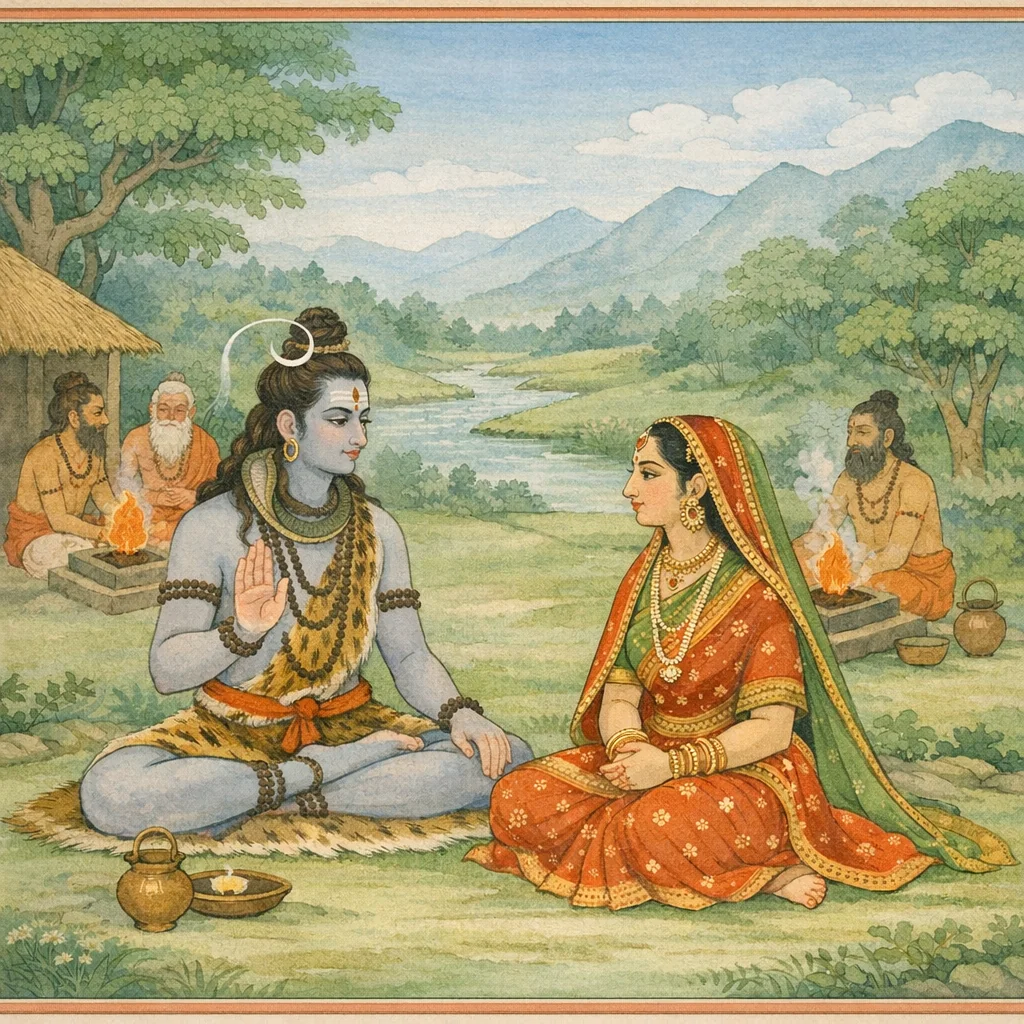
Umā said: “O Lord, the great-souled forest-dwellers (vānaprasthas), steady in mind and observant of vows with discipline, reside in delightful regions—on the pleasant banks of rivers, in ravines and near waterfalls, in thickets along flowing streams, upon mountains, and within forests—choosing pure places rich in fruits and roots for the practice of dharma.”
Verse 2
देशेषु च पवित्रेषु फलवत्सु समाहिता: । मूलवत्सु च मेध्येषु वसन्ति नियतव्रता:,पार्वतीने कहा--भगवन्! नियमपूर्वक व्रतका पालन करनेवाले एकाग्रचित्त वानप्रस्थी महात्मा नदियोंके रमणीय तटप्रदेशोंमें, झरनोंमें, सरिताओंके तटवर्ती निकुंजोंमें, पर्वतोंपर, वनोंमें और फल-मूलसे सम्पन्न पवित्र स्थानोंमें निवास करते हैं
Mahādeva said: “Those disciplined ascetics, steadfast in their vows and gathered in one-pointed concentration, dwell in holy regions—places rich in fruits and roots, and in pure, sanctifying locales. Their way of life is marked by restraint and deliberate choice of environments that support inner clarity and dharmic practice.”
Verse 3
तेषामपि विधिं पुण्यं श्रोतुमिच्छामि शड्कर । वानप्रस्थेषु देवेश स्वशरीरोपजीविषु,कल्याणकारी देवेश्वर! वानप्रस्थी महात्मा अपने शरीरको ही कष्ट पहुँचाकर जीवन- निर्वाह करते हैं; अतः उनके पालन करनेयोग्य जो पवित्र कर्तव्य या नियम है, उसीको मैं सुनना चाहती हूँ
O Śaṅkara, I wish to hear as well the sacred, meritorious rule that governs those vānaprasthas. O Lord of the gods, those great-souled forest-dwellers sustain their lives by enduring hardship upon their own bodies; therefore I desire to learn the pure duties and observances they are to follow.
Verse 4
श्रीमहेश्वर उवाच वानप्रस्थेषु यो धर्मस्तं मे शूणु समाहिता । श्रुत्वा चैकमना देवि धर्मबुद्धिपरा भव,भगवान् _महेश्वरने कहा--देवि! (गृहस्थ एवं) वानप्रस्थोंका जो धर्म है, उसको मुझसे एकाग्रचित्त होकर सुनो और सुनकर एकचित्त हो अपनी बुद्धिको धर्ममें लगाओ
Śrī Maheśvara said: “O Devī, listen with a steady, collected mind as I explain the dharma prescribed for householders and forest-dwellers (vānaprasthas). Having heard it, become single-minded, and set your understanding firmly upon dharma.”
Verse 5
संसिद्धिर्नियमै: सद्धिर्वनवासमुपागतै: । वानप्रस्थैरिदं कर्म कर्तव्यं शूणु यादूशम्,नियमोंका पालन करके सिद्ध हुए वनवासी साधु वानप्रस्थोंको यह कर्म करना चाहिये। कैसा कर्म? यह बताता हूँ, सुनो
Śrī Maheśvara said: “Perfection is attained through disciplined observances by the virtuous who have entered forest-dwelling. Therefore, those who live as vānaprasthas should perform this duty. Listen as I explain what that duty is.”
Verse 6
(भूत्वा पूर्व गृहस्थस्तु पुत्रानृण्यमवाप्य च । कलत्रकार्य संतृप्प कारणात् संत्यजेद् गृहम् ।। मनुष्य पहले गृहस्थ होकर पुत्रोंके उत्पादन-द्वारा पितरोंक ऋणसे उऋण हो पत्नीसे सम्पन्न होनेवाले कार्यकी पूर्ति करके धर्मसम्पादनके लिये गृहका परित्याग कर दे ।। अवस्थाप्य मनो धृत्या व्यवसायपुरस्सर: । निर्दनडो वा सदारो वा वनवासाय सव्रजेत् ।। मनको धैर्यपूर्वक स्थिर करके मनुष्य दृढ़ निश्चयके साथ निर्द्धनद्ध (एकाकी) होकर अथवा स्त्रीको साथ रखकर वनवासके लिये प्रस्थान करे ।। देशा: परमपुण्या ये नदीवनसमन्विता: । अबोधमुक्ता: प्रायेण तीर्थायतनसंयुता: ।। तत्र गत्वा विधि ज्ञात्वा दीक्षां कुर्याद् यथाक्रमम् । दीक्षित्वैकमना भूत्वा परिचर्या समाचरेत् ।। नदी और वनसे युक्त जो परम पुण्यमय प्रदेश हैं, वे प्रायः अज्ञानसे मुक्त और तीथर्थों तथा देवस्थानोंसे सुशोभित हैं। उनमें जाकर विधिका ज्ञान प्राप्त करके क्रमश: ऋषिधर्मकी दीक्षा ग्रहण करे और दीक्षित होनेके पश्चात् एकचित्त हो परिचर्या आरम्भ करे ।। कल्योत्थानं च शौचं च सर्वदेवप्रणामनम् । शकृदालेपन काये त्यक्तदोषप्रमादता ।। सायम्प्रातश्नाभिषेकं चाग्निहोत्रं यथाविधि । काले शौचं च कार्य च जटावल्कलधारणम् ।। सततं वनचर्या च समित्कुसुमकारणात् । नीवाराग्रयणं काले शाकमूलोपचायनम् ।। सदायतनशौचं च तस्य धर्माय चेष्यते । सबेरे उठना, शौचाचारका पालन करना, सब देवताओंको मस्तक झुकाना, शरीरमें गायका गोबर लगाकर नहाना, दोष और प्रमादका त्याग करना, सायंकाल और प्रात:ःकाल स्नान एवं विधिवत् अग्निहोत्र करना, ठीक समयपर शौचाचारका पालन करना, सिरपर जटा और कटियप्रदेशमें वल्कल धारण करना, समिधा और पुष्पका संग्रह करनेके लिये सदा वनमें विचरना, समयपर नीवारसे आग्रयण कर्म (नवशस्येष्टि यज्ञका सम्पादन) करना, साग और मूलका संकलन करना तथा सदा अपने घरको शुद्ध रखना--आदि कार्य वानप्रस्थ मुनिके लिये अभीष्ट है। इनसे उसके धर्मकी सिद्धि होती है ।। अतिथीनामाभिमुख्यं तत्परत्वं च सर्वदा ।। पाद्यासनाभ्यां सम्पूज्य तथाहारनिमन्त्रणम् । अग्राम्यपचनं काले पितृदेवार्चनं॑ तथा ।। पश्चादतिथिसत्कारस्तस्य धर्मा: सनातना: । पहले अतिथियोंके सम्मुख जाय, फिर सदा उनकी सेवामें तत्पर रहे। पाद्य और आसन आदिके द्वारा उनकी पूजा करके उन्हें भोजनके लिये बुलावे। समयपर ऐसी वस्तुओंसे रसोई बनावे, जो गाँवमें पैदा न हुई हों। उस रसोईके द्वारा पहले देवताओं और पितरोंका पूजन करे। तत्पश्चात् अतिथिको सत्कारपूर्वक भोजन करावे। ऐसा करनेवाले वानप्रस्थको सनातन धर्मकी सिद्धि प्राप्त होती है ।। शिष्टैर्थर्मासने चैव धर्मार्थसहिता: कथा: ।। प्रतिश्रयविभागश्व भूमिशय्या शिलासु वा । धर्मासनपर बैठे हुए शिष्ट पुरुषोंद्वारा उसे धर्मार्थयुक्त कथाएँ सुननी चाहिये। उसे अपने लिये पृथक् आश्रम बना लेना चाहिये। वह पृथ्वी अथवा प्रस्तरकी शय्यापर सोये ।। व्रतोपवासयोगकश्न क्षमा चेन्द्रियनिग्रह: ।। दिवारात्र यथायोगं शौचं धर्मस्य चिन्तनम् ।) वानप्रस्थ मुनि व्रत और उपवासमें तत्पर रहे, दूसरोंपर क्षमाका भाव रखे, अपनी इन्द्रियोंको वशमें करे। दिन-रात यथासम्भव शौचाचारका पालन करके धर्मका चिन्तन करे ।। त्रिकालमभिषेकं च पितृदेवार्चनं तथा । अग्निहोत्रपरिस्पन्द इष्टिहोमविधिस्तथा
Śrī Maheśvara said: Having first lived as a householder, a man should discharge the ancestral debt by begetting sons and should complete the obligations that arise through a wife and household life. Then, for the sake of accomplishing dharma, he should renounce the home. Steadying his mind with firmness and led by resolute purpose, he should set out for forest-dwelling—either without possessions and alone, or accompanied by his wife—entering the disciplined life of the vānaprastha as a deliberate ethical transition from worldly duties to spiritual practice.
Verse 7
उन्हें दिनमें तीन बार स्नान, पितरों और देवताओंका पूजन, अग्निहोत्र तथा विधिवत् यज्ञ करने चाहिये ।। नीवारग्रहणं चैव फलमूलनिषेवणम् | इड्डुदैरण्डतैलानां स्नेहार्थे च निषेवणम्,वानप्रस्थको जीविकाके लिये नीवार (तिन्नीका चावल) और फल-मूलका सेवन करना चाहिये तथा शरीरमें स्निग्धता लाने या तेलसे होनेवाले कार्योंके निर्वाहके लिये इंगुद और रेड़ीके तेलका सेवन करना उचित है
Maheshvara teaches the proper livelihood and discipline of a forest-dwelling ascetic (vānaprastha): one should subsist on nivāra grains and on fruits and roots, and for bodily maintenance—keeping the body suitably unctuous and for necessary practical uses—one may employ oils such as iṅguda and castor. The emphasis is on restrained, rule-governed living that supports spiritual duty without indulgence.
Verse 8
योगचर्याकृतैः: सिद्धै: कामक्रोधविवर्जिति: । वीरशय्यामुपासद्धिर्वीरस्थानोपसेविभि:,उन्हें योगका अभ्यास करके उसमें सिद्धि प्राप्त करनी चाहिये। काम और क्रोधको त्याग देना चाहिये। वीरासनसे बैठकर वीरस्थान (विशाल और घने जंगल) में निवास करने चाहिये
Śrī Maheśvara said: “One should undertake the discipline of yoga and, through sustained practice, attain accomplishment in it. One must abandon desire and anger. Established in the ‘hero’s posture’ and embracing the austere ‘hero’s bed,’ one should dwell in heroic places—vast, dense forests—cultivating steadiness, restraint, and inner mastery.”
Verse 9
युक्तैयोंगवहै: सद्धिग्रीष्मे पजचतपैस्तथा । मण्डूकयोगनियतैर्यथान्यायं निषेविभि:,मनको एकाग्र रखकर योगसाधनमें तत्पर रहना चाहिये। श्रेष्ठ वानप्रस्थको गर्मीमें पंचाग्नि सेवन करना चाहिये। हठयोगशास्त्रमें प्रसिद्ध मण्डूकयोगके अभ्यासमें नियमपूर्वक लगे रहना चाहिये। किसी भी वस्तुका न्यायानुकूल सेवन करना चाहिये
Mahādeva said: “With the proper disciplines that carry one toward yoga, one should remain intent on practice with a concentrated mind. In the heat of summer, the exemplary forest-dweller should undertake the austerity of the five fires. One should also persist, according to rule, in the observance of the ‘Frog-posture’ (maṇḍūka-yoga) taught in haṭha-yoga traditions, and partake of whatever is used or enjoyed only in a manner consistent with justice and propriety.”
Verse 10
वीरासनरतैर्नित्यं स्थण्डिले शयनं तथा । शीततोयाग्नियोगश्न चर्तव्यो धर्मबुद्धिभि:,सदा वीरासनसे बैठना और वेदी या चबूतरेपर सोना चाहिये। धर्ममें बुद्धि रखनेवाले वानस्थ मुनियोंकों शीततोयाग्नियोगका आचरण करना चाहिये अर्थात् उन्हें सर्दीकी मौसममें रातको जलके भीतर बैठना या खड़े रहना, बरसातमें खुले मैदानमें सोना और ग्रीष्म-ऋतुमें पंचाग्निका सेवन करना चाहिये
Mahādeva said: “One should always be devoted to the vīrāsana posture, and likewise sleep upon bare ground. Those whose understanding is grounded in dharma should also undertake the discipline of ‘cold water and fire’—that is, practicing austerities suited to the seasons: standing or sitting in cold water during winter nights, lying in the open during the rains, and enduring the ‘five fires’ in the heat of summer.”
Verse 11
अब्भक्षेवायुभक्षैश्न शैवलोत्तरभोजनै: । अश्मकुट्टैस्तथा दान्तै: सम्प्रक्षालैस्तथापरै:
Maheshvara said: “Some live on water alone; some as though feeding only on air; others subsist on algae and such scant fare. Some endure austerities as if chewing stones; others live with the senses restrained and purified by repeated washings and other disciplines.”
Verse 12
वे वायु अथवा जल पीकर रहें। सेवारका भोजन करें। पत्थरसे अन्न या फलको कूँचकर खायाँ अथवा दाँतोंसे चबाकर ही भक्षण करें। सम्प्रक्षालके नियमसे रहें अर्थात् दूसरे दिनके लिये आहार संग्रह करके न रखें ।। चीरवल्कलसंवीतैर्मुगचर्मनिवासिभि: । कार्या यात्रा यथाकालं यथाधर्म यथाविधि,अधोवस्त्रकी जगह चीर और वल्कल पहनें, उत्तरीयके स्थानमें मृगछालेसे ही अपने अंगोंको आच्छादित करें। उन्हें समयके अनुसार धर्मके उद्देश्यसे विधिपूर्वक तीर्थ आदि स्थानोंकी ही यात्रा करनी चाहिये
Maheshvara said: “Let them subsist by drinking air or water, or by taking only what is obtained through service. Let them eat grain or fruit only after crushing it with a stone, or else consume it merely by chewing with the teeth. Let them live by the rule of ‘samprakṣālaka’—that is, they should not store food for the next day. Clad in rags and bark, and covering themselves with deer-skin, they should undertake journeys—such as pilgrimages—only at the proper times, for the sake of dharma, and in accordance with prescribed rites.”
Verse 13
वननित्यैर्वनचरैर्वनस्थैर्वनगोचरै: । वन॑ गुरुमिवासाद्य वस्तव्यं वनजीविभि:,वानप्रस्थको सदा वनमें ही रहना, वनमें ही विचरना, वनमें ही ठहरना, वनके ही मार्गपर चलना और गुरुकी भाँति वनकी शरण लेकर वनमें ही जीवन-निर्वाह करना चाहिये
Mahādeva said: “Those who live by the forest should keep the forest as their constant home—moving within it, dwelling in it, and following its paths. Approaching the forest as one would approach a guru, they should take refuge in it and sustain their life there.”
Verse 14
तेषां होमक्रिया धर्म: पठचयज्ञनिषेवणम् | भागं च पजञ्चयज्ञस्य वेदोक्तस्यथानुपालनम्,प्रतिदिन अग्निहोत्र और पंचमहायज्ञोंका सेवन वानप्रस्थोंका धर्म है। उन्हें विभागपूर्वक वेदोक्त पंच-यज्ञोंका निरन्तर पालन करना चाहिये
For them (the forest-dwelling ascetics), the rightful duty is the performance of fire-offerings (homa) and the continual practice of the prescribed daily sacrifices. They should also, in due and orderly portions, unfailingly observe the five Vedic sacrifices (pañca-yajña) as enjoined—thus sustaining sacred order through disciplined ritual and study.
Verse 15
अष्टमीयज्ञपरता चातुर्मास्यनिषेवणम् । पौर्णमासादयो यज्ञा नित्ययज्ञस्तथैव च,अष्टमी तिथिको होनेवाले अष्टका श्राद्धरूप यज्ञमें तत्पर रहना, चातुर्मास्य व्रतका सेवन करना, पौर्णमास और दर्शादि यज्ञ तथा नित्ययज्ञका अनुष्ठान करना वानप्रस्थ मुनिका धर्म है
Mahādeva said: “For the forest-dwelling ascetic (vānaprastha), the proper discipline is this: to be devoted to the Aṣṭamī-sacrifice (the Aṣṭakā rite performed on the eighth lunar day), to observe the Cāturmāsya seasonal vows, and to regularly perform the rites beginning with the Paurṇamāsa offerings, along with the daily obligatory sacrifices. In this way, steadiness in dharma and regulated worship becomes the ethical foundation of the vānaprastha’s life.”
Verse 16
विमुक्ता दारसंयोगैरविमुक्ता: सर्वसंकरै: । विमुक्ता: सर्वपापैश्न चरन्ति मुनयो वने,वानप्रस्थ मुनि स्त्री-समागम, सब प्रकारके संकर तथा सम्पूर्ण पापोंसे दूर रहकर वनमें विचरते रहते हैं
Śrī Maheśvara said: “Freed from conjugal association, and not entangled in any kind of mixture or moral confusion, the sages—released from all sins—wander in the forest. Thus the forest-dweller’s discipline is marked by restraint, purity of conduct, and withdrawal from household bonds.”
Verse 17
खुग्भाण्डपरमा नित्यं त्रेताग्निशरणा: सदा | सन्त: सत्पथनित्या ये ते यान्ति परमां गतिम्,खुक्-सुवा आदि यज्ञपात्र ही उनके लिये उत्तम उपकरण हैं। वे सदा आहवनीय आदि त्रिविध अग्नियोंकी शरण लेकर सदा उन्हींकी परिचर्यामें लगे रहते हैं और नित्य सन्मार्गपर चलते हैं। इस प्रकार अपने धर्ममें तत्पर रहनेवाले वे श्रेष्ठ पुरुष परमगतिको प्राप्त होते हैं
Maheshvara said: Those who ever regard their sacred implements as foremost, who always take refuge in the three Vedic fires, who remain continually engaged in their service, and who steadfastly walk the path of the good—such virtuous men, devoted to their own dharma, attain the highest state.
Verse 18
ब्रह्मलोक॑ महापुण्यं सोमलोकं च शाश्वतम् । गच्छन्ति मुनयः सिद्धा: सत्यधर्मव्यपाश्रया:,वे मुनि सत्यधर्मका आश्रय लेनेवाले और सिद्ध होते हैं, अतः महान् पुण्यमय ब्रह्मलोक तथा सनातन सोमलोकमें जाते हैं
Maheshvara said: The sages—perfected beings who take refuge in truth and righteousness—attain the supremely meritorious world of Brahmā, and also the eternal world of Soma.
Verse 19
एष धर्मो मया देवि वानप्रस्थाश्रित: शुभ: । विस्तरेणाथ सम्पन्नो यथास्थूलमुदाह्वत:
Maheshvara said: “O Goddess, this auspicious dharma belonging to the stage of the forest-dweller (vānaprastha) has been set forth by me—complete in its details. I have now declared it in a broad, general manner.”
Verse 20
देवि! यह मैंने तुम्हारे निकट विस्तारयुक्त एवं मंगलमय वानप्रस्थधर्मका स्थूलभावसे वर्णन किया है ।। उमोवाच भगवन् सर्वभूतेश सर्वभूतनमस्कृत । यो धर्मो मुनिसंघस्य सिद्धिवादेषु तं वद
Maheshvara said: “Goddess, I have explained to you—at length and in an auspicious manner—the discipline of the forest-dweller (vānaprastha), presenting it in its broad outline.” Uma replied: “O Blessed Lord, Lord of all beings, revered by all beings—tell me that dharma which belongs to the assemblies of sages, as discussed in their teachings on spiritual attainment.”
Verse 21
उमादेवी बोलीं--भगवन्! सर्वभूतेश्वर! समस्त प्राणियोंद्वारा वन्दित महेश्वर! ज्ञानगोष्ठियोंमें मुनि-समुदायका जो धर्म निश्चित किया गया है, उसे बताइये ।। सिद्धिवादेषु संसिद्धास्तथा वननिवासिन: । स्वैरिणो दारसंयुक्तास्तेषां धर्म: कथं स्मृत:,ज्ञानगोष्ठियोंमें जो सम्यक् सिद्ध बताये गये हैं, वे वनवासी मुनि कोई तो एकाकी ही स्वच्छन्द विचरते हैं, कोई पत्नीके साथ रहते हैं। उनका धर्म कैसा माना गया है?
Umā Devī said: “O Blessed Lord, O Sovereign of all beings, O Maheśvara revered by all creatures—tell me the rule of dharma that the assemblies of sages have determined in their discussions on spiritual knowledge. For among those declared fully accomplished in the doctrines concerning attainment, and among the forest-dwelling ascetics, some wander freely alone while others live together with a wife. How is the dharma of such persons understood?”
Verse 22
श्रीमहेश्वर उवाच स्वैरिणस्तपसा देवि सर्वे दारविहारिण: । तेषां मौण्ड्यं कषायश्न वासे रात्रिश्न कारणम्,श्रीमहेश्वरने कहा--देवि! सभी वानप्रस्थ तपस्यामें संलग्न रहते हैं, उनमेंसे कुछ तो स्वच्छन्द विचरनेवाले होते हैं (स्त्रीको साथ नहीं रखते) और कुछ अपनी-अपनी स्त्रीके साथ रहते हैं। स्वच्छन्द विचरनेवाले मुनि सिर मुड़ाकर गेरुए वस्त्र पहनते हैं; (उनका कोई एक स्थान नहीं होता) किंतु जो स्त्रीके साथ रहते हैं, वे रात्रिको अपने आश्रममें ही ठहरते हैं
Śrī Maheśvara said: “O Goddess, all these forest-dwelling ascetics are engaged in austerity. Among them, some wander freely (without keeping a wife), while others live together with their own wives. For those who wander freely, the shaving of the head and the wearing of ochre garments are their distinguishing marks; whereas those who live with their wives remain in their hermitage at night.”
Verse 23
त्रिकालमभिषेक श्न होत्र॑ त्वृषिकृतं महत् । समाधिसत्पथस्थानं यथोद्दिष्टनिषेवणम्,दोनों प्रकारके ही ऋषियोंका यह महान् कर्तव्य है कि वे प्रतिदिन तीनों समय जलनमें स्नान करें और अग्निमें आहुति डालें। समाधि लगावें, सन्मार्गपर चलें और शास्त्रोक्त कर्मोंका अनुष्ठान करें
Śrī Maheśvara said: “For sages, this is a great and time-honored duty: to bathe with water at the three daily junctures, to maintain the sacred fire and offer oblations, to cultivate meditative absorption, to remain established on the true path, and to carry out the disciplines enjoined by the scriptures.”
Verse 24
ये च ते पूर्वकथिता धर्मास्ते वनवासिनाम् | यदि सेवन्ति धर्मास्तानाप्रुवन्ति तप:फलम्,पहले जो तुम्हारे समक्ष वनवासियोंके धर्म बताये गये हैं, उन सबका यदि वे पालन करते हैं तो उन्हें अपनी तपस्याका पूर्ण फल मिलता है
Maheshvara said: “Those duties of the forest-dwellers that were previously described to you—if they truly practice and uphold those very dharmas, then they attain the full fruit of their austerity.”
Verse 25
ये च दम्पतिधर्माण: स्वदारनियतेन्द्रिया: । चरन्ति विधिवद् दृष्टं तदनुकालाभिगामिन:,जो गृहस्थ दाम्पत्य धर्मका पालन करते हुए स्त्रीको अपने साथ रखते हैं, उसके साथ ही इन्द्रियसंयम-पूर्वक वेदविहित धर्मका आचरण करते हैं और केवल ऋतुकालनें ही स्त्री समागम करते हैं, उन धर्मात्माओंको ऋषियोंके बताये हुए धर्मोके पालन करनेका फल मिलता है। धर्मदर्शी पुरुषोंकोी कामनावश किसी भोगका सेवन नहीं करना चाहिये
Mahādeva said: “Those who uphold the duties of married life, who keep their senses restrained with respect to their own lawful wife, who practice the prescribed Vedic conduct in the proper manner, and who approach their wife only at the appropriate season—such righteous householders obtain the fruit of following the dharmas taught by the seers. A man of dharma-vision should not indulge in enjoyments merely out of desire.”
Verse 26
तेषामृषिकृतो धर्मो धर्मिणामुपपद्यते । न कामकारात् कामोडन्य: संसेव्यो धर्मदर्शिभि:,जो गृहस्थ दाम्पत्य धर्मका पालन करते हुए स्त्रीको अपने साथ रखते हैं, उसके साथ ही इन्द्रियसंयम-पूर्वक वेदविहित धर्मका आचरण करते हैं और केवल ऋतुकालनें ही स्त्री समागम करते हैं, उन धर्मात्माओंको ऋषियोंके बताये हुए धर्मोके पालन करनेका फल मिलता है। धर्मदर्शी पुरुषोंकोी कामनावश किसी भोगका सेवन नहीं करना चाहिये
For those who live by dharma, the rule of conduct laid down by the seers truly applies and bears fruit. Those who see dharma clearly should not pursue any enjoyment merely out of whim or desire; desire-driven indulgence is not to be cultivated as a way of life.
Verse 27
सर्वभूतेषु यः सम्यग् ददात्यभयदक्षिणाम् । हिंसादोषविमुक्तात्मा स वै धर्मेण युज्यते,जो हिंसादोषसे मुक्त होकर सम्पूर्ण प्राणियोंको अभयदान कर देता है, उसीको धर्मका फल प्राप्त होता है
Maheshvara said: “Whoever, in the right manner, grants the ‘gift of fearlessness’ to all beings—being inwardly freed from the fault of violence—such a person is truly joined to Dharma and attains its fruit.”
Verse 28
सर्वभूतानुकम्पी यः सर्वभूतार्जवव्रत: । सर्वभूतात्मभूतश्न स वै धर्मेण युज्यते,जो सम्पूर्ण प्राणियोंपर दया करता है, सबके साथ सरलताका बर्ताव करता और समस्त भूतोंको आत्मभावसे देखता है, वही धर्मके फलसे युक्त होता है
Maheshvara said: “One who is compassionate toward all beings, who is vowed to straightforwardness in dealing with all creatures, and who regards all beings with the sense that they are one’s own self—such a person is truly united with dharma and comes to possess its fruits.”
Verse 29
सर्ववेदेषु वा स्नान सर्वभूतेषु चार्जवम् । उभे एते समे स्यातामार्जवं वा विशिष्यते
Mahādeva said: “Whether one performs the purificatory bath prescribed in all the Vedas, or whether one practices straightforwardness toward all living beings—these two may be considered equal; yet, straightforwardness (integrity) is the higher.”
Verse 30
चारों वेदोंमें निष्णात होना और सब जीवोंके प्रति सरलताका बर्ताव करना--ये दोनों एक समान समझे जाते हैं अथवा सरलताका ही महत्त्व अधिक माना जाता है ।। आर्जवं धर्ममित्याहुरधर्मो जिह्म॒ उच्यते । आ्जवेनेह संयुक्तो नरो धर्मेण युज्यते,सरलताको धर्म कहते हैं और कुटिलताको अधर्म। सरलभावसे युक्त मनुष्य ही यहाँ धर्मके फलका भागी होता है
Mahādeva teaches that straightforwardness is itself called dharma, while crookedness is termed adharma. A person who is joined to sincerity and simplicity in conduct becomes truly aligned with dharma here and thus becomes fit to receive its fruits. In ethical weight, such inner rectitude is held equal to—if not greater than—mere mastery of the four Vedas.
Verse 31
आर्जवे तु रतो नित्यं वसत्यमरसंनिधौ । तस्मादार्जवयुक्त: स्याद् य इच्छेद् धर्ममात्मन:,जो सदा सरल बर्तावमें तत्पर रहता है, वह देवताओंके समीप निवास करता है। इसलिये जो अपने धर्मका फल पाना चाहता हो, उसे सरलतापूर्ण बर्तावसे युक्त होना चाहिये
One who is ever devoted to straightforwardness (ārjava) dwells, as it were, in the very presence of the gods. Therefore, whoever wishes to attain the true fruit of one’s own dharma should cultivate conduct marked by simplicity, honesty, and guilelessness.
Verse 32
क्षान्तो दान्तो जितक्रोधो धर्मभूतो विहिंसक: । धर्मे रतमना नित्यं नरो धर्मेण युज्यते,क्षमाशील, जितेन्द्रिय, क्रोधविजयी, धर्मनिष्ठ, अहिंसक और सदा धर्मपरायण मनुष्य ही धर्मके फलका भागी होता है
Maheshvara said: A man who is forbearing, self-restrained, and victorious over anger—one whose very nature is grounded in dharma and who is non-violent—who keeps his mind constantly devoted to dharma, is truly joined to dharma and becomes a rightful sharer in its fruits.
Verse 33
व्यपेततन्द्रिर्धर्मात्मा शकत्या सत्पथमाश्रित: । चारित्रपरमो बुद्धो ब्रह्मभूयाय कल्पते,जो पुरुष आलस्यरहित, धर्मात्मा, शक्तिके अनुसार श्रेष्ठ मार्गपपर चलनेवाला, सच्चरित्र और ज्ञानी होता है, वह ब्रह्मभावको प्राप्त हो जाता है
Maheshvara said: The person who has cast off lethargy, is devoted to dharma, follows the noble path according to his capacity, and is foremost in good conduct and wisdom—such a one becomes fit to attain the state of Brahman. The verse frames liberation not as a mere doctrine but as the ethical culmination of disciplined effort, character, and right understanding.
Verse 34
उमोवाच (एषां यायावराणां तु धर्ममिच्छामि मानद । कृपया परया<<विष्टस्तन्मे ब्रूहि महेश्वर ।। उमादेवी बोलीं--सबको मान देनेवाले महेश्वर! मैं यायावरोंके धर्मको सुनना चाहती हूँ, आप महान् अनुग्रह करके मुझे यह बताइये ।। श्रीमहेश्वर उवाच धर्म यायावराणां त्वं शृणु भामिनि तत्परा ।। व्रतोपवासशुद्धाज्ञास्तीर्थस्नानपरायणा: । श्रीमहेश्वरने कहा--भामिनि! तुम तत्पर होकर यायावरोंके धर्म सुनो। व्रत और उपवाससे उनके अंग-प्रत्यंग शुद्ध हो जाते हैं तथा वे तीर्थ-स्नानमें तत्पर रहते हैं ।। धृतिमन्त: क्षमायुक्ता: सत्यव्रतपरायणा: ।। पक्षमासोपवासै क्ष कर्शिता धर्मदर्शिन: । उनमें धैर्य और क्षमाका भाव होता है। वे सत्यव्रत-परायण होकर एक-एक पक्ष और एक-एक मासका उपवास करके अत्यन्त दुर्बल हो जाते हैं। उनकी दृष्टि सदा धर्मपर ही रहती है ।। वर्ष: शीतातपैरेव कुर्वन्त: परमं तप: ।। कालयोगेन गच्छन्ति शक्रलोकं शुचिस्मिते | पवित्र मुसकानवाली देवि! वे सर्दी, गर्मी और वर्षाका कष्ट सहन करते हुए बड़ी भारी तपस्या करते हैं और कालयोगसे मृत्युको प्राप्त होकर स्वर्गलोकमें जाते हैं |। तत्र ते भोगसंयुक्ता दिव्यगन्धसमन्विता: ।। दिव्यभूषणसंयुक्ता विमानवरसंयुता: । विचरन्ति यथाकामं दिव्यस्त्रीगणसंयुता: ।। एतत् ते कथित देवि कि भूय: श्रोतुमिच्छसि ।। वहाँ भी नाना प्रकारके भोगोंसे संयुक्त और दिव्यगन्धसे सम्पन्न हो दिव्य आभूषण धारण करके सुन्दर विमानोंपर बैठते और दिव्यांगनाओंके साथ इच्छानुसार विहार करते हैं। देवि! यह सब यायावरोंका धर्म मैंने तुम्हें बताया। अब और क्या सुनना चाहती हो? ।। उमोवाच तेषां चक्रचराणां च धर्ममिच्छामि वै प्रभो ।। उमाने कहा--प्रभो! वानप्रस्थ ऋषियोंमें जो चक्रचर (छकड़ेसे यात्रा करनेवाले) हैं उनके धर्मको मैं जानना चाहती हूँ ।। श्रीमहेश्वर उवाच एतत् ते कथयिष्यामि शृणु शाकटिकं शुभे ।। श्रीमहेश्वरने कहा--शुभे! यह मैं तुम्हें बता रहा हूँ। चक्रचारी या शाकटिक मुनियोंका धर्म सुनो ।। संवहन्तो धुरं दारै: शकटानां तु सर्वदा | प्रार्थयन्ते यथाकालं शकटैसभैंक्षचर्यया ।। तपोअ<र्जनपरा धीरास्तपसा क्षीणकल्मषा: । पर्यटन्तो दिश: सर्वा: कामक्रो धविवर्जिता: ।। वे अपनी स्त्रियोंक साथ सदा छकड़ोंके बोझ ढोते हुए यथासमय छकड़ोंद्वारा ही जाकर भिक्षाकी याचना करते हैं। सदा तपस्याके उपार्जनमें लगे रहते हैं। वे धीर मुनि तपस्याद्वारा अपने सारे पापोंका नाश कर डालते हैं तथा काम और क्रोधसे रहित हो सम्पूर्ण दिशाओंमें पर्यटन करते हैं ।। तेनैव कालयोगेन त्रिदिवं यान्ति शो भने । तत्र प्रमुदिता भोगैर्विचरन्ति यथासुखम् ।। एतत् ते कथित देवि कि भूय: श्रोतुमिच्छसि ।। शोभने! उसी जीवनचर्यासे रहित हुए वे कालयोगसे मृत्युको प्राप्त होकर स्वर्गमें जाते हैं और वहाँ दिव्य भोगोंसे आनन्दित हो अपने मौजसे घूमते-फिरते हैं। देवि! तुम्हारे इस प्रश्नका भी उत्तर दे दिया, अब और क्या सुनना चाहती हो ।। उमोवाच वैखानसानां वै धर्म श्रोतुमिच्छाम्यहं प्रभो ।। उमाने कहा--प्रभो! अब मैं वैखानसोंका धर्म सुनना चाहती हूँ ।। श्रीमहेश्वर उवाच ते वै वैखानसा नाम वानप्रस्था: शुभेक्षणे । तीव्रेण तपसा युक्ता दीप्तिमन्त: स्वतेजसा ।। सत्यव्रतपरा धीरास्तेषां निष्कल्मषं तप: । श्रीमहेश्वरने कहा--शुभेक्षणे! वे जो वैखानस नामवाले वानप्रस्थ हैं, बड़ी कठोर तपस्यामें संलग्न रहते हैं। अपने तेजसे देदीप्यमान होते हैं। सत्यव्रत-परायण और धीर होते हैं। उनकी तपस्यामें पापका लेश भी नहीं होता है ।। अभ्मकुद्टास्तथान्ये च दन््तोलूखलिनस्तथा । शीर्णपर्णाशिनश्चान्ये उज्छवृत्तास्तथा परे ।। कपोततवृत्तय श्चान्ये कापोतीं वृत्तिमास्थिता: । पशुप्रचारनिरता: फेनपाश्च तथा परे ।। मृगवन्मृगचर्यायां संचरन्ति तथा परे | उनमेंसे कुछ लोग अभश्मकुट्ट (पत्थरसे ही अन्न या फलको कूँचकर खानेवाले) होते हैं। दूसरे दाँतोंस ही ओखलीका काम लेते हैं, तीसरे सूखे पत्ते चबाकर रहते हैं, चौथे उज्छवृत्तिसे जीविका चलानेवाले होते हैं। कुछ कापोती वृत्तिका आश्रय लेकर कबूतरोंके समान अन्नके एक-एक दाने बीनते हैं। कुछ लोग पशुचर्याको अपनाकर पशुओंके साथ ही चलते और उन्हींकी भाँति तृण खाकर रहते हैं। दूसरे लोग फेन चाटकर रहते हैं तथा अन्य बहुतेरे वैखानस मृगचर्याका आश्रय लेकर मृगोंके समान उन्हींके साथ विचरते हैं ।। अब्भक्षा वायुभक्षाश्न निराहारास्तथैव च ।। केचिच्चरन्ति सद्विष्णो: पादपूजनमुत्तमम् | कुछ लोग जल पीकर रहते, कुछ लोग हवा खाकर निर्वाह करते और कितने ही निराहार रह जाते हैं। कुछ लोग भगवान् विष्णुके चरणारविन्दोंका उत्तम रीतिसे पूजन करते हैं।। संचरन्ति तपो घोरें व्याधिमृत्युविवर्जिता: ।। स्ववशादेव ते मृत्युं भीषयन्ति च नित्यश: ।। इन्द्रलोके तथा तेषां निर्मिता भोगसंचया: । अमरै: समतां यान्ति देववद्धोगसंयुता: ।। वे रोग और मृत्युसे रहित हो घोर तपस्या करते हैं और अपनी ही शक्तिसे प्रतिदिन मृत्युको डराया करते हैं। उनके लिये इन्द्रलोकमें ढेर-के-ढेर भोग संचित रहते हैं। वे देवतुल्य भोगोंसे सम्पन्न हो देवताओंकी समानता प्राप्त कर लेते हैं ।। वराप्सरोभि: संयुक्ताश्चिरकालमनिन्दिते | एतत् ते कथित देवि भूय: श्रीतुं किमिच्छसि ।। सती साध्वी देवि! वे चिरकालतक श्रेष्ठ अप्सराजोंके साथ रहकर सुखका अनुभव करते हैं। यह तुमसे वैखानसोंका धर्म बताया गया, अब और क्या सुनना चाहती हो? ।। उमोवाच भगवन् श्रोतुमिच्छामि वालखिल्यांस्तपोधनान् ।। उमाने कहा--भगवन्! अब मैं तपस्याके धनी वालखिल्योंका परिचय सुनना चाहती हूँ ।। श्रीमहेश्वर उवाच धर्मचर्या तथा देवि वालखिल्यगतां शृणु ।। मृगनिर्मोकवसना निर्दन्द्धास्ते तपोधन: । अड्गुष्ठमात्रा: सुश्रोणि तेष्वेवाज्रेषु संयुता: ।। श्रीमहे श्वरने कहा--देवि! वालखिल्योंकी धर्मचर्याका वर्णन सुनो। वे मृगछाला पहनते हैं, शीत-उष्ण आदि द्वन्द्*ोंका उनपर कोई प्रभाव नहीं पड़ता है। तपस्या ही उनका धन है। सुश्रोणि! उनके शरीरकी लम्बाई एक अंगूठेके बराबर है, उन्हीं शरीरोंमें वे सब एक साथ रहते हैं ।। उद्यन्तं सततं सूर्य स्तुवन्तो विविधै: स्तवै: । भास्करस्येव किरणै: सहसा यान्ति नित्यदा ।। द्योतयन्तो दिश: सर्वा धर्मज्ञा: सत्यवादिन: ।। वे प्रतिदिन नाना प्रकारके स्तोत्रोंद्वारा निरन्तर उगते हुए सूर्यकी स्तुति करते हुए सहसा आगे बढ़ते जाते हैं और अपनी सूर्यतुल्य किरणोंसे सम्पूर्ण दिशाओंको प्रकाशित करते रहते हैं। वे सब-के-सब धर्मज्ञ और सत्यवादी हैं ।। तेष्वेव निर्मल सत्यं लोकार्थ तु प्रतिक्तितम् । लोको<थयं धार्यते देवि तेषामेव तपोबलात् ।। महात्मनां तु तपसा सत्येन च शुचिस्मिते | क्षमया च महाभागे भूतानां संस्थितिं विदु: ।। उन्हींमें लोकरक्षाके लिये निर्मल सत्य प्रतिष्ठित है। देवि! उन वालखिल्योंके ही तपोबलसे यह सारा जगत् टिका हुआ है। पवित्र मुसकानवाली महाभागे! उन्हीं महात्माओंकी तपस्या, सत्य और क्षमाके प्रभावसे सम्पूर्ण भूतोंकी स्थिति बनी हुई है, ऐसा मनीषी पुरुष मानते हैं ।। प्रजार्थमपि लोकार्थ महद्ि: क्रियते तप: । तपसा प्राप्यते सर्व तपसा प्राप्पते फलम् ।। दुष्प्रापमपि यल्लोके तपसा प्राप्यते हि तत् ।।) महान् पुरुष समस्त प्रजावर्ग तथा सम्पूर्ण लोकोंके हितके लिये तपस्या करते हैं। तपस्यासे सब कुछ प्राप्त होता है। तपस्यासे अभीष्ट फलकी प्राप्ति होती है। लोकमें जो दुर्लभ वस्तु है, वह भी तपस्यासे सुलभ हो जाती है ।। उमोवाच आश्रमाभिरता देव तापसा ये तपोधना: । दीप्तिमन्तः कया चैव चर्ययाथ भवन्ति ते,उमाने पूछा--देव! जो तपस्याके धनी तपस्वी अपने आश्रमधर्ममें ही रम रहे हैं, वे किस आचरणसे तपस्वी होते हैं?
Mahādeva said: “O passionate one, listen attentively to the dharma of the yāyāvaras (wandering ascetics). Their bodies are purified by vows and fasts, and they are devoted to bathing at sacred fords. Endowed with steadiness and patience, committed to vows of truth, they become emaciated through fortnight-long and month-long fasts, keeping their vision fixed on dharma. Bearing rain, cold, and heat, they undertake severe austerity; and when their time comes (by the ordinance of Time), they depart to Śakra’s heaven. The ethical emphasis is on self-restraint, truthfulness, endurance, and a life oriented toward sacred practice rather than possession.”
Verse 35
राजानो राजतपूुत्राश्न निर्धना ये महाधना: । कर्मणा केन भगवनू् प्राप्रुवन्ति महाफलम्,भगवन्! जो राजा या राजकुमार हैं अथवा जो निर्धन या महाधनी हैं, वे किस कर्मके प्रभावसे महान् फलके भागी होते हैं?
Maheshvara said: “O Blessed Lord, by what kind of action do kings and princes—indeed, both the poor and the immensely wealthy—become entitled to great reward? What is the deed whose power yields such vast fruit?”
Verse 36
नित्यं स्थानमुपागम्य दिव्यचन्दनभूषिता: । केन वा कर्मणा देव भवन्ति वनगोचरा:,देव! वनवासी मुनि किस कर्मसे दिव्य स्थानको पाकर दिव्य चन्दनसे विभूषित होते हैं?
“O Lord, by what kind of action do forest-dwelling sages—those who move about in the woods—regularly attain a divine abode and become adorned with celestial sandalwood?”
Verse 37
एतन्मे संशयं देव तपश्चर्या55श्रितं शुभम् । शंस सर्वमशेषेण त्र्यक्ष त्रिपुरनाशन,देव! त्रिपुरनाशन त्रिलोचन! तपस्याके आश्रित शुभ फलके विषयमें मेरा यही संदेह है। इस सारे संदेहका उत्तर आप पूर्णरूपसे प्रदान करें
O God, a doubt has arisen in me concerning the auspicious fruit that depends upon ascetic practice. O Three-eyed One, Destroyer of Tripura—tell me everything about it completely, leaving nothing unsaid.
Verse 38
श्रीमहेश्वर उवाच उपवासतव्रतैर्दान्ता हाहिंस्रा: सत्यवादिन: । संसिद्धा: प्रेत्य गन्धर्वै: सह मोदन्त्यनामया:,श्रीमहेश्वरने कहा--जो उपवास व्रतसे सम्पन्न, जितेन्द्रिय, हिंसारहित और सत्यवादी होकर सिद्धिको प्राप्त हो चुके हैं, वे मृत्युके पश्चात् रोग-शोकसे रहित हो गन्धर्वोके साथ रहकर आनन्द भोगते हैं
Śrī Maheśvara said: Those who are perfected through vows of fasting—self-restrained, non-violent, and truthful in speech—having attained spiritual accomplishment, after death rejoice in a state free from illness and sorrow, dwelling in the company of the Gandharvas.
Verse 39
मण्डूकयोगशयनो यथान्यायं यथाविधि । दीक्षां चरति धर्मात्मा स नागै: सह मोदते,जो धर्मात्मा पुरुष न्यायानुसार विधिपूर्वक हठयोग-प्रसिद्ध मण्डूकयोगके अनुसार शयन करता और यज्ञकी दीक्षा लेता है, वह नागलोकमें नागोंके साथ सुख भोगता है
Maheshvara said: The righteous man who, in accordance with proper rule and prescribed method, lies in the posture known in Haṭhayoga as the ‘Maṇḍūka-yoga’ and duly undertakes sacrificial consecration (dīkṣā), attains the Nāga-world and rejoices there in the company of the Nāgas.
Verse 40
शष्पं मृगमुखोच्छिष्टं यो मृगैः सह भक्षति । दीक्षितो वै मुदा युक्त: स गच्छत्यमरावतीम्
Maheshvara said: “He who, while under consecrated observance, gladly partakes—together with the deer—of tender grass that has been left over from the mouths of deer, attains Amarāvatī (the celestial city).”
Verse 41
जो मृगचर्या-व्रतकी दीक्षा ले मृगोंके मुखसे उच्छिष्ट हुई घासको प्रसन्नतापूर्वक उन्हींके साथ रहकर भक्षण करता है, वह मृत्युके पश्चात् अमरावतीपुरीमें जाता है ।। शैवालं शीर्णपर्ण वा तद्व॒ती यो निषेवते । शीतयोगवहो नित्यं स गच्छेत् परमां गतिम्,जो व्रतधारी वानप्रस्थ मुनि सेवार अथवा जीर्ण-शीर्ण पत्तेका आहार करता तथा जाड़ेमें प्रतेदिन शीतका कष्ट सहन करता है, वह परमगतिको प्राप्त होता है
Maheśvara said: Whoever undertakes the initiation into the vow of living like the deer and, dwelling contentedly among them, gladly eats the grass left over from their mouths, goes after death to Amarāvatī, the celestial city. Likewise, the vow-observing ascetic who subsists on algae or on withered, fallen leaves, and who daily endures the hardship of cold, attains the highest state.
Verse 42
वायुभक्षो<म्बुभक्षो वा फलमूलाशनोडपि वा । यक्षेष्वैश्वर्यमाधाय मोदते5प्सरसां गणै:,जो वायु, जल, फल अथवा मूल खाकर रहता है, वह यक्षोंपर अपना प्रभुत्व स्थापित करके अप्सराओंके साथ आनन्द भोगता है
Mahādeva said: “Whether one lives by subsisting on air, on water, or even on fruits and roots, such an ascetic—having established lordship among the Yakṣas—rejoices in the company of hosts of Apsarases.”
Verse 43
अग्नियोगवह्ो ग्रीष्मे विधिदृष्टेन कर्मणा । चीर्त्वा द्वादशवर्षाणि राजा भवति पार्थिव:,जो गर्मीमें शास्त्रोक्त विधिके अनुसार पंचाग्नि सेवन करता है, वह बारह वर्षोतक उक्त व्रतका पालन करके जन्मान्तरमें भूमण्डलका राजा होता है
Maheśvara said: One who, in the heat of summer, undertakes the discipline of the five fires in accordance with the scripturally prescribed rite, and maintains that observance for twelve years, is reborn as a king ruling the earth—attaining worldly sovereignty as the fruit of austere, rule-governed self-control.
Verse 44
आहारनियमं कुत्वा मुनिर्द्धादिशवार्षिकम् मरुं संसाध्य यत्नेन राजा भवति पार्थिव:,जो मुनि बारह वर्षोतक आहारका संयम करता हुआ यत्नपूर्वक मरु-साधना करके अर्थात् जलको भी त्यागकर तप करता है, वह भी इस पृथ्वीका राजा होता है
Śrī Maheśvara said: “A sage who undertakes strict regulation of food for twelve years, and then with sustained effort completes the ‘maru’ austerity—performing penance even by renouncing water—attains sovereignty and becomes a king upon the earth.”
Verse 45
स्थण्डिले शुद्धमाकाशं परिगृह्म समनन््ततः: । प्रविश्य च मुदा युक्तो दीक्षां द्वादशवार्षिकीम्
Mahādeva said: “Having marked out, on a purified earthen ground, a sacred open space all around, and entering it with a joyful, disciplined mind, one should undertake the consecratory vow of initiation lasting twelve years.”
Verse 46
स्थण्डिलस्य फलान्याहुर्यानानि शयनानि च
Maheshvara said: “They declare that the observance of sleeping on bare ground (sthaṇḍila) yields its own fruits—such as conveyances and beds.”
Verse 47
आत्मानमुपजीवन् यो नियतो नियताशन:
Mahādeva said: “He who lives by relying on his own self—disciplined and regulated in his food—(such a person is described as one established in restraint and self-sufficiency).”
Verse 48
आत्मानमुपजीवन दीक्षां द्वादशवार्षिकीम्
“Living by sustaining and disciplining oneself alone, one should undertake a consecrated vow of initiation (dīkṣā) lasting twelve years.”
Verse 49
आत्मानमुपजीवन दीक्षां द्वादशवार्षिकीम्,जो अपने ही सहारे जीवन-यापन करता हुआ निर्द्धन्द्ध और परिग्रहशून्य हो बारह वर्षोके लिये व्रतकी दीक्षा ले अन्तमें पत्थरसे अपने पैरोंको विदीर्ण करके स्वयं ही अपने शरीरको त्याग देता है, वह गुह्कलोकमें आनन्द भोगता है
Maheshvara declares: One who lives depending only on the Self, sustaining life by his own means, free from the pairs of opposites and without possessions, undertakes a vow-initiation for twelve years. At the end, by splitting his own feet with a stone and voluntarily abandoning the body, he attains the secret world (Guhyaka-loka) and enjoys bliss there.
Verse 50
अश्मना चरणोौ भित्त्वा गुह्॒ुकेषु स मोदते । साधयित्वा55त्मना>5>5त्मान निर्दधन्द्धो निष्परिग्रह:,जो अपने ही सहारे जीवन-यापन करता हुआ निर्द्धन्द्ध और परिग्रहशून्य हो बारह वर्षोके लिये व्रतकी दीक्षा ले अन्तमें पत्थरसे अपने पैरोंको विदीर्ण करके स्वयं ही अपने शरीरको त्याग देता है, वह गुह्कलोकमें आनन्द भोगता है
Maheshvara said: “Having split his own feet with a stone and then abandoning the body, he rejoices among the Guhyakas. One who, relying only on himself for sustenance, becomes free from the pairs of opposites and without possessions, undertakes a vowed discipline for twelve years; and at the end, by piercing his feet with a stone, he gives up his body—such a one attains the Guhyaka-world and enjoys bliss there.”
Verse 51
चीर्व्वा द्वादशवर्षाणि दीक्षामेतां मनोगताम् । स्वर्गलोकमवाप्रोति देवैश्व सह मोदते,जो बारह वर्षोतक इस मनोगत दीक्षाका पालन करता है, वह स्वर्गलोकमें जाता और देवताओंके साथ आनन्द भोगता है
Śrī Maheśvara said: “Whoever faithfully observes this inwardly resolved vow of consecration for twelve years attains the world of heaven and rejoices there in the company of the gods.”
Verse 52
आत्मानमुपजीवन् यो दीक्षां द्वादशवार्षिकीम् । ह॒त्वाग्नौ देहमुत्सूज्य वह्विलोके महीयते,जो बारह वर्षोके लिये व्रत-पालनकी दीक्षा ले अपने ही सहारे जीवन-यापन करता हुआ अपने शरीरको अग्निमें होम देता है, वह अग्निलोकमें प्रतिष्ठित होता है
Maheshvara said: “One who, living by his own means, undertakes the consecrated vow for twelve years and then, having offered up his body into the fire, relinquishes it—such a person is honored and attains eminence in the world of Agni (the Fire-god).”
Verse 53
यस्तु देवि यथान्यायं दीक्षितो नियतो द्विज: । आत्मन्यात्मानमाधाय निर्ममों धर्मलालस:
Maheshvara said: “But, O Goddess, that twice-born man who has been duly initiated according to proper rule, who is disciplined and self-restrained, who has placed his mind within the Self, and who is free from possessiveness—such a person is intent upon dharma.”
Verse 54
चीर्व्वा द्वादशवर्षाणि दीक्षामेतां मनोगताम् | अरणीसपितं स्कन्धे बद्ध्वा गच्छत्यनावृत:
“Having observed this inwardly resolved vow of consecration for twelve years, he sets out without turning back, carrying on his shoulder the kindling-wood and the araṇi fire-sticks bound together.”
Verse 55
वीराध्वानगतो नित्यं वीरासनरतस्तथा । वीरस्थायी च सततं स वीरगतिमाप्नुयात्
Śrī Maheśvara said: “One who constantly walks the path of heroism, who is devoted to the heroic posture and discipline, and who ever remains steadfast in heroic resolve—such a person attains the destiny of the heroic.”
Verse 56
देवि! जो ब्राह्मण नियमपूर्वक रहकर यथोचित रीतिसे वनवास-व्रतकी दीक्षा ले अपने मनको परमात्मचिन्तनमें लगाकर ममताशून्य और धर्मका अभिलाषी होकर बारह वर्षोतक इस मनोगत दीक्षाका पालन करके अरणी-सहित अग्निको वृक्षकी डालीमें बाँधकर अर्थात् अग्निका परित्याग करके अनावृत भावसे यात्रा करता है, सदा वीर मार्गसे चलता है, वीरासनपर बैठता है और वीरकी भाँति खड़ा होता है, वह वीरगतिको प्राप्त होता है ।। स शक्रलोकगो नित्यं सर्वकामपुरस्कृत: । दिव्यपुष्पसमाकीर्णो दिव्यचन्दनभूषित:,वह इन्द्रलोकमें जाकर सदा सम्पूर्ण कामनाओंसे सम्पन्न होता है। उसके ऊपर दिव्य पुष्पोंकी वर्षा होती है तथा वह दिव्य चन्दनसे विभूषित होता है
Maheshvara said: “O Goddess, a brahmin who, living under strict discipline, duly undertakes the vow of forest-dwelling; who fixes his mind on contemplation of the Supreme Self; who is free from possessiveness and intent on dharma; who maintains this inwardly held consecration for twelve years; who then binds the fire together with the fire-drills (araṇi) to a tree-branch—meaning, he relinquishes the household fire—and travels openly without concealment; who always walks on the ‘hero’s path,’ sits in the hero’s posture, and stands like a hero—such a man attains the ‘hero’s destiny.’ Having gone to the world of Shakra (Indra), he is ever endowed with the fulfillment of all desires; he is showered with divine flowers and adorned with divine sandalwood.”
Verse 57
सुखं वसति धर्मात्मा दिवि देवगणै: सह । वीरलोकगतो नित्यं वीरयोगसह: सदा,वह धर्मात्मा देवलोकमें देवताओंके साथ सुख-पूर्वक निवास करता है और निरन्तर वीरलोकमें रहकर वीरोंके साथ संयुक्त होता है
Maheshvara said: “The righteous-souled person dwells happily in heaven together with the hosts of gods. Having attained the realm of heroes, he abides there continually, ever united in fellowship with the heroic.”
Verse 58
सच्त्वस्थ: सर्वमुत्सृज्य दीक्षितो नियत: शुचि: । वीराध्वानं प्रपद्येद् यस्तस्य लोका: सनातना:,जो सब कुछ त्यागकर वनवासकी दीक्षा ले सत्त्वगुणमें स्थित नियमपरायण एवं पवित्र हो वीरपथका आश्रय लेता है, उसे सनातन लोक प्राप्त होते हैं
Mahādeva said: “One who, established in sattva, renounces everything, takes up the vowed discipline (dīkṣā), remains self-restrained and pure, and adopts the ‘heroic path’—for such a person, the eternal worlds become his.”
Verse 59
कामगेन विमानेन स वै चरति छन््दत: । शक्रलोकगत: श्रीमान् मोदते च निरामय:,वह इन्द्रलोकमें जाकर नीरोग और दिव्य शोभासे सम्पन्न हो आनन्द भोगता है और इच्छानुसार चलनेवाले विमानके द्वारा स्वच्छन्द विचरता रहता है
Maheshvara said: Having reached the world of Śakra (Indra), he—radiant and free from illness—rejoices there. Riding a wish-fulfilling aerial car that moves by mere desire, he roams about at will.
Verse 141
इस प्रकार श्रीमह्याभारत अनुशासनपव्वके अन्तर्गत दानधर्मपर्वमें एक सौ इकतालीसवाँ अध्याय पूरा हुआ
Thus ends the one hundred and forty-first chapter within the Dāna-dharma section of the Anuśāsana Parva of the Śrī Mahābhārata.
Verse 142
इति श्रीमहाभारते अनुशासनपर्वणि दानधर्मपर्वणि उमामहेश्व॒रसंवादे द्विचत्वारिंशदधिकशततमो< ध्याय:,इस प्रकार श्रीमह्या भारत अनुशासनपर्वके अन्तर्गत दानधर्मपर्वमें उमामहेश्वरसंवादाविषयक एक सौ बयालीसवाँ अध्याय पूरा हुआ
Thus, in the Śrī Mahābhārata, within the Anuśāsana Parva, in the section on the dharma of giving (dāna-dharma), in the dialogue between Umā and Maheśvara, the one-hundred-and-forty-second chapter concludes. (The colophon in the printed edition likewise reiterates that this chapter on the Umā–Maheśvara dialogue, under the Dāna-dharma section, has ended.)
Verse 456
देहं चानशने त्यक्त्वा स स्वर्गे सुखमेधते । जो वानप्रस्थ अपने चारों ओर विशुद्ध आकाशको ग्रहण करता हुआ खुले मैदानमें वेदीपर सोता और बारह वर्षोके लिये प्रसन्नतापूर्वक व्रतकी दीक्षा ले उपवास करके अपना शरीर त्याग देता है, वह स्वर्गलोकमें सुख भोगता है
Maheśvara declares that one who relinquishes the body through fasting—having undertaken the austere discipline of a forest-dweller (vānaprastha) and maintaining a pure, open-air mode of life—attains heaven and enjoys happiness there. The ethical emphasis is on disciplined renunciation and steadfast observance of vows as a dharmic means to higher worlds.
Verse 463
गृहाणि च महाहणि चन्द्रशुभ्राणि भामिनि । भामिनि! वेदीपर शयन करनेसे प्राप्त होनेवाले फल इस प्रकार बताये गये हैं--सवारी, शय्या और चन्द्रमाके समान उज्ज्वल बहुमूल्य गृह
Śrī Maheśvara said: “O passionate lady, accept these—splendid, moon-white dwellings and great gifts. The rewards gained by sleeping upon the altar-platform are declared to be such: conveyances to ride, beds to rest upon, and highly valuable houses shining bright like the moon.”
Verse 473
देहं वानशने त्यक्त्वा स स्वर्ग समुपाश्ुते । जो केवल अपने ही सहारे जीवन-यापन करता हुआ नियमपूर्वक रहता है और नियमित भोजन करता है अथवा अनशन व्रतका आश्रय ले शरीरको त्याग देता है, वह स्वर्गका सुख भोगता है
Maheśvara said: “One who lives in disciplined self-reliance, observing prescribed restraints and regulated food, or who—having undertaken a vow of fasting—relinquishes the body through such austerity, attains heaven and enjoys its felicity.”
Verse 483
त्यक्त्वा महार्णवे देहं वारुणं लोकमश्रुते । जो अपने ही सहारे जीवन-यापन करता हुआ बारह वर्षोकी दीक्षा ले महासागरमें अपने शरीरका त्याग कर देता है, वह वरुणलोकमें सुख भोगता है
Maheśvara said: “One who, living by his own support and observing a twelve-year vow of discipline, relinquishes his body in the great ocean attains Varuṇa’s world and enjoys happiness there.”
Frequently Asked Questions
Yudhiṣṭhira asks how to decide dharma when perception and scripture both claim authority, and how dharma can be unitary if its proofs are multiple (Veda/śruti, perception, and conduct).
Follow the threefold evidentiary path in disciplined practice, consult reputable exemplars, avoid performative disputation, and anchor conduct in the stable virtues of non-injury, truth, non-anger, and giving.
Yes: Bhīṣma warns that doubt proliferates easily and that treating non-proof as proof produces disputes; he discourages excessive speculative inquiry that destabilizes dharma and emphasizes adherence to recognized pramāṇas and ethical fundamentals.