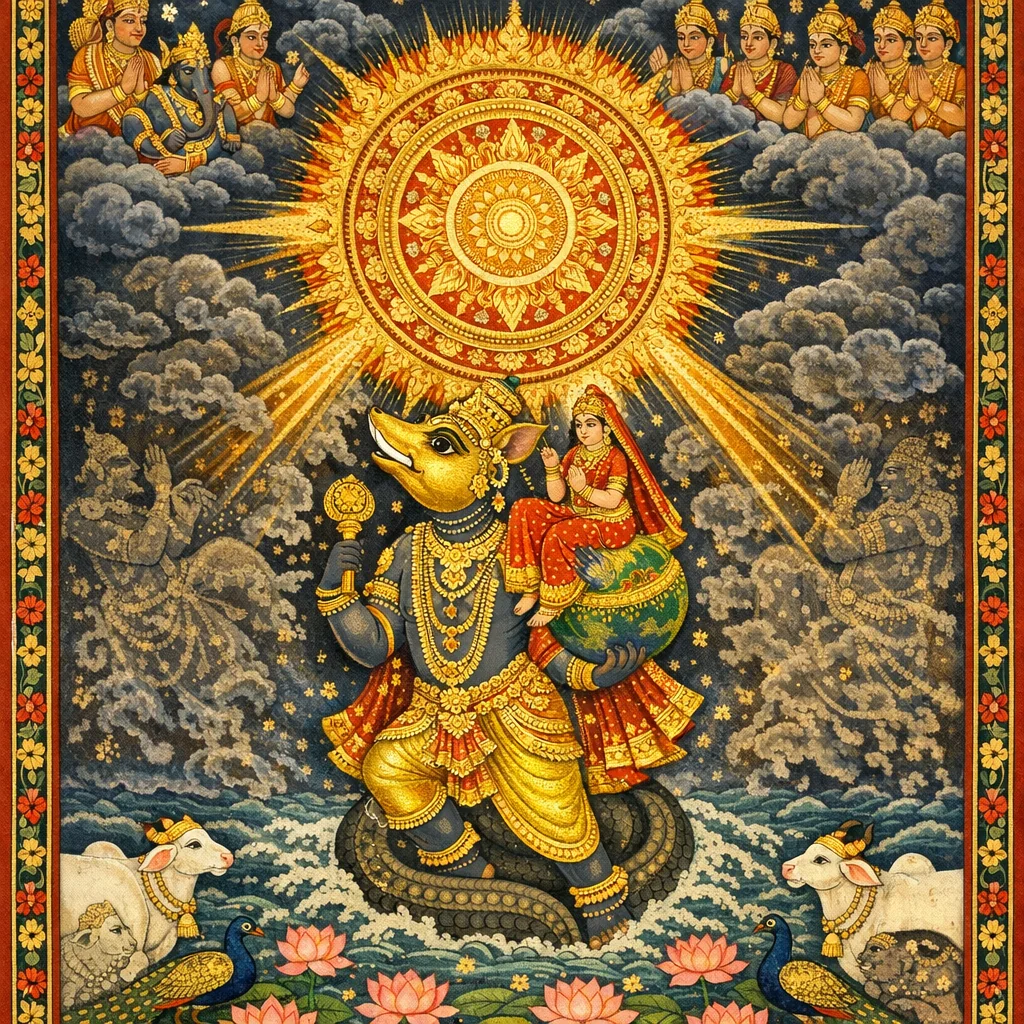
Adhyaya 19
The Slaying of Hiraṇyākṣa and the Triumph of Varāha
Continuing the climactic duel of the previous chapter, this adhyāya heightens the single combat as Lord Varāha accepts Brahmā’s pure prayers and closes in on Hiraṇyākṣa. When Varāha’s mace briefly slips, the demon gains a momentary edge yet keeps warrior decorum, and the Lord summons the Sudarśana discus. Hiraṇyākṣa’s fury erupts into volleys of weapons and then yogic conjurations that mimic cosmic dissolution—dark winds, foul rains, spectral armies—terrifying the heavenly onlookers. Varāha shatters this māyā with His discus, proclaiming His sovereignty over yoga-māyā. The demon then tries brute force, but the Lord remains untouched and ends the battle with a decisive blow, granting Hiraṇyākṣa a blessed death praised by Brahmā. Sūta concludes by extolling the purifying power of hearing this līlā: it destroys sin, bestows worldly and spiritual good, and at life’s end carries the hearer to the Lord’s abode, preparing the transition from avatāra-vijaya to further instruction and bhakti-centered reflection.
Shlokas
Verse 1
मैत्रेय उवाच अवधार्य विरिञ्चस्य निर्व्यलीकामृतं वच: । प्रहस्य प्रेमगर्भेण तदपाङ्गेन सोऽग्रहीत् ॥ १ ॥
Śrī Maitreya said: Hearing Brahmā’s words—free from guile and sinful intent, sweet as nectar—the Lord laughed with love and accepted his prayer with a glance filled with affection.
Verse 2
तत: सपत्नं मुखतश्चरन्तमकुतोभयम् । जघानोत्पत्य गदया हनावसुरमक्षज: ॥ २ ॥
Then the Lord Akṣaja, who had appeared from Brahmā’s nostril, sprang at His foe—the demon Hiraṇyākṣa, striding fearlessly before Him—and struck his chin with His mace.
Verse 3
सा हता तेन गदया विहता भगवत्करात् । विघूर्णितापतद्रेजे तदद्भुतमिवाभवत् ॥ ३ ॥
Yet when struck by the demon’s mace, the Lord’s mace slipped from His hand. As it fell, whirling, it shone splendidly—miraculous indeed, for it blazed with wondrous radiance.
Verse 4
स तदा लब्धतीर्थोऽपि न बबाधे निरायुधम् । मानयन् स मृधे धर्मं विष्वक्सेनं प्रकोपयन् ॥ ४ ॥
Though he had a perfect chance, the demon did not strike his unarmed foe. Honoring the dharma of single combat, he only further kindled the wrath of Viśvaksena, the Supreme Lord.
Verse 5
गदायामपविद्धायां हाहाकारे विनिर्गते । मानयामास तद्धर्मं सुनाभं चास्मरद्विभु: ॥ ५ ॥
As the Lord’s mace fell and a cry of alarm rose from the watching gods and ṛṣis, the all-powerful Lord honored the demon’s regard for dharma and invoked His Sudarśana discus, the fair-hubbed Sunābha.
Verse 6
तं व्यग्रचक्रं दितिपुत्राधमेन स्वपार्षदमुख्येन विषज्जमानम् । चित्रा वाचोऽतद्विदां खेचराणां तत्र स्मासन् स्वस्ति तेऽमुं जहीति ॥ ६ ॥
As the Lord’s Sudarśana discus whirled in His hand and He grappled at close quarters with Hiraṇyākṣa—the vile son of Diti, born as the chief of His own Vaikuṇṭha attendants—strange cries rose from every side from those watching in aerial chariots, ignorant of the Lord’s true nature: “Victory and auspiciousness to You! Slay him! Do not sport with him any longer!”
Verse 7
स तं निशाम्यात्तरथाङ्गमग्रतो व्यवस्थितं पद्मपलाशलोचनम् । विलोक्य चामर्षपरिप्लुतेन्द्रियो रुषा स्वदन्तच्छदमादशच्छ्वसन् ॥ ७ ॥
Seeing before him the Personality of Godhead, lotus-petaled-eyed, standing firm with the Sudarśana discus, the demon’s senses were flooded with indignation. He hissed like a serpent and, in fierce resentment, bit his lip.
Verse 8
करालदंष्ट्रश्चक्षुर्भ्यां सञ्चक्षाणो दहन्निव । अभिप्लुत्य स्वगदया हतोऽसीत्याहनद्धरिम् ॥ ८ ॥
The demon, with dreadful tusks, stared at Hari as if to burn Him with his eyes. Leaping into the air, he aimed his mace at the Lord and cried, “You are slain!”
Verse 9
पदा सव्येन तां साधो भगवान् यज्ञसूकर: । लीलया मिषत: शत्रो: प्राहरद्वातरंहसम् ॥ ९ ॥
O saintly Vidura, as the foe looked on, the Lord in His boar form—the enjoyer of all sacrificial offerings—playfully struck down that mace with His left foot, though it rushed upon Him with the force of a tempest.
Verse 10
आह चायुधमाधत्स्व घटस्व त्वं जिगीषसि । इत्युक्त:स तदा भूयस्ताडयन् व्यनदद् भृशम् ॥ १० ॥
The Lord then said, “Take up your weapon and try again, since you long to conquer Me.” Thus challenged, the demon lifted his mace once more and roared loudly.
Verse 11
तां स आपततीं वीक्ष्य भगवान् समवस्थित: । जग्राह लीलया प्राप्तां गरुत्मानिव पन्नगीम् ॥ ११ ॥
Seeing the mace flying toward Him, the Lord stood firm and caught it with ease, as Garuḍa, king of birds, would seize a serpent.
Verse 12
स्वपौरुषे प्रतिहते हतमानो महासुर: । नैच्छद्गदां दीयमानां हरिणा विगतप्रभ: ॥ १२ ॥
His prowess thwarted, the great demon felt humiliated and lost his luster; he was reluctant to take back the mace when Hari offered it to him.
Verse 13
जग्राह त्रिशिखं शूलं ज्वलज्ज्वलनलोलुपम् । यज्ञाय धृतरूपाय विप्रायाभिचरन् यथा ॥ १३ ॥
He then seized a three-pointed trident, ravenous like blazing fire, and hurled it at the Lord—the enjoyer of all sacrifices—as one might misuse austerity to work malice against a holy brāhmaṇa.
Verse 14
तदोजसा दैत्यमहाभटार्पितं चकासदन्त:ख उदीर्णदीधिति । चक्रेण चिच्छेद निशातनेमिना हरिर्यथा तार्क्ष्यपतत्रमुज्झितम् ॥ १४ ॥
Hurled with full force by the mighty demon-warrior, the trident blazed in the sky; yet Hari shattered it with His sharp-rimmed Sudarśana discus, as Indra once cut off a wing of Garuḍa.
Verse 15
वृक्णे स्वशूले बहुधारिणा हरे: प्रत्येत्य विस्तीर्णमुरो विभूतिमत् । प्रवृद्धरोष: स कठोरमुष्टिना नदन् प्रहृत्यान्तरधीयतासुर: ॥ १५ ॥
Enraged to see his trident shattered by Hari’s discus, the demon rushed forward roaring, struck the Lord’s broad chest—marked with Śrīvatsa—with his hard fist, and then vanished from sight.
Verse 16
तेनेत्थमाहत: क्षत्तर्भगवानादिसूकर: । नाकम्पत मनाक् क्वापि स्रजा हत इव द्विप: ॥ १६ ॥
Hit in this manner by the demon, O Vidura, the Lord, who had appeared as the first boar, did not feel the least quaking in any part of His body, any more than an elephant would when struck with a wreath of flowers.
Verse 17
अथोरुधासृजन्मायां योगमायेश्वरे हरौ । यां विलोक्य प्रजास्त्रस्ता मेनिरेऽस्योपसंयमम् ॥ १७ ॥
The demon, however, employed many conjuring tricks against the Personality of Godhead, who is the Lord of yoga-māyā. At the sight of this the people were filled with alarm and thought that the dissolution of the universe was near.
Verse 18
प्रववुर्वायवश्चण्डास्तम: पांसवमैरयन् । दिग्भ्यो निपेतुर्ग्रावाण: क्षेपणै: प्रहिता इव ॥ १८ ॥
Fierce winds began to blow from all directions, spreading darkness occasioned by dust and hail storms; stones came in volleys from every corner, as if thrown by machine guns.
Verse 19
द्यौर्नष्टभगणाभ्रौघै: सविद्युत्स्तनयित्नुभि: । वर्षद्भि: पूयकेशासृग्विण्मूत्रास्थीनि चासकृत् ॥ १९ ॥
The luminaries in outer space disappeared due to the sky’s being overcast with masses of clouds, which were accompanied by lightning and thunder. The sky rained pus, hair, blood, stool, urine and bones.
Verse 20
गिरय: प्रत्यदृश्यन्त नानायुधमुचोऽनघ । दिग्वाससो यातुधान्य: शूलिन्यो मुक्तमूर्धजा: ॥ २० ॥
O sinless Vidura, mountains discharged weapons of various kinds, and naked demonesses armed with tridents appeared with their hair hanging loose.
Verse 21
बहुभिर्यक्षरक्षोभि: पत्त्यश्वरथकुञ्जरै: । आततायिभिरुत्सृष्टा हिंस्रा वाचोऽतिवैशसा: ॥ २१ ॥
Cruel and savage slogans were uttered by hosts of ruffian Yakṣas and Rākṣasas, who all either marched on foot or rode on horses, elephants or chariots.
Verse 22
प्रादुष्कृतानां मायानामासुरीणां विनाशयत् । सुदर्शनास्त्रं भगवान् प्रायुङ्क्त दयितं त्रिपात् ॥ २२ ॥
The Lord, the personal enjoyer of all sacrifices, now discharged His beloved Sudarśana, which was capable of dispersing the magical forces displayed by the demon.
Verse 23
तदा दिते: समभवत्सहसा हृदि वेपथु: । स्मरन्त्या भर्तुरादेशं स्तनाच्चासृक् प्रसुस्रुवे ॥ २३ ॥
At that very moment, a shudder suddenly ran through the heart of Diti, the mother of Hiraṇyākṣa. She recalled the words of her husband, Kaśyapa, and blood flowed from her breasts.
Verse 24
विनष्टासु स्वमायासु भूयश्चाव्रज्य केशवम् । रुषोपगूहमानोऽमुं ददृशेऽवस्थितं बहि: ॥ २४ ॥
When the demon saw his magic forces dispelled, he once again came into the presence of the Personality of Godhead, Keśava, and, full of rage, tried to embrace Him within his arms to crush Him. But to his great amazement he found the Lord standing outside the circle of his arms.
Verse 25
तं मुष्टिभिर्विनिघ्नन्तं वज्रसारैरधोक्षज: । करेण कर्णमूलेऽहन् यथा त्वाष्ट्रं मरुत्पति: ॥ २५ ॥
The demon now began to strike the Lord with his hard fists, but Lord Adhokṣaja slapped him in the root of the ear, even as Indra, the lord of the Maruts, hit the demon Vṛtra.
Verse 26
स आहतो विश्वजिता ह्यवज्ञया परिभ्रमद्गात्र उदस्तलोचन: । विशीर्णबाह्वङ्घ्रिशिरोरुहोऽपतद् यथा नगेन्द्रो लुलितो नभस्वता ॥ २६ ॥
Though struck indifferently by the Lord, the conqueror of all, the demon’s body began to wheel. His eyeballs bulged out of their sockets. His arms and legs broken and the hair on his head scattered, he fell down dead, like a gigantic tree uprooted by the wind.
Verse 27
क्षितौ शयानं तमकुण्ठवर्चसं करालदंष्ट्रं परिदष्टदच्छदम् । अजादयो वीक्ष्य शशंसुरागता अहो इमां को नु लभेत संस्थितिम् ॥ २७ ॥
Aja [Brahmā] and others arrived on the spot to see the fearfully tusked demon lying on the ground, biting his lip. The glow of his face was yet unfaded, and Brahmā admiringly said: Oh, who could meet such blessed death?
Verse 28
यं योगिनो योगसमाधिना रहो ध्यायन्ति लिङ्गादसतो मुमुक्षया । तस्यैष दैत्यऋषभ: पदाहतो मुखं प्रपश्यंस्तनुमुत्ससर्ज ह ॥ २८ ॥
Brahmā continued: He was struck by a forefoot of the Lord, whom yogīs, seeking freedom from their unreal material bodies, meditate upon in seclusion in mystic trance. While gazing on His countenance, this crest jewel of Diti’s sons has cast off his mortal coil.
Verse 29
एतौ तौ पार्षदावस्य शापाद्यातावसद्गतिम् । पुन: कतिपयै: स्थानं प्रपत्स्येते ह जन्मभि: ॥ २९ ॥
These two personal assistants of the Supreme Lord, having been cursed, have been destined to take birth in demoniac families. After a few such births, they will return to their own positions.
Verse 30
देवा ऊचु: नमो नमस्तेऽखिलयज्ञतन्तवे स्थितौ गृहीतामलसत्त्वमूर्तये । दिष्टया हतोऽयं जगतामरुन्तुद- स्त्वत्पादभक्त्या वयमीश निर्वृता: ॥ ३० ॥
The demigods addressed the Lord: All obeisances unto You! You are the enjoyer of all sacrifices, and You have assumed the form of a boar, in pure goodness, for the purpose of maintaining the world. Fortunately for us, this demon, who was a torment to the worlds, has been slain by You, and we too, O Lord, are now at ease, in devotion to Your lotus feet.
Verse 31
मैत्रेय उवाच एवं हिरण्याक्षमसह्यविक्रमं स सादयित्वा हरिरादिसूकर: । जगाम लोकं स्वमखण्डितोत्सवं समीडित: पुष्करविष्टरादिभि: ॥ ३१ ॥
Maitreya said: Thus, having slain Hiraṇyākṣa of unbearable prowess, the Lord Hari, the primal Boar (Adi-Varāha), returned to His own abode, where the festival is unbroken. Brahmā and the other devas glorified Him.
Verse 32
मया यथानूक्तमवादि ते हरे: कृतावतारस्य सुमित्र चेष्टितम् । यथा हिरण्याक्ष उदारविक्रमो महामृधे क्रीडनवन्निराकृत: ॥ ३२ ॥
Maitreya continued: Dear Vidura, just as I heard it, I have spoken to you the auspicious lila of Lord Hari’s descent as Adi-Varāha—how, in the great battle, He cast aside the extraordinarily valiant Hiraṇyākṣa as though he were a mere plaything.
Verse 33
सूत उवाच इति कौषारवाख्यातामाश्रुत्य भगवत्कथाम् । क्षत्तानन्दं परं लेभे महाभागवतो द्विज ॥ ३३ ॥
Sūta said: O brāhmaṇa, hearing the Bhagavata narration spoken authoritatively by Kauṣārava (Maitreya), Kṣattā (Vidura), the great devotee, attained supreme transcendental bliss and was deeply satisfied.
Verse 34
अन्येषां पुण्यश्लोकानामुद्दामयशसां सताम् । उपश्रुत्य भवेन्मोद: श्रीवत्साङ्कस्य किं पुन: ॥ ३४ ॥
Even hearing of the deeds of saintly devotees, whose fame is deathless, brings transcendental joy; how much more, then, to hear the lilas of the Lord whose chest bears the mark of Śrīvatsa!
Verse 35
यो गजेन्द्र झषग्रस्तं ध्यायन्तं चरणाम्बुजम् । क्रोशन्तीनां करेणूनां कृच्छ्रतोऽमोचयद् द्रुतम् ॥ ३५ ॥
The Lord swiftly delivered Gajendra, king of elephants, seized by a crocodile, as he meditated upon the Lord’s lotus feet; the she-elephants at his side cried out in distress.
Verse 36
तं सुखाराध्यमृजुभिरनन्यशरणैर्नृभि: । कृतज्ञ: को न सेवेत दुराराध्यमसाधुभि: ॥ ३६ ॥
The Lord is easily pleased by spotless, upright devotees who take shelter of Him alone. What grateful soul would not render loving service to such a great Master, the Supreme Personality of Godhead? Yet for the unrighteous, He is difficult to propitiate.
Verse 37
यो वै हिरण्याक्षवधं महाद्भुतं विक्रीडितं कारणसूकरात्मन: । शृणोति गायत्यनुमोदतेऽञ्जसा विमुच्यते ब्रह्मवधादपि द्विजा: ॥ ३७ ॥
O brāhmaṇas, whoever hears, chants, or joyfully approves the wondrous account of the Lord—who appeared as the first Varāha to deliver the world—slaying the demon Hiraṇyākṣa, is at once freed from sinful reactions, even those of killing a brāhmaṇa.
Verse 38
एतन्महापुण्यमलं पवित्रं धन्यं यशस्यं पदमायुराशिषाम् । प्राणेन्द्रियाणां युधि शौर्यवर्धनं नारायणोऽन्ते गतिरङ्ग शृण्वताम् ॥ ३८ ॥
This narrative is supremely meritorious, spotless, and purifying; it bestows blessing, wealth, fame, longevity, and the desired boons. In battle it increases the strength of one’s prāṇa and senses, and it nourishes valor. O dear Śaunaka, one who hears it at life’s end is carried to the supreme abode of Nārāyaṇa.
Frequently Asked Questions
The text highlights the demon’s adherence to the kṣātra code of single combat (yuddha-dharma), which paradoxically becomes the cause of his downfall: his “righteousness” is external and ego-driven, whereas the Lord’s dharma is protective and absolute. The episode underscores that dharma without surrender (bhakti) cannot override the Lord’s will.
By releasing Sudarśana, the Lord nullifies the asura’s conjurations and restores clarity and order. In Bhāgavata theology, Sudarśana represents the Lord’s supreme power and ‘right vision’ that cuts through illusion—showing that even cosmic-scale fear effects cannot stand before Bhagavān’s sovereignty over yoga-māyā.
Brahmā praises the demon’s death as blessed because he dies directly by the Lord’s contact while beholding Him. Even antagonists who are slain by Bhagavān receive extraordinary purification due to the Lord’s transcendental nature; the event also foreshadows the return of the cursed gatekeepers to Vaikuṇṭha after completing their destined births.
Sūta states that hearing/chanting the account of Varāha killing Hiraṇyākṣa immediately relieves sinful reactions (even grave sins), grants merit and auspicious worldly outcomes (fame, longevity, strength), and, if heard at the time of death, transfers the hearer to the Lord’s supreme abode—affirming śravaṇa as a primary bhakti practice.