Adhyaya 9
Bhagīratha Brings Gaṅgā; Saudāsa’s Curse; Khaṭvāṅga’s Instant Renunciation
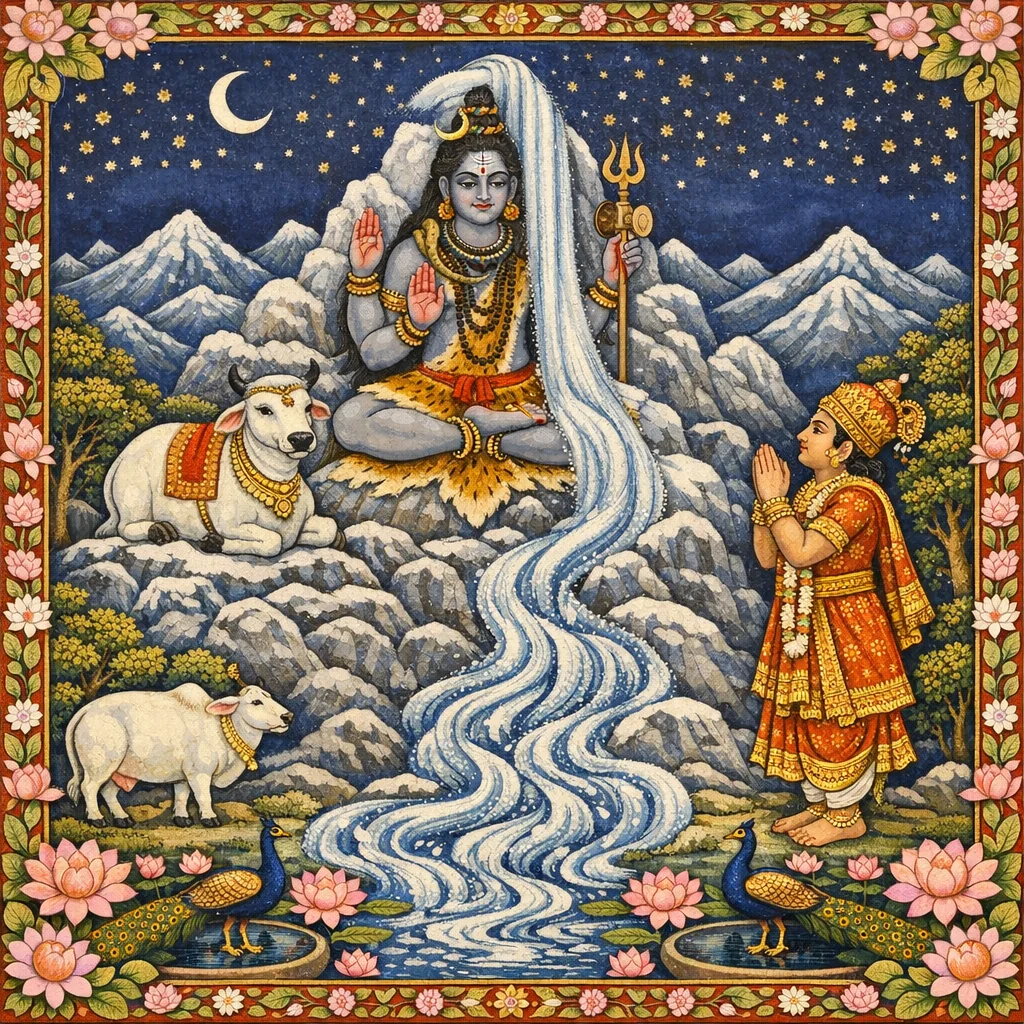
Continuing the Sūryavaṁśa line, Śukadeva tells how Aṁśumān and Dilīpa fail to bring Gaṅgā to earth, while Bhagīratha succeeds through severe tapas. Gaṅgā raises two fears—her destructive force on descent and the burden of taking in people’s sins—answered by bhakti reasoning: Śiva can bear her momentum, and the bathing of pure devotees neutralizes accumulated impurity. Śiva receives and sustains Gaṅgā, who follows Bhagīratha to the ashes of Sagara’s sons and grants them elevation. The genealogy then moves from Bhagīratha to Saudāsa (Mitrasaha/Kalmāṣapāda), where a vengeful Rākṣasa leads Vasiṣṭha to curse the king into man-eating, and a brāhmaṇī’s counter-curse blocks conjugal life and heirs until Vasiṣṭha begets Aśmaka. The line reaches Khaṭvāṅga, who learns he has only a moment to live and immediately fixes his mind on the Lord, teaching that swift, decisive surrender to Vāsudeva is the highest attainment, beyond all worldly boons and even heavenly rewards.
Shlokas
Verse 1
श्रीशुक उवाच अंशुमांश्च तपस्तेपे गङ्गानयनकाम्यया । कालं महान्तं नाशक्नोत् तत: कालेन संस्थित: ॥ १ ॥
Śukadeva Gosvāmī continued: King Aṁśumān performed austerities for a very long time, desiring to bring the Gaṅgā down to this world. Yet he could not accomplish it, and in due course of time he passed away.
Verse 2
दिलीपस्तत्सुतस्तद्वदशक्त: कालमेयिवान् । भगीरथस्तस्य सुतस्तेपे स सुमहत् तप: ॥ २ ॥
Like Aṁśumān, his son Dilīpa was also unable to bring the Gaṅgā down to this world, and in due course he too met death. Then Dilīpa’s son Bhagīratha performed extremely severe austerities to bring the Gaṅgā to the earth.
Verse 3
दर्शयामास तं देवी प्रसन्ना वरदास्मि ते । इत्युक्त: स्वमभिप्रायं शशंसावनतो नृप: ॥ ३ ॥
Thereafter Mother Gaṅgā appeared, pleased, and said, “I am ready to grant you the boon you desire.” Addressed thus by Gaṅgādevī, the King bowed his head in reverence and spoke his heartfelt wish.
Verse 4
कोऽपि धारयिता वेगं पतन्त्या मे महीतले । अन्यथा भूतलं भित्त्वा नृप यास्ये रसातलम् ॥ ४ ॥
Mother Gaṅgā replied: When I descend from the heavens to the earth, my current will be exceedingly fierce. Who will sustain that force? If I am not held, O King, I shall pierce the earth and fall to Rasātala.
Verse 5
किं चाहं न भुवं यास्ये नरा मय्यामृजन्त्यघम् । मृजामि तदघं क्वाहं राजंस्तत्र विचिन्त्यताम् ॥ ५ ॥
O King, I do not wish to descend to the earth, for people will bathe in my waters to wash away the reactions of their sins. When those sins accumulate in me, how shall I be freed from them? Please consider this carefully.
Verse 6
श्रीभगीरथ उवाच साधवो न्यासिन: शान्ता ब्रह्मिष्ठा लोकपावना: । हरन्त्यघं तेऽङ्गसङ्गात् तेष्वास्ते ह्यघभिद्धरि: ॥ ६ ॥
Bhagīratha said: Saintly devotees—renounced, peaceful, and steadfast in Vedic truth—purify the worlds. When such pure souls bathe in your waters, the sins gathered from others are destroyed, for within their hearts dwells Hari, the vanquisher of all sin.
Verse 7
धारयिष्यति ते वेगं रुद्रस्त्वात्मा शरीरिणाम् । यस्मिन्नोतमिदं प्रोतं विश्वं शाटीव तन्तुषु ॥ ७ ॥
Rudra will sustain your mighty force, for he represents the indwelling Self within embodied beings. As cloth is woven of threads in length and breadth, so this entire universe is interlaced within the potencies of the Supreme Lord; thus Śiva can bear your impetuous waves upon his head.
Verse 8
इत्युक्त्वा स नृपो देवं तपसातोषयच्छिवम् । कालेनाल्पीयसा राजंस्तस्येशश्चाश्वतुष्यत ॥ ८ ॥
Having spoken thus, the king satisfied Lord Śiva by performing austerities. O King Parīkṣit, in a short time Lord Śiva was swiftly pleased with Bhagīratha.
Verse 9
तथेति राज्ञाभिहितं सर्वलोकहित: शिव: । दधारावहितो गङ्गां पादपूतजलां हरे: ॥ ९ ॥
Hearing the king’s request, Śiva, the benefactor of all worlds, replied, “So be it.” Then, with utmost care, he bore the Gaṅgā upon his head, for her waters are purifying, having issued from the toes of Śrī Hari (Viṣṇu).
Verse 10
भगीरथ: स राजर्षिर्निन्ये भुवनपावनीम् । यत्र स्वपितृणां देहा भस्मीभूता: स्म शेरते ॥ १० ॥
The saintly king Bhagīratha led the world-purifying Gaṅgā to the very place on earth where the bodies of his forefathers lay, burned to ashes.
Verse 11
रथेन वायुवेगेन प्रयान्तमनुधावती । देशान्पुनन्ती निर्दग्धानासिञ्चत्सगरात्मजान् ॥ ११ ॥
Bhagīratha rode ahead upon a chariot swift as the wind, and Mother Gaṅgā pursued him, purifying many lands, until she sprinkled with her waters the ashes of Sagara’s sons.
Verse 12
यज्जलस्पर्शमात्रेण ब्रह्मदण्डहता अपि । सगरात्मजा दिवं जग्मु: केवलं देहभस्मभि: ॥ १२ ॥
Though Sagara’s sons, struck by a punishment like Brahmā’s rod, were reduced to mere bodily ashes, by the touch of Gaṅgā’s water alone they became fit to ascend to heaven; what, then, can be said of those who, with faith, worship Mother Gaṅgā using her sacred waters?
Verse 13
भस्मीभूताङ्गसङ्गेन स्वर्याता: सगरात्मजा: । किं पुन: श्रद्धया देवीं सेवन्ते ये धृतव्रता: ॥ १३ ॥
By the mere contact of Gaṅgā’s water with the ashes of their burned bodies, Sagara’s sons were raised to the heavenly realms; how immeasurable, then, is the reward of the devotee who, firm in vow, serves and worships Goddess Gaṅgā with faith.
Verse 14
न ह्येतत् परमाश्चर्यं स्वर्धुन्या यदिहोदितम् । अनन्तचरणाम्भोजप्रसूताया भवच्छिद: ॥ १४ ॥
There is nothing astonishing in what is spoken here of Mother Gaṅgā, for she issues from the lotus toe of Anantadeva, the Supreme Personality of Godhead, and thus can sever the bondage of material existence.
Verse 15
सन्निवेश्य मनो यस्मिञ्छ्रद्धया मुनयोऽमला: । त्रैगुण्यं दुस्त्यजं हित्वा सद्यो यातास्तदात्मताम् ॥ १५ ॥
Pure sages, with faith, fix their minds upon Him; abandoning the hard-to-give-up realm of the three guṇas, they at once attain the Lord’s own transcendental state, sharing His spiritual quality.
Verse 16
श्रुतो भगीरथाज्जज्ञे तस्य नाभोऽपरोऽभवत् । सिन्धुद्वीपस्ततस्तस्मादयुतायुस्ततोऽभवत् ॥ १६ ॥ ऋतूपर्णो नलसखो योऽश्वविद्यामयान्नलात् । दत्त्वाक्षहृदयं चास्मै सर्वकामस्तु तत्सुतम् ॥ १७ ॥
Bhagīratha begot a son named Śruta, whose son was Nābha (different from the Nābha mentioned earlier). From Nābha came Sindhudvīpa, from him Ayutāyu, and from him Ṛtūparṇa. Ṛtūparṇa became a friend of King Nala; he taught Nala the secret of dice-play and learned from Nala aśva-vidyā, the art of horses. Ṛtūparṇa’s son was Sarvakāma.
Verse 17
श्रुतो भगीरथाज्जज्ञे तस्य नाभोऽपरोऽभवत् । सिन्धुद्वीपस्ततस्तस्मादयुतायुस्ततोऽभवत् ॥ १६ ॥ ऋतूपर्णो नलसखो योऽश्वविद्यामयान्नलात् । दत्त्वाक्षहृदयं चास्मै सर्वकामस्तु तत्सुतम् ॥ १७ ॥
Bhagīratha begot a son named Śruta, whose son was Nābha (different from the Nābha mentioned earlier). From Nābha came Sindhudvīpa, from him Ayutāyu, and from him Ṛtūparṇa. Ṛtūparṇa became a friend of King Nala; he taught Nala the secret of dice-play and learned from Nala aśva-vidyā, the art of horses. Ṛtūparṇa’s son was Sarvakāma.
Verse 18
तत: सुदासस्तत्पुत्रो दमयन्तीपतिर्नृप: । आहुर्मित्रसहं यं वै कल्माषाङ्घ्रिमुत क्वचित् । वसिष्ठशापाद् रक्षोऽभूदनपत्य: स्वकर्मणा ॥ १८ ॥
Thereafter Sarvakāma had a son named Sudāsa, whose son Saudāsa was the husband of Damayantī. Saudāsa is also known as Mitrasaha or Kalmāṣāṅghri. By his own misdeed he became without offspring, and by Vasiṣṭha’s curse he turned into a man-eating rākṣasa.
Verse 19
श्रीराजोवाच किं निमित्तो गुरो: शाप: सौदासस्य महात्मन: । एतद् वेदितुमिच्छाम: कथ्यतां न रहो यदि ॥ १९ ॥
King Parīkṣit said: O revered Śukadeva, for what reason did Vasiṣṭha, the spiritual master of the great-souled Saudāsa, pronounce a curse? I long to know; if it is not confidential, please tell me.
Verse 20
श्रीशुक उवाच सौदासो मृगयां किञ्चिच्चरन् रक्षो जघान ह । मुमोच भ्रातरं सोऽथ गत: प्रतिचिकीर्षया ॥ २० ॥ सञ्चिन्तयन्नघं राज्ञ: सूदरूपधरो गृहे । गुरवे भोक्तुकामाय पक्त्वा निन्ये नरामिषम् ॥ २१ ॥
Śukadeva Gosvāmī said: Once, while roaming the forest on a hunt, Saudāsa killed a man-eating Rākṣasa, yet mercifully spared and released the Rākṣasa’s brother. That brother, intent on revenge, plotted harm to the king and entered the royal household disguised as a cook. One day, when the guru Vasiṣṭha Muni was invited to dine, that Rākṣasa cook prepared and served him human flesh.
Verse 21
श्रीशुक उवाच सौदासो मृगयां किञ्चिच्चरन् रक्षो जघान ह । मुमोच भ्रातरं सोऽथ गत: प्रतिचिकीर्षया ॥ २० ॥ सञ्चिन्तयन्नघं राज्ञ: सूदरूपधरो गृहे । गुरवे भोक्तुकामाय पक्त्वा निन्ये नरामिषम् ॥ २१ ॥
Śukadeva Gosvāmī said: While hunting in the forest, Saudāsa killed a man-eating Rākṣasa, yet out of mercy released the Rākṣasa’s brother. That brother sought revenge; plotting to harm the king, he entered the royal home disguised as a cook. When Vasiṣṭha Muni was invited to dine, the Rākṣasa cook served him cooked human flesh.
Verse 22
परिवेक्ष्यमाणं भगवान् विलोक्याभक्ष्यमञ्जसा । राजानमशपत् क्रुद्धो रक्षो ह्येवं भविष्यसि ॥ २२ ॥
While examining the meal, Vasiṣṭha Muni, by his yogic power, understood it to be unfit for eating, for it was human flesh. Enraged, he at once cursed Saudāsa: “Thus you shall become a man-eater, like a Rākṣasa.”
Verse 23
रक्ष:कृतं तद् विदित्वा चक्रे द्वादशवार्षिकम् । सोऽप्यपोऽञ्जलिमादाय गुरुं शप्तुं समुद्यत: ॥ २३ ॥ वारितो मदयन्त्यापो रुशती: पादयोर्जहौ । दिश: खमवनीं सर्वं पश्यञ्जीवमयं नृप: ॥ २४ ॥
When Vasiṣṭha realized that the deed was the Rākṣasa’s and not the king’s, he regretted having cursed the blameless ruler and performed austerities for twelve years to purify himself. Meanwhile, Saudāsa took water in his palms and, chanting a curse-mantra, prepared to curse Vasiṣṭha, but his wife Madayantī forbade him; in anger she poured the water down near the guru’s feet. Then the king beheld that the ten directions, the sky, and the earth’s surface were everywhere filled with living beings.
Verse 24
रक्ष:कृतं तद् विदित्वा चक्रे द्वादशवार्षिकम् । सोऽप्यपोऽञ्जलिमादाय गुरुं शप्तुं समुद्यत: ॥ २३ ॥ वारितो मदयन्त्यापो रुशती: पादयोर्जहौ । दिश: खमवनीं सर्वं पश्यञ्जीवमयं नृप: ॥ २४ ॥
When Vasiṣṭha understood that the human flesh had been served by the Rākṣasa and not by the king, he undertook twelve years of austerity to cleanse himself of the fault of cursing the blameless monarch. Meanwhile, Saudāsa took water in his joined palms and recited the curse-mantra, ready to curse Vasiṣṭha, but Madayantī restrained him. Then the king beheld that the ten directions, the sky, and the face of the earth were everywhere filled with living beings.
Verse 25
राक्षसं भावमापन्न: पादे कल्माषतां गत: । व्यवायकाले ददृशे वनौकोदम्पती द्विजौ ॥ २५ ॥
Saudāsa thus took on the nature of a Rākṣasa, and a black mark appeared upon his leg; therefore he became known as Kalmāṣapāda. Once, King Kalmāṣapāda saw in the forest a brāhmaṇa couple engaged in sexual union.
Verse 26
क्षुधार्तो जगृहे विप्रं तत्पत्न्याहाकृतार्थवत् । न भवान् राक्षस: साक्षादिक्ष्वाकूणां महारथ: ॥ २६ ॥ मदयन्त्या: पतिर्वीर नाधर्मं कर्तुमर्हसि । देहि मेऽपत्यकामाया अकृतार्थं पतिं द्विजम् ॥ २७ ॥
Overcome by the Rākṣasa impulse and tormented by hunger, Saudāsa seized the brāhmaṇa. Then the brāhmaṇa’s poor wife pleaded: “O hero, you are not truly a man-eater; you are a great warrior of the Ikṣvāku line, the husband of Madayantī. You should not commit such adharma. I long for a son—therefore, please return my brāhmaṇa husband, who has not yet made me conceive.”
Verse 27
क्षुधार्तो जगृहे विप्रं तत्पत्न्याहाकृतार्थवत् । न भवान् राक्षस: साक्षादिक्ष्वाकूणां महारथ: ॥ २६ ॥ मदयन्त्या: पतिर्वीर नाधर्मं कर्तुमर्हसि । देहि मेऽपत्यकामाया अकृतार्थं पतिं द्विजम् ॥ २७ ॥
Overcome by the Rākṣasa impulse and tormented by hunger, Saudāsa seized the brāhmaṇa. Then the brāhmaṇa’s poor wife pleaded: “O hero, you are not truly a man-eater; you are a great warrior of the Ikṣvāku line, the husband of Madayantī. You should not commit such adharma. I long for a son—therefore, please return my brāhmaṇa husband, who has not yet made me conceive.”
Verse 28
देहोऽयं मानुषो राजन् पुरुषस्याखिलार्थद: । तस्मादस्य वधो वीर सर्वार्थवध उच्यते ॥ २८ ॥
O King, O hero, this human body is meant to bestow all the higher aims of life; therefore to destroy it before its time is said to be the destruction of all the benefits of human existence.
Verse 29
एष हि ब्राह्मणो विद्वांस्तप:शीलगुणान्वित: । आरिराधयिषुर्ब्रह्म महापुरुषसंज्ञितम् । सर्वभूतात्मभावेन भूतेष्वन्तर्हितं गुणै: ॥ २९ ॥
Here is a learned, highly qualified brāhmaṇa, engaged in performing austerity and eagerly desiring to worship the Supreme Lord, the Supersoul who lives within the core of the heart in all living entities.
Verse 30
सोऽयं ब्रह्मर्षिवर्यस्ते राजर्षिप्रवराद् विभो । कथमर्हति धर्मज्ञ वधं पितुरिवात्मज: ॥ ३० ॥
My lord, you are completely aware of the religious principles. As a son never deserves to be killed by his father, here is a brāhmaṇa who should be protected by the king, and never killed. How does he deserve to be killed by a rājarṣi like you?
Verse 31
तस्य साधोरपापस्य भ्रूणस्य ब्रह्मवादिन: । कथं वधं यथा बभ्रोर्मन्यते सन्मतो भवान् ॥ ३१ ॥
You are well known and worshiped in learned circles. How dare you kill this brāhmaṇa, who is a saintly, sinless person, well versed in Vedic knowledge? Killing him would be like destroying the embryo within the womb or killing a cow.
Verse 32
यद्ययं क्रियते भक्ष्यस्तर्हि मां खाद पूर्वत: । न जीविष्ये विना येन क्षणं च मृतकं यथा ॥ ३२ ॥
Without my husband, I cannot live for a moment. If you want to eat my husband, it would be better to eat me first, for without my husband I am as good as a dead body.
Verse 33
एवं करुणभाषिण्या विलपन्त्या अनाथवत् । व्याघ्र: पशुमिवाखादत् सौदास: शापमोहित: ॥ ३३ ॥
Being condemned by the curse of Vasiṣṭha, King Saudāsa devoured the brāhmaṇa, exactly as a tiger eats its prey. Even though the brāhmaṇa’s wife spoke so pitiably, Saudāsa was unmoved by her lamentation.
Verse 34
ब्राह्मणी वीक्ष्य दिधिषुं पुरुषादेन भक्षितम् । शोचन्त्यात्मानमुर्वीशमशपत् कुपिता सती ॥ ३४ ॥
When the chaste wife of the brāhmaṇa saw that her husband, who was about to discharge semen, had been eaten by the man-eater, she was overwhelmed with grief and lamentation. Thus she angrily cursed the King.
Verse 35
यस्मान्मे भक्षित: पाप कामार्ताया: पतिस्त्वया । तवापि मृत्युराधानादकृतप्रज्ञ दर्शित: ॥ ३५ ॥
O foolish, sinful person, because you have eaten my husband when I was sexually inclined and desiring to have the seed of a child, I shall also see you die when you attempt to discharge semen in your wife.
Verse 36
एवं मित्रसहं शप्त्वा पतिलोकपरायणा । तदस्थीनि समिद्धेऽग्नौ प्रास्य भर्तुर्गतिं गता ॥ ३६ ॥
Thus the wife of the brāhmaṇa cursed King Saudāsa, known as Mitrasaha. Then, being inclined to go with her husband, she set fire to her husband’s bones, fell into the fire herself, and went with him to the same destination.
Verse 37
विशापो द्वादशाब्दान्ते मैथुनाय समुद्यत: । विज्ञाप्य ब्राह्मणीशापं महिष्या स निवारित: ॥ ३७ ॥
After twelve years, when King Saudāsa was released from the curse by Vasiṣṭha, he wanted to have sexual intercourse with his wife. But the Queen reminded him about the curse by the brāhmaṇī, and thus he was checked from sexual intercourse.
Verse 38
अत ऊर्ध्वं स तत्याज स्त्रीसुखं कर्मणाप्रजा: । वसिष्ठस्तदनुज्ञातो मदयन्त्यां प्रजामधात् ॥ ३८ ॥
After being thus instructed, the King gave up the future happiness of sexual intercourse and by destiny remained sonless. Later, with the King’s permission, the great saint Vasiṣṭha begot a child in the womb of Madayantī.
Verse 39
सा वै सप्त समा गर्भमबिभ्रन्न व्यजायत । जघ्नेऽश्मनोदरं तस्या: सोऽश्मकस्तेन कथ्यते ॥ ३९ ॥
Madayantī bore the child within the womb for seven years and did not give birth. Therefore Vasiṣṭha struck her abdomen with a stone, and then the child was born. Consequently, the child was known as Aśmaka.
Verse 40
अश्मकाद्बालिको जज्ञे य: स्त्रीभि: परिरक्षित: । नारीकवच इत्युक्तो नि:क्षत्रे मूलकोऽभवत् ॥ ४० ॥
From Aśmaka, Bālika took birth. Because Bālika was surrounded by women and was therefore saved from the anger of Paraśurāma, he was known as Nārīkavaca. When Paraśurāma vanquished all the kṣatriyas, Bālika became the progenitor of more kṣatriyas. Therefore he was known as Mūlaka.
Verse 41
ततो दशरथस्तस्मात् पुत्र ऐडविडिस्तत: । राजा विश्वसहो यस्य खट्वाङ्गश्चक्रवर्त्यभूत् ॥ ४१ ॥
From Bālika came a son named Daśaratha, from Daśaratha came a son named Aiḍaviḍi, and from Aiḍaviḍi came King Viśvasaha. The son of King Viśvasaha was the famous Mahārāja Khaṭvāṅga.
Verse 42
यो देवैरर्थितो दैत्यानवधीद् युधि दुर्जय: । मुहूर्तमायुर्ज्ञात्वैत्य स्वपुरं सन्दधे मन: ॥ ४२ ॥
King Khaṭvāṅga was unconquerable in any fight. Requested by the demigods to join them in fighting the demons, he won victory, and the demigods, being very pleased, wanted to give him a benediction. The King inquired from them about the duration of his life and was informed that he had only one moment more. Thus he immediately left his palace and went to his own residence, where he engaged his mind fully on the lotus feet of the Lord.
Verse 43
न मे ब्रह्मकुलात् प्राणा: कुलदैवान्न चात्मजा: । न श्रियो न मही राज्यं न दाराश्चातिवल्लभा: ॥ ४३ ॥
Mahārāja Khaṭvāṅga thought: Not even my life is dearer to me than the brahminical culture and the brāhmaṇas, who are worshiped by my family. What then is to be said of my kingdom, land, wife, children and opulence? Nothing is dearer to me than the brāhmaṇas.
Verse 44
न बाल्येऽपि मतिर्मह्यमधर्मे रमते क्वचित् । नापश्यमुत्तमश्लोकादन्यत् किञ्चन वस्त्वहम् ॥ ४४ ॥
Even in childhood my mind never delighted in adharma or in trivial things. I saw nothing more substantial than Uttamaśloka, the Supreme Personality of Godhead.
Verse 45
देवै: कामवरो दत्तो मह्यं त्रिभुवनेश्वरै: । न वृणे तमहं कामं भूतभावनभावन: ॥ ४५ ॥
The devas, rulers of the three worlds, wished to grant me whatever boon I desired. Yet I did not choose such wishes, for my heart is drawn to the Supreme Lord, Bhūta-bhāvana, the creator and sustainer of all.
Verse 46
ये विक्षिप्तेन्द्रियधियो देवास्ते स्वहृदि स्थितम् । न विन्दन्ति प्रियं शश्वदात्मानं किमुतापरे ॥ ४६ ॥
Even the devas, though advantaged in higher realms, have minds, senses, and intelligence disturbed by material conditions. Thus they fail to realize the eternally beloved Lord within the heart—what then of others?
Verse 47
अथेशमायारचितेषु सङ्गं गुणेषु गन्धर्वपुरोपमेषु । रूढं प्रकृत्यात्मनि विश्वकर्तु- र्भावेन हित्वा तमहं प्रपद्ये ॥ ४७ ॥
Therefore I shall abandon my attachment to the guṇas and objects fashioned by the Lord’s external māyā, like an illusory city. Fixing my thought on the Creator of the universe, I surrender unto Him.
Verse 48
इति व्यवसितो बुद्ध्या नारायणगृहीतया । हित्वान्यभावमज्ञानं तत: स्वं भावमास्थित: ॥ ४८ ॥
Thus Mahārāja Khaṭvāṅga, with intelligence refined through service to Nārāyaṇa, cast off the ignorant, bodily false identity. Established in his original nature as an eternal servant, he engaged in the Lord’s service.
Verse 49
यत् तद् ब्रह्म परं सूक्ष्ममशून्यं शून्यकल्पितम् । भगवान् वासुदेवेति यं गृणन्ति हि सात्वता: ॥ ४९ ॥
That supreme, most subtle Brahman is not void, though the unintelligent imagine Him as void or impersonal; He is Bhagavān Vāsudeva, whom the pure devotees sing and glorify.
Frequently Asked Questions
Gaṅgā expresses two objections: (1) her descent would be violently forceful and could pierce the earth down to Rasātala unless a capable bearer sustains her; (2) humans would bathe to wash sins, causing sinful reactions to accumulate in her waters. Bhagīratha answers by invoking Śiva’s capacity to bear her momentum and by explaining that the presence of pure devotees—who carry Bhagavān in their hearts—counteracts impurity, restoring Gaṅgā’s purifying function.
Bhagīratha petitions Śiva to hold Gaṅgā’s force on his head. Śiva agrees and sustains her descent, and the chapter explicitly links Gaṅgā’s purity to her origin from the toes of Lord Viṣṇu. Śiva’s role is thus protective and mediating: he bears the divine current so it can bless the world without destructive overflow.
The sons of Sagara were burned to ashes due to offense against a great personality, and their deliverance awaited Gaṅgā’s descent. When Bhagīratha leads Gaṅgā to their remains, the waters sprinkle the ashes and elevate them to heavenly destinations—illustrating the Bhāgavata principle that contact with the Lord’s sacred potency (tīrtha) can transform destiny, especially when invoked through devotional endeavor.
A surviving Rākṣasa, seeking revenge, infiltrates Saudāsa’s household as a cook and serves human flesh to Vasiṣṭha during a meal. By mystic discernment Vasiṣṭha detects the abominable food and, in anger, curses Saudāsa to become a man-eater. Later, realizing the king was faultless and the deception was by the Rākṣasa, Vasiṣṭha performs austerities to atone for the misdirected curse—showing how even great sages model responsibility for speech and judgment.
After Saudāsa, under the curse’s influence, devours her brāhmaṇa husband, the brāhmaṇī curses the king to die whenever he attempts sexual union with his wife. The implication is twofold: it seals the immediate karmic consequence of violence against the protected class (brāhmaṇas) and it redirects the narrative to a dharmic resolution through Vasiṣṭha begetting Aśmaka—preserving lineage while highlighting the gravity of transgression.
When Khaṭvāṅga learns he has only one moment of life remaining, he immediately renounces all attachments and fixes his mind on the lotus feet of the Lord. The teaching is that awareness of mortality can catalyze decisive bhakti, and that devotion to Vāsudeva is superior to all worldly and even celestial benedictions; true success is surrender, not extension of lifespan or acquisition of power.