Adhyaya 77
The Slaying of Śālva and the Destruction of Saubha
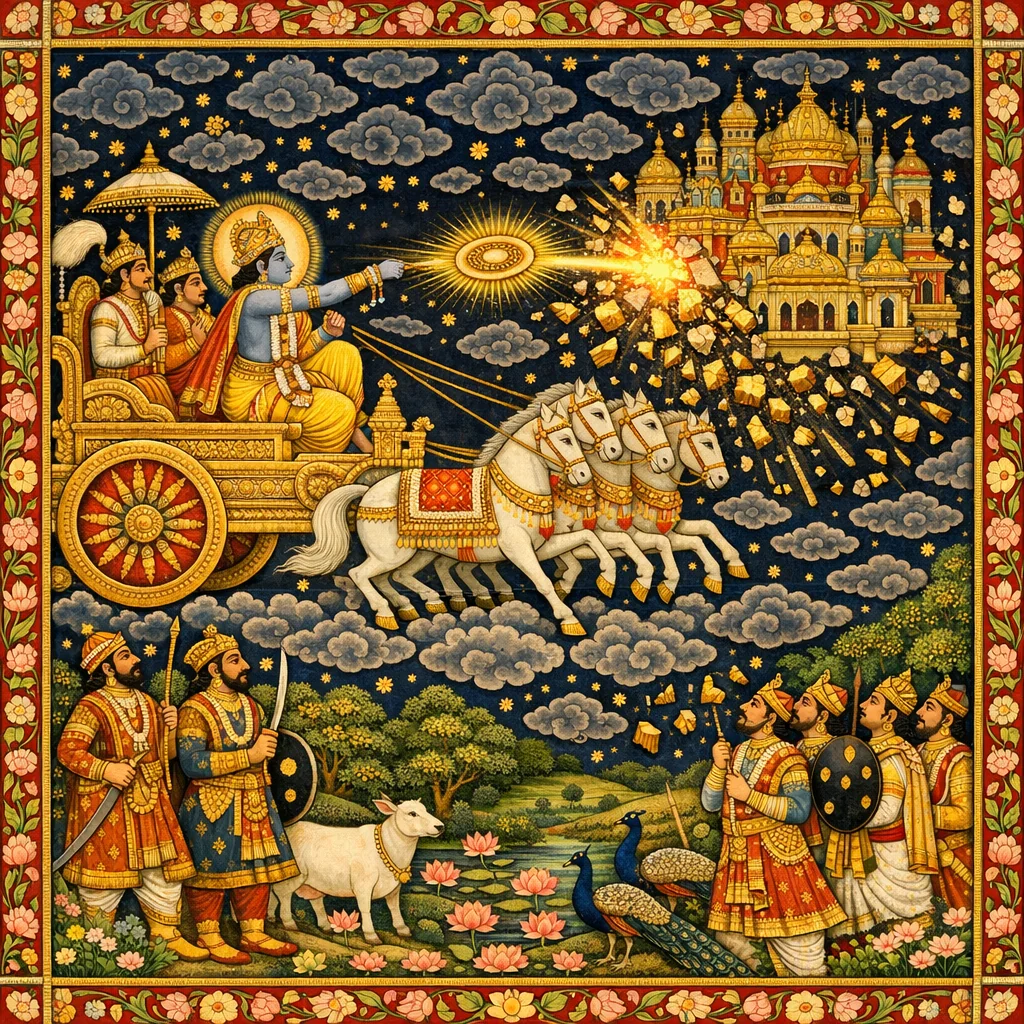
This chapter describes the conclusion of the battle between Lord Kṛṣṇa and Śālva. After twenty-seven days of fighting led by Pradyumna, Kṛṣṇa returns from Indraprastha. Seeing bad omens, He rushes to Dvārakā. Śālva uses mystical illusions (māyā), even staging the false killing of Vasudeva, but Kṛṣṇa, being the omniscient Supreme Person, remains undeluded. Ultimately, Kṛṣṇa destroys the Saubha airship and beheads Śālva with the Sudarśana Cakra. Dantavakra then arrives seeking revenge.
Shlokas
Verse 1
श्रीशुक उवाच स उपस्पृश्य सलिलं दंशितो धृतकार्मुक: । नय मां द्युमत: पार्श्वं वीरस्येत्याह सारथिम् ॥ १ ॥
Śukadeva Gosvāmī said: After touching water to refresh Himself, donning His armor and taking up His bow, Lord Pradyumna told His charioteer, “Take Me to where the hero Dyumān stands.”
Verse 2
विधमन्तं स्वसैन्यानि द्युमन्तं रुक्मिणीसुत: । प्रतिहत्य प्रत्यविध्यान्नाराचैरष्टभि: स्मयन् ॥ २ ॥
In Pradyumna’s absence, Dyumān was ravaging his army; but now Rukmiṇī’s son Pradyumna counterattacked with a smile and pierced Dyumān with eight nārāca arrows.
Verse 3
चतुर्भिश्चतुरो वाहान् सूतमेकेन चाहनत् । द्वाभ्यं धनुश्च केतुं च शरेणान्येन वै शिर: ॥ ३ ॥
With four arrows He struck Dyumān’s four horses; with one, his charioteer; with two more, his bow and chariot flag; and with the final arrow, Dyumān’s head.
Verse 4
गदसात्यकिसाम्बाद्या जघ्नु: सौभपतेर्बलम् । पेतु: समुद्रे सौभेया: सर्वे सञ्छिन्नकन्धरा: ॥ ४ ॥
Gada, Sātyaki, Sāmba and others began slaughtering Śālva’s army, and all the warriors within the airship Saubha fell into the ocean, their necks severed.
Verse 5
एवं यदूनां शाल्वानां निघ्नतामितरेतरम् । युद्धं त्रिनवरात्रं तदभूत्तुमुलमुल्बणम् ॥ ५ ॥
Thus, as the Yadus and Śālva’s followers struck one another, the tumultuous and dreadful battle raged on for twenty-seven days and nights.
Verse 6
इन्द्रप्रस्थं गत: कृष्ण आहूतो धर्मसूनुना । राजसूयेऽथ निवृत्ते शिशुपाले च संस्थिते ॥ ६ ॥ कुरुवृद्धाननुज्ञाप्य मुनींश्च ससुतां पृथाम् । निमित्तान्यतिघोराणि पश्यन् द्वारवतीं ययौ ॥ ७ ॥
Invited by Yudhiṣṭhira, the son of Dharma, Lord Kṛṣṇa went to Indraprastha. When the Rājasūya sacrifice was completed and Śiśupāla slain, the Lord beheld most dreadful omens; thus, taking leave of the Kuru elders and great sages, and also of Pṛthā and her sons, He returned to Dvārakā.
Verse 7
इन्द्रप्रस्थं गत: कृष्ण आहूतो धर्मसूनुना । राजसूयेऽथ निवृत्ते शिशुपाले च संस्थिते ॥ ६ ॥ कुरुवृद्धाननुज्ञाप्य मुनींश्च ससुतां पृथाम् । निमित्तान्यतिघोराणि पश्यन् द्वारवतीं ययौ ॥ ७ ॥
Invited by Yudhiṣṭhira, the son of Dharma, Lord Kṛṣṇa went to Indraprastha. When the Rājasūya sacrifice was completed and Śiśupāla slain, the Lord beheld most dreadful omens; thus, taking leave of the Kuru elders and great sages, and also of Pṛthā and her sons, He returned to Dvārakā.
Verse 8
आह चाहमिहायात आर्यमिश्राभिसङ्गत: । राजन्याश्चैद्यपक्षीया नूनं हन्यु: पुरीं मम ॥ ८ ॥
The Lord said to Himself: Since I have come here with My revered elder brother, the kings devoted to Śiśupāla are surely attacking My capital, Dvārakā.
Verse 9
वीक्ष्य तत् कदनं स्वानां निरूप्य पुररक्षणम् । सौभं च शाल्वराजं च दारुकं प्राह केशव: ॥ ९ ॥
Arriving in Dvārakā and seeing His people threatened with ruin, Lord Keśava arranged the city’s defense; then, beholding Śālva and his Saubha airship, He spoke to Dāruka.
Verse 10
रथं प्रापय मे सूत शाल्वस्यान्तिकमाशु वै । सम्भ्रमस्ते न कर्तव्यो मायावी सौभराडयम् ॥ १० ॥
O charioteer, quickly bring My chariot near Śālva. This lord of Saubha is a mighty wielder of illusion; do not become bewildered.
Verse 11
इत्युक्तश्चोदयामास रथमास्थाय दारुक: । विशन्तं ददृशु: सर्वे स्वे परे चारुणानुजम् ॥ ११ ॥
Thus commanded, Dāruka took charge of the Lord’s chariot and drove forth. As it entered the battlefield, both friend and foe beheld the banner of Garuḍa.
Verse 12
शाल्वश्च कृष्णमालोक्य हतप्रायबलेश्वर: । प्राहरत् कृष्णसूताय शक्तिं भीमरवां मृधे ॥ १२ ॥
Seeing Lord Kṛṣṇa approach, Śālva, master of an army nearly destroyed, hurled a spear at Kṛṣṇa’s charioteer; it roared terribly as it flew in battle.
Verse 13
तामापतन्तीं नभसि महोल्कामिव रंहसा । भासयन्तीं दिश: शौरि: सायकै: शतधाच्छिनत् ॥ १३ ॥
That spear, hurtling through the sky like a mighty meteor and lighting up all directions, Śauri shattered into hundreds of pieces with His arrows.
Verse 14
तं च षोडशभिर्विद्ध्वा बाणै: सौभं च खे भ्रमत् । अविध्यच्छरसन्दोहै: खं सूर्य इव रश्मिभि: ॥ १४ ॥
Lord Kṛṣṇa then pierced Śālva with sixteen arrows and struck the Saubha airship with a deluge of arrows as it darted about the sky. Firing His arrows, the Lord appeared like the sun flooding the heavens with its rays.
Verse 15
शाल्व: शौरेस्तु दो: सव्यं सशार्ङ्गं शार्ङ्गधन्वन: । बिभेद न्यपतद्धस्ताच्छार्ङ्गमासीत्तदद्भुतम् ॥ १५ ॥
Śālva then managed to strike Lord Kṛṣṇa’s left arm, which held His bow Śārṅga, and, amazingly, Śārṅga fell from His hand.
Verse 16
हाहाकारो महानासीद् भूतानां तत्र पश्यताम् । निनद्य सौभराडुच्चैरिदमाह जनार्दनम् ॥ १६ ॥
Those who witnessed this all cried out in dismay. Then the master of Saubha roared loudly and addressed Lord Janārdana.
Verse 17
यत्त्वया मूढ न: सख्युर्भ्रातुर्भार्या हृतेक्षताम् । प्रमत्त: स सभामध्ये त्वया व्यापादित: सखा ॥ १७ ॥ तं त्वाद्य निशितैर्बाणैरपराजितमानिनम् । नयाम्यपुनरावृत्तिं यदि तिष्ठेर्ममाग्रत: ॥ १८ ॥
[Śālva said:] You fool! Because in our presence You kidnapped the bride of our friend Śiśupāla, Your own cousin, and because You later murdered him in the sacred assembly while he was inattentive, today with my sharp arrows I will send You to the land of no return! Though You think Yourself invincible, I will kill You now if You dare stand before me.
Verse 18
यत्त्वया मूढ न: सख्युर्भ्रातुर्भार्या हृतेक्षताम् । प्रमत्त: स सभामध्ये त्वया व्यापादित: सखा ॥ १७ ॥ तं त्वाद्य निशितैर्बाणैरपराजितमानिनम् । नयाम्यपुनरावृत्तिं यदि तिष्ठेर्ममाग्रत: ॥ १८ ॥
[Śālva said:] You fool! Because in our presence You kidnapped the bride of our friend Śiśupāla, Your own cousin, and because You later murdered him in the sacred assembly while he was inattentive, today with my sharp arrows I will send You to the land of no return! Though You think Yourself invincible, I will kill You now if You dare stand before me.
Verse 19
श्रीभगवानुवाच वृथा त्वं कत्थसे मन्द न पश्यस्यन्तिकेऽन्तकम् । पौरुषं दर्शयन्ति स्म शूरा न बहुभाषिण: ॥ १९ ॥
The Supreme Lord said: “Foolish one, you boast in vain, for you do not see death standing near. True heroes do not speak much; by their deeds they reveal their valor.”
Verse 20
इत्युक्त्वा भगवाञ्छाल्वं गदया भीमवेगया । तताड जत्रौ संरब्ध: स चकम्पे वमन्नसृक् ॥ २० ॥
Having said this, the furious Lord swung His club with terrifying speed and force and struck Śālva on the collarbone. Śālva trembled and vomited blood.
Verse 21
गदायां सन्निवृत्तायां शाल्वस्त्वन्तरधीयत । ततो मुहूर्त आगत्य पुरुष: शिरसाच्युतम् । देवक्या प्रहितोऽस्मीति नत्वा प्राह वचो रुदन् ॥ २१ ॥
But as soon as Lord Acyuta withdrew His club, Śālva vanished from sight. A moment later a man approached, bowed his head to the Lord and, sobbing, announced, “Devakī has sent me,” and then spoke as follows.
Verse 22
कृष्ण कृष्ण महाबाहो पिता ते पितृवत्सल । बद्ध्वापनीत: शाल्वेन सौनिकेन यथा पशु: ॥ २२ ॥
[The man said:] “Kṛṣṇa, Kṛṣṇa, mighty-armed One, so devoted and affectionate to Your parents! Śālva has bound Your father and carried him off, like a butcher leading an animal to slaughter.”
Verse 23
निशम्य विप्रियं कृष्णो मानुषीं प्रकृतिं गत: । विमनस्को घृणी स्नेहाद् बभाषे प्राकृतो यथा ॥ २३ ॥
Hearing this distressing news, Lord Kṛṣṇa, who was enacting His human līlā, assumed a human mood. Out of love for His parents He became sorrowful and compassionate, and spoke like an ordinary conditioned soul.
Verse 24
कथं राममसम्भ्रान्तं जित्वाजेयं सुरासुरै: । शाल्वेनाल्पीयसा नीत: पिता मे बलवान् विधि: ॥ २४ ॥
[Lord Kṛṣṇa said:] Balarāma is ever vigilant, and no demigod or demon can defeat Him. So how could this insignificant Śālva defeat Him and abduct My father? Indeed, fate is all-powerful!
Verse 25
इति ब्रुवाणे गोविन्दे सौभराट् प्रत्युपस्थित: । वसुदेवमिवानीय कृष्णं चेदमुवाच स: ॥ २५ ॥
After Govinda spoke these words, the master of Saubha again appeared, apparently leading Vasudeva before the Lord. Śālva then spoke as follows.
Verse 26
एष ते जनिता तातो यदर्थमिह जीवसि । वधिष्ये वीक्षतस्तेऽमुमीशश्चेत् पाहि बालिश ॥ २६ ॥
[Śālva said:] Here is Your dear father, who begot You and for whose sake You are living in this world. I shall now kill him before Your very eyes. Save him if You can, weakling!
Verse 27
एवं निर्भर्त्स्य मायावी खड्गेनानकदुन्दुभे: । उत्कृत्य शिर आदाय खस्थं सौभं समाविशत् ॥ २७ ॥
After he had mocked the Lord in this way, the magician Śālva appeared to cut off Vasudeva’s head with his sword. Taking the head with him, he entered the Saubha vehicle, which was hovering in the sky.
Verse 28
ततो मुहूर्तं प्रकृतावुपप्लुत: स्वबोध आस्ते स्वजनानुषङ्गत: । महानुभावस्तदबुध्यदासुरीं मायां स शाल्वप्रसृतां मयोदिताम् ॥ २८ ॥
By nature Lord Kṛṣṇa is full in knowledge, and He possesses unlimited powers of perception. Yet for a moment, out of great affection for His loved ones, He remained absorbed in the mood of an ordinary human being. He soon recalled, however, that this was all a demoniac illusion engineered by Maya Dānava and employed by Śālva.
Verse 29
न तत्र दूतं न पितु: कलेवरं प्रबुद्ध आजौ समपश्यदच्युत: । स्वाप्नं यथा चाम्बरचारिणं रिपुं सौभस्थमालोक्य निहन्तुमुद्यत: ॥ २९ ॥
Then, fully alert to the truth of the situation, Lord Acyuta saw on the battlefield neither the messenger nor His father’s body, as if awakened from a dream. Seeing His foe flying overhead in the Saubha craft, the Lord prepared to slay him.
Verse 30
एवं वदन्ति राजर्षे ऋषय: के च नान्विता: । यत् स्ववाचो विरुध्येत नूनं ते न स्मरन्त्युत ॥ ३० ॥
O wise King, some sages speak in this way; but those who speak so illogically contradict their own words, having forgotten what they previously said.
Verse 31
क्व शोकमोहौ स्नेहो वा भयं वा येऽज्ञसम्भवा: । क्व चाखण्डितविज्ञानज्ञानैश्वर्यस्त्वखण्डित: ॥ ३१ ॥
How could lamentation, bewilderment, worldly affection, or fear—born of ignorance—be attributed to the infinite Supreme Lord, whose perception, knowledge, and power are likewise infinite and unbroken?
Verse 32
यत्पादसेवोर्जितयात्मविद्यया हिन्वन्त्यनाद्यात्मविपर्ययग्रहम् । लभन्त आत्मीयमनन्तमैश्वरं कुतो नु मोह: परमस्य सद्गते: ॥ ३२ ॥
By serving His lotus feet, strengthened by self-realization, the Lord’s devotees dispel the bodily misconception that has bewildered the soul since time without beginning. Thus they attain eternal glory in His personal association. How, then, could that Supreme Truth—the goal of all true saints—be subject to illusion?
Verse 33
तं शस्त्रपूगै: प्रहरन्तमोजसा शाल्वं शरै: शौरिरमोघविक्रम: । विद्ध्वाच्छिनद् वर्म धनु: शिरोमणिं सौभं च शत्रोर्गदया रुरोज ह ॥ ३३ ॥
As Śālva kept hurling torrents of weapons with great force, Śauri Kṛṣṇa—whose prowess never fails—shot him with arrows, wounding him and shattering his armor, bow, and crest jewel. Then, with His club, the Lord smashed the enemy’s Saubha airship.
Verse 34
तत् कृष्णहस्तेरितया विचूर्णितं पपात तोये गदया सहस्रधा । विसृज्य तद् भूतलमास्थितो गदा- मुद्यम्य शाल्वोऽच्युतमभ्यगाद्द्रुतम् ॥ ३४ ॥
Smashed into thousands of fragments by the club in Lord Kṛṣṇa’s hand, the Saubha airship plunged into the water. Śālva abandoned it, took his stand on the ground, raised his club, and rushed swiftly toward Lord Acyuta.
Verse 35
आधावत: सगदं तस्य बाहुं भल्लेन छित्त्वाथ रथाङ्गमद्भुतम् । वधाय शाल्वस्य लयार्कसन्निभं बिभ्रद् बभौ सार्क इवोदयाचल: ॥ ३५ ॥
As Śālva charged with his club, the Lord loosed a bhalla dart and severed the arm that held it. Resolving to slay Śālva, Kṛṣṇa then raised His Sudarśana disc, blazing like the sun at cosmic dissolution; He shone like the eastern mountain bearing the rising sun.
Verse 36
जहार तेनैव शिर: सकुण्डलं किरीटयुक्तं पुरुमायिनो हरि: । वज्रेण वृत्रस्य यथा पुरन्दरो बभूव हाहेति वचस्तदा नृणाम् ॥ ३६ ॥
With that very disc, Lord Hari severed the great magician’s head, complete with earrings and crown, just as Purandara once cut off Vṛtra’s head with his thunderbolt. Seeing this, Śālva’s followers cried, “Alas, alas!”
Verse 37
तस्मिन् निपतिते पापे सौभे च गदया हते । नेदुर्दुन्दुभयो राजन् दिवि देवगणेरिता: । सखीनामपचितिं कुर्वन्दन्तवक्रो रुषाभ्यगात् ॥ ३७ ॥
O King, when the sinful Śālva had fallen and the Saubha airship was destroyed by the club, the heavens resounded with kettledrums struck by hosts of devas. Then Dantavakra, seeking to avenge his friends, attacked Lord Acyuta in fury.
Frequently Asked Questions
Śālva weaponizes māyā to destabilize Kṛṣṇa’s battlefield focus by targeting His apparent humanlike affection for parents. The text identifies this as a demoniac illusion engineered through Maya Dānava’s magic and used as psychological warfare. The theological point is that such māyā cannot truly bind the Supreme; it functions only within līlā, and the Lord remains the controller of illusion, not its victim.
They argue by siddhānta that lamentation, fear, and bewilderment arise from ajñāna (ignorance) and therefore cannot coherently apply to the infinite Supreme Lord whose knowledge and power are unlimited. The passage further reasons that if devotees—by realized service to His feet—overcome bodily illusion, then the Lord Himself, the destination of saints, cannot be subject to māyā. Thus any narration implying real delusion is treated as contradictory and must be interpreted through līlā, not limitation.
Dyumān is a warrior aligned with Śālva’s campaign whose assault becomes prominent during Pradyumna’s temporary absence. Pradyumna’s return and precise counterattack restores Yadu momentum and shows the coordinated defense of Dvārakā: while Kṛṣṇa confronts Śālva directly, His son and other Yadu heroes neutralize key threats, illustrating poṣaṇa through both divine leadership and empowered devotees.
Sudarśana represents the Lord’s irresistible sovereignty that ends demoniac aggression and dissolves magical protections. The comparison to Indra beheading Vṛtra underscores a cosmic pattern: divine authority reestablishes order when adharma becomes violent and deceptive. Narratively, it concludes the Saubha terror and opens the next arc, as Dantavakra arrives seeking vengeance.