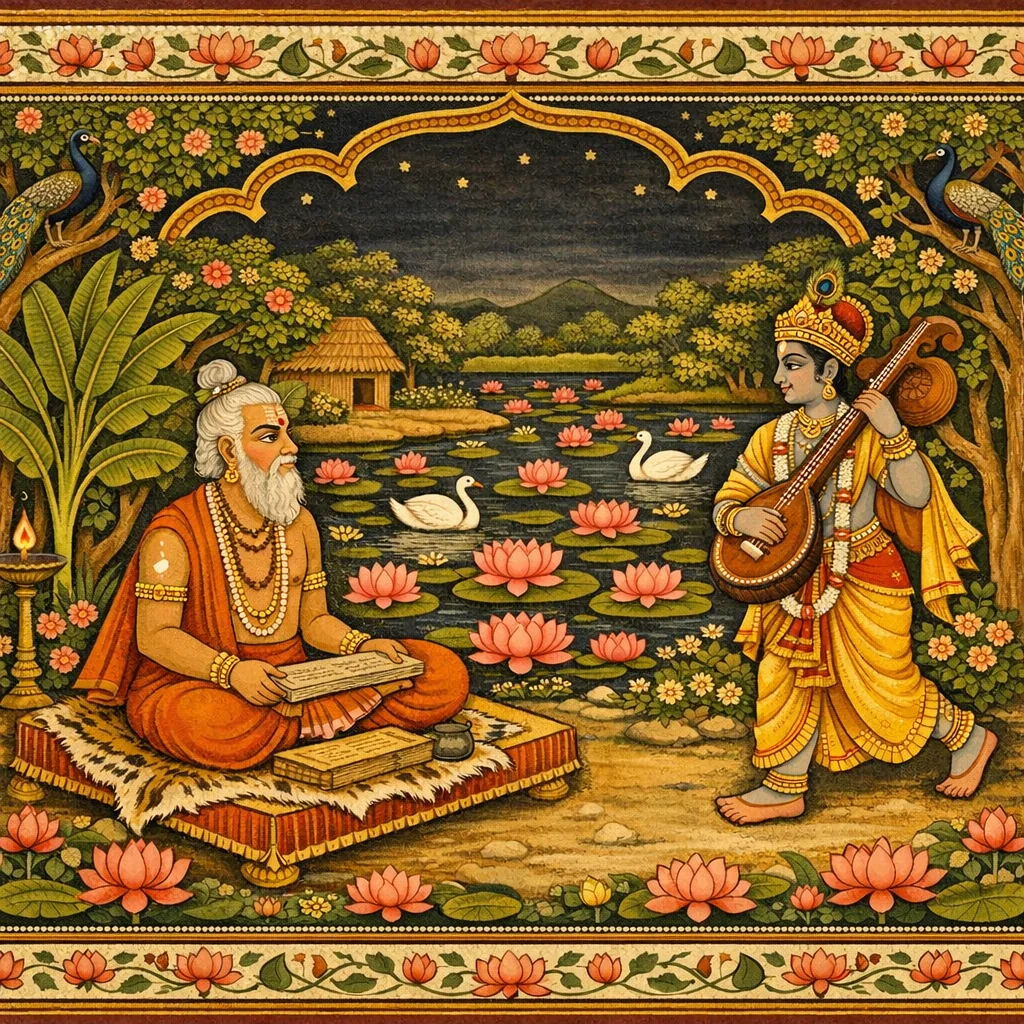
Adhyaya 4
The Appearance of Śrī Nārada and Vyāsa’s Dissatisfaction (Veda-vibhāga and the Need for Bhakti)
Following the sages’ request to hear the Bhāgavata’s sacred message, Śaunaka intensifies the inquiry: who was Śukadeva, how was he recognized, and what circumstance led Parīkṣit to receive the Bhāgavata on the Gaṅgā’s bank. Sūta begins answering by shifting to the prior cause: Vyāsadeva’s birth and his assessment of yuga-dharma decline. Seeing Kali’s effects—reduced lifespan, weakened goodness, impatience, and spiritual incapacity—Vyāsa systematizes revelation: he divides the one Veda into four, assigns custodians (Paila, Jaimini, Vaiśampāyana, Sumantu), and entrusts Purāṇas/itihāsa to Romaharṣaṇa. Out of compassion he composes Mahābhārata for those excluded from Vedic study. Yet despite these monumental works, Vyāsa feels inner incompleteness, diagnosing the root: he did not explicitly and centrally proclaim bhagavad-bhakti. At that moment of repentance, Nārada arrives at Vyāsa’s Sarasvatī āśrama—bridging this chapter into the next, where Nārada will instruct Vyāsa on the Bhāgavata’s essential devotional purpose.
Shlokas
Verse 1
व्यास उवाच इति ब्रुवाणं संस्तूय मुनीनां दीर्घसत्रिणाम् । वृद्ध: कुलपति: सूतं बह्वृच: शौनकोऽब्रवीत् ॥ १ ॥
Vyāsadeva said: On hearing Sūta Gosvāmī speak thus, Śaunaka Muni, who was the elderly, learned leader of all the ṛṣis engaged in that prolonged sacrificial ceremony, congratulated Sūta Gosvāmī by addressing him as follows.
Verse 2
शौनक उवाच सूत सूत महाभाग वद नो वदतां वर । कथां भागवतीं पुण्यां यदाह भगवाञ्छुक: ॥ २ ॥
Śaunaka said: O Sūta Gosvāmī, you are the most fortunate and respected of all those who can speak and recite. Please relate the pious message of Śrīmad-Bhāgavatam, which was spoken by the great and powerful sage Śukadeva Gosvāmī.
Verse 3
कस्मिन् युगे प्रवृत्तेयं स्थाने वा केन हेतुना । कुत: सञ्चोदित: कृष्ण: कृतवान् संहितां मुनि: ॥ ३ ॥
In what period and at what place was this first begun, and why was this taken up? From where did Kṛṣṇa-dvaipāyana Vyāsa, the great sage, get the inspiration to compile this literature?
Verse 4
तस्य पुत्रो महायोगी समदृङ्निर्विकल्पक: । एकान्तमतिरुन्निद्रो गूढो मूढ इवेयते ॥ ४ ॥
His [Vyāsadeva’s] son was a great devotee, an equibalanced monist, whose mind was always concentrated in monism. He was transcendental to mundane activities, but being unexposed, he appeared like an ignorant person.
Verse 5
दृष्ट्वानुयान्तमृषिमात्मजमप्यनग्नं देव्यो ह्रिया परिदधुर्न सुतस्य चित्रम् । तद्वीक्ष्य पृच्छति मुनौ जगदुस्तवास्ति स्त्रीपुम्भिदा न तु सुतस्य विविक्तदृष्टे: ॥ ५ ॥
While Śrī Vyāsadeva was following his son, beautiful young damsels who were bathing naked covered their bodies with cloth, although Śrī Vyāsadeva himself was not naked. But they had not done so when his son had passed. The sage inquired about this, and the young ladies replied that his son was purified and when looking at them made no distinction between male and female. But the sage made such distinctions.
Verse 6
कथमालक्षित: पौरै: सम्प्राप्त: कुरुजाङ्गलान् । उन्मत्तमूकजडवद्विचरन् गजसाह्वये ॥ ६ ॥
How was he [Śrīla Śukadeva, the son of Vyāsa] recognized by the citizens when he entered the city of Hastināpura [now Delhi], after wandering in the provinces of Kuru and Jāṅgala, appearing like a madman, dumb and retarded?
Verse 7
कथं वा पाण्डवेयस्य राजर्षेर्मुनिना सह । संवाद: समभूत्तात यत्रैषा सात्वती श्रुति: ॥ ७ ॥
How did it so happen that King Parīkṣit met this great sage, making it possible for this great transcendental essence of the Vedas [Bhāgavatam] to be sung to him?
Verse 8
स गोदोहनमात्रं हि गृहेषु गृहमेधिनाम् । अवेक्षते महाभागस्तीर्थीकुर्वंस्तदाश्रमम् ॥ ८ ॥
He [Śukadeva Gosvāmī] was accustomed to stay at the door of a householder only long enough for a cow to be milked. And he did this just to sanctify the residence.
Verse 9
अभिमन्युसुतं सूत प्राहुर्भागवतोत्तमम् । तस्य जन्म महाश्चर्यं कर्माणि च गृणीहि न: ॥ ९ ॥
It is said that Mahārāja Parīkṣit is a great first-class devotee of the Lord and that his birth and activities are all wonderful. Please tell us about him.
Verse 10
स सम्राट् कस्य वा हेतो: पाण्डूनां मानवर्धन: । प्रायोपविष्टो गङ्गायामनादृत्याधिराट्श्रियम् ॥ १० ॥
He was a great emperor and possessed all the opulences of his acquired kingdom. He was so exalted that he was increasing the prestige of the Pāṇḍu dynasty. Why did he give up everything to sit down on the bank of the Ganges and fast until death?
Verse 11
नमन्ति यत्पादनिकेतमात्मन: शिवायहानीय धनानि शत्रव: । कथं स वीर: श्रियमङ्ग दुस्त्यजां युवैषतोत्स्रष्टुमहो सहासुभि: ॥ ११ ॥
He was such a great emperor that all his enemies would come and bow down at his feet and surrender all their wealth for their own benefit. He was full of youth and strength, and he possessed kingly opulences that were difficult to give up. Why did he want to give up everything, including his life?
Verse 12
शिवाय लोकस्य भवाय भूतये य उत्तमश्लोकपरायणा जना: । जीवन्ति नात्मार्थमसौ पराश्रयं मुमोच निर्विद्य कुत: कलेवरम् ॥ १२ ॥
Those who are devoted to the cause of the Personality of Godhead live only for the welfare, development and happiness of others. They do not live for any selfish interest. So even though the Emperor [Parīkṣit] was free from all attachment to worldly possessions, how could he give up his mortal body, which was the shelter for others?
Verse 13
तत्सर्वं न: समाचक्ष्व पृष्टो यदिह किञ्चन । मन्ये त्वां विषये वाचां स्नातमन्यत्र छान्दसात् ॥ १३ ॥
We know that you are expert in the meaning of all subjects, except some portions of the Vedas, and thus you can clearly explain the answers to all the questions we have just put to you.
Verse 14
सूत उवाच द्वापरे समनुप्राप्ते तृतीये युगपर्यये । जात: पराशराद्योगी वासव्यां कलया हरे: ॥ १४ ॥
Sūta Gosvāmī said: When the second millennium overlapped the third, the great sage [Vyāsadeva] was born to Parāśara in the womb of Satyavatī, the daughter of Vasu.
Verse 15
स कदाचित्सरस्वत्या उपस्पृश्य जलं शुचि: । विविक्त एक आसीन उदिते रविमण्डले ॥ १५ ॥
Once upon a time he [Vyāsadeva], as the sun rose, took his morning ablution in the waters of the Sarasvatī and sat alone to concentrate.
Verse 16
परावरज्ञ: स ऋषि: कालेनाव्यक्तरंहसा । युगधर्मव्यतिकरं प्राप्तं भुवि युगे युगे ॥ १६ ॥
The great sage Vyāsadeva saw anomalies in the duties of the millennium. This happens on the earth in different ages, due to the unseen force of time.
Verse 17
भौतिकानां च भावानां शक्तिह्रासं च तत्कृतम् । अश्रद्दधानान्नि:सत्त्वान्दुर्मेधान् ह्रसितायुष: ॥ १७ ॥ दुर्भगांश्च जनान् वीक्ष्य मुनिर्दिव्येन चक्षुषा । सर्ववर्णाश्रमाणां यद्दध्यौ हितममोघदृक् ॥ १८ ॥
The great sage, who was fully equipped in knowledge, could see through his transcendental vision the deterioration of everything material due to the influence of the age. He could also see that the faithless people in general would be reduced in duration of life and would be impatient due to lack of goodness. Thus he contemplated for the welfare of men in all statuses and orders of life.
Verse 18
भौतिकानां च भावानां शक्तिह्रासं च तत्कृतम् । अश्रद्दधानान्नि:सत्त्वान्दुर्मेधान् ह्रसितायुष: ॥ १७ ॥ दुर्भगांश्च जनान् वीक्ष्य मुनिर्दिव्येन चक्षुषा । सर्ववर्णाश्रमाणां यद्दध्यौ हितममोघदृक् ॥ १८ ॥
The great sage, who was fully equipped in knowledge, could see through his transcendental vision the deterioration of everything material due to the influence of the age. He could also see that the faithless people in general would be reduced in duration of life and would be impatient due to lack of goodness. Thus he contemplated for the welfare of men in all statuses and orders of life.
Verse 19
चातुर्होत्रं कर्म शुद्धं प्रजानां वीक्ष्य वैदिकम् । व्यदधाद्यज्ञसन्तत्यै वेदमेकं चतुर्विधम् ॥ १९ ॥
He saw that the sacrifices mentioned in the Vedas were means by which the people’s occupations could be purified. And to simplify the process he divided the one Veda into four, in order to expand them among men.
Verse 20
ऋग्यजु:सामाथर्वाख्या वेदाश्चत्वार उद्धृता: । इतिहासपुराणं च पञ्चमो वेद उच्यते ॥ २० ॥
The four divisions of the original sources of knowledge [the Vedas] were made separately. But the historical facts and authentic stories mentioned in the Purāṇas are called the fifth Veda.
Verse 21
तत्रर्ग्वेदधर: पैल: सामगो जैमिनि: कवि: । वैशम्पायन एवैको निष्णातो यजुषामुत ॥ २१ ॥
After the Vedas were divided into four divisions, Paila Ṛṣi became the professor of the Ṛg Veda, Jaimini the professor of the Sāma Veda, and Vaiśampāyana alone became glorified by the Yajur Veda.
Verse 22
अथर्वाङ्गिरसामासीत्सुमन्तुर्दारुणो मुनि: । इतिहासपुराणानां पिता मे रोमहर्षण: ॥ २२ ॥
The Sumantu Muni Aṅgirā, who was very devotedly engaged, was entrusted with the Atharva Veda. And my father, Romaharṣaṇa, was entrusted with the Purāṇas and historical records.
Verse 23
त एत ऋषयो वेदं स्वं स्वं व्यस्यन्ननेकधा । शिष्यै: प्रशिष्यैस्तच्छिष्यैर्वेदास्ते शाखिनोऽभवन् ॥ २३ ॥
All these learned scholars, in their turn, rendered their entrusted Vedas unto their many disciples, granddisciples and great-granddisciples, and thus the respective branches of the followers of the Vedas came into being.
Verse 24
त एव वेदा दुर्मेधैर्धार्यन्ते पुरुषैर्यथा । एवं चकार भगवान् व्यास: कृपणवत्सल: ॥ २४ ॥
Thus the great sage Vyāsadeva, who is very kind to the ignorant masses, edited the Vedas so they might be assimilated by less intellectual men.
Verse 25
स्त्रीशूद्रद्विजबन्धूनां त्रयी न श्रुतिगोचरा । कर्मश्रेयसि मूढानां श्रेय एवं भवेदिह । इति भारतमाख्यानं कृपया मुनिना कृतम् ॥ २५ ॥
Out of compassion, the great sage thought it wise that this would enable men to achieve the ultimate goal of life. Thus he compiled the great historical narration called the Mahābhārata for women, laborers and friends of the twice-born.
Verse 26
एवं प्रवृत्तस्य सदा भूतानां श्रेयसि द्विजा: । सर्वात्मकेनापि यदा नातुष्यद्धृदयं तत: ॥ २६ ॥
O twice-born brāhmaṇas, still his mind was not satisfied, although he engaged himself in working for the total welfare of all people.
Verse 27
नातिप्रसीदद्धृदय: सरस्वत्यास्तटे शुचौ । वितर्कयन् विविक्तस्थ इदं चोवाच धर्मवित् ॥ २७ ॥
Thus the sage, being dissatisfied at heart, at once began to reflect, because he knew the essence of religion, and he said within himself:
Verse 28
धृतव्रतेन हि मया छन्दांसि गुरवोऽग्नय: । मानिता निर्व्यलीकेन गृहीतं चानुशासनम् ॥ २८ ॥ भारतव्यपदेशेन ह्याम्नायार्थश्च प्रदर्शित: । दृश्यते यत्र धर्मादि स्त्रीशूद्रादिभिरप्युत ॥ २९ ॥
I have, under strict disciplinary vows, unpretentiously worshiped the Vedas, the spiritual masters and the altar of sacrifice. I have also abided by the rulings and have shown the import of disciplic succession through the explanation of the Mahābhārata, by which even women, śūdras and others [friends of the twice-born] can see the path of religion.
Verse 29
धृतव्रतेन हि मया छन्दांसि गुरवोऽग्नय: । मानिता निर्व्यलीकेन गृहीतं चानुशासनम् ॥ २८ ॥ भारतव्यपदेशेन ह्याम्नायार्थश्च प्रदर्शित: । दृश्यते यत्र धर्मादि स्त्रीशूद्रादिभिरप्युत ॥ २९ ॥
I have, under strict disciplinary vows, unpretentiously worshiped the Vedas, the spiritual masters and the altar of sacrifice. I have also abided by the rulings and have shown the import of disciplic succession through the explanation of the Mahābhārata, by which even women, śūdras and others [friends of the twice-born] can see the path of religion.
Verse 30
तथापि बत मे दैह्यो ह्यात्मा चैवात्मना विभु: । असम्पन्न इवाभाति ब्रह्मवर्चस्य सत्तम: ॥ ३० ॥
I am feeling incomplete, though I myself am fully equipped with everything required by the Vedas.
Verse 31
किं वा भागवता धर्मा न प्रायेण निरूपिता: । प्रिया: परमहंसानां त एव ह्यच्युतप्रिया: ॥ ३१ ॥
This may be because I did not specifically point out the devotional service of the Lord, which is dear both to perfect beings and to the infallible Lord.
Verse 32
तस्यैवं खिलमात्मानं मन्यमानस्य खिद्यत: । कृष्णस्य नारदोऽभ्यागादाश्रमं प्रागुदाहृतम् ॥ ३२ ॥
As mentioned before, Nārada reached the cottage of Kṛṣṇa-dvaipāyana Vyāsa on the banks of the Sarasvatī just as Vyāsadeva was regretting his defects.
Verse 33
तमभिज्ञाय सहसा प्रत्युत्थायागतं मुनि: । पूजयामास विधिवन्नारदं सुरपूजितम् ॥ ३३ ॥
At the auspicious arrival of Śrī Nārada, Śrī Vyāsadeva got up respectfully and worshiped him, giving him veneration equal to that given to Brahmājī, the creator.
Frequently Asked Questions
Vyāsa foresees Kali-yuga’s reduced sattva, shorter lifespan, and diminished capacity for complex ritual and memorization. The division (Veda-vibhāga) is a compassionate pedagogical act: organizing revelation into accessible branches and appointing teachers so that dharma and spiritual knowledge remain practicable for less qualified generations.
Śukadeva is depicted as a perfected renunciate—internally established in Brahman-realization and devotion, externally indifferent to social conventions. His lack of worldly engagement makes him appear like a madman or dull person to ordinary citizens, yet his purity is evidenced by his equal vision (no bodily distinction) and spontaneous detachment.
The chapter’s theological diagnosis is that Vyāsa’s works, though vast and beneficial, did not foreground exclusive devotional service to the Supreme Lord as the direct, central conclusion. Without explicit bhakti (that which pleases both siddhas and Bhagavān), scholarship and ritual instruction can remain incomplete in producing full heart-satisfaction (ātmā suprasīdati).
Romaharṣaṇa is identified as Sūta’s father and is presented as the entrusted custodian of Purāṇas and historical accounts (itihāsa). His mention anchors the legitimacy of Sūta’s later narration: Sūta stands within an authorized chain of Purāṇic transmission, paralleling the Vedic branch lineages.