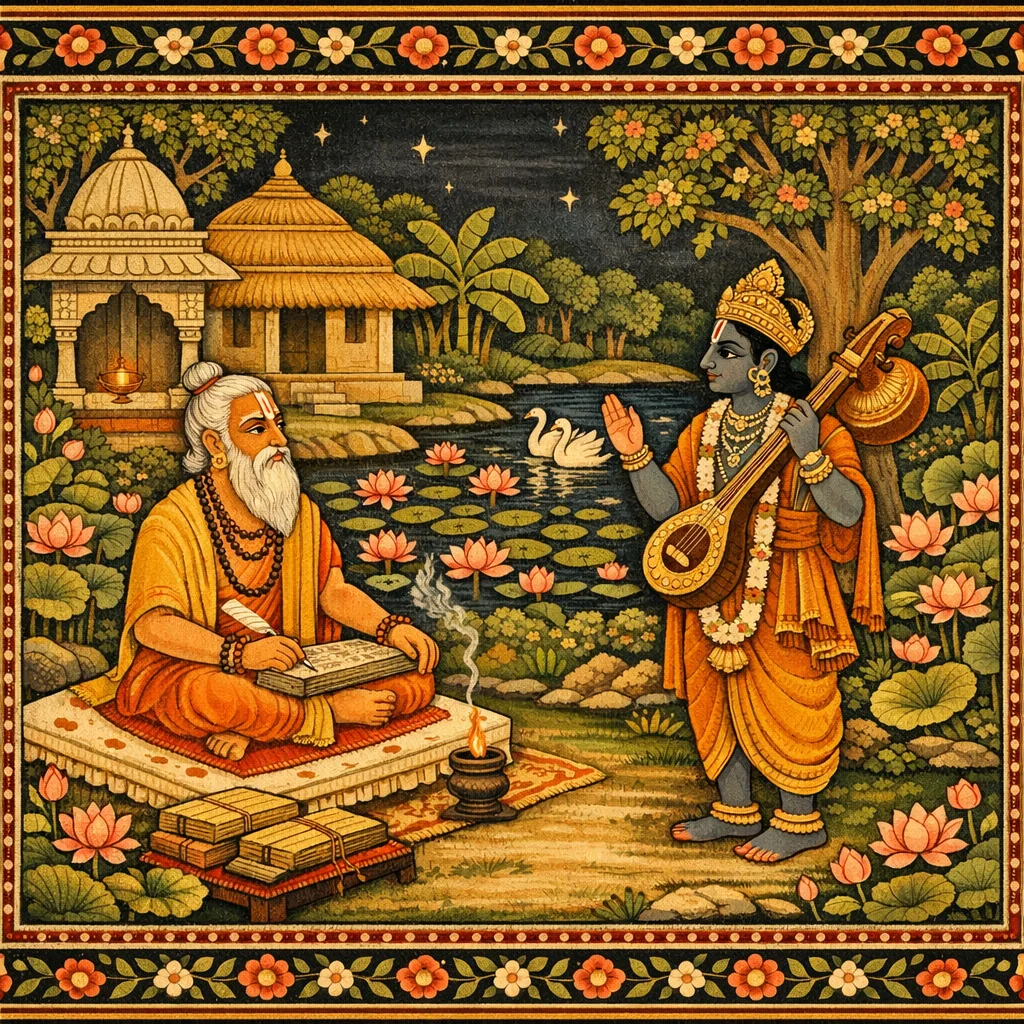
Adhyaya 5
Nārada’s Instruction to Vyāsa: The Defect of Bhakti-less Literature and the Mandate of Kṛṣṇa-kathā
Continuing from Vyāsa’s inner dissatisfaction after compiling vast Vedic literature, this chapter depicts Nārada’s visit and diagnostic counsel. Nārada first acknowledges Vyāsa’s achievements—Veda arrangement, Vedānta delineation, and the Mahābhārata’s dharma exposition—yet asks why despondency persists. Vyāsa admits the lack of inner peace and requests the root cause. Nārada identifies the deficiency: Vyāsa has not sufficiently broadcast the spotless glories of Bhagavān; literature not centered on Vāsudeva is compared to a crow’s pilgrimage, whereas even imperfectly composed Bhagavān-kathā transforms the world. He critiques encouragement of sense-enjoyment under the label of religion and insists that those attached to matter must be led by narrations of the Lord’s transcendental activities. Nārada then establishes bhakti’s supremacy: even an immature devotee is not a loser, while nondevotional duty yields no ultimate gain; intelligent persons seek the unattainable-by-travel goal (prema/bhagavat-prāpti), letting worldly happiness come automatically. He briefly states the Lord’s relation to the cosmos (emanation, maintenance, dissolution) and urges Vyāsa to vividly describe Śrī Kṛṣṇa’s līlā. The chapter transitions into Nārada’s own formative history (expanded next), grounding authority in lived transformation through association with bhakti-vedāntins and hearing Kṛṣṇa-kathā.
Shlokas
Verse 1
सूत उवाच अथ तं सुखमासीन उपासीनं बृहच्छ्रवा: । देवर्षि: प्राह विप्रर्षिं वीणापाणि: स्मयन्निव ॥ १ ॥
Sūta Gosvāmī said: Thus the sage amongst the gods [Nārada], comfortably seated and apparently smiling, addressed the ṛṣi amongst the brāhmaṇas [Vedavyāsa].
Verse 2
नारद उवाच पाराशर्य महाभाग भवत: कच्चिदात्मना । परितुष्यति शारीर आत्मा मानस एव वा ॥ २ ॥
Addressing Vyāsadeva, the son of Parāśara, Nārada inquired: Are you satisfied by identifying with the body or the mind as objects of self-realization?
Verse 3
जिज्ञासितं सुसम्पन्नमपि ते महदद्भुतम् । कृतवान् भारतं यस्त्वं सर्वार्थपरिबृंहितम् ॥ ३ ॥
Your inquiries were full and your studies were also well fulfilled, and there is no doubt that you have prepared a great and wonderful work, the Mahābhārata, which is full of all kinds of Vedic sequences elaborately explained.
Verse 4
जिज्ञासितमधीतं च ब्रह्म यत्तत्सनातनम् । तथापि शोचस्यात्मानमकृतार्थ इव प्रभो ॥ ४ ॥
You have fully delineated the subject of impersonal Brahman as well as the knowledge derived therefrom. Why should you be despondent in spite of all this, thinking that you are undone, my dear prabhu?
Verse 5
व्यास उवाच अस्त्येव मे सर्वमिदं त्वयोक्तं तथापि नात्मा परितुष्यते मे । तन्मूलमव्यक्तमगाधबोधं पृच्छामहे त्वात्मभवात्मभूतम् ॥ ५ ॥
Śrī Vyāsadeva said: All you have said about me is perfectly correct. Despite all this, I am not pacified. I therefore question you about the root cause of my dissatisfaction, for you are a man of unlimited knowledge due to your being the offspring of one [Brahmā] who is self-born [without mundane father and mother].
Verse 6
स वै भवान् वेद समस्तगुह्य- मुपासितो यत्पुरुष: पुराण: । परावरेशो मनसैव विश्वं सृजत्यवत्यत्ति गुणैरसङ्ग: ॥ ६ ॥
My lord! Everything that is mysterious is known to you because you worship the creator and destroyer of the material world and the maintainer of the spiritual world, the original Personality of Godhead, who is transcendental to the three modes of material nature.
Verse 7
त्वं पर्यटन्नर्क इव त्रिलोकी- मन्तश्चरो वायुरिवात्मसाक्षी । परावरे ब्रह्मणि धर्मतो व्रतै: स्नातस्य मे न्यूनमलं विचक्ष्व ॥ ७ ॥
Like the sun, Your Goodness can travel everywhere in the three worlds, and like the air you can penetrate the internal region of everyone. As such, you are as good as the all-pervasive Supersoul. Please, therefore, find out the deficiency in me, despite my being absorbed in transcendence under disciplinary regulations and vows.
Verse 8
श्रीनारद उवाच भवतानुदितप्रायं यशो भगवतोऽमलम् । येनैवासौ न तुष्येत मन्ये तद्दर्शनं खिलम् ॥ ८ ॥
Śrī Nārada said: You have not actually broadcast the sublime and spotless glories of the Personality of Godhead. That philosophy which does not satisfy the transcendental senses of the Lord is considered worthless.
Verse 9
यथा धर्मादयश्चार्था मुनिवर्यानुकीर्तिता: । न तथा वासुदेवस्य महिमा ह्यनुवर्णित: ॥ ९ ॥
Although, great sage, you have very broadly described the four principles beginning with religious performances, you have not described the glories of the Supreme Personality, Vāsudeva.
Verse 10
न यद्वचश्चित्रपदं हरेर्यशो जगत्पवित्रं प्रगृणीत कर्हिचित् । तद्वायसं तीर्थमुशन्ति मानसा न यत्र हंसा निरमन्त्युशिक्क्षया: ॥ १० ॥
Those words which do not describe the glories of the Lord, who alone can sanctify the atmosphere of the whole universe, are considered by saintly persons to be like unto a place of pilgrimage for crows. Since the all-perfect persons are inhabitants of the transcendental abode, they do not derive any pleasure there.
Verse 11
तद्वाग्विसर्गो जनताघविप्लवो यस्मिन् प्रतिश्लोकमबद्धवत्यपि । नामान्यनन्तस्य यशोऽङ्कितानि यत् शृण्वन्ति गायन्ति गृणन्ति साधव: ॥ ११ ॥
On the other hand, that literature which is full of descriptions of the transcendental glories of the name, fame, forms, pastimes, etc., of the unlimited Supreme Lord is a different creation, full of transcendental words directed toward bringing about a revolution in the impious lives of this world’s misdirected civilization. Such transcendental literatures, even though imperfectly composed, are heard, sung and accepted by purified men who are thoroughly honest.
Verse 12
नैष्कर्म्यमप्यच्युतभाववर्जितं न शोभते ज्ञानमलं निरञ्जनम् । कुत: पुन: शश्वदभद्रमीश्वरे न चार्पितं कर्म यदप्यकारणम् ॥ १२ ॥
Knowledge of self-realization, even though free from all material affinity, does not look well if devoid of a conception of the Infallible [God]. What, then, is the use of fruitive activities, which are naturally painful from the very beginning and transient by nature, if they are not utilized for the devotional service of the Lord?
Verse 13
अथो महाभाग भवानमोघदृक् शुचिश्रवा: सत्यरतो धृतव्रत: । उरुक्रमस्याखिलबन्धमुक्तये समाधिनानुस्मर तद्विचेष्टितम् ॥ १३ ॥
O Vyāsadeva, your vision is completely perfect. Your good fame is spotless. You are firm in vow and situated in truthfulness. And thus you can think of the pastimes of the Lord in trance for the liberation of the people in general from all material bondage.
Verse 14
ततोऽन्यथा किञ्चन यद्विवक्षत: पृथग्दृशस्तत्कृतरूपनामभि: । न कर्हिचित्क्वापि च दु:स्थिता मति- र्लभेत वाताहतनौरिवास्पदम् ॥ १४ ॥
Whatever you desire to describe that is separate in vision from the Lord simply reacts, with different forms, names and results, to agitate the mind, as the wind agitates a boat which has no resting place.
Verse 15
जुगुप्सितं धर्मकृतेऽनुशासत: स्वभावरक्तस्य महान् व्यतिक्रम: । यद्वाक्यतो धर्म इतीतर: स्थितो न मन्यते तस्य निवारणं जन: ॥ १५ ॥
The people in general are naturally inclined to enjoy, and you have encouraged them in that way in the name of religion. This is verily condemned and is quite unreasonable. Because they are guided under your instructions, they will accept such activities in the name of religion and will hardly care for prohibitions.
Verse 16
विचक्षणोऽस्यार्हति वेदितुं विभो- रनन्तपारस्य निवृत्तित: सुखम् । प्रवर्तमानस्य गुणैरनात्मन- स्ततो भवान्दर्शय चेष्टितं विभो: ॥ १६ ॥
The Supreme Lord is unlimited. Only a very expert personality, retired from the activities of material happiness, deserves to understand this knowledge of spiritual values. Therefore those who are not so well situated, due to material attachment, should be shown the ways of transcendental realization, by Your Goodness, through descriptions of the transcendental activities of the Supreme Lord.
Verse 17
त्यक्त्वा स्वधर्मं चरणाम्बुजं हरे- र्भजन्नपक्वोऽथ पतेत्ततो यदि । यत्र क्व वाभद्रमभूदमुष्य किं को वार्थ आप्तोऽभजतां स्वधर्मत: ॥ १७ ॥
One who has forsaken his material occupations to engage in the devotional service of the Lord may sometimes fall down while in an immature stage, yet there is no danger of his being unsuccessful. On the other hand, a nondevotee, though fully engaged in occupational duties, does not gain anything.
Verse 18
तस्यैव हेतो: प्रयतेत कोविदो न लभ्यते यद्भ्रमतामुपर्यध: । तल्लभ्यते दु:खवदन्यत: सुखं कालेन सर्वत्र गभीररंहसा ॥ १८ ॥
Persons who are actually intelligent and philosophically inclined should endeavor only for that purposeful end which is not obtainable even by wandering from the topmost planet [Brahmaloka] down to the lowest planet [Pātāla]. As far as happiness derived from sense enjoyment is concerned, it can be obtained automatically in course of time, just as in course of time we obtain miseries even though we do not desire them.
Verse 19
न वै जनो जातु कथञ्चनाव्रजे- न्मुकुन्दसेव्यन्यवदङ्ग संसृतिम् । स्मरन्मुकुन्दाङ्घ्र्युरपगूहनं पुन- र्विहातुमिच्छेन्न रसग्रहो जन: ॥ १९ ॥
My dear Vyāsa, even though a devotee of Lord Kṛṣṇa sometimes falls down somehow or other, he certainly does not undergo material existence like others [fruitive workers, etc.] because a person who has once relished the taste of the lotus feet of the Lord can do nothing but remember that ecstasy again and again.
Verse 20
इदं हि विश्वं भगवानिवेतरो यतो जगत्स्थाननिरोधसम्भवा: । तद्धि स्वयं वेद भवांस्तथापि ते प्रादेशमात्रं भवत: प्रदर्शितम् ॥ २० ॥
The Supreme Lord Personality of Godhead is Himself this cosmos, and still He is aloof from it. From Him only has this cosmic manifestation emanated, in Him it rests, and unto Him it enters after annihilation. Your good self knows all about this. I have given only a synopsis.
Verse 21
त्वमात्मनात्मानमवेह्यमोघदृक् परस्य पुंस: परमात्मन: कलाम् । अजं प्रजातं जगत: शिवाय त- न्महानुभावाभ्युदयोऽधिगण्यताम् ॥ २१ ॥
Your Goodness has perfect vision. You yourself can know the Supersoul Personality of Godhead because you are present as the plenary portion of the Lord. Although you are birthless, you have appeared on this earth for the well-being of all people. Please, therefore, describe the transcendental pastimes of the Supreme Personality of Godhead, Śrī Kṛṣṇa more vividly.
Verse 22
इदं हि पुंसस्तपस: श्रुतस्य वा स्विष्टस्य सूक्तस्य च बुद्धिदत्तयो: । अविच्युतोऽर्थ: कविभिर्निरूपितो यदुत्तमश्लोकगुणानुवर्णनम् ॥ २२ ॥
Learned circles have positively concluded that the infallible purpose of the advancement of knowledge, namely austerities, study of the Vedas, sacrifice, chanting of hymns and charity, culminates in the transcendental descriptions of the Lord, who is defined in choice poetry.
Verse 23
अहं पुरातीतभवेऽभवं मुने दास्यास्तु कस्याश्चन वेदवादिनाम् । निरूपितो बालक एव योगिनां शुश्रूषणे प्रावृषि निर्विविक्षताम् ॥ २३ ॥
O Muni, in the last millennium I was born as the son of a certain maidservant engaged in the service of brāhmaṇas who were following the principles of Vedānta. When they were living together during the four months of the rainy season, I was engaged in their personal service.
Verse 24
ते मय्यपेताखिलचापलेऽर्भके दान्तेऽधृतक्रीडनकेऽनुवर्तिनि । चक्रु: कृपां यद्यपि तुल्यदर्शना: शुश्रूषमाणे मुनयोऽल्पभाषिणि ॥ २४ ॥
Although they were impartial by nature, those followers of the Vedānta blessed me with their causeless mercy. As far as I was concerned, I was self-controlled and had no attachment for sports, even though I was a boy. In addition, I was not naughty, and I did not speak more than required.
Verse 25
उच्छिष्टलेपाननुमोदितो द्विजै: सकृत्स्म भुञ्जे तदपास्तकिल्बिष: । एवं प्रवृत्तस्य विशुद्धचेतस- स्तद्धर्म एवात्मरुचि: प्रजायते ॥ २५ ॥
Once only, by their permission, I took the remnants of their food, and by so doing all my sins were at once eradicated. Thus being engaged, I became purified in heart, and at that time the very nature of the transcendentalist became attractive to me.
Verse 26
तत्रान्वहं कृष्णकथा: प्रगायता- मनुग्रहेणाशृणवं मनोहरा: । ता: श्रद्धया मेऽनुपदं विशृण्वत: प्रियश्रवस्यङ्ग ममाभवद्रुचि: ॥ २६ ॥
O Vyāsadeva, in that association and by the mercy of those great Vedāntists, I could hear them describe the attractive activities of Lord Kṛṣṇa. And thus listening attentively, my taste for hearing of the Personality of Godhead increased at every step.
Verse 27
तस्मिंस्तदा लब्धरुचेर्महामते प्रियश्रवस्यस्खलिता मतिर्मम । ययाहमेतत्सदसत्स्वमायया पश्ये मयि ब्रह्मणि कल्पितं परे ॥ २७ ॥
O great sage, as soon as I got a taste of the Personality of Godhead, my attention to hear of the Lord was unflinching. And as my taste developed, I could realize that it was only in my ignorance that I had accepted gross and subtle coverings, for both the Lord and I are transcendental.
Verse 28
इत्थं शरत्प्रावृषिकावृतू हरे- र्विशृण्वतो मेऽनुसवं यशोऽमलम् । सङ्कीर्त्यमानं मुनिभिर्महात्मभि- र्भक्ति: प्रवृत्तात्मरजस्तमोपहा ॥ २८ ॥
Thus during two seasons — the rainy season and autumn — I had the opportunity to hear these great-souled sages constantly chant the unadulterated glories of the Lord Hari. As the flow of my devotional service began, the coverings of the modes of passion and ignorance vanished.
Verse 29
तस्यैवं मेऽनुरक्तस्य प्रश्रितस्य हतैनस: । श्रद्दधानस्य बालस्य दान्तस्यानुचरस्य च ॥ २९ ॥
I was very much attached to those sages. I was gentle in behavior, and all my sins were eradicated in their service. In my heart I had strong faith in them. I had subjugated the senses, and I was strictly following them with body and mind.
Verse 30
ज्ञानं गुह्यतमं यत्तत्साक्षाद्भगवतोदितम् । अन्ववोचन् गमिष्यन्त: कृपया दीनवत्सला: ॥ ३० ॥
As they were leaving, those bhakti-vedāntas, who are very kind to poor-hearted souls, instructed me in that most confidential subject which is instructed by the Personality of Godhead Himself.
Verse 31
येनैवाहं भगवतो वासुदेवस्य वेधस: । मायानुभावमविदं येन गच्छन्ति तत्पदम् ॥ ३१ ॥
By that confidential knowledge, I could understand clearly the influence of the energy of Lord Śrī Kṛṣṇa, the creator, maintainer and annihilator of everything. By knowing that, one can return to Him and personally meet Him.
Verse 32
एतत्संसूचितं ब्रह्मंस्तापत्रयचिकित्सितम् । यदीश्वरे भगवति कर्म ब्रह्मणि भावितम् ॥ ३२ ॥
O Brāhmaṇa Vyāsadeva, it is decided by the learned that the best remedial measure for removing all troubles and miseries is to dedicate one’s activities to the service of the Supreme Lord Personality of Godhead [Śrī Kṛṣṇa].
Verse 33
आमयो यश्च भूतानां जायते येन सुव्रत । तदेव ह्यामयं द्रव्यं न पुनाति चिकित्सितम् ॥ ३३ ॥
O good soul, does not a thing, applied therapeutically, cure a disease which was caused by that very same thing?
Verse 34
एवं नृणां क्रियायोगा: सर्वे संसृतिहेतव: । त एवात्मविनाशाय कल्पन्ते कल्पिता: परे ॥ ३४ ॥
Thus when all a man’s activities are dedicated to the service of the Lord, those very activities which caused his perpetual bondage become the destroyer of the tree of work.
Verse 35
यदत्र क्रियते कर्म भगवत्परितोषणम् । ज्ञानं यत्तदधीनं हि भक्तियोगसमन्वितम् ॥ ३५ ॥
Whatever work is done here in this life for the satisfaction of the mission of the Lord is called bhakti-yoga, or transcendental loving service to the Lord, and what is called knowledge becomes a concomitant factor.
Verse 36
कुर्वाणा यत्र कर्माणि भगवच्छिक्षयासकृत् । गृणन्ति गुणनामानि कृष्णस्यानुस्मरन्ति च ॥ ३६ ॥
While performing duties according to the order of Śrī Kṛṣṇa, the Supreme Personality of Godhead, one constantly remembers Him, His names and His qualities.
Verse 37
ॐ नमो भगवते तुभ्यं वासुदेवाय धीमहि । प्रद्युम्नायानिरुद्धाय नम: सङ्कर्षणाय च ॥ ३७ ॥
Let us all chant the glories of Vāsudeva along with His plenary expansions Pradyumna, Aniruddha and Saṅkarṣaṇa.
Verse 38
इति मूर्त्यभिधानेन मन्त्रमूर्तिममूर्तिकम् । यजते यज्ञपुरुषं स सम्यग्दर्शन: पुमान् ॥ ३८ ॥
Thus he is the actual seer who worships, in the form of transcendental sound representation, the Supreme Personality of Godhead, Viṣṇu, who has no material form.
Verse 39
इमं स्वनिगमं ब्रह्मन्नवेत्य मदनुष्ठितम् । अदान्मे ज्ञानमैश्वर्यं स्वस्मिन् भावं च केशव: ॥ ३९ ॥
O brāhmaṇa, thus by the Supreme Lord Kṛṣṇa I was endowed first with the transcendental knowledge of the Lord as inculcated in the confidential parts of the Vedas, then with the spiritual opulences, and then with His intimate loving service.
Verse 40
त्वमप्यदभ्रश्रुत विश्रुतं विभो: समाप्यते येन विदां बुभुत्सितम् । प्राख्याहि दु:खैर्मुहुरर्दितात्मनां सङ्क्लेशनिर्वाणमुशन्ति नान्यथा ॥ ४० ॥
Please, therefore, describe the almighty Lord’s activities which you have learned by your vast knowledge of the Vedas, for that will satisfy the hankerings of great learned men and at the same time mitigate the miseries of the masses of common people who are always suffering from material pangs. Indeed, there is no other way to get out of such miseries.
Frequently Asked Questions
Nārada explains that Vyāsa’s despondency arose from an incomplete presentation of the Purāṇa’s heart: explicit, relish-filled glorification of Bhagavān’s name, form, qualities, and pastimes. Works focused on dharma, artha, kāma, or even impersonal Brahman can remain spiritually insufficient because they may not directly engage the transcendental senses of the Lord nor awaken loving service (bhakti). Vyāsa’s dissatisfaction is thus treated as a divine prompt to compose literature that centers Vāsudeva as the ultimate meaning of all Vedic knowledge.
The chapter defines as ‘worthless’ any presentation that does not satisfy the Lord’s transcendental senses—i.e., does not culminate in devotion and glorification of Bhagavān. Nārada’s standard is not mere elegance, logic, or moral instruction; it is whether the discourse establishes sambandha (relationship with the Lord), abhidheya (devotional practice), and prayojana (love of God). Hence, even imperfect composition becomes supremely valuable if it carries sincere Bhagavān-kīrtana that purifies hearers.