Adhyaya 17
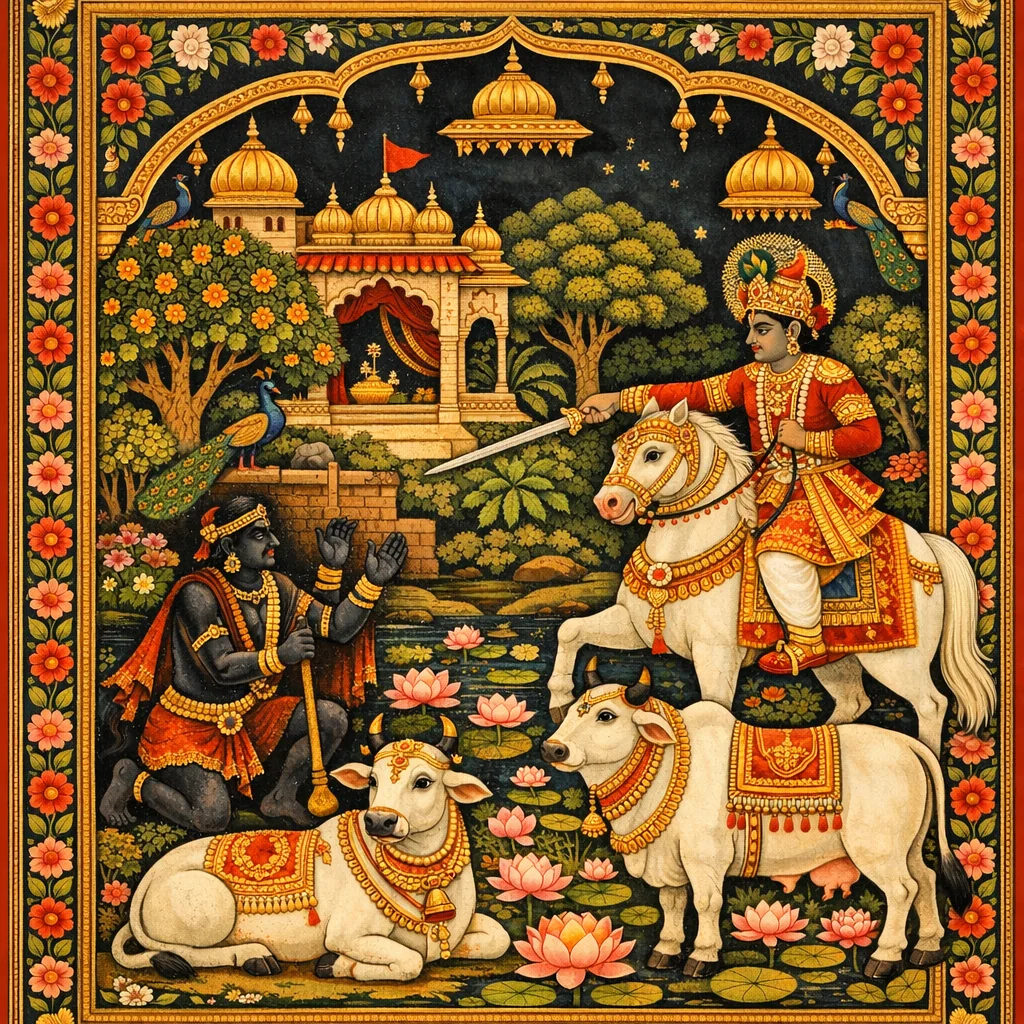
Parīkṣit Confronts Kali: Dharma (Bull) and Bhūmi (Cow) at the Dawn of Kali-yuga
Continuing Parīkṣit Mahārāja’s tour of his kingdom after assuming imperial responsibility, the narrative pivots from general observation of Kali-yuga symptoms to a direct confrontation with adharma personified. Parīkṣit discovers a śūdra-like figure dressed as a king beating a cow and a bull—Bhūmi and Dharma—signaling the inversion of varṇāśrama order and the abuse of the helpless. The King vows protection, questions the bull about the loss of three legs, and hears Dharma’s cautious reflection on competing causal theories (self, fate, karma, nature), highlighting the limits of mere tarka (argument). Parīkṣit identifies Dharma, diagnoses Kali-yuga’s moral collapse—truth remaining as the last leg—and raises his sword to kill Kali. Kali surrenders; Parīkṣit, embodying kṣatriya mercy and the ethics of śaraṇāgati, spares him but banishes him to domains that institutionalize vice: gambling, intoxication, prostitution, animal slaughter, and ultimately gold (wealth that amplifies deceit and envy). The chapter closes by showing Parīkṣit restoring dharma’s strength and stabilizing the earth, preparing the next progression: Kali’s permitted footholds become the social ecology for Parīkṣit’s later curse and the Bhāgavatam’s seven-day discourse.
Shlokas
Verse 1
सूत उवाच तत्र गोमिथुनं राजा हन्यमानमनाथवत् । दण्डहस्तं च वृषलं ददृशे नृपलाञ्छनम् ॥ १ ॥
Sūta Gosvāmī said: After reaching that place, Mahārāja Parīkṣit observed that a lower-caste śūdra, dressed like a king, was beating a cow and a bull with a club, as if they had no owner.
Verse 2
वृषं मृणालधवलं मेहन्तमिव बिभ्यतम् । वेपमानं पदैकेन सीदन्तं शूद्रताडितम् ॥ २ ॥
The bull was as white as a white lotus flower. He was terrified of the śūdra who was beating him, and he was so afraid that he was standing on one leg, trembling and urinating.
Verse 3
गां च धर्मदुघां दीनां भृशं शूद्रपदाहताम् । विवत्सामाश्रुवदनां क्षामां यवसमिच्छतीम् ॥ ३ ॥
Although the cow is beneficial because one can draw religious principles from her, she was now rendered poor and calfless. Her legs were being beaten by a śūdra. There were tears in her eyes, and she was distressed and weak. She was hankering after some grass in the field.
Verse 4
पप्रच्छ रथमारूढ: कार्तस्वरपरिच्छदम् । मेघगम्भीरया वाचा समारोपितकार्मुक: ॥ ४ ॥
Mahārāja Parīkṣit, well equipped with arrows and bow and seated on a gold-embossed chariot, spoke to him [the śūdra] with a deep voice sounding like thunder.
Verse 5
कस्त्वं मच्छरणे लोके बलाद्धंस्यबलान् बली । नरदेवोऽसि वेशेण नटवत्कर्मणाद्विज: ॥ ५ ॥
Oh, who are you? You appear to be strong and yet you dare kill, within my protection, those who are helpless! By your dress you pose yourself to be a godly man [king], but by your deeds you are opposing the principles of the twice-born kṣatriyas.
Verse 6
यस्त्वं कृष्णे गते दूरं सहगाण्डीवधन्वना । शोच्योऽस्यशोच्यान् रहसि प्रहरन् वधमर्हसि ॥ ६ ॥
You rogue, do you dare beat an innocent cow because Lord Kṛṣṇa and Arjuna, the carrier of the Gāṇḍīva bow, are out of sight? Since you are beating the innocent in a secluded place, you are considered a culprit and therefore deserve to be killed.
Verse 7
त्वं वा मृणालधवल: पादैर्न्यून: पदा चरन् । वृषरूपेण किं कश्चिद् देवो न: परिखेदयन् ॥ ७ ॥
Then he [Mahārāja Parīkṣit] asked the bull: Oh, who are you? Are you a bull as white as a white lotus, or are you a demigod? You have lost three of your legs and are moving on only one. Are you some demigod causing us grief in the form of a bull?
Verse 8
न जातु कौरवेन्द्राणां दोर्दण्डपरिरम्भिते । भूतलेऽनुपतन्त्यस्मिन् विना ते प्राणिनां शुच: ॥ ८ ॥
Now for the first time in a kingdom well protected by the arms of the kings of the Kuru dynasty, I see you grieving with tears in your eyes. Up till now no one on earth has ever shed tears because of royal negligence.
Verse 9
मा सौरभेयात्र शुचो व्येतु ते वृषलाद् भयम् । मा रोदीरम्ब भद्रं ते खलानां मयि शास्तरि ॥ ९ ॥
O son of Surabhi, you need lament no longer now. There is no need to fear this low-class śūdra. And, O mother cow, as long as I am living as the ruler and subduer of all envious men, there is no cause for you to cry. Everything will be good for you.
Verse 10
यस्य राष्ट्रे प्रजा: सर्वास्त्रस्यन्ते साध्व्यसाधुभि: । तस्य मत्तस्य नश्यन्ति कीर्तिरायुर्भगो गति: ॥ १० ॥ एष राज्ञां परो धर्मो ह्यार्तानामार्तिनिग्रह: । अत एनं वधिष्यामि भूतद्रुहमसत्तमम् ॥ ११ ॥
O chaste one, the king’s good name, duration of life and good rebirth vanish when all kinds of living beings are terrified by miscreants in his kingdom. It is certainly the prime duty of the king to subdue first the sufferings of those who suffer. Therefore I must kill this most wretched man because he is violent against other living beings.
Verse 11
यस्य राष्ट्रे प्रजा: सर्वास्त्रस्यन्ते साध्व्यसाधुभि: । तस्य मत्तस्य नश्यन्ति कीर्तिरायुर्भगो गति: ॥ १० ॥ एष राज्ञां परो धर्मो ह्यार्तानामार्तिनिग्रह: । अत एनं वधिष्यामि भूतद्रुहमसत्तमम् ॥ ११ ॥
O chaste one, the king’s good name, duration of life and good rebirth vanish when all kinds of living beings are terrified by miscreants in his kingdom. It is certainly the prime duty of the king to subdue first the sufferings of those who suffer. Therefore I must kill this most wretched man because he is violent against other living beings.
Verse 12
कोऽवृश्चत् तव पादांस्त्रीन् सौरभेय चतुष्पद । मा भूवंस्त्वादृशा राष्ट्रे राज्ञां कृष्णानुवर्तिनाम् ॥ १२ ॥
He [Mahārāja Parīkṣit] repeatedly addressed and questioned the bull thus: O son of Surabhi, who has cut off your three legs? In the state of the kings who are obedient to the laws of the Supreme Personality of Godhead, Kṛṣṇa, there is no one as unhappy as you.
Verse 13
आख्याहि वृष भद्रं व: साधूनामकृतागसाम् । आत्मवैरूप्यकर्तारं पार्थानां कीर्तिदूषणम् ॥ १३ ॥
O bull, you are offenseless and thoroughly honest; therefore I wish all good to you. Please tell me of the perpetrator of these mutilations, which blacken the reputation of the sons of Pṛthā.
Verse 14
जनेऽनागस्यघं युञ्जन् सर्वतोऽस्य च मद्भयम् । साधूनां भद्रमेव स्यादसाधुदमने कृते ॥ १४ ॥
Whoever causes offenseless living beings to suffer must fear me anywhere and everywhere in the world. By curbing dishonest miscreants, one automatically benefits the offenseless.
Verse 15
अनाग:स्विह भूतेषु य आगस्कृन्निरङ्कुश: । आहर्तास्मि भुजं साक्षादमर्त्यस्यापि साङ्गदम् ॥ १५ ॥
An upstart living being who commits offenses by torturing those who are offenseless shall be directly uprooted by me, even though he be a denizen of heaven with armor and decorations.
Verse 16
राज्ञो हि परमो धर्म: स्वधर्मस्थानुपालनम् । शासतोऽन्यान् यथाशास्त्रमनापद्युत्पथानिह ॥ १६ ॥
The supreme duty of the ruling king is to give all protection to law-abiding persons and to chastise those who stray from the ordinances of the scriptures in ordinary times, when there is no emergency.
Verse 17
धर्म उवाच एतद् व: पाण्डवेयानां युक्तमार्ताभयं वच: । येषां गुणगणै: कृष्णो दौत्यादौ भगवान् कृत: ॥ १७ ॥
The personality of religion said: These words just spoken by you befit a person of the Pāṇḍava dynasty. Captivated by the devotional qualities of the Pāṇḍavas, even Lord Kṛṣṇa, the Personality of Godhead, performed duties as a messenger.
Verse 18
न वयं क्लेशबीजानि यत: स्यु: पुरुषर्षभ । पुरुषं तं विजानीमो वाक्यभेदविमोहिता: ॥ १८ ॥
O greatest among human beings, it is very difficult to ascertain the particular miscreant who has caused our sufferings, because we are bewildered by all the different opinions of theoretical philosophers.
Verse 19
केचिद् विकल्पवसना आहुरात्मानमात्मन: । दैवमन्येऽपरे कर्म स्वभावमपरे प्रभुम् ॥ १९ ॥
Some of the philosophers, who deny all sorts of duality, declare that one’s own self is responsible for his personal happiness and distress. Others say that superhuman powers are responsible, while yet others say that activity is responsible, and the gross materialists maintain that nature is the ultimate cause.
Verse 20
अप्रतर्क्यादनिर्देश्यादिति केष्वपि निश्चय: । अत्रानुरूपं राजर्षे विमृश स्वमनीषया ॥ २० ॥
There are also some thinkers who believe that no one can ascertain the cause of distress by argumentation, nor know it by imagination, nor express it by words. O sage amongst kings, judge for yourself by thinking over all this with your own intelligence.
Verse 21
सूत उवाच एवं धर्मे प्रवदति स सम्राड् द्विजसत्तमा: । समाहितेन मनसा विखेद: पर्यचष्ट तम् ॥ २१ ॥
Sūta Gosvāmī said: O best among the brāhmaṇas, the Emperor Parīkṣit, thus hearing the personality of religion speak, was fully satisfied, and without mistake or regret he gave his reply.
Verse 22
राजोवाच धर्मं ब्रवीषि धर्मज्ञ धर्मोऽसि वृषरूपधृक् । यदधर्मकृत: स्थानं सूचकस्यापि तद्भवेत् ॥ २२ ॥
The King said: O you, who are in the form of a bull! You know the truth of religion, and you are speaking according to the principle that the destination intended for the perpetrator of irreligious acts is also intended for one who identifies the perpetrator. You are no other than the personality of religion.
Verse 23
अथवा देवमायाया नूनं गतिरगोचरा । चेतसो वचसश्चापि भूतानामिति निश्चय: ॥ २३ ॥
Thus it is concluded that the Lord’s energies are inconceivable. No one can estimate them by mental speculation or by word jugglery.
Verse 24
तप: शौचं दया सत्यमिति पादा: कृते कृता: । अधर्मांशैस्त्रयो भग्ना: स्मयसङ्गमदैस्तव ॥ २४ ॥
In the age of Satya [truthfulness] your four legs were established by the four principles of austerity, cleanliness, mercy and truthfulness. But it appears that three of your legs are broken due to rampant irreligion in the form of pride, lust for women, and intoxication.
Verse 25
इदानीं धर्म पादस्ते सत्यं निर्वर्तयेद्यत: । तं जिघृक्षत्यधर्मोऽयमनृतेनैधित: कलि: ॥ २५ ॥
You are now standing on one leg only, which is your truthfulness, and you are somehow or other hobbling along. But quarrel personified [Kali], flourishing by deceit, is also trying to destroy that leg.
Verse 26
इयं च भूमिर्भगवता न्यासितोरुभरा सती । श्रीमद्भिस्तत्पदन्यासै: सर्वत: कृतकौतुका ॥ २६ ॥
The burden of the earth was certainly diminished by the Personality of Godhead and by others as well. When He was present as an incarnation, all good was performed because of His auspicious footprints.
Verse 27
शोचत्यश्रुकला साध्वी दुर्भगेवोज्झिता सती । अब्रह्मण्या नृपव्याजा: शूद्रा भोक्ष्यन्ति मामिति ॥ २७ ॥
Now she, the chaste one, being unfortunately forsaken by the Personality of Godhead, laments her future with tears in her eyes, for now she is being ruled and enjoyed by lower-class men who pose as rulers.
Verse 28
इति धर्मं महीं चैव सान्त्वयित्वा महारथ: । निशातमाददे खड्गं कलयेऽधर्महेतवे ॥ २८ ॥
Mahārāja Parīkṣit, who could fight one thousand enemies single-handedly, thus pacified the personality of religion and the earth. Then he took up his sharp sword to kill the personality of Kali, who is the cause of all irreligion.
Verse 29
तं जिघांसुमभिप्रेत्य विहाय नृपलाञ्छनम् । तत्पादमूलं शिरसा समगाद् भयविह्वल: ॥ २९ ॥
When the personality of Kali understood that the King was willing to kill him, he at once abandoned the dress of a king and, under pressure of fear, completely surrendered to him, bowing his head.
Verse 30
पतितं पादयोर्वीर: कृपया दीनवत्सल: । शरण्यो नावधीच्छ्लोक्य आह चेदं हसन्निव ॥ ३० ॥
Mahārāja Parīkṣit, who was qualified to accept surrender and worthy of being sung in history, did not kill the poor surrendered and fallen Kali, but smiled compassionately, for he was kind to the poor.
Verse 31
राजोवाच न ते गुडाकेशयशोधराणां बद्धाञ्जलेर्वै भयमस्ति किञ्चित् । न वर्तितव्यं भवता कथञ्चन क्षेत्रे मदीये त्वमधर्मबन्धु: ॥ ३१ ॥
The King thus said: We have inherited the fame of Arjuna; therefore since you have surrendered yourself with folded hands you need not fear for your life. But you cannot remain in my kingdom, for you are the friend of irreligion.
Verse 32
त्वां वर्तमानं नरदेवदेहे- ष्वनुप्रवृत्तोऽयमधर्मपूग: । लोभोऽनृतं चौर्यमनार्यमंहो ज्येष्ठा च माया कलहश्च दम्भ: ॥ ३२ ॥
If the personality of Kali, irreligion, is allowed to act as a man-god or an executive head, certainly irreligious principles like greed, falsehood, robbery, incivility, treachery, misfortune, cheating, quarrel and vanity will abound.
Verse 33
न वर्तितव्यं तदधर्मबन्धो धर्मेण सत्येन च वर्तितव्ये । ब्रह्मावर्ते यत्र यजन्ति यज्ञै- र्यज्ञेश्वरं यज्ञवितानविज्ञा: ॥ ३३ ॥
Therefore, O friend of irreligion, you do not deserve to remain in a place where experts perform sacrifices according to truth and religious principles for the satisfaction of the Supreme Personality of Godhead.
Verse 34
यस्मिन् हरिर्भगवानिज्यमान इज्यात्ममूर्तिर्यजतां शं तनोति । कामानमोघान् स्थिरजङ्गमाना- मन्तर्बहिर्वायुरिवैष आत्मा ॥ ३४ ॥
In all sacrificial ceremonies, although sometimes a demigod is worshiped, the Supreme Lord Personality of Godhead is worshiped because He is the Supersoul of everyone, and exists both inside and outside like the air. Thus it is He only who awards all welfare to the worshiper.
Verse 35
सूत उवाच परीक्षितैवमादिष्ट: स कलिर्जातवेपथु: । तमुद्यतासिमाहेदं दण्डपाणिमिवोद्यतम् ॥ ३५ ॥
Śrī Sūta Gosvāmī said: The personality of Kali, thus being ordered by Mahārāja Parīkṣit, began to tremble in fear. Seeing the King before him like Yamarāja, ready to kill him, Kali spoke to the King as follows.
Verse 36
कलिरुवाच यत्र क्व वाथ वत्स्यामि सार्वभौम तवाज्ञया । लक्षये तत्र तत्रापि त्वामात्तेषुशरासनम् ॥ ३६ ॥
O Your Majesty, though I may live anywhere and everywhere under your order, I shall but see you with bow and arrows wherever I look.
Verse 37
तन्मे धर्मभृतां श्रेष्ठ स्थानं निर्देष्टुमर्हसि । यत्रैव नियतो वत्स्य आतिष्ठंस्तेऽनुशासनम् ॥ ३७ ॥
Therefore, O chief amongst the protectors of religion, please fix some place for me where I can live permanently under the protection of your government.
Verse 38
सूत उवाच अभ्यर्थितस्तदा तस्मै स्थानानि कलये ददौ । द्यूतं पानं स्त्रिय: सूना यत्राधर्मश्चतुर्विध: ॥ ३८ ॥
Sūta Gosvāmī said: Mahārāja Parīkṣit, thus being petitioned by the personality of Kali, gave him permission to reside in places where gambling, drinking, prostitution and animal slaughter were performed.
Verse 39
पुनश्च याचमानाय जातरूपमदात्प्रभु: । ततोऽनृतं मदं कामं रजो वैरं च पञ्चमम् ॥ ३९ ॥
The personality of Kali asked for something more, and because of his begging, the King gave him permission to live where there is gold because wherever there is gold there is also falsity, intoxication, lust, envy and enmity.
Verse 40
अमूनि पञ्च स्थानानि ह्यधर्मप्रभव: कलि: । औत्तरेयेण दत्तानि न्यवसत् तन्निदेशकृत् ॥ ४० ॥
Thus the personality of Kali, by the directions of Mahārāja Parīkṣit, the son of Uttarā, was allowed to live in those five places.
Verse 41
अथैतानि न सेवेत बुभूषु: पुरुष: क्वचित् । विशेषतो धर्मशीलो राजा लोकपतिर्गुरु: ॥ ४१ ॥
Therefore, whoever desires progressive well-being, especially kings, religionists, public leaders, brāhmaṇas and sannyāsīs, should never come in contact with the four above-mentioned irreligious principles.
Verse 42
वृषस्य नष्टांस्त्रीन् पादान् तप: शौचं दयामिति । प्रतिसन्दध आश्वास्य महीं च समवर्धयत् ॥ ४२ ॥
Thereafter the King reestablished the lost legs of the personality of religion [the bull], and by encouraging activities he sufficiently improved the condition of the earth.
Verse 43
स एष एतर्ह्यध्यास्त आसनं पार्थिवोचितम् । पितामहेनोपन्यस्तं राज्ञारण्यं विविक्षता ॥ ४३ ॥ आस्तेऽधुना स राजर्षि: कौरवेन्द्रश्रियोल्लसन् । गजाह्वये महाभागश्चक्रवर्ती बृहच्छ्रवा: ॥ ४४ ॥
The most fortunate emperor Mahārāja Parīkṣit, who was entrusted with the kingdom of Hastināpura by Mahārāja Yudhiṣṭhira when he desired to retire to the forest, is now ruling the world with great success due to his being glorified by the deeds of the kings of the Kuru dynasty.
Verse 44
स एष एतर्ह्यध्यास्त आसनं पार्थिवोचितम् । पितामहेनोपन्यस्तं राज्ञारण्यं विविक्षता ॥ ४३ ॥ आस्तेऽधुना स राजर्षि: कौरवेन्द्रश्रियोल्लसन् । गजाह्वये महाभागश्चक्रवर्ती बृहच्छ्रवा: ॥ ४४ ॥
The most fortunate emperor Mahārāja Parīkṣit, who was entrusted with the kingdom of Hastināpura by Mahārāja Yudhiṣṭhira when he desired to retire to the forest, is now ruling the world with great success due to his being glorified by the deeds of the kings of the Kuru dynasty.
Verse 45
इत्थम्भूतानुभावोऽयमभिमन्युसुतो नृप: । यस्य पालयत: क्षौणीं यूयं सत्राय दीक्षिता: ॥ ४५ ॥
Mahārāja Parīkṣit, the son of Abhimanyu, is so experienced that by dint of his expert administration and patronage, it has been possible for you to perform a sacrifice such as this.
Frequently Asked Questions
The cow represents Bhūmi (Earth) and the bull represents Dharma (Religion/virtue). Their beating symbolizes Kali-yuga’s social and moral inversion: rulers who are unqualified (a śūdra dressed as a king) exploit and terrorize the innocent, causing dharma to weaken and the earth to suffer under misrule.
Parīkṣit explains that in Satya-yuga dharma stood firmly on four supports: tapas (austerity), śauca (cleanliness), dayā (mercy), and satya (truthfulness). In Kali-yuga three are broken by dominant irreligious tendencies (notably pride, lust, and intoxication), leaving satya as the remaining leg—also threatened by deceit.
Kali surrenders in fear, and Parīkṣit exemplifies the kṣatriya code aligned with dharma: a surrendered person is not to be killed. Yet mercy is balanced with public protection—Kali is expelled from righteous society and restricted to specific places where vice is practiced, limiting his spread while honoring the principle of accepting surrender.
Parīkṣit assigns Kali to four primary sites of adharma: gambling (dyūta), intoxication (pāna), prostitution/illicit sex (strī-saṅga), and animal slaughter/violence (sūnā). Kali additionally receives residence in gold (hiraṇya), because wealth—when unregulated by dharma—tends to generate falsity, intoxication, lust, envy, and enmity.
The chapter defines the king’s foremost duty as rakṣā: protecting law-abiding and helpless beings and restraining miscreants. A ruler’s fame, longevity, and auspicious destination diminish when citizens live in fear; therefore, governance must actively remove suffering and uphold scriptural ordinances.