Adhyaya 1
Questions by the Sages of Naimiṣāraṇya (Śaunaka’s Inquiries and the Bhāgavata Thesis)
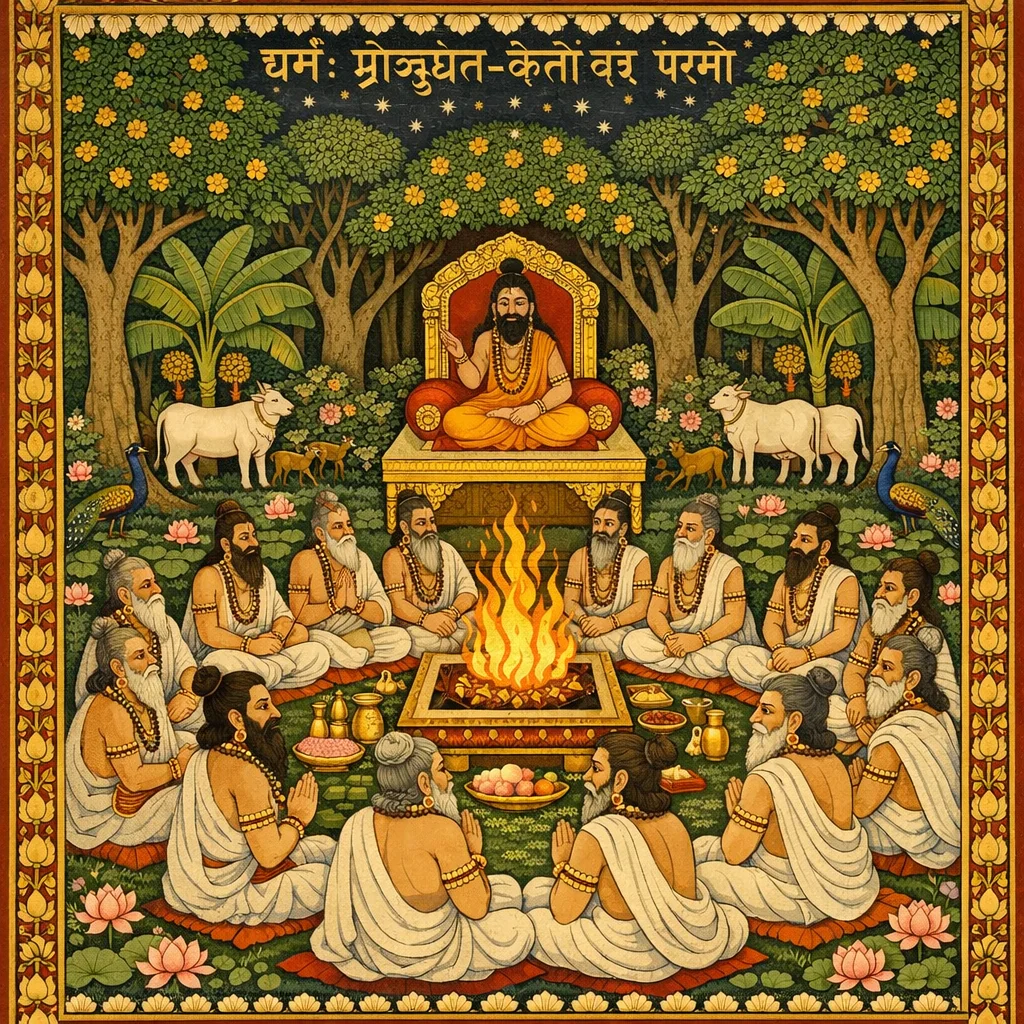
The Bhāgavatam begins with a theological invocation identifying Śrī Kṛṣṇa as the Absolute Truth and the conscious, independent source of sarga–sthiti–pralaya, who instructs Brahmā from within and whose māyā bewilders even devas and ṛṣis. The text then declares its purpose: rejecting kaitava-dharma and presenting the highest truth for pure-hearted devotees, effective through attentive, submissive hearing that installs the Lord in the heart. The scene shifts to Naimiṣāraṇya, where Śaunaka and other sages commence a thousand-year sacrifice for the Lord’s pleasure and honor Sūta Gosvāmī. Recognizing his learning, humility, and disciplic blessings, they request an essence suitable for Kali-yuga’s short-lived, disturbed people. Their questions prioritize Kṛṣṇa’s avatāras and līlās, the sanctifying power of saints and the holy name, and culminate in a pressing concern: after Kṛṣṇa’s departure, where has dharma taken shelter? This chapter sets the inquiry that the next chapters progressively answer through Sūta’s structured narration and the Bhāgavata’s lineage of speakers.
Shlokas
Verse 1
ॐ नमो भगवते वासुदेवाय जन्माद्यस्य यतोऽन्वयादितरतश्चार्थेष्वभिज्ञ: स्वराट् तेने ब्रह्म हृदा य आदिकवये मुह्यन्ति यत्सूरय: । तेजोवारिमृदां यथा विनिमयो यत्र त्रिसर्गोऽमृषा धाम्ना स्वेन सदा निरस्तकुहकं सत्यं परं धीमहि ॥ १ ॥
O my Lord, Śrī Kṛṣṇa, son of Vasudeva, O all-pervading Personality of Godhead, I offer my respectful obeisances unto You. I meditate upon Lord Śrī Kṛṣṇa because He is the Absolute Truth and the primeval cause of all causes of the creation, sustenance and destruction of the manifested universes. He is directly and indirectly conscious of all manifestations, and He is independent because there is no other cause beyond Him. It is He only who first imparted the Vedic knowledge unto the heart of Brahmājī, the original living being. By Him even the great sages and demigods are placed into illusion, as one is bewildered by the illusory representations of water seen in fire, or land seen on water. Only because of Him do the material universes, temporarily manifested by the reactions of the three modes of nature, appear factual, although they are unreal. I therefore meditate upon Him, Lord Śrī Kṛṣṇa, who is eternally existent in the transcendental abode, which is forever free from the illusory representations of the material world. I meditate upon Him, for He is the Absolute Truth.
Verse 2
धर्म: प्रोज्झितकैतवोऽत्र परमो निर्मत्सराणां सतां वेद्यं वास्तवमत्र वस्तु शिवदं तापत्रयोन्मूलनम् । श्रीमद्भागवते महामुनिकृते किं वा परैरीश्वर: सद्यो हृद्यवरुध्यतेऽत्र कृतिभि: शुश्रूषुभिस्तत्क्षणात् ॥ २ ॥
Completely rejecting all religious activities which are materially motivated, this Bhāgavata Purāṇa propounds the highest truth, which is understandable by those devotees who are fully pure in heart. The highest truth is reality distinguished from illusion for the welfare of all. Such truth uproots the threefold miseries. This beautiful Bhāgavatam, compiled by the great sage Vyāsadeva [in his maturity], is sufficient in itself for God realization. What is the need of any other scripture? As soon as one attentively and submissively hears the message of Bhāgavatam, by this culture of knowledge the Supreme Lord is established within his heart.
Verse 3
निगमकल्पतरोर्गलितं फलं शुकमुखादमृतद्रवसंयुतम् । पिबत भागवतं रसमालयं मुहुरहो रसिका भुवि भावुका: ॥ ३ ॥
O expert and thoughtful men, relish Śrīmad-Bhāgavatam, the mature fruit of the desire tree of Vedic literatures. It emanated from the lips of Śrī Śukadeva Gosvāmī. Therefore this fruit has become even more tasteful, although its nectarean juice was already relishable for all, including liberated souls.
Verse 4
नैमिषेऽनिमिषक्षेत्रे ऋषय: शौनकादय: । सत्रं स्वर्गायलोकाय सहस्रसममासत ॥ ४ ॥
Once, in a holy place in the forest of Naimiṣāraṇya, great sages headed by the sage Śaunaka assembled to perform a great thousand-year sacrifice for the satisfaction of the Lord and His devotees.
Verse 5
त एकदा तु मुनय: प्रातर्हुतहुताग्नय: । सत्कृतं सूतमासीनं पप्रच्छुरिदमादरात् ॥ ५ ॥
One day, after finishing their morning duties by burning a sacrificial fire and offering a seat of esteem to Śrīla Sūta Gosvāmī, the great sages made inquiries, with great respect, about the following matters.
Verse 6
त्वया खलु पुराणानि सेतिहासानि चानघ । आख्यातान्यप्यधीतानि धर्मशास्त्राणि यान्युत ॥ ६ ॥
The sages said: Respected Sūta Gosvāmī, you are completely free from all vice. You are well versed in all the scriptures famous for religious life, and in the Purāṇas and the histories as well, for you have gone through them under proper guidance and have also explained them.
Verse 7
यानि वेदविदां श्रेष्ठो भगवान् बादरायण: । अन्ये च मुनय: सूत परावरविदो विदु: ॥ ७ ॥
Being the eldest learned Vedāntist, O Sūta Gosvāmī, you are acquainted with the knowledge of Vyāsadeva, who is the incarnation of Godhead, and you also know other sages who are fully versed in all kinds of physical and metaphysical knowledge.
Verse 8
वेत्थ त्वं सौम्य तत्सर्वं तत्त्वतस्तदनुग्रहात् । ब्रूयु: स्निग्धस्य शिष्यस्य गुरवो गुह्यमप्युत ॥ ८ ॥
And because you are submissive, your spiritual masters have endowed you with all the favors bestowed upon a gentle disciple. Therefore you can tell us all that you have scientifically learned from them.
Verse 9
तत्र तत्राञ्जसायुष्मन् भवता यद्विनिश्चितम् । पुंसामेकान्तत: श्रेयस्तन्न: शंसितुमर्हसि ॥ ९ ॥
Please, therefore, being blessed with many years, explain to us, in an easily understandable way, what you have ascertained to be the absolute and ultimate good for the people in general.
Verse 10
प्रायेणाल्पायुष: सभ्य कलावस्मिन् युगे जना: । मन्दा: सुमन्दमतयो मन्दभाग्या ह्युपद्रुता: ॥ १० ॥
O learned one, in this iron Age of Kali men almost always have but short lives. They are quarrelsome, lazy, misguided, unlucky and, above all, always disturbed.
Verse 11
भूरीणि भूरिकर्माणि श्रोतव्यानि विभागश: । अत: साधोऽत्र यत्सारं समुद्धृत्य मनीषया । ब्रूहि भद्रायभूतानां येनात्मा सुप्रसीदति ॥ ११ ॥
There are many varieties of scriptures, and in all of them there are many prescribed duties, which can be learned only after many years of study in their various divisions. Therefore, O sage, please select the essence of all these scriptures and explain it for the good of all living beings, that by such instruction their hearts may be fully satisfied.
Verse 12
सूत जानासि भद्रं ते भगवान् सात्वतां पति: । देवक्यां वसुदेवस्य जातो यस्य चिकीर्षया ॥ १२ ॥
All blessings upon you, O Sūta Gosvāmī. You know for what purpose the Personality of Godhead appeared in the womb of Devakī as the son of Vasudeva.
Verse 13
तन्न: शुश्रूषमाणानामर्हस्यङ्गानुवर्णितुम् । यस्यावतारो भूतानां क्षेमाय च भवाय च ॥ १३ ॥
O Sūta Gosvāmī, we are eager to learn about the Personality of Godhead and His incarnations. Please explain to us those teachings imparted by previous masters [ācāryas], for one is uplifted both by speaking them and by hearing them.
Verse 14
आपन्न: संसृतिं घोरां यन्नाम विवशो गृणन् । तत: सद्यो विमुच्येत यद्बिभेति स्वयं भयम् ॥ १४ ॥
Living beings who are entangled in the complicated meshes of birth and death can be freed immediately by even unconsciously chanting the holy name of Kṛṣṇa, which is feared by fear personified.
Verse 15
यत्पादसंश्रया: सूत मुनय: प्रशमायना: । सद्य: पुनन्त्युपस्पृष्टा: स्वर्धुन्यापोऽनुसेवया ॥ १५ ॥
O Sūta, those great sages who have completely taken shelter of the lotus feet of the Lord can at once sanctify those who come in touch with them, whereas the waters of the Ganges can sanctify only after prolonged use.
Verse 16
को वा भगवतस्तस्य पुण्यश्लोकेड्यकर्मण: । शुद्धिकामो न शृणुयाद्यश: कलिमलापहम् ॥ १६ ॥
Who is there, desiring deliverance from the vices of the age of quarrel, who is not willing to hear the virtuous glories of the Lord?
Verse 17
तस्य कर्माण्युदाराणि परिगीतानि सूरिभि: । ब्रूहि न: श्रद्दधानानां लीलया दधत: कला: ॥ १७ ॥
His transcendental acts are magnificent and gracious, and great learned sages like Nārada sing of them. Please, therefore, speak to us, who are eager to hear, about the adventures He performs in His various incarnations.
Verse 18
अथाख्याहिहरेर्धीमन्नवतारकथा: शुभा: । लीला विदधत: स्वैरमीश्वरस्यात्ममायया ॥ १८ ॥
O wise Sūta, please narrate to us the transcendental pastimes of the Supreme Godhead’s multi-incarnations. Such auspicious adventures and pastimes of the Lord, the supreme controller, are performed by His internal powers.
Verse 19
वयं तु न वितृप्याम उत्तमश्लोकविक्रमे । यच्छृण्वतां रसज्ञानां स्वादु स्वादु पदे पदे ॥ १९ ॥
We never tire of hearing the transcendental pastimes of the Personality of Godhead, who is glorified by hymns and prayers. Those who have developed a taste for transcendental relationships with Him relish hearing of His pastimes at every moment.
Verse 20
कृतवान् किल कर्माणि सह रामेण केशव: । अतिमर्त्यानि भगवान् गूढ: कपटमानुष: ॥ २० ॥
Lord Śrī Kṛṣṇa, the Personality of Godhead, along with Balarāma, played like a human being, and so masked He performed many superhuman acts.
Verse 21
कलिमागतमाज्ञाय क्षेत्रेऽस्मिन् वैष्णवे वयम् । आसीना दीर्घसत्रेण कथायां सक्षणा हरे: ॥ २१ ॥
Knowing well that the Age of Kali has already begun, we are assembled here in this holy place to hear at great length the transcendental message of Godhead and in this way perform sacrifice.
Verse 22
त्वं न: सन्दर्शितो धात्रा दुस्तरं निस्तितीर्षताम् । कलिं सत्त्वहरं पुंसां कर्णधार इवार्णवम् ॥ २२ ॥
We think that we have met Your Goodness by the will of providence, just so that we may accept you as captain of the ship for those who desire to cross the difficult ocean of Kali, which deteriorates all the good qualities of a human being.
Verse 23
ब्रूहि योगेश्वरे कृष्णे ब्रह्मण्ये धर्मवर्मणि । स्वां काष्ठामधुनोपेते धर्म: कं शरणं गत: ॥ २३ ॥
Since Śrī Kṛṣṇa, the Absolute Truth, the master of all mystic powers, has departed for His own abode, please tell us to whom the religious principles have now gone for shelter.
Frequently Asked Questions
It establishes the Bhāgavata’s siddhānta that the Absolute Truth is personal, conscious, and independent—Kṛṣṇa—who is both the efficient and ultimate source behind cosmic manifestation. By stating that He enlightens Brahmā internally, it also defines revelation as grace-based knowledge (śabda) received through the Lord’s sanction, not merely human speculation.
Through śravaṇa performed with attention and submission, the mind becomes purified from ulterior motives (kaitava) and the heart becomes receptive to bhakti. In Bhāgavata theology, the Lord reciprocates with the listener by revealing Himself (bhagavat-pratyakṣatā) and anchoring dharma as loving service rather than external ritual identity.
To justify a distilled, universally applicable sādhana: Kṛṣṇa-kathā and bhakti centered on hearing and chanting. The sages seek the ‘essence of all scriptures’ because Kali-yuga conditions make extensive ritual and prolonged study difficult, while the Bhāgavata’s method offers direct spiritual efficacy.
The phrase indicates that even the principle of fear—rooted in mortality and bondage—cannot stand before the Lord’s name. In devotional exegesis, the holy name is non-different from Kṛṣṇa, so contact with nāma dissolves the causes of fear (sinful reactions and ignorance) and can liberate even when chanted unconsciously.
It introduces the transition problem of the world after Kṛṣṇa’s visible departure and prompts Sūta to explain the enduring shelter of dharma in the Bhāgavata, saintly teachers, and the Lord’s instructions and incarnational arrangements—leading into the broader narration of Bhāgavata transmission and the remedy for Kali-yuga.