Adhyaya 6
Nārada’s Past Life, the Lord’s Brief Vision, and the Power of Kīrtana
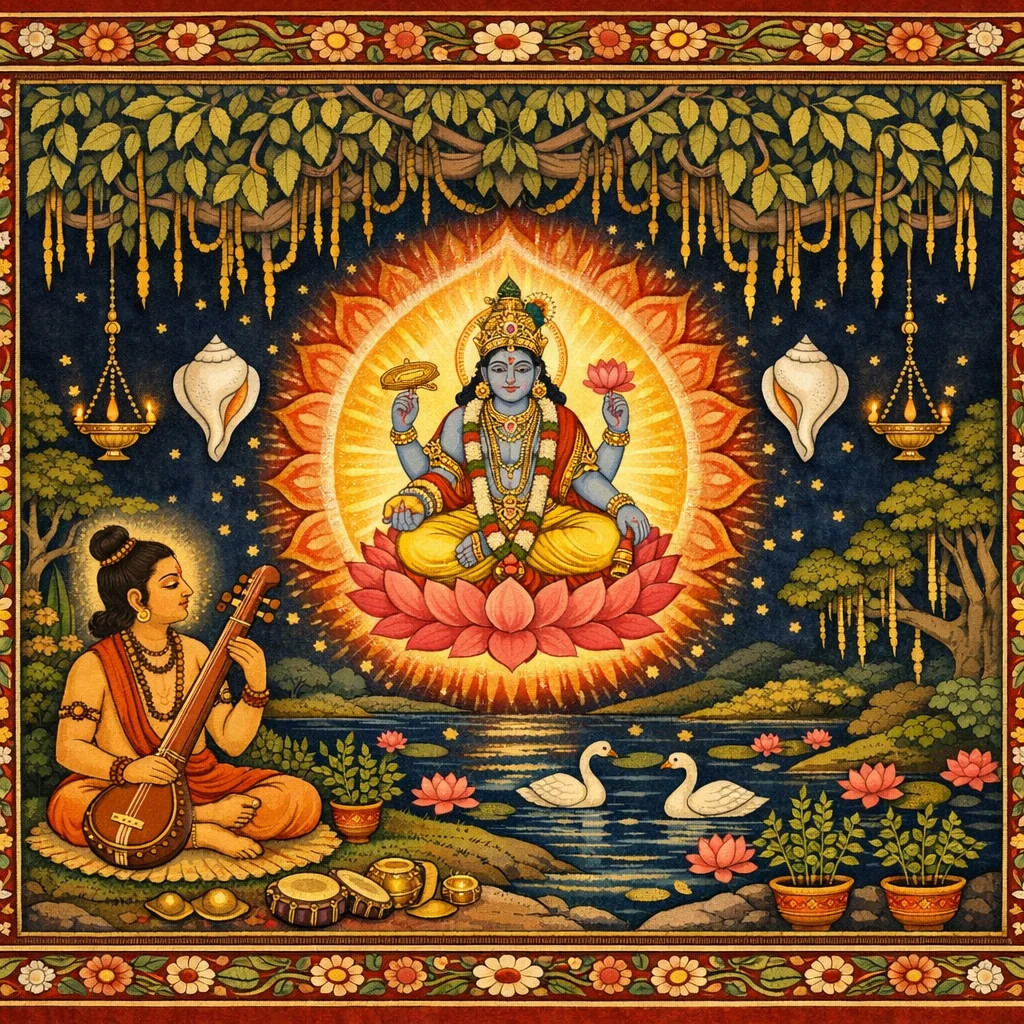
After hearing of Nārada’s birth and activities, Vyāsadeva asks what occurred after the great sages departed and how Nārada could remember events from a prior day of Brahmā. Nārada recounts his childhood as the son of a maidservant, bound by affection yet ultimately directed by daiva (supreme time). When his mother dies from a snakebite, he accepts it as the Lord’s mercy and journeys north, passing through varied landscapes until exhaustion leads him to bathe and then meditate beneath a banyan tree. Through learned bhakti-meditation, the Lord appears within his heart; overwhelmed, Nārada then loses that vision and grieves. The Lord speaks: Nārada will not see Him again in that life, because residual material taints obstruct constant vision; the single glimpse is meant to intensify longing, purify desire, and fix intelligence in devotion. Nārada then adopts constant nāma-kīrtana and līlā-kathā, becomes unattached, dies free of karma, receives a transcendental body, survives cosmic dissolution, and reappears with the ṛṣis in the next creation. Now he roams unrestricted, singing with his vīṇā, teaching that kīrtana is the boat across saṁsāra—superior to mere sense-restraint—thus preparing Vyāsa to compose the Bhāgavata as a kīrtana-centered scripture.
Shlokas
Verse 1
सूत उवाच एवं निशम्य भगवान्देवर्षेर्जन्म कर्म च । भूय: पप्रच्छ तं ब्रह्मन् व्यास: सत्यवतीसुत: ॥ १ ॥
Sūta said: O brāhmaṇas, thus hearing all about Śrī Nārada’s birth and activities, Vyāsadeva, the incarnation of God and son of Satyavatī, inquired as follows.
Verse 2
व्यास उवाच भिक्षुभिर्विप्रवसिते विज्ञानादेष्टृभिस्तव । वर्तमानो वयस्याद्ये तत: किमकरोद्भवान् ॥ २ ॥
Śrī Vyāsadeva said: What did you [Nārada] do after the departure of the great sages who had instructed you in scientific transcendental knowledge before the beginning of your present birth?
Verse 3
स्वायम्भुव कया वृत्त्या वर्तितं ते परं वय: । कथं चेदमुदस्राक्षी: काले प्राप्ते कलेवरम् ॥ ३ ॥
O son of Brahmā, how did you pass your life after initiation, and how did you attain this body, having quit your old one in due course?
Verse 4
प्राक्कल्पविषयामेतां स्मृतिं ते मुनिसत्तम । न ह्येष व्यवधात्काल एष सर्वनिराकृति: ॥ ४ ॥
O great sage, time annihilates everything in due course, so how is it that this subject matter, which happened prior to this day of Brahmā, is still fresh in your memory, undisturbed by time?
Verse 5
नारद उवाच भिक्षुभिर्विप्रवसिते विज्ञानादेष्टृभिर्मम । वर्तमानो वयस्याद्ये तत एतदकारषम् ॥ ५ ॥
Śrī Nārada said: The great sages, who had imparted scientific knowledge of transcendence to me, departed for other places, and I had to pass my life in this way.
Verse 6
एकात्मजा मे जननी योषिन्मूढा च किङ्करी । मय्यात्मजेऽनन्यगतौ चक्रे स्नेहानुबन्धनम् ॥ ६ ॥
I was the only son of my mother, who was not only a simple woman but a maidservant as well. Since I was her only offspring, she had no other alternative for protection: she bound me with the tie of affection.
Verse 7
सास्वतन्त्रा न कल्पासीद्योगक्षेमं ममेच्छती । ईशस्य हि वशे लोको योषा दारुमयी यथा ॥ ७ ॥
She wanted to look after my maintenance properly, but because she was not independent, she was not able to do anything for me. The world is under the full control of the Supreme Lord; therefore everyone is like a wooden doll in the hands of a puppet master.
Verse 8
अहं च तद्ब्रह्मकुले ऊषिवांस्तदुपेक्षया । दिग्देशकालाव्युत्पन्नो बालक: पञ्चहायन: ॥ ८ ॥
When I was a mere child of five years, I lived in a brāhmaṇa school. I was dependent on my mother’s affection and had no experience of different lands.
Verse 9
एकदा निर्गतां गेहाद्दुहन्तीं निशि गां पथि । सर्पोऽदशत्पदा स्पृष्ट: कृपणां कालचोदित: ॥ ९ ॥
Once upon a time, my poor mother, when going out one night to milk a cow, was bitten on the leg by a serpent, influenced by supreme time.
Verse 10
तदा तदहमीशस्य भक्तानां शमभीप्सत: । अनुग्रहं मन्यमान: प्रातिष्ठं दिशमुत्तराम् ॥ १० ॥
I took this as the special mercy of the Lord, who always desires benediction for His devotees, and so thinking, I started for the north.
Verse 11
स्फीताञ्जनपदांस्तत्र पुरग्रामव्रजाकरान् । खेटखर्वटवाटीश्च वनान्युपवनानि च ॥ ११ ॥
After my departure, I passed through many flourishing metropolises, towns, villages, animal farms, mines, agricultural lands, valleys, flower gardens, nursery gardens and natural forests.
Verse 12
चित्रधातुविचित्राद्रीनिभभग्नभुजद्रुमान् । जलाशयाञ्छिवजलान्नलिनी: सुरसेविता: । चित्रस्वनै: पत्ररथैर्विभ्रमद्भ्रमरश्रिय: ॥ १२ ॥
I passed through hills and mountains full of reservoirs of various minerals like gold, silver and copper, and through tracts of land with reservoirs of water filled with beautiful lotus flowers, fit for the denizens of heaven, decorated with bewildered bees and singing birds.
Verse 13
नलवेणुशरस्तन्बकुशकीचकगह्वरम् । एक एवातियातोऽहमद्राक्षं विपिनं महत् । घोरं प्रतिभयाकारं व्यालोलूकशिवाजिरम् ॥ १३ ॥
I then passed alone through many forests of rushes, bamboo, reeds, sharp grass, weeds and caves, which were very difficult to go through alone. I visited deep, dark and dangerously fearful forests, which were the play yards of snakes, owls and jackals.
Verse 14
परिश्रान्तेन्द्रियात्माहं तृट्परीतो बुभुक्षित: । स्नात्वा पीत्वा ह्रदे नद्या उपस्पृष्टो गतश्रम: ॥ १४ ॥
Thus traveling, I felt tired, both bodily and mentally, and I was both thirsty and hungry. So I took a bath in a river lake and also drank water. By contacting water, I got relief from my exhaustion.
Verse 15
तस्मिन्निर्मनुजेऽरण्ये पिप्पलोपस्थ आश्रित: । आत्मनात्मानमात्मस्थं यथाश्रुतमचिन्तयम् ॥ १५ ॥
After that, under the shadow of a banyan tree in an uninhabited forest I began to meditate upon the Supersoul situated within, using my intelligence, as I had learned from liberated souls.
Verse 16
ध्यायतश्चरणाम्भोजं भावनिर्जितचेतसा । औत्कण्ठ्याश्रुकलाक्षस्य हृद्यासीन्मे शनैर्हरि: ॥ १६ ॥
As soon as I began to meditate upon the lotus feet of the Personality of Godhead with my mind transformed in transcendental love, tears rolled down my eyes, and without delay the Personality of Godhead, Śrī Kṛṣṇa, appeared on the lotus of my heart.
Verse 17
प्रेमातिभरनिर्भिन्नपुलकाङ्गोऽतिनिर्वृत: । आनन्दसम्प्लवे लीनो नापश्यमुभयं मुने ॥ १७ ॥
O Vyāsadeva, at that time, being exceedingly overpowered by feelings of happiness, every part of my body became separately enlivened. Being absorbed in an ocean of ecstasy, I could not see both myself and the Lord.
Verse 18
रूपं भगवतो यत्तन्मन:कान्तं शुचापहम् । अपश्यन् सहसोत्तस्थे वैक्लव्याद्दुर्मना इव ॥ १८ ॥
The transcendental form of the Lord, as it is, satisfies the mind’s desire and at once erases all mental incongruities. Upon losing that form, I suddenly got up, being perturbed, as is usual when one loses that which is desirable.
Verse 19
दिदृक्षुस्तदहं भूय: प्रणिधाय मनो हृदि । वीक्षमाणोऽपि नापश्यमवितृप्त इवातुर: ॥ १९ ॥
I desired to see again that transcendental form of the Lord, but despite my attempts to concentrate upon the heart with eagerness to view the form again, I could not see Him any more, and thus dissatisfied, I was very much aggrieved.
Verse 20
एवं यतन्तं विजने मामाहागोचरो गिराम् । गम्भीरश्लक्ष्णया वाचा शुच: प्रशमयन्निव ॥ २० ॥
Seeing my attempts in that lonely place, the Personality of Godhead, who is transcendental to all mundane description, spoke to me with gravity and pleasing words, just to mitigate my grief.
Verse 21
हन्तास्मिञ्जन्मनि भवान्मा मां द्रष्टुमिहार्हति । अविपक्वकषायाणां दुर्दर्शोऽहं कुयोगिनाम् ॥ २१ ॥
O Nārada [the Lord spoke], I regret that during this lifetime you will not be able to see Me anymore. Those who are incomplete in service and who are not completely free from all material taints can hardly see Me.
Verse 22
सकृद् यद्दर्शितं रूपमेतत्कामाय तेऽनघ । मत्काम: शनकै: साधु सर्वान्मुञ्चति हृच्छयान् ॥ २२ ॥
O virtuous one, you have only once seen My person, and this is just to increase your desire for Me, because the more you hanker for Me, the more you will be freed from all material desires.
Verse 23
सत्सेवयादीर्घयापि जाता मयि दृढा मति: । हित्वावद्यमिमं लोकं गन्ता मज्जनतामसि ॥ २३ ॥
By service of the Absolute Truth, even for a few days, a devotee attains firm and fixed intelligence in Me. Consequently he goes on to become My associate in the transcendental world after giving up the present deplorable material worlds.
Verse 24
मतिर्मयि निबद्धेयं न विपद्येत कर्हिचित् । प्रजासर्गनिरोधेऽपि स्मृतिश्च मदनुग्रहात् ॥ २४ ॥
Intelligence engaged in My devotion cannot be thwarted at any time. Even at the time of creation, as well as at the time of annihilation, your remembrance will continue by My mercy.
Verse 25
एतावदुक्त्वोपरराम तन्महद् भूतं नभोलिङ्गमलिङ्गमीश्वरम् । अहं च तस्मै महतां महीयसे शीर्ष्णावनामं विदधेऽनुकम्पित: ॥ २५ ॥
Then that supreme authority, personified by sound and unseen by eyes, but most wonderful, stopped speaking. Feeling a sense of gratitude, I offered my obeisances unto Him, bowing my head.
Verse 26
नामान्यनन्तस्य हतत्रप: पठन् गुह्यानि भद्राणि कृतानि च स्मरन् । गां पर्यटंस्तुष्टमना गतस्पृह: कालं प्रतीक्षन् विमदो विमत्सर: ॥ २६ ॥
Thus I began chanting the holy name and fame of the Lord by repeated recitation, ignoring all the formalities of the material world. Such chanting and remembering of the transcendental pastimes of the Lord are benedictory. So doing, I traveled all over the earth, fully satisfied, humble and unenvious.
Verse 27
एवं कृष्णमतेर्ब्रह्मन्नासक्तस्यामलात्मन: । काल: प्रादुरभूत्काले तडित्सौदामनी यथा ॥ २७ ॥
And so, O Brāhmaṇa Vyāsadeva, in due course of time I, who was fully absorbed in thinking of Kṛṣṇa and who therefore had no attachments, being completely freed from all material taints, met with death, as lightning and illumination occur simultaneously.
Verse 28
प्रयुज्यमाने मयि तां शुद्धां भागवतीं तनुम् । आरब्धकर्मनिर्वाणो न्यपतत् पाञ्चभौतिक: ॥ २८ ॥
Having been awarded a transcendental body befitting an associate of the Personality of Godhead, I quit the body made of five material elements, and thus all acquired fruitive results of work [karma] stopped.
Verse 29
कल्पान्त इदमादाय शयानेऽम्भस्युदन्वत: । शिशयिषोरनुप्राणं विविशेऽन्तरहं विभो: ॥ २९ ॥
At the end of the millennium, when the Personality of Godhead, Lord Nārāyaṇa, lay down within the water of devastation, Brahmā began to enter into Him along with all creative elements, and I also entered through His breathing.
Verse 30
सहस्रयुगपर्यन्ते उत्थायेदं सिसृक्षत: । मरीचिमिश्रा ऋषय: प्राणेभ्योऽहं च जज्ञिरे ॥ ३० ॥
After 4,300,000,000 solar years, when Brahmā awoke to create again by the will of the Lord, all the ṛṣis like Marīci, Aṅgirā, Atri and so on were created from the transcendental body of the Lord, and I also appeared along with them.
Verse 31
अन्तर्बहिश्च लोकांस्त्रीन् पर्येम्यस्कन्दितव्रत: । अनुग्रहान्महाविष्णोरविघातगति: क्वचित् ॥ ३१ ॥
Since then, by the grace of the almighty Viṣṇu, I travel everywhere without restriction both in the transcendental world and in the three divisions of the material world. This is because I am fixed in unbroken devotional service of the Lord.
Verse 32
देवदत्तामिमां वीणां स्वरब्रह्मविभूषिताम् । मूर्च्छयित्वा हरिकथां गायमानश्चराम्यहम् ॥ ३२ ॥
And thus I travel, constantly singing the transcendental message of the glories of the Lord, vibrating this instrument called a vīṇā, which is charged with transcendental sound and which was given to me by Lord Kṛṣṇa.
Verse 33
प्रगायत: स्ववीर्याणि तीर्थपाद: प्रियश्रवा: । आहूत इव मे शीघ्रं दर्शनं याति चेतसि ॥ ३३ ॥
The Supreme Lord Śrī Kṛṣṇa, whose glories and activities are pleasing to hear, at once appears on the seat of my heart, as if called for, as soon as I begin to chant His holy activities.
Verse 34
एतद्ध्यातुरचित्तानां मात्रास्पर्शेच्छया मुहु: । भवसिन्धुप्लवो दृष्टो हरिचर्यानुवर्णनम् ॥ ३४ ॥
It is personally experienced by me that those who are always full of cares and anxieties due to desiring contact of the senses with their objects can cross the ocean of nescience on a most suitable boat — the constant chanting of the transcendental activities of the Personality of Godhead.
Verse 35
यमादिभिर्योगपथै: कामलोभहतो मुहु: । मुकुन्दसेवया यद्वत्तथात्माद्धा न शाम्यति ॥ ३५ ॥
It is true that by practicing restraint of the senses by the yoga system one can get relief from the disturbances of desire and lust, but this is not sufficient to give satisfaction to the soul, for this [satisfaction] is derived from devotional service to the Personality of Godhead.
Verse 36
सर्वं तदिदमाख्यातं यत्पृष्टोऽहं त्वयानघ । जन्मकर्मरहस्यं मे भवतश्चात्मतोषणम् ॥ ३६ ॥
O Vyāsadeva, you are freed from all sins. Thus I have explained my birth and activities for self-realization, as you asked. All this will be conducive for your personal satisfaction also.
Verse 37
सूत उवाच एवं सम्भाष्य भगवान्नारदो वासवीसुतम् । आमन्त्र्य वीणां रणयन् ययौ यादृच्छिको मुनि: ॥ ३७ ॥
Sūta Gosvāmī said: Thus addressing Vyāsadeva, Śrīla Nārada Muni took leave of him, and vibrating on his vīṇā instrument, he left to wander at his free will.
Verse 38
अहो देवर्षिर्धन्योऽयं यत्कीर्तिं शार्ङ्गधन्वन: । गायन्माद्यन्निदं तन्त्र्या रमयत्यातुरं जगत् ॥ ३८ ॥
All glory and success to Śrīla Nārada Muni because he glorifies the activities of the Personality of Godhead, and so doing he himself takes pleasure and also enlivens all the distressed souls of the universe.
Frequently Asked Questions
The Lord’s brief darśana functions as anugraha (mercy) that awakens intense longing (lālasā) and accelerates purification. The chapter states that those not fully free from material taints cannot maintain continual vision; the single glimpse is granted to deepen desire for the Lord so that competing desires are dissolved. Separation (viraha) becomes a spiritual catalyst, turning the mind from episodic meditation to uninterrupted remembrance through kīrtana and service.
Nārada explains that remembrance is preserved by the Lord’s mercy: devotionally engaged intelligence is not thwarted even during creation and annihilation. The Lord explicitly promises continuity of remembrance (smṛti) across cosmic cycles for one fixed in bhakti. Thus, time erases material arrangements, but bhakti—being connected to the eternal—carries consciousness beyond nirodha (dissolution).
Nārada interprets the sudden loss as poṣaṇam in a hidden form: the Lord removes worldly dependence that would obstruct full surrender. The event cuts the last binding attachment and redirects him to solitary practice and wholehearted seeking. In Bhāgavata theology, such reversals are not random tragedy but transformative grace that reorients the devotee toward the eternal good.
The chapter acknowledges that yogic restraint can reduce agitation from lust and desire, but it does not necessarily satisfy the ātmā. Satisfaction arises from positive engagement—bhakti—especially śravaṇa-kīrtana of Bhagavān’s guṇa and līlā. Kīrtana both purifies (removing anarthas) and nourishes (giving rasa), making it the most suitable means to cross the ocean of nescience in Kali-yuga.
The text states the vīṇā was given by Lord Kṛṣṇa. It represents divya-śabda (transcendental sound) as a vehicle of presence: when Nārada sings, the Lord ‘appears’ on the heart’s seat as if invoked. Symbolically, the vīṇā embodies the Bhāgavata principle that sound imbued with devotion is not merely descriptive but participatory—linking the chanter to Bhagavān.