Adhyaya 19
Parīkṣit’s Vow on the Gaṅgā and the Advent of Śukadeva Gosvāmī
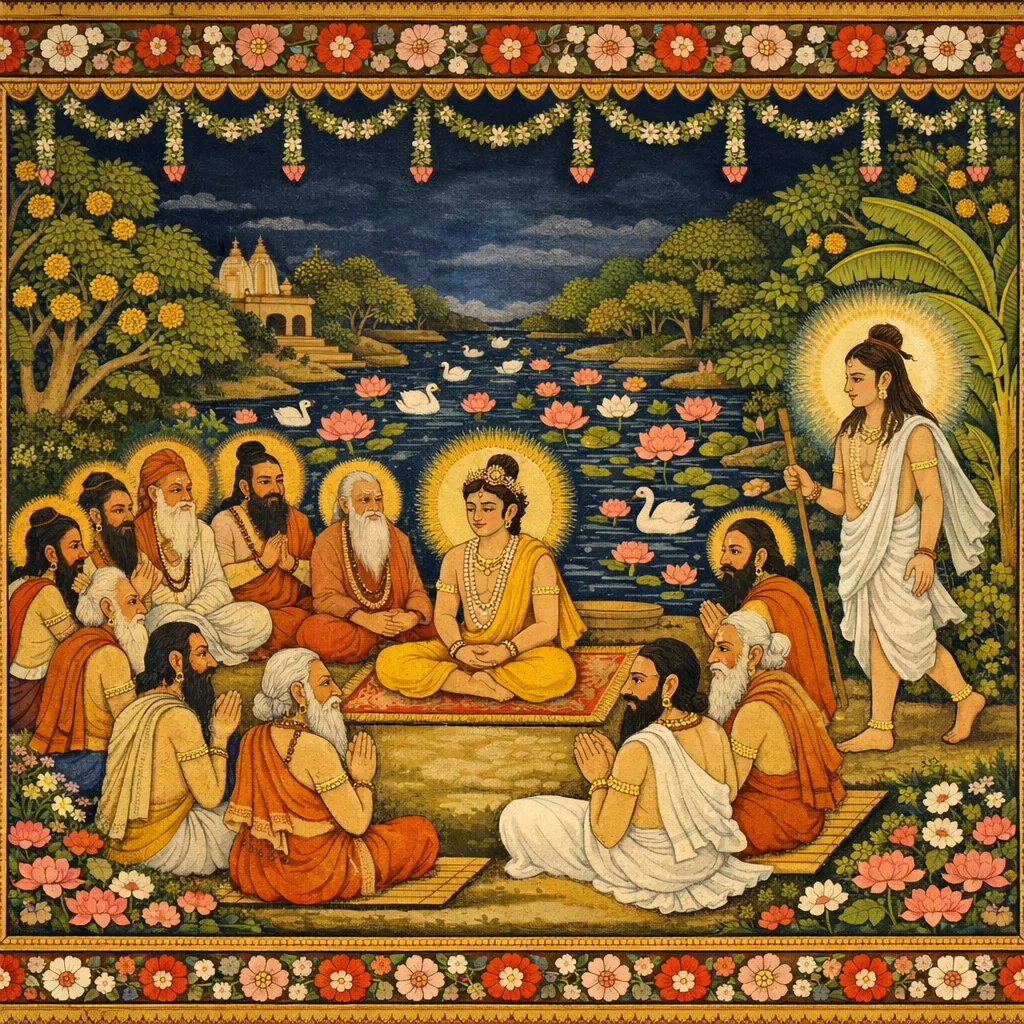
Returning from the incident with the brāhmaṇa, Parīkṣit Mahārāja is seized by remorse, recognizing his offense as a rupture of brahminical culture, God consciousness, and cow protection. When he learns of the curse—death by the bite of Takṣaka, the “snake-bird”—he accepts it as providential, a merciful shock meant to sever attachment. He renounces alternative self-realization paths and sits on the Gaṅgā’s bank to fast until death, taking sage-like vows and entrusting the kingdom to his son. The sanctity of Gaṅgā is extolled as the final shelter for the dying, bearing dust of the Lord’s lotus feet and tulasī. Great ṛṣis, demigods, and rājarṣis assemble, praising Parīkṣit’s renunciation. The king petitions them for the universal duty—especially for one at death’s door—then the pivotal transition occurs: Śukadeva Gosvāmī arrives, is honored by all, and Parīkṣit formally inquires what one should hear, chant, remember, and worship. The chapter thus bridges the king’s repentance to the forthcoming seven-day Bhāgavata discourse, with Śuka poised to answer in the next chapter.
Shlokas
Verse 1
सूत उवाच महीपतिस्त्वथ तत्कर्म गर्ह्यं विचिन्तयन्नात्मकृतं सुदुर्मना: । अहो मया नीचमनार्यवत्कृतं निरागसि ब्रह्मणि गूढतेजसि ॥ १ ॥
Śrī Sūta Gosvāmī said: While returning home, the King [Mahārāja Parīkṣit] felt that the act he had committed against the faultless and powerful brāhmaṇa was heinous and uncivilized. Consequently he was distressed.
Verse 2
ध्रुवं ततो मे कृतदेवहेलनाद् दुरत्ययं व्यसनं नातिदीर्घात् । तदस्तु कामं ह्यघनिष्कृताय मे यथा न कुर्यां पुनरेवमद्धा ॥ २ ॥
[King Parīkṣit thought:] Due to my neglecting the injunctions of the Supreme Lord I must certainly expect some difficulty to overcome me in the near future. I now desire without reservation that the calamity come now, for in this way I may be freed of the sinful action and not commit such an offense again.
Verse 3
अद्यैव राज्यं बलमृद्धकोशं प्रकोपितब्रह्मकुलानलो मे । दहत्वभद्रस्य पुनर्न मेऽभूत् पापीयसी धीर्द्विजदेवगोभ्य: ॥ ३ ॥
I am uncivilized and sinful due to my neglect of brahminical culture, God consciousness and cow protection. Therefore I wish that my kingdom, strength and riches burn up immediately by the fire of the brāhmaṇa’s wrath so that in the future I may not be guided by such inauspicious attitudes.
Verse 4
स चिन्तयन्नित्थमथाशृणोद् यथा मुने: सुतोक्तो निऋर्तिस्तक्षकाख्य: । स साधु मेने न चिरेण तक्षका- नलं प्रसक्तस्य विरक्तिकारणम् ॥ ४ ॥
While the King was thus repenting, he received news of his imminent death, which would be due to the bite of a snake-bird, occasioned by the curse spoken by the sage’s son. The King accepted this as good news, for it would be the cause of his indifference toward worldly things.
Verse 5
अथो विहायेमममुं च लोकं विमर्शितौ हेयतया पुरस्तात् । कृष्णाङ्घ्रिसेवामधिमन्यमान उपाविशत् प्रायममर्त्यनद्याम् ॥ ५ ॥
Mahārāja Parīkṣit sat down firmly on the banks of the Ganges to concentrate his mind in Kṛṣṇa consciousness, rejecting all other practices of self-realization, because transcendental loving service to Kṛṣṇa is the greatest achievement, superseding all other methods.
Verse 6
या वै लसच्छ्रीतुलसीविमिश्र- कृष्णाङ्घ्रिरेण्वभ्यधिकाम्बुनेत्री । पुनाति लोकानुभयत्र सेशान् कस्तां न सेवेत मरिष्यमाण: ॥ ६ ॥
The river [by which the King sat to fast] carries the most auspicious water, which is mixed with the dust of the lotus feet of the Lord and tulasī leaves. Therefore that water sanctifies the three worlds inside and outside and even sanctifies Lord Śiva and other demigods. Consequently everyone who is destined to die must take shelter of this river.
Verse 7
इति व्यवच्छिद्य स पाण्डवेय: प्रायोपवेशं प्रति विष्णुपद्याम् । दधौ मुकुन्दाङ्घ्रिमनन्यभावो मुनिव्रतो मुक्तसमस्तसङ्ग: ॥ ७ ॥
Thus the King, the worthy descendant of the Pāṇḍavas, decided once and for all and sat on the Ganges’ bank to fast until death and give himself up to the lotus feet of Lord Kṛṣṇa, who alone is able to award liberation. So, freeing himself from all kinds of associations and attachments, he accepted the vows of a sage.
Verse 8
तत्रोपजग्मुर्भुवनं पुनाना महानुभावा मुनय: सशिष्या: । प्रायेण तीर्थाभिगमापदेशै: स्वयं हि तीर्थानि पुनन्ति सन्त: ॥ ८ ॥
At that time all the great minds and thinkers, accompanied by their disciples, and sages who could verily sanctify a place of pilgrimage just by their presence, arrived there on the plea of making a pilgrim’s journey.
Verse 9
अत्रिर्वसिष्ठश्च्यवन: शरद्वा- नरिष्टनेमिर्भृगुरङ्गिराश्च । पराशरो गाधिसुतोऽथ राम उतथ्य इन्द्रप्रमदेध्मवाहौ ॥ ९ ॥ मेधातिथिर्देवल आर्ष्टिषेणो भारद्वाजो गौतम: पिप्पलाद: । मैत्रेय और्व: कवष: कुम्भयोनि- र्द्वैपायनो भगवान्नारदश्च ॥ १० ॥
From different parts of the universe there arrived great sages like Atri, Cyavana, Śaradvān, Ariṣṭanemi, Bhṛgu, Vasiṣṭha, Parāśara, Viśvāmitra, Aṅgirā, Paraśurāma, Utathya, Indrapramada, Idhmavāhu, Medhātithi, Devala, Ārṣṭiṣeṇa, Bhāradvāja, Gautama, Pippalāda, Maitreya, Aurva, Kavaṣa, Kumbhayoni, Dvaipāyana and the great personality Nārada.
Verse 10
अत्रिर्वसिष्ठश्च्यवन: शरद्वा- नरिष्टनेमिर्भृगुरङ्गिराश्च । पराशरो गाधिसुतोऽथ राम उतथ्य इन्द्रप्रमदेध्मवाहौ ॥ ९ ॥ मेधातिथिर्देवल आर्ष्टिषेणो भारद्वाजो गौतम: पिप्पलाद: । मैत्रेय और्व: कवष: कुम्भयोनि- र्द्वैपायनो भगवान्नारदश्च ॥ १० ॥
From different parts of the universe there arrived great sages like Atri, Cyavana, Śaradvān, Ariṣṭanemi, Bhṛgu, Vasiṣṭha, Parāśara, Viśvāmitra, Aṅgirā, Paraśurāma, Utathya, Indrapramada, Idhmavāhu, Medhātithi, Devala, Ārṣṭiṣeṇa, Bhāradvāja, Gautama, Pippalāda, Maitreya, Aurva, Kavaṣa, Kumbhayoni, Dvaipāyana and the great personality Nārada.
Verse 11
अन्ये च देवर्षिब्रह्मर्षिवर्या राजर्षिवर्या अरुणादयश्च । नानार्षेयप्रवरान् समेता- नभ्यर्च्य राजा शिरसा ववन्दे ॥ ११ ॥
There were also many other saintly demigods, kings and special royal orders called aruṇādayas [a special rank of rājarṣis] from different dynasties of sages. When they all assembled together to meet the Emperor [Parīkṣit], he received them properly and bowed his head to the ground.
Verse 12
सुखोपविष्टेष्वथ तेषु भूय: कृतप्रणाम: स्वचिकीर्षितं यत् । विज्ञापयामास विविक्तचेता उपस्थितोऽग्रेऽभिगृहीतपाणि: ॥ १२ ॥
After all the ṛṣis and others had seated themselves comfortably, the King, humbly standing before them with folded hands, told them of his decision to fast until death.
Verse 13
राजोवाच
The fortunate King said: Indeed, we are the most grateful of all the kings who are trained to get favors from the great souls. Generally you [sages] consider royalty as refuse to be rejected and left in a distant place.
Verse 14
तस्यैव मेऽघस्य परावरेशो व्यासक्तचित्तस्य गृहेष्वभीक्ष्णम् । निर्वेदमूलो द्विजशापरूपो यत्र प्रसक्तो भयमाशु धत्ते ॥ १४ ॥
The Supreme Personality of Godhead, the controller of both the transcendental and mundane worlds, has graciously overtaken me in the form of a brāhmaṇa’s curse. Due to my being too much attached to family life, the Lord, in order to save me, has appeared before me in such a way that only out of fear I will detach myself from the world.
Verse 15
तं मोपयातं प्रतियन्तु विप्रा गङ्गा च देवी धृतचित्तमीशे । द्विजोपसृष्ट: कुहकस्तक्षको वा दशत्वलं गायत विष्णुगाथा: ॥ १५ ॥
O brāhmaṇas, just accept me as a completely surrendered soul, and let mother Ganges, the representative of the Lord, also accept me in that way, for I have already taken the lotus feet of the Lord into my heart. Let the snake-bird — or whatever magical thing the brāhmaṇa created — bite me at once. I only desire that you all continue singing the deeds of Lord Viṣṇu.
Verse 16
पुनश्च भूयाद्भगवत्यनन्ते रति: प्रसङ्गश्च तदाश्रयेषु । महत्सु यां यामुपयामि सृष्टिं मैत्र्यस्तु सर्वत्र नमो द्विजेभ्य: ॥ १६ ॥
Again, offering obeisances unto all you brāhmaṇas, I pray that if I should again take my birth in the material world I will have complete attachment to the unlimited Lord Kṛṣṇa, association with His devotees and friendly relations with all living beings.
Verse 17
इति स्म राजाध्यवसाययुक्त: प्राचीनमूलेषु कुशेषु धीर: । उदङ्मुखो दक्षिणकूल आस्ते समुद्रपत्न्या: स्वसुतन्यस्तभार: ॥ १७ ॥
In perfect self-control, Mahārāja Parīkṣit sat down on a seat of straw, with straw-roots facing the east, placed on the southern bank of the Ganges, and he himself faced the north. Just previously he had given charge of his kingdom over to his son.
Verse 18
एवं च तस्मिन्नरदेवदेवे प्रायोपविष्टे दिवि देवसङ्घा: । प्रशस्य भूमौ व्यकिरन् प्रसूनै- र्मुदा मुहुर्दुन्दुभयश्च नेदु: ॥ १८ ॥
Thus the King, Mahārāja Parīkṣit, sat to fast until death. All the demigods of the higher planets praised the King’s actions and in pleasure continually scattered flowers over the earth and beat celestial drums.
Verse 19
महर्षयो वै समुपागता ये प्रशस्य साध्वित्यनुमोदमाना: । ऊचु: प्रजानुग्रहशीलसारा यदुत्तमश्लोकगुणाभिरूपम् ॥ १९ ॥
All the great sages who were assembled there also praised the decision of Mahārāja Parīkṣit, and they expressed their approval by saying “Very good.” Naturally the sages are inclined to do good to common men, for they have all the qualitative powers of the Supreme Lord. Therefore they were very much pleased to see Mahārāja Parīkṣit, a devotee of the Lord, and they spoke as follows.
Verse 20
न वा इदं राजर्षिवर्य चित्रं भवत्सु कृष्णं समनुव्रतेषु । येऽध्यासनं राजकिरीटजुष्टं सद्यो जहुर्भगवत्पार्श्वकामा: ॥ २० ॥
[The sages said:] O chief of all the saintly kings of the Pāṇḍu dynasty who are strictly in the line of Lord Śrī Kṛṣṇa! It is not at all astonishing that you give up your throne, which is decorated with the helmets of many kings, to achieve eternal association with the Personality of Godhead.
Verse 21
सर्वे वयं तावदिहास्महेऽथ कलेवरं यावदसौ विहाय । लोकं परं विरजस्कं विशोकं यास्यत्ययं भागवतप्रधान: ॥ २१ ॥
We shall all wait here until the foremost devotee of the Lord, Mahārāja Parīkṣit, returns to the supreme planet, which is completely free from all mundane contamination and all kinds of lamentation.
Verse 22
आश्रुत्य तदृषिगणवच: परीक्षित् समं मधुच्युद् गुरु चाव्यलीकम् । आभाषतैनानभिनन्द्य युक्तान् शुश्रूषमाणश्चरितानि विष्णो: ॥ २२ ॥
All that was spoken by the great sages was very sweet to hear, full of meaning and appropriately presented as perfectly true. So after hearing them, Mahārāja Parīkṣit, desiring to hear of the activities of Lord Śrī Kṛṣṇa, the Personality of Godhead, congratulated the great sages.
Verse 23
समागता: सर्वत एव सर्वे वेदा यथा मूर्तिधरास्त्रिपृष्ठे । नेहाथ नामुत्र च कश्चनार्थ ऋते परानुग्रहमात्मशीलम् ॥ २३ ॥
The King said: O great sages, you have all very kindly assembled here, having come from all parts of the universe. You are all as good as supreme knowledge personified, who resides in the planet above the three worlds [Satyaloka]. Consequently you are naturally inclined to do good to others, and but for this you have no interest, either in this life or in the next.
Verse 24
ततश्च व: पृच्छ्यमिमं विपृच्छे विश्रभ्य विप्रा इति कृत्यतायाम् । सर्वात्मना म्रियमाणैश्च कृत्यं शुद्धं च तत्रामृशताभियुक्ता: ॥ २४ ॥
O trustworthy brāhmaṇas, I now ask you about my immediate duty. Please, after proper deliberation, tell me of the unalloyed duty of everyone in all circumstances, and specifically of those who are just about to die.
Verse 25
तत्राभवद्भगवान् व्यासपुत्रो यदृच्छया गामटमानोऽनपेक्ष: । अलक्ष्यलिङ्गो निजलाभतुष्टो वृतश्च बालैरवधूतवेष: ॥ २५ ॥
At that moment there appeared the powerful son of Vyāsadeva, who traveled over the earth disinterested and satisfied with himself. He did not manifest any symptoms of belonging to any social order or status of life. He was surrounded with women and children, and he dressed as if others had neglected him.
Verse 26
तं द्व्यष्टवर्षं सुकुमारपाद- करोरुबाह्वंसकपोलगात्रम् । चार्वायताक्षोन्नसतुल्यकर्ण- सुभ्र्वाननं कम्बुसुजातकण्ठम् ॥ २६ ॥
This son of Vyāsadeva was only sixteen years old. His legs, hands, thighs, arms, shoulders, forehead and the other parts of his body were all delicately formed. His eyes were beautifully wide, and his nose and ears were highly raised. He had a very attractive face, and his neck was well formed and beautiful like a conchshell.
Verse 27
निगूढजत्रुं पृथुतुङ्गवक्षस- मावर्तनाभिं वलिवल्गूदरं च । दिगम्बरं वक्त्रविकीर्णकेशं प्रलम्बबाहुं स्वमरोत्तमाभम् ॥ २७ ॥
His collarbone was fleshy, his chest broad and thick, his navel deep and his abdomen beautifully striped. His arms were long, and curly hair was strewn over his beautiful face. He was naked, and the hue of his body reflected that of Lord Kṛṣṇa.
Verse 28
श्यामं सदापीव्यवयोऽङ्गलक्ष्म्या स्त्रीणां मनोज्ञं रुचिरस्मितेन । प्रत्युत्थितास्ते मुनय: स्वासनेभ्य- स्तल्लक्षणज्ञा अपि गूढवर्चसम् ॥ २८ ॥
He was blackish and very beautiful due to his youth. Because of the glamor of his body and his attractive smiles, he was pleasing to women. Though he tried to cover his natural glories, the great sages present there were all expert in the art of physiognomy, and so they honored him by rising from their seats.
Verse 29
स विष्णुरातोऽतिथय आगताय तस्मै सपर्यां शिरसाजहार । ततो निवृत्ता ह्यबुधा: स्त्रियोऽर्भका महासने सोपविवेश पूजित: ॥ २९ ॥
Mahārāja Parīkṣit, who is also known as Viṣṇurāta [one who is always protected by Viṣṇu], bowed his head to receive the chief guest, Śukadeva Gosvāmī. At that time all the ignorant women and boys ceased following Śrīla Śukadeva. Receiving respect from all, Śukadeva Gosvāmī took his exalted seat.
Verse 30
स संवृतस्तत्र महान् महीयसां ब्रह्मर्षिराजर्षिदेवर्षिसङ्घै: । व्यरोचतालं भगवान् यथेन्दु- र्ग्रहर्क्षतारानिकरै: परीत: ॥ ३० ॥
Śukadeva Gosvāmī was then surrounded by saintly sages and demigods just as the moon is surrounded by stars, planets and other heavenly bodies. His presence was gorgeous, and he was respected by all.
Verse 31
प्रशान्तमासीनमकुण्ठमेधसं मुनिं नृपो भागवतोऽभ्युपेत्य । प्रणम्य मूर्ध्नावहित: कृताञ्जलि- र्नत्वा गिरा सूनृतयान्वपृच्छत् ॥ ३१ ॥
The sage Śrī Śukadeva Gosvāmī sat perfectly pacified, intelligent and ready to answer any question without hesitation. The great devotee, Mahārāja Parīkṣit, approached him, offered his respects by bowing before him, and politely inquired with sweet words and folded hands.
Verse 32
परीक्षिदुवाच अहो अद्य वयं ब्रह्मन् सत्सेव्या: क्षत्रबन्धव: । कृपयातिथिरूपेण भवद्भिस्तीर्थका: कृता: ॥ ३२ ॥
The fortunate King Parīkṣit said: O brāhmaṇa, by your mercy only, you have sanctified us, making us like unto places of pilgrimage, all by your presence here as my guest. By your mercy, we, who are but unworthy royalty, become eligible to serve the devotee.
Verse 33
येषां संस्मरणात्पुंसां सद्य: शुद्ध्यन्ति वै गृहा: । किं पुनर्दर्शनस्पर्शपादशौचासनादिभि: ॥ ३३ ॥
Simply by our remembering you, our houses become instantly sanctified. And what to speak of seeing you, touching you, washing your holy feet and offering you a seat in our home?
Verse 34
सान्निध्यात्ते महायोगिन्पातकानि महान्त्यपि । सद्यो नश्यन्ति वै पुंसां विष्णोरिव सुरेतरा: ॥ ३४ ॥
Just as the atheist cannot remain in the presence of the Personality of Godhead, so also the invulnerable sins of a man are immediately vanquished in your presence, O saint! O great mystic!
Verse 35
अपि मे भगवान् प्रीत: कृष्ण: पाण्डुसुतप्रिय: । पैतृष्वसेयप्रीत्यर्थं तद्गोत्रस्यात्तबान्धव: ॥ ३५ ॥
Lord Kṛṣṇa, the Personality of Godhead, who is very dear to the sons of King Pāṇḍu, has accepted me as one of those relatives just to please His great cousins and brothers.
Verse 36
अन्यथा तेऽव्यक्तगतेर्दर्शनं न: कथं नृणाम् । नितरां म्रियमाणानां संसिद्धस्य वनीयस: ॥ ३६ ॥
Otherwise [without being inspired by Lord Kṛṣṇa] how is it that you have voluntarily appeared here, though you are moving incognito to the common man and are not visible to us who are on the verge of death?
Verse 37
अत: पृच्छामि संसिद्धिं योगिनां परमं गुरुम् । पुरुषस्येह यत्कार्यं म्रियमाणस्य सर्वथा ॥ ३७ ॥
You are the spiritual master of great saints and devotees. I am therefore begging you to show the way of perfection for all persons, and especially for one who is about to die.
Verse 38
यच्छ्रोतव्यमथो जप्यं यत्कर्तव्यं नृभि: प्रभो । स्मर्तव्यं भजनीयं वा ब्रूहि यद्वा विपर्ययम् ॥ ३८ ॥
Please let me know what a man should hear, chant, remember and worship, and also what he should not do. Please explain all this to me.
Verse 39
नूनं भगवतो ब्रह्मन् गृहेषु गृहमेधिनाम् । न लक्ष्यते ह्यवस्थानमपि गोदोहनं क्वचित् ॥ ३९ ॥
O powerful brāhmaṇa, it is said that you hardly stay in the houses of men long enough to milk a cow.
Verse 40
सूत उवाच एवमाभाषित: पृष्ट: स राज्ञा श्लक्ष्णया गिरा । प्रत्यभाषत धर्मज्ञो भगवान् बादरायणि: ॥ ४० ॥
Śrī Sūta Gosvāmī said: The King thus spoke and questioned the sage, using sweet language. Then the great and powerful personality, the son of Vyāsadeva, who knew the principles of religion, began his reply.
Frequently Asked Questions
He interprets the curse as Bhagavān’s corrective mercy: the Lord “overtakes” him through fear to break excessive attachment to family and kingship. Rather than seeking countermeasures, he welcomes the imminent end as a purifier that prevents repeated aparādha (offense) and accelerates nirodha—fixing the mind exclusively on Kṛṣṇa through surrender and hearing.
Gaṅgā is portrayed as uniquely sanctifying because her waters are mixed with tulasī and the dust of the Lord’s lotus feet; she purifies the three worlds and is revered even by great devas like Śiva. The theological point is not mere geography but refuge (āśraya): at death, one should take shelter of Hari-kathā and devotion, symbolized by the Gaṅgā’s purity and the saintly assembly on her banks.
Śukadeva is Vyāsadeva’s son, a self-satisfied (ātmārāma) renunciate beyond social designation, whose realized detachment qualifies him to teach the essence of dharma without worldly motive. His arrival answers the narrative need created by Parīkṣit’s question—providing the authoritative speaker for the seven-day Śrīmad Bhāgavatam recitation that unfolds in subsequent chapters.