Adhyaya 9
Bhīṣmadeva’s Passing Away in the Presence of Lord Kṛṣṇa
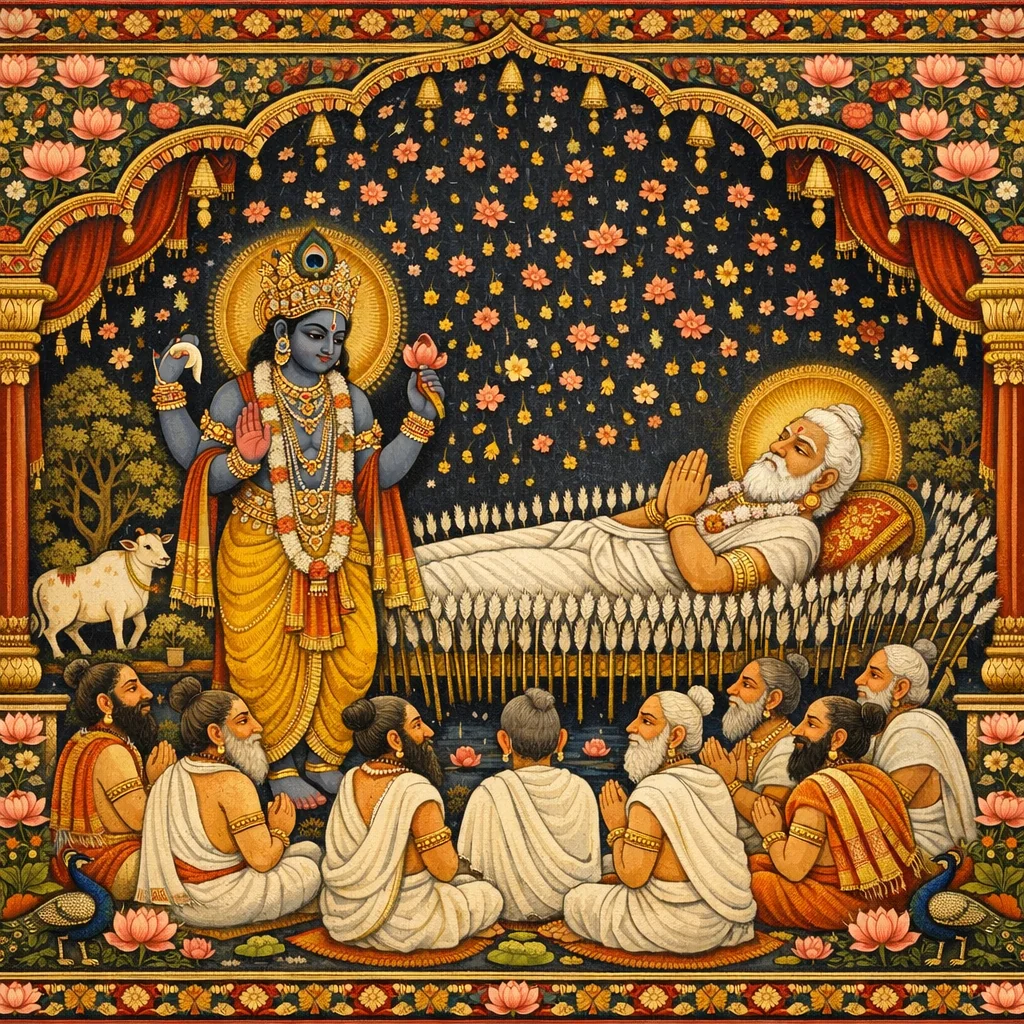
After the Kurukṣetra war, Yudhiṣṭhira—burdened by grief and fear of sin—travels with his brothers, sages (Vyāsa, Dhaumya, Nārada, Paraśurāma, and many others), and Śrī Kṛṣṇa to see Bhīṣma lying on his bed of arrows. The cosmic assembly underscores Bhīṣma’s stature and frames his death as a dhārmic and devotional event rather than tragedy. Bhīṣma consoles the Pāṇḍavas, attributes reversals to kāla and the Lord’s inconceivable plan, and urges Yudhiṣṭhira to accept kingship and protect the helpless. He reveals Kṛṣṇa’s supreme identity (ādi-Nārāyaṇa) despite His intimate human-like dealings. At Yudhiṣṭhira’s request, Bhīṣma outlines varṇāśrama-dharma, royal duties, charity, detachment/attachment frameworks, and duties of women and devotees. As uttarāyaṇa begins—favored for self-willed departure—Bhīṣma withdraws his senses, fixes his gaze on four-armed Kṛṣṇa, and offers a sequence of concentrated prayers remembering Kṛṣṇa’s līlā (as Arjuna’s charioteer, the Gītā teacher, the beloved of Vraja, and the honored Lord at the Rājasūya). He then merges his consciousness in the Lord; the universe honors him with silence, drums, and flowers. After the rites, Yudhiṣṭhira returns to Hastināpura with Kṛṣṇa, consoles Dhṛtarāṣṭra and Gāndhārī, and begins righteous rule—setting up the next movement of governance and Kali-yuga’s pressures.
Shlokas
Verse 1
सूत उवाच इति भीत: प्रजाद्रोहात्सर्वधर्मविवित्सया । ततो विनशनं प्रागाद् यत्र देवव्रतोऽपतत् ॥ १ ॥
Sūta Gosvāmī said: Being afraid for having killed so many subjects on the Battlefield of Kurukṣetra, Mahārāja Yudhiṣṭhira went to the scene of the massacre. There, Bhīṣmadeva was lying on a bed of arrows, about to pass away.
Verse 2
तदा ते भ्रातर: सर्वे सदश्वै: स्वर्णभूषितै: । अन्वगच्छन् रथैर्विप्रा व्यासधौम्यादयस्तथा ॥ २ ॥
At that time all his brothers followed him on beautiful chariots drawn by first-class horses decorated with gold ornaments. With them were Vyāsa and ṛṣis like Dhaumya [the learned priest of the Pāṇḍavas] and others.
Verse 3
भगवानपि विप्रर्षे रथेन सधनञ्जय: । स तैर्व्यरोचत नृप: कुवेर इव गुह्यकै: ॥ ३ ॥
O sage amongst the brāhmaṇas, Lord Śrī Kṛṣṇa, the Personality of Godhead, also followed, seated on a chariot with Arjuna. Thus King Yudhiṣṭhira appeared very aristocratic, like Kuvera surrounded by his companions [the Guhyakas].
Verse 4
दृष्ट्वा निपतितं भूमौ दिवश्च्युतमिवामरम् । प्रणेमु: पाण्डवा भीष्मं सानुगा: सह चक्रिणा ॥ ४ ॥
Seeing him [Bhīṣma] lying on the ground, like a demigod fallen from the sky, the Pāṇḍava King Yudhiṣṭhira, along with his younger brothers and Lord Kṛṣṇa, bowed down before him.
Verse 5
तत्र ब्रह्मर्षय: सर्वे देवर्षयश्च सत्तम । राजर्षयश्च तत्रासन् द्रष्टुं भरतपुङ्गवम् ॥ ५ ॥
Just to see the chief of the descendants of King Bharata [Bhīṣma], all the great souls in the universe, namely the ṛṣis amongst the demigods, brāhmaṇas and kings, all situated in the quality of goodness, were assembled there.
Verse 6
पर्वतो नारदो धौम्यो भगवान् बादरायण: । बृहदश्वो भरद्वाज: सशिष्यो रेणुकासुत: ॥ ६ ॥ वसिष्ठ इन्द्रप्रमदस्त्रितो गृत्समदोऽसित: । कक्षीवान् गौतमोऽत्रिश्च कौशिकोऽथ सुदर्शन: ॥ ७ ॥
All the sages like Parvata Muni, Nārada, Dhaumya, Vyāsa the incarnation of God, Bṛhadaśva, Bharadvāja and Paraśurāma and disciples, Vasiṣṭha, Indrapramada, Trita, Gṛtsamada, Asita, Kakṣīvān, Gautama, Atri, Kauśika and Sudarśana were present.
Verse 7
पर्वतो नारदो धौम्यो भगवान् बादरायण: । बृहदश्वो भरद्वाज: सशिष्यो रेणुकासुत: ॥ ६ ॥ वसिष्ठ इन्द्रप्रमदस्त्रितो गृत्समदोऽसित: । कक्षीवान् गौतमोऽत्रिश्च कौशिकोऽथ सुदर्शन: ॥ ७ ॥
All the sages like Parvata Muni, Nārada, Dhaumya, Vyāsa the incarnation of God, Bṛhadaśva, Bharadvāja and Paraśurāma and disciples, Vasiṣṭha, Indrapramada, Trita, Gṛtsamada, Asita, Kakṣīvān, Gautama, Atri, Kauśika and Sudarśana were present.
Verse 8
अन्ये च मुनयो ब्रह्मन् ब्रह्मरातादयोऽमला: । शिष्यैरुपेता आजग्मु: कश्यपाङ्गिरसादय: ॥ ८ ॥
And many others like Śukadeva Gosvāmī and other purified souls, Kaśyapa and Āṅgirasa and others, all accompanied by their respective disciples, arrived there.
Verse 9
तान् समेतान् महाभागानुपलभ्य वसूत्तम: । पूजयामास धर्मज्ञो देशकालविभागवित् ॥ ९ ॥
Bhīṣmadeva, who was the best amongst the eight Vasus, received and welcomed all the great and powerful ṛṣis who were assembled there, for he knew perfectly all the religious principles according to time and place.
Verse 10
कृष्णं च तत्प्रभावज्ञ आसीनं जगदीश्वरम् । हृदिस्थं पूजयामास माययोपात्तविग्रहम् ॥ १० ॥
Lord Śrī Kṛṣṇa is situated in everyone’s heart, yet He manifests His transcendental form by His internal potency. This very Lord was sitting before Bhīṣmadeva, and since Bhīṣmadeva knew of His glories, he worshiped Him duly.
Verse 11
पाण्डुपुत्रानुपासीनान् प्रश्रयप्रेमसङ्गतान् । अभ्याचष्टानुरागाश्रैरन्धीभूतेन चक्षुषा ॥ ११ ॥
The sons of Mahārāja Pāṇḍu were sitting silently nearby, overtaken with affection for their dying grandfather. Seeing this, Bhīṣmadeva congratulated them with feeling. There were tears of ecstasy in his eyes, for he was overwhelmed by love and affection.
Verse 12
अहो कष्टमहोऽन्याय्यं यद्यूयं धर्मनन्दना: । जीवितुं नार्हथ क्लिष्टं विप्रधर्माच्युताश्रया: ॥ १२ ॥
Bhīṣmadeva said: Oh, what terrible sufferings and what terrible injustices you good souls suffer for being the sons of religion personified. You did not deserve to remain alive under those tribulations, yet you were protected by the brāhmaṇas, God and religion.
Verse 13
संस्थितेऽतिरथे पाण्डौ पृथा बालप्रजा वधू: । युष्मत्कृते बहून् क्लेशान् प्राप्ता तोकवती मुहु: ॥ १३ ॥
As far as my daughter-in-law Kuntī is concerned, upon the great General Pāṇḍu’s death, she became a widow with many children, and therefore she suffered greatly. And when you were grown up she suffered a great deal also because of your actions.
Verse 14
सर्वं कालकृतं मन्ये भवतां च यदप्रियम् । सपालो यद्वशे लोको वायोरिव घनावलि: ॥ १४ ॥
In my opinion, this is all due to inevitable time, under whose control everyone in every planet is carried, just as the clouds are carried by the wind.
Verse 15
यत्र धर्मसुतो राजा गदापाणिर्वृकोदर: । कृष्णोऽस्त्री गाण्डिवं चापं सुहृत्कृष्णस्ततो विपत् ॥ १५ ॥
Oh, how wonderful is the influence of inevitable time! It is irreversible — otherwise, how can there be reverses in the presence of King Yudhiṣṭhira, the son of the demigod controlling religion; Bhīma, the great fighter with a club; the great bowman Arjuna with his mighty weapon Gāṇḍīva; and above all, the Lord, the direct well-wisher of the Pāṇḍavas?
Verse 16
न ह्यस्य कर्हिचिद्राजन् पुमान् वेद विधित्सितम् । यद्विजिज्ञासया युक्ता मुह्यन्ति कवयोऽपि हि ॥ १६ ॥
O King, no one can know the plan of the Lord [Śrī Kṛṣṇa]. Even though great philosophers inquire exhaustively, they are bewildered.
Verse 17
तस्मादिदं दैवतन्त्रं व्यवस्य भरतर्षभ । तस्यानुविहितोऽनाथा नाथ पाहि प्रजा: प्रभो ॥ १७ ॥
O best among the descendants of Bharata [Yudhiṣṭhira], I maintain, therefore, that all this is within the plan of the Lord. Accepting the inconceivable plan of the Lord, you must follow it. You are now the appointed administrative head, and, my lord, you should now take care of those subjects who are now rendered helpless.
Verse 18
एष वै भगवान्साक्षादाद्यो नारायण: पुमान् । मोहयन्मायया लोकं गूढश्चरति वृष्णिषु ॥ १८ ॥
This Śrī Kṛṣṇa is no other than the inconceivable, original Personality of Godhead. He is the first Nārāyaṇa, the supreme enjoyer. But He is moving amongst the descendants of King Vṛṣṇi just like one of us, and He is bewildering us with His self-created energy.
Verse 19
अस्यानुभावं भगवान् वेद गुह्यतमं शिव: । देवर्षिर्नारद: साक्षाद्भगवान् कपिलो नृप ॥ १९ ॥
O King, Lord Śiva, Nārada the sage amongst the demigods, and Kapila, the incarnation of Godhead, all know very confidentially about His glories through direct contact.
Verse 20
यं मन्यसे मातुलेयं प्रियं मित्रं सुहृत्तमम् । अकरो: सचिवं दूतं सौहृदादथ सारथिम् ॥ २० ॥
O King, that personality whom, out of ignorance only, you thought to be your maternal cousin, your very dear friend, well-wisher, counselor, messenger, benefactor, etc., is that very Personality of Godhead Śrī Kṛṣṇa.
Verse 21
सर्वात्मन: समदृशो ह्यद्वयस्यानहङ्कृते: । तत्कृतं मतिवैषम्यं निरवद्यस्य न क्वचित् ॥ २१ ॥
Being the Absolute Personality of Godhead, He is present in everyone’s heart. He is equally kind to everyone, and He is free from the false ego of differentiation. Therefore whatever He does is free from material inebriety. He is equibalanced.
Verse 22
तथाप्येकान्तभक्तेषु पश्य भूपानुकम्पितम् । यन्मेऽसूंस्त्यजत: साक्षात्कृष्णो दर्शनमागत: ॥ २२ ॥
Yet, despite His being equally kind to everyone, He has graciously come before me while I am ending my life, for I am His unflinching servitor.
Verse 23
भक्त्यावेश्य मनो यस्मिन् वाचा यन्नाम कीर्तयन् । त्यजन् कलेवरं योगी मुच्यते कामकर्मभि: ॥ २३ ॥
The Personality of Godhead, who appears in the mind of the devotee by attentive devotion and meditation and by chanting of the holy name, releases the devotee from the bondage of fruitive activities at the time of his quitting the material body.
Verse 24
स देवदेवो भगवान् प्रतीक्षतां कलेवरं यावदिदं हिनोम्यहम् । प्रसन्नहासारुणलोचनोल्लस- न्मुखाम्बुजो ध्यानपथश्चतुर्भुज: ॥ २४ ॥
May my Lord, who is four-handed and whose beautifully decorated lotus face, with eyes as red as the rising sun, is smiling, kindly await me at that moment when I quit this material body.
Verse 25
सूत उवाच युधिष्ठिरस्तदाकर्ण्य शयानं शरपञ्जरे । अपृच्छद्विविधान्धर्मानृषीणां चानुशृण्वताम् ॥ २५ ॥
Sūta Gosvāmī said: Mahārāja Yudhiṣṭhira, after hearing Bhīṣmadeva speak in that appealing tone, asked him, in the presence of all the great ṛṣis, about the essential principles of various religious duties.
Verse 26
पुरुषस्वभावविहितान् यथावर्णं यथाश्रमम् । वैराग्यरागोपाधिभ्यामाम्नातोभयलक्षणान् ॥ २६ ॥
At Mahārāja Yudhiṣṭhira’s inquiry, Bhīṣmadeva first defined all the classifications of castes and orders of life in terms of the individual’s qualifications. Then he systematically, in twofold divisions, described counteraction by detachment and interaction by attachment.
Verse 27
दानधर्मान् राजधर्मान् मोक्षधर्मान् विभागश: । स्त्रीधर्मान् भगवद्धर्मान् समासव्यासयोगत: ॥ २७ ॥
He then explained, by divisions, acts of charity, the pragmatic activities of a king and activities for salvation. Then he described the duties of women and devotees, both briefly and extensively.
Verse 28
धर्मार्थकाममोक्षांश्च सहोपायान् यथा मुने । नानाख्यानेतिहासेषु वर्णयामास तत्त्ववित् ॥ २८ ॥
Then he described the occupational duties of different orders and statuses of life, citing instances from history, for he was himself well acquainted with the truth.
Verse 29
धर्मं प्रवदतस्तस्य स काल: प्रत्युपस्थित: । यो योगिनश्छन्दमृत्योर्वाञ्छितस्तूत्तरायण: ॥ २९ ॥
While Bhīṣmadeva was describing occupational duties, the sun’s course ran into the northern hemisphere. This period is desired by mystics who die at their will.
Verse 30
तदोपसंहृत्य गिर: सहस्रणी- र्विमुक्तसङ्गं मन आदिपूरुषे । कृष्णे लसत्पीतपटे चतुर्भुजे पुर:स्थितेऽमीलितदृग्व्यधारयत् ॥ ३० ॥
Thereupon that man who spoke on different subjects with thousands of meanings, and who fought on thousands of battlefields and protected thousands of men, stopped speaking and, being completely freed from all bondage, withdrew his mind from everything else and fixed his wide-open eyes upon the original Personality of Godhead, Śrī Kṛṣṇa, who stood before him, four-handed, dressed in yellow garments that glittered and shined.
Verse 31
विशुद्धया धारणया हताशुभ- स्तदीक्षयैवाशु गतायुधश्रम: । निवृत्तसर्वेन्द्रियवृत्तिविभ्रम- स्तुष्टाव जन्यं विसृजञ्जनार्दनम् ॥ ३१ ॥
By pure meditation, looking at Lord Śrī Kṛṣṇa, he at once was freed from all material inauspiciousness and was relieved of all bodily pains caused by the arrow wounds. Thus all the external activities of his senses at once stopped, and he prayed transcendentally to the controller of all living beings while quitting his material body.
Verse 32
श्रीभीष्म उवाच इति मतिरुपकल्पिता वितृष्णा भगवति सात्वतपुङ्गवे विभूम्नि । स्वसुखमुपगते क्वचिद्विहर्तुं प्रकृतिमुपेयुषि यद्भवप्रवाह: ॥ ३२ ॥
Bhīṣmadeva said: Let me now invest my thinking, feeling and willing, which were so long engaged in different subjects and occupational duties, in the all-powerful Lord Śrī Kṛṣṇa. He is always self-satisfied, but sometimes, being the leader of the devotees, He enjoys transcendental pleasure by descending to the material world, although from Him only the material world is created.
Verse 33
त्रिभुवनकमनं तमालवर्णं रविकरगौरवराम्बरं दधाने । वपुरलककुलावृताननाब्जं विजयसखे रतिरस्तु मेऽनवद्या ॥ ३३ ॥
Śrī Kṛṣṇa is the intimate friend of Arjuna. He has appeared on this earth in His transcendental body, which resembles the bluish color of the tamāla tree. His body attracts everyone in the three planetary systems [upper, middle and lower]. May His glittering yellow dress and His lotus face, covered with paintings of sandalwood pulp, be the object of my attraction, and may I not desire fruitive results.
Verse 34
युधि तुरगरजोविधूम्रविष्वक्- कचलुलितश्रमवार्यलङ्कृतास्ये । मम निशितशरैर्विभिद्यमान- त्वचि विलसत्कवचेऽस्तु कृष्ण आत्मा ॥ ३४ ॥
On the battlefield [where Śrī Kṛṣṇa attended Arjuna out of friendship], the flowing hair of Lord Kṛṣṇa turned ashen due to the dust raised by the hoofs of the horses. And because of His labor, beads of sweat wetted His face. All these decorations, intensified by the wounds dealt by my sharp arrows, were enjoyed by Him. Let my mind thus go unto Śrī Kṛṣṇa.
Verse 35
सपदि सखिवचो निशम्य मध्ये निजपरयोर्बलयो रथं निवेश्य । स्थितवति परसैनिकायुरक्ष्णा हृतवति पार्थसखे रतिर्ममास्तु ॥ ३५ ॥
In obedience to the command of His friend, Lord Śrī Kṛṣṇa entered the arena of the Battlefield of Kurukṣetra between the soldiers of Arjuna and Duryodhana, and while there He shortened the life spans of the opposite party by His merciful glance. This was done simply by His looking at the enemy. Let my mind be fixed upon that Kṛṣṇa.
Verse 36
व्यवहितपृतनामुखं निरीक्ष्य स्वजनवधाद्विमुखस्य दोषबुद्ध्या । कुमतिमहरदात्मविद्यया य- श्चरणरति: परमस्य तस्य मेऽस्तु ॥ ३६ ॥
When Arjuna was seemingly polluted by ignorance upon observing the soldiers and commanders before him on the battlefield, the Lord eradicated his ignorance by delivering transcendental knowledge. May His lotus feet always remain the object of my attraction.
Verse 37
स्वनिगममपहाय मत्प्रतिज्ञा- मृतमधिकर्तुमवप्लुतो रथस्थ: । धृतरथचरणोऽभ्ययाच्चलद्गु- र्हरिरिव हन्तुमिभं गतोत्तरीय: ॥ ३७ ॥
Fulfilling my vow and sacrificing His own promise, He got down from the chariot, took up its wheel, and ran towards me hurriedly, just as a lion goes to kill an elephant. He even dropped His outer garment on the way.
Verse 38
शितविशिखहतो विशीर्णदंश: क्षतजपरिप्लुत आततायिनो मे । प्रसभमभिससार मद्वधार्थं स भवतु मे भगवान् गतिर्मुकुन्द: ॥ ३८ ॥
May He, Lord Śrī Kṛṣṇa, the Personality of Godhead, who awards salvation, be my ultimate destination. On the battlefield He charged me, as if angry because of the wounds dealt by my sharp arrows. His shield was scattered, and His body was smeared with blood due to the wounds.
Verse 39
विजयरथकुटुम्ब आत्ततोत्रे धृतहयरश्मिनि तच्छ्रियेक्षणीये । भगवति रतिरस्तु मे मुमूर्षो- र्यमिह निरीक्ष्य हता गता: स्वरूपम् ॥ ३९ ॥
At the moment of death, let my ultimate attraction be to Śrī Kṛṣṇa, the Personality of Godhead. I concentrate my mind upon the chariot driver of Arjuna who stood with a whip in His right hand and a bridle rope in His left, who was very careful to give protection to Arjuna’s chariot by all means. Those who saw Him on the Battlefield of Kurukṣetra attained their original forms after death.
Verse 40
ललितगतिविलासवल्गुहास- प्रणयनिरीक्षणकल्पितोरुमाना: । कृतमनुकृतवत्य उन्मदान्धा: प्रकृतिमगन् किल यस्य गोपवध्व: ॥ ४० ॥
Let my mind be fixed upon Lord Śrī Kṛṣṇa, whose motions and smiles of love attracted the damsels of Vrajadhāma [the gopīs]. The damsels imitated the characteristic movements of the Lord [after His disappearance from the rāsa dance].
Verse 41
मुनिगणनृपवर्यसङ्कुलेऽन्त: सदसि युधिष्ठिरराजसूय एषाम् । अर्हणमुपपेद ईक्षणीयो मम दृशिगोचर एष आविरात्मा ॥ ४१ ॥
At the Rājasūya-yajña [sacrifice] performed by Mahārāja Yudhiṣṭhira, there was the greatest assembly of all the elite men of the world, the royal and learned orders, and in that great assembly Lord Śrī Kṛṣṇa was worshiped by one and all as the most exalted Personality of Godhead. This happened during my presence, and I remembered the incident in order to keep my mind upon the Lord.
Verse 42
तमिममहमजं शरीरभाजां हृदि हृदि धिष्ठितमात्मकल्पितानाम् । प्रतिदृशमिव नैकधार्कमेकं समधिगतोऽस्मि विधूतभेदमोह: ॥ ४२ ॥
Now I can meditate with full concentration upon that one Lord, Śrī Kṛṣṇa, now present before me because now I have transcended the misconceptions of duality in regard to His presence in everyone’s heart, even in the hearts of the mental speculators. He is in everyone’s heart. The sun may be perceived differently, but the sun is one.
Verse 43
सूत उवाच कृष्ण एवं भगवति मनोवाग्दृष्टिवृत्तिभि: । आत्मन्यात्मानमावेश्य सोऽन्त:श्वास उपारमत् ॥ ४३ ॥
Sūta Gosvāmī said: Thus Bhīṣmadeva merged himself in the Supersoul, Lord Śrī Kṛṣṇa, the Supreme Personality of Godhead, with his mind, speech, sight and actions, and thus he became silent, and his breathing stopped.
Verse 44
सम्पद्यमानमाज्ञाय भीष्मं ब्रह्मणि निष्कले । सर्वे बभूवुस्ते तूष्णीं वयांसीव दिनात्यये ॥ ४४ ॥
Knowing that Bhīṣmadeva had merged into the unlimited eternity of the Supreme Absolute, all present there became silent like birds at the end of the day.
Verse 45
तत्र दुन्दुभयो नेदुर्देवमानववादिता: । शशंसु: साधवो राज्ञां खात्पेतु: पुष्पवृष्टय: ॥ ४५ ॥
Thereafter, both men and demigods sounded drums in honor, and the honest royal order commenced demonstrations of honor and respect. And from the sky fell showers of flowers.
Verse 46
तस्य निर्हरणादीनि सम्परेतस्य भार्गव । युधिष्ठिर: कारयित्वा मुहूर्तं दु:खितोऽभवत् ॥ ४६ ॥
O descendant of Bhṛgu [Śaunaka], after performing funeral rituals for the dead body of Bhīṣmadeva, Mahārāja Yudhiṣṭhira was momentarily overtaken with grief.
Verse 47
तुष्टुवुर्मुनयो हृष्टा: कृष्णं तद्गुह्यनामभि: । ततस्ते कृष्णहृदया: स्वाश्रमान् प्रययु: पुन: ॥ ४७ ॥
All the great sages then glorified Lord Śrī Kṛṣṇa, who was present there, by confidential Vedic hymns. Then all of them returned to their respective hermitages, bearing always Lord Kṛṣṇa within their hearts.
Verse 48
ततो युधिष्ठिरो गत्वा सहकृष्णो गजाह्वयम् । पितरं सान्त्वयामास गान्धारीं च तपस्विनीम् ॥ ४८ ॥
Thereafter, Mahārāja Yudhiṣṭhira at once went to his capital, Hastināpura, accompanied by Lord Śrī Kṛṣṇa, and there he consoled his uncle and aunt Gāndhārī, who was an ascetic.
Verse 49
पित्रा चानुमतो राजा वासुदेवानुमोदित: । चकार राज्यं धर्मेण पितृपैतामहं विभु: ॥ ४९ ॥
After this, the great religious King, Mahārāja Yudhiṣṭhira, executed the royal power in the kingdom strictly according to the codes of royal principles approved by his uncle and confirmed by Lord Śrī Kṛṣṇa.
Frequently Asked Questions
Because rāja-dharma includes accountability for mass death and social disruption even when war is dharmic. The Bhāgavata presents Yudhiṣṭhira as a tender-hearted dhārmika who feels responsible for the loss of subjects; this moral sensitivity becomes the doorway for Bhīṣma’s instruction: accept the Lord’s arrangement, then protect and rebuild society.
Bhīṣma explicitly reveals that the one treated as cousin, friend, messenger, and counselor is actually the original Personality of Godhead—Ādi-Nārāyaṇa—present in everyone’s heart yet manifest by internal potency. The chapter resolves the apparent ‘human’ role of Kṛṣṇa as deliberate līlā that bewilders even great thinkers while nourishing devotee-rasa.
It exemplifies the Bhāgavata’s core soteriology: liberation and perfection arise from bhakti-smarana—single-point remembrance of Bhagavān—especially at anta-kāla. Bhīṣma’s senses withdraw, pain ceases by pure meditation, and he offers prayers centered on Kṛṣṇa’s līlā and lotus feet, demonstrating the devotee’s final refuge (śaraṇāgati) beyond karma and duality.
Uttarāyaṇa is traditionally regarded as an auspicious time for yogic departure, and Bhīṣma—blessed with icchā-mṛtyu—waits for it. The Bhāgavata uses this to highlight mastery over the body and timing, while still emphasizing that the decisive factor is devotion: his perfected meditation on Kṛṣṇa.
He outlines varṇa and āśrama based on guṇa and qualification, explains twofold engagement (attachment and detachment) as methods of regulation, and details dāna (charity), rāja-nīti (pragmatic governance), sādhana for mokṣa, and duties of women and devotees—showing how social dharma culminates when aligned with devotion to Bhagavān.