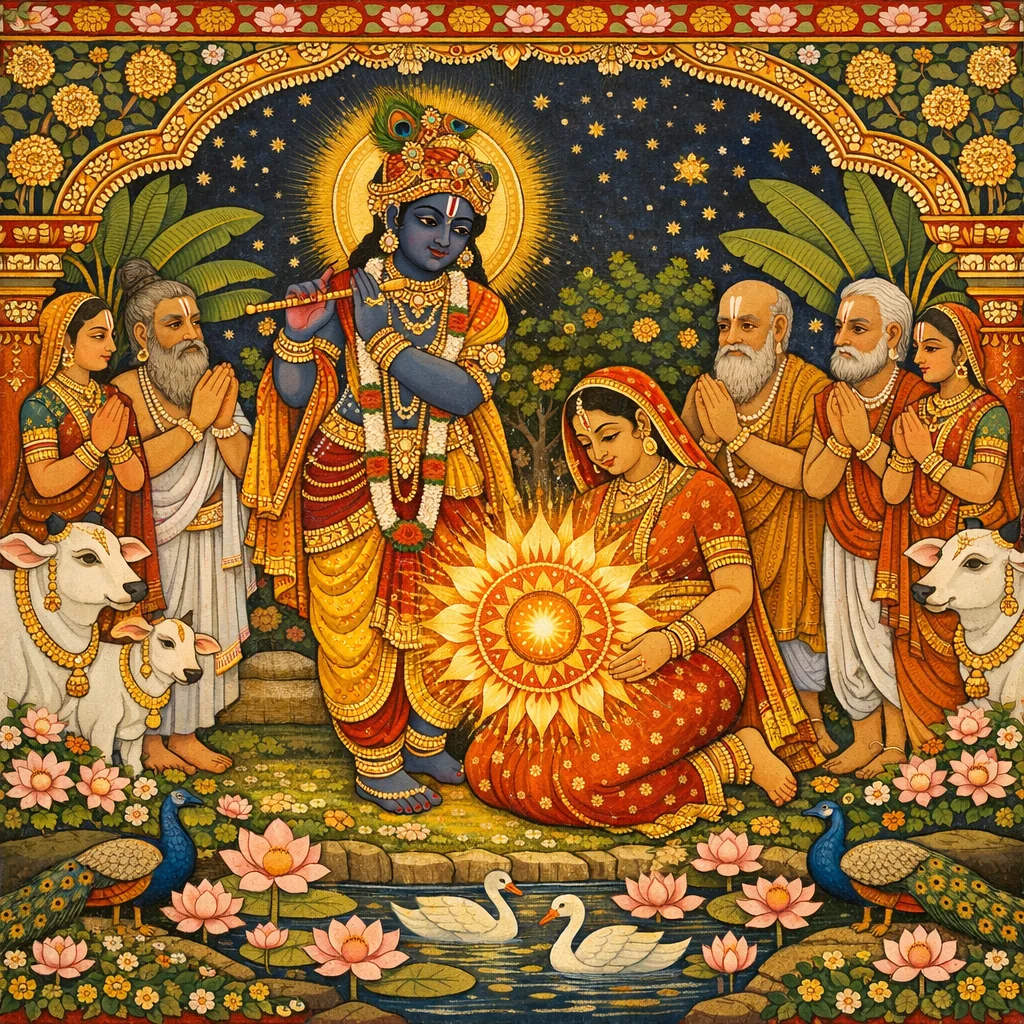
Adhyaya 8
Kuntī’s Prayers and the Neutralization of the Brahmāstra (Uttarā Protected; Yudhiṣṭhira’s Grief Begins)
After the Kurukṣetra war, the Pāṇḍavas perform funerary rites at the Gaṅgā, overwhelmed by grief. Kṛṣṇa and the sages console them by invoking divine law (kāla, karma, īśvara-niyama). As Kṛṣṇa prepares to depart for Dvārakā following Yudhiṣṭhira’s aśvamedha sacrifices, Uttarā rushes to Him in terror: Aśvatthāmā has released a brahmāstra to terminate the last heir of the Kuru line. The Pāṇḍavas arm themselves, but Kṛṣṇa intervenes decisively—Sudarśana and His yogamāyā shield the embryo, and Viṣṇu’s potency nullifies the otherwise irresistible weapon, preserving the dynasty through Parīkṣit. In gratitude and urgency at Kṛṣṇa’s impending departure, Kuntī offers profound prayers on His transcendence, His intimate līlā, calamity as a doorway to remembrance, and the necessity of ananya-bhakti. The chapter then transitions toward the next movement: Yudhiṣṭhira, still inconsolable, stops Kṛṣṇa and begins a moral crisis of conscience over wartime slaughter, setting up extended instruction on dharma and atonement.
Shlokas
Verse 1
सूत उवाच अथ ते सम्परेतानां स्वानामुदकमिच्छताम् । दातुं सकृष्णा गङ्गायां पुरस्कृत्य ययु: स्त्रिय: ॥ १ ॥
Sūta Gosvāmī said: Thereafter the Pāṇḍavas, desiring to deliver water to the dead relatives who had desired it, went to the Ganges with Draupadī. The ladies walked in front.
Verse 2
ते निनीयोदकं सर्वे विलप्य च भृशं पुन: । आप्लुता हरिपादाब्जरज:पूतसरिज्जले ॥ २ ॥
Having lamented over them and sufficiently offered Ganges water, they bathed in the Ganges, whose water is sanctified due to being mixed with the dust of the lotus feet of the Lord.
Verse 3
तत्रासीनं कुरुपतिं धृतराष्ट्रं सहानुजम् । गान्धारीं पुत्रशोकार्तां पृथां कृष्णां च माधव: ॥ ३ ॥
There sat the King of the Kurus, Mahārāja Yudhiṣṭhira, along with his younger brothers and Dhṛtarāṣṭra, Gāndhārī, Kuntī and Draupadī, all overwhelmed with grief. Lord Kṛṣṇa was also there.
Verse 4
सान्त्वयामास मुनिभिर्हतबन्धूञ्शुचार्पितान् । भूतेषु कालस्य गतिं दर्शयन्न प्रतिक्रियाम् ॥ ४ ॥
Citing the stringent laws of the Almighty and their reactions upon living beings, Lord Śrī Kṛṣṇa and the munis began to pacify those who were shocked and affected.
Verse 5
साधयित्वाजातशत्रो: स्वं राज्यं कितवैर्हृतम् । घातयित्वासतो राज्ञ: कचस्पर्शक्षतायुष: ॥ ५ ॥
The clever Duryodhana and his party cunningly usurped the kingdom of Yudhiṣṭhira, who had no enemy. By the grace of the Lord, the recovery was executed, and the unscrupulous kings who joined with Duryodhana were killed by Him. Others also died, their duration of life having decreased for their rough handling of the hair of Queen Draupadī.
Verse 6
याजयित्वाश्वमेधैस्तं त्रिभिरुत्तमकल्पकै: । तद्यश: पावनं दिक्षु शतमन्योरिवातनोत् ॥ ६ ॥
Lord Śrī Kṛṣṇa caused three well-performed aśvamedha-yajñas [horse sacrifices] to be conducted by Mahārāja Yudhiṣṭhira and thus caused his virtuous fame to be glorified in all directions, like that of Indra, who had performed one hundred such sacrifices.
Verse 7
आमन्त्र्य पाण्डुपुत्रांश्च शैनेयोद्धवसंयुत: । द्वैपायनादिभिर्विप्रै: पूजितै: प्रतिपूजित: ॥ ७ ॥
Lord Śrī Kṛṣṇa then prepared for His departure. He invited the sons of Pāṇḍu, after having been worshiped by the brāhmaṇas, headed by Śrīla Vyāsadeva. The Lord also reciprocated greetings.
Verse 8
गन्तुं कृतमतिर्ब्रह्मन् द्वारकां रथमास्थित: । उपलेभेऽभिधावन्तीमुत्तरां भयविह्वलाम् ॥ ८ ॥
As soon as He seated Himself on the chariot to start for Dvārakā, He saw Uttarā hurrying toward Him in fear.
Verse 9
उत्तरोवाच पाहि पाहि महायोगिन् देवदेव जगत्पते । नान्यं त्वदभयं पश्ये यत्र मृत्यु: परस्परम् ॥ ९ ॥
Uttarā said: O Lord of lords, Lord of the universe! You are the greatest of mystics. Please protect me, protect me, for there is no one else who can save me from the clutches of death in this world of duality.
Verse 10
अभिद्रवति मामीश शरस्तप्तायसो विभो । कामं दहतु मां नाथ मा मे गर्भो निपात्यताम् ॥ १० ॥
O my Lord, You are all-powerful. A fiery iron arrow is coming towards me fast. My Lord, let it burn me personally, if You so desire, but please do not let it burn and abort my embryo. Please do me this favor, my Lord.
Verse 11
सूत उवाच उपधार्य वचस्तस्या भगवान् भक्तवत्सल: । अपाण्डवमिदं कर्तुं द्रौणेरस्त्रमबुध्यत ॥ ११ ॥
Sūta Gosvāmī said: Having patiently heard her words, Lord Śrī Kṛṣṇa, who is always very affectionate to His devotees, could at once understand that Aśvatthāmā, the son of Droṇācārya, had thrown the brahmāstra to finish the last life in the Pāṇḍava family.
Verse 12
तर्ह्येवाथ मुनिश्रेष्ठ पाण्डवा: पञ्च सायकान् । आत्मनोऽभिमुखान्दीप्तानालक्ष्यास्त्राण्युपाददु: ॥ १२ ॥
O foremost among the great thinkers [munis] [Śaunaka], seeing the glaring brahmāstra proceeding towards them, the Pāṇḍavas took up their five respective weapons.
Verse 13
व्यसनं वीक्ष्य तत्तेषामनन्यविषयात्मनाम् । सुदर्शनेन स्वास्त्रेण स्वानां रक्षां व्यधाद्विभु: ॥ १३ ॥
The almighty Personality of Godhead, Śrī Kṛṣṇa, having observed that a great danger was befalling His unalloyed devotees, who were fully surrendered souls, at once took up His Sudarśana disc to protect them.
Verse 14
अन्त:स्थ: सर्वभूतानामात्मा योगेश्वरोहरि: । स्वमाययावृणोद्गर्भं वैराट्या: कुरुतन्तवे ॥ १४ ॥
The Lord of supreme mysticism, Śrī Kṛṣṇa, resides within everyone’s heart as the Paramātmā. As such, just to protect the progeny of the Kuru dynasty, He covered the embryo of Uttarā by His personal energy.
Verse 15
यद्यप्यस्त्रं ब्रह्मशिरस्त्वमोघं चाप्रतिक्रियम् । वैष्णवं तेज आसाद्य समशाम्यद् भृगूद्वह ॥ १५ ॥
O Śaunaka, glory of Bhṛgu’s family, although the supreme brahmāstra weapon released by Aśvatthāmā was irresistible and without check or counteraction, it was neutralized and foiled when confronted by the strength of Viṣṇu [Lord Kṛṣṇa].
Verse 16
मा मंस्था ह्येतदाश्चर्यं सर्वाश्चर्यमयेऽच्युते । य इदं मायया देव्या सृजत्यवति हन्त्यज: ॥ १६ ॥
O brāhmaṇas, do not think this to be especially wonderful in the activities of the mysterious and infallible Personality of Godhead. By His own transcendental energy He creates, maintains and annihilates all material things, although He Himself is unborn.
Verse 17
ब्रह्मतेजोविनिर्मुक्तैरात्मजै: सह कृष्णया । प्रयाणाभिमुखं कृष्णमिदमाह पृथा सती ॥ १७ ॥
Thus saved from the radiation of the brahmāstra, Kuntī, the chaste devotee of the Lord, and her five sons and Draupadī addressed Lord Kṛṣṇa as He started for home.
Verse 18
कुन्त्युवाच नमस्ये पुरुषं त्वाद्यमीश्वरं प्रकृते: परम् । अलक्ष्यं सर्वभूतानामन्तर्बहिरवस्थितम् ॥ १८ ॥
Śrīmatī Kuntī said: O Kṛṣṇa, I offer my obeisances unto You because You are the original personality and are unaffected by the qualities of the material world. You are existing both within and without everything, yet You are invisible to all.
Verse 19
मायाजवनिकाच्छन्नमज्ञाधोक्षजमव्ययम् । न लक्ष्यसे मूढदृशा नटो नाट्यधरो यथा ॥ १९ ॥
Being beyond the range of limited sense perception, You are the eternally irreproachable factor covered by the curtain of deluding energy. You are invisible to the foolish observer, exactly as an actor dressed as a player is not recognized.
Verse 20
तथा परमहंसानां मुनीनाममलात्मनाम् । भक्तियोगविधानार्थं कथं पश्येम हि स्त्रिय: ॥ २० ॥
You Yourself descend to propagate the transcendental science of devotional service unto the hearts of the advanced transcendentalists and mental speculators, who are purified by being able to discriminate between matter and spirit. How then can we women know You perfectly?
Verse 21
कृष्णाय वासुदेवाय देवकीनन्दनाय च । नन्दगोपकुमाराय गोविन्दाय नमो नम: ॥ २१ ॥
Let me therefore offer my respectful obeisances unto the Lord, who has become the son of Vasudeva, the pleasure of Devakī, the boy of Nanda and the other cowherd men of Vṛndāvana, and the enlivener of the cows and the senses.
Verse 22
नम: पङ्कजनाभाय नम: पङ्कजमालिने । नम: पङ्कजनेत्राय नमस्ते पङ्कजाङ्घ्रये ॥ २२ ॥
My respectful obeisances are unto You, O Lord, whose abdomen is marked with a depression like a lotus flower, who are always decorated with garlands of lotus flowers, whose glance is as cool as the lotus and whose feet are engraved with lotuses.
Verse 23
यथा हृषीकेश खलेन देवकी कंसेन रुद्धातिचिरं शुचार्पिता । विमोचिताहं च सहात्मजा विभो त्वयैव नाथेन मुहुर्विपद्गणात् ॥ २३ ॥
O Hṛṣīkeśa, master of the senses and Lord of lords, You have released Your mother, Devakī, who was long imprisoned and distressed by the envious King Kaṁsa, and me and my children from a series of constant dangers.
Verse 24
विषान्महाग्ने: पुरुषाददर्शना- दसत्सभाया वनवासकृच्छ्रत: । मृधे मृधेऽनेकमहारथास्त्रतो द्रौण्यस्त्रतश्चास्म हरेऽभिरक्षिता: ॥ २४ ॥
My dear Kṛṣṇa, Your Lordship has protected us from a poisoned cake, from a great fire, from cannibals, from the vicious assembly, from sufferings during our exile in the forest and from the battle where great generals fought. And now You have saved us from the weapon of Aśvatthāmā.
Verse 25
विपद: सन्तु ता: शश्वत्तत्र तत्र जगद्गुरो । भवतो दर्शनं यत्स्यादपुनर्भवदर्शनम् ॥ २५ ॥
I wish that all those calamities would happen again and again so that we could see You again and again, for seeing You means that we will no longer see repeated births and deaths.
Verse 26
जन्मैश्वर्यश्रुतश्रीभिरेधमानमद: पुमान् । नैवार्हत्यभिधातुं वै त्वामकिञ्चनगोचरम् ॥ २६ ॥
My Lord, Your Lordship can easily be approached, but only by those who are materially exhausted. One who is on the path of [material] progress, trying to improve himself with respectable parentage, great opulence, high education and bodily beauty, cannot approach You with sincere feeling.
Verse 27
नमोऽकिञ्चनवित्ताय निवृत्तगुणवृत्तये । आत्मारामाय शान्ताय कैवल्यपतये नम: ॥ २७ ॥
My obeisances are unto You, who are the property of the materially impoverished. You have nothing to do with the actions and reactions of the material modes of nature. You are self-satisfied, and therefore You are the most gentle and are master of the monists.
Verse 28
मन्ये त्वां कालमीशानमनादिनिधनं विभुम् । समं चरन्तं सर्वत्र भूतानां यन्मिथ: कलि: ॥ २८ ॥
My Lord, I consider Your Lordship to be eternal time, the supreme controller, without beginning and end, the all-pervasive one. In distributing Your mercy, You are equal to everyone. The dissensions between living beings are due to social intercourse.
Verse 29
न वेद कश्चिद्भगवंश्चिकीर्षितं तवेहमानस्य नृणां विडम्बनम् । न यस्य कश्चिद्दयितोऽस्ति कर्हिचिद् द्वेष्यश्च यस्मिन् विषमा मतिर्नृणाम् ॥ २९ ॥
O Lord, no one can understand Your transcendental pastimes, which appear to be human and so are misleading. You have no specific object of favor, nor do You have any object of envy. People only imagine that You are partial.
Verse 30
जन्म कर्म च विश्वात्मन्नजस्याकर्तुरात्मन: । तिर्यङ्नृषिषु याद:सु तदत्यन्तविडम्बनम् ॥ ३० ॥
Of course it is bewildering, O soul of the universe, that You work, though You are inactive, and that You take birth, though You are the vital force and the unborn. You Yourself descend amongst animals, men, sages and aquatics. Verily, this is bewildering.
Verse 31
गोप्याददे त्वयि कृतागसि दाम तावद् या ते दशाश्रुकलिलाञ्जनसम्भ्रमाक्षम् । वक्त्रं निनीय भयभावनया स्थितस्य सा मां विमोहयति भीरपि यद्बिभेति ॥ ३१ ॥
My dear Kṛṣṇa, Yaśodā took up a rope to bind You when You committed an offense, and Your perturbed eyes overflooded with tears, which washed the mascara from Your eyes. And You were afraid, though fear personified is afraid of You. This sight is bewildering to me.
Verse 32
केचिदाहुरजं जातं पुण्यश्लोकस्य कीर्तये । यदो: प्रियस्यान्ववाये मलयस्येव चन्दनम् ॥ ३२ ॥
Some say that the Unborn is born for the glorification of pious kings, and others say that He is born to please King Yadu, one of Your dearest devotees. You appear in his family as sandalwood appears in the Malaya hills.
Verse 33
अपरे वसुदेवस्य देवक्यां याचितोऽभ्यगात् । अजस्त्वमस्य क्षेमाय वधाय च सुरद्विषाम् ॥ ३३ ॥
Others say that since both Vasudeva and Devakī prayed for You, You have taken Your birth as their son. Undoubtedly You are unborn, yet You take Your birth for their welfare and to kill those who are envious of the demigods.
Verse 34
भारावतारणायान्ये भुवो नाव इवोदधौ । सीदन्त्या भूरिभारेण जातो ह्यात्मभुवार्थित: ॥ ३४ ॥
Others say that the world, being overburdened like a boat at sea, is much aggrieved, and that Brahmā, who is Your son, prayed for You, and so You have appeared to diminish the trouble.
Verse 35
भवेऽस्मिन् क्लिश्यमानानामविद्याकामकर्मभि: । श्रवणस्मरणार्हाणि करिष्यन्निति केचन ॥ ३५ ॥
And yet others say that You appeared for the sake of rejuvenating the devotional service of hearing, remembering, worshiping and so on in order that the conditioned souls suffering from material pangs might take advantage and gain liberation.
Verse 36
शृण्वन्ति गायन्ति गृणन्त्यभीक्ष्णश: स्मरन्ति नन्दन्ति तवेहितं जना: । त एव पश्यन्त्यचिरेण तावकं भवप्रवाहोपरमं पदाम्बुजम् ॥ ३६ ॥
O Kṛṣṇa, those who continuously hear, chant and repeat Your transcendental activities, or take pleasure in others’ doing so, certainly see Your lotus feet, which alone can stop the repetition of birth and death.
Verse 37
अप्यद्य नस्त्वं स्वकृतेहित प्रभो जिहाससि स्वित्सुहृदोऽनुजीविन: । येषां न चान्यद्भवत: पदाम्बुजात् परायणं राजसु योजितांहसाम् ॥ ३७ ॥
O my Lord, You have executed all duties Yourself. Are you leaving us today, though we are completely dependent on Your mercy and have no one else to protect us, now when all kings are at enmity with us?
Verse 38
के वयं नामरूपाभ्यां यदुभि: सह पाण्डवा: । भवतोऽदर्शनं यर्हि हृषीकाणामिवेशितु: ॥ ३८ ॥
As the name and fame of a particular body is finished with the disappearance of the living spirit, similarly if You do not look upon us, all our fame and activities, along with the Pāṇḍavas and Yadus, will end at once.
Verse 39
नेयं शोभिष्यते तत्र यथेदानीं गदाधर । त्वत्पदैरङ्किता भाति स्वलक्षणविलक्षितै: ॥ ३९ ॥
O Gadādhara [Kṛṣṇa], our kingdom is now being marked by the impressions of Your feet, and therefore it appears beautiful. But when You leave, it will no longer be so.
Verse 40
इमे जनपदा: स्वृद्धा: सुपक्वौषधिवीरुध: । वनाद्रिनद्युदन्वन्तो ह्येधन्ते तव वीक्षितै: ॥ ४० ॥
All these cities and villages are flourishing in all respects because the herbs and grains are in abundance, the trees are full of fruits, the rivers are flowing, the hills are full of minerals and the oceans full of wealth. And this is all due to Your glancing over them.
Verse 41
अथ विश्वेश विश्वात्मन् विश्वमूर्ते स्वकेषु मे । स्नेहपाशमिमं छिन्धि दृढं पाण्डुषु वृष्णिषु ॥ ४१ ॥
O Lord of the universe, soul of the universe, O personality of the form of the universe, please, therefore, sever my tie of affection for my kinsmen, the Pāṇḍavas and the Vṛṣṇis.
Verse 42
त्वयि मेऽनन्यविषया मतिर्मधुपतेऽसकृत् । रतिमुद्वहतादद्धा गङ्गेवौघमुदन्वति ॥ ४२ ॥
O Lord of Madhu, as the Ganges forever flows to the sea without hindrance, let my attraction be constantly drawn unto You without being diverted to anyone else.
Verse 43
श्रीकृष्ण कृष्णसख वृष्ण्यृषभावनिध्रुग् राजन्यवंशदहनानपवर्गवीर्य । गोविन्द गोद्विजसुरार्तिहरावतार योगेश्वराखिलगुरो भगवन्नमस्ते ॥ ४३ ॥
O Kṛṣṇa, O friend of Arjuna, O chief amongst the descendants of Vṛṣṇi, You are the destroyer of those political parties which are disturbing elements on this earth. Your prowess never deteriorates. You are the proprietor of the transcendental abode, and You descend to relieve the distresses of the cows, the brāhmaṇas and the devotees. You possess all mystic powers, and You are the preceptor of the entire universe. You are the almighty God, and I offer You my respectful obeisances.
Verse 44
सूत उवाच पृथयेत्थं कलपदै: परिणूताखिलोदय: । मन्दं जहास वैकुण्ठो मोहयन्निव मायया ॥ ४४ ॥
Sūta Gosvāmī said: The Lord, thus hearing the prayers of Kuntīdevī, composed in choice words for His glorification, mildly smiled. That smile was as enchanting as His mystic power.
Verse 45
तां बाढमित्युपामन्त्र्य प्रविश्य गजसाह्वयम् । स्त्रियश्च स्वपुरं यास्यन् प्रेम्णा राज्ञा निवारित: ॥ ४५ ॥
Thus accepting the prayers of Śrīmatī Kuntīdevī, the Lord subsequently informed other ladies of His departure by entering the palace of Hastināpura. But upon preparing to leave, He was stopped by King Yudhiṣṭhira, who implored Him lovingly.
Verse 46
व्यासाद्यैरीश्वरेहाज्ञै: कृष्णेनाद्भुतकर्मणा । प्रबोधितोऽपीतिहासैर्नाबुध्यत शुचार्पित: ॥ ४६ ॥
King Yudhiṣṭhira, who was much aggrieved, could not be convinced, despite instructions by great sages headed by Vyāsa and the Lord Kṛṣṇa Himself, the performer of superhuman feats, and despite all historical evidence.
Verse 47
आह राजा धर्मसुतश्चिन्तयन् सुहृदां वधम् । प्राकृतेनात्मना विप्रा: स्नेहमोहवशं गत: ॥ ४७ ॥
King Yudhiṣṭhira, son of Dharma, overwhelmed by the death of his friends, was aggrieved just like a common, materialistic man. O sages, thus deluded by affection, he began to speak.
Verse 48
अहो मे पश्यताज्ञानं हृदि रूढं दुरात्मन: । पारक्यस्यैव देहस्य बह्व्यो मेऽक्षौहिणीर्हता: ॥ ४८ ॥
King Yudhiṣṭhira said: O my lot! I am the most sinful man! Just see my heart, which is full of ignorance! This body, which is ultimately meant for others, has killed many, many phalanxes of men.
Verse 49
बालद्विजसुहृन्मित्रपितृभ्रातृगुरुद्रुह: । न मे स्यान्निरयान्मोक्षो ह्यपि वर्षायुतायुतै: ॥ ४९ ॥
I have killed many boys, brāhmaṇas, well-wishers, friends, parents, preceptors and brothers. Though I live millions of years, I will not be relieved from the hell that awaits me for all these sins.
Verse 50
नैनो राज्ञ: प्रजाभर्तुर्धर्मयुद्धे वधो द्विषाम् । इति मे न तु बोधाय कल्पते शासनं वच: ॥ ५० ॥
There is no sin for a king who kills for the right cause, who is engaged in maintaining his citizens. But this injunction is not applicable to me.
Verse 51
स्त्रीणां मद्धतबन्धूनां द्रोहो योऽसाविहोत्थित: । कर्मभिर्गृहमेधीयैर्नाहं कल्पो व्यपोहितुम् ॥ ५१ ॥
I have killed many friends of women, and I have thus caused enmity to such an extent that it is not possible to undo it by material welfare work.
Verse 52
यथा पङ्केन पङ्काम्भ: सुरया वा सुराकृतम् । भूतहत्यां तथैवैकां न यज्ञैर्मार्ष्टुमर्हति ॥ ५२ ॥
As it is not possible to filter muddy water through mud, or purify a wine-stained pot with wine, it is not possible to counteract the killing of men by sacrificing animals.
Frequently Asked Questions
Aśvatthāmā’s act represents vengeance degenerating into adharma: unable to defeat the Pāṇḍavas directly, he targets the future—ending the Kuru succession by killing the unborn heir. Śāstrically, it illustrates how brahminical power (astra-vidyā) becomes catastrophic when divorced from dharma. The episode also foregrounds vaṁśānucarita: the Bhāgavata’s historical continuity depends on Parīkṣit’s survival, through whom the later narration to Śukadeva becomes possible.
The text stresses that the brahmāstra is ‘without check or counteraction’ on the material plane, yet it is foiled when confronted by Viṣṇu’s strength. This teaches hierarchical theology: all astras and devas operate within the Lord’s sovereignty. Kṛṣṇa’s Sudarśana and personal energy (yogamāyā) protect the embryo, demonstrating rakṣā for surrendered devotees and establishing that the Supreme is not merely a powerful hero but the ultimate controller of all energies.
Kuntī’s prayers articulate bhakti’s inner grammar: God is simultaneously transcendent (beyond guṇas and sense perception) and intimate (Yaśodā binding Him). She interprets repeated calamities as grace because they intensify darśana and remembrance, and she asks for detachment from clan-identity in favor of uninterrupted devotion—like the Gaṅgā flowing to the sea. The prayers also critique material pride (birth, wealth, education, beauty) as an obstacle to sincere approach, emphasizing humility and dependence.
Uttarā’s embryo—later Mahārāja Parīkṣit—is saved. This is crucial because Parīkṣit becomes the listener of the Bhāgavata from Śukadeva Gosvāmī; thus, the preservation of his life safeguards the very historical channel through which the Purāṇa’s teachings are delivered to the world.