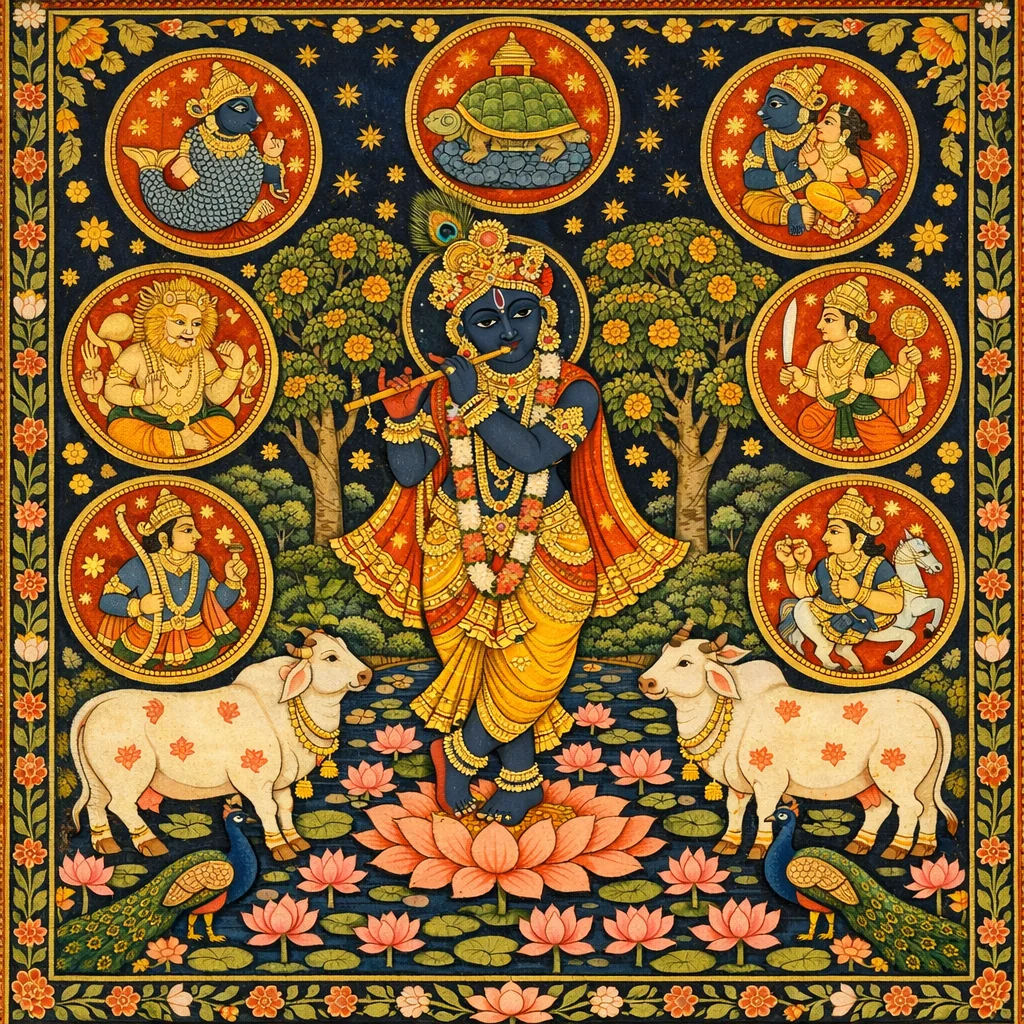
Adhyaya 3
Avatāra-kathā — The Puruṣa, the Many Incarnations, and Kṛṣṇa as Svayam Bhagavān
Continuing Sūta’s response to the Naimiṣāraṇya sages’ desire to hear the essence of dharma and the Lord’s līlā, this chapter begins with sarga/visarga framing: the Lord’s puruṣa expansion initiates material manifestation, Brahmā appears from the lotus, and yet the Lord remains untouched and fully spiritual. Sūta then enumerates prominent avatāras—Kumāras, Varāha, Nārada, Nara-Nārāyaṇa, Kapila, Dattātreya (Atri-putra), Yajña, Ṛṣabha, Pṛthu, Matsya, Kūrma, Dhanvantari, Mohinī, Nṛsiṁha, Vāmana, Paraśurāma, Vyāsa, Rāma, Balarāma-Kṛṣṇa, Buddha, and Kalki—while affirming that incarnations are innumerable. The theological apex declares: all listed forms are aṁśa/kalā, but Śrī Kṛṣṇa is the original Personality of Godhead (svayam bhagavān), who descends to protect the faithful when atheistic disturbance arises. The chapter then clarifies virāṭ-rūpa as a conceptual aid for neophytes, distinguishes self from gross/subtle bodies, and concludes that only unbroken favorable service reveals the Lord. It bridges toward deeper Bhāgavata focus: the text itself as the Lord’s literary avatāra and the necessity of sincere inquiry for liberation.
Shlokas
Verse 1
सूत उवाच जगृहे पौरुषं रूपं भगवान्महदादिभि: । सम्भूतं षोडशकलमादौ लोकसिसृक्षया ॥ १ ॥
Sūta said: In the beginning of the creation, the Lord first expanded Himself in the universal form of the puruṣa incarnation and manifested all the ingredients for the material creation. And thus at first there was the creation of the sixteen principles of material action. This was for the purpose of creating the material universes.
Verse 2
यस्याम्भसि शयानस्य योगनिद्रां वितन्वत: । नाभिह्रदाम्बुजादासीद्ब्रह्मा विश्वसृजां पति: ॥ २ ॥
A part of the puruṣa lies down within the water of the universe, from the navel lake of His body sprouts a lotus stem, and from the lotus flower atop this stem, Brahmā, the master of all engineers in the universe, becomes manifest.
Verse 3
यस्यावयवसंस्थानै: कल्पितो लोकविस्तर: । तद्वै भगवतो रूपं विशुद्धं सत्त्वमूर्जितम् ॥ ३ ॥
It is believed that all the universal planetary systems are situated on the extensive body of the puruṣa, but He has nothing to do with the created material ingredients. His body is eternally in spiritual existence par excellence.
Verse 4
पश्यन्त्यदो रूपमदभ्रचक्षुषा सहस्रपादोरुभुजाननाद्भुतम् । सहस्रमूर्धश्रवणाक्षिनासिकं सहस्रमौल्यम्बरकुण्डलोल्लसत् ॥ ४ ॥
The devotees, with their perfect eyes, see the transcendental form of the puruṣa who has thousands of legs, thighs, arms and faces — all extraordinary. In that body there are thousands of heads, ears, eyes and noses. They are decorated with thousands of helmets and glowing earrings and are adorned with garlands.
Verse 5
एतन्नानावताराणां निधानं बीजमव्ययम् । यस्यांशांशेन सृज्यन्ते देवतिर्यङ्नरादय: ॥ ५ ॥
This form [the second manifestation of the puruṣa] is the source and indestructible seed of multifarious incarnations within the universe. From the particles and portions of this form, different living entities, like demigods, men and others, are created.
Verse 6
स एव प्रथमं देव: कौमारं सर्गमाश्रित: । चचार दुश्चरं ब्रह्मा ब्रह्मचर्यमखण्डितम् ॥ ६ ॥
First of all, in the beginning of creation, there were the four unmarried sons of Brahmā [the Kumāras], who, being situated in a vow of celibacy, underwent severe austerities for realization of the Absolute Truth.
Verse 7
द्वितीयं तु भवायास्य रसातलगतां महीम् । उद्धरिष्यन्नुपादत्त यज्ञेश: सौकरं वपु: ॥ ७ ॥
The supreme enjoyer of all sacrifices accepted the incarnation of a boar [the second incarnation], and for the welfare of the earth He lifted the earth from the nether regions of the universe.
Verse 8
तृतीयमृषिसर्गं वै देवर्षित्वमुपेत्य स: । तन्त्रं सात्वतमाचष्ट नैष्कर्म्यं कर्मणां यत: ॥ ८ ॥
In the millennium of the ṛṣis, the Personality of Godhead accepted the third empowered incarnation in the form of Devarṣi Nārada, who is a great sage among the demigods. He collected expositions of the Vedas which deal with devotional service and which inspire nonfruitive action.
Verse 9
तुर्ये धर्मकलासर्गे नरनारायणावृषी । भूत्वात्मोपशमोपेतमकरोद्दुश्चरं तप: ॥ ९ ॥
In the fourth incarnation, the Lord became Nara and Nārāyaṇa, the twin sons of the wife of King Dharma. Thus He undertook severe and exemplary penances to control the senses.
Verse 10
पञ्चम: कपिलो नाम सिद्धेश: कालविप्लुतम् । प्रोवाचासुरये साङ्ख्यं तत्त्वग्रामविनिर्णयम् ॥ १० ॥
The fifth incarnation, named Lord Kapila, is foremost among perfected beings. He gave an exposition of the creative elements and metaphysics to Āsuri Brāhmaṇa, for in course of time this knowledge had been lost.
Verse 11
षष्ठमत्रेरपत्यत्वं वृत: प्राप्तोऽनसूयया । आन्वीक्षिकीमलर्काय प्रह्लादादिभ्य ऊचिवान् ॥ ११ ॥
The sixth incarnation of the puruṣa was the son of the sage Atri. He was born from the womb of Anasūyā, who prayed for an incarnation. He spoke on the subject of transcendence to Alarka, Prahlāda and others [Yadu, Haihaya, etc.].
Verse 12
तत: सप्तम आकूत्यां रुचेर्यज्ञोऽभ्यजायत । स यामाद्यै: सुरगणैरपात्स्वायम्भुवान्तरम् ॥ १२ ॥
The seventh incarnation was Yajña, the son of Prajāpati Ruci and his wife Ākūti. He controlled the period during the change of the Svāyambhuva Manu and was assisted by demigods such as His son Yāma.
Verse 13
अष्टमे मेरुदेव्यां तु नाभेर्जात उरुक्रम: । दर्शयन् वर्त्म धीराणां सर्वाश्रमनमस्कृतम् ॥ १३ ॥
The eighth incarnation was King Ṛṣabha, son of King Nābhi and his wife Merudevī. In this incarnation the Lord showed the path of perfection, which is followed by those who have fully controlled their senses and who are honored by all orders of life.
Verse 14
ऋषिभिर्याचितो भेजे नवमं पार्थिवं वपु: । दुग्धेमामोषधीर्विप्रास्तेनायं स उशत्तम: ॥ १४ ॥
O brāhmaṇas, in the ninth incarnation, the Lord, prayed for by sages, accepted the body of a king [Pṛthu] who cultivated the land to yield various produce, and for that reason the earth was beautiful and attractive.
Verse 15
रूपं स जगृहे मात्स्यं चाक्षुषोदधिसम्प्लवे । नाव्यारोप्य महीमय्यामपाद्वैवस्वतं मनुम् ॥ १५ ॥
When there was a complete inundation after the period of the Cākṣuṣa Manu and the whole world was deep within water, the Lord accepted the form of a fish and protected Vaivasvata Manu, keeping him up on a boat.
Verse 16
सुरासुराणामुदधिं मथ्नतां मन्दराचलम् । दध्रे कमठरूपेण पृष्ठ एकादशे विभु: ॥ १६ ॥
The eleventh incarnation of the Lord took the form of a tortoise whose shell served as a pivot for the Mandarācala Hill, which was being used as a churning rod by the theists and atheists of the universe.
Verse 17
धान्वन्तरं द्वादशमं त्रयोदशममेव च । अपाययत्सुरानन्यान्मोहिन्या मोहयन् स्त्रिया ॥ १७ ॥
In the twelfth incarnation, the Lord appeared as Dhanvantari, and in the thirteenth He allured the atheists by the charming beauty of a woman and gave nectar to the demigods to drink.
Verse 18
चतुर्दशं नारसिंहं बिभ्रद्दैत्येन्द्रमूर्जितम् । ददार करजैरूरावेरकां कटकृद्यथा ॥ १८ ॥
In the fourteenth incarnation, the Lord appeared as Nṛsiṁha and bifurcated the strong body of the atheist Hiraṇyakaśipu with His nails, just as a carpenter pierces cane.
Verse 19
पञ्चदशं वामनकं कृत्वागादध्वरं बले: । पदत्रयं याचमान: प्रत्यादित्सुस्त्रिपिष्टपम् ॥ १९ ॥
In the fifteenth incarnation, the Lord assumed the form of a dwarf brāhmaṇa [Vāmana] and visited the arena of sacrifice arranged by Mahārāja Bali. Although at heart He was willing to regain the kingdom of the three planetary systems, He simply asked for a donation of three steps of land.
Verse 20
अवतारे षोडशमे पश्यन् ब्रह्मद्रुहो नृपान् । त्रि:सप्तकृत्व: कुपितो नि:क्षत्रामकरोन्महीम् ॥ २० ॥
In the sixteenth incarnation of the Godhead, the Lord [as Bhṛgupati] annihilated the administrative class [kṣatriyas] twenty-one times, being angry with them because of their rebellion against the brāhmaṇas [the intelligent class].
Verse 21
तत: सप्तदशे जात: सत्यवत्यां पराशरात् । चक्रे वेदतरो: शाखा दृष्ट्वा पुंसोऽल्पमेधस: ॥ २१ ॥
Thereafter, in the seventeenth incarnation of Godhead, Śrī Vyāsadeva appeared in the womb of Satyavatī through Parāśara Muni, and he divided the one Veda into several branches and subbranches, seeing that the people in general were less intelligent.
Verse 22
नरदेवत्वमापन्न: सुरकार्यचिकीर्षया । समुद्रनिग्रहादीनि चक्रे वीर्याण्यत: परम् ॥ २२ ॥
In the eighteenth incarnation, the Lord appeared as King Rāma. In order to perform some pleasing work for the demigods, He exhibited superhuman powers by controlling the Indian Ocean and then killing the atheist King Rāvaṇa, who was on the other side of the sea.
Verse 23
एकोनविंशे विंशतिमे वृष्णिषु प्राप्य जन्मनी । रामकृष्णाविति भुवो भगवानहरद्भरम् ॥ २३ ॥
In the nineteenth and twentieth incarnations, the Lord advented Himself as Lord Balarāma and Lord Kṛṣṇa in the family of Vṛṣṇi [the Yadu dynasty], and by so doing He removed the burden of the world.
Verse 24
तत: कलौ सम्प्रवृत्ते सम्मोहाय सुरद्विषाम् । बुद्धो नाम्नाञ्जनसुत: कीकटेषु भविष्यति ॥ २४ ॥
Then, in the beginning of Kali-yuga, the Lord will appear as Lord Buddha, the son of Añjanā, in the province of Gayā, just for the purpose of deluding those who are envious of the faithful theist.
Verse 25
अथासौ युगसन्ध्यायां दस्युप्रायेषु राजसु । जनिता विष्णुयशसो नाम्ना कल्किर्जगत्पति: ॥ २५ ॥
Thereafter, at the conjunction of two yugas, the Lord of the creation will take His birth as the Kalki incarnation and become the son of Viṣṇu Yaśā. At this time almost all the rulers of the earth will have degenerated into plunderers.
Verse 26
अवतारा ह्यसङ्ख्येया हरे: सत्त्वनिधेर्द्विजा: । यथाविदासिन: कुल्या: सरस: स्यु: सहस्रश: ॥ २६ ॥
O brāhmaṇas, the incarnations of the Lord are innumerable, like rivulets flowing from inexhaustible sources of water.
Verse 27
ऋषयो मनवो देवा मनुपुत्रा महौजस: । कला: सर्वे हरेरेव सप्रजापतय: स्मृता: ॥ २७ ॥
All the ṛṣis, Manus, demigods and descendants of Manu, who are especially powerful, are plenary portions or portions of the plenary portions of the Lord. This also includes the Prajāpatis.
Verse 28
एते चांशकला: पुंस: कृष्णस्तु भगवान् स्वयम् । इन्द्रारिव्याकुलं लोकं मृडयन्ति युगे युगे ॥ २८ ॥
All of the above-mentioned incarnations are either plenary portions or portions of the plenary portions of the Lord, but Lord Śrī Kṛṣṇa is the original Personality of Godhead. All of them appear on planets whenever there is a disturbance created by the atheists. The Lord incarnates to protect the theists.
Verse 29
जन्म गुह्यं भगवतो य एतत्प्रयतो नर: । सायं प्रातर्गृणन् भक्त्या दु:खग्रामाद्विमुच्यते ॥ २९ ॥
Whoever carefully recites the mysterious appearances of the Lord, with devotion in the morning and in the evening, gets relief from all miseries of life.
Verse 30
एतद्रूपं भगवतो ह्यरूपस्य चिदात्मन: । मायागुणैर्विरचितं महदादिभिरात्मनि ॥ ३० ॥
The conception of the virāṭ universal form of the Lord, as appearing in the material world, is imaginary. It is to enable the less intelligent [and neophytes] to adjust to the idea of the Lord’s having form. But factually the Lord has no material form.
Verse 31
यथा नभसि मेघौघो रेणुर्वा पार्थिवोऽनिले । एवं द्रष्टरि दृश्यत्वमारोपितमबुद्धिभि: ॥ ३१ ॥
Clouds and dust are carried by the air, but less intelligent persons say that the sky is cloudy and the air is dirty. Similarly, they also implant material bodily conceptions on the spirit self.
Verse 32
अत: परं यदव्यक्तमव्यूढगुणबृंहितम् । अदृष्टाश्रुतवस्तुत्वात्स जीवो यत्पुनर्भव: ॥ ३२ ॥
Beyond this gross conception of form is another, subtle conception of form which is without formal shape and is unseen, unheard and unmanifest. The living being has his form beyond this subtlety, otherwise he could not have repeated births.
Verse 33
यत्रेमे सदसद्रूपे प्रतिषिद्धे स्वसंविदा । अविद्ययात्मनि कृते इति तद्ब्रह्मदर्शनम् ॥ ३३ ॥
Whenever a person experiences, by self-realization, that both the gross and subtle bodies have nothing to do with the pure self, at that time he sees himself as well as the Lord.
Verse 34
यद्येषोपरता देवी माया वैशारदी मति: । सम्पन्न एवेति विदुर्महिम्नि स्वे महीयते ॥ ३४ ॥
If the illusory energy subsides and the living entity becomes fully enriched with knowledge by the grace of the Lord, then he becomes at once enlightened with self-realization and thus becomes situated in his own glory.
Verse 35
एवं जन्मानि कर्माणि ह्यकर्तुरजनस्य च । वर्णयन्ति स्म कवयो वेदगुह्यानि हृत्पते: ॥ ३५ ॥
Thus learned men describe the births and activities of the unborn and inactive, which is undiscoverable even in the Vedic literatures. He is the Lord of the heart.
Verse 36
स वा इदं विश्वममोघलील: सृजत्यवत्यत्ति न सज्जतेऽस्मिन् । भूतेषु चान्तर्हित आत्मतन्त्र: षाड्वर्गिकं जिघ्रति षड्गुणेश: ॥ ३६ ॥
The Lord, whose activities are always spotless, is the master of the six senses and is fully omnipotent with six opulences. He creates the manifested universes, maintains them and annihilates them without being in the least affected. He is within every living being and is always independent.
Verse 37
न चास्य कश्चिन्निपुणेन धातु- रवैति जन्तु: कुमनीष ऊती: । नामानि रूपाणि मनोवचोभि: सन्तन्वतो नटचर्यामिवाज्ञ: ॥ ३७ ॥
The foolish with a poor fund of knowledge cannot know the transcendental nature of the forms, names and activities of the Lord, who is playing like an actor in a drama. Nor can they express such things, neither in their speculations nor in their words.
Verse 38
स वेद धातु: पदवीं परस्य दुरन्तवीर्यस्य रथाङ्गपाणे: । योऽमायया सन्ततयानुवृत्त्या भजेत तत्पादसरोजगन्धम् ॥ ३८ ॥
Only those who render unreserved, uninterrupted, favorable service unto the lotus feet of Lord Kṛṣṇa, who carries the wheel of the chariot in His hand, can know the creator of the universe in His full glory, power and transcendence.
Verse 39
अथेह धन्या भगवन्त इत्थं यद्वासुदेवेऽखिललोकनाथे । कुर्वन्ति सर्वात्मकमात्मभावं न यत्र भूय: परिवर्त उग्र: ॥ ३९ ॥
Only by making such inquiries in this world can one be successful and perfectly cognizant, for such inquiries invoke transcendental ecstatic love unto the Personality of Godhead, who is the proprietor of all the universes, and guarantee cent-percent immunity from the dreadful repetition of birth and death.
Verse 40
इदं भागवतं नाम पुराणं ब्रह्मसम्मितम् । उत्तमश्लोकचरितं चकार भगवानृषि: । नि:श्रेयसाय लोकस्य धन्यं स्वस्त्ययनं महत् ॥ ४० ॥
This Śrīmad-Bhāgavatam is the literary incarnation of God, and it is compiled by Śrīla Vyāsadeva, the incarnation of God. It is meant for the ultimate good of all people, and it is all-successful, all-blissful and all-perfect.
Verse 41
तदिदं ग्राहयामास सुतमात्मवतां वरम् । सर्ववेदेतिहासानां सारं सारं समुद्धृतम् ॥ ४१ ॥
Śrī Vyāsadeva delivered it to his son, who is the most respected among the self-realized, after extracting the cream of all Vedic literatures and histories of the universe.
Verse 42
स तु संश्रावयामास महाराजं परीक्षितम् । प्रायोपविष्टं गङ्गायां परीतं परमर्षिभि: ॥ ४२ ॥
Śukadeva Gosvāmī, the son of Vyāsadeva, in his turn delivered the Bhāgavatam to the great Emperor Parīkṣit, who sat surrounded by sages on the bank of the Ganges, awaiting death without taking food or drink.
Verse 43
कृष्णे स्वधामोपगते धर्मज्ञानादिभि: सह । कलौ नष्टदृशामेष पुराणार्कोऽधुनोदित: ॥ ४३ ॥
This Bhāgavata Purāṇa is as brilliant as the sun, and it has arisen just after the departure of Lord Kṛṣṇa to His own abode, accompanied by religion, knowledge, etc. Persons who have lost their vision due to the dense darkness of ignorance in the Age of Kali shall get light from this Purāṇa.
Verse 44
तत्र कीर्तयतो विप्रा विप्रर्षेर्भूरितेजस: । अहं चाध्यगमं तत्र निविष्टस्तदनुग्रहात् । सोऽहं व: श्रावयिष्यामि यथाधीतं यथामति ॥ ४४ ॥
O learned brāhmaṇas, when Śukadeva Gosvāmī recited Bhāgavatam there [in the presence of Emperor Parīkṣit], I heard him with rapt attention, and thus, by his mercy, I learned the Bhāgavatam from that great and powerful sage. Now I shall try to make you hear the very same thing as I learned it from him and as I have realized it.
Frequently Asked Questions
The Bhāgavata presents avatāras as continuous divine interventions responding to cosmic administration and dharma’s protection. Just as countless rivulets flow from an inexhaustible source, the Lord’s aṁśa and kalā manifestations appear according to time, place, and need—governing creation, teaching knowledge and renunciation, rescuing devotees, and reestablishing righteousness—without exhausting the Lord’s fullness.
After listing major avatāras as plenary portions (aṁśa) or portions of plenary portions (kalā), the text makes a categorical distinction: ‘kṛṣṇas tu bhagavān svayam’—Kṛṣṇa is Bhagavān Himself, not merely an expansion. The surrounding verses reinforce function (protecting theists when atheists disturb), while later Bhāgavata narratives (especially Skandhas 10–11) supply the full theological and līlā-based demonstration of that original status.
‘Imaginary’ (kalpanā) here means a didactic visualization for beginners who cannot yet conceive of the Lord’s transcendental, non-material form. The virāṭ conception helps the mind relate the cosmos to divine sovereignty, but the Bhāgavata insists the Lord’s actual form is spiritual and independent of material elements. The teaching protects devotion from anthropomorphic materialism while still offering an accessible contemplative entry point.