Adhyaya 8
Bharata Mahārāja’s Attachment to a Deer and His Fall from Yoga
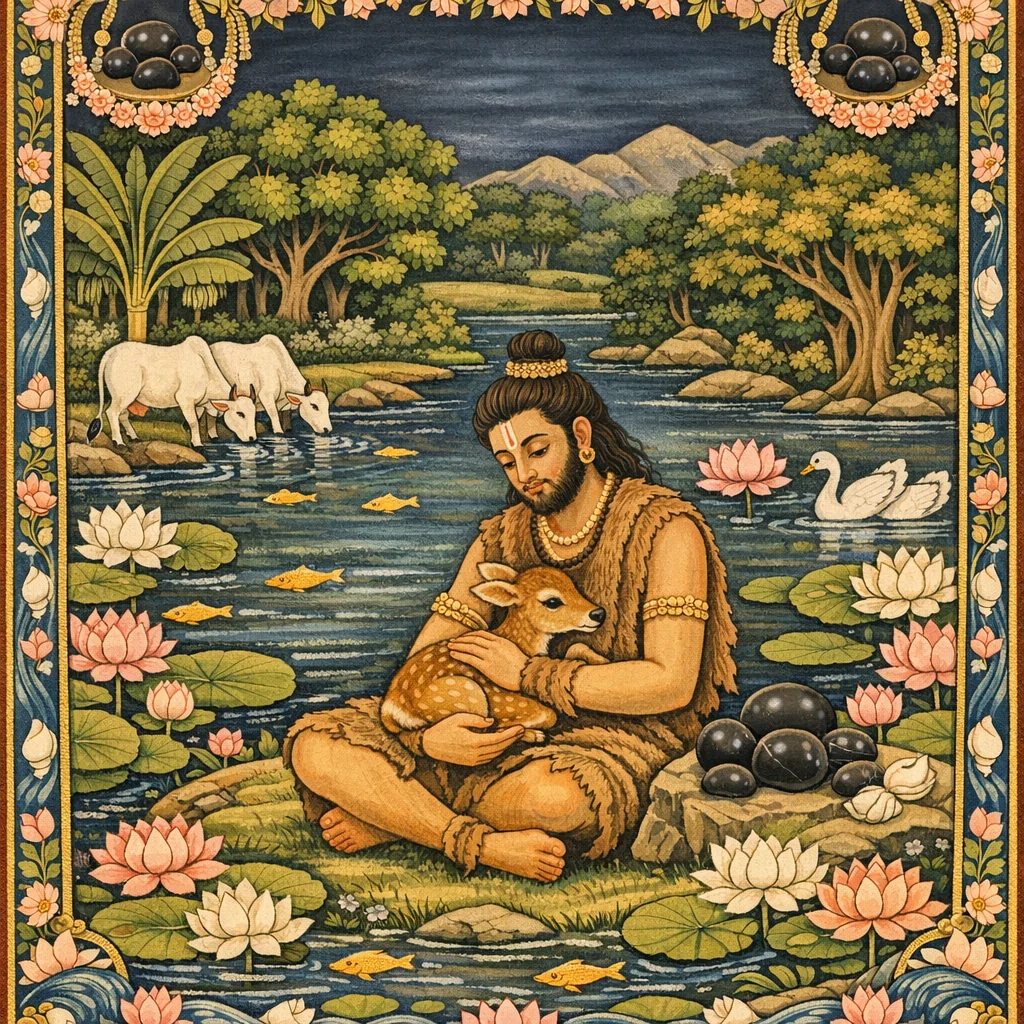
Continuing from Bharata’s forest renunciation and regulated worship, this chapter introduces the decisive turn: after morning ablutions at the Gaṇḍakī, Bharata chants his mantra when a pregnant doe, startled by a nearby lion’s roar, miscarries mid-leap and dies, leaving a fawn drifting in the river. Bharata’s compassion prompts rescue, but care matures into possessive affection—he feeds, protects, pets, carries, and constantly checks on the deer, gradually neglecting niyama and Bhagavān’s worship. When the deer goes missing, Bharata’s mind becomes agitated and irrational; he laments, idealizes the deer’s footprints, and projects meanings onto the moon, revealing how attachment distorts buddhi. Śukadeva diagnoses the fall as karma-driven: despite prior renunciation, latent impressions reawaken through misplaced saṅga. At death, Bharata’s consciousness fixes on the deer; he attains a deer body yet retains memory due to prior bhakti. Repentant, he avoids bad association, returns to Śālagrāma environs, and waits for death—setting up the next chapter’s continuation of his purification and eventual re-entry into human spiritual pursuit.
Shlokas
Verse 1
श्रीशुक उवाच एकदा तु महानद्यां कृताभिषेकनैयमिकावश्यको ब्रह्माक्षरमभिगृणानो मुहूर्तत्रयमुदकान्त उपविवेश ॥ १ ॥
Śrī Śukadeva Gosvāmī continued: My dear King, one day, after finishing his morning duties — evacuating, urinating and bathing — Mahārāja Bharata sat down on the bank of the river Gaṇḍakī for a few minutes and began chanting his mantra, beginning with oṁkāra.
Verse 2
तत्र तदा राजन् हरिणी पिपासया जलाशयाभ्याशमेकैवोपजगाम ॥ २ ॥
O King, while Bharata Mahārāja was sitting on the bank of that river, a doe, being very thirsty, came there to drink.
Verse 3
तया पेपीयमान उदके तावदेवाविदूरेण नदतो मृगपतेरुन्नादो लोकभयङ्कर उदपतत् ॥ ३ ॥
While the doe was drinking with great satisfaction, a lion, which was very close, roared very loudly. This was frightful to every living entity, and it was heard by the doe.
Verse 4
तमुपश्रुत्य सा मृगवधू: प्रकृतिविक्लवा चकितनिरीक्षणा सुतरामपिहरिभयाभिनिवेशव्यग्रहृदया पारिप्लवदृष्टिरगततृषा भयात् सहसैवोच्चक्राम ॥ ४ ॥
By nature the doe was always afraid of being killed by others, and it was always looking about suspiciously. When it heard the lion’s tumultuous roar, it became very agitated. Looking here and there with disturbed eyes, the doe, although it had not fully satisfied itself by drinking water, suddenly leaped across the river.
Verse 5
तस्या उत्पतन्त्या अन्तर्वत्न्या उरुभयावगलितो योनिनिर्गतो गर्भ: स्रोतसि निपपात ॥ ५ ॥
The doe was pregnant, and when it jumped out of fear, the baby deer fell from its womb into the flowing waters of the river.
Verse 6
तत्प्रसवोत्सर्पणभयखेदातुरा स्वगणेन वियुज्यमाना कस्याञ्चिद्दर्यां कृष्णसारसती निपपाताथ च ममार ॥ ६ ॥
Being separated from its flock and distressed by its miscarriage, the black doe, having crossed the river, was very much distressed. Indeed, it fell down in a cave and died immediately.
Verse 7
तं त्वेणकुणकं कृपणं स्रोतसानूह्यमानमभिवीक्ष्यापविद्धं बन्धुरिवानुकम्पया राजर्षिर्भरत आदाय मृतमातरमित्याश्रमपदमनयत् ॥ ७ ॥
The great King Bharata, while sitting on the bank of the river, saw the small deer, bereft of its mother, floating down the river. Seeing this, he felt great compassion. Like a sincere friend, he lifted the infant deer from the waves, and, knowing it to be motherless, brought it to his āśrama.
Verse 8
तस्य ह वा एणकुणक उच्चैरेतस्मिन् कृतनिजाभिमानस्याहरहस्तत्पोषणपालनलालनप्रीणनानुध्यानेनात्मनियमा: सहयमा: पुरुषपरिचर्यादय एकैकश: कतिपयेनाहर्गणेन वियुज्यमाना: किल सर्व एवोदवसन् ॥ ८ ॥
Gradually Mahārāja Bharata became very affectionate toward the deer. He began to raise it and maintain it by giving it grass. He was always careful to protect it from the attacks of tigers and other animals. When it itched, he petted it, and in this way he always tried to keep it in a comfortable condition. He sometimes kissed it out of love. Being attached to raising the deer, Mahārāja Bharata forgot the rules and regulations for the advancement of spiritual life, and he gradually forgot to worship the Supreme Personality of Godhead. After a few days, he forgot everything about his spiritual advancement.
Verse 9
अहो बतायं हरिणकुणक: कृपण ईश्वररथचरणपरिभ्रमणरयेण स्वगणसुहृद् बन्धुभ्य: परिवर्जित: शरणं च मोपसादितो मामेव मातापितरौ भ्रातृज्ञातीन् यौथिकांश्चैवोपेयाय नान्यं कञ्चन वेद मय्यतिविस्रब्धश्चात एव मया मत्परायणस्य पोषणपालनप्रीणनलालनमनसूयुनानुष्ठेयं शरण्योपेक्षादोषविदुषा ॥ ९ ॥
The great King Mahārāja Bharata began to think: Alas, this helpless young deer, by the force of time, an agent of the Supreme Personality of Godhead, has now lost its relatives and friends and has taken shelter of me. It does not know anyone but me, as I have become its father, mother, brother and relatives. This deer is thinking in this way, and it has full faith in me. It does not know anyone but me; therefore I should not be envious and think that for the deer my own welfare will be destroyed. I should certainly raise, protect, gratify and fondle it. When it has taken shelter with me, how can I neglect it? Even though the deer is disturbing my spiritual life, I realize that a helpless person who has taken shelter cannot be neglected. That would be a great fault.
Verse 10
नूनं ह्यार्या: साधव उपशमशीला: कृपणसुहृद एवंविधार्थे स्वार्थानपि गुरुतरानुपेक्षन्ते ॥ १० ॥
Even though one is in the renounced order, one who is advanced certainly feels compassion for suffering living entities. One should certainly neglect his own personal interests, although they may be very important, to protect one who has surrendered.
Verse 11
इति कृतानुषङ्ग आसनशयनाटनस्नानाशनादिषु सह मृगजहुना स्नेहानुबद्धहृदय आसीत् ॥ ११ ॥
Due to attachment for the deer, Mahārāja Bharata lay down with it, walked about with it, bathed with it and even ate with it. Thus his heart became bound to the deer in affection.
Verse 12
कुशकुसुमसमित्पलाशफलमूलोदकान्याहरिष्यमाणो वृकसालावृकादिभ्यो भयमाशंसमानो यदा सह हरिणकुणकेन वनं समाविशति ॥ १२ ॥
When Mahārāja Bharata wanted to enter the forest to collect kuśa grass, flowers, wood, leaves, fruits, roots and water, he would fear that dogs, jackals, tigers and other ferocious animals might kill the deer. He would therefore always take the deer with him when entering the forest.
Verse 13
पथिषु च मुग्धभावेन तत्र तत्र विषक्तमतिप्रणयभरहृदय: कार्पण्यात्स्कन्धेनोद्वहति एवमुत्सङ्ग उरसि चाधायोपलालयन्मुदं परमामवाप ॥ १३ ॥
When entering the forest, the animal would appear very attractive to Mahārāja Bharata due to its childish behavior. Mahārāja Bharata would even take the deer on his shoulders and carry it due to affection. His heart was so filled with great love for the deer that he would sometimes keep it on his lap or, when sleeping, on his chest. In this way he felt great pleasure in fondling the animal.
Verse 14
क्रियायां निर्वर्त्यमानायामन्तरालेऽप्युत्थायोत्थाय यदैनमभिचक्षीत तर्हि वाव स वर्षपति: प्रकृतिस्थेन मनसा तस्मा आशिष आशास्ते स्वस्ति स्ताद्वत्स ते सर्वत इति ॥ १४ ॥
When Mahārāja Bharata was actually worshiping the Lord or was engaged in some ritualistic ceremony, although his activities were unfinished, he would still, at intervals, get up and see where the deer was. In this way he would look for it, and when he could see that the deer was comfortably situated, his mind and heart would be very satisfied, and he would bestow his blessings upon the deer, saying, “My dear calf, may you be happy in all respects.”
Verse 15
अन्यदा भृशमुद्विग्नमना नष्टद्रविण इव कृपण: सकरुणमतितर्षेण हरिणकुणक विरहविह्वलहृदयसन्तापस्तमेवानुशोचन् किल कश्मलं महदभिरम्भित इति होवाच ॥ १५ ॥
If Bharata Mahārāja sometimes could not see the deer, his mind would be very agitated. He would become like a miser, who, having obtained some riches, had lost them and had then become very unhappy. When the deer was gone, he would be filled with anxiety and would lament due to separation. Thus he would become illusioned and speak as follows.
Verse 16
अपि बत स वै कृपण एणबालको मृतहरिणीसुतोऽहो ममानार्यस्य शठकिरातमतेरकृतसुकृतस्य कृतविस्रम्भ आत्मप्रत्ययेन तदविगणयन् सुजन इवागमिष्यति ॥ १६ ॥
Bharata Mahārāja would think: Alas, the deer is now helpless. I am now very unfortunate, and my mind is like a cunning hunter, for it is always filled with cheating propensities and cruelty. The deer has put its faith in me, just as a good man who has a natural interest in good behavior forgets the misbehavior of a cunning friend and puts his faith in him. Although I have proved faithless, will this deer return and place its faith in me?
Verse 17
अपि क्षेमेणास्मिन्नाश्रमोपवने शष्पाणि चरन्तं देवगुप्तं द्रक्ष्यामि ॥ १७ ॥
Alas, is it possible that I shall again see this animal protected by the Lord and fearless of tigers and other animals? Shall I again see him wandering in the garden eating soft grass?
Verse 18
अपि च न वृक: सालावृकोऽन्यतमो वा नैकचर एकचरो वा भक्षयति ॥ १८ ॥
I do not know, but the deer might have been eaten by a wolf or a dog or by the boars that flock together or the tiger who travels alone.
Verse 19
निम्लोचति ह भगवान् सकलजगत्क्षेमोदयस्त्रय्यात्माद्यापि मम न मृगवधून्यास आगच्छति ॥ १९ ॥
Alas, when the sun rises, all auspicious things begin. Unfortunately, they have not begun for me. The sun-god is the Vedas personified, but I am bereft of all Vedic principles. That sun-god is now setting, yet the poor animal who trusted in me since its mother died has not returned.
Verse 20
अपिस्विदकृतसुकृतमागत्य मां सुखयिष्यति हरिणराजकुमारो विविधरुचिरदर्शनीयनिजमृगदारकविनोदैरसन्तोषं स्वानामपनुदन् ॥ २० ॥
That deer is exactly like a prince. When will it return? When will it again display its personal activities, which are so pleasing? When will it again pacify a wounded heart like mine? I certainly must have no pious assets, otherwise the deer would have returned by now.
Verse 21
क्ष्वेलिकायां मां मृषासमाधिनाऽऽमीलितदृशं प्रेमसंरम्भेण चकितचकित आगत्य पृषदपरुषविषाणाग्रेण लुठति ॥ २१ ॥
Alas, the small deer, while playing with me and seeing me feigning meditation with closed eyes, would circumambulate me due to anger arising from love, and it would fearfully touch me with the points of its soft horns, which felt like drops of water.
Verse 22
आसादितहविषि बर्हिषि दूषिते मयोपालब्धो भीतभीत: सपद्युपरतरास ऋषिकुमारवदवहितकरणकलाप आस्ते ॥ २२ ॥
When I placed all the sacrificial ingredients on the kuśa grass, the deer, when playing, would touch the grass with its teeth and thus pollute it. When I chastised the deer by pushing it away, it would immediately become fearful and sit down motionless, exactly like the son of a saintly person. Thus it would stop its play.
Verse 23
किं वा अरे आचरितं तपस्तपस्विन्यानया यदियमवनि: सविनयकृष्णसारतनयतनुतरसुभगशिवतमाखरखुरपदपङ्क्तिभिर्द्रविणविधुरातुरस्य कृपणस्य मम द्रविणपदवीं सूचयन्त्यात्मानं च सर्वत: कृतकौतुकं द्विजानां स्वर्गापवर्गकामानां देवयजनं करोति ॥ २३ ॥
After speaking like a madman in this way, Mahārāja Bharata got up and went outside. Seeing the footprints of the deer on the ground, he praised the footprints out of love, saying: O unfortunate Bharata, your austerities and penances are very insignificant compared to the penance and austerity undergone by this earth planet. Due to the earth’s severe penances, the footprints of this deer, which are small, beautiful, most auspicious and soft, are imprinted on the surface of this fortunate planet. This series of footprints show a person like me, who am bereaved due to loss of the deer, how the animal has passed through the forest and how I can regain my lost wealth. By these footprints, this land has become a proper place for brāhmaṇas who desire heavenly planets or liberation to execute sacrifices to the demigods.
Verse 24
अपिस्विदसौ भगवानुडुपतिरेनं मृगपतिभयान्मृतमातरं मृगबालकं स्वाश्रमपरिभ्रष्टमनुकम्पया कृपणजनवत्सल: परिपाति ॥ २४ ॥
Mahārāja Bharata continued to speak like a madman. Seeing above his head the dark marks on the rising moon, which resembled a deer, he said: Can it be that the moon, who is so kind to an unhappy man, might also be kind upon my deer, knowing that it has strayed from home and has become motherless? This moon has given the deer shelter near itself just to protect it from the fearful attacks of a lion.
Verse 25
किं वाऽऽत्मजविश्लेषज्वरदवदहनशिखाभिरुपतप्यमानहृदयस्थलनलिनीकं मामुपसृतमृगीतनयं शिशिरशान्तानुरागगुणितनिजवदनसलिलामृतमयगभस्तिभि: स्वधयतीति च ॥ २५ ॥
After perceiving the moonshine, Mahārāja Bharata continued speaking like a crazy person. He said: The deer’s son was so submissive and dear to me that due to its separation I am feeling separation from my own son. Due to the burning fever of this separation, I am suffering as if inflamed by a forest fire. My heart, which is like the lily of the land, is now burning. Seeing me so distressed, the moon is certainly splashing its shining nectar upon me — just as a friend throws water on another friend who has a high fever. In this way, the moon is bringing me happiness.
Verse 26
एवमघटमानमनोरथाकुलहृदयो मृगदारकाभासेन स्वारब्धकर्मणा योगारम्भणतो विभ्रंशित: स योगतापसो भगवदाराधनलक्षणाच्च कथमितरथा जात्यन्तर एणकुणक आसङ्ग: साक्षान्नि:श्रेयसप्रतिपक्षतया प्राक्परित्यक्तदुस्त्यजहृदयाभिजातस्य तस्यैवमन्तरायविहत योगारम्भणस्य राजर्षेर्भरतस्य तावन्मृगार्भकपोषणपालनप्रीणनलालनानुषङ्गेणाविगणयत आत्मानमहिरिवाखुबिलं दुरतिक्रम: काल: करालरभस आपद्यत ॥ २६ ॥
Śukadeva Gosvāmī continued: My dear King, in this way Bharata Mahārāja was overwhelmed by an uncontrollable desire which was manifest in the form of the deer. Due to the fruitive results of his past deeds, he fell down from mystic yoga, austerity and worship of the Supreme Personality of Godhead. If it were not due to his past fruitive activity, how could he have been attracted to the deer after giving up the association of his own son and family, considering them stumbling blocks on the path of spiritual life? How could he show such uncontrollable affection for a deer? This was definitely due to his past karma. The King was so engrossed in petting and maintaining the deer that he fell down from his spiritual activities. In due course of time, insurmountable death, which is compared to a venomous snake that enters the hole created by a mouse, situated itself before him.
Verse 27
तदानीमपि पार्श्ववर्तिनमात्मजमिवानुशोचन्तमभिवीक्षमाणो मृग एवाभिनिवेशितमना विसृज्य लोकमिमं सह मृगेण कलेवरं मृतमनु न मृतजन्मानुस्मृतिरितरवन्मृगशरीरमवाप ॥ २७ ॥
At the time of death, the King saw that the deer was sitting by his side, exactly like his own son, and was lamenting his death. Actually the mind of the King was absorbed in the body of the deer, and consequently — like those bereft of Kṛṣṇa consciousness — he left the world, the deer, and his material body and acquired the body of a deer. However, there was one advantage. Although he lost his human body and received the body of a deer, he did not forget the incidents of his past life.
Verse 28
तत्रापि ह वा आत्मनो मृगत्वकारणं भगवदाराधनसमीहानुभावेनानुस्मृत्य भृशमनुतप्यमान आह ॥ २८ ॥
Although in the body of a deer, Bharata Mahārāja, due to his rigid devotional service in his past life, could understand the cause of his birth in that body. Considering his past and present life, he constantly repented his activities, speaking in the following way.
Verse 29
अहो कष्टं भ्रष्टोऽहमात्मवतामनुपथाद्यद्विमुक्तसमस्तसङ्गस्य विविक्तपुण्यारण्यशरणस्यात्मवत आत्मनि सर्वेषामात्मनां भगवति वासुदेवे तदनुश्रवणमननसङ्कीर्तनाराधनानुस्मरणाभियोगेनाशून्यसकलयामेन कालेन समावेशितं समाहितं कार्त्स्न्येन मनस्तत्तु पुनर्ममाबुधस्यारान्मृगसुतमनु परिसुस्राव ॥ २९ ॥
In the body of a deer, Bharata Mahārāja began to lament: What misfortune! I have fallen from the path of the self-realized. I gave up my real sons, wife and home to advance in spiritual life, and I took shelter in a solitary holy place in the forest. I became self-controlled and self-realized, and I engaged constantly in devotional service — hearing, thinking, chanting, worshiping and remembering the Supreme Personality of Godhead, Vāsudeva. I was successful in my attempt, so much so that my mind was always absorbed in devotional service. However, due to my personal foolishness, my mind again became attached — this time to a deer. Now I have obtained the body of a deer and have fallen far from my devotional practices.
Verse 30
इत्येवं निगूढनिर्वेदो विसृज्य मृगीं मातरं पुनर्भगवत्क्षेत्रमुपशमशीलमुनिगणदयितं शालग्रामं पुलस्त्यपुलहाश्रमं कालञ्जरात्प्रत्याजगाम ॥ ३० ॥
Although Bharata Mahārāja received the body of a deer, by constant repentance he became completely detached from all material things. He did not disclose these things to anyone, but he left his mother deer in a place known as Kālañjara Mountain, where he was born. He again went to the forest of Śālagrāma and to the āśrama of Pulastya and Pulaha.
Verse 31
तस्मिन्नपि कालं प्रतीक्षमाणः सङ्गाच्च भृशमुद्विग्नः । आत्मसहचरः शुष्कपर्णतृणवीरुधा वर्तमानो मृगत्वनिमित्तावसानमेव ॥ गणयन्मृगशरीरं तीर्थोदकक्लिन्नमुत्ससर्ज ॥ ३१ ॥
Remaining in that āśrama, the great King Bharata Mahārāja was now very careful not to fall victim to bad association. Without disclosing his past to anyone, he remained in that āśrama and ate dry leaves only. He was not exactly alone, for he had the association of the Supersoul. In this way he waited for death in the body of a deer. Bathing in that holy place, he finally gave up that body.
Frequently Asked Questions
The lion’s roar functions as a catalyst of kāla (time), precipitating an event that draws Bharata’s compassion into a new object of attachment. The miscarriage and death create an apparently “innocent” scenario where dhayā (mercy) is natural; yet the narrative demonstrates that even virtuous impulses can become binding when they replace exclusive remembrance of Vāsudeva.
Śukadeva explains the fall as the resurfacing of past karma and saṁskāras that redirected Bharata’s attention from Bhagavān to the deer. The practical mechanism is gradual: protective care becomes emotional dependence, which then displaces regulated worship and constant smaraṇa—showing that the mind’s object, not the external status of āśrama, determines steadiness.
Because his consciousness at death was absorbed in the deer, he attained a deer body—illustrating the Bhāgavata principle that anta-kāla-smṛti shapes the next embodiment. The advantage was that, by the strength of prior devotional service, he retained memory and discernment, enabling repentance, detachment, and deliberate avoidance of bad association in his deer life.
No. The chapter affirms that compassion for the surrendered is noble, even for renunciants. The caution is about misplacement and excess: compassion must be harmonized with sādhana so that service to a dependent being does not become a substitute object of love that eclipses worship and remembrance of the Supreme Personality of Godhead.
Pulastya and Pulaha are great ṛṣis associated with sacred hermitage lineages. Bharata’s movement to that āśrama region (near Śālagrāma) signals a return to sanctified association and disciplined living—an intentional strategy to counteract saṅga-driven fall-down by re-rooting consciousness in holy place (tīrtha) and the presence of the Paramātmā.