Adhyaya 16
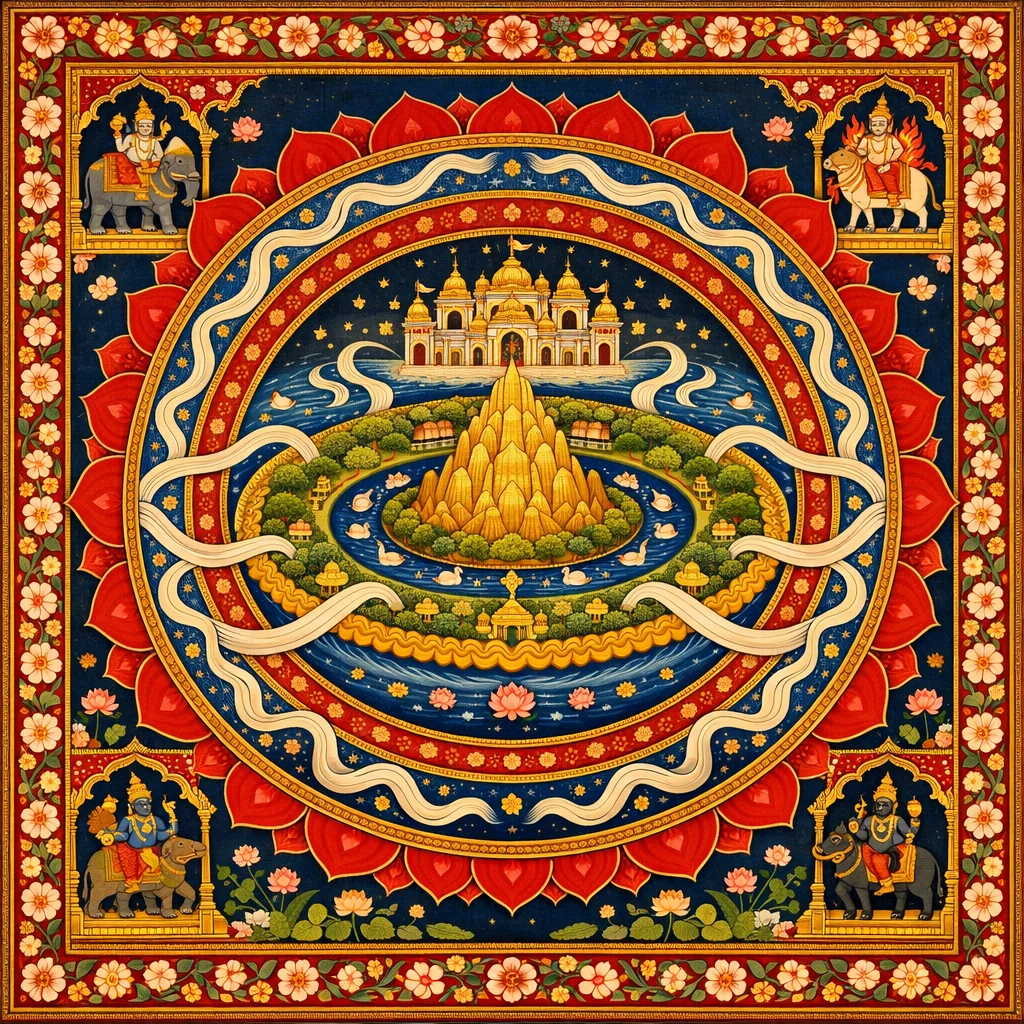
Bhū-maṇḍala as a Lotus: Jambūdvīpa, Ilāvṛta, and the Meru System (Mountains, Rivers, Lakes, and Brahmapurī)
Continuing the Bhū-maṇḍala discussion introduced earlier (Priyavrata’s seven trenches forming seven oceans and islands), Parīkṣit presses Śukadeva for a detailed, measurable description of the dvīpas and varṣas. He also asks how the Lord’s gross universal form (virāṭ) is perceived, since such contemplation elevates the mind toward pure goodness and ultimately toward Vāsudeva beyond the guṇas. Śukadeva answers with epistemic humility—no finite being can exhaustively describe the Lord’s material energy—yet he outlines the principal regions of Bhūloka. He presents Bhū-maṇḍala as lotus-like, with Jambūdvīpa at the center and Ilāvṛta-varṣa as the middle division containing golden Mount Sumeru (Meru) with precise dimensions. He maps the boundary mountains separating the nine varṣas, the four “belt” mountains around Meru, the celestial trees, lakes with distinctive tastes, and gardens enjoyed by Siddhas, Cāraṇas, and Gandharvas. The chapter then explains the origin of fragrant rivers (Aruṇodā, Jambū-nadī), honey streams, and prosperity-giving flows, culminating in Meru’s summit township of Brahmā (Śātakaumbhī) and surrounding abodes of the lokapālas—setting the stage for further elaboration of cosmic regions in subsequent chapters.
Shlokas
Verse 1
राजोवाच उक्तस्त्वया भूमण्डलायामविशेषो यावदादित्यस्तपति यत्र चासौ ज्योतिषां गणैश्चन्द्रमा वा सह दृश्यते ॥ १ ॥
King Parīkṣit said to Śukadeva Gosvāmī: O brāhmaṇa, you have already informed me that the radius of Bhū-maṇḍala extends as far as the sun spreads its light and heat and as far as the moon and all the stars can be seen.
Verse 2
तत्रापि प्रियव्रतरथचरणपरिखातै: सप्तभि: सप्त सिन्धव उपक्लृप्ता यत एतस्या: सप्तद्वीपविशेषविकल्पस्त्वया भगवन् खलु सूचित एतदेवाखिलमहं मानतो लक्षणतश्च सर्वं विजिज्ञासामि ॥ २ ॥
My dear Lord, the rolling wheels of Mahārāja Priyavrata’s chariot created seven ditches, in which the seven oceans came into existence. Because of these seven oceans, Bhū-maṇḍala is divided into seven islands. You have given a very general description of their measurement, names and characteristics. Now I wish to know of them in detail. Kindly fulfill my desire.
Verse 3
भगवतो गुणमये स्थूलरूप आवेशितं मनो ह्यगुणेऽपि सूक्ष्मतम आत्मज्योतिषि परे ब्रह्मणि भगवति वासुदेवाख्ये क्षममावेशितुं तदु हैतद् गुरोऽर्हस्यनुवर्णयितुमिति ॥ ३ ॥
When the mind is fixed upon the Supreme Personality of Godhead in His external feature made of the material modes of nature — the gross universal form — it is brought to the platform of pure goodness. In that transcendental position, one can understand the Supreme Personality of Godhead, Vāsudeva, who in His subtler form is self-effulgent and beyond the modes of nature. O my lord, please describe vividly how that form, which covers the entire universe, is perceived.
Verse 4
ऋषिरुवाच न वै महाराज भगवतो मायागुणविभूते: काष्ठां मनसा वचसा वाधिगन्तुमलं विबुधायुषापि पुरुषस्तस्मात्प्राधान्येनैव भूगोलकविशेषं नामरूप मानलक्षणतो व्याख्यास्याम: ॥ ४ ॥
The great ṛṣi Śukadeva Gosvāmī said: My dear King, there is no limit to the expansion of the Supreme Personality of Godhead’s material energy. This material world is a transformation of the material qualities [sattva-guṇa, rajo-guṇa and tamo-guṇa], yet no one could possibly explain it perfectly, even in a lifetime as long as that of Brahmā. No one in the material world is perfect, and an imperfect person could not describe this material universe accurately, even after continued speculation. O King, I shall nevertheless try to explain to you the principal regions, such as Bhūloka, with their names, forms, measurements and various symptoms.
Verse 5
यो वायं द्वीप: कुवलयकमलकोशाभ्यन्तरकोशो नियुतयोजन विशाल: समवर्तुलो यथा पुष्करपत्रम् ॥ ५ ॥
The planetary system known as Bhū-maṇḍala resembles a lotus flower, and its seven islands resemble the whorl of that flower. The length and breadth of the island known as Jambūdvīpa, which is situated in the middle of the whorl, are one million yojanas [eight million miles]. Jambūdvīpa is round like the leaf of a lotus flower.
Verse 6
यस्मिन्नव वर्षाणि नवयोजनसहस्रायामान्यष्टभिर्मर्यादागिरिभि: सुविभक्तानि भवन्ति ॥ ६ ॥
In Jambūdvīpa there are nine divisions of land, each with a length of 9,000 yojanas [72,000 miles]. There are eight mountains that mark the boundaries of these divisions and separate them nicely.
Verse 7
एषां मध्ये इलावृतं नामाभ्यन्तरवर्षं यस्य नाभ्यामवस्थित: सर्वत: सौवर्ण: कुलगिरिराजो मेरुर्द्वीपायामसमुन्नाह: कर्णिकाभूत: कुवलयकमलस्य मूर्धनि द्वात्रिंशत् सहस्रयोजनविततो मूले षोडशसहस्रं तावतान्तर्भूम्यां प्रविष्ट: ॥ ७ ॥
Amidst these divisions, or varṣas, is the varṣa named Ilāvṛta, which is situated in the middle of the whorl of the lotus. Within Ilāvṛta-varṣa is Sumeru Mountain, which is made of gold. Sumeru Mountain is like the pericarp of the lotuslike Bhū-maṇḍala planetary system. The mountain’s height is the same as the width of Jambūdvīpa — or, in other words, 100,000 yojanas [800,000 miles]. Of that, 16,000 yojanas [128,000 miles] are within the earth, and therefore the mountain’s height above the earth is 84,000 yojanas [672,000 miles]. The mountain’s width is 32,000 yojanas [256,000 miles] at its summit and 16,000 yojanas at its base.
Verse 8
उत्तरोत्तरेणेलावृतं नील: श्वेत: शृङ्गवानिति त्रयो रम्यकहिरण्मयकुरूणां वर्षाणां मर्यादागिरय: प्रागायता उभयत: क्षारोदावधयो द्विसहस्रपृथव एकैकश: पूर्वस्मात्पूर्वस्मादुत्तर उत्तरो दशांशाधिकांशेन दैर्घ्य एव ह्रसन्ति ॥ ८ ॥
Just north of Ilāvṛta-varṣa — and going further northward, one after another — are three mountains named Nīla, Śveta and Śṛṅgavān. These mark the borders of the three varṣas named Ramyaka, Hiraṇmaya and Kuru and separate them from one another. The width of these mountains is 2,000 yojanas [16,000 miles]. Lengthwise, they extend east and west to the beaches of the ocean of salt water. Going from south to north, the length of each mountain is one tenth that of the previous mountain, but the height of them all is the same.
Verse 9
एवं दक्षिणेनेलावृतं निषधो हेमकूटो हिमालय इति प्रागायता यथा नीलादयोऽयुतयोजनोत्सेधा हरिवर्षकिम्पुरुषभारतानां यथासङ्ख्यम् ॥ ९ ॥
Similarly, south of Ilāvṛta-varṣa and extending from east to west are three great mountains named (from north to south) Niṣadha, Hemakūṭa and Himālaya. Each of them is 10,000 yojanas [80,000 miles] high. They mark the boundaries of the three varṣas named Hari-varṣa, Kimpuruṣa-varṣa and Bhārata-varṣa [India].
Verse 10
तथैवेलावृतमपरेण पूर्वेण च माल्यवद्गन्धमादनावानीलनिषधायतौ द्विसहस्रं पप्रथतु: केतुमालभद्राश्वयो: सीमानं विदधाते ॥ १० ॥
In the same way, west and east of Ilāvṛta-varṣa are two great mountains named Mālyavān and Gandhamādana respectively. These two mountains, which are 2,000 yojanas [16,000 miles] high, extend as far as Nīla Mountain in the north and Niṣadha in the south. They indicate the borders of Ilāvṛta-varṣa and also the varṣas known as Ketumāla and Bhadrāśva.
Verse 11
मन्दरो मेरुमन्दर: सुपार्श्व: कुमुद इत्ययुतयोजनविस्तारोन्नाहा मेरोश्चतुर्दिशमवष्टम्भगिरय उपक्लृप्ता: ॥ ११ ॥
On the four sides of the great mountain known as Sumeru are four mountains — Mandara, Merumandara, Supārśva and Kumuda — which are like its belts. The length and height of these mountains are calculated to be 10,000 yojanas [80,000 miles].
Verse 12
चतुर्ष्वेतेषु चूतजम्बूकदम्बन्यग्रोधाश्चत्वार: पादप प्रवरा: पर्वतकेतव इवाधिसहस्रयोजनोन्नाहास्तावद् विटपविततय: शतयोजनपरिणाहा: ॥ १२ ॥
Standing like flagstaffs on the summits of these four mountains are a mango tree, a rose apple tree, a kadamba tree and a banyan tree. Those trees are calculated to have a width of 100 yojanas [800 miles] and a height of 1,100 yojanas [8,800 miles]. Their branches also spread to a radius of 1,100 yojanas.
Verse 13
ह्रदाश्चत्वार: पयोमध्विक्षुरसमृष्टजला यदुपस्पर्शिन उपदेवगणा योगैश्वर्याणि स्वाभाविकानि भरतर्षभ धारयन्ति ॥ १३ ॥ देवोद्यानानि च भवन्ति चत्वारि नन्दनं चैत्ररथं वैभ्राजकं सर्वतोभद्रमिति ॥ १४ ॥
O Mahārāja Parīkṣit, best of the Bharata dynasty, between these four mountains are four huge lakes. The water of the first tastes just like milk; the water of the second, like honey; and that of the third, like sugarcane juice. The fourth lake is filled with pure water. The celestial beings such as the Siddhas, Cāraṇas and Gandharvas, who are also known as demigods, enjoy the facilities of those four lakes. Consequently they have the natural perfections of mystic yoga, such as the power to become smaller than the smallest or greater than the greatest. There are also four celestial gardens named Nandana, Caitraratha, Vaibhrājaka and Sarvatobhadra.
Verse 14
ह्रदाश्चत्वार: पयोमध्विक्षुरसमृष्टजला यदुपस्पर्शिन उपदेवगणा योगैश्वर्याणि स्वाभाविकानि भरतर्षभ धारयन्ति ॥ १३ ॥ देवोद्यानानि च भवन्ति चत्वारि नन्दनं चैत्ररथं वैभ्राजकं सर्वतोभद्रमिति ॥ १४ ॥
O Mahārāja Parīkṣit, best of the Bharata dynasty, between these four mountains are four huge lakes. The water of the first tastes just like milk; the water of the second, like honey; and that of the third, like sugarcane juice. The fourth lake is filled with pure water. The celestial beings such as the Siddhas, Cāraṇas and Gandharvas, who are also known as demigods, enjoy the facilities of those four lakes. Consequently they have the natural perfections of mystic yoga, such as the power to become smaller than the smallest or greater than the greatest. There are also four celestial gardens named Nandana, Caitraratha, Vaibhrājaka and Sarvatobhadra.
Verse 15
येष्वमर परिवृढा: सह सुरललनाललामयूथपतय उपदेवगणैरुपगीयमानमहिमान: किल विहरन्ति ॥ १५ ॥
The best of the demigods, along with their wives, who are like ornaments of heavenly beauty, meet together and enjoy within those gardens, while their glories are sung by lesser demigods known as Gandharvas.
Verse 16
मन्दरोत्सङ्ग एकादशशतयोजनोत्तुङ्गदेवचूतशिरसो गिरिशिखरस्थूलानि फलान्यमृतकल्पानि पतन्ति ॥ १६ ॥
On the lower slopes of Mandara Mountain is a mango tree named Devacūta. It is 1,100 yojanas high. Mangoes as big as mountain peaks and as sweet as nectar fall from the top of this tree for the enjoyment of the denizens of heaven.
Verse 17
तेषां विशीर्यमाणानामतिमधुरसुरभिसुगन्धि बहुलारुणरसोदेनारुणोदा नाम नदी मन्दरगिरिशिखरान्निपतन्ती पूर्वेणेलावृतमुपप्लावयति ॥ १७ ॥
When all those solid fruits fall from such a height, they break, and the sweet, fragrant juice within them flows out and becomes increasingly more fragrant as it mixes with other scents. That juice cascades from the mountain in waterfalls and becomes a river called Aruṇodā, which flows pleasantly through the eastern side of Ilāvṛta.
Verse 18
यदुपजोषणाद्भवान्या अनुचरीणां पुण्यजनवधूनामवयवस्पर्शसुगन्धवातो दशयोजनं समन्तादनुवासयति ॥ १८ ॥
The pious wives of the Yakṣas act as personal maidservants to assist Bhavānī, the wife of Lord Śiva. Because they drink the water of the river Aruṇodā, their bodies become fragrant, and as the air carries away that fragrance, it perfumes the entire atmosphere for eighty miles around.
Verse 19
एवं जम्बूफलानामत्युच्चनिपातविशीर्णानामनस्थिप्रायाणामिभकायनिभानां रसेन जम्बू नाम नदी मेरुमन्दरशिखरादयुतयोजनादवनितले निपतन्ती दक्षिणेनात्मानं यावदिलावृतमुपस्यन्दयति ॥ १९ ॥
Similarly, the fruits of the jambū tree, which are full of pulp and have very small seeds, fall from a great height and break to pieces. Those fruits are the size of elephants, and the juice gliding from them becomes a river named Jambū-nadī. This river falls a distance of 10,000 yojanas, from the summit of Merumandara to the southern side of Ilāvṛta, and floods the entire land of Ilāvṛta with juice.
Verse 20
तावदुभयोरपि रोधसोर्या मृत्तिका तद्रसेनानुविध्यमाना वाय्वर्कसंयोगविपाकेन सदामरलोकाभरणं जाम्बूनदं नाम सुवर्णं भवति ॥ २० ॥ यदु ह वाव विबुधादय: सह युवतिभिर्मुकुटकटककटिसूत्राद्याभरणरूपेण खलु धारयन्ति ॥ २१ ॥
The mud on both banks of the river Jambū-nadī, being moistened by the flowing juice and then dried by the air and the sunshine, produces huge quantities of gold called Jāmbū-nada. The denizens of heaven use this gold for various kinds of ornaments. Therefore all the inhabitants of the heavenly planets and their youthful wives are fully decorated with golden helmets, bangles and belts, and thus they enjoy life.
Verse 21
तावदुभयोरपि रोधसोर्या मृत्तिका तद्रसेनानुविध्यमाना वाय्वर्कसंयोगविपाकेन सदामरलोकाभरणं जाम्बूनदं नाम सुवर्णं भवति ॥ २० ॥ यदु ह वाव विबुधादय: सह युवतिभिर्मुकुटकटककटिसूत्राद्याभरणरूपेण खलु धारयन्ति ॥ २१ ॥
The mud on both banks of the river Jambū-nadī, being moistened by the flowing juice and then dried by the air and the sunshine, produces huge quantities of gold called Jāmbū-nada. The denizens of heaven use this gold for various kinds of ornaments. Therefore all the inhabitants of the heavenly planets and their youthful wives are fully decorated with golden helmets, bangles and belts, and thus they enjoy life.
Verse 22
यस्तु महाकदम्ब: सुपार्श्वनिरूढो यास्तस्य कोटरेभ्यो विनि:सृता: पञ्चायामपरिणाहा: पञ्च मधुधारा: सुपार्श्वशिखरात्पतन्त्योऽपरेणात्मानमिलावृतमनुमोदयन्ति ॥ २२ ॥
On the side of Supārśva Mountain stands a big tree called Mahākadamba, which is very celebrated. From the hollows of this tree flow five rivers of honey, each about five vyāmas wide. This flowing honey falls incessantly from the top of Supārśva Mountain and flows all around Ilāvṛta-varṣa, beginning from the western side. Thus the whole land is saturated with the pleasing fragrance.
Verse 23
या ह्युपयुञ्जानानां मुखनिर्वासितो वायु: समन्ताच्छतयोजनमनुवासयति ॥ २३ ॥
The air carrying the scent from the mouths of those who drink that honey perfumes the land for a hundred yojanas around.
Verse 24
एवं कुमुदनिरूढो य: शतवल्शो नाम वटस्तस्य स्कन्धेभ्यो नीचीना: पयोदधिमधुघृतगुडान्नाद्यम्बरशय्यासनाभरणादय: सर्व एव कामदुघा नदा: कुमुदाग्रात्पतन्तस्तमुत्तरेणेलावृतमुपयोजयन्ति ॥ २४ ॥
Similarly, on Kumuda Mountain there is a great banyan tree, which is called Śatavalśa because it has a hundred main branches. From those branches come many roots, from which many rivers are flowing. These rivers flow down from the top of the mountain to the northern side of Ilāvṛta-varṣa for the benefit of those who live there. Because of these flowing rivers, all the people have ample supplies of milk, yogurt, honey, clarified butter [ghee], molasses, food grains, clothes, bedding, sitting places and ornaments. All the objects they desire are sufficiently supplied for their prosperity, and therefore they are very happy.
Verse 25
यानुपजुषाणानां न कदाचिदपि प्रजानां वलीपलितक्लमस्वेददौर्गन्ध्यजरामयमृत्युशीतोष्णवैवर्ण्योपसर्गादयस्तापविशेषा भवन्ति यावज्जीवं सुखं निरतिशयमेव ॥ २५ ॥
The residents of the material world who enjoy the products of these flowing rivers have no wrinkles on their bodies and no grey hair. They never feel fatigue, and perspiration does not give their bodies a bad odor. They are not afflicted by old age, disease or untimely death, they do not suffer from chilly cold or scorching heat, nor do their bodies lose their luster. They all live very happily, without anxieties, until death.
Verse 26
कुरङ्गकुररकुसुम्भवैकङ्कत्रिकूटशिशिरपतङ्गरुचकनिषधशिनीवासकपिलशङ्खवैदूर्यजारुधिहंसऋषभनागकालञ्जरनारदादयो विंशतिगिरयो मेरो: कर्णिकाया इव केसरभूता मूलदेशे परित उपक्लृप्ता: ॥ २६ ॥
There are other mountains beautifully arranged around the foot of Mount Meru like the filaments around the whorl of a lotus flower. Their names are Kuraṅga, Kurara, Kusumbha, Vaikaṅka, Trikūṭa, Śiśira, Pataṅga, Rucaka, Niṣadha, Sinīvāsa, Kapila, Śaṅkha, Vaidūrya, Jārudhi, Haṁsa, Ṛṣabha, Nāga, Kālañjara and Nārada.
Verse 27
जठरदेवकूटौ मेरुं पूर्वेणाष्टादशयोजनसहस्रमुदगायतौ द्विसहस्रं पृथुतुङ्गौ भवत: । एवमपरेण पवनपारियात्रौ दक्षिणेन कैलासकरवीरौ प्रागायतावेवमुत्तरतस्त्रिशृङ्गमकरावष्टभिरेतै: परिसृतोऽग्निरिव परितश्चकास्ति काञ्चनगिरि: ॥ २७ ॥
On the eastern side of Sumeru Mountain are two mountains named Jaṭhara and Devakūṭa, which extend to the north and south for 18,000 yojanas [144,000 miles]. Similarly, on the western side of Sumeru are two mountains named Pavana and Pāriyātra, which also extend north and south for the same distance. On the southern side of Sumeru are two mountains named Kailāsa and Karavīra, which extend east and west for 18,000 yojanas, and on the northern side of Sumeru, extending for the same distance east and west, are two mountains named Triśṛṅga and Makara. The width and height of all these mountains is 2,000 yojanas [16,000 miles]. Sumeru, a mountain of solid gold shining as brilliantly as fire, is surrounded by these eight mountains.
Verse 28
मेरोर्मूर्धनि भगवत आत्मयोनेर्मध्यत उपक्लृप्तां पुरीमयुतयोजनसाहस्रीं समचतुरस्रां शातकौम्भीं वदन्ति ॥ २८ ॥
In the middle of the summit of Meru is the township of Lord Brahmā. Each of its four sides is calculated to extend for ten million yojanas [eighty million miles]. It is made entirely of gold, and therefore learned scholars and sages call it Śātakaumbhī.
Verse 29
तामनुपरितो लोकपालानामष्टानां यथादिशं यथारूपं तुरीयमानेन पुरोऽष्टावुपक्लृप्ता: ॥ २९ ॥
Surrounding Brahmapurī in all directions are the residences of the eight principal governors of the planetary systems, beginning with King Indra. These abodes are similar to Brahmapurī but are one fourth the size.
Frequently Asked Questions
Parīkṣit’s request is not mere curiosity; it is a śāstric method of fixing the mind. Precise names, forms, and measurements support contemplation of sthāna (cosmic order) and make the virāṭ-rūpa intelligible as a devotional meditation, moving the mind toward sattva and ultimately toward Vāsudeva.
Śukadeva describes Bhū-maṇḍala as lotus-shaped: the seven islands resemble the whorl, and Jambūdvīpa sits centrally like a circular lotus leaf. Within the central division Ilāvṛta stands Mount Sumeru like the lotus pericarp, organizing the surrounding varṣas, mountains, rivers, and celestial abodes.
At Meru’s summit is the township of Lord Brahmā, called Śātakaumbhī (golden). Surrounding it in all directions are the residences of the eight principal governors of planetary systems (lokapālas), beginning with Indra, described as similar in style but one-fourth the size.
Jambū-nadī is formed from the juice of fallen jambū fruits; its banks produce Jāmbū-nada gold when the moistened mud dries. The narrative links cosmic features to divine opulence and celestial culture, illustrating poṣaṇa (sustenance) through nature’s abundance under Bhagavān’s energies.
The lakes (milk, honey, sugarcane juice, and pure water) and gardens (Nandana, Caitraratha, Vaibhrājaka, Sarvatobhadra) are enjoyed by Siddhas, Cāraṇas, and Gandharvas. Their refined environment is said to support natural siddhis (like aṇimā and mahimā), showing how higher realms facilitate extraordinary capacities—yet remain within the governed cosmos.