Adhyaya 21
The Orbit of the Sun, the Measure of Day and Night, and the Sun-God’s Chariot
Continuing the Fifth Canto’s cosmographic survey, Śukadeva Gosvāmī transitions from the universe’s general dimensions to the functional mechanics of time in antarikṣa (mid-space). He explains how the sun’s movement—northward, southward, and across the equator—produces unequal or equal days and nights through its contact with rāśis (zodiacal signs). The chapter then situates the sun’s circular path around Mānasottara Mountain and correlates sunrise, noon, sunset, and midnight with four directional abodes linked to Indra, Yama, Varuṇa, and the moon-god. A key cosmological explanation follows: Sumeru’s inhabitants experience perpetual midday due to the sun’s relative position, while the dakṣiṇāvarta wind creates apparent directional motion. Śukadeva details the sun’s speed, the trayīmaya nature of the sun’s worship (om bhūr bhuvaḥ svaḥ), and the symbolic engineering of the chariot—Saṁvatsara as the wheel, months as spokes, seasons as rim-sections—leading naturally into subsequent descriptions of other luminaries and their regulated courses within Bhū-maṇḍala.
Shlokas
Verse 1
श्रीशुक उवाच एतावानेव भूवलयस्य सन्निवेश: प्रमाणलक्षणतो व्याख्यात: ॥ १ ॥
Śukadeva Gosvāmī said: My dear King, I have thus far described the diameter of the universe [fifty crores of yojanas, or four billion miles] and its general characteristics, according to the estimations of learned scholars.
Verse 2
एतेन हि दिवो मण्डलमानं तद्विद उपदिशन्ति यथा द्विदलयोर्निष्पावादीनां ते अन्तरेणान्तरिक्षं तदुभयसन्धितम् ॥ २ ॥
As a grain of wheat is divided into two parts and one can estimate the size of the upper part by knowing that of the lower, so, expert geographers instruct, one can understand the measurements of the upper part of the universe by knowing those of the lower part. The sky between the earthly sphere and heavenly sphere is called antarikṣa, or outer space. It adjoins the top of the sphere of earth and the bottom of that of heaven.
Verse 3
यन्मध्यगतो भगवांस्तपतपतिस्तपन आतपेन त्रिलोकीं प्रतपत्यवभासयत्यात्मभासा स एष उदगयनदक्षिणायनवैषुवतसंज्ञाभिर्मान्द्यशैघ्य्रसमानाभिर्गतिभिरारोहणावरोहणसमानस्थानेषु यथासवनमभिपद्यमानो मकरादिषु राशिष्वहोरात्राणि दीर्घह्रस्वसमानानि विधत्ते ॥ ३ ॥
In the midst of that region of outer space [antarikṣa] is the most opulent sun, the king of all the planets that emanate heat, such as the moon. By the influence of its radiation, the sun heats the universe and maintains its proper order. It also gives light to help all living entities see. While passing toward the north, toward the south or through the equator, in accordance with the order of the Supreme Personality of Godhead, it is said to move slowly, swiftly or moderately. According to its movements in rising above, going beneath or passing through the equator — and correspondingly coming in touch with various signs of the zodiac, headed by Makara [Capricorn] — days and nights are short, long or equal to one another.
Verse 4
यदा मेषतुलयोर्वर्तते तदाहोरात्राणि समानानि भवन्ति यदा वृषभादिषु पञ्चसु च राशिषु चरति तदाहान्येव वर्धन्ते ह्रसति च मासि मास्येकैका घटिका रात्रिषु ॥ ४ ॥
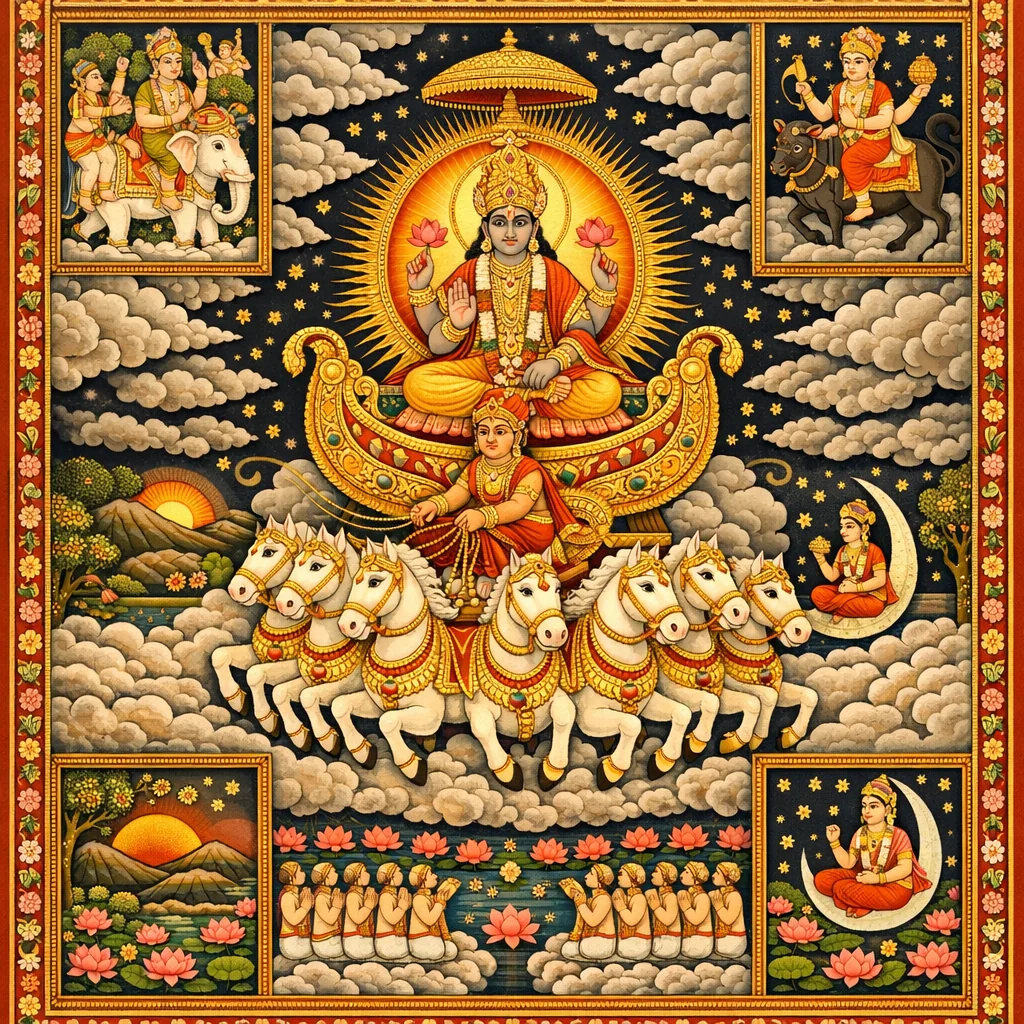
When the sun passes through Meṣa [Aries] and Tulā [Libra], the durations of day and night are equal. When it passes through the five signs headed by Vṛṣabha [Taurus], the duration of the days increases [until Cancer], and then it gradually decreases by half an hour each month, until day and night again become equal [in Libra].
Verse 5
यदा वृश्चिकादिषु पञ्चसु वर्तते तदाहोरात्राणि विपर्ययाणि भवन्ति ॥ ५ ॥
When the sun passes through the five signs beginning with Vṛścika [Scorpio], the duration of the days decreases [until Capricorn], and then gradually it increases month after month, until day and night become equal [in Aries].
Verse 6
यावद्दक्षिणायनमहानि वर्धन्ते यावदुदगयनं रात्रय: ॥ ६ ॥
Until the sun travels to the south the days grow longer, and until it travels to the north the nights grow longer.
Verse 7
एवं नव कोटय एकपञ्चाशल्लक्षाणि योजनानां मानसोत्तरगिरिपरिवर्तनस्योपदिशन्ति तस्मिन्नैन्द्रीं पुरीं पूर्वस्मान्मेरोर्देवधानीं नाम दक्षिणतो याम्यां संयमनीं नाम पश्चाद्वारुणीं निम्लोचनीं नाम उत्तरत: सौम्यां विभावरीं नाम तासूदयमध्याह्नास्तमयनिशीथानीति भूतानां प्रवृत्तिनिवृत्तिनिमित्तानि समयविशेषेण मेरोश्चतुर्दिशम् ॥ ७ ॥
Śukadeva Gosvāmī continued; My dear King, as stated before, the learned say that the sun travels over all sides of Mānasottara Mountain in a circle whose length is 95,100,000 yojanas [760,800,000 miles]. On Mānasottara Mountain, due east of Mount Sumeru, is a place known as Devadhānī, possessed by King Indra. Similarly, in the south is a place known as Saṁyamanī, possessed by Yamarāja, in the west is a place known as Nimlocanī, possessed by Varuṇa, and in the north is a place named Vibhāvarī, possessed by the moon-god. Sunrise, midday, sunset and midnight occur in all those places according to specific times, thus engaging all living entities in their various occupational duties and also making them cease such duties.
Verse 8
तत्रत्यानां दिवसमध्यङ्गत एव सदाऽऽदित्यस्तपति सव्येनाचलं दक्षिणेन करोति ॥ ८ ॥ यत्रोदेति तस्य ह समानसूत्रनिपाते निम्लोचति यत्र क्वचन स्यन्देनाभितपति तस्य हैष समानसूत्रनिपाते प्रस्वापयति तत्र गतं न पश्यन्ति ये तं समनुपश्येरन् ॥ ९ ॥
The living entities residing on Sumeru Mountain are always very warm, as at midday, because for them the sun is always overhead. Although the sun moves counterclockwise, facing the constellations, with Sumeru Mountain on its left, it also moves clockwise and appears to have the mountain on its right because it is influenced by the dakṣiṇāvarta wind. People living in countries at points diametrically opposite to where the sun is first seen rising will see the sun setting, and if a straight line were drawn from a point where the sun is at midday, the people in countries at the opposite end of the line would be experiencing midnight. Similarly, if people residing where the sun is setting were to go to countries diametrically opposite, they would not see the sun in the same condition.
Verse 9
तत्रत्यानां दिवसमध्यङ्गत एव सदाऽऽदित्यस्तपति सव्येनाचलं दक्षिणेन करोति ॥ ८ ॥ यत्रोदेति तस्य ह समानसूत्रनिपाते निम्लोचति यत्र क्वचन स्यन्देनाभितपति तस्य हैष समानसूत्रनिपाते प्रस्वापयति तत्र गतं न पश्यन्ति ये तं समनुपश्येरन् ॥ ९ ॥
The living entities residing on Sumeru Mountain are always very warm, as at midday, because for them the sun is always overhead. Although the sun moves counterclockwise, facing the constellations, with Sumeru Mountain on its left, it also moves clockwise and appears to have the mountain on its right because it is influenced by the dakṣiṇāvarta wind. People living in countries at points diametrically opposite to where the sun is first seen rising will see the sun setting, and if a straight line were drawn from a point where the sun is at midday, the people in countries at the opposite end of the line would be experiencing midnight. Similarly, if people residing where the sun is setting were to go to countries diametrically opposite, they would not see the sun in the same condition.
Verse 10
यदा चैन्द्य्रा: पुर्या: प्रचलते पञ्चदशघटिकाभिर्याम्यां सपादकोटिद्वयं योजनानां सार्धद्वादशलक्षाणि साधिकानि चोपयाति ॥ १० ॥
When the sun travels from Devadhānī, the residence of Indra, to Saṁyamanī, the residence of Yamarāja, it travels 23,775,000 yojanas [190,200,000 miles] in fifteen ghaṭikās [six hours].
Verse 11
एवं ततो वारुणीं सौम्यामैन्द्रीं च पुनस्तथान्ये च ग्रहा: सोमादयो नक्षत्रै: सह ज्योतिश्चक्रे समभ्युद्यन्ति सह वा निम्लोचन्ति ॥ ११ ॥
From the residence of Yamarāja the sun travels to Nimlocanī, the residence of Varuṇa, from there to Vibhāvarī, the residence of the moon-god, and from there again to the residence of Indra. In a similar way, the moon, along with the other stars and planets, becomes visible in the celestial sphere and then sets and again becomes invisible.
Verse 12
एवं मुहूर्तेन चतुस्त्रिंशल्लक्षयोजनान्यष्टशताधिकानि सौरो रथस्त्रयीमयोऽसौ चतसृषु परिवर्तते पुरीषु ॥ १२ ॥
Thus the chariot of the sun-god, which is trayīmaya, or worshiped by the words om bhūr bhuvaḥ svaḥ, travels through the four residences mentioned above at a speed of 3,400,800 yojanas [27,206,400 miles] in a muhūrta.
Verse 13
यस्यैकं चक्रं द्वादशारं षण्नेमि त्रिणाभि संवत्सरात्मकं समामनन्ति तस्याक्षो मेरोर्मूर्धनि कृतो मानसोत्तरे कृतेतरभागो यत्र प्रोतं रविरथचक्रं तैलयन्त्रचक्रवद् भ्रमन्मानसोत्तरगिरौ परिभ्रमति ॥ १३ ॥
The chariot of the sun-god has only one wheel, which is known as Saṁvatsara. The twelve months are calculated to be its twelve spokes, the six seasons are the sections of its rim, and the three cātur-māsya periods are its three-sectioned hub. One side of the axle carrying the wheel rests upon the summit of Mount Sumeru, and the other rests upon Mānasottara Mountain. Affixed to the outer end of the axle, the wheel continuously rotates on Mānasottara Mountain like the wheel of an oil-pressing machine.
Verse 14
तस्मिन्नक्षे कृतमूलो द्वितीयोऽक्षस्तुर्यमानेन सम्मितस्तैलयन्त्राक्षवद् ध्रुवे कृतोपरिभाग: ॥ १४ ॥
As in an oil-pressing machine, this first axle is attached to a second axle, which is one-fourth as long [3,937,500 yojanas, or 31,500,000 miles]. The upper end of this second axle is attached to Dhruvaloka by a rope of wind.
Verse 15
रथनीडस्तु षट्त्रिंशल्लक्षयोजनायतस्तत्तुरीयभागविशालस्तावान् रविरथयुगो यत्र हयाश्छन्दोनामान: सप्तारुणयोजिता वहन्ति देवमादित्यम् ॥ १५ ॥
My dear King, the carriage of the sun-god’s chariot is estimated to be 3,600,000 yojanas [28,800,000 miles] long and one-fourth as wide [900,000 yojanas, or 7,200,000 miles]. The chariot’s horses, which are named after Gāyatrī and other Vedic meters, are harnessed by Aruṇadeva to a yoke that is also 900,000 yojanas wide. This chariot continuously carries the sun-god.
Verse 16
पुरस्तात्सवितुररुण: पश्चाच्च नियुक्त: सौत्ये कर्मणि किलास्ते ॥ १६ ॥
Although Aruṇadeva sits in front of the sun-god and is engaged in driving the chariot and controlling the horses, he looks backward toward the sun-god.
Verse 17
तथा वालिखिल्या ऋषयोऽङ्गुष्ठपर्वमात्रा: षष्टिसहस्राणि पुरत: सूर्यं सूक्तवाकाय नियुक्ता: संस्तुवन्ति ॥ १७ ॥
There are sixty thousand saintly persons named Vālikhilyas, each the size of a thumb, who are located in front of the sun-god and who offer him eloquent prayers of glorification.
Verse 18
तथान्ये च ऋषयो गन्धर्वाप्सरसो नागा ग्रामण्यो यातुधाना देवा इत्येकैकशो गणा: सप्त चतुर्दश मासि मासि भगवन्तं सूर्यमात्मानं नानानामानं पृथङ्नानानामान: पृथक्कर्मभिर्द्वन्द्वश उपासते ॥ १८ ॥
Similarly, fourteen other saints, Gandharvas, Apsarās, Nāgas, Yakṣas, Rākṣasas and demigods, who are divided into groups of two, assume different names every month and continuously perform different ritualistic ceremonies to worship the Supreme Lord as the most powerful demigod Sūryadeva, who holds many names.
Verse 19
लक्षोत्तरं सार्धनवकोटियोजनपरिमण्डलं भूवलयस्य क्षणेन सगव्यूत्युत्तरं द्विसहस्रयोजनानि स भुङ्क्ते ॥ १९ ॥
My dear King, in his orbit through Bhū-maṇḍala, the sun-god traverses a distance of 95,100,000 yojanas [760,800,000 miles] at the speed of 2,000 yojanas and two krośas [16,004 miles] in a moment.
Frequently Asked Questions
Śukadeva links day/night length to the sun’s course through the zodiac and its shifting position north of, south of, or on the equator. When the sun passes Meṣa (Aries) and Tulā (Libra), day and night are equal; through the signs beginning with Vṛṣabha (Taurus) days increase up to the northern extreme and then decrease, while through signs beginning with Vṛścika (Scorpio) days decrease toward the southern extreme and then increase again—presented as a regulated system under the Supreme Lord’s order.
They are described as four key stations on Mānasottara Mountain aligned with the cardinal directions: Devadhānī (east, Indra), Saṁyamanī (south, Yamarāja), Nimlocanī (west, Varuṇa), and Vibhāvarī (north, the moon-god). The chapter uses them to explain how sunrise, midday, sunset, and midnight occur in a coordinated manner across the world.
Trayīmaya indicates that the sun is worshiped through the Vedic triad—often expressed as om bhūr bhuvaḥ svaḥ—signifying that Sūrya’s role is integrated with Vedic revelation and yajña. The sun is not independent; it functions as a powerful deva executing the Supreme Lord’s command, enabling vision, heat, seasons, and the ritual calendar.
The naming expresses that cosmic movement and sacred sound are coordinated: chandas (Vedic meters) symbolize regulated rhythm, measure, and order. By portraying the horses as meters, the text frames the sun’s motion as a disciplined, dharma-supporting cadence rather than random physical drift.
They are sixty thousand tiny sages (thumb-sized) positioned before the sun who continuously offer prayers. Their presence emphasizes that the sun’s grandeur is embedded in devotion and liturgy—cosmic power is surrounded by glorification of the Lord and His empowered servants.