Adhyaya 17
Viṣṇupadī Gaṅgā: Descent, Cosmic Pathways, and Śiva’s Praise of Saṅkarṣaṇa
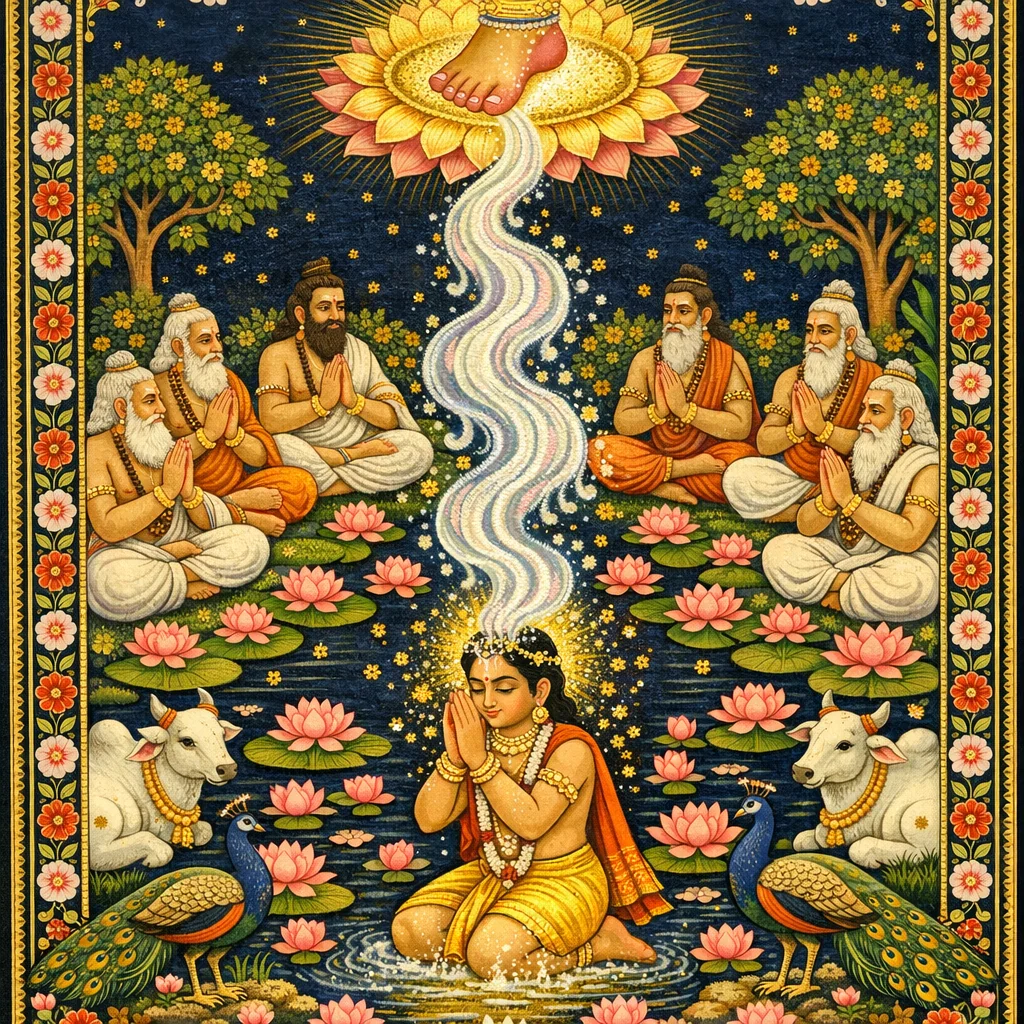
Continuing Skandha 5’s Bhū-maṇḍala mapping, this chapter pivots from spatial description to the sanctifying movement of Gaṅgā, linking cosmic geography with devotional causality. Śukadeva explains that when Vāmanadeva expanded His foot, the universe’s covering was pierced and the causal waters entered as Gaṅgā, becoming pink from the Lord’s foot-dust and eternally purifying as Viṣṇupadī. The river’s descent is traced through Dhruvaloka—where Dhruva Mahārāja receives it on his head in ecstasy—and past the Saptarṣis, who regard it as the culmination of austerity and the wealth of spiritual life. Gaṅgā then reaches Candraloka and Brahmā’s abode atop Meru, dividing into four principal branches (Sītā, Alakanandā, Cakṣu, Bhadrā) that irrigate varṣas and oceans. The narrative then transitions to Ilāvṛta-varṣa, where Śiva alone resides, guarded by Durgā, and culminates in Śiva’s stotra to Saṅkarṣaṇa, affirming the Lord’s transcendence over creation and māyā. This sets up the next movement: further detailing of varṣas, their rulers, and the Lord’s expansions worshiped therein.
Shlokas
Verse 1
श्रीशुक उवाच तत्र भगवत: साक्षाद्यज्ञलिङ्गस्य विष्णोर्विक्रमतो वामपादाङ्गुष्ठनखनिर्भिन्नोर्ध्वाण्डकटाहविवरेणान्त:प्रविष्टा या बाह्यजलधारा तच्चरणपङ्कजावनेजनारुणकिञ्जल्कोपरञ्जिताखिलजगदघमलापहोपस्पर्शनामला साक्षाद्भगवत्पदीत्यनुपलक्षितवचोऽभिधीयमानातिमहता कालेन युगसहस्रोपलक्षणेन दिवो मूर्धन्यवततार यत्तद्विष्णुपदमाहु: ॥ १ ॥
Śukadeva Gosvāmī said: My dear King, Lord Viṣṇu, the enjoyer of all sacrifices, appeared as Vāmanadeva in the sacrificial arena of Bali Mahārāja. Then He extended His left foot to the end of the universe and pierced a hole in its covering with the nail of His big toe. Through the hole, the pure water of the Causal Ocean entered this universe as the Ganges River. Having washed the lotus feet of the Lord, which are covered with reddish powder, the water of the Ganges acquired a very beautiful pink color. Every living being can immediately purify his mind of material contamination by touching the transcendental water of the Ganges, yet its waters remain ever pure. Because the Ganges directly touches the lotus feet of the Lord before descending within this universe, she is known as Viṣṇupadī. Later she received other names like Jāhnavī and Bhāgīrathī. After one thousand millenniums, the water of the Ganges descended to Dhruvaloka, the topmost planet in this universe. Therefore all learned sages and scholars proclaim Dhruvaloka to be Viṣṇupada [“situated on Lord Viṣṇu’s lotus feet”].
Verse 2
यत्र ह वाव वीरव्रत औत्तानपादि: परमभागवतोऽस्मत्कुलदेवताचरणारविन्दोदकमिति यामनुसवनमुत्कृष्यमाणभगवद्भक्तियोगेन दृढं क्लिद्यमानान्तर्हृदय औत्कण्ठ्यविवशामीलितलोचनयुगलकुड्मलविगलितामलबाष्पकलयाभिव्यज्यमानरोमपुलककुलकोऽधुनापि परमादरेण शिरसा बिभर्ति ॥ २ ॥
Dhruva Mahārāja, the famous son of Mahārāja Uttānapāda, is known as the most exalted devotee of the Supreme Lord because of his firm determination in executing devotional service. Knowing that the sacred Ganges water washes the lotus feet of Lord Viṣṇu, Dhruva Mahārāja, situated on his own planet, to this very day accepts that water on his head with great devotion. Because he constantly thinks of Kṛṣṇa very devoutly within the core of his heart, he is overcome with ecstatic anxiety. Tears flow from his half-open eyes, and eruptions appear on his entire body.
Verse 3
तत: सप्त ऋषयस्तत्प्रभावाभिज्ञा यां ननु तपसआत्यन्तिकी सिद्धिरेतावती भगवति सर्वात्मनि वासुदेवेऽनुपरतभक्तियोगलाभेनैवोपेक्षितान्यार्थात्मगतयो मुक्तिमिवागतां मुमुक्षव इव सबहुमानमद्यापि जटाजूटैरुद्वहन्ति ॥ ३ ॥
The seven great sages [Marīci, Vasiṣṭha, Atri and so on] reside on planets beneath Dhruvaloka. Well aware of the influence of the water of the Ganges, to this day they keep Ganges water on the tufts of hair on their heads. They have concluded that this is the ultimate wealth, the perfection of all austerities, and the best means of prosecuting transcendental life. Having obtained uninterrupted devotional service to the Supreme Personality of Godhead, they neglect all other beneficial processes like religion, economic development, sense gratification and even merging into the Supreme. Just as jñānīs think that merging into the existence of the Lord is the highest truth, these seven exalted personalities accept devotional service as the perfection of life.
Verse 4
ततोऽनेकसहस्रकोटिविमानानीकसङ्कुलदेवयानेनावतरन्तीन्दुमण्डलमावार्य ब्रह्मसदने निपतति ॥ ४ ॥
After purifying the seven planets near Dhruvaloka [the polestar], the Ganges water is carried through the spaceways of the demigods in billions of celestial airplanes. Then it inundates the moon [Candraloka] and finally reaches Lord Brahmā’s abode atop Mount Meru.
Verse 5
तत्र चतुर्धा भिद्यमाना चतुर्भिर्नामभिश्चतुर्दिशमभिस्पन्दन्ती नदनदीपतिमेवाभिनिविशति सीतालकनन्दा चक्षुर्भद्रेति ॥ ५ ॥
On top of Mount Meru, the Ganges divides into four branches, each of which gushes in a different direction [east, west, north and south]. These branches, known by the names Sītā, Alakanandā, Cakṣu and Bhadrā, flow down to the ocean.
Verse 6
सीता तु ब्रह्मसदनात्केसराचलादिगिरिशिखरेभ्योऽधोऽध: प्रस्रवन्ती गन्धमादनमूर्धसु पतित्वान्तरेण भद्राश्ववर्षं प्राच्यां दिशि क्षारसमुद्रमभिप्रविशति ॥ ६ ॥
The branch of the Ganges known as the Sītā flows through Brahmapurī atop Mount Meru, and from there it runs down to the nearby peaks of the Kesarācala Mountains, which stand almost as high as Mount Meru itself. These mountains are like a bunch of filaments around Mount Meru. From the Kesarācala Mountains, the Ganges falls to the peak of Gandhamādana Mountain and then flows into the land of Bhadrāśva-varṣa. Finally it reaches the ocean of salt water in the west.
Verse 7
एवं माल्यवच्छिखरान्निष्पतन्ती ततोऽनुपरतवेगा केतुमालमभि चक्षु: प्रतीच्यां दिशि सरित्पतिं प्रविशति ॥ ७ ॥
The branch of the Ganges known as Cakṣu falls onto the summit of Mālyavān Mountain and from there cascades onto the land of Ketumāla-varṣa. The Ganges flows incessantly through Ketumāla-varṣa and in this way also reaches the ocean of salt water in the west.
Verse 8
भद्रा चोत्तरतो मेरुशिरसो निपतिता गिरिशिखराद्गिरिशिखरमतिहाय शृङ्गवत: शृङ्गादवस्यन्दमाना उत्तरांस्तु कुरूनभित उदीच्यां दिशि जलधिमभिप्रविशति ॥ ८ ॥
The branch of the Ganges known as Bhadrā flows from the northern side of Mount Meru. Its waters fall onto the peaks of Kumuda Mountain, Mount Nīla, Śveta Mountain and Śṛṅgavān Mountain in succession. Then it runs down into the province of Kuru and, after crossing through that land, flows into the saltwater ocean in the north.
Verse 9
तथैवालकनन्दा दक्षिणेन ब्रह्मसदनाद्बहूनि गिरिकूटान्यतिक्रम्य हेमकूटाद्धैमकूटान्यतिरभसतररंहसा लुठयन्ती भारतमभिवर्षं दक्षिणस्यां दिशि जलधिमभिप्रविशति यस्यां स्नानार्थं चागच्छत: पुंस: पदे पदेऽश्वमेधराजसूयादीनां फलं न दुर्लभमिति ॥ ९ ॥
Similarly, the branch of the Ganges known as Alakanandā flows from the southern side of Brahmapurī [Brahma-sadana]. Passing over the tops of mountains in various lands, it falls down with fierce force upon the peaks of the mountains Hemakūṭa and Himakūṭa. After inundating the tops of those mountains, the Ganges falls down onto the tract of land known as Bhārata-varṣa, which she also inundates. Then the Ganges flows into the ocean of salt water in the south. Persons who come to bathe in this river are fortunate. It is not very difficult for them to achieve with every step the results of performing great sacrifices like the Rājasūya and Aśvamedha yajñas.
Verse 10
अन्ये च नदा नद्यश्च वर्षे वर्षे सन्ति बहुशो मेर्वादिगिरिदुहितर: शतश: ॥ १० ॥
Many other rivers, both big and small, flow from the top of Mount Meru. These rivers are like daughters of the mountain, and they flow to the various tracts of land in hundreds of branches.
Verse 11
तत्रापि भारतमेव वर्षं कर्मक्षेत्रमन्यान्यष्ट वर्षाणि स्वर्गिणां पुण्यशेषोपभोगस्थानानि भौमानि स्वर्गपदानि व्यपदिशन्ति ॥ ११ ॥
Among the nine varṣas, the tract of land known as Bhārata-varṣa is understood to be the field of fruitive activities. Learned scholars and saintly persons declare the other eight varṣas to be meant for very highly elevated pious persons. After returning from the heavenly planets, they enjoy the remaining results of their pious activities in these eight earthly varṣas.
Verse 12
एषु पुरुषाणामयुतपुरुषायुर्वर्षाणां देवकल्पानां नागायुतप्राणानां वज्रसंहननबलवयोमोदप्रमुदितमहासौरतमिथुनव्यवायापवर्गवर्षधृतैकगर्भ कलत्राणां तत्र तु त्रेतायुगसम: कालो वर्तते ॥ १२ ॥
In these eight varṣas, or tracts of land, human beings live ten thousand years according to earthly calculations. All the inhabitants are almost like demigods. They have the bodily strength of ten thousand elephants. Indeed, their bodies are as sturdy as thunderbolts. The youthful duration of their lives is very pleasing, and both men and women enjoy sexual union with great pleasure for a long time. After years of sensual pleasure — when a balance of one year of life remains — the wife conceives a child. Thus the standard of pleasure for the residents of these heavenly regions is exactly like that of the human beings who lived during Tretā-yuga.
Verse 13
यत्र ह देवपतय: स्वै: स्वैर्गणनायकैर्विहितमहार्हणा: सर्वर्तुकुसुमस्तबकफलकिसलयश्रियाऽऽनम्यमानविटपलता विटपिभिरुपशुम्भमानरुचिरकाननाश्रमायतनवर्षगिरिद्रोणीषु तथा चामलजलाशयेषु विकचविविधनववनरुहामोदमुदितराजहंसजलकुक्कुटकारण्डवसारसचक्रवाकादिभिर्मधुकरनिकराकृतिभिरुपकूजितेषु जलक्रीडादिभिर्विचित्रविनोदै: सुललितसुरसुन्दरीणां कामकलिलविलासहासलीलावलोकाकृष्टमनोदृष्टय: स्वैरं विहरन्ति ॥ १३ ॥
In each of those tracts of land, there are many gardens filled with flowers and fruits according to the season, and there are beautifully decorated hermitages as well. Between the great mountains demarcating the borders of those lands lie enormous lakes of clear water filled with newly grown lotus flowers. Aquatic birds such as swans, ducks, water chickens, and cranes become greatly excited by the fragrance of lotus flowers, and the charming sound of bumblebees fills the air. The inhabitants of those lands are important leaders among the demigods. Always attended by their respective servants, they enjoy life in gardens alongside the lakes. In this pleasing situation, the wives of the demigods smile playfully at their husbands and look upon them with lusty desires. All the demigods and their wives are constantly supplied with sandalwood pulp and flower garlands by their servants. In this way, all the residents of the eight heavenly varṣas enjoy, attracted by the activities of the opposite sex.
Verse 14
नवस्वपि वर्षेषु भगवान्नारायणो महापुरुष: पुरुषाणां तदनुग्रहायात्मतत्त्वव्यूहेनात्मनाद्यापि सन्निधीयते ॥ १४ ॥
To show mercy to His devotees in each of these nine tracts of land, the Supreme Personality of Godhead known as Nārāyaṇa expands Himself in His quadruple principles of Vāsudeva, Saṅkarṣaṇa, Pradyumna and Aniruddha. In this way He remains near His devotees to accept their service.
Verse 15
इलावृते तु भगवान् भव एक एव पुमान्न ह्यन्यस्तत्रापरो निर्विशति भवान्या: शापनिमित्तज्ञो यत्प्रवेक्ष्यत: स्त्रीभावस्तत्पश्चाद्वक्ष्यामि ॥ १५ ॥
Śukadeva Gosvāmī said: In the tract of land known as Ilāvṛta-varṣa, the only male person is Lord Śiva, the most powerful demigod. Goddess Durgā, the wife of Lord Śiva, does not like any man to enter that land. If any foolish man dares to do so, she immediately turns him into a woman. I shall explain this later [in the Ninth Canto of Śrīmad-Bhāgavatam].
Verse 16
भवानीनाथै: स्त्रीगणार्बुदसहस्रैरवरुध्यमानो भगवतश्चतुर्मूर्तेर्महापुरुषस्य तुरीयां तामसीं मूर्तिं प्रकृतिमात्मन: सङ्कर्षणसंज्ञामात्मसमाधिरूपेण सन्निधाप्यैतदभिगृणन् भव उप-धावति ॥ १६ ॥
In Ilāvṛta-varṣa, Lord Śiva is always encircled by ten billion maidservants of Goddess Durgā, who minister to him. The quadruple expansion of the Supreme Lord is composed of Vāsudeva, Pradyumna, Aniruddha and Saṅkarṣaṇa. Saṅkarṣaṇa, the fourth expansion, is certainly transcendental, but because His activities of destruction in the material world are in the mode of ignorance, He is known as tāmasī, the Lord’s form in the mode of ignorance. Lord Śiva knows that Saṅkarṣaṇa is the original cause of his own existence, and thus he always meditates upon Him in trance by chanting the following mantra.
Verse 17
श्रीभगवानुवाच ॐ नमो भगवते महापुरुषाय सर्वगुणसङ्ख्यानायानन्तायाव्यक्ताय नम इति ॥ १७ ॥
The most powerful Lord Śiva says: O Supreme Personality of Godhead, I offer my respectful obeisances unto You in Your expansion as Lord Saṅkarṣaṇa. You are the reservoir of all transcendental qualities. Although You are unlimited, You remain unmanifest to the nondevotees.
Verse 18
भजे भजन्यारणपादपङ्कजंभगस्य कृत्स्नस्य परं परायणम् । भक्तेष्वलं भावितभूतभावनंभवापहं त्वा भवभावमीश्वरम् ॥ १८ ॥
O my Lord, You are the only worshipable person, for You are the Supreme Personality of Godhead, the reservoir of all opulences. Your secure lotus feet are the only source of protection for all Your devotees, whom You satisfy by manifesting Yourself in various forms. O my Lord, You deliver Your devotees from the clutches of material existence. Nondevotees, however, remain entangled in material existence by Your will. Kindly accept me as Your eternal servant.
Verse 19
न यस्य मायागुणचित्तवृत्तिभि-र्निरीक्षतो ह्यण्वपि दृष्टिरज्यते । ईशे यथा नोऽजितमन्युरंहसांकस्तं न मन्येत जिगीषुरात्मन: ॥ १९ ॥
We cannot control the force of our anger. Therefore when we look at material things, we cannot avoid feeling attraction or repulsion for them. But the Supreme Lord is never affected in this way. Although He glances over the material world for the purpose of creating, maintaining and destroying it, He is not affected, even to the slightest degree. Therefore, one who desires to conquer the force of the senses must take shelter of the lotus feet of the Lord. Then he will be victorious.
Verse 20
असद्दृशो य: प्रतिभाति मायया क्षीबेव मध्वासवताम्रलोचन: । न नागवध्वोऽर्हण ईशिरे ह्रियायत्पादयो: स्पर्शनधर्षितेन्द्रिया: ॥ २० ॥
For persons with impure vision, the Supreme Lord’s eyes appear like those of someone who indiscriminately drinks intoxicating beverages. Thus bewildered, such unintelligent persons become angry at the Supreme Lord, and due to their angry mood the Lord Himself appears angry and very fearful. However, this is an illusion. When the wives of the serpent demon were agitated by the touch of the Lord’s lotus feet, due to shyness they could proceed no further in their worship of Him. Yet the Lord remained unagitated by their touch, for He is equipoised in all circumstances. Therefore who will not worship the Supreme Personality of Godhead?
Verse 21
यमाहुरस्य स्थितिजन्मसंयमंत्रिभिर्विहीनं यमनन्तमृषय: । न वेद सिद्धार्थमिव क्वचित्स्थितंभूमण्डलं मूर्धसहस्रधामसु॒ ॥ २१ ॥
Lord Śiva continued: All the great sages accept the Lord as the source of creation, maintenance and destruction, although He actually has nothing to do with these activities. Therefore the Lord is called unlimited. Although the Lord in His incarnation as Śeṣa holds all the universes on His hoods, each universe feels no heavier than a mustard seed to Him. Therefore, what person desiring perfection will not worship the Lord?
Verse 22
यस्याद्य आसीद् गुणविग्रहो महान्विज्ञानधिष्ण्यो भगवानज: किल । यत्सम्भवोऽहं त्रिवृता स्वतेजसावैकारिकं तामसमैन्द्रियं सृजे ॥ २२ ॥ एते वयं यस्य वशे महात्मन:स्थिता: शकुन्ता इव सूत्रयन्त्रिता: । महानहं वैकृततामसेन्द्रिया:सृजाम सर्वे यदनुग्रहादिदम् ॥ २३ ॥
From that Supreme Personality of Godhead appears Lord Brahmā, whose body is made from the total material energy, the reservoir of intelligence predominated by the passionate mode of material nature. From Lord Brahmā, I myself am born as a representation of false ego known as Rudra. By my own power I create all the other demigods, the five elements and the senses. Therefore, I worship the Supreme Personality of Godhead, who is greater than any of us and under whose control are situated all the demigods, material elements and senses, and even Lord Brahmā and I myself, like birds bound by a rope. Only by the Lord’s grace can we create, maintain and annihilate the material world. Therefore I offer my respectful obeisances unto the Supreme Being.
Verse 23
यस्याद्य आसीद् गुणविग्रहो महान्विज्ञानधिष्ण्यो भगवानज: किल । यत्सम्भवोऽहं त्रिवृता स्वतेजसावैकारिकं तामसमैन्द्रियं सृजे ॥ २२ ॥ एते वयं यस्य वशे महात्मन:स्थिता: शकुन्ता इव सूत्रयन्त्रिता: । महानहं वैकृततामसेन्द्रिया:सृजाम सर्वे यदनुग्रहादिदम् ॥ २३ ॥
From that Supreme Personality of Godhead appears Lord Brahmā, whose body is made from the total material energy, the reservoir of intelligence predominated by the passionate mode of material nature. From Lord Brahmā, I myself am born as a representation of false ego known as Rudra. By my own power I create all the other demigods, the five elements and the senses. Therefore, I worship the Supreme Personality of Godhead, who is greater than any of us and under whose control are situated all the demigods, material elements and senses, and even Lord Brahmā and I myself, like birds bound by a rope. Only by the Lord’s grace can we create, maintain and annihilate the material world. Therefore I offer my respectful obeisances unto the Supreme Being.
Verse 24
यन्निर्मितां कर्ह्यपि कर्मपर्वणींमायां जनोऽयं गुणसर्गमोहित: । न वेद निस्तारणयोगमञ्जसातस्मै नमस्ते विलयोदयात्मने ॥ २४ ॥
The illusory energy of the Supreme Personality of Godhead binds all of us conditioned souls to this material world. Therefore, without being favored by Him, persons like us cannot understand how to get out of that illusory energy. Let me offer my respectful obeisances unto the Lord, who is the cause of creation and annihilation.
Frequently Asked Questions
She is called Viṣṇupadī because her waters first touch and wash the lotus feet of Lord Viṣṇu before entering the universe. This contact establishes her as intrinsically purifying (pavitrīkaraṇa) and theologically marks her as grace descending from the Lord (āśraya), not merely a terrestrial river.
Gaṅgā descends to Dhruvaloka after an immense span of time, and Dhruva Mahārāja continuously receives that water on his head in devotion. Because the river is Viṣṇu’s foot-wash and reaches Dhruva’s realm, sages describe Dhruvaloka as ‘Viṣṇupada’—a realm defined by proximity to the Lord’s lotus feet and by unwavering remembrance of Kṛṣṇa.
Atop Mount Meru, Gaṅgā divides into four principal streams flowing in the cardinal directions: Sītā, Alakanandā, Cakṣu, and Bhadrā. Each branch is traced through specific mountains and varṣas, showing how sacred water structures the cosmic landscape and sanctifies multiple realms.
Bhārata-varṣa is singled out as karmabhūmi because it is the arena where deliberate dharma, yajña, and conscious spiritual choice are emphasized. The other varṣas are portrayed as enjoyment-realms for highly pious beings exhausting residual merit, whereas Bhārata-varṣa uniquely supports purposeful sādhana leading beyond karma to bhakti and mukti.
The chapter states that Lord Śiva is the only male in Ilāvṛta-varṣa and that Durgā prevents other men from entering, transforming intruders into women. The narrative underscores Ilāvṛta as a protected divine domain centered on Śiva’s worship and discipline, emphasizing boundaries around sacred space and the potency of the presiding śakti.
Śiva acknowledges Saṅkarṣaṇa as the original cause of his own existence and the transcendental foundation behind cosmic functions. Although Śiva is associated with destruction and the guṇa dynamics, his stotra clarifies that the Supreme Lord remains untouched by material modes; therefore, mastery over senses and liberation from māyā require shelter at the Lord’s lotus feet.