Adhyaya 18
Varṣa-devatā Worship in Jambūdvīpa: Hayagrīva/Hayaśīrṣa, Nṛsiṁha, Kāmadeva (Pradyumna), Matsya, Kūrma, and Varāha
Continuing the Fifth Canto’s systematic presentation of Jambūdvīpa and its varṣas, Śukadeva shifts from descriptive cosmography to liturgical theology by detailing how distinct regions worship the Supreme Lord in particular forms. In Bhadrāśva-varṣa, Bhadraśravā leads worship of Vāsudeva’s plenary expansion Hayaśīrṣa (Hayagrīva), praising the Lord as the director of dharma and the restorer of the stolen Vedas. The narration then moves to Hari-varṣa, where Prahlāda and the inhabitants worship Nṛsiṁhadeva, emphasizing inner purification, fearlessness, and renunciation of household entanglement in favor of sādhu-saṅga and bhakti-yoga. Next, in Ketumāla-varṣa, Lakṣmīdevī worships Viṣṇu as Kāmadeva/Pradyumna, reframing ‘husband/protector’ as the Lord alone and warning against material motive in worship. In Ramyaka-varṣa, Vaivasvata Manu worships Matsya, acknowledging divine governance over all social orders and cosmic maintenance during inundation. In Hiraṇmaya-varṣa, Aryamā worships Kūrma, distinguishing the virāṭ-rūpa from the Lord’s true transcendental form and affirming the world as a temporary display of inconceivable energy. Finally, in Uttarakuru-varṣa, Bhū-devī and residents worship Varāha as yajña-svarūpa, recalling the slaying of Hiraṇyākṣa and the lifting of the earth—preparing the reader to continue through remaining varṣa accounts and the canto’s broader cosmological-moral arc.
Shlokas
Verse 1
श्रीशुक उवाच तथा च भद्रश्रवा नाम धर्मसुतस्तत्कुलपतय: पुरुषा भद्राश्ववर्षे साक्षाद्भगवतो वासुदेवस्य प्रियांतनुं धर्ममयीं हयशीर्षाभिधानां परमेण समाधिना सन्निधाप्येदमभिगृणन्त उपधावन्ति ॥ १ ॥
Śrī Śukadeva Gosvāmī said: Bhadraśravā, the son of Dharmarāja, rules the tract of land known as Bhadrāśva-varṣa. Just as Lord Śiva worships Saṅkarṣaṇa in Ilāvṛta-varṣa, Bhadraśravā, accompanied by his intimate servants and all the residents of the land, worships the plenary expansion of Vāsudeva known as Hayaśīrṣa. Lord Hayaśīrṣa is very dear to the devotees, and He is the director of all religious principles. Fixed in the topmost trance, Bhadraśravā and his associates offer their respectful obeisances to the Lord and chant the following prayers with careful pronunciation.
Verse 2
भद्रश्रवस ऊचु: ॐ नमो भगवते धर्मायात्मविशोधनाय नम इति ॥ २ ॥
The ruler Bhadraśravā and his intimate associates utter the following prayer: We offer our respectful obeisances unto the Supreme Personality of Godhead, the reservoir of all religious principles, who cleanses the heart of the conditioned soul in this material world. Again and again we offer our respectful obeisances unto Him.
Verse 3
अहो विचित्रं भगवद्विचेष्टितंघ्नन्तं जनोऽयं हि मिषन्न पश्यति । ध्यायन्नसद्यर्हि विकर्म सेवितुंनिर्हृत्य पुत्रं पितरं जिजीविषति ॥ ३ ॥
Alas! How wonderful it is that the foolish materialist does not heed the great danger of impending death! He knows that death will surely come, yet he is nevertheless callous and neglectful. If his father dies, he wants to enjoy his father’s property, and if his son dies, he wants to enjoy his son’s possessions as well. In either case, he heedlessly tries to enjoy material happiness with the acquired money.
Verse 4
वदन्ति विश्वं कवय: स्म नश्वरंपश्यन्ति चाध्यात्मविदो विपश्चित: । तथापि मुह्यन्ति तवाज माययासुविस्मितं कृत्यमजं नतोऽस्मि तम् ॥ ४ ॥
O unborn one, learned Vedic scholars who are advanced in spiritual knowledge certainly know that this material world is perishable, as do other logicians and philosophers. In trance they realize the factual position of this world, and they preach the truth as well. Yet even they are sometimes bewildered by Your illusory energy. This is Your own wonderful pastime. Therefore, I can understand that Your illusory energy is very wonderful, and I offer my respectful obeisances unto You.
Verse 5
विश्वोद्भवस्थाननिरोधकर्म तेह्यकर्तुरङ्गीकृतमप्यपावृत: । युक्तं न चित्रं त्वयि कार्यकारणेसर्वात्मनि व्यतिरिक्ते च वस्तुत: ॥ ५ ॥
O Lord, although You are completely detached from the creation, maintenance and annihilation of this material world and are not directly affected by these activities, they are all attributed to You. We do not wonder at this, for Your inconceivable energies perfectly qualify You to be the cause of all causes. You are the active principle in everything, although You are separate from everything. Thus we can realize that everything is happening because of Your inconceivable energy.
Verse 6
वेदान् युगान्ते तमसा तिरस्कृतान्रसातलाद्यो नृतुरङ्गविग्रह: । प्रत्याददे वै कवयेऽभियाचतेतस्मै नमस्तेऽवितथेहिताय इति ॥ ६ ॥
At the end of the millennium, ignorance personified assumed the form of a demon, stole all the Vedas and took them down to the planet of Rasātala. The Supreme Lord, however, in His form of Hayagrīva retrieved the Vedas and returned them to Lord Brahmā when he begged for them. I offer my respectful obeisances unto the Supreme Lord, whose determination never fails.
Verse 7
हरिवर्षे चापि भगवान्नरहरिरूपेणास्ते । तद्रूपग्रहणनिमित्तमुत्तरत्राभिधास्ये । तद्दयितं रूपं महापुरुषगुणभाजनो महाभागवतो दैत्यदानवकुलतीर्थीकरणशीलाचरित: प्रह्लादोऽव्यवधानानन्यभक्तियोगेन सह तद्वर्षपुरुषैरुपास्ते इदं चोदाहरति ॥ ७ ॥
Śukadeva Gosvāmī continued: My dear King, Lord Nṛsiṁhadeva resides in the tract of land known as Hari-varṣa. In the Seventh Canto of Śrīmad-Bhāgavatam, I shall describe to you how Prahlāda Mahārāja caused the Lord to assume the form of Nṛsiṁhadeva. Prahlāda Mahārāja, the topmost devotee of the Lord, is a reservoir of all the good qualities of great personalities. His character and activities have delivered all the fallen members of his demoniac family. Lord Nṛsiṁhadeva is very dear to this exalted personality. Thus Prahlāda Mahārāja, along with his servants and all the denizens of Hari-varṣa, worships Lord Nṛsiṁhadeva by chanting the following mantra.
Verse 8
ॐ नमो भगवते नरसिंहाय नमस्तेजस्तेजसे आविराविर्भव वज्रनख वज्रदंष्ट्र कर्माशयान् रन्धय रन्धय तमो ग्रस ग्रस ॐ स्वाहा । अभयमभयमात्मनि भूयिष्ठा ॐ क्ष्रौम् ॥ ८ ॥
I offer my respectful obeisances unto Lord Nṛsiṁhadeva, the source of all power. O my Lord who possess nails and teeth just like thunderbolts, kindly vanquish our demonlike desires for fruitive activity in this material world. Please appear in our hearts and drive away our ignorance so that by Your mercy we may become fearless in the struggle for existence in this material world.
Verse 9
स्वस्त्यस्तु विश्वस्य खल: प्रसीदतां ध्यायन्तु भूतानि शिवं मिथो धिया । मनश्च भद्रं भजतादधोक्षजे आवेश्यतां नो मतिरप्यहैतुकी ॥ ९ ॥
May there be good fortune throughout the universe, and may all envious persons be pacified. May all living entities become calm by practicing bhakti-yoga, for by accepting devotional service they will think of each other’s welfare. Therefore let us all engage in the service of the supreme transcendence, Lord Śrī Kṛṣṇa, and always remain absorbed in thought of Him.
Verse 10
मागारदारात्मजवित्तबन्धुषु सङ्गो यदि स्याद्भगवत्प्रियेषु न: । य: प्राणवृत्त्या परितुष्ट आत्मवान् सिद्ध्यत्यदूरान्न तथेन्द्रियप्रिय: ॥ १० ॥
My dear Lord, we pray that we may never feel attraction for the prison of family life, consisting of home, wife, children, friends, bank balance, relatives and so on. If we do have some attachment, let it be for devotees, whose only dear friend is Kṛṣṇa. A person who is actually self-realized and who has controlled his mind is perfectly satisfied with the bare necessities of life. He does not try to gratify his senses. Such a person quickly advances in Kṛṣṇa consciousness, whereas others, who are too attached to material things, find advancement very difficult.
Verse 11
यत्सङ्गलब्धं निजवीर्यवैभवं तीर्थं मुहु: संस्पृशतां हि मानसम् । हरत्यजोऽन्त: श्रुतिभिर्गतोऽङ्गजं को वै न सेवेत मुकुन्दविक्रमम् ॥ ११ ॥
By associating with persons for whom the Supreme Personality of Godhead, Mukunda, is the all in all, one can hear of His powerful activities and soon come to understand them. The activities of Mukunda are so potent that simply by hearing of them one immediately associates with the Lord. For a person who constantly and very eagerly hears narrations of the Lord’s powerful activities, the Absolute Truth, the Personality of Godhead in the form of sound vibrations, enters within his heart and cleanses it of all contamination. On the other hand, although bathing in the Ganges diminishes bodily contaminations and infections, this process and the process of visiting holy places can cleanse the heart only after a long time. Therefore who is the sane man who will not associate with devotees to quickly perfect his life?
Verse 12
यस्यास्ति भक्तिर्भगवत्यकिञ्चना सर्वैर्गुणैस्तत्र समासते सुरा: । हरावभक्तस्य कुतो महद्गुणा मनोरथेनासति धावतो बहि: ॥ १२ ॥
All the demigods and their exalted qualities, such as religion, knowledge and renunciation, become manifest in the body of one who has developed unalloyed devotion for the Supreme Personality of Godhead, Vāsudeva. On the other hand, a person devoid of devotional service and engaged in material activities has no good qualities. Even if he is adept at the practice of mystic yoga or the honest endeavor of maintaining his family and relatives, he must be driven by his own mental speculations and must engage in the service of the Lord’s external energy. How can there be any good qualities in such a man?
Verse 13
हरिर्हि साक्षाद्भगवान् शरीरिणा- मात्मा झषाणामिव तोयमीप्सितम् । हित्वा महांस्तं यदि सज्जते गृहे तदा महत्त्वं वयसा दम्पतीनाम् ॥ १३ ॥
Just as aquatics always desire to remain in the vast mass of water, all conditioned living entities naturally desire to remain in the vast existence of the Supreme Lord. Therefore if someone very great by material calculations fails to take shelter of the Supreme Soul but instead becomes attached to material household life, his greatness is like that of a young, low-class couple. One who is too attached to material life loses all good spiritual qualities.
Verse 14
तस्माद्रजोरागविषादमन्यु- मानस्पृहाभयदैन्याधिमूलम् । हित्वा गृहं संसृतिचक्रवालं नृसिंहपादं भजताकुतोभयमिति ॥ १४ ॥
Therefore, O demons, give up the so-called happiness of family life and simply take shelter of the lotus feet of Lord Nṛsiṁhadeva, which are the actual shelter of fearlessness. Entanglement in family life is the root cause of material attachment, indefatigable desires, moroseness, anger, despair, fear and the desire for false prestige, all of which result in the repetition of birth and death.
Verse 15
केतुमालेऽपि भगवान् कामदेवस्वरूपेण लक्ष्म्या: प्रियचिकीर्षया प्रजापतेर्दुहितृणां पुत्राणां तद्वर्षपतीनां पुरुषायुषाहोरात्रपरिसङ्ख्यानानां यासां गर्भा महापुरुषमहास्त्रतेजसोद्वेजितमनसां विध्वस्ता व्यसव: संवत्सरान्ते विनिपतन्ति ॥ १५ ॥
Śukadeva Gosvāmī continued: In the tract of land called Ketumāla-varṣa, Lord Viṣṇu lives in the form of Kāmadeva, only for the satisfaction of His devotees. These include Lakṣmījī [the goddess of fortune], the Prajāpati Saṁvatsara and all of Saṁvatsara’s sons and daughters. The daughters of Prajāpati are considered the controlling deities of the nights, and his sons are considered the controllers of the days. The Prajāpati’s offspring number 36,000, one for each day and each night in the lifetime of a human being. At the end of each year, the Prajāpati’s daughters become very agitated upon seeing the extremely effulgent disc of the Supreme Personality of Godhead, and thus they all suffer miscarriages.
Verse 16
अतीव सुललितगतिविलासविलसितरुचिरहासलेशावलोकलीलया किञ्चिदुत्तम्भितसुन्दरभ्रूमण्डलसुभगवदनारविन्दश्रिया रमां रमयन्निन्द्रियाणि रमयते ॥ १६ ॥
In Ketumāla-varṣa, Lord Kāmadeva [Pradyumna] moves very graciously. His mild smile is very beautiful, and when He increases the beauty of His face by slightly raising His eyebrows and glancing playfully, He pleases the goddess of fortune. Thus He enjoys His transcendental senses.
Verse 17
तद्भगवतो मायामयं रूपं परमसमाधियोगेन रमा देवी संवत्सरस्य रात्रिषु प्रजापतेर्दुहितृभिरुपेताह:सु च तद्भर्तृभिरुपास्ते इदं चोदाहरति ॥ १७ ॥
Accompanied during the daytime by the sons of the Prajāpati [the predominating deities of the days] and accompanied at night by his daughters [the deities of the nights], Lakṣmīdevī worships the Lord during the period known as the Saṁvatsara in His most merciful form as Kāmadeva. Fully absorbed in devotional service, she chants the following mantras.
Verse 18
ॐ ह्रां ह्रीं ह्रूं ॐ नमो भगवते हृषीकेशाय सर्वगुणविशेषैर्विलक्षितात्मने आकूतीनां चित्तीनां चेतसां विशेषाणां चाधिपतये षोडशकलायच्छन्दोमयायान्नमयायामृतमयाय सर्वमयाय सहसे ओजसे बलाय कान्ताय कामाय नमस्ते उभयत्र भूयात् ॥ १८ ॥
Let me offer my respectful obeisances unto the Supreme Personality of Godhead, Lord Hṛṣīkeśa, the controller of all my senses and the origin of everything. As the supreme master of all bodily, mental and intellectual activities, He is the only enjoyer of their results. The five sense objects and eleven senses, including the mind, are His partial manifestations. He supplies all the necessities of life, which are His energy and thus nondifferent from Him, and He is the cause of everyone’s bodily and mental prowess, which is also nondifferent from Him. Indeed, He is the husband and provider of necessities for all living entities. The purpose of all the Vedas is to worship Him. Therefore let us all offer Him our respectful obeisances. May He always be favorable toward us in this life and the next.
Verse 19
स्त्रियो व्रतैस्त्वा हृषीकेश्वरं स्वतो ह्याराध्य लोके पतिमाशासतेऽन्यम् । तासां न ते वै परिपान्त्यपत्यं प्रियं धनायूंषि यतोऽस्वतन्त्रा: ॥ १९ ॥
My dear Lord, You are certainly the fully independent master of all the senses. Therefore all women who worship You by strictly observing vows because they wish to acquire a husband to satisfy their senses are surely under illusion. They do not know that such a husband cannot actually give protection to them or their children. Nor can he protect their wealth or duration of life, for he himself is dependent on time, fruitive results and the modes of nature, which are all subordinate to You.
Verse 20
स वै पति: स्यादकुतोभय: स्वयं समन्तत: पाति भयातुरं जनम् । स एक एवेतरथा मिथो भयं नैवात्मलाभादधि मन्यते परम् ॥ २० ॥
He alone who is never afraid but who, on the contrary, gives complete shelter to all fearful persons can actually become a husband and protector. Therefore, my Lord, You are the only husband, and no one else can claim this position. If You were not the only husband, You would be afraid of others. Therefore persons learned in all Vedic literature accept only Your Lordship as everyone’s master, and they think no one else a better husband and protector than You.
Verse 21
या तस्य ते पादसरोरुहार्हणं निकामयेत्साखिलकामलम्पटा । तदेव रासीप्सितमीप्सितोऽर्चितो यद्भग्नयाच्ञा भगवन् प्रतप्यते ॥ २१ ॥
My dear Lord, You automatically fulfill all the desires of a woman who worships Your lotus feet in pure love. However, if a woman worships Your lotus feet for a particular purpose, You also quickly fulfill her desires, but in the end she becomes broken-hearted and laments. Therefore one need not worship Your lotus feet for some material benefit.
Verse 22
मत्प्राप्तयेऽजेशसुरासुरादय- स्तप्यन्त उग्रं तप ऐन्द्रियेधिय: । ऋते भवत्पादपरायणान्न मां विन्दन्त्यहं त्वद्धृदया यतोऽजित ॥ २२ ॥
O supreme unconquerable Lord, when they become absorbed in thoughts of material enjoyment, Lord Brahmā and Lord Śiva, as well as other demigods and demons, undergo severe penances and austerities to receive my benedictions. But I do not favor anyone, however great he may be, unless he is always engaged in the service of Your lotus feet. Because I always keep You within my heart, I cannot favor anyone but a devotee.
Verse 23
स त्वं ममाप्यच्युत शीर्ष्णि वन्दितं कराम्बुजं यत्त्वदधायि सात्वताम् । बिभर्षि मां लक्ष्म वरेण्य मायया क ईश्वरस्येहितमूहितुं विभुरिति ॥ २३ ॥
O infallible one, Your lotus palm is the source of all benediction. Therefore Your pure devotees worship it, and You very mercifully place Your hand on their heads. I wish that You may also place Your hand on My head, for although You already bear my insignia of golden streaks on Your chest, I regard this honor as merely a kind of false prestige for me. You show Your real mercy to Your devotees, not to me. Of course, You are the supreme absolute controller, and no one can understand Your motives.
Verse 24
रम्यके च भगवत: प्रियतमं मात्स्यमवताररूपं तद्वर्षपुरुषस्य मनो: प्राक्प्रदर्शितं स इदानीमपि महता भक्तियोगेनाराधयतीदं चोदाहरति ॥ २४ ॥
Śukadeva Gosvāmī continued: In Ramyaka-varṣa, where Vaivasvata Manu rules, the Supreme Personality of Godhead appeared as Lord Matsya at the end of the last era [the Cākṣuṣa-manvantara]. Vaivasvata Manu now worships Lord Matsya in pure devotional service and chants the following mantra.
Verse 25
ॐ नमो भगवते मुख्यतमाय नम: सत्त्वाय प्राणायौजसे सहसे बलाय महामत्स्याय नम इति ॥ २५ ॥
I offer my respectful obeisances unto the Supreme Personality of Godhead, who is pure transcendence. He is the origin of all life, bodily strength, mental power and sensory ability. Known as Matsyāvatāra, the gigantic fish incarnation, He appears first among all the incarnations. Again I offer my obeisances unto Him.
Verse 26
अन्तर्बहिश्चाखिललोकपालकै- रदृष्टरूपो विचरस्युरुस्वन: । स ईश्वरस्त्वं य इदं वशेऽनय- न्नाम्ना यथा दारुमयीं नर: स्त्रियम् ॥ २६ ॥
My dear Lord, just as a puppeteer controls his dancing dolls and a husband controls his wife, Your Lordship controls all the living entities in the universe, such as the brāhmaṇas, kṣatriyas, vaiśyas and śūdras. Although You are in everyone’s heart as the supreme witness and commander and are outside everyone as well, the so-called leaders of societies, communities and countries cannot realize You. Only those who hear the vibration of the Vedic mantras can appreciate You.
Verse 27
यं लोकपाला: किल मत्सरज्वरा हित्वा यतन्तोऽपि पृथक्समेत्य च । पातुं न शेकुर्द्विपदश्चतुष्पद: सरीसृपं स्थाणु यदत्र दृश्यते ॥ २७ ॥
My Lord, from the great leaders of the universe, such as Lord Brahmā and other demigods, down to the political leaders of this world, all are envious of Your authority. Without Your help, however, they could neither separately nor concertedly maintain the innumerable living entities within the universe. You are actually the only maintainer of all human beings, of animals like cows and asses, and of plants, reptiles, birds, mountains and whatever else is visible within this material world.
Verse 28
भवान् युगान्तार्णव ऊर्मिमालिनि क्षोणीमिमामोषधिवीरुधां निधिम् । मया सहोरु क्रमतेऽज ओजसा तस्मै जगत्प्राणगणात्मने नम इति ॥ २८ ॥
O almighty Lord, at the end of the millennium this planet earth, which is the source of all kinds of herbs, drugs and trees, was inundated by water and drowned beneath the devastating waves. At that time, You protected me along with the earth and roamed the sea with great speed. O unborn one, You are the actual maintainer of the entire universal creation, and therefore You are the cause of all living entities. I offer my respectful obeisances unto You.
Verse 29
हिरण्मयेऽपि भगवान्निवसति कूर्मतनुं बिभ्राणस्तस्य तत्प्रियतमां तनुमर्यमा सह वर्षपुरुषै: पितृगणाधिपतिरुपधावति मन्त्रमिमं चानुजपति ॥ २९ ॥
Śukadeva Gosvāmī continued: In Hiraṇmaya-varṣa, the Supreme Lord, Viṣṇu, lives in the form of a tortoise [kūrma-śarīra]. This most dear and beautiful form is always worshiped there in devotional service by Aryamā, the chief resident of Hiraṇmaya-varṣa, along with the other inhabitants of that land. They chant the following hymns.
Verse 30
ॐ नमो भगवते अकूपाराय सर्वसत्त्वगुणविशेषणायानुपलक्षितस्थानाय नमो वर्ष्मणे नमो भूम्ने नमो नमोऽवस्थानाय नमस्ते ॥ ३० ॥
O my Lord, I offer my respectful obeisances unto You, who have assumed the form of a tortoise. You are the reservoir of all transcendental qualities, and being entirely untinged by matter, You are perfectly situated in pure goodness. You move here and there in the water, but no one can discern Your position. Therefore I offer my respectful obeisances unto You. Because of Your transcendental position, You are not limited by past, present and future. You are present everywhere as the shelter of all things, and therefore I offer my respectful obeisances unto You again and again.
Verse 31
यद्रूपमेतन्निजमाययार्पित- मर्थस्वरूपं बहुरूपरूपितम् । सङ्ख्या न यस्यास्त्ययथोपलम्भनात्- तस्मै नमस्तेऽव्यपदेशरूपिणे ॥ ३१ ॥
My dear Lord, this visible cosmic manifestation is a demonstration of Your own creative energy. Since the countless varieties of forms within this cosmic manifestation are simply a display of Your external energy, this virāṭ-rūpa [universal body] is not Your real form. Except for a devotee in transcendental consciousness, no one can perceive Your actual form. Therefore I offer my respectful obeisances unto You.
Verse 32
जरायुजं स्वेदजमण्डजोद्भिदं चराचरं देवर्षिपितृभूतमैन्द्रियम् । द्यौ: खं क्षिति: शैलसरित्समुद्र- द्वीपग्रहर्क्षेत्यभिधेय एक: ॥ ३२ ॥
My dear Lord, You manifest Your different energies in countless forms: as living entities born from wombs, from eggs and from perspiration; as plants and trees that grow out of the earth; as all living entities, both moving and standing, including the demigods, the learned sages and the pitās; as outer space, as the higher planetary system containing the heavenly planets, and as the planet earth with its hills, rivers, seas, oceans and islands. Indeed, all the stars and planets are simply manifestations of Your different energies, but originally You are one without a second. Therefore there is nothing beyond You. This entire cosmic manifestation is therefore not false but is simply a temporary manifestation of Your inconceivable energy.
Verse 33
यस्मिन्नसङ्ख्येयविशेषनाम- रूपाकृतौ कविभि: कल्पितेयम् । सङ्ख्या यया तत्त्वदृशापनीयते तस्मै नम: साङ्ख्यनिदर्शनाय ते इति ॥ ३३ ॥
O my Lord, Your name, form and bodily features are expanded in countless forms. No one can determine exactly how many forms exist, yet You Yourself, in Your incarnation as the learned scholar Kapiladeva, have analyzed the cosmic manifestation as containing twenty-four elements. Therefore if one is interested in Sāṅkhya philosophy, by which one can enumerate the different truths, he must hear it from You. Unfortunately, nondevotees simply count the different elements and remain ignorant of Your actual form. I offer my respectful obeisances unto You.
Verse 34
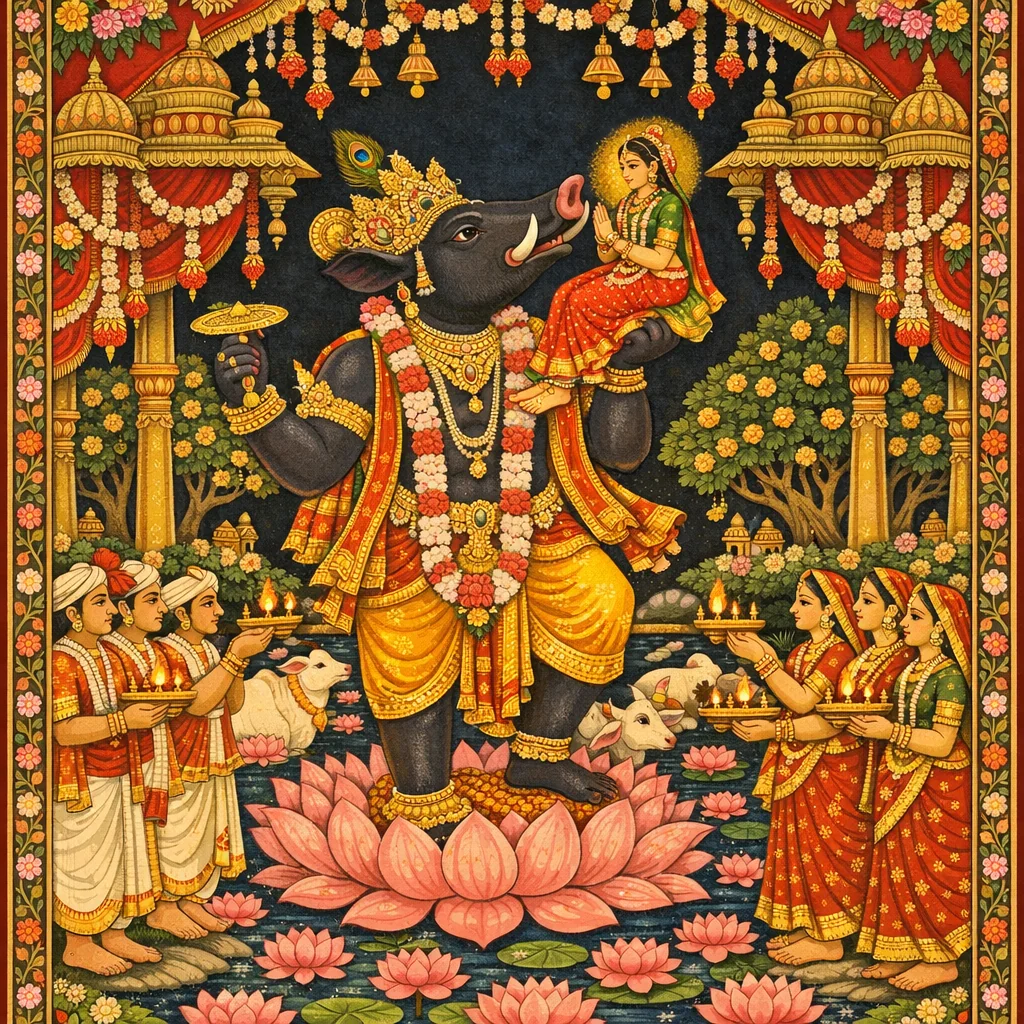
उत्तरेषु च कुरुषु भगवान् यज्ञपुरुष: कृतवराहरूप आस्ते तं तु देवी हैषा भू: सह कुरुभिरस्खलितभक्तियोगेनोपधावति इमां च परमामुपनिषदमावर्तयति ॥ ३४ ॥
Śukadeva Gosvāmī said: Dear King, the Supreme Lord in His boar incarnation, who accepts all sacrificial offerings, lives in the northern part of Jambūdvīpa. There, in the tract of land known as Uttarakuru-varṣa, mother earth and all the other inhabitants worship Him with unfailing devotional service by repeatedly chanting the following Upaniṣadic mantra.
Verse 35
ॐ नमो भगवते मन्त्रतत्त्वलिङ्गाय यज्ञक्रतवे महाध्वरावयवाय महापुरुषाय नम: कर्मशुक्लाय त्रियुगाय नमस्ते ॥ ३५ ॥ ।
O Lord, we offer our respectful obeisances unto You as the gigantic person. Simply by chanting mantras, we shall be able to understand You fully. You are yajña [sacrifice], and You are the kratu [ritual]. Therefore all the ritualistic ceremonies of sacrifice are part of Your transcendental body, and You are the only enjoyer of all sacrifices. Your form is composed of transcendental goodness. You are known as tri-yuga because in Kali-yuga You appeared as a concealed incarnation and because You always fully possess the three pairs of opulences.
Verse 36
यस्य स्वरूपं कवयो विपश्चितो गुणेषु दारुष्विव जातवेदसम् । मथ्नन्ति मथ्ना मनसा दिदृक्षवो गूढं क्रियार्थैर्नम ईरितात्मने ॥ ३६ ॥
By manipulating a fire-generating stick, great saints and sages can bring forth the fire lying dormant within wood. In the same way, O Lord, those expert in understanding the Absolute Truth try to see You in everything — even in their own bodies. Yet you remain concealed. You are not to be understood by indirect processes involving mental or physical activities. Because You are self-manifested, only when You see that a person is wholeheartedly engaged in searching for You do You reveal Yourself. Therefore I offer my respectful obeisances unto You.
Verse 37
द्रव्यक्रियाहेत्वयनेशकर्तृभि- र्मायागुणैर्वस्तुनिरीक्षितात्मने । अन्वीक्षयाङ्गातिशयात्मबुद्धिभि- र्निरस्तमायाकृतये नमो नम: ॥ ३७ ॥
The objects of material enjoyment [sound, form, taste, touch and smell], the activities of the senses, the controllers of sensory activities [the demigods], the body, eternal time and egotism are all creations of Your material energy. Those whose intelligence has become fixed by perfect execution of mystic yoga can see that all these elements result from the actions of Your external energy. They can also see Your transcendental form as Supersoul in the background of everything. Therefore I repeatedly offer my respectful obeisances unto You.
Verse 38
करोति विश्वस्थितिसंयमोदयं यस्येप्सितं नेप्सितमीक्षितुर्गुणै: । माया यथायो भ्रमते तदाश्रयं ग्राव्णो नमस्ते गुणकर्मसाक्षिणे ॥ ३८ ॥
O Lord, You do not desire the creation, maintenance or annihilation of this material world, but You perform these activities for the conditioned souls by Your creative energy. Exactly as a piece of iron moves under the influence of a lodestone, inert matter moves when You glance over the total material energy.
Verse 39
प्रमथ्य दैत्यं प्रतिवारणं मृधे यो मां रसाया जगदादिसूकर: । कृत्वाग्रदंष्ट्रे निरगादुदन्वत: क्रीडन्निवेभ: प्रणतास्मि तं विभुमिति ॥ ३९ ॥
My Lord, as the original boar within this universe, You fought and killed the great demon Hiraṇyakṣa. Then You lifted me [the earth] from the Garbhodaka Ocean on the end of Your tusk, exactly as a sporting elephant plucks a lotus flower from the water. I bow down before You.
Frequently Asked Questions
Hayaśīrṣa is described as a plenary expansion of Vāsudeva, dear to devotees and the director of religious principles. In this chapter He is praised as Hayagrīva who retrieves the stolen Vedas from Rasātala and restores them to Brahmā, highlighting poṣaṇam (divine protection) and the Lord’s role as the source and guardian of śruti and dharma.
Because the Bhāgavata frames the deeper ‘asura’ as inner anarthas—fruitive desire, ignorance, and fear rooted in ego and attachment. Prahlāda asks Nṛsiṁha to appear in the heart, destroy ignorance, and grant fearlessness, teaching that true protection is spiritual: purification leading to steady bhakti rather than merely changing external circumstances.
The text explicitly presents Kāmadeva as Viṣṇu’s form ‘only for the satisfaction of His devotees’ and frames Lakṣmī’s worship around Hṛṣīkeśa—the controller and true enjoyer of the senses. The theological point is that sense-power and beauty originate in the Lord and are purified when oriented to devotion; seeking a ‘husband’ or pleasure apart from Him is described as illusion and insecurity under time and guṇas.
They distinguish the universal form as a display of the Lord’s external energy from His actual transcendental form, which is accessible only to devotees in transcendental consciousness. This clarifies that the cosmos is not ‘false’ but temporary and energetic—real as śakti-vikāra—while Bhagavān remains one without a second, beyond time’s limitation.
Varāha is praised as the embodiment and enjoyer of sacrifice: ritual (kratu) and yajña are parts of His transcendental body, indicating that all dharmic offerings culminate in Viṣṇu. He is called tri-yuga because the Lord is not openly manifest as a yuga-avatāra in Kali (appearing in a concealed manner) while fully possessing the three pairs of opulences; thus worship is directed to the hidden, sustaining Lord behind all sacrificial order.