Adhyaya 12
Rahūgaṇa Instructed by Jaḍa Bharata — Dehātma-buddhi, Nondual Truth, and the Mercy of Devotees
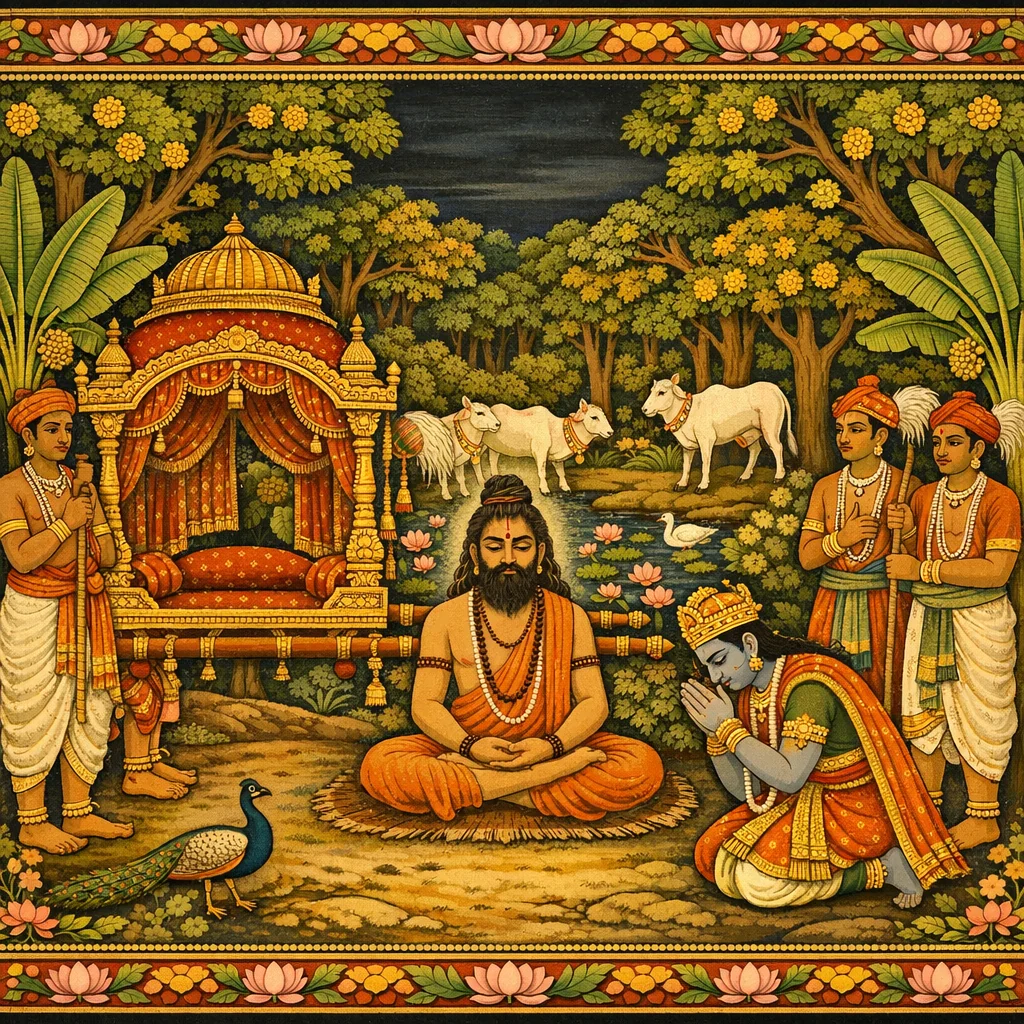
Following the prior tension where King Rahūgaṇa, riding in a palanquin, chastises the seemingly slow carrier Jaḍa Bharata, this chapter turns as the King recognizes Jaḍa Bharata’s spiritual stature and seeks clarification. Rahūgaṇa confesses pride and requests a simpler restatement of the earlier, subtle teaching—especially the claim that perceived fatigue and bodily movement do not touch the self. Jaḍa Bharata replies by dismantling the King’s identification with the palanquin-body complex: carriers, palanquin, and kingly body are all transformations of earth, while the conscious self is distinct. He exposes the King’s injustice toward the unpaid carriers as a symptom of false prestige, then expands into a philosophical critique of material varieties and atomistic causation, establishing that worldly distinctions are imposed names and forms under material nature. He culminates in the Bhāgavata’s graduated realization of the Absolute—Brahman, Paramātmā, and finally Bhagavān Vāsudeva—and insists that realization depends not on austerities alone but on the dust/mercy of great devotees. Jaḍa Bharata reveals his identity as Bharata Mahārāja, recounts his deer-birth due to attachment, and closes by praising sādhu-saṅga as the swift means to revive bhakti through śravaṇa and kīrtana. The narrative naturally prepares the next chapter’s continued refinement of Rahūgaṇa’s understanding and the broader canto’s movement from embodied pride to liberated vision.
Shlokas
Verse 1
रहूगण उवाच नमो नम: कारणविग्रहाय स्वरूपतुच्छीकृतविग्रहाय । नमोऽवधूत द्विजबन्धुलिङ्ग- निगूढनित्यानुभवाय तुभ्यम् ॥ १ ॥
King Rahūgaṇa said: O most exalted personality, you are not different from the Supreme Personality of Godhead. By the influence of your true self, all kinds of contradiction in the śāstras have been removed. In the dress of a friend of a brāhmaṇa, you are hiding your transcendental blissful position. I offer my respectful obeisances unto you.
Verse 2
ज्वरामयार्तस्य यथागदं सत् निदाघदग्धस्य यथा हिमाम्भ: । कुदेहमानाहिविदष्टदृष्टे: ब्रह्मन् वचस्तेऽमृतमौषधं मे ॥ २ ॥
O best of the brāhmaṇas, my body is filled with dirty things, and my vision has been bitten by the serpent of pride. Due to my material conceptions, I am diseased. Your nectarean instructions are the proper medicine for one suffering from such a fever, and they are cooling waters for one scorched by the heat.
Verse 3
तस्माद्भवन्तं मम संशयार्थं प्रक्ष्यामि पश्चादधुना सुबोधम् । अध्यात्मयोगग्रथितं तवोक्त- माख्याहि कौतूहलचेतसो मे ॥ ३ ॥
Whatever doubts I have about a particular subject matter I shall ask you about later. For the time being, these mysterious yoga instructions you have given me for self-realization appear very difficult to understand. Please repeat them in a simple way so that I can understand them. My mind is very inquisitive, and I want to understand this clearly.
Verse 4
यदाह योगेश्वर दृश्यमानं क्रियाफलं सद्व्यहारमूलम् । न ह्यञ्जसा तत्त्वविमर्शनाय भवानमुष्मिन् भ्रमते मनो मे ॥ ४ ॥
O master of yogic power, you said that fatigue resulting from moving the body here and there is appreciated by direct perception but actually there is no fatigue. It simply exists as a matter of formality. By such inquiries and answers, no one can come to the conclusion of the Absolute Truth. Because of your presentation of this statement, my mind is a little disturbed.
Verse 5
ब्राह्मण उवाच अयं जनो नाम चलन् पृथिव्यां य: पार्थिव: पार्थिव कस्य हेतो: । तस्यापि चाङ्घ्र्योयोरधि गुल्फजङ्घा- जानूरुमध्योरशिरोधरांसा: ॥ ५ ॥ अंसेऽधि दार्वी शिबिका च यस्यां सौवीरराजेत्यपदेश आस्ते । यस्मिन् भवान् रूढनिजाभिमानो राजास्मि सिन्धुष्विति दुर्मदान्ध: ॥ ६ ॥
The self-realized brāhmaṇa Jaḍa Bharata said: Among the various material combinations and permutations, there are various forms and earthly transformations. For some reason, these move on the surface of the earth and are called palanquin carriers. Those material transformations which do not move are gross material objects like stones. In any case, the material body is made of earth and stone in the form of feet, ankles, calves, knees, thighs, torso, throat and head. Upon the shoulders is the wooden palanquin, and within the palanquin is the so-called King of Sauvīra. The body of the King is simply another transformation of earth, but within that body Your Lordship is situated and falsely thinking that you are the King of the state of Sauvīra.
Verse 6
ब्राह्मण उवाच अयं जनो नाम चलन् पृथिव्यां य: पार्थिव: पार्थिव कस्य हेतो: । तस्यापि चाङ्घ्र्योयोरधि गुल्फजङ्घा- जानूरुमध्योरशिरोधरांसा: ॥ ५ ॥ अंसेऽधि दार्वी शिबिका च यस्यां सौवीरराजेत्यपदेश आस्ते । यस्मिन् भवान् रूढनिजाभिमानो राजास्मि सिन्धुष्विति दुर्मदान्ध: ॥ ६ ॥
The self-realized brāhmaṇa Jaḍa Bharata said: Among the various material combinations and permutations, there are various forms and earthly transformations. For some reason, these move on the surface of the earth and are called palanquin carriers. Those material transformations which do not move are gross material objects like stones. In any case, the material body is made of earth and stone in the form of feet, ankles, calves, knees, thighs, torso, throat and head. Upon the shoulders is the wooden palanquin, and within the palanquin is the so-called King of Sauvīra. The body of the King is simply another transformation of earth, but within that body Your Lordship is situated and falsely thinking that you are the King of the state of Sauvīra.
Verse 7
शोच्यानिमांस्त्वमधिकष्टदीनान् विष्ट्या निगृह्णन्निरनुग्रहोऽसि । जनस्य गोप्तास्मि विकत्थमानो न शोभसे वृद्धसभासु धृष्ट: ॥ ७ ॥
It is a fact, however, that these innocent people carrying your palanquin without payment are certainly suffering due to this injustice. Their condition is very lamentable because you have forcibly engaged them in carrying your palanquin. This proves that you are cruel and unkind, yet due to false prestige you were thinking that you were protecting the citizens. This is ludicrous. You were such a fool that you could not have been adored as a great man in an assembly of persons advanced in knowledge.
Verse 8
यदा क्षितावेव चराचरस्य विदाम निष्ठां प्रभवं च नित्यम् । तन्नामतोऽन्यद् व्यवहारमूलं निरूप्यतां सत् क्रिययानुमेयम् ॥ ८ ॥
All of us on the surface of the globe are living entities in different forms. Some of us are moving and some not moving. All of us come into existence, remain for some time and are annihilated when the body is again mingled with the earth. We are all simply different transformations of the earth. Different bodies and capacities are simply transformations of the earth that exist in name only, for everything grows out of the earth and when everything is annihilated it again mingles with the earth. In other words, we are but dust, and we shall but be dust. Everyone can consider this point.
Verse 9
एवं निरुक्तं क्षितिशब्दवृत्त- मसन्निधानात्परमाणवो ये । अविद्यया मनसा कल्पितास्ते येषां समूहेन कृतो विशेष: ॥ ९ ॥
One may say that varieties arise from the planet earth itself. However, although the universe may temporarily appear to be the truth, it ultimately has no real existence. The earth was originally created by a combination of atomic particles, but these particles are impermanent. Actually the atom is not the cause of the universe, although some philosophers think so. It is not a fact that the varieties found in this material world simply result from atomic juxtaposition or combination.
Verse 10
एवं कृशं स्थूलमणुर्बृहद्यद् असच्च सज्जीवमजीवमन्यत् । द्रव्यस्वभावाशयकालकर्म- नाम्नाजयावेहि कृतं द्वितीयम् ॥ १० ॥
Since this universe has no real ultimate existence, the things within it — shortness, differences, grossness, skinniness, smallness, bigness, result, cause, living symptoms, and materials — are all imagined. They are all pots made of the same substance, earth, but they are named differently. The differences are characterized by the substance, nature, predisposition, time and activity. You should know that all these are simply mechanical manifestations created by material nature.
Verse 11
ज्ञानं विशुद्धं परमार्थमेक- मनन्तरं त्वबहिर्ब्रह्म सत्यम् । प्रत्यक् प्रशान्तं भगवच्छब्दसंज्ञं यद्वासुदेवं कवयो वदन्ति ॥ ११ ॥
What, then, is the ultimate truth? The answer is that nondual knowledge is the ultimate truth. It is devoid of the contamination of material qualities. It gives us liberation. It is the one without a second, all-pervading and beyond imagination. The first realization of that knowledge is Brahman. Then Paramātmā, the Supersoul, is realized by the yogīs who try to see Him without grievance. This is the second stage of realization. Finally, full realization of the same supreme knowledge is realized in the Supreme Person. All learned scholars describe the Supreme Person as Vāsudeva, the cause of Brahman, Paramātmā and others.
Verse 12
रहूगणैतत्तपसा न याति न चेज्यया निर्वपणाद् गृहाद्वा । नच्छन्दसा नैव जलाग्निसूर्यै- र्विना महत्पादरजोऽभिषेकम् ॥ १२ ॥
My dear King Rahūgaṇa, unless one has the opportunity to smear his entire body with the dust of the lotus feet of great devotees, one cannot realize the Absolute Truth. One cannot realize the Absolute Truth simply by observing celibacy [brahmacarya], strictly following the rules and regulations of householder life, leaving home as a vānaprastha, accepting sannyāsa, or undergoing severe penances in winter by keeping oneself submerged in water or surrounding oneself in summer by fire and the scorching heat of the sun. There are many other processes to understand the Absolute Truth, but the Absolute Truth is only revealed to one who has attained the mercy of a great devotee.
Verse 13
यत्रोत्तमश्लोकगुणानुवाद: प्रस्तूयते ग्राम्यकथाविघात: । निषेव्यमाणोऽनुदिनं मुमुक्षो- र्मतिं सतीं यच्छति वासुदेवे ॥ १३ ॥
Who are the pure devotees mentioned here? In an assembly of pure devotees, there is no question of discussing material subjects like politics and sociology. In an assembly of pure devotees, there is discussion only of the qualities, forms and pastimes of the Supreme Personality of Godhead. He is praised and worshiped with full attention. In the association of pure devotees, by constantly hearing such topics respectfully, even a person who wants to merge into the existence of the Absolute Truth abandons this idea and gradually becomes attached to the service of Vāsudeva.
Verse 14
अहं पुरा भरतो नाम राजा विमुक्तदृष्टश्रुतसङ्गबन्ध: । आराधनं भगवत ईहमानो मृगोऽभवं मृगसङ्गाद्धतार्थ: ॥ १४ ॥
In a previous birth I was known as Mahārāja Bharata. I attained perfection by becoming completely detached from material activities through direct experience, and through indirect experience I received understanding from the Vedas. I was fully engaged in the service of the Lord, but due to my misfortune, I became very affectionate to a small deer, so much so that I neglected my spiritual duties. Due to my deep affection for the deer, in my next life I had to accept the body of a deer.
Verse 15
सा मां स्मृतिर्मृगदेहेऽपि वीर कृष्णार्चनप्रभवा नो जहाति । अथो अहं जनसङ्गादसङ्गो विशङ्कमानोऽविवृतश्चरामि ॥ १५ ॥
My dear heroic King, due to my past sincere service to the Lord, I could remember everything of my past life even while in the body of a deer. Because I am aware of the falldown in my past life, I always keep myself separate from the association of ordinary men. Being afraid of their bad, materialistic association, I wander alone unnoticed by others.
Verse 16
तस्मान्नरोऽसङ्गसुसङ्गजात- ज्ञानासिनेहैव विवृक्णमोह: । हरिं तदीहाकथनश्रुताभ्यां लब्धस्मृतिर्यात्यतिपारमध्वन: ॥ १६ ॥
Simply by associating with exalted devotees, anyone can attain perfection of knowledge and with the sword of knowledge can cut to pieces the illusory associations within this material world. Through the association of devotees, one can engage in the service of the Lord by hearing and chanting [śravaṇaṁ kīrtanam]. Thus one can revive his dormant Kṛṣṇa consciousness and, sticking to the cultivation of Kṛṣṇa consciousness, return home, back to Godhead, even in this life.
Frequently Asked Questions
Jaḍa Bharata uses ‘earth-transformations’ to break Rahūgaṇa’s dehātma-buddhi. By analyzing body, palanquin, and social roles as temporary configurations of matter (pañca-bhūta, especially pṛthvī), he shows that ‘king’ and ‘servant’ are imposed designations on perishable forms. The intent is not nihilism but discrimination: the conscious self is distinct from matter, and therefore pride, domination, and the claim of doership rest on misidentification.
The chapter presents a single nondual reality (advaya-jñāna) realized in three progressive ways: Brahman as the first, impersonal realization of spiritual existence; Paramātmā as the localized Supersoul perceived by yogīs through disciplined inner vision; and Bhagavān as the complete realization of the same truth as the Supreme Person, identified as Vāsudeva, the source of Brahman and Paramātmā. Thus the ‘stages’ describe depth of realization, not different ultimate truths.
Austerities (tapas), celibacy, and āśrama observances can purify and stabilize the practitioner, but Jaḍa Bharata states that the Absolute is ultimately self-revealing through bhakti, awakened by the mercy of great devotees. Without sādhu-saṅga—symbolized by ‘the dust of devotees’ feet’—one may remain within moral discipline or impersonal pursuit without entering the relational, fully personal realization of Vāsudeva that dissolves subtle ego and grants true liberation.
Pure devotees are characterized by exclusive absorption in the Lord’s qualities, forms, and pastimes (guṇa-rūpa-līlā), not by material discourse (politics, sociology, prestige). Their assembly is a hearing-and-chanting environment where respectful śravaṇa gradually transforms even a liberation-seeker who wishes to merge into Brahman, redirecting the heart toward service (sevā) to Vāsudeva.